9 Best AI Customer Support Vendors to Evaluate in 2026
This guide helps you evaluate AI support vendors by comparing nine leading platforms across five critical dimensions—autonomy, integration depth, learning capability, analytics quality, and scalability—so B2B SaaS teams can confidently choose between lightweight chatbot builders and full-stack AI agents without costly implementation mistakes.
 Matt PattoliFounder14 min read
Choosing the wrong AI support vendor is an expensive mistake. Not just in licensing costs, but in implementation time, team disruption, and the customer experience setbacks that follow. The market is crowded with platforms ranging from lightweight chatbot builders to full-stack AI agents capable of autonomous ticket resolution, bug reporting, and business intelligence.
This guide cuts through the noise. We evaluated nine leading AI customer support vendors across five dimensions: autonomy (can it actually resolve tickets, not just deflect them?), integration depth, learning capability, analytics quality, and scalability for B2B SaaS teams. Whether you're replacing a legacy helpdesk, layering AI onto an existing platform, or building a support stack from scratch, this list gives you a clear starting point.
For a broader look at what to expect from modern AI support tooling, see our guide on AI support platform features and customer support AI benefits.
1. Halo AI
Best for: B2B SaaS teams that want autonomous ticket resolution with business intelligence built in
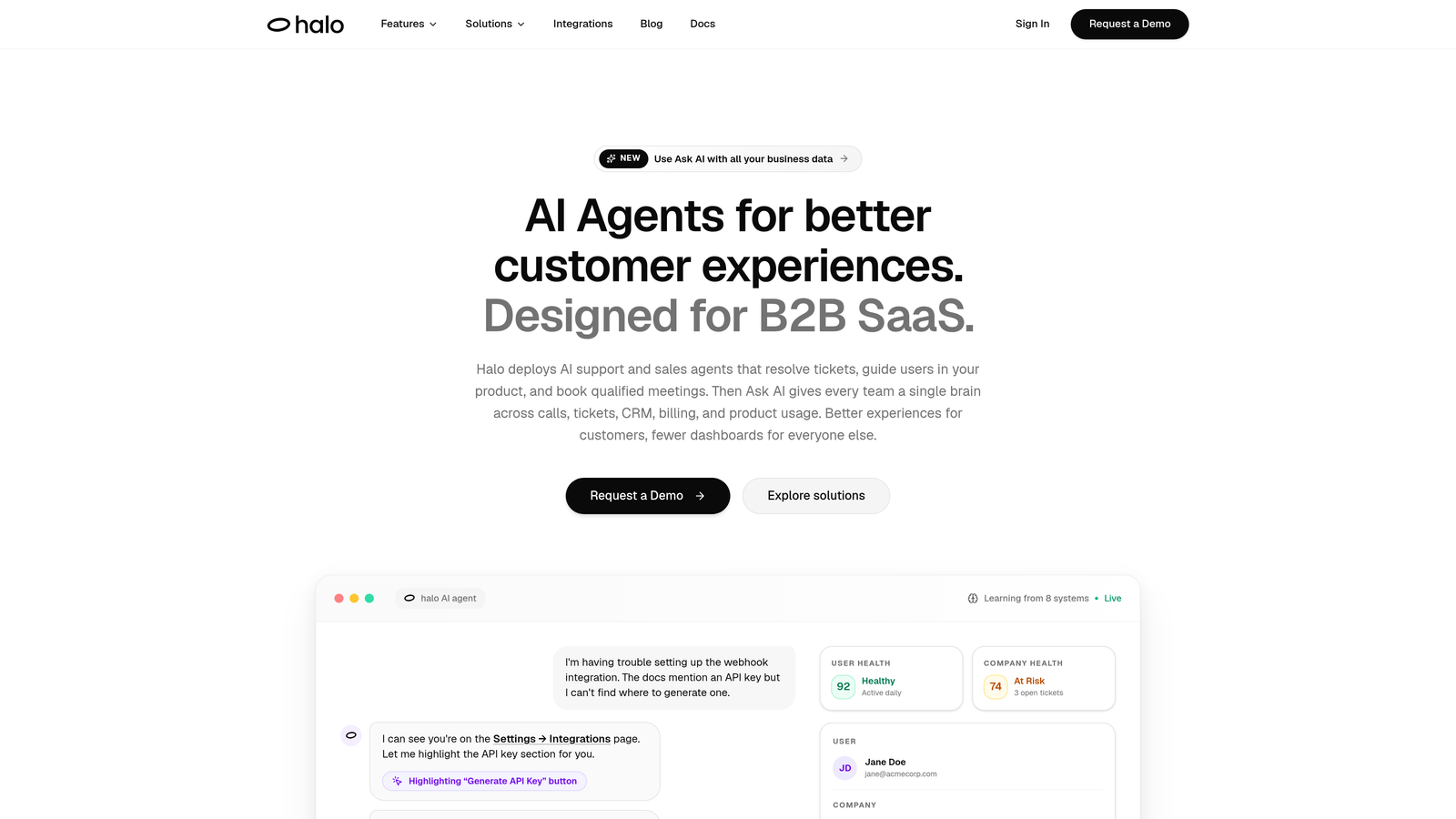
Halo AI is an AI-first customer support platform built specifically for B2B SaaS teams who want more than deflection.
Where This Tool Shines
What separates Halo from most vendors on this list is that AI isn't a layer bolted onto a traditional helpdesk. It's the foundation. The platform deploys autonomous AI agents that resolve tickets end-to-end, guide users through your product with page-aware context, auto-generate bug reports routed directly to your engineering workflow, and surface business intelligence signals like churn risk and revenue anomalies.
The continuous learning loop is a genuine differentiator. Rather than requiring manual retraining as your product evolves, Halo's AI improves automatically from every resolved interaction. For fast-moving SaaS teams, that compounds quickly into a support function that gets smarter without additional overhead.
Key Features
Page-Aware Chat Widget: The AI sees exactly what the user sees in your product, enabling contextual UI guidance that goes beyond generic knowledge base answers.
Autonomous Ticket Resolution: AI agents handle tickets end-to-end with intelligent escalation to live agents when complexity requires a human touch.
Auto Bug Ticket Creation: Automatically identifies and routes bug reports to Linear or your existing engineering workflow, closing the loop between support and product.
Smart Inbox with Business Intelligence: Surfaces customer health signals, revenue anomalies, and churn risk indicators directly from support interactions, giving you insights beyond CSAT scores.
Native Integration Stack: Connects with Slack, HubSpot, Intercom, Stripe, Zoom, PandaDoc, and Fathom out of the box, not via workarounds.
Continuous Learning Loop: The AI improves automatically from every interaction without requiring manual retraining cycles.
Best For
B2B SaaS companies that want AI to genuinely resolve tickets rather than deflect them, and product teams that need support intelligence to feed back into roadmap decisions. Particularly strong for teams whose support function intersects with product, engineering, and revenue workflows.
Pricing
Contact for pricing. Halo is designed for B2B SaaS teams and positions itself as an enterprise-grade solution rather than a per-seat commodity tool.
2. Intercom (Fin AI Agent)
Best for: Teams already invested in the Intercom ecosystem who want AI natively integrated
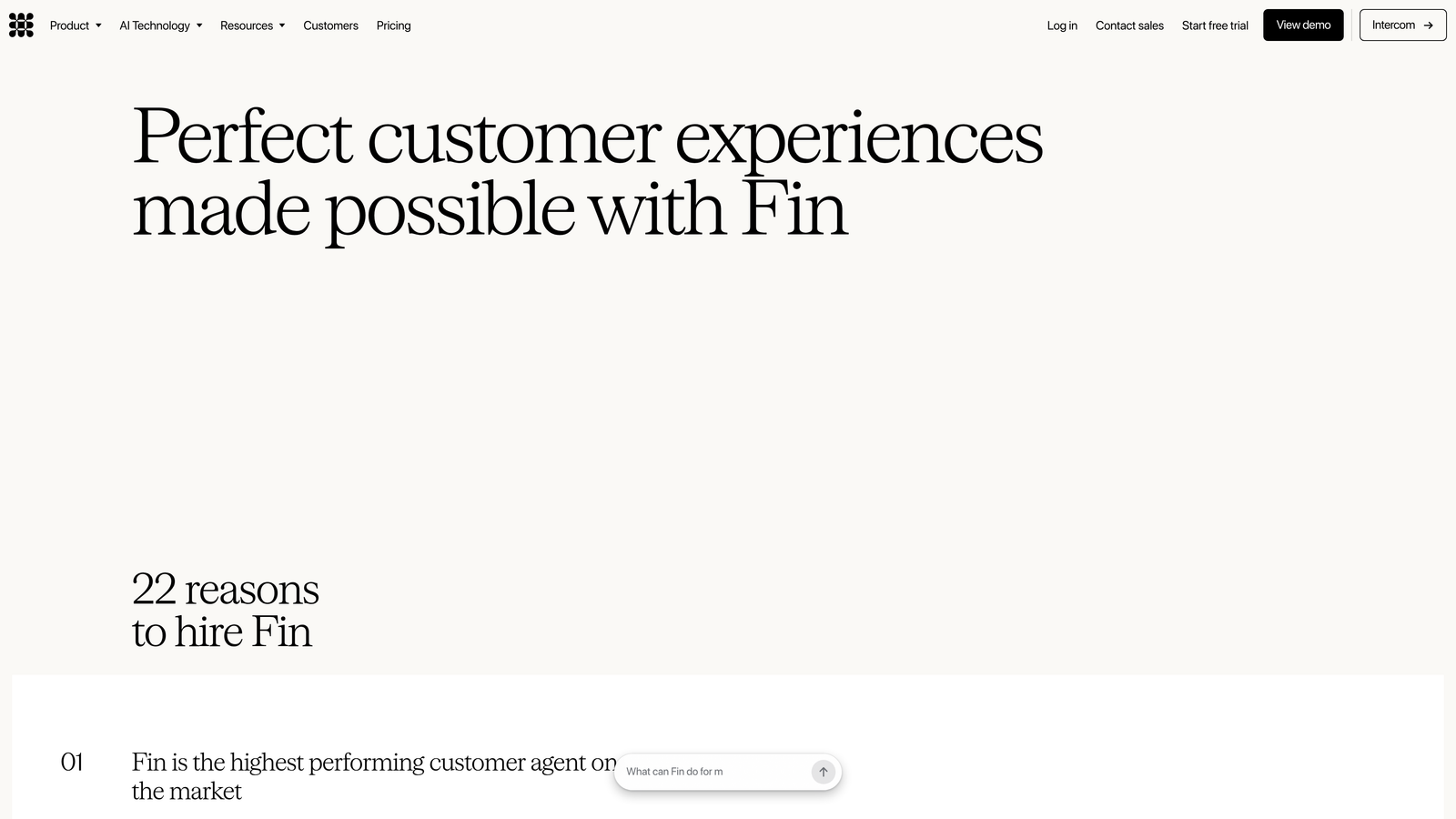
Intercom Fin is an LLM-powered AI agent that lives natively inside the Intercom messenger and is trained on your existing knowledge base content.
Where This Tool Shines
If your team is already running on Intercom, Fin is the most frictionless path to AI-assisted support. There's no migration, no new interface to learn, and no integration work to do. Fin plugs directly into your existing Intercom setup and starts handling conversations using the content you've already written.
The handoff experience is particularly well-executed. When Fin reaches the edge of its capability, it transitions to a human agent smoothly within the same messenger thread. For teams where conversation continuity matters, that's a meaningful advantage.
Key Features
LLM-Powered AI Agent: Trained on your help center content to handle common questions with natural, conversational responses.
Native Messenger Integration: Operates entirely within the Intercom interface, requiring no additional tooling or context-switching.
Multilingual Support: Handles conversations in multiple languages out of the box without additional configuration.
Smooth Human Handoff: Escalates to live agents within the same conversation thread, preserving context throughout.
Conversation Analytics and CSAT: Built-in reporting on resolution rates, satisfaction scores, and conversation trends.
Best For
Companies already on Intercom who want to add AI capability without switching platforms. Less compelling for teams not already in the Intercom ecosystem, where the onboarding cost becomes harder to justify.
Pricing
Consumption-based pricing on top of your existing Intercom subscription. Fin charges per resolution, so costs scale with usage. Teams with high conversation volumes should model this carefully before committing.
3. Zendesk AI
Best for: Enterprise teams with established Zendesk infrastructure who need AI-powered triage and agent assist
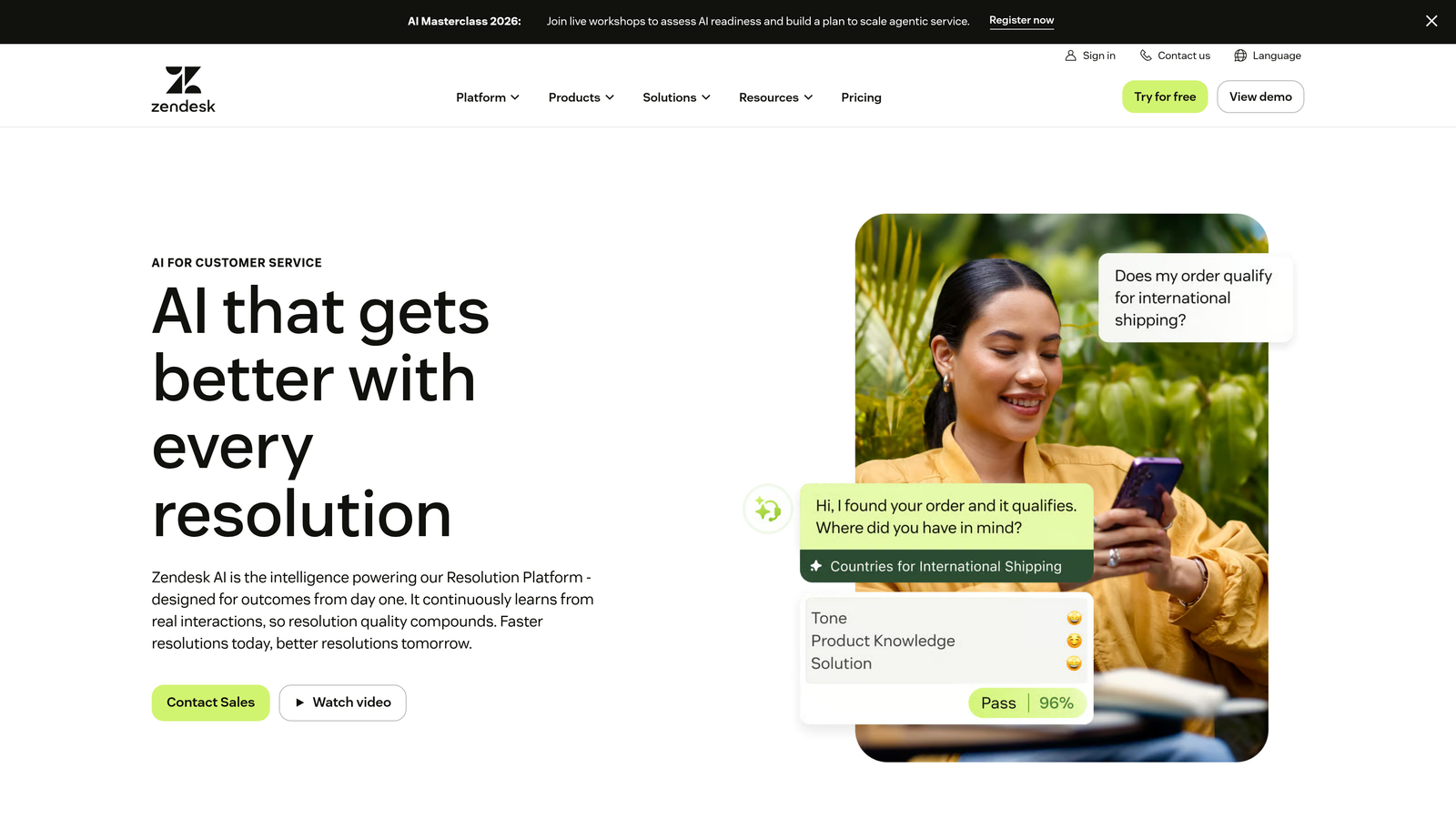
Zendesk AI adds intelligent triage, generative agent assist, and self-service automation to one of the most established helpdesk platforms in the market.
Where This Tool Shines
Zendesk AI is a strong choice when you have a large, complex support operation already running on Zendesk and you want to layer in AI without disrupting your existing workflows. The intent detection and sentiment analysis capabilities help route tickets more accurately, and the generative AI for reply drafts can meaningfully reduce handle time for high-volume teams.
The breadth of Zendesk's third-party integration marketplace is also worth noting. If your stack is complex, Zendesk likely has a connector for it. The trade-off is that the AI feels additive rather than foundational, which matters if you're evaluating vendors for net-new implementations.
Key Features
AI-Powered Ticket Triage: Intent and sentiment detection that routes tickets to the right team or queue automatically.
Generative AI for Agent Assist: Drafts reply suggestions and summarizes long ticket threads to reduce agent effort.
Self-Service Automation: AI-powered bots in the help center that deflect common questions before they reach the queue.
Advanced Routing and SLA Management: Enterprise-grade workflow controls built for large, multi-team support organizations.
Extensive Integration Marketplace: Hundreds of third-party integrations across CRM, billing, project management, and communication tools.
Best For
Large enterprise support teams already running on Zendesk who want to improve efficiency without platform migration. Less suited for teams starting fresh who want AI to be the core architecture rather than an add-on.
Pricing
AI features are available on Suite plans with pricing that varies by tier and agent count. Enterprise-level investment is expected. Contact Zendesk for current pricing specific to your team size.
4. Freshdesk Freddy AI
Best for: SMB and mid-market teams seeking an accessible AI entry point within a broader CRM ecosystem
Freshdesk Freddy AI is Freshworks' AI layer across their support suite, offering self-service bots, agent copilot assistance, and analytics at a price point accessible to growing teams.
Where This Tool Shines
Freddy AI's strength is its tiered structure. You can start with Freddy Self Service for customer-facing deflection, add Freddy Copilot for agent productivity, and layer in Freddy Insights for analytics, scaling your AI investment as your team grows. That modularity makes it easier to justify the initial budget conversation.
For teams already using other Freshworks products like Freshsales or Freshservice, the cross-platform integration is a genuine advantage. Freddy can pull context from CRM records and ITSM workflows, giving agents a more complete picture without switching tabs.
Key Features
Freddy Self Service: AI chatbot for customer-facing deflection, trained on your help center content.
Freddy Copilot: Real-time reply suggestions and draft generation for agents handling live conversations.
Freddy Insights: AI-generated analytics that surface trends, anomalies, and performance patterns across your support data.
Freshworks Ecosystem Integration: Connects natively with Freshsales (CRM), Freshservice (ITSM), and other Freshworks products.
Competitive SMB Pricing: More accessible entry point than enterprise-tier alternatives, with tiered plans that scale with team growth.
Best For
SMB and mid-market teams that want AI capabilities without enterprise pricing, especially those already using other Freshworks products. Less suited for teams with complex, multi-system integration requirements outside the Freshworks ecosystem.
Pricing
Freddy AI is available as an add-on on Growth plans and above. Base Freshdesk plans start around $15 per agent per month, with Freddy AI pricing layered on top. Check Freshworks' current pricing page for the most accurate figures.
5. Tidio
Best for: Small teams and e-commerce brands that need fast deployment with minimal technical overhead
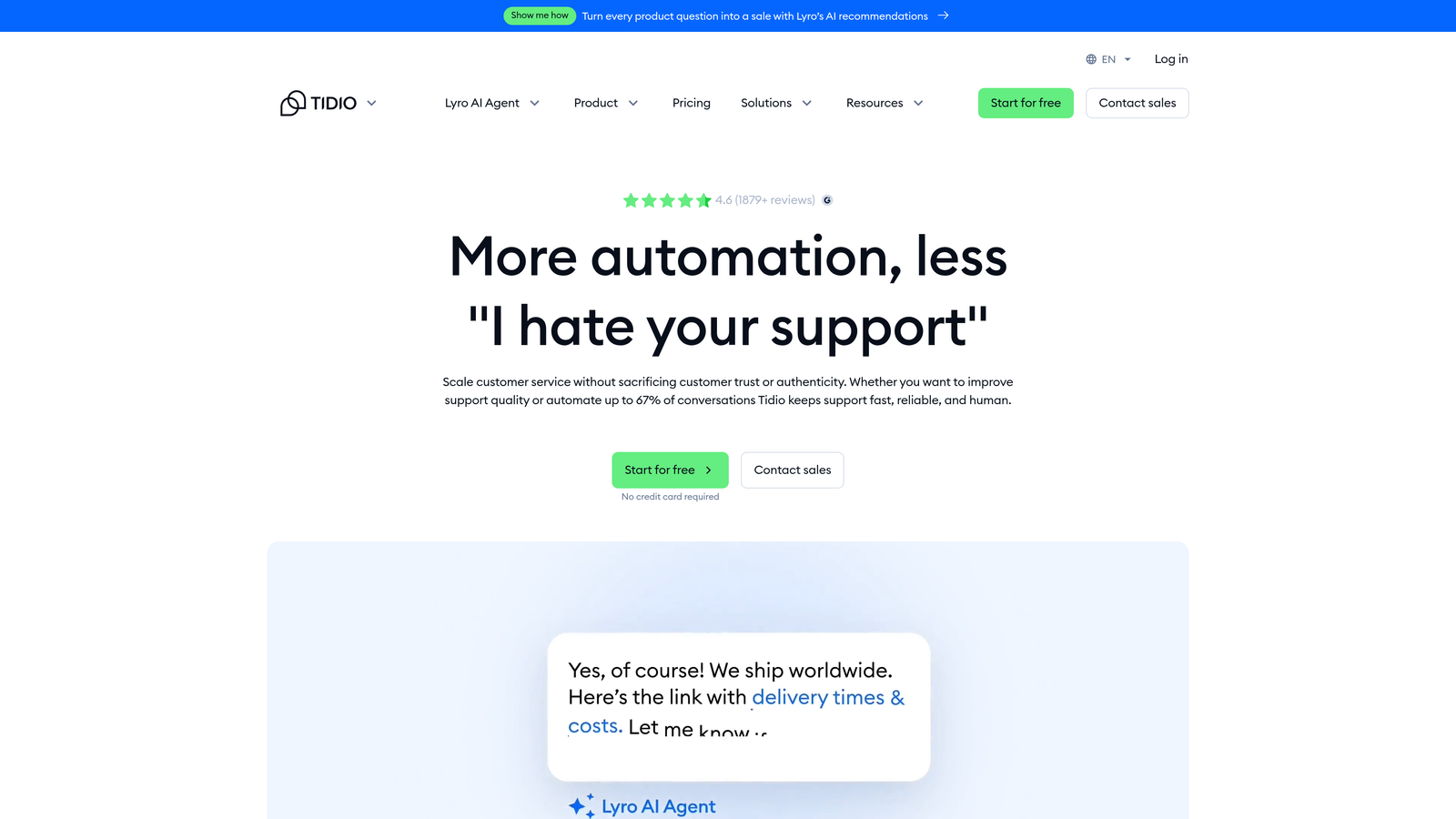
Tidio combines live chat with Lyro, its AI-powered conversational agent, offering fast deployment and a visual bot builder suited to small teams and direct-to-consumer brands.
Where This Tool Shines
Tidio's biggest advantage is speed to value. You can have a functional AI chatbot live in hours rather than weeks, using a visual drag-and-drop builder that requires no coding. For small teams without dedicated technical resources, that's a meaningful reduction in friction.
Lyro, Tidio's AI agent, handles common questions using your existing support content and escalates to a human when needed. The interface consolidates live chat, email, and social media into a single inbox, which reduces context-switching for lean support teams managing multiple channels.
Key Features
Lyro AI Agent: Conversational AI trained on your support content to handle repetitive questions automatically.
Visual Bot Builder: Drag-and-drop chatflow editor that requires no coding to create and customize conversation flows.
Unified Inbox: Consolidates live chat, email, and social media conversations in a single interface.
E-Commerce Integrations: Native connections with Shopify and WooCommerce for order status, returns, and product questions.
Fast Setup: Deployable in hours, not weeks, with minimal technical configuration required.
Best For
Small businesses, e-commerce brands, and early-stage teams that need a capable AI chatbot quickly without significant technical investment. Tidio's complexity ceiling is lower than enterprise tools, so teams expecting rapid scale should plan for a platform transition down the road.
Pricing
A free plan is available. Lyro AI starts at approximately $29 per month, with paid plans scaling by conversation volume. For teams with predictable, lower traffic, the pricing is very accessible.
6. Kustomer
Best for: High-volume B2C brands that need CRM-native support organized around full customer timelines
Kustomer is a CRM-native customer service platform that organizes support around complete customer histories rather than individual tickets, with AI automation built for high-volume operations.
Where This Tool Shines
Kustomer's core insight is that tickets are the wrong unit of measurement. Every customer has a history, and that history should be visible to every agent in every interaction. The customer timeline view consolidates all touchpoints across channels, giving agents full context without digging through disconnected records.
The AI capabilities, including intent detection and automated routing, are built on top of this CRM foundation. That means the AI isn't just routing tickets, it's routing tickets with full customer context attached, which improves both speed and quality of responses.
Key Features
Customer Timeline View: Consolidates all interactions across channels into a single chronological customer record.
AI-Powered Intent Detection: Automatically identifies what customers need and routes conversations to the appropriate team or workflow.
Omnichannel Inbox: Handles email, chat, SMS, social media, and voice in one unified interface.
Deep CRM Data Integration: Pulls customer data into every interaction for context-rich support without tab-switching.
Workflow Automation: Automates repetitive, high-volume processes to reduce manual handling for common request types.
Best For
High-volume B2C brands, particularly in retail, consumer apps, and subscription services, where customer history is critical to support quality. The pricing and complexity make it a harder fit for smaller teams or B2B SaaS companies with lower ticket volumes.
Pricing
Enterprise pricing applies. Plans start around $89 per user per month, making Kustomer best suited for larger support teams where the per-seat cost is justified by volume and complexity.
7. Help Scout
Best for: Teams that want AI to make agents more effective rather than replace them entirely
Help Scout is a human-first support platform that uses AI to amplify agent effectiveness, featuring AI Drafts, AI Summarize, and a clean shared inbox experience.
Where This Tool Shines
Help Scout's philosophy is intentionally different from most vendors on this list. Rather than pushing toward full automation, it treats AI as a tool for making human agents faster and more consistent. That's the right call for support teams where tone, empathy, and relationship quality are central to the brand experience.
The AI features are practical and focused. AI Drafts generates reply suggestions that agents review and send. AI Summarize condenses long threads into quick briefings. AI Assist rewrites agent-composed replies for clarity and tone. None of these replace the human, but all of them meaningfully reduce the cognitive load of high-volume inbox work.
Key Features
AI Drafts: Generates reply suggestions based on conversation context for agents to review, edit, and send.
AI Summarize: Condenses long email threads into quick briefings so agents can get up to speed instantly.
AI Assist: Rewrites and improves agent-composed replies for clarity, tone, and professionalism.
Docs Knowledge Base: Built-in knowledge base with AI-powered search to help customers find answers before contacting support.
Clean Shared Inbox UX: Simple, distraction-free interface designed to keep humans in control without unnecessary complexity.
Best For
Support teams where the human element is a deliberate brand choice, not a limitation. Particularly well-suited for professional services, SaaS companies with complex customer relationships, and any team where agent judgment is essential to resolution quality.
Pricing
Plans start at $22 per user per month on the Standard tier. AI features are included on Plus and Pro plans. Straightforward per-seat pricing with no consumption-based surprises.
8. Drift (Salesloft)
Best for: Revenue-driven B2B teams that need support and sales qualification in one conversational interface
Drift is a conversational AI platform designed for revenue teams, blending sales qualification and support automation in one interface as part of the broader Salesloft revenue platform.
Where This Tool Shines
Drift sits at the intersection of support and sales in a way that most pure-play support tools don't attempt. Its AI chatbots are built to qualify inbound leads, route conversations to the right team, and schedule meetings, all while handling support questions in the same interface. For B2B companies where support and sales conversations often overlap, that consolidation has real value.
The integration with Salesloft, Salesforce, and HubSpot means that buyer intent signals captured in support conversations can flow directly into sales workflows. That's a meaningful capability for teams trying to connect support interactions to revenue outcomes.
Key Features
AI Chatbots for Lead Qualification: Identifies and qualifies inbound leads in real time, routing high-intent visitors to sales or support as appropriate.
Meeting Scheduling Automation: Books meetings with the right team member directly from the chat interface without human intervention.
Revenue Platform Integration: Connects natively with Salesforce, HubSpot, and Salesloft to pass intent signals and conversation data into sales workflows.
Real-Time Buyer Intent Signals: Surfaces behavioral signals to help support and sales teams prioritize high-value conversations.
Video Messaging and Async Tools: Supports video messages and asynchronous communication for teams with complex, multi-touch sales cycles.
Best For
Mid-market and enterprise B2B companies where support and sales motions overlap, and where capturing revenue signals from support conversations is a strategic priority. Less suited for teams that need deep support-specific features like ticket management, SLA tracking, or complex escalation workflows.
Pricing
Premium and Advanced plans are available. Pricing is available on request and is best suited for mid-market and enterprise budgets. Expect enterprise-tier investment.
9. Chatbase
Best for: Teams that need a fast, lightweight knowledge-base chatbot with minimal setup
Chatbase is a lightweight custom AI chatbot builder that lets you train a chatbot on your own documents, help center, or URLs and embed it anywhere with minimal configuration required.
Where This Tool Shines
Chatbase occupies a clear niche: it's the fastest path from zero to a functional AI chatbot trained on your own content. You upload PDFs, paste URLs, or connect a Notion page, and within minutes you have a chatbot that can answer questions based on your existing documentation. No engineering resources required.
For teams that need basic deflection coverage quickly, or for internal knowledge base use cases, Chatbase delivers real value. The trade-off is ceiling height. Chatbase is a chatbot builder, not a support platform, so teams with complex routing, ticketing, SLA, or integration requirements will outgrow it quickly.
Key Features
Flexible Training Sources: Train on PDFs, URLs, Notion pages, or plain text without any coding.
Embeddable Anywhere: Deploy on any website via embed code or connect programmatically via API.
Customizable Widget: Adjust chat widget appearance, personality, and response style to match your brand.
Multilingual Support: Handles conversations in multiple languages automatically based on user input.
Basic Analytics: Tracks conversation volume and topic patterns to give a surface-level view of chatbot performance.
Best For
Early-stage startups, small teams, or internal knowledge management use cases where speed of deployment matters more than platform depth. Also useful as a stopgap while evaluating more comprehensive support platforms. Not a fit for teams with complex support workflows or enterprise-scale requirements.
Pricing
A free plan is available. Paid plans start at $19 per month and scale by message credits. Among the most affordable options on this list, which reflects both the accessibility and the ceiling of the platform.
Which Tool Is the Right Fit for Your Team?
Every vendor on this list solves a real problem. The question is whether it solves your problem, at your scale, with your stack.
Here's a quick orientation by use case. If you're a B2B SaaS team that wants autonomous ticket resolution with business intelligence built in, Halo AI is designed specifically for that. If you're deeply embedded in the Intercom ecosystem, Fin AI Agent is the most frictionless next step. Enterprise teams already running on Zendesk should evaluate Zendesk AI before considering a platform migration. SMBs on a budget will find Freshdesk Freddy AI or Tidio the lowest-friction entry points. Teams that want AI to assist rather than replace agents should look closely at Help Scout. Revenue-driven B2B teams should explore Drift. And if you just need a quick knowledge-base chatbot, Chatbase gets you there fast.
The most important thing to keep in mind as you evaluate: deflection rate is not the same as resolution rate. Any vendor can claim high deflection. What matters is whether customers leave the conversation with their problem actually solved. Press every vendor you speak with on this distinction, and ask to see resolution data, not just deflection data.
Before you commit to a vendor, run a structured pilot with real tickets from your queue. Measure resolution quality, not just volume. Evaluate how deeply the tool connects to your existing stack, and watch for pricing models that punish growth, particularly per-resolution pricing with no caps.
For more on building a scalable support strategy, explore our customer support automation strategy guide and automated customer support overview.
Your support team shouldn't scale linearly with your customer base. Let AI agents handle routine tickets, guide users through your product, and surface business intelligence while your team focuses on complex issues that need a human touch. See Halo in action and discover how continuous learning transforms every interaction into smarter, faster support.