8 Best AI Support Platforms vs Freshdesk: Which Is Right for Your Team in 2026?
This guide compares Freshdesk Vs AI Support Platforms across 8 leading tools, evaluating automation depth, integration breadth, and scalability to help B2B support teams decide whether a traditional helpdesk or an AI-native platform is the right foundation for modern customer support in 2026.
 Grant CooperFounder13 min read
Freshdesk has been a go-to helpdesk for years: reliable ticketing, solid multichannel support, and a familiar interface that support teams know well. But as AI-native platforms mature, more B2B teams are asking a pointed question — is a traditional helpdesk with AI features bolted on still the right foundation for modern support?
This comparison cuts through the noise. We've evaluated Freshdesk alongside several AI-first and AI-enhanced support platforms based on automation depth, integration breadth, learning capabilities, and how well each scales without scaling headcount. Whether you're a SaaS team hitting ticket volume limits, a product team wanting smarter bug triage, or a support leader evaluating a full platform switch, this guide gives you a direct, honest breakdown.
The tools featured range from fully autonomous AI agents to hybrid platforms that layer intelligence on top of traditional helpdesk infrastructure — so you can find the right fit for where your team is today and where it's headed.
1. Halo AI
Best for: B2B SaaS teams wanting autonomous AI agents that resolve tickets end-to-end
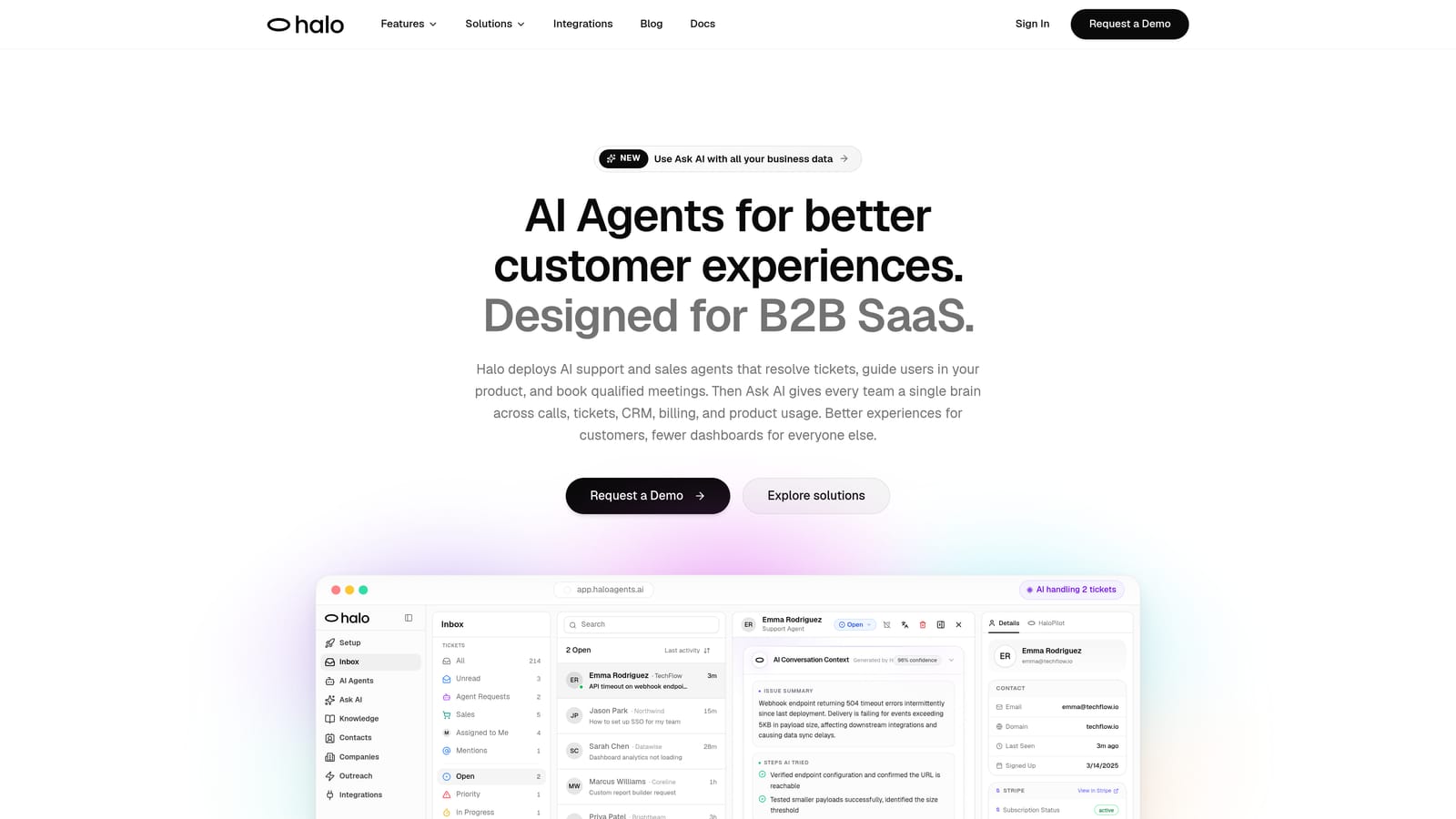
Halo AI is an AI-first customer support platform that deploys autonomous agents to resolve tickets, guide users through your product, and surface business intelligence — all while learning from every interaction.
Where This Tool Shines
Most platforms add AI on top of an existing helpdesk architecture. Halo is built the other way around: AI is the foundation, not a feature. Its autonomous agents handle common tickets end-to-end without requiring a human agent to review or approve every response. That's a meaningful distinction when your ticket volume is growing but your headcount isn't.
What sets Halo apart from other AI-native tools is its page-aware context. The chat widget understands the exact UI state and page the user is on, so when someone asks "why can't I export this report?" the AI already knows they're on the exports page and what they've been doing. That level of context makes resolutions faster and more accurate than generic chatbot flows.
Key Features
Autonomous AI Agents: Resolve tickets end-to-end for common issues without human intervention, escalating only when complexity warrants it.
Page-Aware Chat Widget: Understands the exact page and UI state a user is on, enabling contextually precise guidance and answers.
Auto Bug Ticket Creation: Automatically creates and routes bug reports directly to Linear or connected project management tools, eliminating manual triage.
Smart Inbox with Business Intelligence: Surfaces customer health signals, revenue anomaly detection, and churn indicators alongside support conversations.
Live Agent Handoff: Escalates complex issues to human agents with full conversation context preserved, so nothing gets repeated.
Deep Integrations: Connects natively with Linear, Slack, HubSpot, Intercom, Stripe, Zoom, PandaDoc, and Fathom.
Continuous Learning: Every resolved interaction feeds back into the system to improve future responses over time.
Best For
B2B SaaS companies and product teams that want AI to handle the first 80% of ticket volume autonomously. Particularly strong for teams managing both customer support and product feedback loops, where routing bug reports and surfacing churn signals matter as much as resolving tickets.
Pricing
Contact for pricing. A demo is available at haloagents.ai. Given the autonomous resolution model, pricing is best evaluated against your current cost-per-ticket and agent headcount.
2. Freshdesk
Best for: Teams that want a proven multichannel helpdesk with familiar workflows and broad integrations
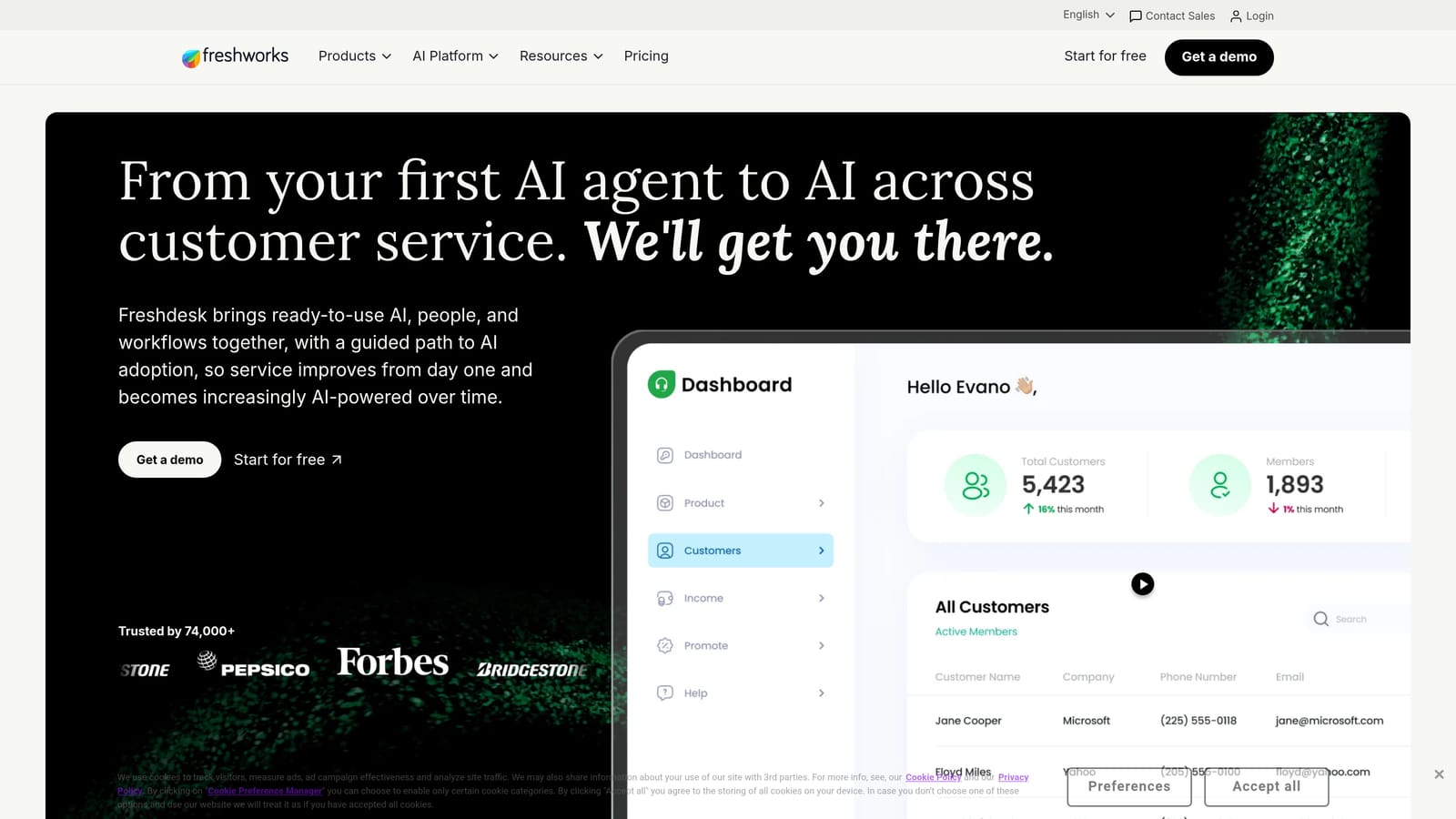
Freshdesk is a widely adopted multichannel helpdesk by Freshworks with ticketing, knowledge base, and Freddy AI as an assistant layer for agents.
Where This Tool Shines
Freshdesk's strength is its maturity. It handles email, chat, phone, and social channels in a single inbox, with well-developed SLA management, automation rules, and reporting. For teams that have built their support workflows around a traditional helpdesk model, Freshdesk is reliable and well-documented.
Freddy AI adds useful capabilities: suggested replies, auto-categorization, and a self-service bot. But it's worth being clear about what Freddy is: an assistant layer that helps human agents work faster, not an autonomous resolver that replaces the first tier of handling. If your goal is to reduce agent workload dramatically, Freddy's current positioning may fall short of that expectation.
Key Features
Multichannel Ticketing: Email, chat, phone, and social conversations managed in one unified inbox.
Freddy AI: Provides suggested replies, auto-categorization, and a self-service bot for common queries.
Automation Rules: Ticket routing, SLA management, and escalation workflows based on configurable conditions.
Freshworks Marketplace: Over 1,000 integrations available, covering a broad range of business tools.
Reporting and CSAT: Robust dashboards for tracking team performance, ticket trends, and customer satisfaction scores.
Best For
SMB and mid-market teams that want a proven, cost-effective helpdesk with broad integration options. A good fit for teams not yet ready to transition to a fully AI-autonomous model, or those with complex multichannel needs where workflow customization matters more than AI depth.
Pricing
Free plan available for up to 10 agents. Paid plans start at approximately $15 per agent per month (Growth tier), scaling up through Pro and Enterprise tiers. Note that advanced AI features are generally available on higher-tier plans.
3. Intercom
Best for: PLG SaaS companies wanting AI-first resolution combined with in-app messaging and product tours
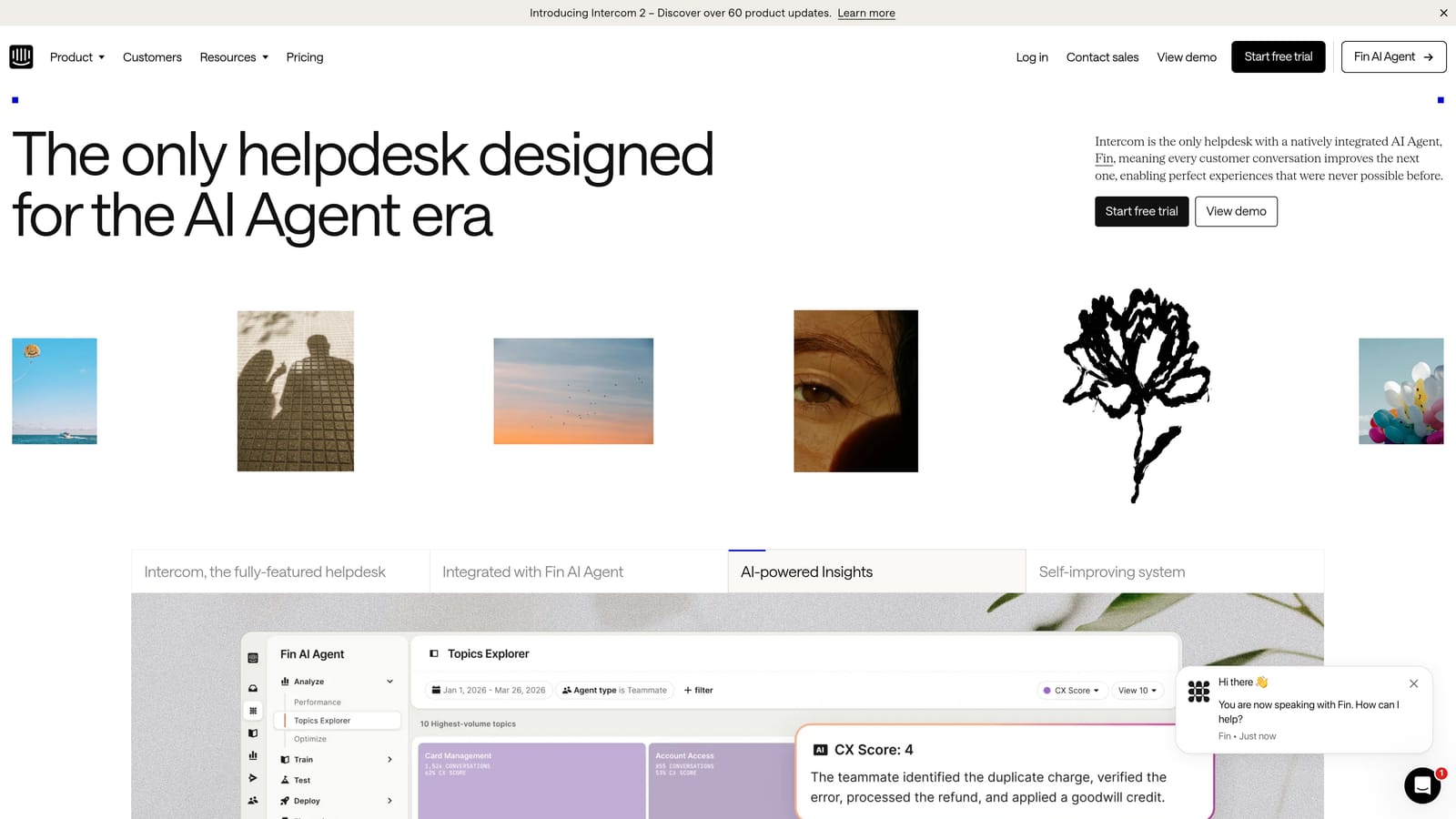
Intercom is a customer communications platform with Fin AI Agent as its front-line resolver, combining in-app messaging, proactive support, and a knowledge base.
Where This Tool Shines
Intercom's Fin AI Agent is one of the more capable AI resolvers on the market, built on large language models and positioned as a genuine front-line handler rather than a suggestion engine. For product-led growth companies where in-app messaging and user onboarding are central to the support experience, Intercom combines those capabilities in a way few platforms match.
The platform's proactive messaging and product tour features make it especially useful for SaaS teams that want to deflect support tickets before they're created, guiding users through new features or common friction points in context.
Key Features
Fin AI Agent: Autonomous ticket resolution using large language models, designed as a front-line resolver rather than an assistant.
In-App Messenger: Proactive messaging and product tours for user onboarding and feature adoption.
Unified Inbox: Combines chat, email, and social conversations in one workspace.
Help Center: Knowledge base with AI-powered article suggestions surfaced to users in context.
Outcome-Based Pricing: Option to pay per AI resolution rather than per seat, aligning cost with actual value delivered.
Best For
SaaS companies with strong product-led growth motions where in-app messaging, onboarding, and proactive support are as important as reactive ticket handling. Also suits teams that want outcome-based pricing aligned to AI resolution rates.
Pricing
Starts at approximately $39 per seat per month (Essential plan). Fin AI resolutions are priced separately under the outcome-based model. Costs can scale quickly at higher volumes, so model out your resolution volume before committing.
4. Zendesk
Best for: Mid-market and enterprise teams needing deep customization, compliance tooling, and a large partner ecosystem
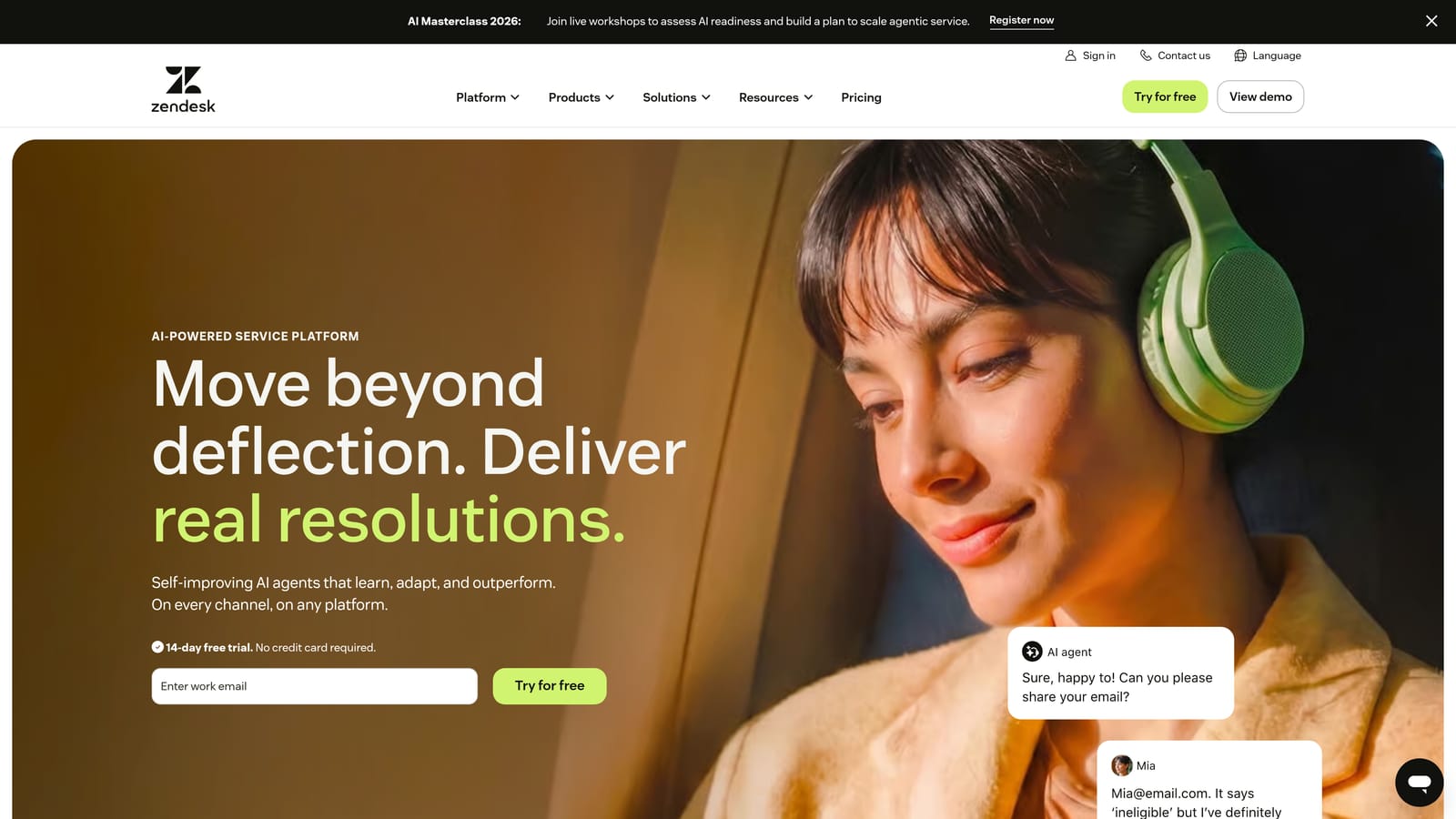
Zendesk is an enterprise-grade support platform with a mature AI suite, extensive customization, and one of the largest partner ecosystems in the market.
Where This Tool Shines
Zendesk is the incumbent for a reason. Its workflow builder, multi-brand support, SLA management, and compliance tooling are genuinely mature, and the marketplace gives enterprise teams access to hundreds of native integrations. If your organization has complex support operations across multiple brands, languages, or regulatory environments, Zendesk has the infrastructure to handle it.
The AI suite — covering intelligent triage, intent detection, macro suggestions, and AI agents — is capable, but like Freshdesk's Freddy, it's layered onto an existing helpdesk architecture rather than built AI-first. Teams that need deep AI autonomy may find themselves working around the platform's traditional ticket-centric model.
Key Features
Zendesk AI Suite: Intelligent triage, intent detection, macro suggestions, and AI agents across the support workflow.
Advanced Workflow Builder: Conditional logic and multi-step automations for complex ticket handling scenarios.
Multi-Brand and Multi-Language Support: Handles complex enterprise setups with multiple customer-facing brands or global teams.
Extensive Marketplace: Hundreds of native integrations covering CRM, billing, project management, and more.
SLA and Compliance Tooling: Robust management for organizations with strict service level or regulatory requirements.
Best For
Mid-market and enterprise support operations with complex workflows, multi-brand requirements, or compliance needs. Teams already embedded in the Zendesk ecosystem who want to layer in AI incrementally rather than migrate entirely.
Pricing
Suite Team starts at approximately $55 per agent per month. AI features are available on higher tiers or as add-ons, which can make total cost of ownership higher than the base price suggests.
5. Kustomer
Best for: High-volume B2C, subscription, and e-commerce brands that need full customer context inside every support conversation
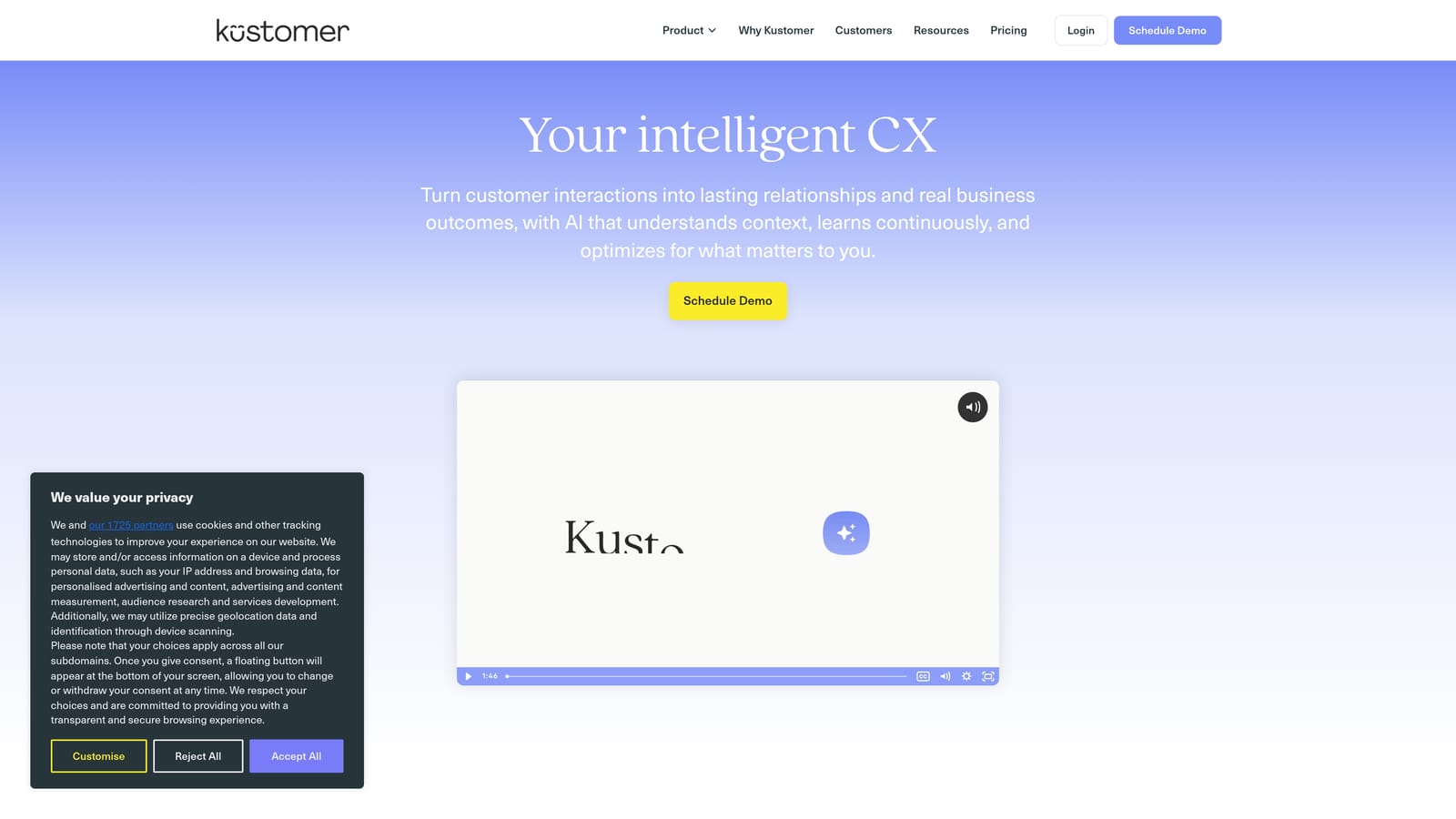
Kustomer is a CRM-first support platform that surfaces the full customer timeline — purchases, prior interactions, subscription data — directly inside every support conversation.
Where This Tool Shines
Kustomer's core differentiator is context. Where traditional helpdesks show you a ticket, Kustomer shows you the customer: their purchase history, previous interactions, subscription status, and behavioral data all in one unified timeline. For support teams handling high-volume, relationship-driven conversations, that context reduces handle time and improves resolution quality.
The AI features — auto-classification and suggested responses — are useful, but they're secondary to the platform's CRM-first architecture. If your primary problem is context-switching between your helpdesk and your CRM, Kustomer solves that more elegantly than most.
Key Features
Unified Customer Timeline: All touchpoints, orders, and interaction history visible in a single view within every conversation.
AI Auto-Classification and Suggested Responses: Speeds up agent handling with intelligent categorization and reply recommendations.
Omnichannel Inbox: Email, chat, SMS, social, and voice in one workspace.
Business Rules Engine: Automated workflows based on customer data, conversation type, and custom conditions.
Native CRM Data: Reduces the need to switch between support and CRM tools during conversations.
Best For
High-volume B2C brands, subscription businesses, and e-commerce teams where customer history is central to every support interaction. Less suited to B2B SaaS teams where the CRM-first model is less relevant than AI autonomy or product integration depth.
Pricing
Enterprise pricing starting around $89 per agent per month. Contact Kustomer directly for current rates, as pricing can vary based on volume and contract terms.
6. Help Scout
Best for: Small teams and startups that want a clean, human-centric shared inbox without automation complexity
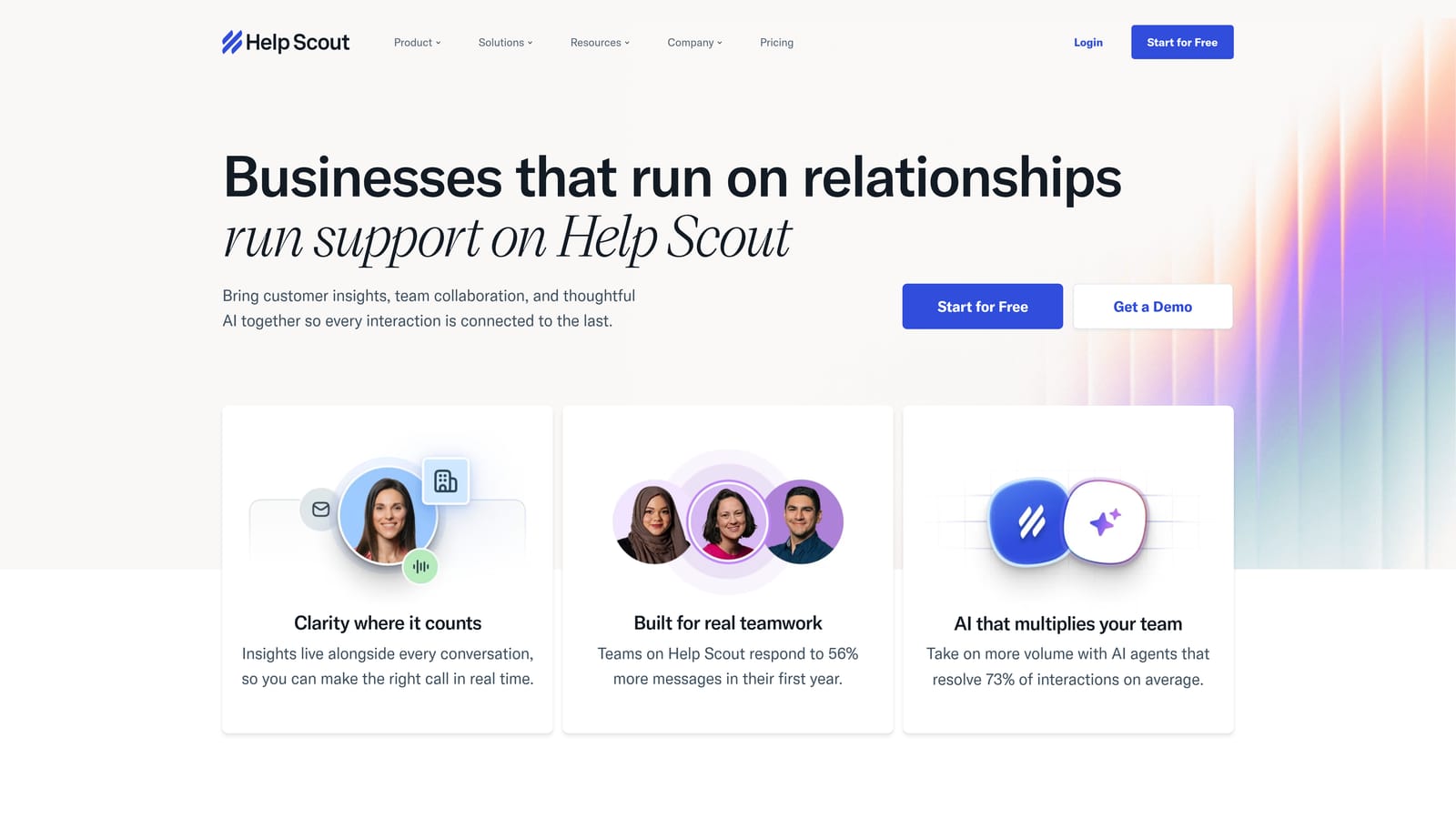
Help Scout is a clean, human-centric shared inbox and knowledge base platform with light AI assistance, built for small teams that prioritize simplicity over automation depth.
Where This Tool Shines
Help Scout's appeal is deliberate restraint. It doesn't try to be an enterprise platform or an AI powerhouse — it's a well-designed shared inbox with good knowledge base tooling and a Beacon chat widget that surfaces relevant articles before a user submits a ticket. For small teams that find Zendesk or Freshdesk over-engineered for their needs, Help Scout is a breath of fresh air.
The AI Summarize and AI Assist features added in recent years help agents work faster without fundamentally changing the human-centric model. If your team values personal, thoughtful support over automation volume, that's a feature, not a limitation.
Key Features
Shared Inbox: Collision detection, internal notes, and assignment tools for clean team collaboration on tickets.
Beacon Chat Widget: Self-service knowledge base surfacing within the widget before escalating to a human agent.
AI Summarize and AI Assist: Helps agents draft responses and understand long conversation threads faster.
Docs Knowledge Base: Built-in search and article management for self-service support content.
Simple Pricing: Per-seat model with no complex feature-gating across tiers.
Best For
Small teams, early-stage startups, and companies where support volume is manageable and the priority is clean tooling over AI depth. Not the right fit for teams looking to automate a significant portion of ticket handling.
Pricing
Standard plan from approximately $22 per user per month. Plus and Pro tiers available with additional features. Pricing is straightforward with no hidden AI add-on costs at the base level.
7. Tidio
Best for: SMB e-commerce and small SaaS teams wanting affordable AI chatbot resolution with a low barrier to entry
Tidio is an SMB-friendly live chat and AI chatbot platform featuring Lyro, a conversational AI that handles common queries autonomously before escalating to a human agent.
Where This Tool Shines
Tidio's Lyro AI chatbot is genuinely conversational: it handles context-aware queries rather than just matching keywords to canned responses. For small teams with high repetitive query volumes — shipping questions, return policies, account issues — Lyro can deflect a meaningful portion of tickets before they reach a human agent.
The visual chatbot flow builder also gives non-technical teams the ability to create custom conversation paths without engineering support, which matters a lot when your support team doesn't have a developer on call.
Key Features
Lyro AI Chatbot: Conversational, context-aware query resolution for common support scenarios before human escalation.
Live Chat with Agent Takeover: Smooth handoff to human agents when Lyro reaches the limits of its resolution capability.
Visual Chatbot Flow Builder: Drag-and-drop custom conversation paths without coding requirements.
E-Commerce Integrations: Native connections with Shopify, WooCommerce, and PrestaShop for order-related support.
Affordable Entry Point: Free plan and low-cost paid tiers make it accessible for teams with limited budgets.
Best For
SMB e-commerce stores and small SaaS teams with high volumes of repetitive queries and limited support budgets. Less suited to B2B teams needing deep product integrations, business intelligence, or enterprise-grade workflow automation.
Pricing
Free plan available. Lyro AI conversations priced at approximately $0.50 to $1 per resolution. Paid plans from approximately $29 per month. Total cost scales with conversation volume rather than seat count.
8. Gorgias
Best for: E-commerce brands on Shopify, WooCommerce, or BigCommerce that need support tightly integrated with order management
Gorgias is a support platform built specifically for e-commerce brands, with deep Shopify-native integrations and AI auto-responses for order-related queries.
Where This Tool Shines
Gorgias is the most vertically focused tool on this list, and that focus is its biggest advantage. If you're running an e-commerce brand on Shopify, the native integration means agents can view order details, process refunds, and update subscriptions directly inside the support conversation without switching tabs. For high-volume order support, that operational efficiency is significant.
The AI auto-response capability handles the most common e-commerce queries — order status, shipping updates, return requests — without agent involvement. It's not the most sophisticated AI on this list, but it's well-targeted to the use case it serves.
Key Features
Native E-Commerce Integrations: Deep connections with Shopify, WooCommerce, and BigCommerce for order management inside conversations.
AI Auto-Responses: Automated handling of order status, return, and shipping queries without agent involvement.
Revenue Statistics: Ties support interactions to revenue data, showing the commercial impact of your support team.
Omnichannel Inbox: Email, chat, SMS, Instagram, and Facebook conversations in one workspace.
Macros and Rules: High-volume repetitive ticket handling with templated responses and automated routing.
Best For
E-commerce brands with high order-related support volume. Not a strong fit for B2B SaaS teams — the platform's value is tightly coupled to e-commerce workflows, and that vertical focus means it lacks the product integration depth or business intelligence features that SaaS teams typically need.
Pricing
Starter plan from approximately $10 per month for up to 50 tickets. Pricing scales by ticket volume rather than seat count, which works well for e-commerce teams with variable seasonal demand.
Which Platform Is Right for Your Team?
The core question running through this comparison is a simple one: do you want AI to assist your agents, or do you want AI to handle the first 80% of ticket volume entirely on its own?
If you want AI as an assistant layer on top of proven helpdesk infrastructure, Freshdesk and Zendesk are mature choices with broad integrations and familiar workflows. Zendesk suits larger enterprise teams; Freshdesk works well for SMB and mid-market teams watching budget.
If you want AI as the primary resolver with human escalation as the exception rather than the rule, Halo AI and Intercom's Fin Agent are the strongest options for B2B SaaS teams. Intercom brings strong in-app messaging for PLG companies; Halo brings page-aware context, auto bug triage, and business intelligence that goes beyond support into product and revenue signals.
For specific verticals: Gorgias is the clear choice for e-commerce brands on Shopify. Kustomer suits high-volume B2C teams that live and die by customer history. Help Scout serves small teams that value simplicity. Tidio offers an affordable entry point for SMBs testing AI chatbot resolution for the first time.
Your support team shouldn't scale linearly with your customer base. Let AI agents handle routine tickets, guide users through your product, and surface business intelligence while your team focuses on complex issues that need a human touch. See Halo in action and discover how continuous learning transforms every interaction into smarter, faster support.