9 Best Freshdesk Alternatives & AI Support Software in 2026
Comparing freshdesk vs ai support software options, this guide evaluates 9 leading alternatives across AI capabilities, integrations, and scalability to help B2B teams determine whether a traditional helpdesk with AI add-ons or a purpose-built autonomous resolution platform better fits their 2026 support strategy.
 Grant CooperFounder14 min read
Freshdesk built its reputation as a reliable, multi-channel helpdesk, and for many teams, it still gets the job done. But the way B2B companies think about customer support has shifted considerably. Ticket management alone isn't enough anymore. Teams now expect autonomous resolution, contextual in-product guidance, and support systems that surface business intelligence rather than just tracking SLA compliance.
The real question in 2026 isn't just "which helpdesk should we use?" It's whether you want AI bolted onto a traditional ticketing system or an AI-native platform built from the ground up around autonomous resolution. That distinction shapes everything from how quickly tickets get resolved to how much your support costs scale as you grow.
This list covers the top alternatives to Freshdesk and the best ai helpdesk software options available today, evaluated on AI capabilities, integration depth, scalability, pricing transparency, and fit for B2B product teams. Whether you're looking to replace Freshdesk entirely or supplement it with smarter customer service automation, there's an option here for you.
1. Halo AI
Best for: B2B SaaS teams that want AI-native autonomous support with business intelligence built in.
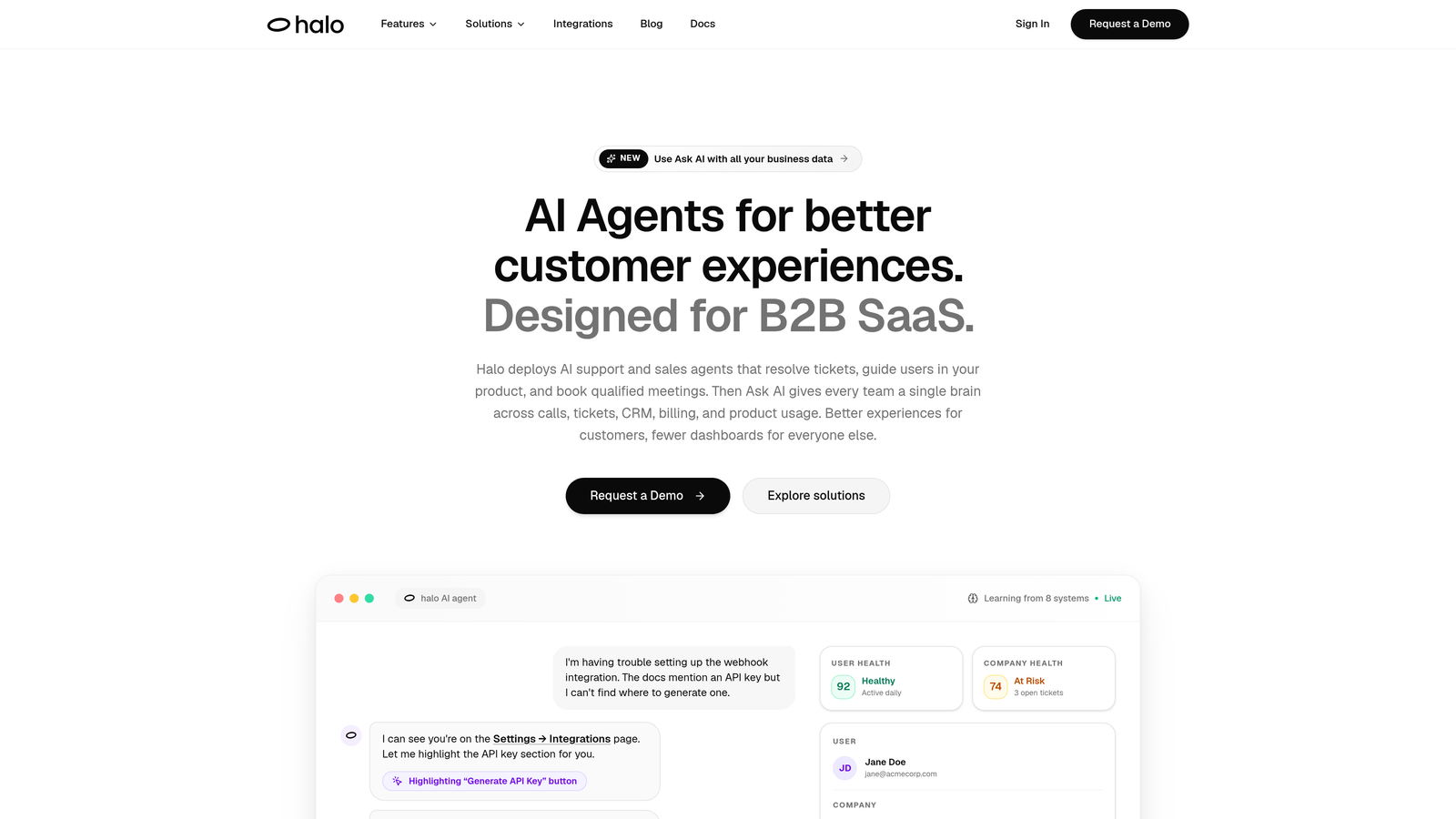
Halo AI is an AI-native customer support platform that deploys autonomous agents to resolve tickets, guide users through your product, and generate business intelligence from every support interaction.
Where This Tool Shines
Most support tools treat AI as a feature layer on top of a ticketing system. Halo AI is architected the other way around: the AI agent is the primary responder, and human escalation is the exception rather than the rule. This means tickets get resolved faster without adding headcount, and the system gets smarter with every interaction it handles.
What sets Halo apart from other AI support tools is the page-aware context. The chat widget can see what users are looking at in your product, which means it can provide visual, step-by-step guidance that's actually relevant to where someone is stuck. That's a meaningfully different experience from a generic chatbot that serves the same canned responses regardless of context.
Key Features
Autonomous AI Agents: Resolve support tickets without human intervention, handling routine questions and workflows end-to-end.
Page-Aware Chat Widget: Sees what users see in your product to deliver contextual, visual guidance rather than generic responses.
Smart Inbox with Business Intelligence: Goes beyond ticket tracking to surface customer health signals, revenue intelligence, and anomaly detection across your support data.
Auto Bug Ticket Creation: Automatically generates bug reports integrated with Linear, Slack, and other developer tools when issues are detected.
Live Agent Handoff: Escalates complex issues to human agents with full conversation context preserved, so customers never have to repeat themselves.
Best For
Halo AI is best suited for growing SaaS companies and B2B product teams that want to scale support without scaling headcount. If you're using tools like Intercom, Zendesk, Linear, Slack, HubSpot, or Stripe, Halo connects across your entire business stack and adds a layer of intelligence that traditional helpdesks can't match.
Pricing
Contact for pricing. Halo offers plans designed for growing SaaS teams through enterprise, with options tailored to ticket volume and team size.
2. Freshdesk
Best for: Teams wanting a proven multi-channel helpdesk with broad integrations and accessible pricing.
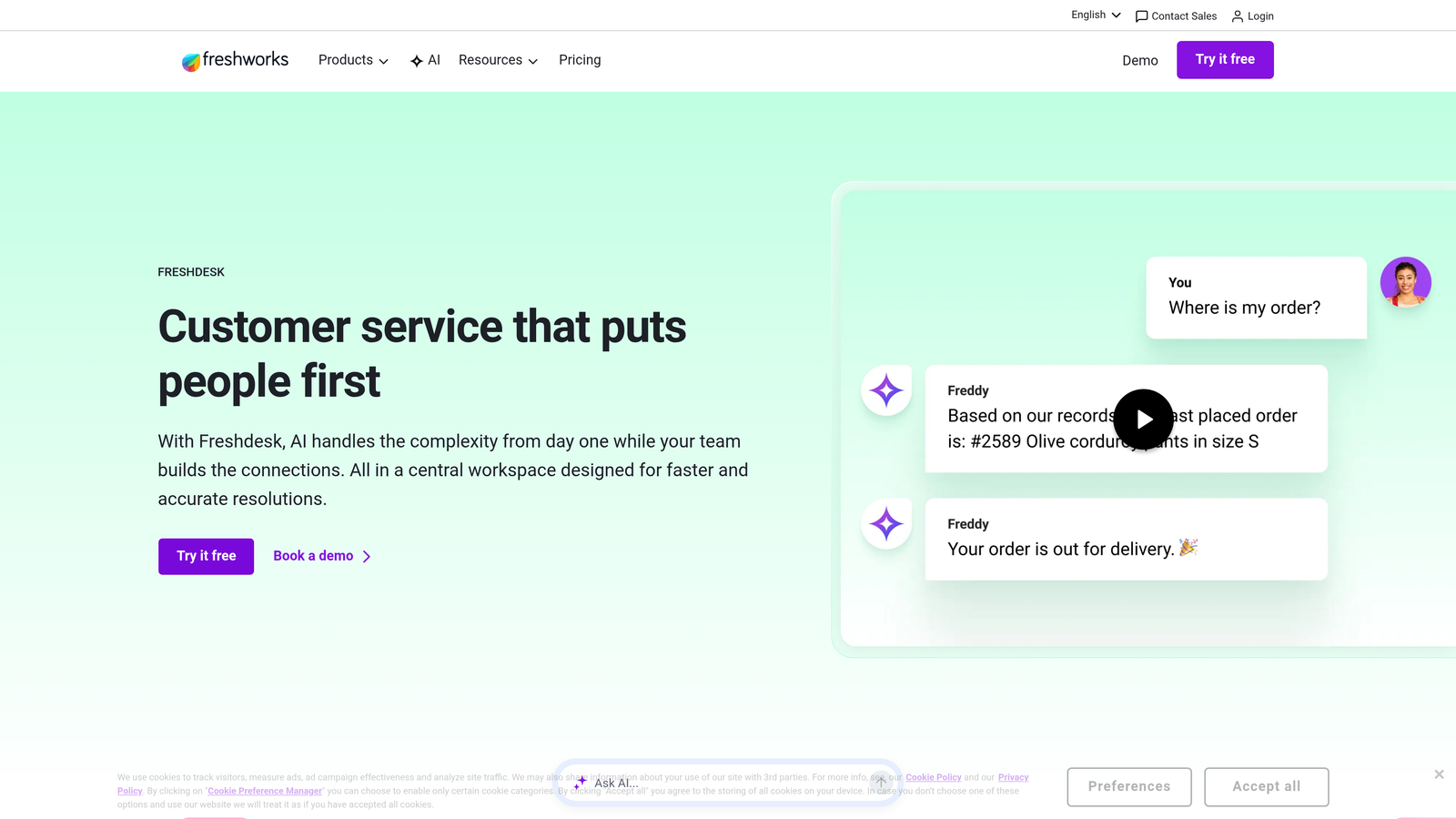
Freshdesk is an established helpdesk platform by Freshworks offering multi-channel ticketing, self-service portals, and Freddy AI copilot features for agent assistance and customer-facing automation.
Where This Tool Shines
Freshdesk's strength is breadth. It handles email, chat, phone, and social channels in one place, and its marketplace offers hundreds of third-party integrations that make it relatively easy to connect to your existing stack. For teams that need a dependable ticketing backbone without a steep learning curve, Freshdesk delivers.
Freddy AI has expanded Freshdesk's automation capabilities, but it's worth understanding that Freddy operates within Freshdesk's traditional ticket-centric architecture. It augments what agents do rather than replacing the ticket workflow itself. If your team is comfortable managing tickets and wants AI assistance layered on top, that's a reasonable fit.
Key Features
Multi-Channel Ticketing: Consolidates support across email, chat, phone, and social into a single inbox.
Freddy AI Copilot: Provides agent assist suggestions and powers customer-facing chatbots for deflection and self-service.
Extensive Marketplace: Hundreds of third-party app integrations covering CRM, billing, ecommerce, and developer tools.
Knowledge Base and Self-Service Portal: Built-in documentation tools for reducing inbound ticket volume.
SLA Management and Workflow Automations: Rules-based automation for routing, escalation, and compliance tracking.
Best For
Freshdesk suits mid-market teams that need a reliable, multi-channel helpdesk with solid out-of-the-box functionality. It's a particularly good fit if your team is agent-centric and wants AI to assist rather than replace human workflows.
Pricing
Free tier available. Paid plans start around $15 per agent per month, scaling to $79 or more per agent per month for enterprise features.
3. Intercom
Best for: Product-led SaaS teams wanting conversational support with in-app engagement and proactive messaging.
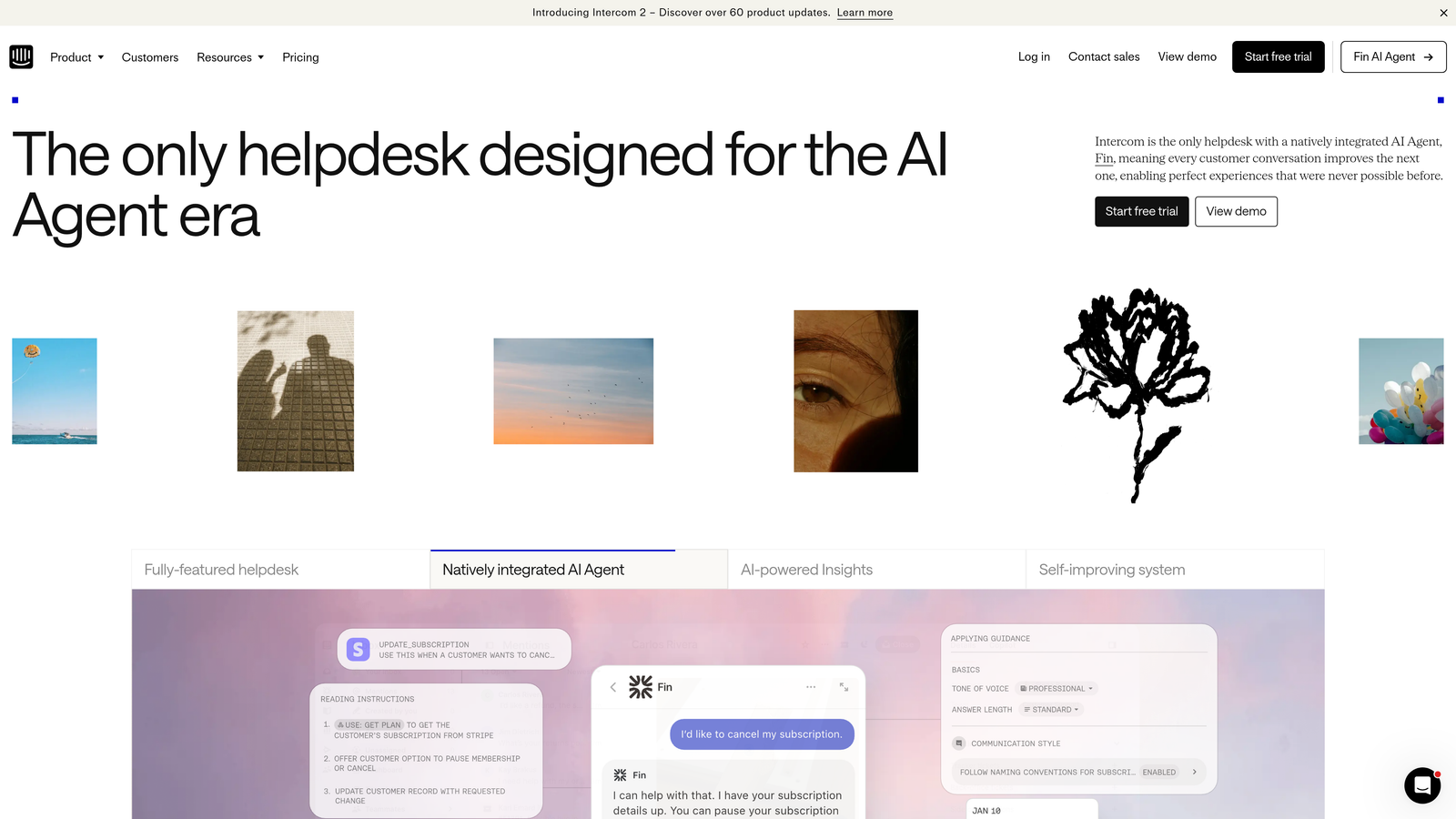
Intercom is a conversational support platform combining a messenger-first UX with the Fin AI agent for automated resolution, proactive messaging, and in-app engagement.
Where This Tool Shines
Intercom's Fin AI agent has become one of the more talked-about AI support tools in the SaaS space, and for good reason. It uses your help center content and custom knowledge to resolve questions autonomously, and it integrates naturally into Intercom's messenger experience that many SaaS users already recognize.
Beyond support, Intercom blurs the line between support, sales, and marketing by giving all three functions a shared inbox. If your team wants to use the same platform for onboarding outreach, proactive messaging, and reactive support, Intercom's unified approach can reduce tool sprawl significantly.
Key Features
Fin AI Agent: Resolves customer questions autonomously using help center content and custom knowledge sources.
In-App Messenger: Combines reactive support with product tours and proactive outbound messaging in one widget.
Unified Inbox: Brings support, sales, and marketing conversations into a single shared workspace.
Custom Bots and Workflow Builder: Visual builder for routing logic, automation, and escalation flows.
API and Integration Ecosystem: Strong developer tools and integrations with major CRMs and business platforms.
Best For
Intercom is a natural fit for product-led SaaS companies that want support and customer engagement handled from a single platform. Teams already using Intercom for onboarding or sales will find the support expansion particularly seamless.
Pricing
Starts at $39 per seat per month. Fin AI is charged per resolution. Enterprise pricing is available for larger teams with higher volume needs.
4. Zendesk
Best for: Enterprise teams needing deep customization, advanced reporting, and a mature AI agent ecosystem.
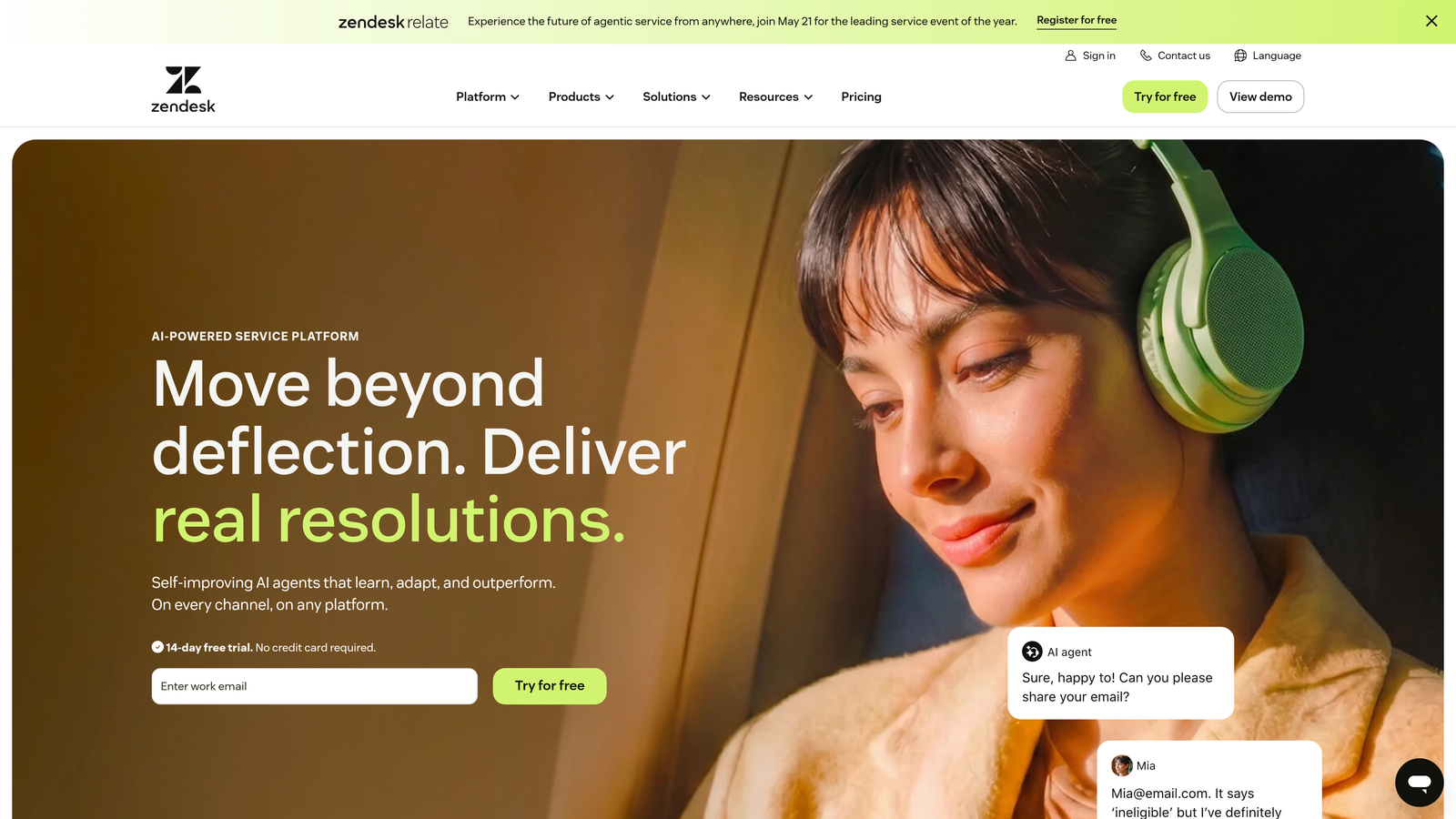
Zendesk is an enterprise-grade customer service platform with extensive configurability, a massive app marketplace, and expanding AI agent and copilot capabilities built on top of its ticketing core.
Where This Tool Shines
Zendesk's depth is hard to match. The combination of advanced routing, triggers, custom views, and 1,500-plus marketplace apps means you can configure it to fit almost any support workflow. For large teams with complex operational requirements, that flexibility is genuinely valuable.
Zendesk has invested heavily in AI agents and copilot features in recent years, adding autonomous resolution capabilities alongside its traditional agent-assist tools. Like Freshdesk, though, these AI features sit on top of Zendesk's ticket-centric foundation rather than replacing it, which is worth factoring into your evaluation if autonomous resolution is a primary goal.
Key Features
Advanced Ticketing Configuration: Highly customizable routing, triggers, and views for complex support operations.
AI Agents and Copilot: Automated resolution and real-time agent assistance powered by Zendesk's AI layer.
1,500-Plus App Marketplace: One of the largest integration ecosystems in customer support software.
Omnichannel Support: Email, chat, voice, social, and messaging channels unified in one platform.
Advanced Analytics: Custom reporting dashboards and performance tracking across teams and channels.
Best For
Zendesk is best for larger enterprises with dedicated support operations teams, complex routing needs, and the resources to configure and maintain a sophisticated setup. Smaller teams may find the overhead and cost harder to justify.
Pricing
Starts around $19 per agent per month. Suite plans begin at approximately $55 per agent per month. AI features may require additional add-on pricing depending on the plan.
5. Ada
Best for: Enterprise teams building AI-native, multilingual automated support at scale across multiple channels.
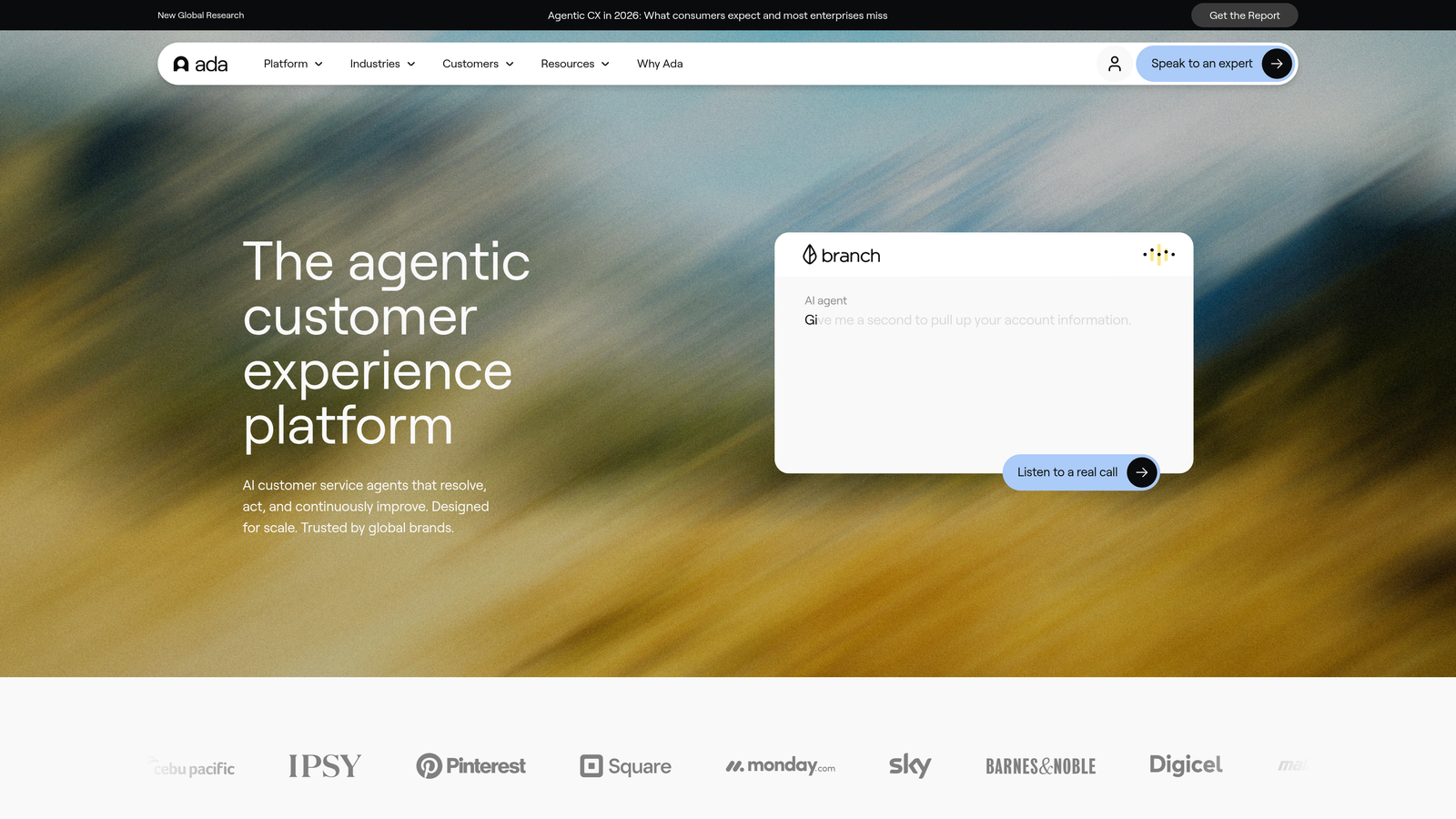
Ada is an enterprise AI agent platform purpose-built for autonomous customer service, offering no-code setup, multilingual resolution, and deployment across web, mobile, social, and messaging channels.
Where This Tool Shines
Ada has repositioned itself firmly as an AI agent company rather than a chatbot platform, and that distinction matters. The architecture is designed around autonomous resolution from the start, with a no-code interface that lets non-technical teams build and manage AI agents without ongoing developer involvement.
For global enterprises, Ada's multilingual support across more than 50 languages is a meaningful differentiator. Deploying consistent, automated support across regions and languages without building separate workflows for each is a real operational advantage at scale.
Key Features
AI-Native Architecture: Built for autonomous resolution at scale rather than agent-assist functionality bolted onto existing workflows.
No-Code Agent Builder: Non-technical teams can build, manage, and iterate on AI agents without developer support.
Multilingual Support: Automated resolution across 50-plus languages for global customer bases.
Omnichannel Deployment: Web, SMS, social media, and messaging app channels supported from a single platform.
Helpdesk and CRM Integrations: Connects with Salesforce, Zendesk, and other major platforms for data continuity.
Best For
Ada is designed for enterprise organizations with high ticket volumes, global audiences, and the need for consistent automated support across multiple channels and languages. It's less suited to smaller teams or those with simpler support needs.
Pricing
Custom enterprise pricing. Contact Ada directly for quotes based on your volume and deployment requirements.
6. Tidio
Best for: SMBs and e-commerce teams wanting affordable AI chat with strong Shopify and WooCommerce integrations.
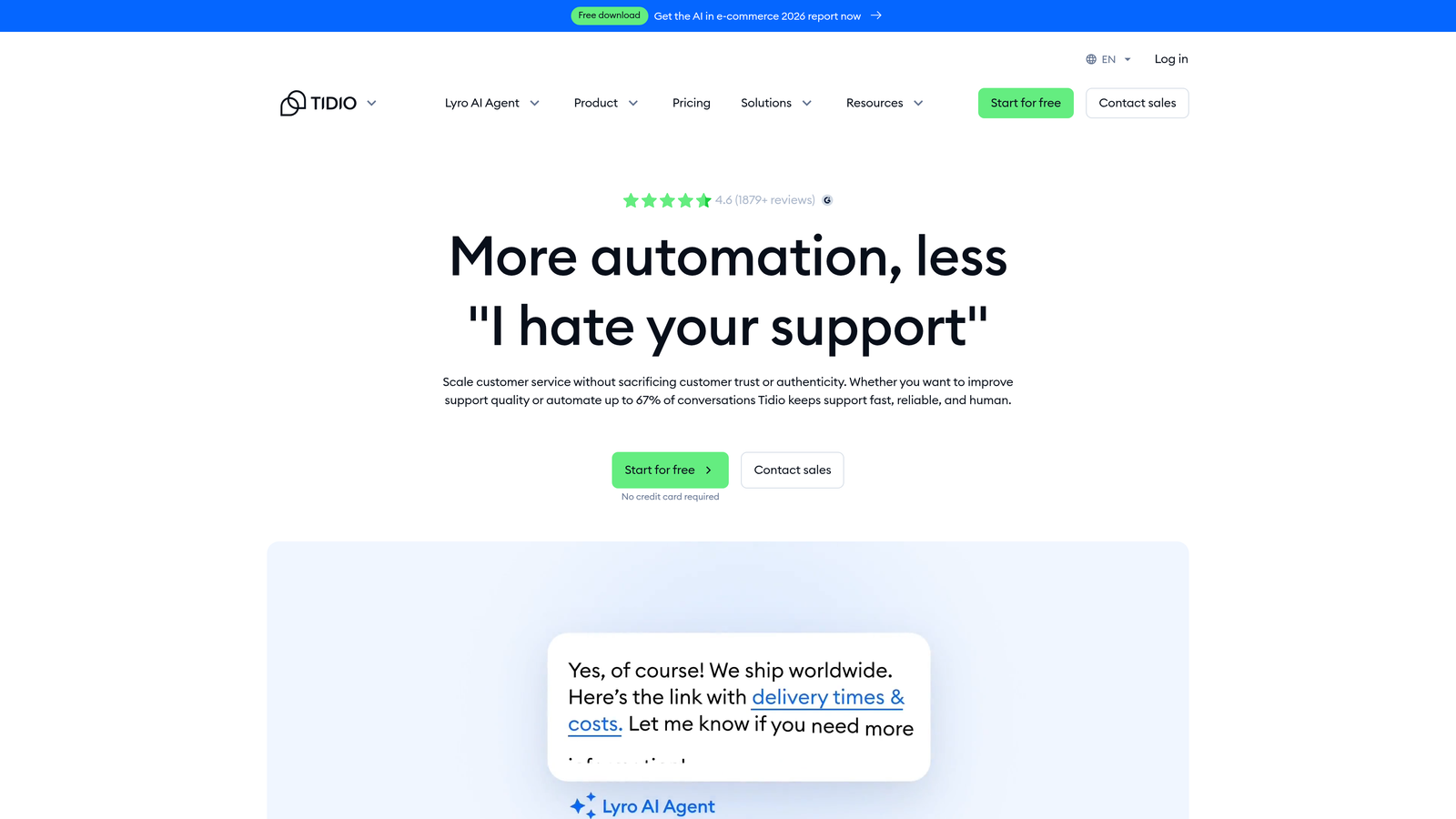
Tidio is an accessible AI chatbot and live chat platform built for smaller teams, featuring the Lyro AI assistant for automated conversations and native integrations with major e-commerce platforms.
Where This Tool Shines
Tidio's appeal is straightforward: it combines live chat and AI chatbot functionality in a single widget at a price point that works for small and medium-sized businesses. The Lyro AI assistant handles common customer questions automatically, freeing up small support teams to focus on conversations that actually need a human.
The e-commerce integrations are genuinely strong. If you're running a Shopify or WooCommerce store, Tidio connects natively and can pull order information, track shipping, and handle common post-purchase questions without custom development work.
Key Features
Lyro AI Chatbot: Automated customer conversations powered by AI, trained on your support content.
Combined Live Chat and Chatbot: Both channels in a single widget with smooth handoff between automated and human responses.
E-Commerce Integrations: Native Shopify, WooCommerce, and WordPress connections with order data access.
Visual Flow Builder: No-code chatbot flow creation for common support scenarios and routing.
Visitor Tracking and Analytics: Basic visitor behavior data and conversation analytics for small teams.
Best For
Tidio is the right call for SMBs, e-commerce businesses, and early-stage teams that want to automate common support conversations without enterprise-level complexity or pricing. It's not built for high-volume B2B SaaS operations.
Pricing
Free plan available. Paid plans start around $29 per month. Lyro AI conversations are priced separately based on volume.
7. Help Scout
Best for: Growing teams that prioritize clean UX, simplicity, and a human-first support experience.
Help Scout is a human-first helpdesk known for its intuitive shared inbox, now offering AI-powered draft replies, conversation summaries, and a well-built knowledge base for teams that value simplicity.
Where This Tool Shines
Help Scout's design philosophy is refreshingly focused: build something that feels like email, not a ticketing system, so agents can focus on conversations rather than workflows. The result is one of the cleanest UX experiences in the helpdesk category, and teams that switch from heavier platforms often find their agents adapt quickly.
The AI additions, including draft reply suggestions and conversation summaries, fit naturally into Help Scout's workflow without overwhelming the interface. This isn't an AI-first platform, but for teams that want AI assistance without rebuilding their entire support operation, it's a sensible middle ground.
Key Features
Shared Inbox with Collision Detection: Prevents duplicate replies with real-time agent visibility and private internal notes.
AI Draft Replies and Summaries: AI-generated response suggestions and conversation summaries to speed up agent workflows.
Docs Knowledge Base: Built-in documentation with search functionality and an embeddable Beacon widget for self-service.
Customer Satisfaction Ratings: Simple CSAT collection and reporting integrated into the conversation flow.
Integrations and API: Connects with popular business tools including CRMs, billing platforms, and communication tools.
Best For
Help Scout suits small to mid-sized teams that want a clean, agent-friendly helpdesk with thoughtful AI assistance rather than full automation. It's particularly popular with teams that find Zendesk or Freshdesk overly complex for their needs.
Pricing
Starts at $25 per user per month. The Plus plan is available at $50 per user per month with advanced features including more reporting and integrations.
8. Forethought
Best for: Teams that want AI-powered triage and resolution without migrating away from their existing helpdesk.
Forethought is an AI layer designed to sit on top of existing helpdesk platforms like Zendesk and Salesforce, providing intelligent triage, automated resolution, and agent assist without requiring a platform migration.
Where This Tool Shines
Forethought occupies an interesting position in the market: it's not trying to replace your helpdesk, it's trying to make it smarter. If your team has invested heavily in Zendesk or Salesforce Service Cloud and isn't ready to migrate, Forethought adds a meaningful AI layer without forcing you to start over.
The two-product approach, Solve for customer-facing autonomous resolution and Assist for real-time agent suggestions, lets teams adopt AI gradually. You can start with agent assist and expand to autonomous resolution as confidence in the AI grows, which lowers the adoption risk compared to a full platform switch.
Key Features
AI-Powered Triage and Routing: Intelligent classification and routing that gets tickets to the right place faster.
Solve: Customer-facing AI agent for autonomous resolution of common questions and requests.
Assist: Real-time AI suggestions surfaced to human agents during live conversations.
Helpdesk Integration Layer: Designed to work on top of Zendesk, Salesforce, and other major platforms without replacing them.
AI Performance Analytics: Dashboard tracking resolution rates, deflection, and agent assist effectiveness.
Best For
Forethought is ideal for mid-market and enterprise teams that are locked into an existing helpdesk investment and want to add AI capabilities incrementally rather than through a full platform migration.
Pricing
Custom pricing based on ticket volume and which modules you deploy. Contact Forethought directly for a quote.
9. Kustomer
Best for: Customer-centric teams that want a unified CRM and support platform with a full timeline view of every interaction.
Kustomer is a CRM-powered customer service platform offering a unified timeline view of all customer interactions, AI-driven classification and routing, and omnichannel support capabilities.
Where This Tool Shines
The core differentiator for Kustomer is context. Rather than showing agents a stream of tickets, Kustomer presents a complete timeline of every interaction a customer has had with your business across every channel. That holistic view changes how agents approach conversations, especially for high-value customers where history matters.
The built-in CRM with custom objects means you can store and surface business-specific data alongside support conversations without stitching together a separate CRM and helpdesk. For teams where customer data is central to support quality, that consolidation has real operational value.
Key Features
Timeline-Based Customer View: Unified history of all interactions, purchases, and data points in a single chronological view.
AI-Powered Classification and Routing: Automated conversation classification, intelligent routing, and suggested responses for agents.
Omnichannel Support: Email, chat, social, SMS, and voice channels handled from a single platform.
Built-In CRM with Custom Objects: Store and surface business-specific customer data without a separate CRM tool.
Self-Service and Chatbot Builder: Knowledge base and bot tools for deflecting common questions before they reach agents.
Best For
Kustomer works well for teams where deep customer context is essential to support quality, particularly in e-commerce, subscription businesses, or any model where customer history directly shapes how issues get resolved.
Pricing
Enterprise pricing starting around $89 per user per month. Contact Kustomer for current plans and volume-based options.
Which Tool Is the Right Fit for Your Team?
The most useful way to think about this list is through a simple lens: are you looking to add AI to an existing helpdesk workflow, or are you ready to build support around AI from the start?
Here's a quick-reference breakdown by use case to help you orient your evaluation.
AI-first autonomous support: Halo AI is built for this. If you want an ai support agent that resolves tickets, guides users through your product, and surfaces business intelligence without being bolted onto a legacy ticketing system, Halo is the strongest fit for B2B SaaS teams.
Traditional helpdesk with AI add-ons: Freshdesk and Zendesk are the natural choices here. Both offer mature, multi-channel ticketing with AI copilot features layered on top. Freshdesk is more accessible for mid-market teams; Zendesk suits larger enterprises with complex configuration needs.
Conversational and product-led support: Intercom excels for SaaS teams that want support, onboarding, and customer engagement from a single messenger-first platform. Fin AI handles a meaningful portion of resolution automatically.
Enterprise AI automation: Ada and Forethought are both strong here, with different approaches. Ada is purpose-built for autonomous resolution from scratch; Forethought adds AI intelligence on top of your existing helpdesk investment.
SMB and budget-conscious teams: Tidio offers the most accessible entry point, particularly for e-commerce businesses on Shopify or WooCommerce.
Simplicity-first teams: Help Scout delivers a clean, human-friendly experience with thoughtful AI assist features for teams that find heavier platforms overwhelming.
CRM-centric support: Kustomer is the right call when full customer context and interaction history are central to how your team delivers support.
Your support team shouldn't scale linearly with your customer base. Let automated customer support handle routine tickets, guide users through your product, and surface business intelligence while your team focuses on complex issues that need a human touch. See Halo in action and discover how continuous learning transforms every interaction into smarter, faster support.