8 Best Freshdesk Alternatives & AI Support Tools in 2026
Comparing freshdesk vs ai support tools, this guide evaluates 8 leading alternatives for B2B teams questioning whether traditional helpdesks can still meet modern customer expectations. It breaks down how AI-native platforms differ architecturally from Freshdesk by prioritizing autonomous ticket resolution and intelligent behavior detection, helping teams decide whether to augment, replace, or upgrade their current support stack.
 Grant CooperFounder14 min read
Freshdesk has long been a go-to helpdesk for growing teams: reliable ticketing, solid macros, decent reporting. But as customer expectations shift toward instant, intelligent responses, many B2B teams are asking whether a traditional helpdesk is still enough.
The landscape has changed. AI-native support platforms now resolve tickets autonomously, detect anomalies in customer behavior, and integrate across your entire business stack, not just your inbox. The architectural difference matters: traditional helpdesks were built for human agents managing queues, while AI-native platforms are built for autonomous resolution first, with human escalation as the exception.
This article compares Freshdesk against the leading AI support tools available in 2026, so you can evaluate what actually fits your team's needs. Whether you're looking to augment Freshdesk with AI, replace it entirely, or find a purpose-built agent that learns from every interaction, you'll find a clear breakdown of each option's strengths, ideal users, and pricing.
Halo AI is featured at #1 as the most AI-native option in this comparison, but every tool here earns its place on merit.
1. Halo AI
Best for: B2B SaaS teams that want autonomous ticket resolution with continuous learning and cross-stack intelligence.
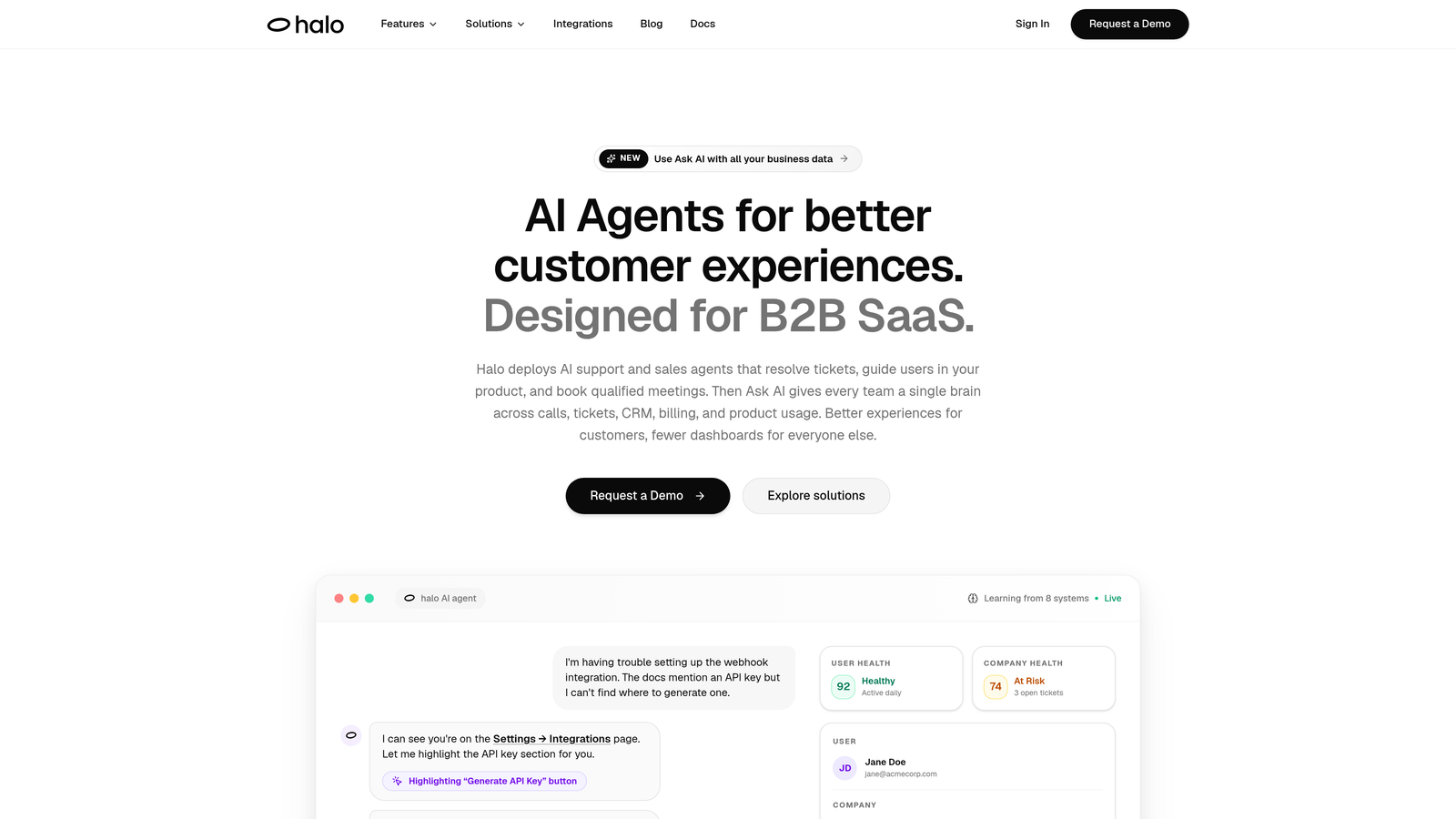
Halo AI is an AI-first customer support platform that deploys autonomous agents to resolve tickets, guide users through your product with page-aware context, and surface business intelligence signals, all while learning from every interaction.
Where This Tool Shines
The core differentiator here is architecture. Halo wasn't built as a helpdesk with AI bolted on afterward. It was designed from the ground up around autonomous resolution, which means the AI isn't a feature you toggle on; it's the foundation everything else runs on.
The page-aware chat widget is particularly compelling for SaaS teams. Rather than responding to a user's description of their problem, Halo's agent can see exactly what the user sees in your UI, which makes guidance more precise and reduces the back-and-forth that frustrates both customers and agents. Add the smart inbox's business intelligence layer, which surfaces customer health signals and revenue anomalies, and you're getting support infrastructure that informs your entire business, not just your ticket queue.
Key Features
Autonomous AI Agents: Resolve tickets without human intervention by understanding context, pulling relevant information, and delivering accurate responses.
Page-Aware Chat Widget: The AI sees what users see in your product UI, enabling contextual guidance rather than generic troubleshooting.
Smart Inbox with Business Intelligence: Surfaces customer health signals, revenue anomalies, and trend detection so support data feeds strategic decisions.
Auto Bug Ticket Creation: Automatically identifies and routes bug reports directly to Linear or your preferred issue tracker, removing manual triage from the equation.
Live Agent Handoff: Complex escalations transfer seamlessly to human agents with full context preserved, so customers never have to repeat themselves.
Cross-Stack Integrations: Connects with HubSpot, Slack, Stripe, Zoom, PandaDoc, Fathom, and Intercom, giving the AI access to your full business context.
Best For
Halo is purpose-built for B2B SaaS companies and product teams that want support to scale without scaling headcount. If you're already using a modern tech stack and want your support layer to connect meaningfully with your CRM, billing, and product tools, this is the most cohesive option in this comparison.
Pricing
Pricing is not publicly listed. Halo operates on a demo-based model, so you'll need to contact the team directly for a quote tailored to your use case and volume.
2. Freshdesk
Best for: Mid-market teams wanting structured ticketing, SLA management, and proven workflow automation.
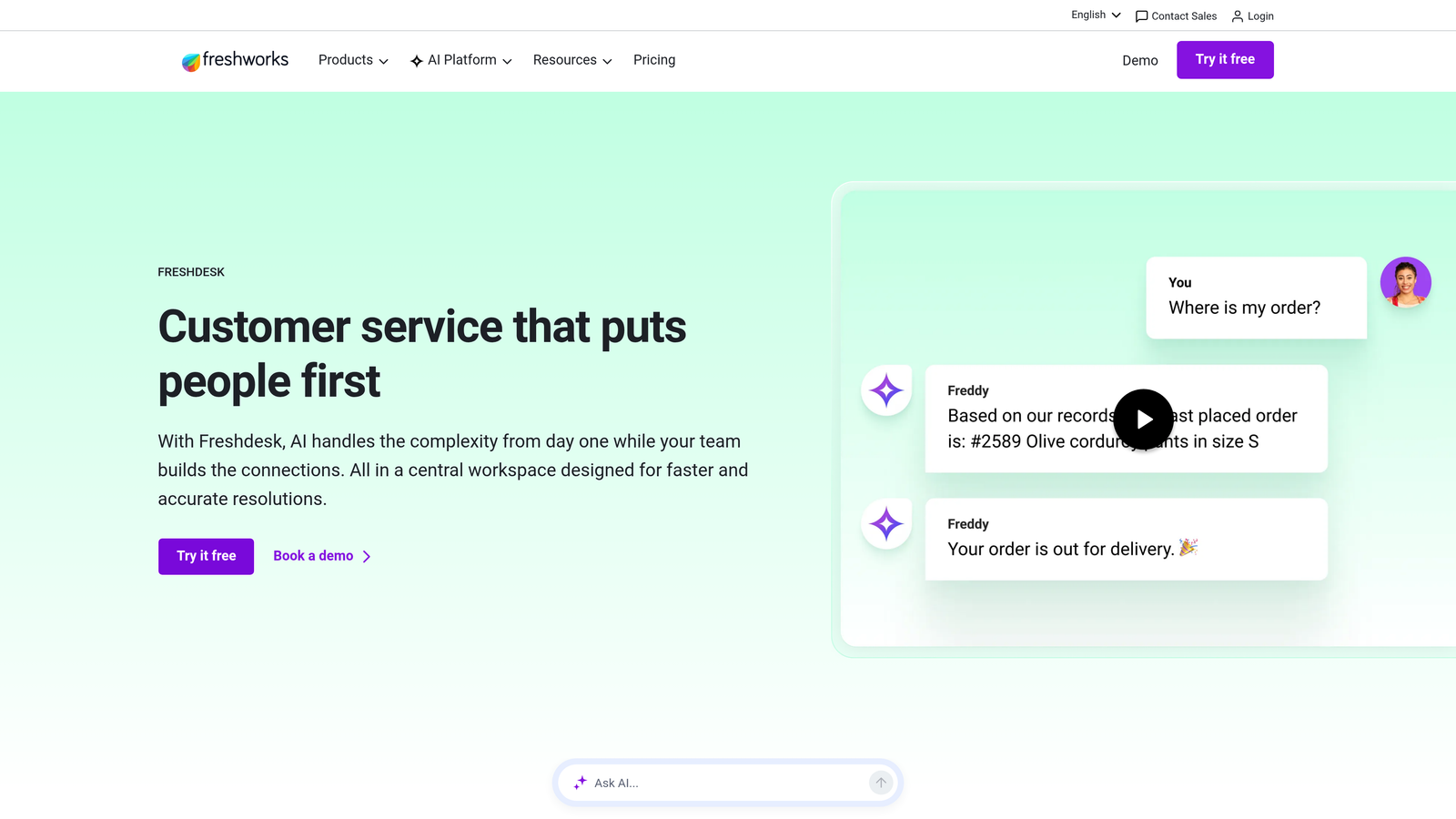
Freshdesk is a mature, widely-used helpdesk platform from Freshworks with structured ticketing, SLA management, and Freddy AI as an optional layer for self-service, agent assist, and analytics.
Where This Tool Shines
Freshdesk's strength is its reliability and ecosystem maturity. It has been refined over more than a decade, which means the workflow automation, SLA management, and escalation rules are genuinely robust. For teams that need structured queue management with predictable behavior, Freshdesk delivers consistently.
Freddy AI adds meaningful functionality, including suggested replies, auto-triage, and a self-service bot, but it's worth understanding the architectural reality: Freddy is a layer applied on top of a traditional helpdesk, not a foundational AI engine. It doesn't continuously learn from every ticket interaction by default. If your primary goal is AI-driven autonomous resolution, Freshdesk will require more configuration and add-on investment to get there.
Key Features
Freddy AI: Covers self-service bots (Freddy Self Service), agent copilot (Freddy Copilot), and predictive analytics (Freddy Insights) as modular components.
SLA Management: Configurable SLA policies with escalation workflows and breach notifications keep response times accountable.
Marketplace Integrations: Over 1,000 integrations available, covering CRMs, communication tools, and e-commerce platforms.
Omnichannel Support: Handles email, phone, chat, and social channels from a unified inbox.
Collision Detection: Prevents multiple agents from working the same ticket simultaneously, reducing duplicated effort.
Best For
Freshdesk suits mid-market teams with established support processes who want reliable automation without rebuilding their stack. It's also a reasonable starting point for teams not yet ready to commit to a fully AI-native platform but who want some AI assistance layered in.
Pricing
Free plan available for up to 10 agents. Paid plans run approximately $15/agent/month (Growth), $49/agent/month (Pro), and $79/agent/month (Enterprise). Freddy AI Copilot is a paid add-on on top of these tiers.
3. Intercom
Best for: SaaS companies wanting AI-powered autonomous resolution combined with in-app messaging and customer lifecycle context.
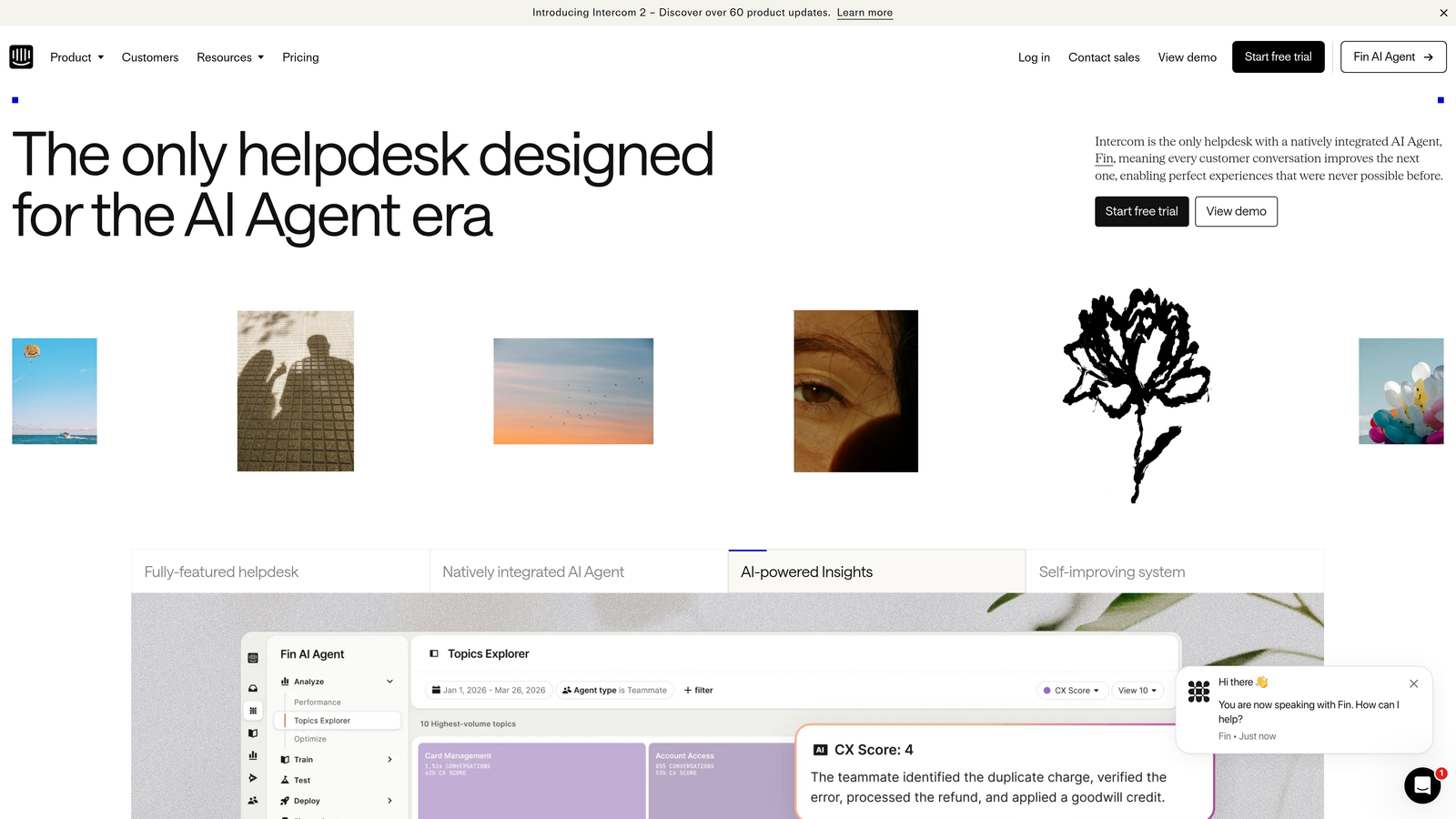
Intercom is a customer communications platform featuring Fin AI Agent, an LLM-powered bot that autonomously resolves support queries, alongside in-app messaging, product tours, and an AI Copilot for human agents.
Where This Tool Shines
Fin AI Agent is genuinely impressive for autonomous resolution. Built on large language models, it handles a meaningful portion of support queries without human involvement, and Intercom's pricing model reflects this: you pay per resolution rather than per seat, which aligns cost directly with value delivered.
Where Intercom stands apart from pure support tools is its customer lifecycle context. If you're already using Intercom for in-app messaging, onboarding flows, and product tours, the support layer benefits from rich behavioral and historical data. That context makes AI responses more relevant and human escalations more informed. The tradeoff is cost: Intercom is positioned as a premium product, and the per-resolution pricing can become significant at scale.
Key Features
Fin AI Agent: Autonomously resolves support queries using LLM reasoning, with pricing tied to successful resolutions rather than agent seats.
In-App Messaging and Product Tours: Proactive support capabilities that reduce inbound volume by addressing common friction points before users submit tickets.
AI Copilot for Agents: Provides suggested replies, conversation summaries, and next-step recommendations for human agents handling escalations.
Customer Data Platform: Stores conversation history, product usage, and lifecycle stage, giving every interaction rich context.
SaaS and Mobile Integrations: Strong native connections with common SaaS tools and mobile app environments.
Best For
SaaS companies already invested in the Intercom ecosystem will find the support layer a natural extension. It's also a strong choice for teams where proactive messaging and support are closely linked, and where autonomous resolution volume justifies the per-resolution pricing model.
Pricing
Platform fee plus per-resolution pricing for Fin AI Agent. Overall cost scales with usage and is generally positioned at the premium end of the market. Contact Intercom for current rates based on your volume.
4. Zendesk
Best for: Enterprise support operations requiring deep customization, compliance, and a mature AI layer.
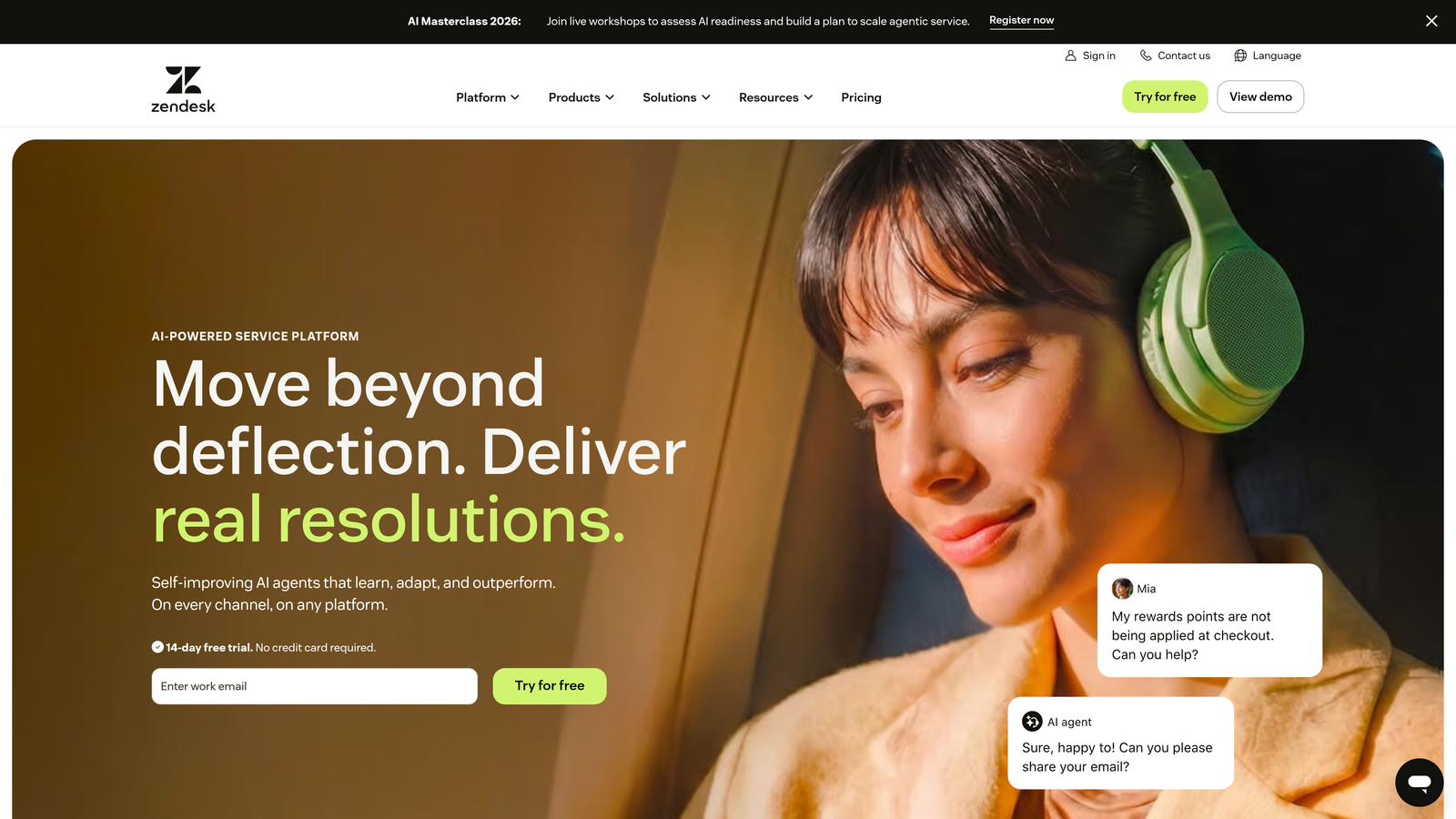
Zendesk is the enterprise-grade helpdesk standard, offering deep customization, compliance features, and a robust AI layer for intelligent triage, AI agents, and agent assist, powered in part by its acquisition of Ultimate.ai.
Where This Tool Shines
Zendesk's depth is unmatched for large support operations. The customization options, compliance certifications, and reporting capabilities are built for organizations with dedicated support ops teams who need to configure, measure, and optimize at scale. If your organization has complex routing logic, multiple support tiers, and strict security requirements, Zendesk handles all of it.
The AI layer has matured considerably. Intelligent triage, AI agents for automated resolution, and Agent Copilot for real-time assistance are all capable tools. That said, Zendesk's AI capabilities still carry the heritage of a traditional helpdesk evolving toward AI rather than a platform built AI-first. For teams where AI-native architecture is a priority, that distinction matters.
Key Features
Intelligent Triage and Routing: Zendesk AI automatically categorizes, prioritizes, and routes incoming tickets based on content and context.
AI Agents: Automated resolution across channels for common queries, with escalation paths to human agents.
Agent Copilot: Real-time assistance for human agents including suggested actions, knowledge base surfacing, and conversation summaries.
Advanced Analytics: Custom reporting and dashboards built for support operations teams managing large volumes and multiple teams.
Enterprise Security and Compliance: Robust SLA management, data residency options, and compliance certifications for regulated industries.
Best For
Large enterprises and scaling organizations with dedicated support operations teams. Zendesk is overkill for smaller teams but genuinely earns its position at the enterprise tier where complexity and compliance requirements are real constraints.
Pricing
Suite plans run approximately $55/agent/month (Team) to $115+/agent/month (Enterprise). AI add-ons are priced separately, and total cost can become significant at scale. Verify current pricing directly with Zendesk.
5. Tidio
Best for: SMBs and e-commerce stores wanting fast AI chatbot deployment at an accessible price point.
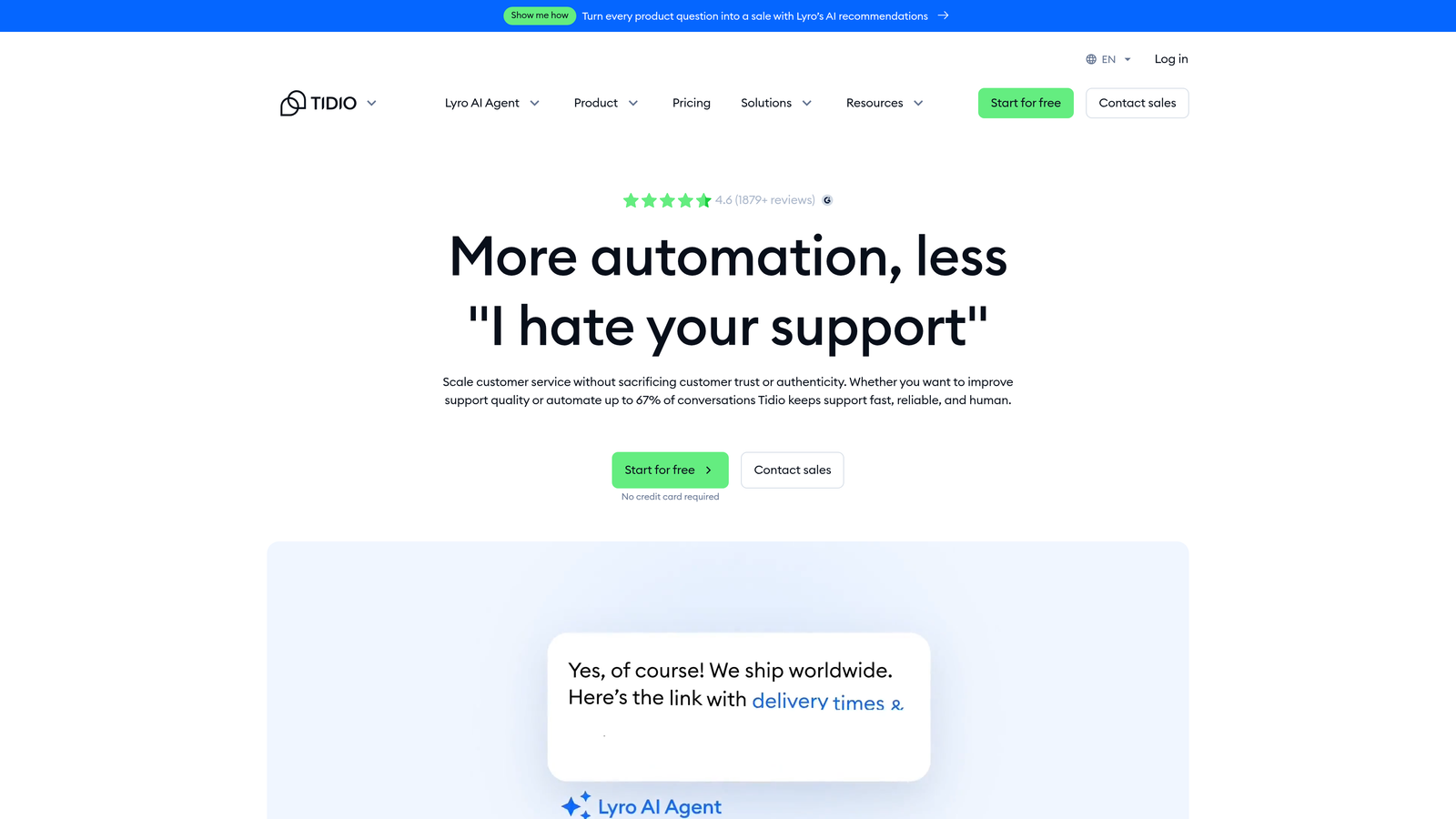
Tidio is an accessible AI chat platform built for small and medium businesses, featuring the Lyro AI chatbot that handles common customer queries automatically with fast deployment and e-commerce integrations.
Where This Tool Shines
Tidio's biggest advantage is speed to value. Lyro AI can be deployed quickly without technical complexity, making it genuinely accessible for small teams without dedicated support engineers. For businesses handling high volumes of repetitive queries, like FAQs, shipping questions, and basic troubleshooting, Lyro deflects a meaningful portion of tickets without much configuration.
The e-commerce integrations with Shopify and WooCommerce are a practical strength for retail-adjacent businesses. That said, Tidio is not designed for complex B2B SaaS support flows. If your tickets require nuanced product knowledge, multi-step troubleshooting, or deep CRM context, you'll hit the platform's limits relatively quickly.
Key Features
Lyro AI Chatbot: Handles FAQ and common support queries automatically, with conversational responses drawn from your knowledge base.
Live Chat with Agent Handoff: Smooth transition from AI to human agent when queries exceed the bot's scope.
E-Commerce Integrations: Native connections with Shopify and WooCommerce for order-related query handling.
Visual Chatbot Builder: No-code flow builder for teams that want to customize conversation paths without developer involvement.
Email and Messenger Support: Extends beyond live chat to cover additional channels within the same interface.
Best For
Small businesses and e-commerce brands that need affordable AI chat with quick deployment. Not the right fit for B2B SaaS teams with complex support requirements or enterprise-scale operations.
Pricing
Free plan available. Lyro AI starts from approximately $29/month, with paid plans scaling based on conversation volume. One of the more budget-friendly options in this comparison.
6. Help Scout
Best for: Teams prioritizing human-first support quality with light AI assistance and a clean, simple interface.
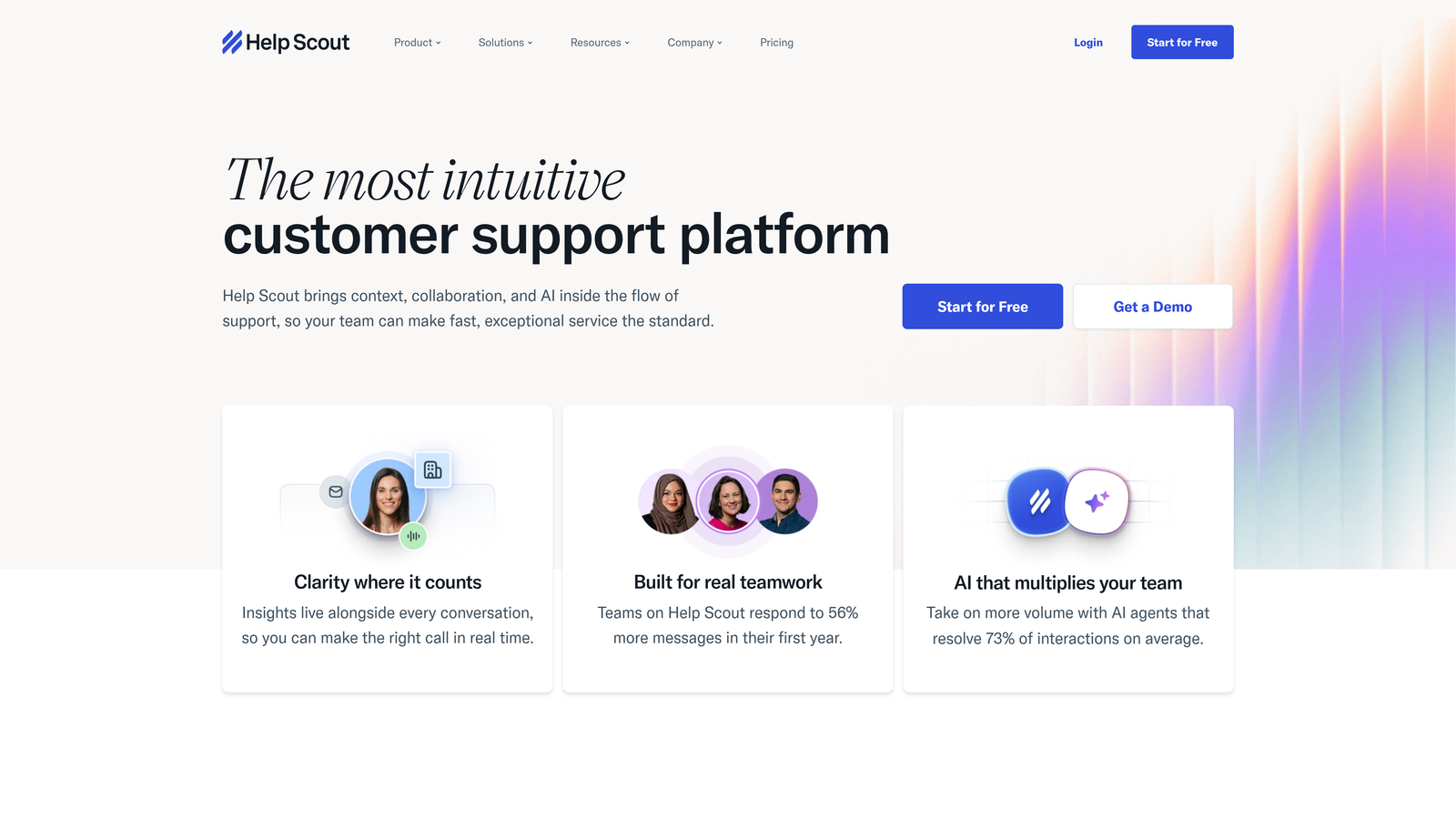
Help Scout is a human-first shared inbox and help center platform with AI assistance features designed to make agents more effective without replacing the human touch.
Where This Tool Shines
Help Scout occupies a distinct philosophical position in this comparison: it believes human relationships are the core of great support, and its AI features reflect that. Rather than autonomous resolution, the AI helps agents work faster and more accurately. AI Summarize condenses long threads, AI Assist helps draft better replies, and AI Answers handles self-service deflection. The result is a tool that amplifies human judgment rather than bypassing it.
The interface is genuinely clean and fast to onboard. Teams that have struggled with Zendesk's complexity or Freshdesk's configuration overhead often find Help Scout refreshingly straightforward. The tradeoff is that if you need deep automation, complex routing, or autonomous AI resolution, Help Scout will feel limited.
Key Features
Shared Inbox: Collaborative inbox with collision detection, private notes, and assignment workflows for team-based support.
AI Summarize: Condenses long conversation threads so agents can get up to speed instantly without reading every message.
AI Assist: Drafts and improves agent replies, reducing the time spent composing responses from scratch.
AI Answers: Self-service deflection that surfaces relevant help center content before a ticket is submitted.
Minimal, Fast UI: Designed for quick onboarding and low cognitive overhead, which matters for teams where support is one of many responsibilities.
Best For
Small to mid-sized teams where support quality and customer relationship integrity matter more than automation depth. Also a good fit for teams transitioning away from email-based support who want structure without complexity.
Pricing
Plans run approximately $20/user/month (Standard) to $65/user/month (Pro). Transparent, per-user pricing with no hidden add-ons for core AI features.
7. Kustomer
Best for: High-volume support teams that need unified customer history, CRM context, and AI-powered routing.
Kustomer is a CRM-native helpdesk that unifies the full customer timeline, including purchases, interactions, and behavior, with AI-powered routing, auto-responses, and sentiment analysis for high-volume support environments.
Where This Tool Shines
Kustomer's defining feature is its unified customer timeline. Rather than showing agents a ticket in isolation, Kustomer surfaces the full context: purchase history, previous interactions, behavioral signals, and sentiment trends. For support teams handling customers with complex histories, this context dramatically improves resolution quality and speed.
The AI capabilities, including intelligent routing, auto-responses, and sentiment analysis, are built on top of this rich data foundation, which makes them more contextually accurate than AI layers operating on conversation data alone. Kustomer is particularly well-suited to high-volume environments where routing accuracy and proactive escalation prevent issues from compounding.
Key Features
Unified Customer Timeline: Combines CRM and support data into a single view so agents see the full customer picture, not just the current ticket.
AI-Powered Routing and Auto-Responses: Intelligent triage that routes tickets based on content, customer history, and priority signals.
Sentiment Analysis: Detects frustration and escalation risk in real time, enabling proactive intervention before situations deteriorate.
Omnichannel Support: Handles conversations across email, chat, phone, and social with full context preserved across channels.
Custom Workflows: Flexible business process automation for teams with unique routing or escalation requirements.
Best For
High-volume B2C and B2B support teams where customer history context is a meaningful factor in resolution quality. Strong fit for organizations that have outgrown simpler helpdesks and need CRM-grade customer data integrated with support workflows.
Pricing
Enterprise pricing model with plans starting around $89/user/month. Contact Kustomer directly for current rates, as pricing may vary based on volume and feature requirements.
8. Gorgias
Best for: E-commerce brands on Shopify or WooCommerce needing AI autoresponders tied to live order data.
Gorgias is a support platform purpose-built for e-commerce brands, with deep Shopify and WooCommerce integrations and AI autoresponders that pull live order data to resolve order-related tickets automatically.
Where This Tool Shines
Gorgias dominates its niche for good reason. The integration depth with Shopify, WooCommerce, and Magento goes well beyond surface-level connections. AI autoresponders can pull live order data, shipping status, and return eligibility to resolve the most common e-commerce support queries, including "where's my order," returns, and refunds, without any agent involvement.
The ticket volume-based pricing model is also worth noting. For e-commerce brands with fluctuating seasonal volumes, paying per ticket rather than per agent seat can be significantly more cost-effective. The revenue statistics tied to support interactions give merchants a clear view of how support performance connects to sales outcomes.
Key Features
Native E-Commerce Integrations: Deep connections with Shopify, WooCommerce, and Magento that surface live order data directly in the support interface.
AI Autoresponders: Trained on order and product data to resolve common e-commerce queries autonomously without agent involvement.
Volume-Based Pricing: Tickets are priced by volume rather than agent seats, which suits brands with seasonal demand spikes.
Macros and Rules: Pre-built automation for repetitive query types, reducing manual handling for common scenarios.
Revenue Statistics: Links support interactions to revenue outcomes, helping teams understand the business impact of support quality.
Best For
E-commerce brands running on Shopify or WooCommerce where order-related queries make up the majority of support volume. Not a fit for B2B SaaS teams or organizations with complex, non-transactional support needs.
Pricing
Starts at approximately $10/month for 50 tickets, scaling with ticket volume rather than agent count. One of the most cost-effective options for e-commerce teams with predictable query patterns.
Which Tool Is Right for Your Team?
The right choice here depends less on feature checklists and more on a fundamental question: are you looking for a helpdesk that has added AI, or an AI platform that handles support?
If you're a B2B SaaS team that wants autonomous resolution, continuous learning, and support intelligence that feeds your entire business stack, Halo AI is the most architecturally coherent choice. Its page-aware context, cross-stack integrations, and business intelligence layer go well beyond what any traditional helpdesk offers, even with AI add-ons.
For other use cases, here's a quick decision guide:
Enterprise helpdesk with compliance requirements: Zendesk's depth, customization, and security posture make it the standard for large support operations that need fine-grained control.
Conversational SaaS support: Intercom's Fin AI Agent and customer lifecycle context make it the natural fit for SaaS companies already using Intercom for product communications.
Human-first simplicity: Help Scout is the cleanest option for teams where relationship quality matters more than automation depth, and where onboarding speed is a priority.
E-commerce brands: Gorgias is the clear winner for Shopify and WooCommerce merchants where order-related queries dominate and volume-based pricing makes financial sense.
SMB budget constraints: Tidio delivers accessible AI chat at a price point that works for small teams who need quick deployment without technical overhead.
Established mid-market workflows: Freshdesk remains a solid choice for teams with mature processes who want proven automation and a large integration ecosystem, with Freddy AI available as an enhancement layer.
Your support team shouldn't scale linearly with your customer base. Let AI agents handle routine tickets, guide users through your product, and surface business intelligence while your team focuses on complex issues that need a human touch. See Halo in action and discover how continuous learning transforms every interaction into smarter, faster support.