Front vs AI Support Platforms: 9 Best Tools for Modern Customer Support in 2026
Comparing Front vs AI support platforms, this guide evaluates nine tools—including Front and eight AI-native alternatives—across autonomous resolution capability, integration depth, and ticket volume reduction. Whether you're a scaling SaaS startup or an enterprise team overwhelmed by repetitive requests, this breakdown helps you determine if a shared inbox still meets your needs or if an AI-first platform will deliver meaningfully better support outcomes.
 Grant CooperFounder15 min read
Front has long been a go-to shared inbox solution for customer-facing teams, but the rise of AI-native support platforms has fundamentally changed what's possible. Teams that once relied on Front for email triage and collaboration are now asking a harder question: is a shared inbox enough, or do we need a platform built around AI from the ground up?
This comparison covers Front alongside eight AI-powered alternatives, evaluating each on autonomous resolution capability, integration depth, scalability, and how well they actually reduce ticket volume rather than just organize it. Whether you're a SaaS startup scaling past your first support hire or an enterprise team drowning in repetitive tickets, this list will help you find the right fit.
Tools are selected based on AI capability maturity, integration ecosystem, pricing transparency, and suitability for B2B SaaS teams specifically.
1. Halo AI
Best for: SaaS teams that want autonomous ticket resolution and business intelligence from support interactions.
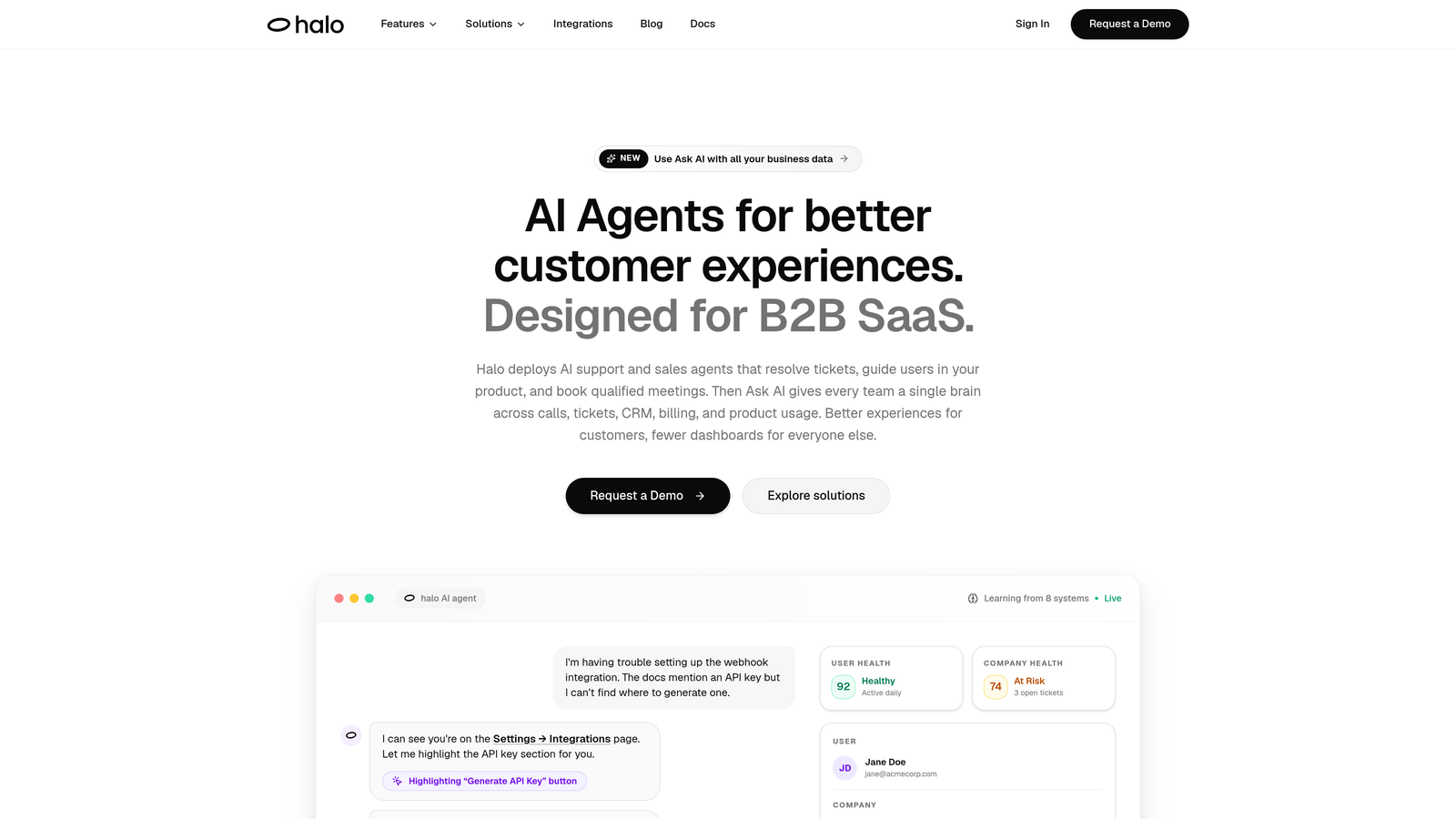
Halo AI is an AI-native customer support platform that resolves tickets autonomously, guides users through your product with page-aware context, and surfaces business intelligence from every support interaction.
Where This Tool Shines
Most AI support tools are bolt-ons: a chatbot layer sitting on top of a traditional helpdesk. Halo was built AI-first, which means the architecture is designed around autonomous resolution rather than assisted human workflows. The system handles common tickets end-to-end without any agent involvement, escalating to humans only when complexity genuinely warrants it.
What sets Halo apart is the page-aware chat widget. The AI sees exactly what the user sees inside your product, which allows it to give contextual, step-by-step guidance rather than generic answers. Combine that with a smart inbox that surfaces customer health signals, churn indicators, and revenue anomalies, and you have a platform that turns your support queue into a source of business intelligence rather than a cost center to manage.
Key Features
Autonomous AI Agents: Resolve tickets end-to-end without human involvement for common and repetitive issues, learning from every interaction to improve over time.
Page-Aware Chat Widget: The AI understands the exact page and UI state the user is on, enabling precise in-product guidance that generic chatbots simply can't match.
Smart Inbox with Business Intelligence: Surfaces customer health signals, revenue anomalies, and churn indicators directly from support conversations, giving product and success teams visibility they wouldn't otherwise have.
Auto Bug Ticket Creation: Automatically converts support conversations into structured, well-formatted engineering tickets, eliminating the manual handoff between support and dev teams.
Live Agent Handoff: Seamlessly escalates to a human agent when AI confidence drops below a threshold, with full conversation context preserved so agents aren't starting from scratch.
Deep Integration Stack: Connects with Linear, Slack, HubSpot, Intercom, Stripe, Zoom, PandaDoc, and Fathom, making it a central hub rather than an isolated support tool.
Best For
Product-led SaaS companies that want support to generate business intelligence, not just close tickets. Particularly well-suited for teams scaling past their first few support hires who need AI to absorb volume without adding headcount. Also a strong fit for product teams who want bug reports created automatically from real user conversations.
Pricing
Visit haloagents.ai for current pricing and free trial options. The platform offers flexible plans designed for growing SaaS teams.
2. Front
Best for: Customer-facing teams that prioritize collaborative human workflows across multiple communication channels.
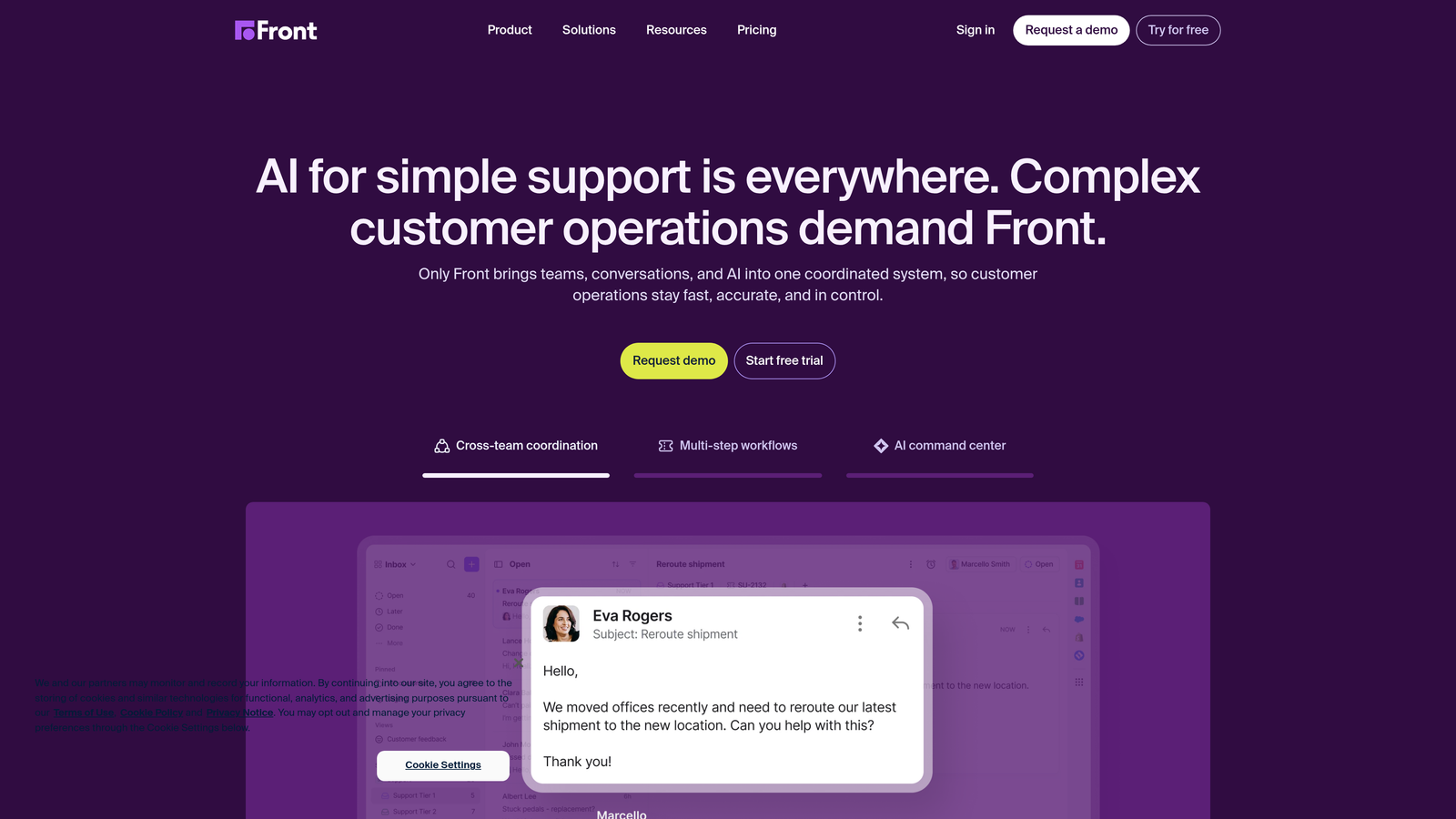
Front is a shared inbox platform combining email, chat, SMS, and social into a collaborative team workspace with AI-assisted features layered on top.
Where This Tool Shines
Front excels when your support work genuinely requires human judgment on most tickets and your team needs strong collaboration tooling to coordinate. Features like collision detection, internal comments, and assignment workflows make it easy for teams to work through complex customer relationships together without stepping on each other.
The AI features in Front are assistive rather than autonomous. AI Summarize, AI Compose, and AI Answers help agents work faster, but a human is still in the loop for resolution. For teams where that's intentional, such as customer success teams managing high-value accounts, this philosophy is a feature, not a limitation.
Key Features
Multi-Channel Shared Inbox: Consolidates email, SMS, social media, and live chat into a single collaborative workspace with clear ownership and assignment.
Team Collaboration Tools: Assignments, internal comments, and collision detection prevent duplicated effort and keep team communication organized around customer threads.
AI Summarize, Compose, and Answers: AI-assisted features that help agents draft responses faster and surface knowledge base answers, though resolution still requires human action.
SLA Tracking and Analytics: Built-in performance tracking and reporting to monitor response times, resolution rates, and team workload distribution.
Broad Integration Ecosystem: Connects with Salesforce, HubSpot, Jira, Slack, and a wide range of other tools that customer-facing teams typically rely on.
Best For
Customer success teams, sales-support hybrids, and teams managing high-touch relationships where human judgment drives most interactions. Less suited for teams looking to deflect or autonomously resolve a significant portion of their ticket volume through AI.
Pricing
Starter at approximately $19/seat/month; Growth at approximately $59/seat/month; Scale at approximately $99/seat/month. Verify current pricing at front.com as plans change regularly.
3. Intercom
Best for: SaaS companies wanting chat-first AI support combined with in-product messaging and onboarding capabilities.
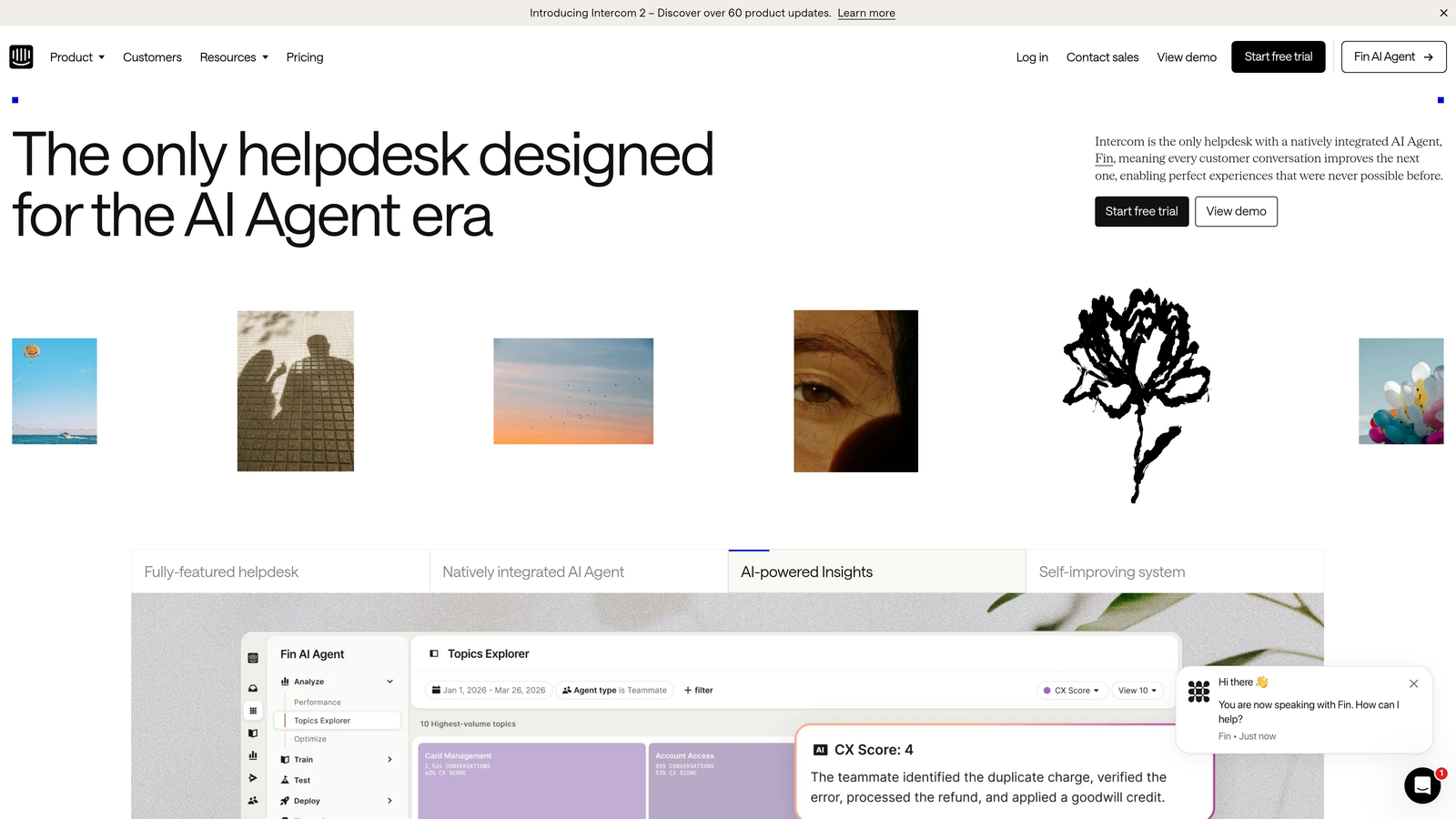
Intercom is a conversational customer service platform featuring the Fin AI Agent for autonomous resolution, alongside in-product messaging and onboarding tools built for product-led growth companies.
Where This Tool Shines
Intercom's Fin AI Agent is one of the more mature AI resolution engines on the market, built on large language models and designed to handle a meaningful share of common support queries without human involvement. Intercom publishes resolution rate data on their website, so it's worth checking current figures directly rather than relying on third-party claims.
Beyond support, Intercom offers in-product tours, proactive messaging, and onboarding nudges that make it a broader customer engagement platform rather than a pure support tool. For SaaS teams that want to unify support and product adoption in one system, that's a compelling combination.
Key Features
Fin AI Agent: Large language model-powered agent capable of autonomous resolution for common queries, with human handoff for complex cases.
In-Product Messaging and Tours: Proactive onboarding nudges, product tours, and targeted messages that reduce support volume by helping users succeed before they need to ask.
Omnichannel Coverage: Handles chat, email, SMS, and WhatsApp alongside a help center and outbound messaging from a single platform.
Strong Integration Ecosystem: Connects with Salesforce, HubSpot, Stripe, GitHub, Jira, and Slack, covering the core stack of most SaaS companies.
Best For
SaaS companies with a product-led growth motion that want to unify support, onboarding, and proactive engagement. Teams already using Intercom for in-app messaging will find the AI support layer a natural extension.
Pricing
Usage and seat-based pricing that can scale significantly at higher volumes. Verify current plans at intercom.com before budgeting, as pricing structure has evolved over time.
4. Zendesk
Best for: Enterprise and mid-market teams with complex multi-channel support operations needing a mature, extensible platform.
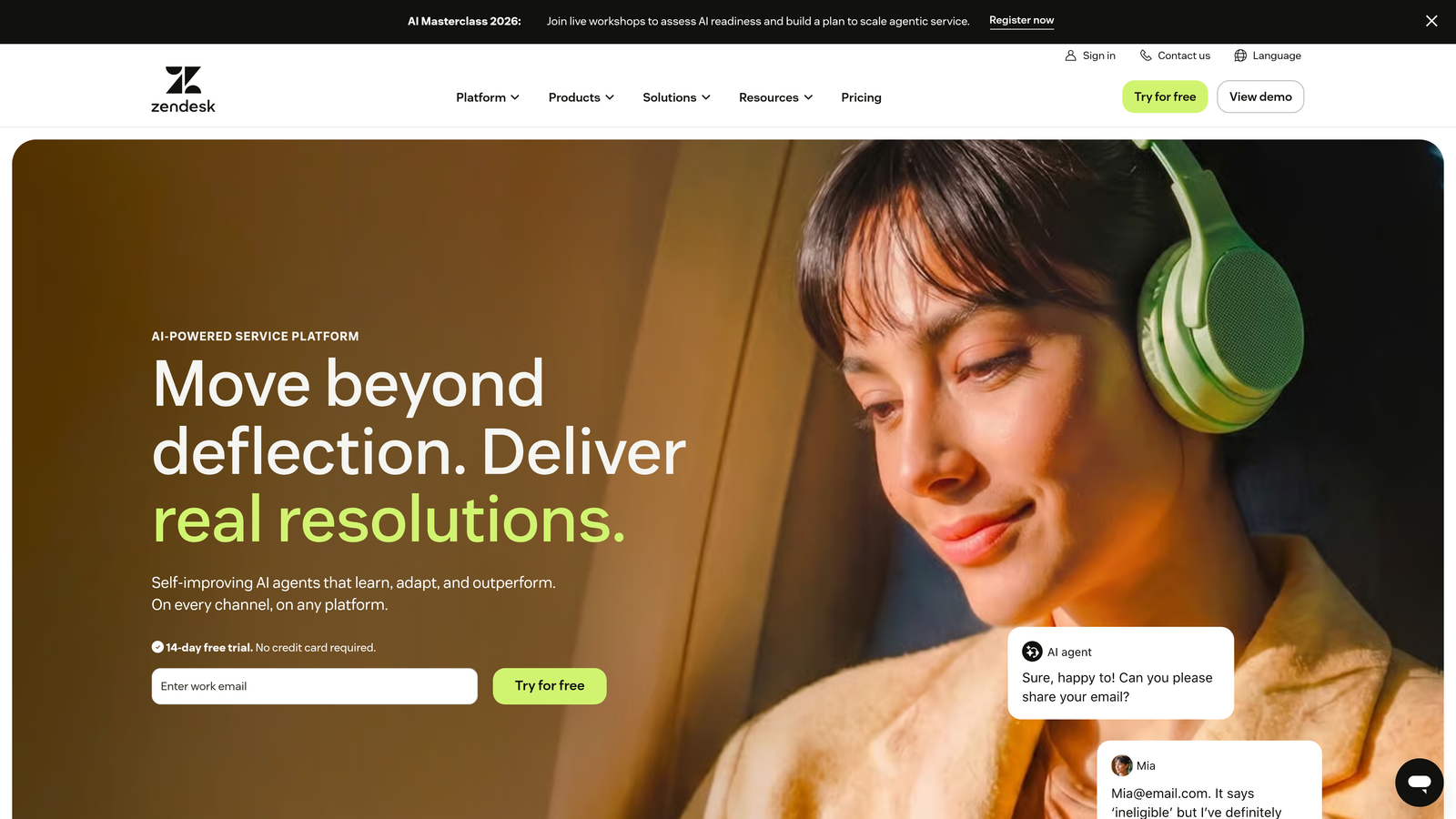
Zendesk is an enterprise-grade helpdesk platform with a mature AI Suite add-on for intelligent triage, automated responses, and agent assistance at scale.
Where This Tool Shines
Zendesk's core strength is depth. The platform has been built out over many years, which means its reporting, workforce management tools, and multi-brand support capabilities are genuinely mature compared to newer entrants. For enterprise teams with complex routing rules, multiple support tiers, and compliance requirements, that maturity matters.
The AI Suite adds intelligent triage, automated macros, knowledge base suggestions, and Zendesk AI Agents for ticket deflection on top of the core platform. It's an add-on cost rather than native, which is worth factoring into total cost of ownership, but the underlying helpdesk infrastructure it builds on is robust.
Key Features
AI Suite: Intelligent triage, automated macros, AI-powered knowledge suggestions, and Zendesk AI Agents for autonomous ticket deflection, available as an add-on to core plans.
1,000+ Marketplace Integrations: One of the largest integration ecosystems in the category, covering virtually any tool an enterprise support team might use.
Advanced Reporting and Workforce Management: Detailed analytics, custom dashboards, and workforce management tools suited for large teams managing complex operations.
Multi-Brand and Multi-Language Support: Native support for organizations managing multiple product lines, brands, or regional customer bases from a single instance.
Best For
Enterprise and mid-market teams with established support operations, complex multi-channel needs, and the budget to invest in a mature platform with an extensive integration ecosystem. Teams evaluating Zendesk specifically may also find the Halo AI comparison useful for understanding the AI-first alternative.
Pricing
Suite Team starts at approximately $55/agent/month; the AI Suite is an additional cost on top of base plans. Verify current pricing at zendesk.com as tiers are updated regularly.
5. Freshdesk
Best for: SMBs and growing teams that want AI-assisted support features without enterprise-level pricing commitments.
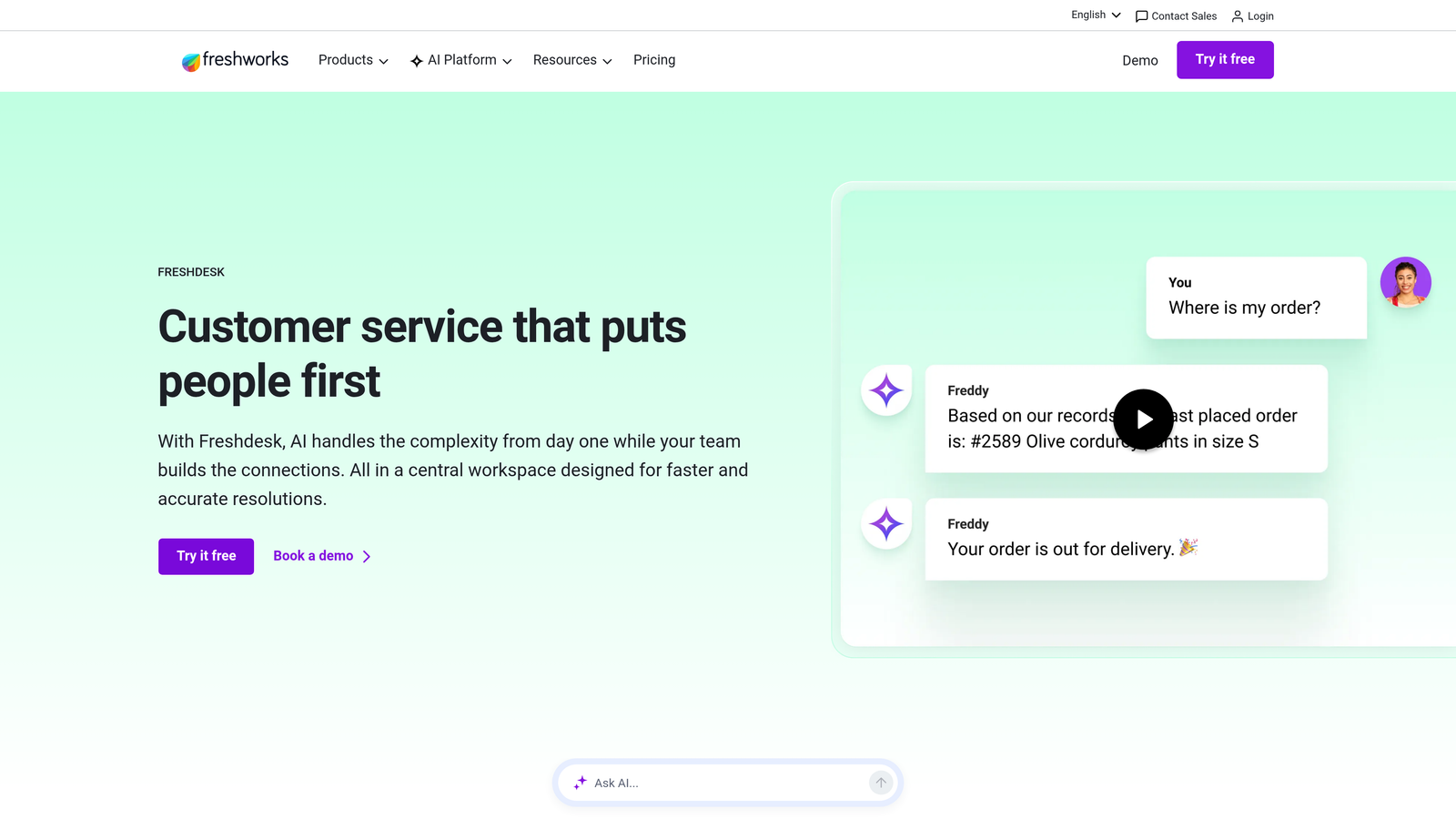
Freshdesk is an accessible helpdesk platform with Freddy AI built in, offering agent assistance and self-service automation across affordable pricing tiers including a free option.
Where This Tool Shines
Freshdesk's primary advantage is accessibility. The free tier makes it a realistic starting point for small teams, and the Freddy AI features offer a genuine path toward automation without requiring an enterprise contract. For teams that have outgrown a shared inbox but aren't ready for Zendesk-level complexity or cost, Freshdesk occupies a useful middle ground.
Freddy AI Copilot helps agents work faster with suggested replies and ticket summarization, while Freddy AI Agent handles end-user self-service conversations autonomously. Both are available as add-ons, so teams can start with the base helpdesk and layer in AI capabilities as their needs grow.
Key Features
Freddy AI Copilot: Provides agents with suggested replies, ticket summarization, and contextual guidance to speed up resolution without fully automating it.
Freddy AI Agent: Autonomous bot for end-user self-service, capable of resolving common queries without agent involvement when configured properly.
Free Tier: A functional free plan for small teams that includes core helpdesk features, making it one of the few platforms with a genuine no-cost starting point.
Omnichannel Support: Handles email, chat, phone, and social media from a unified inbox with routing and assignment tools built in.
Broad Integrations: Connects with Slack, Jira, HubSpot, Salesforce, and Shopify, covering the essentials for most growing teams.
Best For
SMBs, early-stage startups, and growing teams that want a capable helpdesk with a path to AI automation, without committing to enterprise pricing from day one.
Pricing
Free tier available for small teams; paid plans scale upward with Freddy AI Copilot and Freddy AI Agent available as add-ons. Verify current pricing and add-on costs at freshdesk.com.
6. Tidio
Best for: Small teams and e-commerce businesses wanting quick AI chatbot deployment with minimal setup complexity.
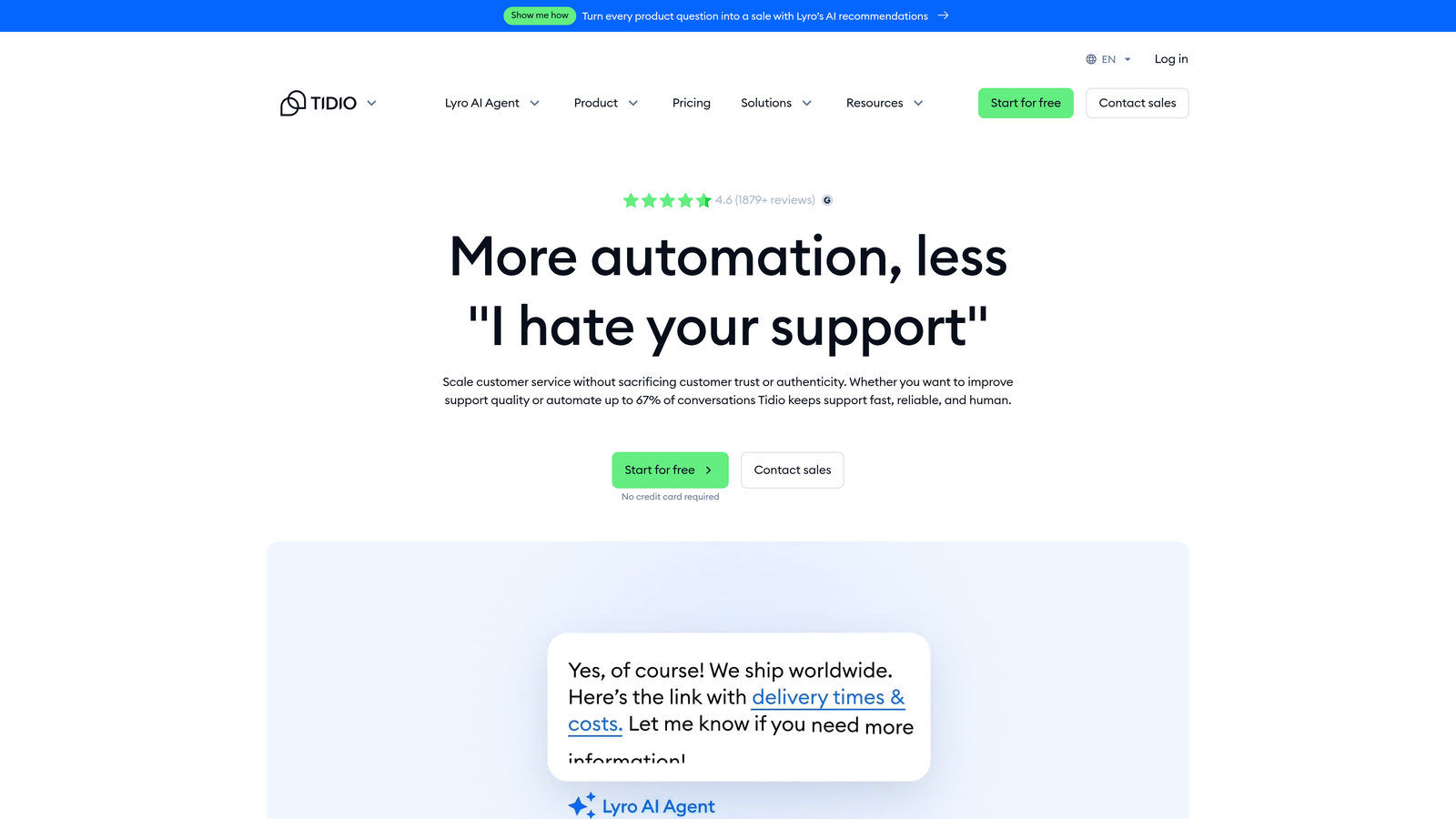
Tidio is a live chat and AI chatbot platform designed for SMBs and e-commerce teams, featuring the Lyro AI agent for automated customer conversations alongside a no-code bot builder.
Where This Tool Shines
Tidio's strength is speed of deployment. The no-code bot builder and pre-built templates mean a small team can have a functional AI chatbot live in hours rather than weeks. For e-commerce businesses dealing with high volumes of order status, return, and shipping queries, Lyro AI can handle a meaningful share of that volume without any engineering involvement.
The platform keeps things intentionally simple, which is both its appeal and its ceiling. Teams with complex support workflows or deep B2B SaaS needs will likely outgrow it, but for its target audience of small retailers and early-stage SaaS companies, the simplicity is a genuine feature.
Key Features
Lyro AI: Conversational AI chatbot trained on your support content, capable of handling common customer questions autonomously across live chat.
No-Code Chatbot Builder: Visual drag-and-drop builder for creating automated conversation flows without any technical knowledge required.
Unified Live Chat and AI Interface: Agents and the AI work from the same interface, making handoffs between automated and human responses seamless.
E-Commerce Integrations: Native integrations with Shopify, WooCommerce, and BigCommerce make it particularly well-suited for online retail teams.
Best For
Small e-commerce teams and early-stage SaaS companies that need a fast, affordable AI chatbot without complex configuration. Less suited for B2B teams with intricate support workflows or enterprise-scale volume.
Pricing
Free tier available with paid plans starting at accessible price points for higher conversation volumes. Verify current pricing at tidio.com before committing.
7. Drift (Salesloft)
Best for: B2B companies where support and sales conversations overlap and revenue intelligence from chat is a priority.
Drift, now part of Salesloft, is a conversational AI platform that blends sales qualification and customer support, using AI-powered chat to engage prospects and resolve customer questions within the same system.
Where This Tool Shines
Drift occupies a unique position in this list because it was never purely a support tool. Its AI-powered chatbots handle both inbound sales qualification and support queries simultaneously, which makes it genuinely useful for B2B companies where the line between a prospect question and a customer question is blurry. The integration with Salesloft deepens the revenue intelligence angle considerably.
For account-based marketing teams, the real-time buyer intent signals and targeted routing features are particularly valuable. When a target account lands on your site, Drift can route them to the right human immediately rather than letting them queue through a generic support flow.
Key Features
AI-Powered Chatbots for Sales and Support: Handles both inbound prospect qualification and customer support queries from a single conversational interface.
Revenue Intelligence: Connects support and chat conversations to pipeline data, giving revenue teams visibility into how support interactions influence deals.
Account-Based Marketing Features: Targeted engagement tools for identifying and routing high-value accounts to the right team member in real time.
Real-Time Buyer Intent Signals: Surfaces intent data to help sales and support teams prioritize which conversations need immediate human attention.
Best For
B2B companies with significant overlap between sales and support, particularly those running account-based marketing programs where real-time engagement with target accounts is a priority. Less suited for teams looking for a pure support automation platform.
Pricing
Enterprise-focused pricing structure. Verify current plans and packaging at drift.com, as the Salesloft integration has influenced how Drift is sold and bundled.
8. Help Scout
Best for: Teams that want a clean, human-first support experience with selective AI assistance rather than full automation.
Help Scout is a simple, thoughtfully designed shared inbox and help center platform with AI tools that are explicitly built to assist agents rather than replace them.
Where This Tool Shines
Help Scout's design philosophy is refreshingly honest: it believes most support interactions benefit from a human touch, and AI should make that human faster rather than remove them from the equation. The result is a product that feels clean and focused, without the complexity bloat that comes with platforms trying to do everything at once.
AI Summarize and AI Drafts meaningfully reduce the time agents spend writing responses, while the AI Answers feature in the Beacon widget handles self-service queries using your knowledge base. The built-in Docs knowledge base included on all plans is a genuine differentiator for teams that don't want to pay separately for documentation tooling.
Key Features
AI Summarize and AI Drafts: Helps agents quickly understand long conversation threads and draft responses faster without requiring full automation.
AI Answers in Beacon: Knowledge base-powered self-service widget that resolves common questions before they become tickets, embedded directly in your product or website.
Clean, Distraction-Free Inbox UI: Intentionally simple interface designed to reduce cognitive load for support teams handling high daily message volumes.
Built-In Docs Knowledge Base: A full knowledge base tool included on all plans, eliminating the need for a separate documentation platform.
Reliable Integration Coverage: Connects with Slack, Jira, Salesforce, HubSpot, and Zapier for the workflows most support teams rely on daily.
Best For
Teams that value simplicity, clean UX, and a human-first support philosophy. Particularly well-suited for companies where brand voice and personalized responses matter more than maximizing autonomous resolution rates.
Pricing
Standard at approximately $22/user/month; Plus at approximately $44/user/month. Verify current pricing at helpscout.com as plans are updated periodically.
9. Kustomer
Best for: High-volume teams that need a complete customer history timeline as the foundation for AI-driven support automation.
Kustomer is a CRM-native customer service platform that builds a full customer timeline and uses AI automation layered on top of rich customer history and behavioral context.
Where This Tool Shines
Kustomer's core differentiator is context. While most support platforms show agents a conversation thread, Kustomer shows them a complete customer timeline: every interaction, purchase, behavior, and prior ticket in a single unified view. That context makes both human agents and AI automation significantly more effective because they're working with the full picture rather than a fragment of it.
KIQ AI Agents use that customer history to power autonomous resolution that's meaningfully more personalized than what a context-free chatbot can deliver. For high-volume D2C and SaaS teams where customer history is complex and relevant to every interaction, this approach can make a real difference in resolution quality.
Key Features
Full Customer Timeline: Every interaction, purchase, and behavioral data point unified in a single chronological view, giving agents and AI complete context for every conversation.
KIQ AI Agents: Autonomous resolution agents that use customer history and context to deliver personalized responses rather than generic knowledge base answers.
Omnichannel Threading: Email, chat, phone, SMS, and social conversations are unified into a single customer thread rather than siloed by channel.
Workflow Automation: Business rules and AI routing tools that automate triage, assignment, and escalation based on customer data and conversation content.
Flexible Integration Layer: Connects with Shopify, Salesforce, Slack, and custom APIs for teams with non-standard data requirements.
Best For
High-volume D2C brands and SaaS teams with complex customer data that want AI resolution grounded in full customer context. Enterprise-focused pricing makes it less accessible for smaller teams.
Pricing
Enterprise-focused pricing structure. Verify current plans at kustomer.com before evaluating for budget fit.
Which Tool Is the Right Fit for Your Team?
Teams comparing Front to AI-native platforms are really choosing between two distinct philosophies: human collaboration with AI assistance, or AI-first resolution with human escalation as the exception. Neither is wrong, but they serve fundamentally different needs.
If your support work is genuinely complex and relationship-driven, and most tickets require human judgment, Front and Help Scout remain solid choices. They're built around making human agents more efficient, and they do that well.
But if you're a SaaS team looking to actually reduce ticket volume rather than just organize it better, the AI-native platforms offer meaningfully more leverage. Here's a quick reference by use case:
For autonomous ticket resolution and business intelligence from support: Halo AI is purpose-built for this, with page-aware context and a smart inbox that surfaces signals beyond just support metrics.
For SaaS teams wanting chat-first AI with in-product onboarding: Intercom's Fin AI Agent and in-product messaging make it a strong choice for product-led growth companies.
For enterprise teams with complex multi-channel operations: Zendesk's maturity and integration depth are hard to match at scale, though the AI Suite adds to the total cost.
For SMBs and growing teams on a budget: Freshdesk's accessible pricing and Freddy AI features offer a practical path to automation without enterprise commitment.
For B2B teams where sales and support overlap: Drift's revenue intelligence and account-based features serve a use case none of the others address as directly.
Your support team shouldn't scale linearly with your customer base. Let AI agents handle routine tickets, guide users through your product, and surface business intelligence while your team focuses on complex issues that need a human touch. See Halo in action and discover how continuous learning transforms every interaction into smarter, faster support that scales without scaling headcount.