9 Best AI Customer Service Platforms to Get Started With in 2026
Choosing the right AI customer service platform has never been more critical as businesses move away from traditional ticket-based support toward autonomous, AI-native solutions. This guide evaluates nine leading platforms across resolution capabilities, integration depth, deployment ease, analytics, and pricing to help you get an AI customer service platform that fits your team's current stage and existing tech stack.
 Grant CooperFounder13 min read
Customer support is undergoing a fundamental shift. Traditional helpdesks built around ticket queues and manual routing are giving way to AI-native platforms that can resolve issues autonomously, understand product context, and surface intelligence that goes far beyond deflection rates. If you're evaluating your options right now, you're not alone in feeling like the landscape is moving faster than any one team can track.
To put this list together, we evaluated platforms across five dimensions: AI resolution capabilities, integration depth with common business tools, ease of deployment, analytics and intelligence features, and pricing transparency. The result spans AI-native platforms built from the ground up with intelligence at the core, as well as AI layers that sit on top of existing helpdesk infrastructure. Whether you're starting fresh or enhancing what you already have, there's a fit here for your stage and stack.
If you're thinking through your broader AI support platform strategy, this list is a good starting point for understanding what's possible before you commit to a direction.
1. Halo AI
Best for: B2B teams that want AI-native support with product-aware context and business intelligence.
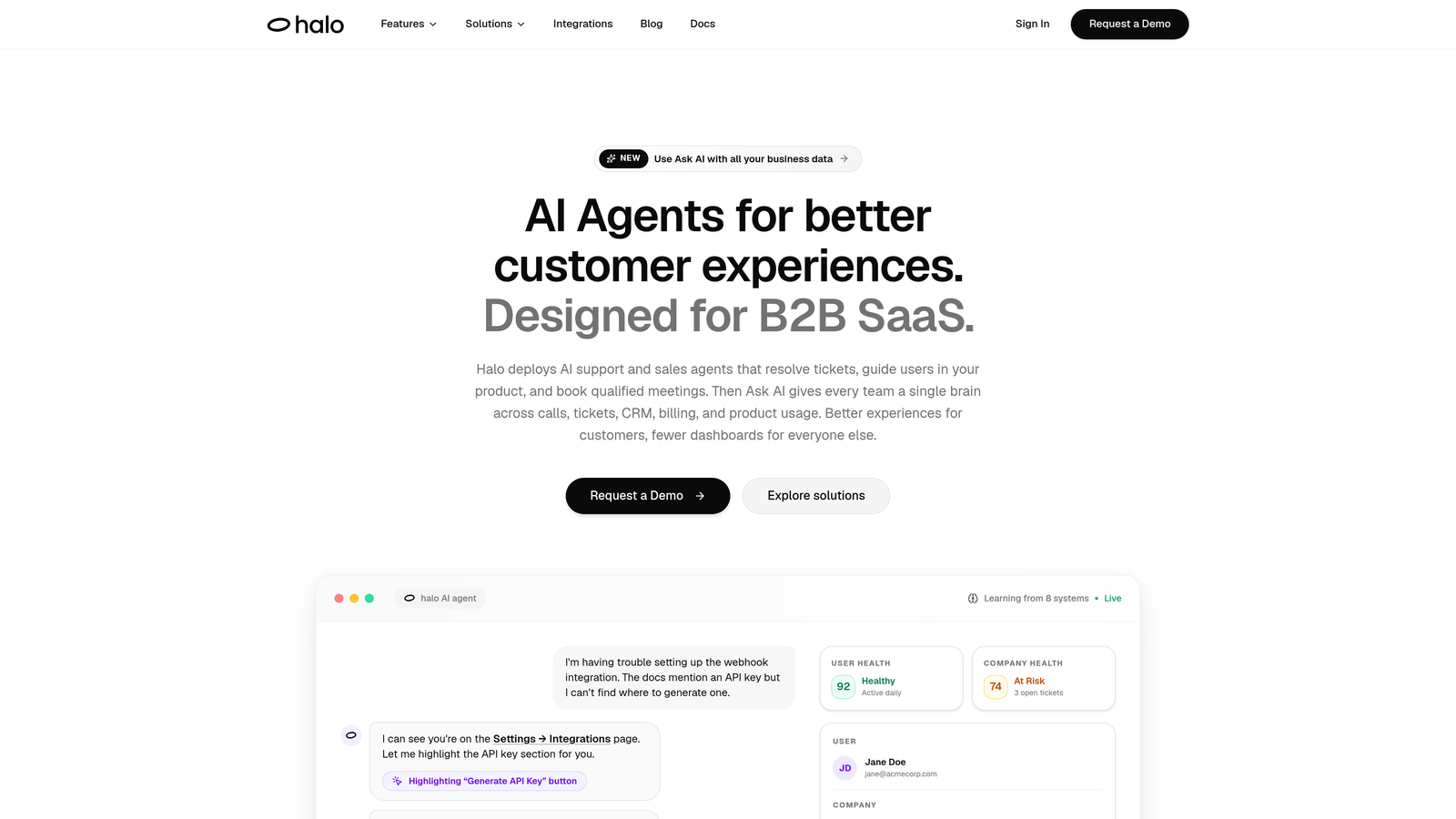
Halo AI is an AI-native customer support platform that deploys intelligent agents capable of resolving tickets, guiding users through your product, creating bug reports autonomously, and surfacing business intelligence like customer health signals and revenue insights.
Where This Tool Shines
What separates Halo from most platforms on this list is the architectural decision to build AI-first rather than bolt it on. The platform's page-aware context means its agents actually understand what a user is looking at in your product when they ask for help, enabling visual UI guidance that generic chatbots simply can't provide.
Beyond ticket resolution, Halo surfaces intelligence that matters to the broader business: customer health scoring, revenue signals, and anomaly detection that can flag churn risk or billing issues before they escalate. For B2B teams that want support to function as a business intelligence layer, not just a cost center, this is a meaningful differentiator.
Key Features
Page-Aware Chat Widget: Sees what the user sees in your product and provides contextual visual UI guidance, not generic answers.
Continuous Learning: Every resolved interaction makes the AI progressively smarter, improving resolution accuracy over time without manual retraining.
Autonomous Bug Ticket Creation: Automatically creates bug tickets in tools like Linear when issues are detected, removing manual steps from your engineering workflow.
Smart Inbox with Business Intelligence: Goes beyond support metrics to surface customer health scores, revenue signals, and anomaly detection directly in the inbox.
Deep Integration Ecosystem: Connects natively with Linear, Slack, HubSpot, Intercom, Stripe, Zoom, PandaDoc, and Fathom, covering the full B2B business stack.
Best For
B2B SaaS companies and product teams that are scaling their customer base without wanting to scale headcount proportionally. Particularly strong for teams whose users need in-product guidance, and for organizations that want support data to inform product and revenue decisions, not just close tickets.
Pricing
Contact for pricing. Designed for B2B teams looking to scale support operations intelligently without linear headcount growth.
2. Intercom Fin
Best for: Teams already on Intercom who want AI resolution without changing their support infrastructure.
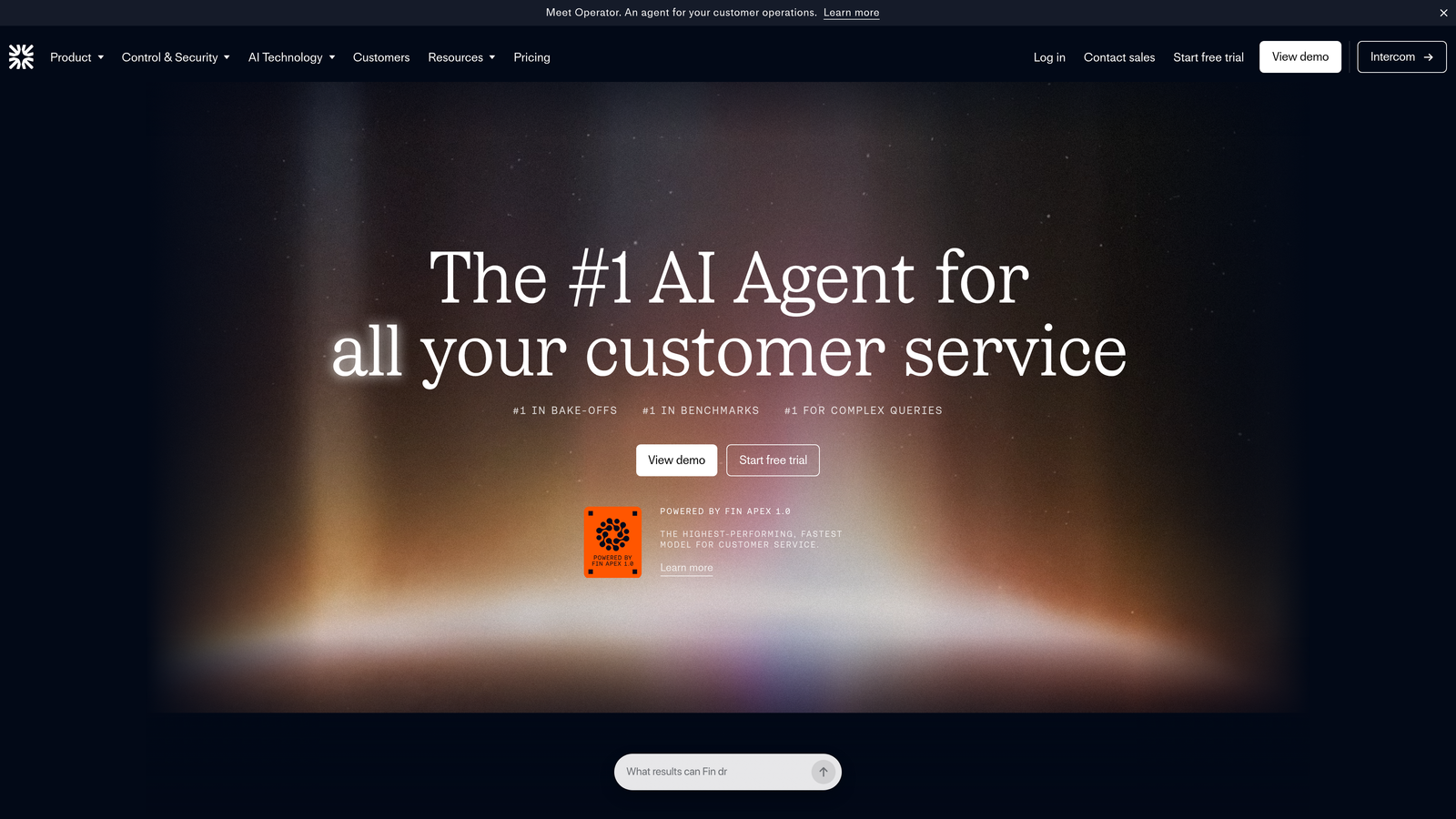
Intercom Fin is Intercom's AI agent, built to resolve customer questions using your existing help center content, conversation history, and custom-trained answers.
Where This Tool Shines
Fin's biggest advantage is how deeply it integrates with the Intercom ecosystem. If your team already lives in Intercom's inbox, deploying Fin feels seamless: the AI handles front-line resolution and hands off to human agents within the same interface, with no context lost in the transition.
The per-resolution pricing model is worth paying attention to. It aligns costs with outcomes rather than seats, which can work well for teams with variable support volumes but requires careful monitoring as resolution rates scale.
Key Features
Help Center-Powered Resolution: Fin draws on your existing help content, past conversations, and custom answers to resolve queries without additional training overhead.
Seamless Human Handoff: Escalations happen within the same Intercom inbox, preserving conversation context for the agent picking up the ticket.
Multilingual Support: Handles conversations across chat, email, and social in multiple languages.
Custom AI Answers: Allows teams to create specific, curated answers for nuanced or sensitive scenarios where generic resolution isn't appropriate.
Resolution Reporting: Built-in analytics tracking AI resolution rates and CSAT scores to measure impact.
Best For
Companies already invested in the Intercom platform that want to add AI resolution without a migration or a new vendor relationship. Less ideal for teams not on Intercom, since Fin requires an active Intercom subscription as its foundation.
Pricing
Per-resolution pricing model layered on top of an existing Intercom subscription. Costs can scale quickly at high volumes, so model your expected resolution rates before committing.
3. Zendesk AI
Best for: Enterprise support teams that need AI capabilities across a mature, feature-rich helpdesk environment.
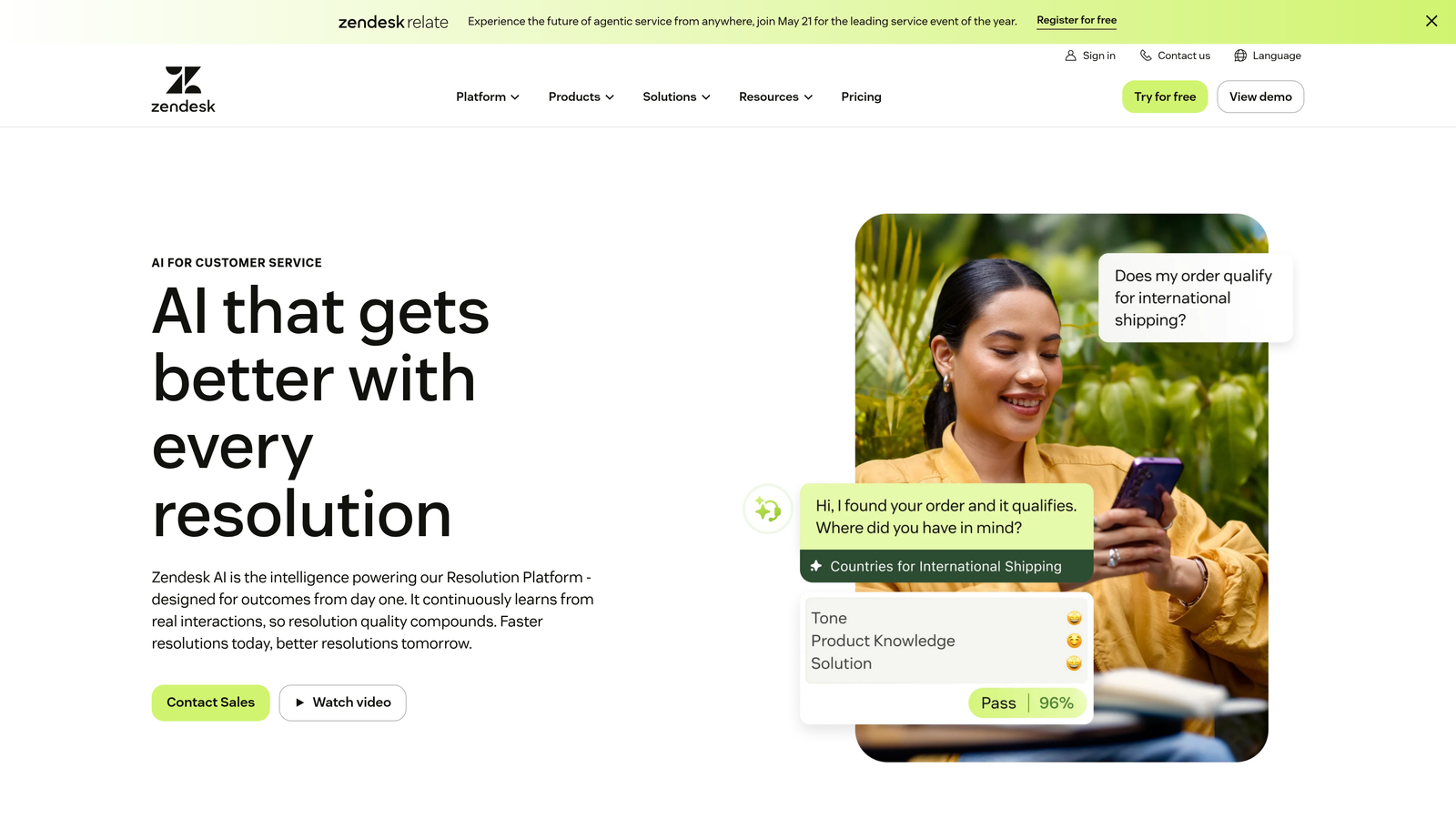
Zendesk AI is the AI layer built across Zendesk's enterprise support suite, covering automated resolution, intelligent triage, and agent-assist tools for complex tickets.
Where This Tool Shines
Zendesk's strength is scale and ecosystem. With over 1,500 marketplace integrations and years of enterprise deployment experience, it's a known quantity for large support organizations. The AI features layer intelligently onto existing workflows rather than requiring teams to rebuild their operations.
The agent copilot is particularly useful for teams handling complex, nuanced tickets where full automation isn't appropriate. Suggested responses and knowledge surfacing speed up human agents without removing them from the equation entirely.
Key Features
AI Agents: Automated resolution across email, chat, and messaging channels for common query types.
Intelligent Triage: Automatically classifies tickets by intent, language, and sentiment to route them to the right team or workflow.
Agent Copilot: Suggests responses and surfaces relevant knowledge base articles to human agents in real time.
1,500+ Integrations: Massive marketplace covering virtually every business tool a support team might use.
Enterprise SLA Management: AI-enhanced routing and prioritization that respects complex SLA configurations.
Best For
Enterprise teams with established Zendesk infrastructure that want to add AI capabilities incrementally. Also suitable for organizations that need deep customization, compliance controls, and a large integration ecosystem.
Pricing
AI features are available on Suite Professional and above, with an additional AI add-on available. Pricing varies based on the specific modules selected; contact Zendesk sales for enterprise quotes.
4. Ada
Best for: High-volume customer service operations that need omnichannel AI automation without heavy technical lift.
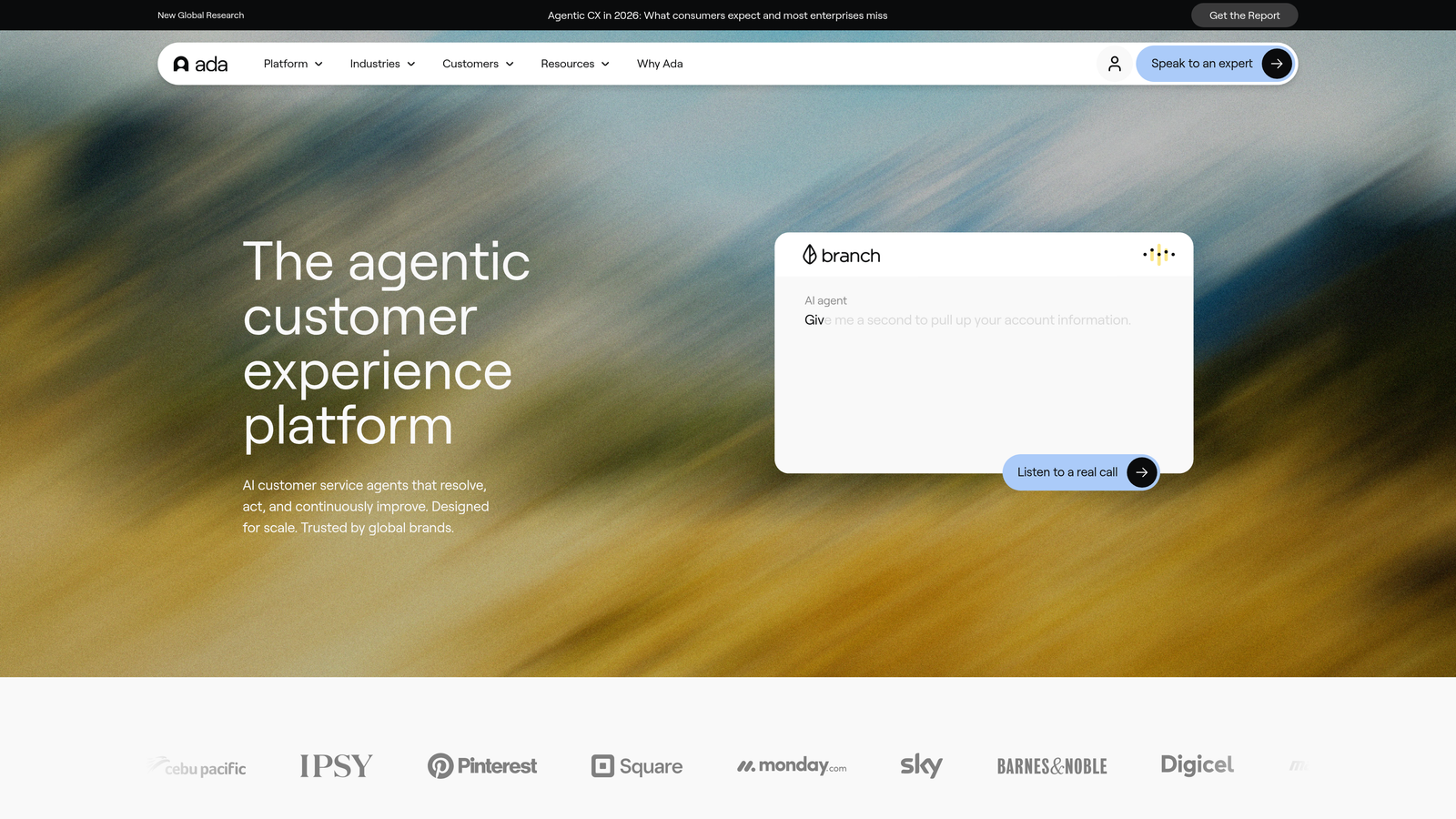
Ada is an AI-powered customer service automation platform built for high-volume resolution across chat, email, phone, and social channels, featuring a no-code builder for non-technical teams.
Where This Tool Shines
Ada's no-code workflow builder makes it accessible to operations and support leaders who don't want to depend on engineering for every configuration change. Creating and updating AI workflows, adjusting resolution logic, and managing channel-specific experiences can all be done without writing a line of code.
The multilingual capabilities stand out here: support for over 50 languages makes Ada a strong fit for globally distributed customer bases where consistent resolution quality across languages is a real operational challenge.
Key Features
No-Code Automation Builder: Create and manage AI workflows visually, without requiring developer resources for ongoing changes.
Omnichannel Deployment: Consistent AI resolution across web, mobile, social, SMS, and phone from a single platform.
50+ Language Support: Multilingual resolution that maintains quality across a wide range of languages and regional variations.
AI Reasoning Engine: Handles multi-step resolution autonomously, including scenarios that require pulling data from integrated systems.
CRM and Helpdesk Integrations: Connects with major CRMs, helpdesks, and e-commerce platforms to pull relevant customer context during resolution.
Best For
Mid-market and enterprise companies with high ticket volumes across multiple channels and languages. Particularly strong for teams that want non-technical staff to own and manage AI workflows without engineering bottlenecks.
Pricing
Custom pricing based on resolution volume. Contact Ada's sales team for a quote tailored to your expected usage.
5. Freshdesk Freddy AI
Best for: SMBs and mid-market teams that want accessible AI-powered support within a broader customer engagement suite.
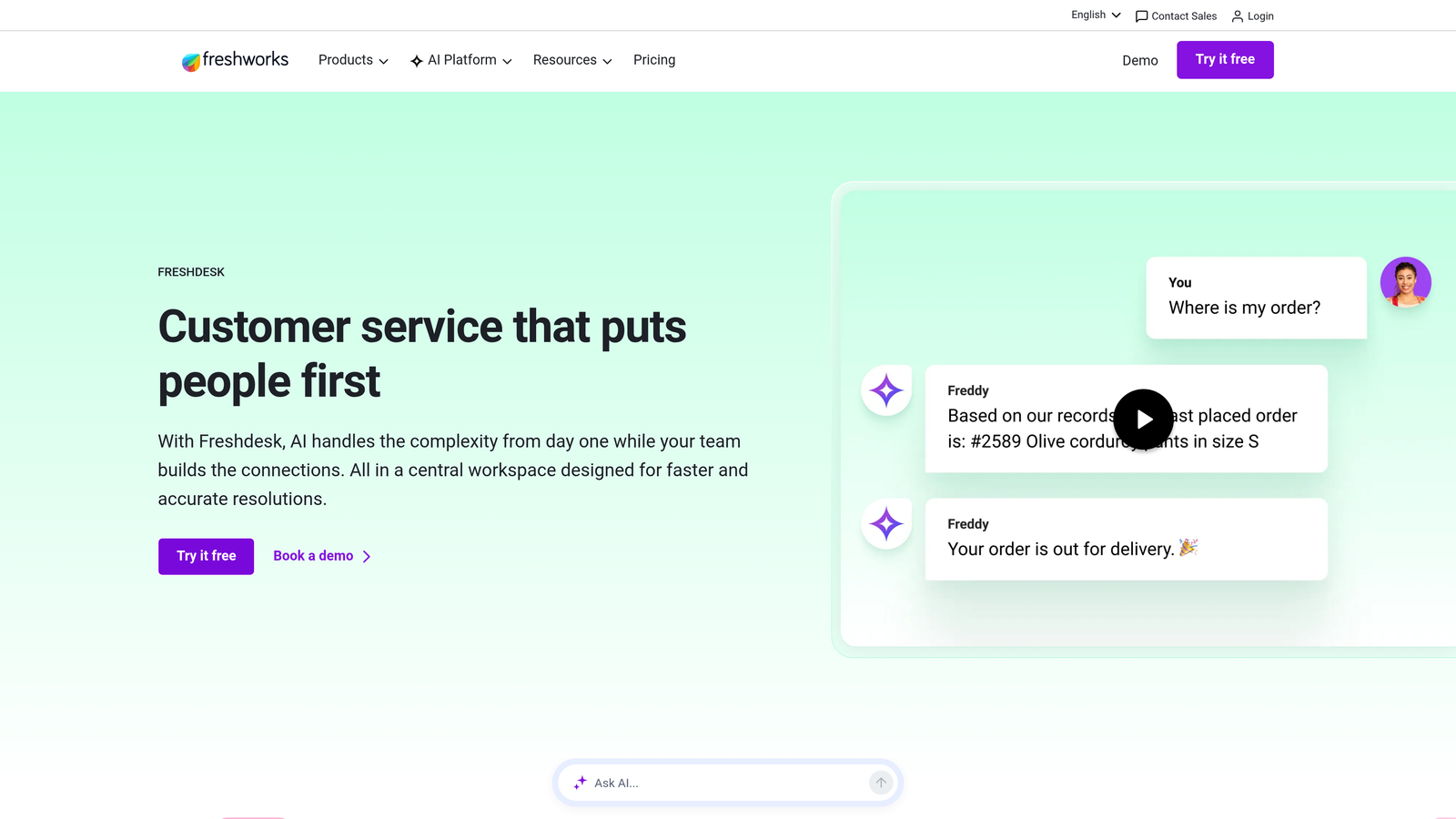
Freshdesk Freddy AI is Freshworks' AI layer for Freshdesk, offering automated ticket resolution, agent assist, and AI-powered insights at a price point designed to be accessible to smaller teams.
Where This Tool Shines
Freshdesk's appeal has always been its balance of capability and affordability, and Freddy AI continues that tradition. The combination of a customer-facing AI agent and an agent-assist copilot in the same platform gives teams flexibility to automate where they can while keeping humans in the loop where they need to.
For teams already using other Freshworks products like their CRM or ITSM tools, Freddy AI creates a unified intelligence layer across the whole ecosystem, which reduces data silos without requiring a major platform change.
Key Features
Freddy AI Agent: Customer-facing automated resolution for common queries, drawing on your help content and configured workflows.
Freddy Copilot: Agent-assist tool that drafts responses, summarizes tickets, and surfaces relevant knowledge for human agents.
Ticket Summarization and Sentiment Analysis: Automatically summarizes long threads and flags sentiment for prioritization.
Freshworks Ecosystem Integration: Works natively with Freshworks CRM, ITSM, and marketing products for a unified view of the customer.
Free Tier Available: Basic functionality available without a paid commitment, lowering the barrier to getting started.
Best For
Smaller teams and growing companies that need capable AI-assisted support without enterprise-level pricing. Also a natural fit for organizations already in the Freshworks ecosystem looking to expand AI capabilities without adding new vendors.
Pricing
Free tier available for basic needs. Paid plans start at $15 per agent per month, with AI features unlocking on higher-tier plans.
6. Tidio
Best for: Small businesses and e-commerce stores that need fast, affordable AI chat deployment.
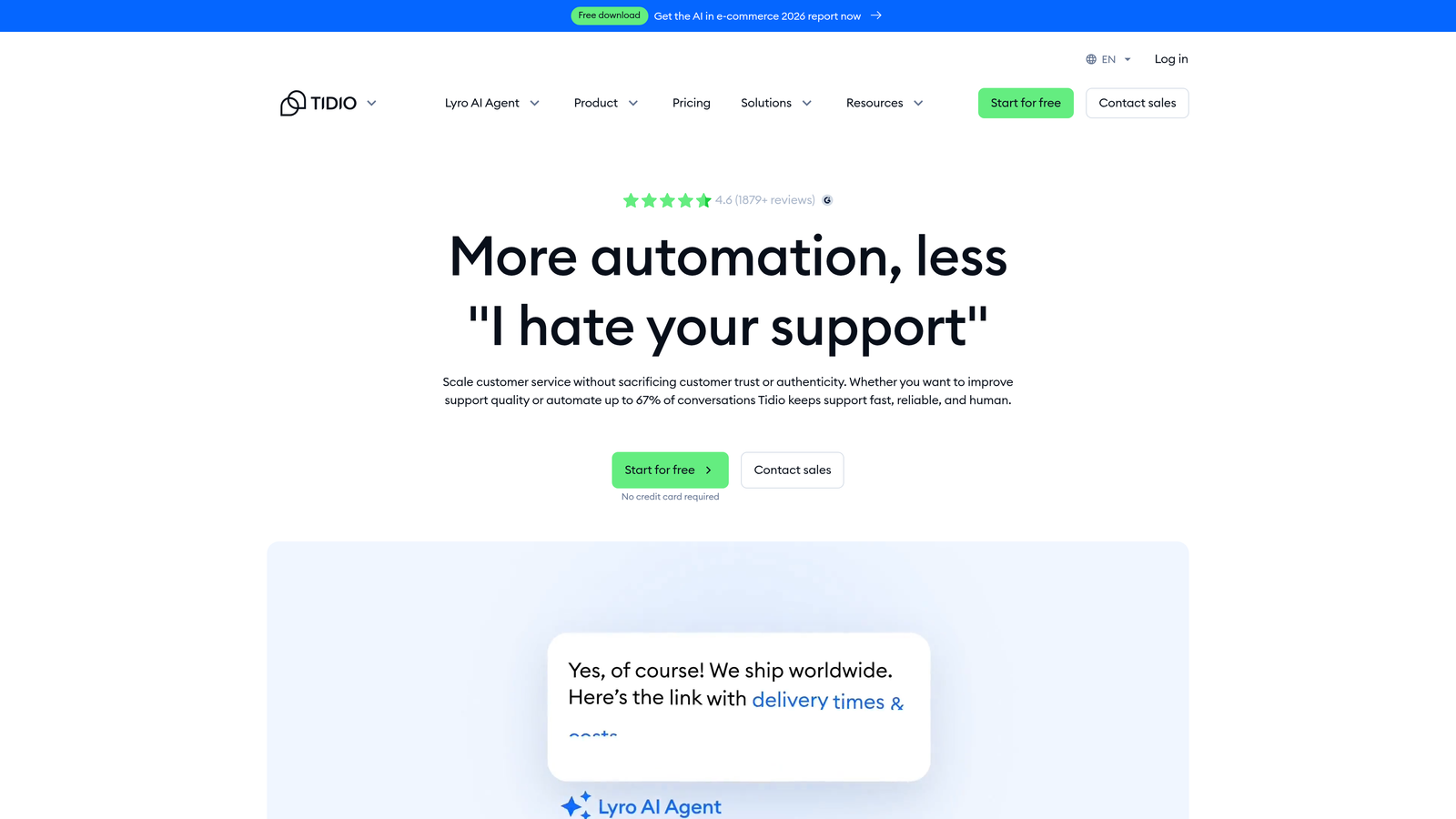
Tidio is a conversational AI and live chat platform designed for small businesses and e-commerce, combining a visual chatbot builder with fast deployment and strong e-commerce integrations.
Where This Tool Shines
Tidio's core advantage is simplicity and speed. A small team can go from signup to a live AI chatbot handling real customer questions in a matter of hours, not weeks. The visual drag-and-drop builder removes technical barriers entirely, and the Lyro AI chatbot learns from your FAQ and help content without complex configuration.
For Shopify and WooCommerce merchants in particular, Tidio's native integrations mean the AI can surface order status, product information, and shipping updates without custom development work.
Key Features
Lyro AI Chatbot: Learns from your FAQ and help content to handle common customer questions with conversational accuracy.
Visual Flow Builder: Drag-and-drop chatbot builder for creating custom conversation flows without writing code.
E-Commerce Integrations: Native connections to Shopify, WordPress, and WooCommerce for order and product context.
Combined Live Chat and AI: A single widget that handles both AI-automated conversations and live agent interactions seamlessly.
Visitor Tracking and Triggers: Proactively engages visitors based on behavior, page time, or cart activity.
Best For
Small businesses, e-commerce stores, and teams with limited technical resources that need an affordable, fast-to-deploy AI chat solution. Less suited for complex B2B support scenarios or teams with sophisticated routing and escalation requirements.
Pricing
Free plan available. Lyro AI features start at $39 per month, making it one of the more accessible entry points on this list.
7. Forethought
Best for: Teams that want to add AI intelligence to an existing helpdesk without migrating to a new platform.
Forethought is an AI platform that layers intelligent triage, automated resolution, and agent assist onto existing helpdesks like Zendesk, Salesforce, and ServiceNow.
Where This Tool Shines
Forethought's key architectural decision is to work as a layer on top of your existing helpdesk rather than replacing it. For teams with significant investment in platforms like Zendesk or Salesforce Service Cloud, this means getting AI capabilities without the disruption of a full migration.
SupportGPT, trained on your historical ticket data, is the engine behind Forethought's resolution quality. Because it learns from your actual past tickets rather than generic training data, the contextual accuracy tends to improve significantly as the system ingests more of your support history.
Key Features
SupportGPT: AI trained on your historical ticket data for contextually relevant, company-specific resolution.
Intelligent Triage: Routes tickets by intent, urgency, and complexity to the right team or automation workflow.
Solve and Assist Products: Separate products for customer-facing AI resolution (Solve) and agent-facing assistance (Assist), allowing modular deployment.
Helpdesk-Agnostic Architecture: Works as a layer on Zendesk, Salesforce, ServiceNow, and others without requiring platform migration.
Analytics Dashboard: Tracks deflection rates, resolution time improvements, and AI accuracy to demonstrate ROI.
Best For
Mid-market and enterprise teams with established helpdesk infrastructure who want AI capabilities without a rip-and-replace approach. Particularly useful for organizations where a full platform migration isn't feasible in the near term.
Pricing
Custom pricing based on ticket volume and which modules (Solve, Assist, or both) are selected. Contact Forethought for a tailored quote.
8. Kustomer
Best for: Customer-obsessed teams that want the full customer timeline at the center of every support interaction.
Kustomer is a CRM-centric customer service platform that unifies every customer interaction, order, and data point into a single timeline, with AI automation and agent assistance layered on top.
Where This Tool Shines
Kustomer's differentiation is the unified customer timeline. Rather than treating each support ticket as an isolated event, the platform gives agents a complete view of every interaction a customer has had, every order they've placed, and every data point from connected systems. This context makes both AI and human responses meaningfully more relevant.
For e-commerce brands with complex post-purchase support needs, the depth of Shopify and Magento integration means the AI can handle order-related queries with accurate, real-time data rather than generic responses.
Key Features
Unified Customer Timeline: Every interaction, order, and data point consolidated in one view for agents and AI alike.
AI Chatbots and Automated Workflows: Automated resolution and workflow routing built on top of rich customer data.
Omnichannel Support: Handles email, chat, social, SMS, and voice from a single platform.
E-Commerce Integrations: Deep connections with Shopify and Magento for order context during support interactions.
Proactive Support Triggers: Initiates outreach based on customer behavior signals and data events, shifting from reactive to proactive support.
Best For
E-commerce brands and high-growth consumer companies where customer lifetime value is high and support quality directly impacts retention. Teams that want CRM-depth context in every support interaction, not just ticket history.
Pricing
Enterprise pricing. Contact Kustomer's sales team for a quote based on your team size and requirements.
9. Drift (by Salesloft)
Best for: Revenue-focused teams that want AI to serve both customer support and sales qualification simultaneously.
Drift is a conversational AI platform that bridges customer support and revenue generation, with AI chatbots designed to handle service queries and qualify sales leads within the same conversation flow.
Where This Tool Shines
Drift occupies a unique position on this list because it was never purely a support tool. Its AI chatbots are designed to identify and route high-value prospects while simultaneously handling support queries, which makes it particularly interesting for B2B companies where the line between support and sales engagement is blurry.
The integration with Salesloft's broader revenue platform means that intelligence gathered in support conversations can flow directly into sales workflows, creating a feedback loop between customer success and pipeline generation that most pure-play support tools don't offer.
Key Features
Dual-Purpose AI Chatbots: Handle support queries and qualify sales leads in the same conversation, reducing the need for separate tools at different funnel stages.
ABM Routing and Targeting: Account-based marketing logic that identifies and prioritizes high-value accounts for personalized engagement.
Conversational Landing Pages: Replaces static forms with dynamic, personalized conversation flows for inbound visitors.
Salesloft Platform Integration: Connects support and sales intelligence across the full Salesloft revenue platform.
Meeting Scheduling: Allows prospects and customers to book meetings directly within the chat experience, accelerating both sales and support resolution.
Best For
B2B companies where sales and support overlap significantly, particularly those already using Salesloft for revenue operations. Less suited for teams that need deep helpdesk functionality or complex post-sale support workflows as their primary use case.
Pricing
Custom pricing as part of Salesloft's platform packages. Contact Salesloft for a quote based on your use case and team configuration.
Which Platform Is Right for Your Team?
The honest answer is that the best AI customer service platform depends heavily on where you're starting from and what you're trying to achieve beyond ticket deflection.
If you're building from scratch or ready to move past a legacy helpdesk, AI-native platforms like Halo AI give you the advantage of intelligence built into the architecture from day one, not layered on as an afterthought. That matters when you want capabilities like page-aware context, continuous learning, and business intelligence signals that go beyond what traditional support metrics can tell you.
If you're deeply invested in an existing platform, the bolt-on approach makes more sense. Intercom Fin and Zendesk AI are the strongest options here for teams that want capable AI without a migration. Forethought is worth a look if you're on Salesforce or ServiceNow and want AI that learns from your historical ticket data specifically.
For smaller teams and e-commerce businesses, Tidio and Freshdesk Freddy AI offer the most accessible entry points with free tiers and straightforward deployment. Ada and Kustomer are strong mid-market choices when omnichannel depth and customer data richness matter. And Drift stands alone for teams where support and sales qualification need to happen in the same conversation.
One thing worth keeping in mind as you evaluate: the platforms that will serve you best long-term are the ones that treat every support interaction as a source of intelligence, not just a ticket to close. Your support team shouldn't scale linearly with your customer base. Let AI agents handle routine tickets, guide users through your product, and surface business intelligence while your team focuses on complex issues that need a human touch. See Halo in action and discover how continuous learning transforms every interaction into smarter, faster support.