9 Best AI Support Software Platforms to Get Started With in 2026
Discover the 9 best platforms to get AI support software working for your team in 2026, with expert evaluations covering autonomous resolution capabilities, integration depth, and pricing transparency to help you choose the right solution without wasted implementation time or frustrated customers.
 Grant CooperFounder13 min read
Customer support expectations have shifted dramatically. B2B buyers now expect instant, accurate answers at any hour, and support teams are under real pressure to deliver that without endlessly growing headcount. The response from the software market has been a wave of AI-powered platforms, each promising to transform how your team handles tickets, conversations, and escalations.
But here's the challenge: the market is genuinely crowded. You'll find everything from lightweight chatbots that deflect a handful of FAQs to full-stack AI agent platforms that take autonomous action across your entire support stack. Choosing the wrong one means wasted implementation time, frustrated agents, and customers who still can't get answers.
To help you cut through the noise, we evaluated platforms based on autonomous resolution capabilities, integration depth, ability to learn and improve over time, deployment speed, and pricing transparency. Whether you're running a lean startup support team or scaling a mid-market operation, this list covers solutions worth serious consideration. For broader context, see our guides on automated customer support and AI customer service.
1. Halo AI
Best for: B2B teams that want AI-first, autonomous support with deep product context and business intelligence.
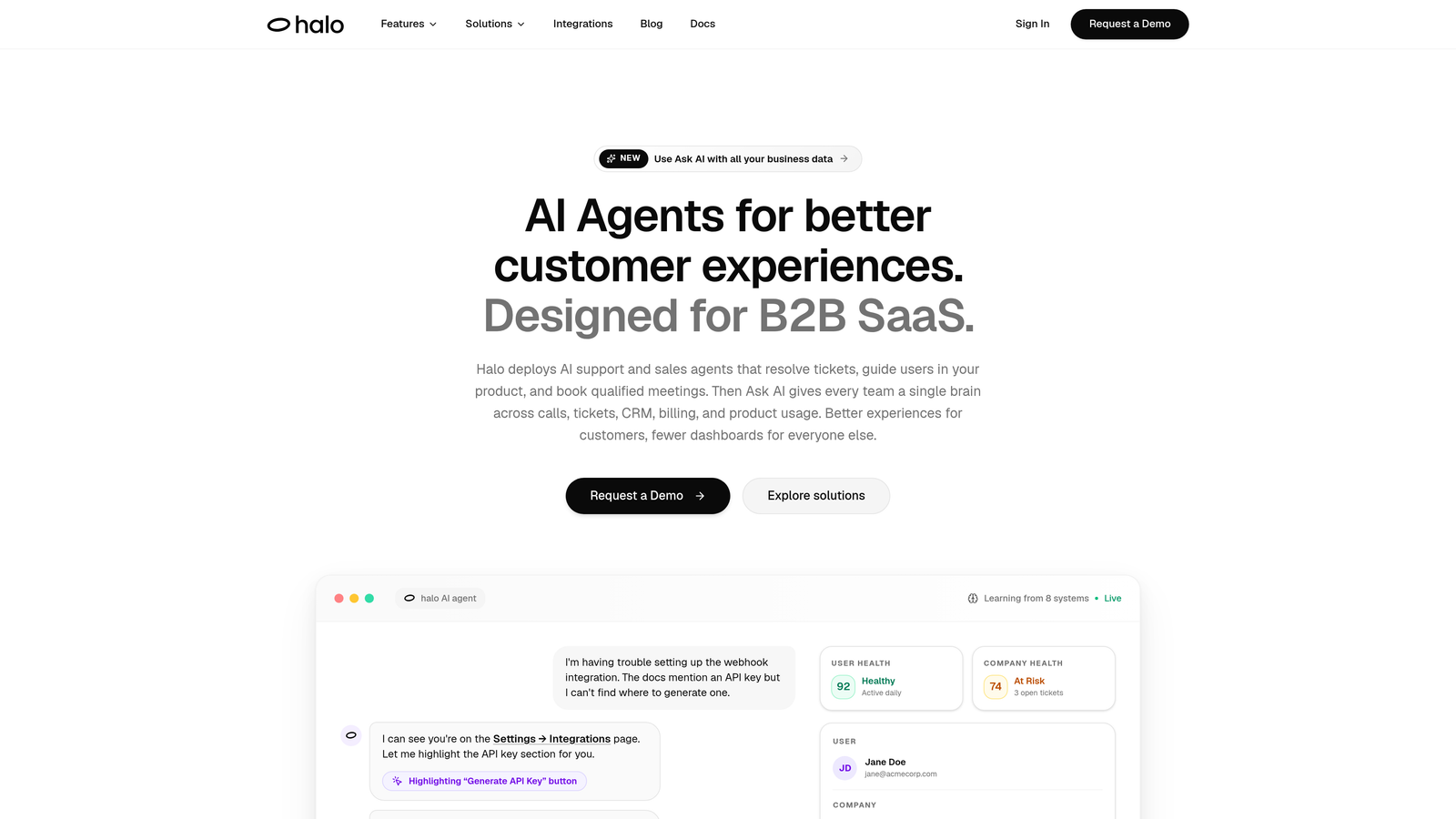
Halo AI is an AI-native customer support platform that deploys autonomous agents to resolve tickets, guide users through your product, and surface business intelligence from every interaction.
Where This Tool Shines
What separates Halo from most platforms on this list is its page-aware architecture. The AI doesn't just respond to what a user types; it understands what they're actually looking at inside your product and provides contextual, visual UI guidance in real time. That's a meaningful step beyond generic chatbot deflection.
Halo is also genuinely AI-first, meaning the entire platform was built around autonomous agents rather than retrofitting AI onto a legacy helpdesk. Every resolved ticket, every escalation, every user interaction feeds back into the system so it gets smarter over time. The smart inbox adds another layer by surfacing customer health signals, revenue intelligence, and anomaly detection, turning your support channel into a source of business insight.
Key Features
Page-Aware Chat Widget: Understands what users see inside your product and delivers contextual visual guidance, not just text responses.
Autonomous AI Agents: Resolve support tickets end-to-end and continuously learn from every interaction to improve resolution quality over time.
Smart Inbox with Business Intelligence: Surfaces customer health signals, revenue intelligence, and anomaly detection directly from support data.
Auto Bug Ticket Creation and Live Agent Handoff: Automatically generates bug reports and escalates complex issues to human agents with full context preserved.
Deep Integrations: Connects natively with Linear, Slack, HubSpot, Intercom, Stripe, Zoom, PandaDoc, and Fathom, so your support stack stays connected to your broader business operations.
Best For
B2B SaaS teams that want to scale support without scaling headcount. Particularly strong for product-led companies where in-app guidance and contextual support are critical, and for teams that want support data to feed into broader business intelligence rather than sitting in a silo.
Pricing
Contact for pricing. Halo is designed for B2B teams looking to replace or augment traditional helpdesk setups with an AI-first approach that grows with their customer base.
2. Zendesk AI
Best for: Established teams already on the Zendesk Suite who want to layer AI onto existing workflows.
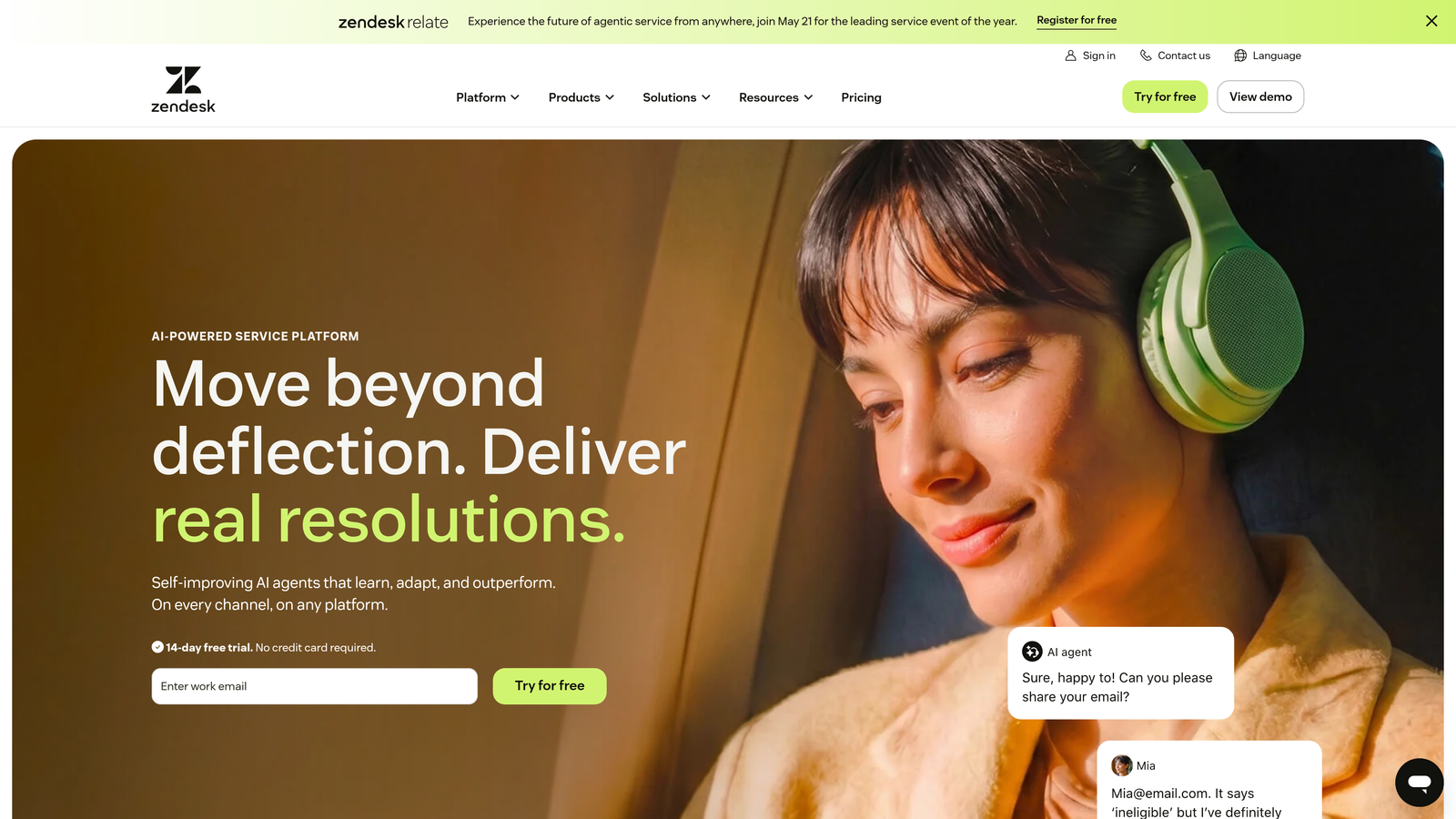
Zendesk AI brings AI capabilities directly into the Zendesk Suite, drawing on an enormous dataset of historical support interactions to power automated responses, agent assist, and intelligent routing.
Where This Tool Shines
Zendesk's core advantage is data. The company has processed billions of support interactions across thousands of customers, and that training foundation means its AI models arrive with a level of domain knowledge that newer platforms are still building toward. If your team is already running on Zendesk, the AI features slot into existing workflows without a platform migration.
The agent copilot experience is particularly well-regarded. Agents get real-time response suggestions, relevant knowledge base articles surfaced automatically, and ticket summaries that reduce the time spent getting up to speed on complex threads.
Key Features
AI Agents: Trained on Zendesk's massive dataset of support interactions to handle common queries without human involvement.
Intelligent Triage: Automatically classifies ticket intent, language, and sentiment to route issues to the right team or agent.
Agent Copilot: Suggests responses, surfaces knowledge base articles, and helps agents resolve tickets faster.
Native Suite Integration: Works across Zendesk Support, Guide, Chat, and Talk without additional connectors or middleware.
Best For
Mid-market and enterprise teams already invested in the Zendesk ecosystem. Less compelling as a greenfield choice if you're evaluating platforms from scratch, since the AI is an add-on to the core platform rather than the foundation.
Pricing
AI features are available on Suite Professional and above. AI agents are billed per automated resolution, so costs scale with usage volume.
3. Intercom Fin
Best for: Teams using Intercom's messenger who want a conversational AI agent with resolution-based pricing.
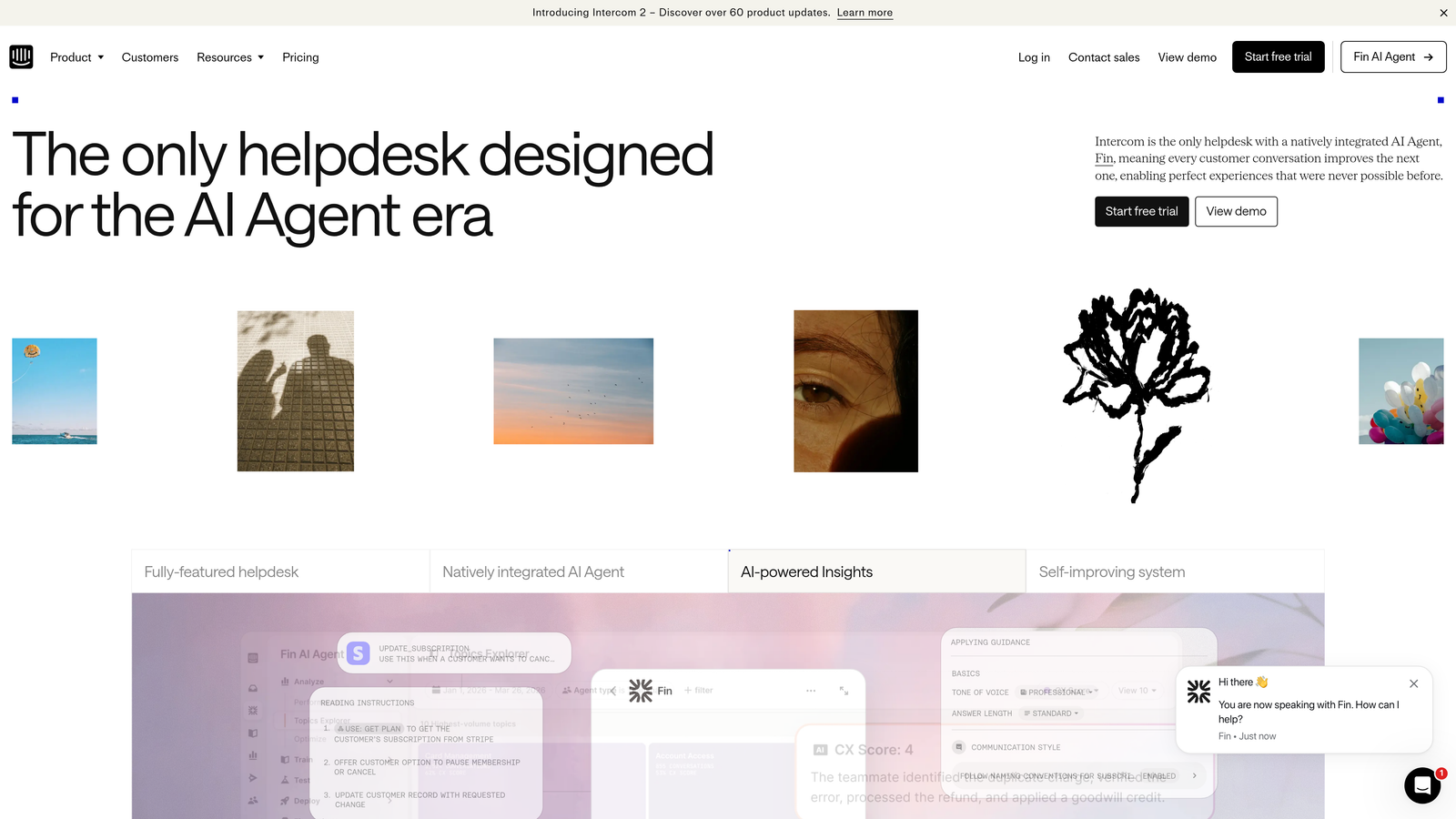
Intercom Fin is Intercom's dedicated AI agent, built to resolve customer questions conversationally within the Intercom messenger using your help center and past conversation data as its knowledge base.
Where This Tool Shines
Fin's resolution-based pricing model is genuinely different from most competitors. You pay per resolved conversation rather than per seat or per interaction, which aligns the platform's incentives with your actual outcomes. That structure also makes it easier to forecast costs as you scale.
The conversational quality is strong, and Fin handles handoffs to human agents gracefully, passing full conversation context so customers don't have to repeat themselves. Customizable tone and guardrails give you control over how the AI represents your brand.
Key Features
Native Messenger Integration: Embedded directly in Intercom's chat experience with no additional widget or overlay required.
Multi-Source Learning: Learns from help center articles, past conversations, and custom data sources to improve resolution accuracy.
Resolution-Based Pricing: You pay per resolved conversation, not per message or seat, aligning cost with actual value delivered.
Tone and Behavior Customization: Configurable guardrails keep the AI on-topic and consistent with your brand voice.
Seamless Human Handoff: Transfers to live agents with complete conversation context intact.
Best For
Teams already using Intercom as their primary support channel. The pricing model works well for teams with high resolution rates; if your queries are complex and frequently escalated, the per-resolution cost structure is less advantageous.
Pricing
Resolution-based pricing starts at $0.99 per resolved conversation. An active Intercom plan is required.
4. Freshdesk Freddy AI
Best for: Mid-market teams on Freshdesk looking for AI-assisted ticketing without enterprise-level pricing.
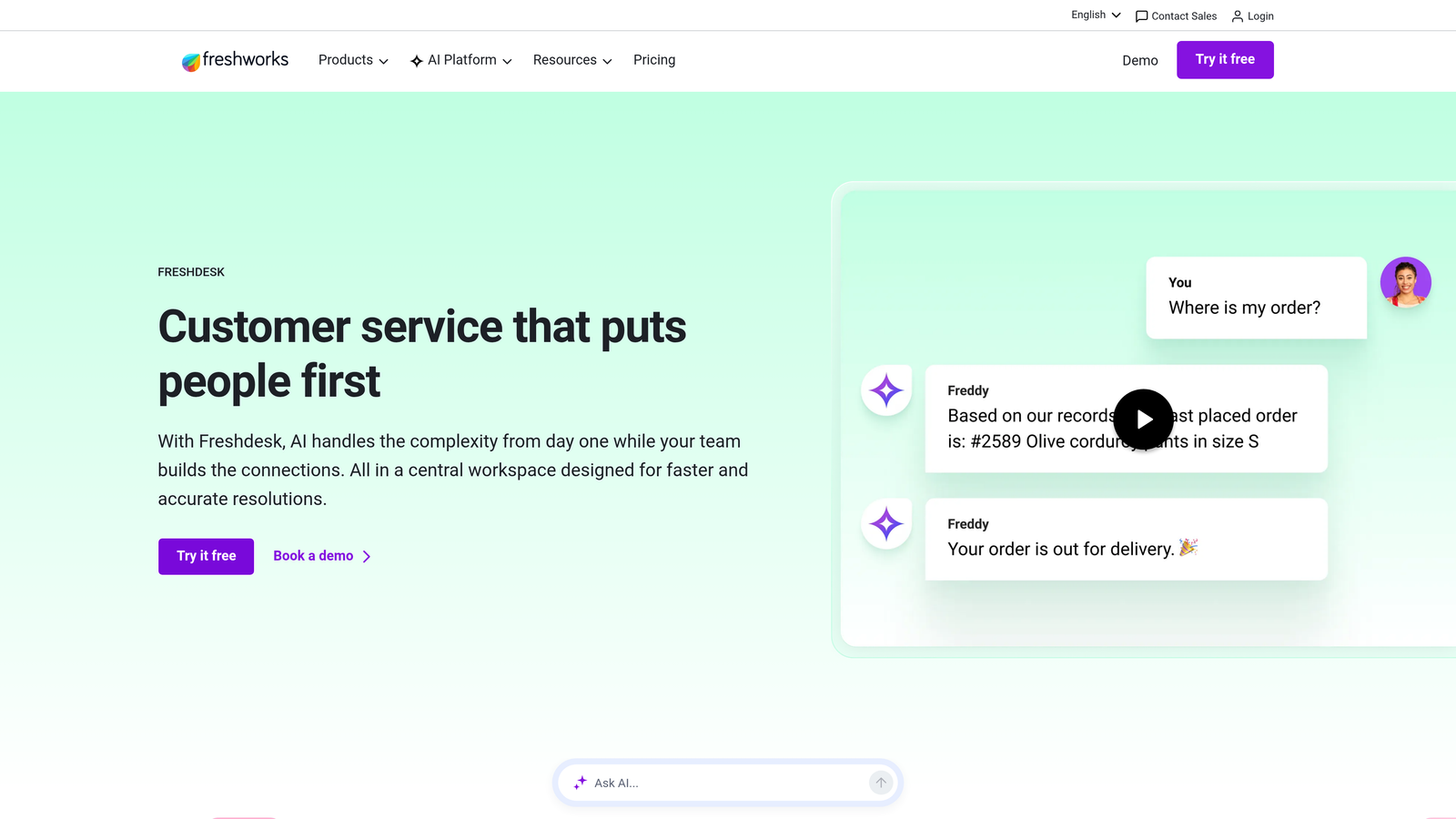
Freshdesk Freddy AI is the AI layer within Freshworks' Freshdesk platform, covering both customer-facing automated resolution and agent-facing assist tools at pricing that works for growing teams.
Where This Tool Shines
Freddy AI has two distinct modes that address different parts of the support workflow. The customer-facing Freddy AI Agent handles automated resolution before a ticket ever reaches a human. The agent-facing Freddy Copilot helps live agents work faster with response suggestions, ticket summaries, and next-best-action recommendations. Having both in a single platform reduces the tooling complexity that often comes with bolting AI onto a legacy helpdesk.
For teams already in the Freshworks ecosystem, including CRM, ITSM, or marketing tools, Freddy AI extends naturally across those products, giving you a consistent AI layer across the entire customer lifecycle.
Key Features
Freddy AI Agent: Handles customer-facing automated resolution for common support queries without agent involvement.
Freddy Copilot: Provides agents with response suggestions, ticket summaries, and next-best-action guidance in real time.
Auto-Triage and Smart Routing: Classifies tickets by intent and priority to route them to the right team automatically.
Freshworks Ecosystem Integration: Works across Freshdesk, Freshsales CRM, and other Freshworks products for unified AI capabilities.
Best For
Mid-market teams on Freshdesk or those evaluating Freshworks as an all-in-one platform. Strong value for teams that want AI-assisted support without moving to enterprise pricing tiers.
Pricing
AI features are included in Pro and Enterprise plans. Freshdesk plans start at $15 per agent per month, making it one of the more accessible options on this list.
5. Ada
Best for: Enterprise teams with high support volumes that need maximum automated resolution rates across multiple channels and languages.
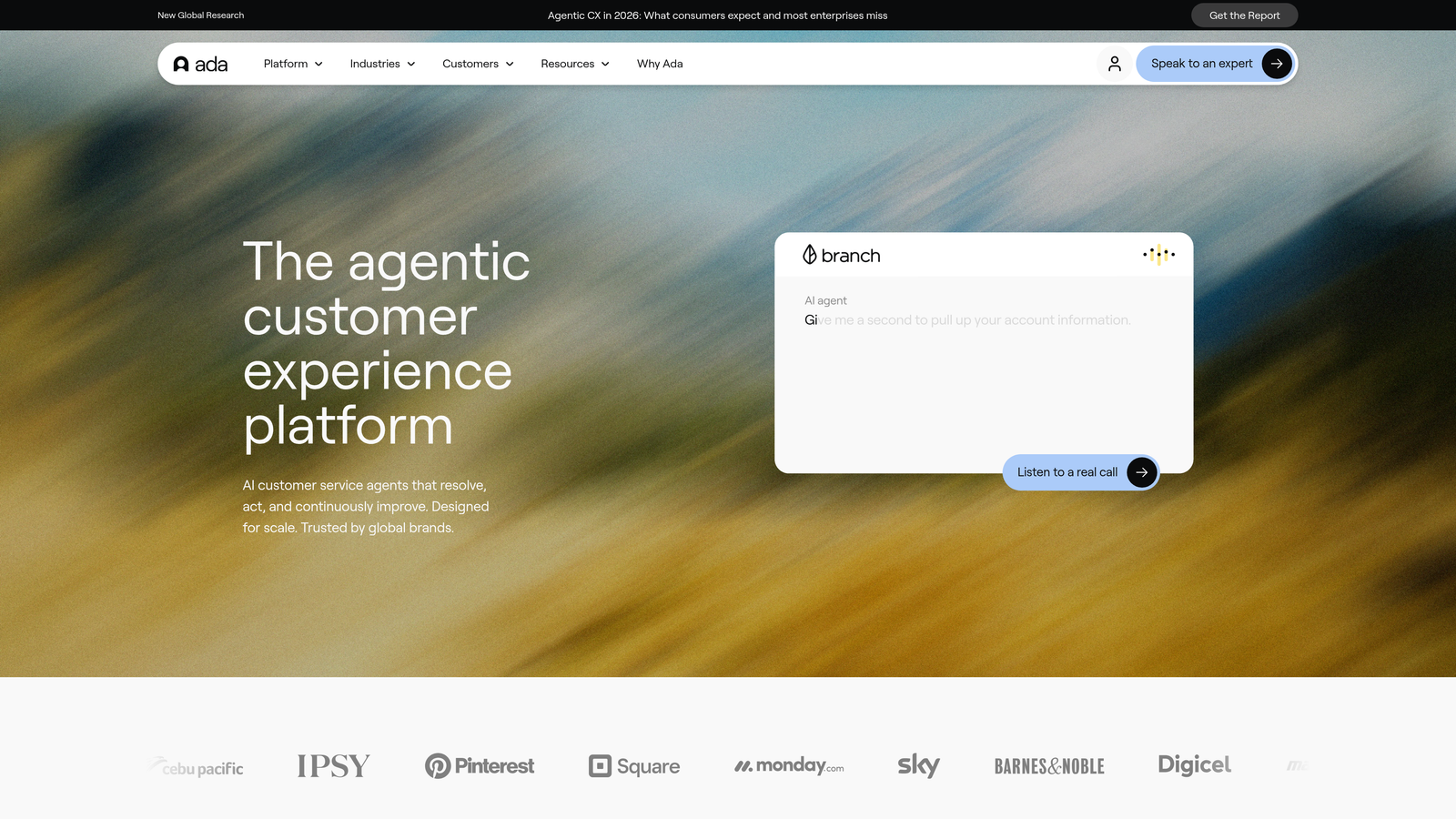
Ada is an enterprise-grade AI automation platform purpose-built for high-volume customer support, with a strong emphasis on containment rates and multilingual capability.
Where This Tool Shines
Ada is built around one primary goal: resolving as many customer issues as possible without human intervention. Its action-oriented architecture means the AI doesn't just answer questions; it can look up orders, process refunds, update account details, and trigger downstream workflows. For high-volume operations where routine transactions make up the bulk of tickets, that capability directly reduces support costs.
The no-code bot builder makes it accessible to non-technical teams who need to customize flows and update content without engineering support. The 50-plus language support out of the box is a genuine differentiator for global operations.
Key Features
High-Containment AI Agent: Designed for maximum autonomous resolution, handling complex multi-step interactions without escalation.
50+ Language Support: Multilingual capability available out of the box, without additional configuration for each language.
No-Code Bot Builder: Non-technical teams can customize conversation flows and update content independently.
Action-Oriented Integrations: Can look up orders, process refunds, and update accounts rather than just answering questions.
Helpdesk Layer Integration: Works on top of Zendesk, Salesforce, and other platforms without requiring a full migration.
Best For
Enterprise teams with high ticket volumes, global customer bases, and complex transactional support needs. Overkill for smaller teams; the platform is designed for scale.
Pricing
Custom enterprise pricing. Contact Ada directly for a quote based on your volume and use case.
6. Tidio
Best for: Small businesses and e-commerce teams that need affordable AI chat without enterprise complexity.
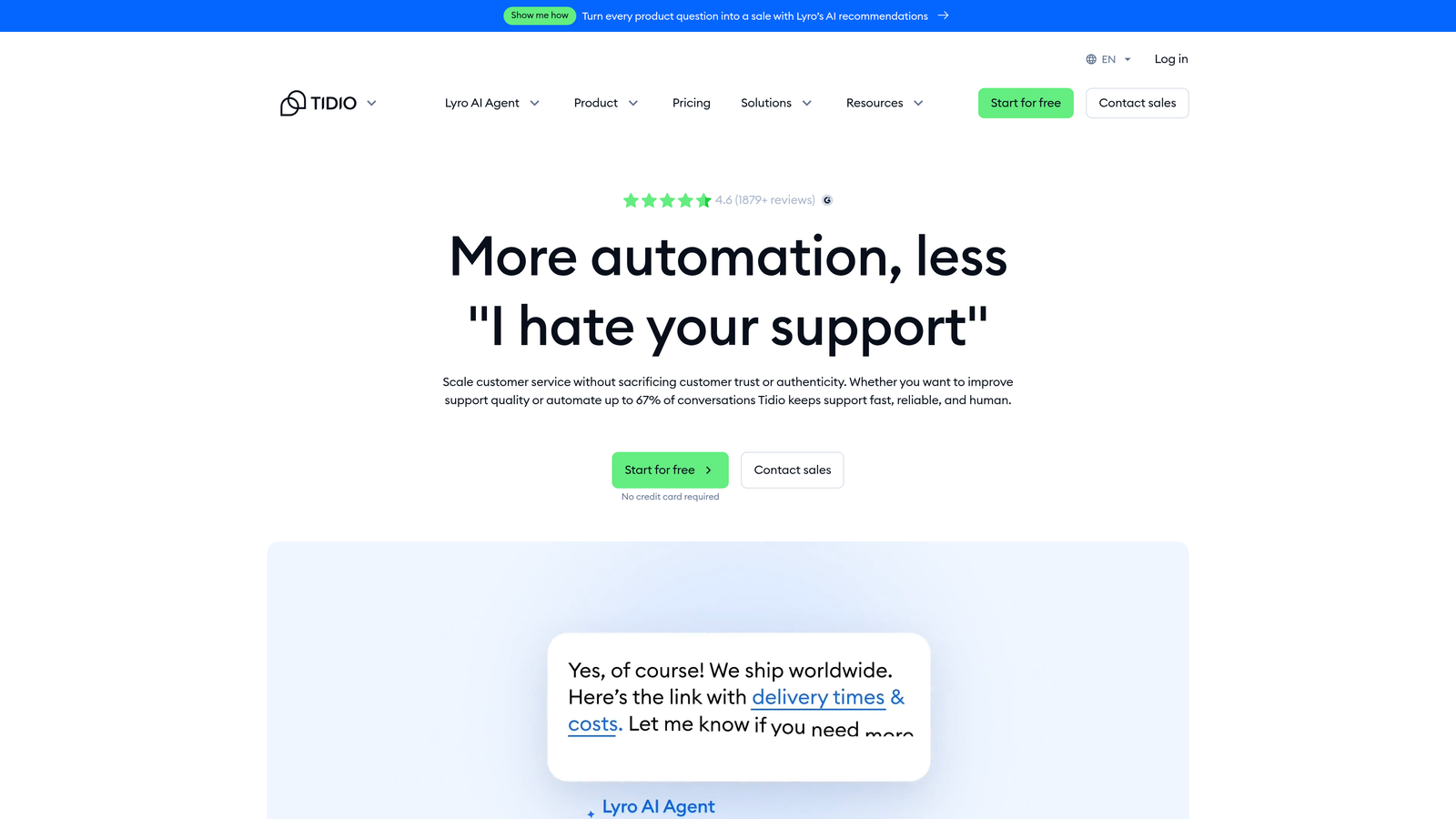
Tidio is a lightweight AI chat platform combining live chat, chatbot automation, and the Lyro AI assistant in a single, affordable package built with small business budgets in mind.
Where This Tool Shines
Tidio's strength is accessibility. The free tier gets small teams started without upfront investment, and the visual drag-and-drop chatbot builder means you don't need a developer to set up automated flows. For e-commerce teams on Shopify or WooCommerce, the native integrations make it easy to connect support directly to order data.
Lyro, Tidio's AI assistant, learns from your FAQ and help content to handle common questions automatically. It's not as sophisticated as the enterprise platforms on this list, but for a team fielding repetitive product and order questions, it handles a meaningful portion of incoming volume without agent involvement.
Key Features
Lyro AI Assistant: Learns from your FAQ and help content to resolve common customer questions autonomously.
Visual Bot Builder: Drag-and-drop interface for building custom conversation flows without writing code.
E-Commerce Integrations: Native connections to Shopify, WooCommerce, and BigCommerce for order-aware support.
Combined Live Chat and AI: Single widget handles both automated and human-assisted conversations.
Free Tier: Available for small teams to get started without a paid commitment.
Best For
Small businesses, e-commerce stores, and early-stage teams that need a simple, affordable AI chat solution. Not the right fit for B2B SaaS teams with complex support needs or enterprise-scale volumes.
Pricing
Free plan available. Paid plans start at around $29 per month. The Lyro AI add-on is priced separately.
7. Forethought
Best for: Teams with an existing helpdesk investment who want to add generative AI and intelligent triage without replacing their current platform.
Forethought is an AI platform that sits as a layer on top of your existing helpdesk, using its SupportGPT technology to deliver generative AI responses, intelligent triage, and workflow automation.
Where This Tool Shines
Forethought's core value proposition is that you don't have to rip and replace your current setup. If your team is on Zendesk or Salesforce and you're not ready for a full platform migration, Forethought adds generative AI capabilities on top without disrupting existing workflows. That's a meaningful advantage for teams with significant helpdesk customization or integrations already in place.
SupportGPT generates responses grounded in your knowledge base rather than hallucinating answers, which addresses one of the most common concerns teams have about deploying generative AI in customer-facing contexts.
Key Features
SupportGPT: Generates AI responses grounded in your knowledge base, reducing the risk of inaccurate or off-brand answers.
Intelligent Triage Engine: Classifies, prioritizes, and routes incoming tickets automatically based on intent and content.
Helpdesk Overlay Architecture: Works on top of Zendesk, Salesforce, and other platforms without requiring migration.
Workflow Automations: Handles multi-step processes beyond simple Q&A, including routing logic and follow-up actions.
Best For
Teams with existing helpdesk investments who want generative AI capabilities without committing to a full platform switch. Particularly useful for operations with complex routing logic or specialized knowledge bases.
Pricing
Custom pricing based on ticket volume and the specific modules you deploy. Contact Forethought directly for a quote.
8. Drift (Salesloft)
Best for: B2B revenue teams that want a single conversational AI platform spanning support, sales qualification, and meeting booking.
Drift, now part of Salesloft's revenue engagement suite, blends AI-powered support with sales engagement, making it a unique option for teams where support and sales overlap significantly.
Where This Tool Shines
Drift's differentiation is its revenue focus. Most platforms on this list are built purely for support; Drift is built for the full buyer and customer journey. Its AI can handle support queries, qualify inbound leads, and book meetings within the same conversation thread. For B2B teams where website visitors are both prospects and existing customers, that unified capability reduces the number of tools in play.
The account-based targeting features let you personalize chatbot experiences based on company size, industry, or account status, which is a level of sophistication most pure-play support tools don't offer.
Key Features
Unified Support and Sales AI: Handles both customer support queries and sales qualification within a single conversational interface.
Meeting Booking and Lead Routing: AI can schedule meetings and route qualified leads to the right sales rep automatically.
Salesloft Platform Integration: Connects with Salesloft's broader revenue orchestration capabilities for full-funnel visibility.
Account-Based Personalization: Targets and personalizes chatbot experiences based on company attributes and account status.
Best For
B2B teams where support and sales functions overlap, particularly companies with high-value accounts where personalized, account-aware conversations matter. Less suited for teams that need deep support-only functionality.
Pricing
Drift is part of Salesloft's platform pricing. Contact Salesloft sales for current plan details and packaging.
9. HubSpot Service Hub
Best for: Teams already on HubSpot CRM who want AI-assisted support tools connected to unified customer data.
HubSpot Service Hub is HubSpot's customer service platform, featuring the Breeze AI copilot and an AI chatbot builder built directly on top of HubSpot's CRM for complete customer context in every interaction.
Where This Tool Shines
The core advantage here is the CRM connection. When your support tool shares a data layer with your marketing and sales tools, agents see the full customer picture: deal stage, recent emails, product usage, and past tickets, all in one view. Breeze AI uses that context to generate more relevant ticket summaries and response drafts than tools working from support data alone.
For teams not yet on any dedicated support platform, the free tier offers a genuine starting point with basic ticketing, live chat, and a knowledge base, making it one of the lower-friction ways to get AI-assisted support off the ground.
Key Features
Breeze AI Copilot: Handles ticket summarization, response drafting, and knowledge base article generation using CRM-connected context.
CRM-Connected Chatbot Builder: AI chatbot pulls directly from HubSpot CRM data for personalized, context-aware conversations.
Unified Customer View: Shared data layer across HubSpot Marketing, Sales, and Service for complete customer visibility.
Built-In Support Tools: Knowledge base, customer portal, and feedback surveys included without additional integrations.
Free Tier: Basic ticketing and live chat available at no cost for teams just getting started.
Best For
Teams already using HubSpot for marketing or sales who want to extend the platform into support. The CRM integration is the primary draw; if you're not in the HubSpot ecosystem, the AI capabilities alone don't differentiate it strongly from other options.
Pricing
Free tools available. Service Hub Starter starts at $20 per seat per month; Professional at $100 per seat per month.
Choosing the Right AI Support Software for Your Team
The platforms on this list cover a wide range of use cases, team sizes, and budget levels. The right choice depends less on which tool has the most features and more on where your team is starting from and what you actually need AI to do.
If you're already embedded in an established helpdesk like Zendesk or Freshdesk, layering in their native AI features is often the fastest path to value. If you're on Intercom or HubSpot, Fin and Breeze AI respectively are the natural next steps given their deep platform integration.
For teams evaluating from scratch or looking to move beyond bolt-on AI, the calculus changes. Ada is the right call for high-volume enterprise operations with global reach. Tidio works well for small e-commerce teams on a budget. Forethought is worth considering if you want generative AI without a full migration.
For B2B SaaS teams that want something genuinely AI-first, Halo AI stands out. The page-aware context, continuous learning architecture, and business intelligence layer make it more than a support tool; it becomes a source of product and customer insight that grows more valuable over time. The deep integrations with tools like Linear, Slack, Stripe, and HubSpot mean it connects to how your team already works rather than requiring you to build around it.
Your support team shouldn't scale linearly with your customer base. Let AI agents handle routine tickets, guide users through your product, and surface business intelligence while your team focuses on complex issues that need a human touch. See Halo in action and discover how continuous learning transforms every interaction into smarter, faster support.