8 Best Gorgias Alternatives for SaaS Companies in 2026
Gorgias was built for e-commerce, leaving SaaS teams with weak developer integrations, limited BI, and rule-based AI that misses churn signals. This guide evaluates 8 Gorgias alternatives for SaaS companies on AI capability, SaaS-relevant integrations, and scalability — so you can find the right support platform for your B2B product without a painful implementation.
 Matt PattoliFounder12 min read
Gorgias was built for e-commerce, and it shows. If you're running a SaaS company, you've likely already hit its ceiling: limited integrations with developer tools, no native bug tracking, weak business intelligence, and AI that's more rule-based than genuinely autonomous. The result is a support team that's still manually triaging tickets while churn signals go undetected in the inbox.
This list focuses specifically on support platforms built for, or well-suited to, SaaS workflows. Think CRM integrations, product feedback loops, API-first architectures, and AI that actually learns from your product context. We evaluated tools based on AI capability, SaaS-relevant integrations, scalability, and value for growing B2B teams. Whether you need full AI autonomy, a smarter helpdesk, or a lightweight alternative that won't require a six-month implementation, there's an option here for you.
1. Halo AI
Best for: B2B SaaS teams that want autonomous AI agents, not just automation rules
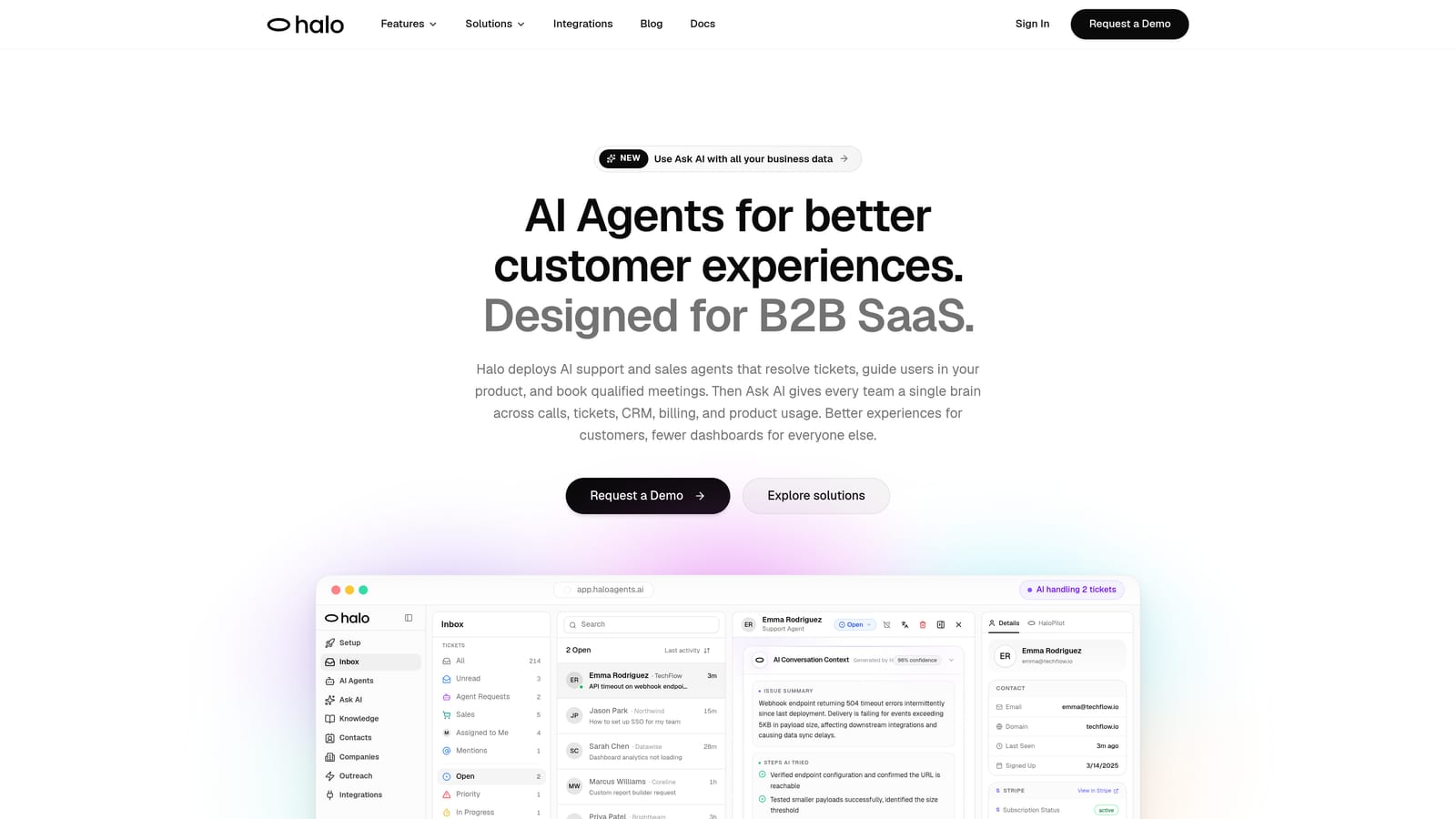
Halo AI is an AI-first customer support platform built specifically for B2B SaaS workflows, deploying autonomous agents that resolve tickets, guide users through your product, and surface business intelligence signals.
Where This Tool Shines
Most support platforms treat AI as a bolt-on feature layered over a traditional helpdesk. Halo is architected the other way around: AI is the core, and everything else is built to support it. The result is a platform where agents genuinely resolve tickets end-to-end rather than just suggesting canned responses for a human to copy-paste.
The page-aware chat widget is a standout differentiator. The AI sees what the user sees in your product, enabling contextual visual guidance rather than generic troubleshooting steps. Pair that with auto bug ticket creation routed directly to Linear or connected dev tools, and you have a support layer that actually closes the loop between customer issues and your engineering team.
Key Features
Autonomous AI Agents: Resolve support tickets end-to-end without human intervention, learning continuously from every resolved interaction.
Page-Aware Chat Widget: The AI sees what the user sees in your product, enabling contextual, visual guidance rather than generic responses.
Auto Bug Ticket Creation: Automatically creates and routes bug reports directly to Linear or other connected dev tools when issues are detected.
Smart Inbox with Business Intelligence: Surfaces customer health signals, churn indicators, and revenue anomalies from within your support conversations.
Live Agent Handoff: Escalates complex issues to human agents seamlessly, with full conversation context preserved.
Deep SaaS Integrations: Connects with Linear, Slack, HubSpot, Intercom, Stripe, Zoom, PandaDoc, and Fathom out of the box.
Best For
SaaS product and support teams that want to scale support without scaling headcount. Particularly strong for companies that need their support layer to feed product and engineering workflows, and for teams that want business intelligence signals surfaced proactively rather than buried in ticket data.
Pricing
Contact for pricing; Halo operates on a demo-first model. Reach out via haloagents.ai to explore fit and get a custom quote.
2. Intercom
Best for: Mid-market SaaS teams that want AI resolution plus in-app onboarding in one platform
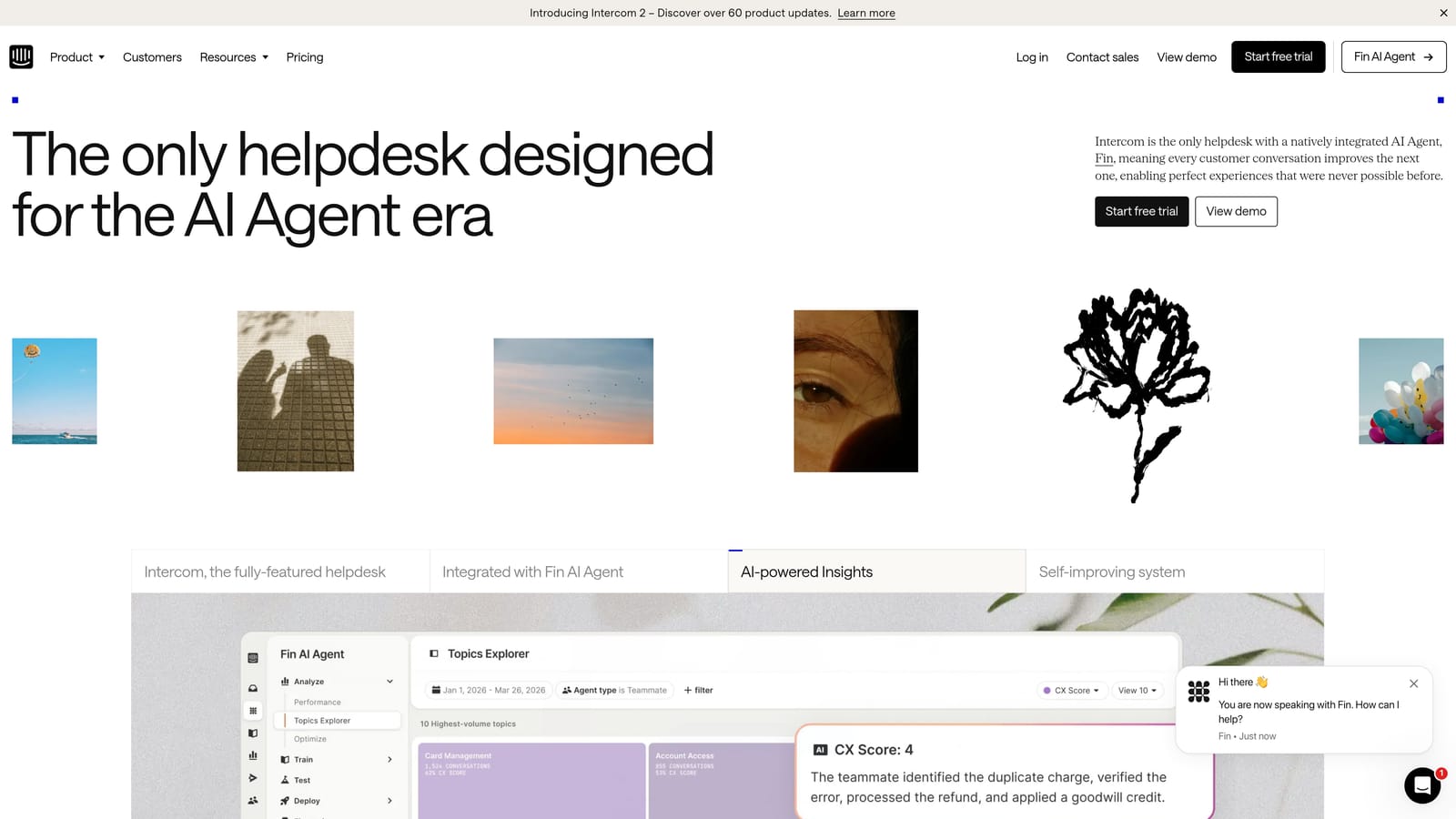
Intercom is a mature, all-in-one customer messaging and support platform widely adopted across SaaS, featuring a capable AI agent and strong in-app engagement tools.
Where This Tool Shines
Intercom's Fin AI agent is one of the more capable autonomous resolution tools on the market, built on large language models and able to handle a meaningful share of inbound queries without human involvement. For SaaS teams, the combination of AI-powered support and native product tours, onboarding flows, and in-app messaging makes Intercom a platform that serves both support and product growth goals.
The integration marketplace is extensive, and the shared inbox includes solid team collaboration features. The main consideration is cost: Intercom can become expensive at scale, and pricing has been a recurring complaint in user reviews. It's better suited for mid-market teams with the budget to match than early-stage startups watching every line item.
Key Features
Fin AI Agent: Autonomously resolves inbound queries using large language models, with handoff to human agents when needed.
In-App Messaging and Product Tours: Native tools for onboarding flows, feature announcements, and contextual user guidance.
Extensive Integration Marketplace: Connects with hundreds of SaaS tools across CRM, analytics, and engineering categories.
Shared Inbox with Collaboration Tools: Assignment, tagging, internal notes, and team performance visibility.
Conversation Analytics: Reporting on resolution rates, response times, and AI performance.
Best For
Mid-market SaaS companies that want a single platform for support, onboarding, and in-app engagement. Teams already invested in the Intercom ecosystem will find the most value here.
Pricing
Starts at approximately $39/seat/month for the base plan; AI features and advanced capabilities are available on higher tiers, which can push costs significantly higher at scale.
3. Zendesk
Best for: Enterprise SaaS organizations with dedicated ops resources and complex support requirements
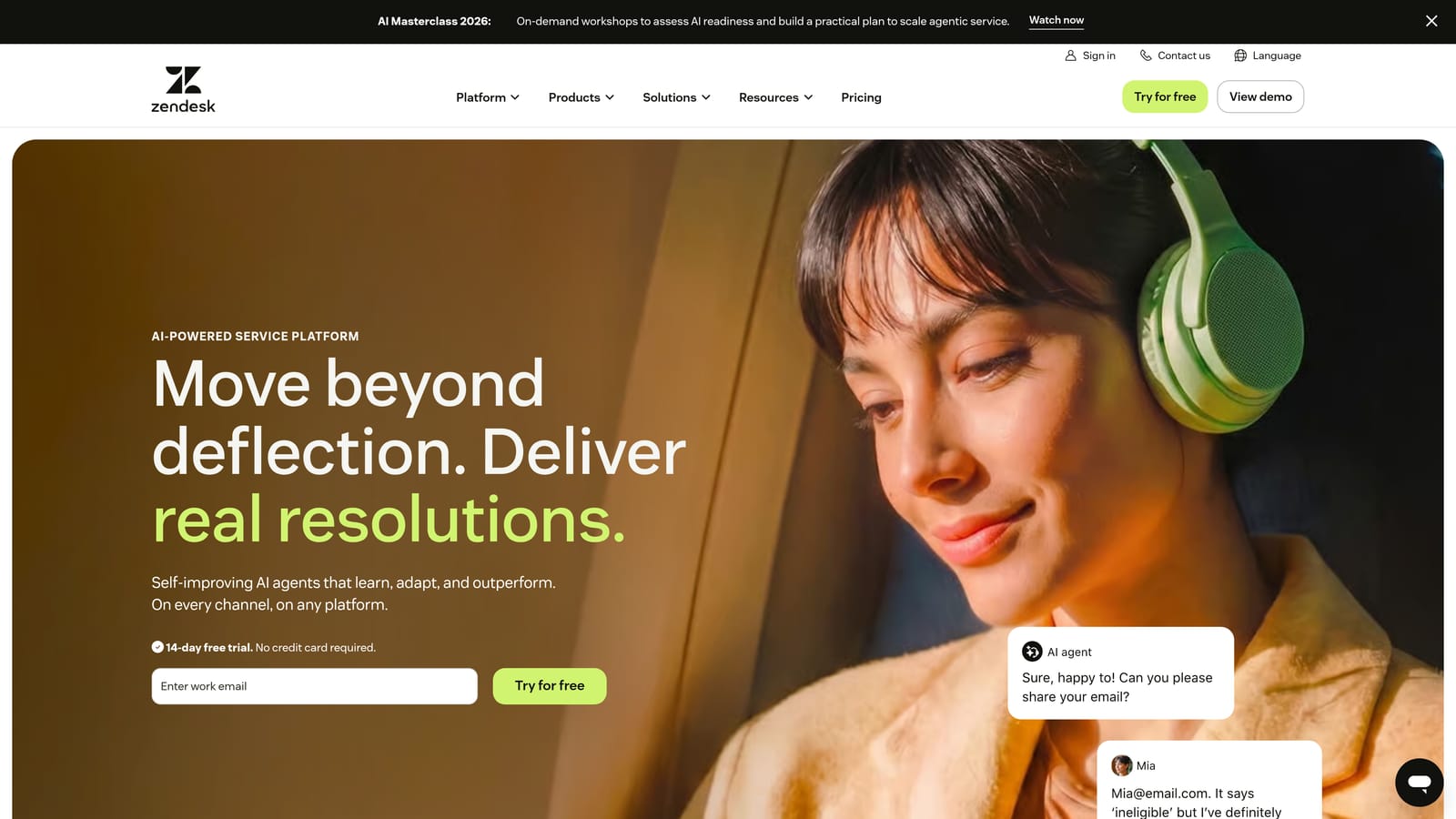
Zendesk is the enterprise standard in customer support software, offering deep configurability, a large app marketplace, and increasingly capable AI features built on their acquisition of Ultimate.ai.
Where This Tool Shines
Zendesk's strength is its configurability. SLA management, routing logic, custom ticket fields, reporting, and compliance controls are all highly customizable, making it a strong fit for organizations with complex support operations and the internal resources to manage them. The 1,000+ app marketplace means you can connect Zendesk to almost any tool in your stack.
The tradeoff is implementation complexity and cost. Teams without dedicated IT or operations resources often find Zendesk overwhelming to set up and maintain. It's a platform that rewards investment, which means it's best suited for companies at a stage where that investment makes sense.
Key Features
Configurable Ticketing System: Robust SLA management, custom fields, routing rules, and workflow automation at enterprise scale.
Zendesk AI: Agent assist, automated triage, and conversation intelligence powered by their AI layer.
1,000+ App Marketplace: Integrations spanning CRM, engineering, analytics, and communication tools.
Advanced Reporting Suite: Custom dashboards, team performance analytics, and conversation insights.
Enterprise Security and Compliance: SOC 2, GDPR, HIPAA-eligible configurations, and role-based access controls.
Best For
Enterprise SaaS companies and scale-ups with dedicated operations or IT teams. Organizations that need deep configurability, compliance controls, and a large integration ecosystem will find Zendesk worth the complexity.
Pricing
Suite plans start at approximately $55/agent/month; enterprise plans are priced significantly higher. Implementation and customization costs should also be factored in for larger deployments.
4. Freshdesk
Best for: SaaS startups and SMBs that need capable omnichannel support without enterprise pricing
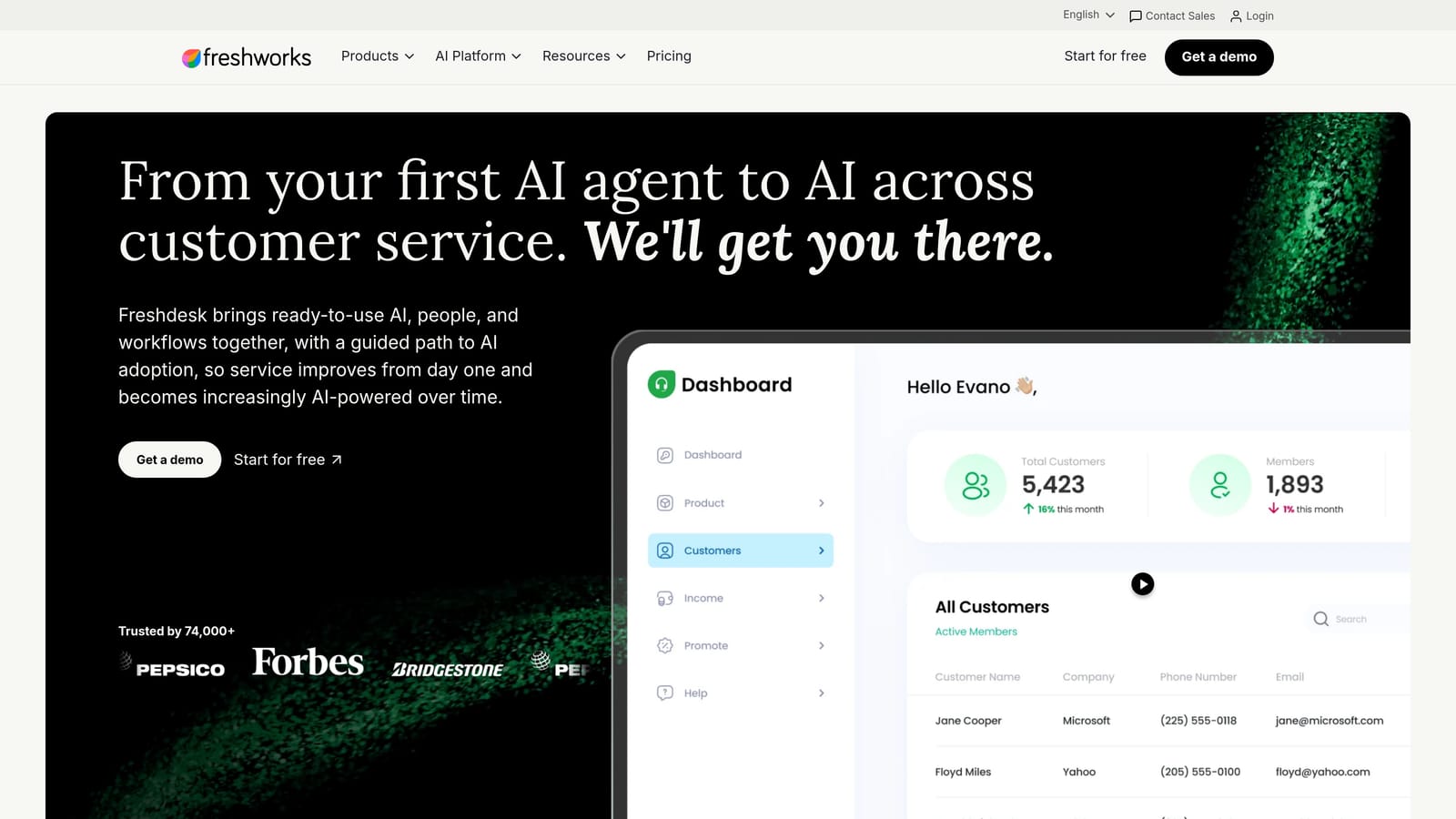
Freshdesk is a cost-competitive omnichannel helpdesk from Freshworks, with AI capabilities through its Freddy AI assistant and a free tier that makes it accessible for early-stage teams.
Where This Tool Shines
Freshdesk's value proposition is straightforward: a solid, full-featured support platform at a price point that doesn't require budget approval from the CFO. Omnichannel coverage across email, chat, phone, and social is included across most plans, and the Freddy AI assistant adds bot, agent assist, and predictive analytics capabilities on higher tiers.
For teams already using other Freshworks products like Freshsales (CRM) or Freshservice (ITSM), the native integration between products is a genuine advantage. The platform is less configurable than Zendesk and less AI-forward than newer entrants, but for teams that need a reliable helpdesk without complexity, it delivers well.
Key Features
Freddy AI: Covers bot, agent assist, and predictive analytics capabilities across support workflows.
Omnichannel Support: Email, chat, phone, and social channels included across most paid plans.
Free Plan: Available for small teams, making it accessible for early-stage startups testing their support stack.
Freshworks Ecosystem Integration: Native connectivity with Freshsales CRM and Freshservice ITSM for teams in the Freshworks ecosystem.
Automation and Workflow Builder: Rule-based routing, auto-assignment, and workflow automation across ticket lifecycle.
Best For
SaaS startups and SMBs looking for a capable, affordable helpdesk. Particularly strong for teams already using Freshworks products or those who want omnichannel coverage without the cost of Zendesk or Intercom.
Pricing
Free plan available; paid plans start at approximately $15/agent/month. Freddy AI features are available on higher tiers, so factor that in when comparing total cost.
5. Help Scout
Best for: SaaS teams that prioritize clean UX, fast onboarding, and human-feeling support interactions
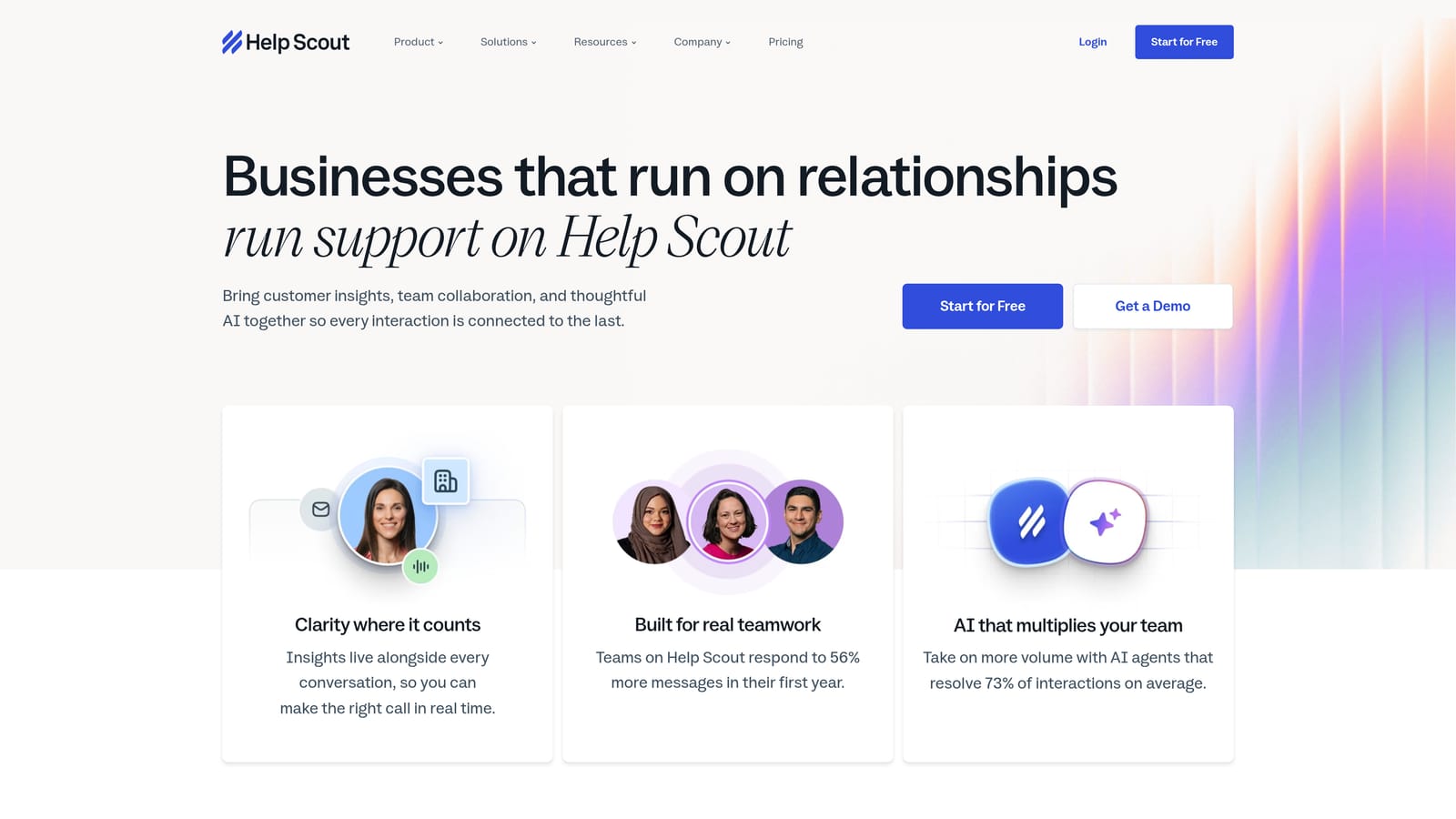
Help Scout is a deliberately simple shared inbox and knowledge base platform that has added AI drafting and summarization features while maintaining its reputation for straightforward pricing and fast setup.
Where This Tool Shines
Help Scout is built on a clear philosophy: support should feel human, and tools shouldn't get in the way. The result is a platform with an exceptionally clean interface, fast onboarding, and predictable pricing that teams actually enjoy using. Collision detection, internal notes, and the Docs knowledge base cover the core workflow needs without overwhelming agents with configuration options.
Recent additions of AI Drafts and AI Summarize have improved agent productivity without turning Help Scout into something it's not. The Beacon widget adds in-app contextual help and chat for SaaS products. If your team has been burned by complex platform implementations, Help Scout's intentional simplicity is genuinely refreshing.
Key Features
Shared Inbox with Collision Detection: Prevents duplicate replies with real-time visibility into who's working on which conversation.
Docs Knowledge Base: Built-in self-service knowledge base for reducing inbound ticket volume.
Beacon Widget: In-app help widget for contextual support and proactive chat in your SaaS product.
AI Drafts and AI Summarize: AI-assisted response drafting and conversation summarization to improve agent speed.
Simple Per-User Pricing: Predictable, flat pricing without complex tier structures or per-feature add-ons.
Best For
Small to mid-sized SaaS teams that value simplicity and fast implementation over deep configurability. Ideal for companies that have outgrown shared Gmail but don't need the complexity of Zendesk or Intercom.
Pricing
Starts at approximately $20/user/month, with straightforward per-user pricing across tiers.
6. Front
Best for: SaaS teams where support and account management overlap and agents live in email
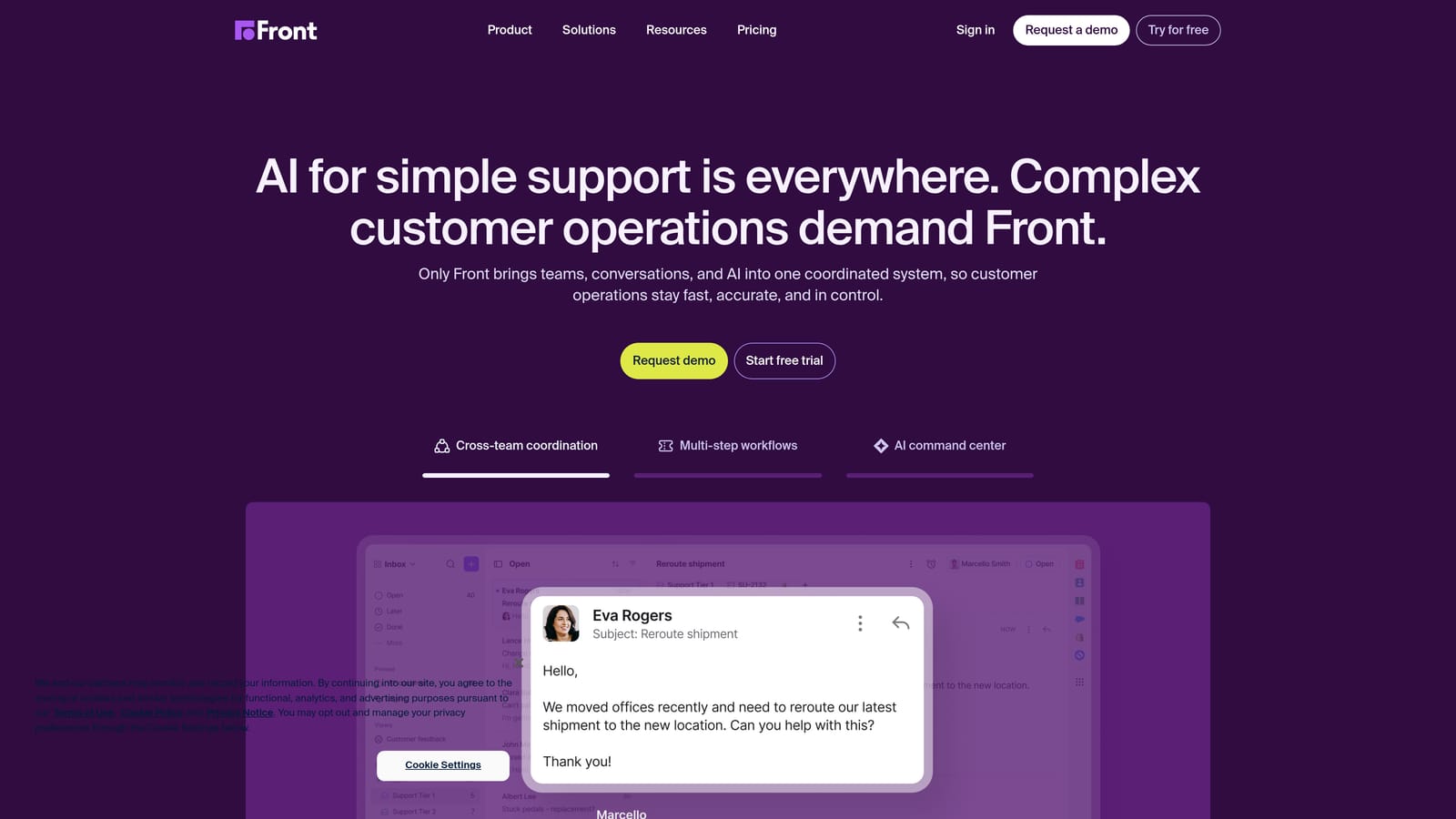
Front is an email-native collaborative inbox that layers helpdesk functionality on top of familiar email workflows, making it a natural fit for teams where support and customer success share the same conversations.
Where This Tool Shines
Front's core insight is that many support interactions, especially in B2B SaaS, happen in email and feel nothing like traditional ticketing. By building a collaborative inbox on top of email rather than replacing it, Front lets agents work in an environment that feels familiar while adding assignment, routing, SLA tracking, and internal comments on top.
The CRM-lite contact and account management features make Front particularly useful for teams where the same person handles both support and account management. Integrations with Salesforce, HubSpot, Jira, and similar tools extend its usefulness for SaaS workflows. The limitation is that Front isn't a traditional ticketing system, so teams that need complex ticket lifecycle management may find it constraining.
Key Features
Collaborative Shared Inbox: Assignment, tagging, internal comments, and shared drafts on top of familiar email workflows.
CRM-Lite Contact Management: Account and contact views that give agents customer context without leaving the inbox.
SLA Tracking and Routing Rules: Conversation routing and SLA monitoring for teams that need basic service level management.
AI Drafting and Summaries: AI-assisted response drafting and conversation summarization for faster replies.
SaaS Tool Integrations: Connects with Salesforce, HubSpot, Jira, and a range of other B2B SaaS tools.
Best For
SaaS teams where support and account management overlap, or where agents genuinely prefer working from an email-style interface. Less suited for high-volume support operations that need traditional ticketing workflows.
Pricing
Starts at approximately $19/seat/month; higher tiers unlock advanced analytics, automation, and integrations.
7. Groove
Best for: Early-stage SaaS teams that have outgrown shared email but aren't ready for enterprise helpdesk complexity
Groove is a lightweight shared inbox designed for small SaaS teams that need more than Gmail but less than Zendesk, with fast setup and flat-rate pricing options that appeal to budget-conscious early-stage companies.
Where This Tool Shines
Groove's positioning is honest and clear: it's a step up from managing support in a shared Gmail inbox, not a competitor to enterprise helpdesks. Setup is fast, training requirements are minimal, and the built-in knowledge base and live chat cover the core needs of a small support team without requiring dedicated ops resources to configure.
The flat-rate pricing model at certain tiers is a genuine differentiator for small teams watching per-agent costs. AI capabilities are limited compared to more mature platforms, so teams that need autonomous AI resolution or deep business intelligence will outgrow Groove quickly. But as a practical, no-fuss starting point for early-stage SaaS support, it does the job well.
Key Features
Shared Inbox with Automation: Basic routing, assignment, and automation rules for small team workflows.
Built-In Knowledge Base: Self-service documentation to reduce repetitive inbound queries.
Live Chat: Basic live chat widget for real-time customer support on your product or website.
Simple Reporting: Response time and team performance metrics without complex analytics configuration.
Fast Setup: Minimal configuration required; teams can be operational within hours rather than weeks.
Best For
Early-stage SaaS startups with small support teams, limited budgets, and a preference for simplicity. Groove is a practical bridge before a team is ready to invest in a more capable platform.
Pricing
Starts at approximately $16/agent/month, with flat-rate options at certain tiers that can be cost-effective for small teams.
8. Kustomer
Best for: Growth-stage SaaS companies with high ticket volumes and complex customer data infrastructure
Kustomer is a CRM-centric support platform that unifies every customer touchpoint into a single timeline view, making it particularly powerful for teams where understanding full customer context is critical to effective support.
Where This Tool Shines
Kustomer's defining feature is its unified customer timeline: every interaction across every channel, purchases, tickets, chats, calls, and more, aggregated into a single view. For SaaS companies with complex customer data and high ticket volumes, this context richness can meaningfully improve both resolution quality and agent efficiency.
The workflow automation builder handles complex routing logic well, and AI-powered intent detection and suggested responses reduce agent effort on high-volume queues. The premium pricing reflects the platform's positioning at the upper end of the market, and teams without significant customer data infrastructure may not get full value from the CRM-centric approach. But for growth-stage companies managing a large, complex customer base, Kustomer's depth is hard to match.
Key Features
Unified Customer Timeline: Aggregates all customer interactions across channels into a single, chronological view for full context.
AI Intent Detection and Suggested Responses: Automatically classifies incoming queries and surfaces relevant response suggestions for agents.
Workflow Automation Builder: Handles complex routing logic, escalation rules, and multi-step automation across ticket workflows.
Omnichannel Support: Email, chat, SMS, social, and voice channels managed from a single platform.
Deep CRM Data Integration: Pulls in customer data from connected CRM and billing systems for context-rich support interactions.
Best For
Growth-stage SaaS companies with high ticket volumes, complex customer data, and the budget to match Kustomer's premium positioning. Teams that need CRM-depth in their support platform will find the investment worthwhile.
Pricing
Starts at approximately $89/user/month, positioning Kustomer at the premium end of the market. Best evaluated alongside the operational value of its CRM-centric approach.
Which Tool Is Right for Your SaaS Team?
The right choice depends heavily on where your company is in its growth trajectory and what you need your support platform to do beyond just handling tickets.
If you're an early-stage startup that has outgrown shared email and needs something operational fast, Groove or Help Scout are the pragmatic choices. Both are quick to set up, easy to manage, and priced for teams that aren't yet ready to invest in enterprise tooling.
If you're a growing SaaS company that needs omnichannel support with reasonable AI capabilities and competitive pricing, Freshdesk and Front are strong contenders. Freshdesk wins on breadth and value; Front wins when support and account management overlap in the same team.
If you're at the enterprise end of the spectrum with dedicated ops resources and complex requirements, Zendesk remains the configurable standard. Intercom is the better choice when in-app onboarding and product engagement are as important as support resolution. Kustomer earns its premium pricing for teams where unified customer data is a genuine operational need.
And if you're a B2B SaaS team that wants to move beyond the traditional helpdesk model entirely, Halo AI is built for exactly that. Autonomous AI agents that resolve tickets end-to-end, page-aware context that sees what your users see, bug reports that route automatically to your dev tools, and business intelligence signals surfaced from your support conversations. That's not a feature list bolted onto a legacy platform; it's how Halo was designed from the ground up.
Your support team shouldn't scale linearly with your customer base. See Halo in action and discover how continuous learning transforms every interaction into smarter, faster support.