9 Best Help Desk AI Tools for Faster, Smarter Support in 2026
This guide evaluates the 9 best help desk AI tools available in 2026, comparing AI-first platforms against traditional AI-augmented helpdesks across key metrics like autonomous ticket resolution rates, integration depth, and deployment ease—helping B2B and SaaS support teams find the right solution for resolving tickets faster while scaling efficiently.
 Grant CooperFounder13 min read
Support teams are drowning in repetitive tickets while customers expect instant answers around the clock. Help desk AI tools have moved well beyond simple chatbots: today's platforms resolve tickets autonomously, surface business intelligence, and hand off complex issues to human agents without missing a beat.
The distinction that matters most in 2026 is the difference between AI-augmented helpdesks (traditional platforms with AI features added on) and AI-first platforms built from the ground up around autonomous resolution. B2B SaaS buyers are increasingly evaluating tools on autonomous ticket resolution rates, not just deflection rates. These are meaningfully different metrics.
This list covers nine of the strongest help desk AI tools available right now, evaluated on autonomous resolution capability, integration depth, ease of deployment, and value for B2B and SaaS teams. Whether you're running a lean support team or scaling a product-led growth motion, there's an option here built for your situation.
1. Halo AI
Best for: AI-first B2B SaaS teams wanting autonomous resolution and business intelligence in one platform.
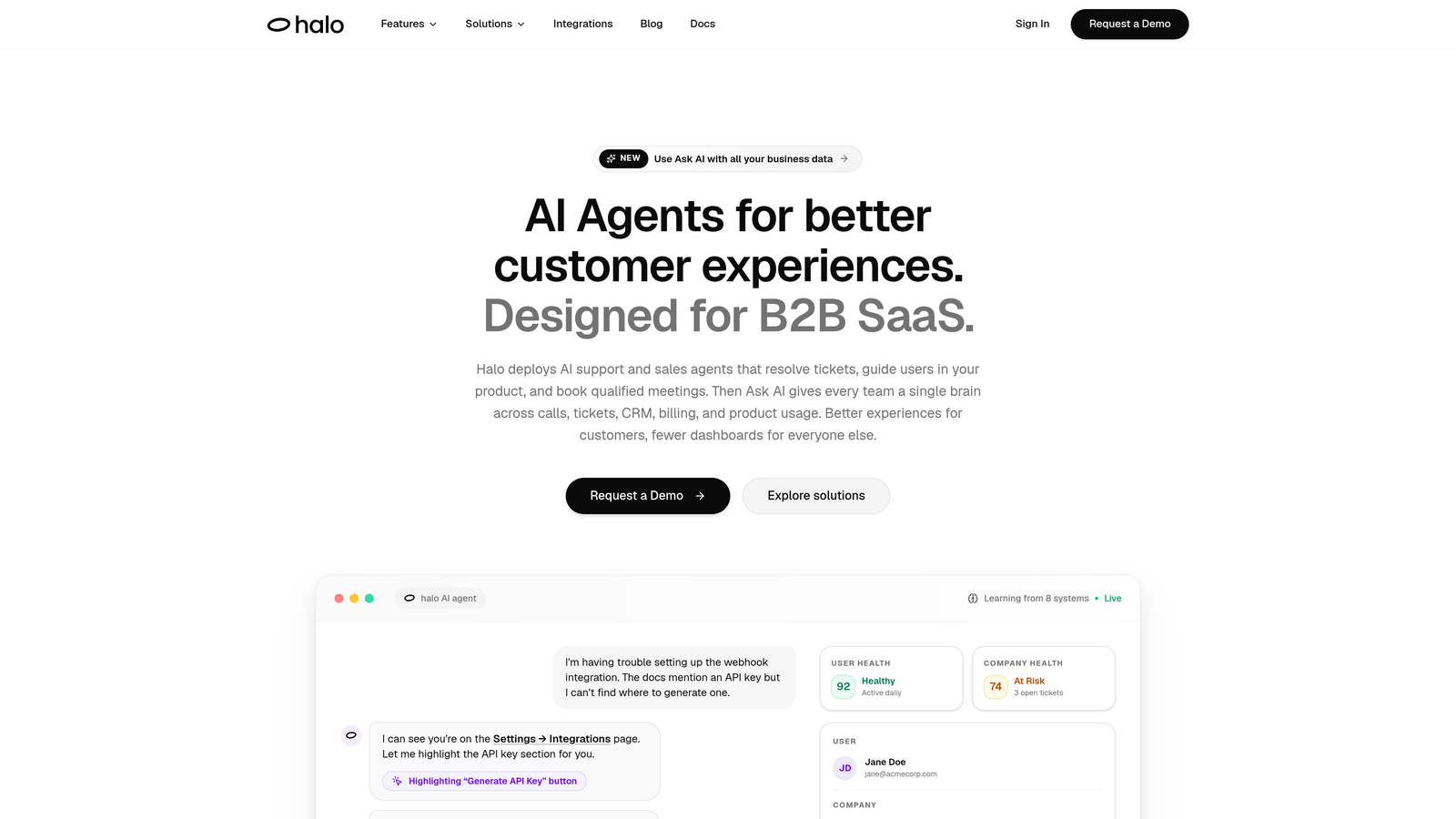
Halo AI is an AI-first customer support platform built specifically for B2B SaaS teams who want more than ticket deflection.
Where This Tool Shines
What sets Halo apart from most tools on this list is its page-aware context engine. The AI agent literally sees what the user sees inside your product, which means it can provide step-by-step visual guidance rather than generic help center links. That's a meaningful difference when your customers are stuck mid-workflow at 11pm.
Halo is also one of the few platforms that treats support as a source of business intelligence, not just a cost center. The smart inbox surfaces customer health signals, revenue anomalies, and product friction patterns alongside standard support metrics. Your support data starts informing decisions across product, sales, and engineering.
Key Features
Page-Aware Chat Widget: The AI sees the user's current product context and delivers precise, visual UI guidance rather than generic answers.
Intelligent AI Agents: Autonomous ticket resolution with a continuous learning loop that improves resolution quality with every interaction.
Smart Inbox with Business Intelligence: Customer health signals, anomaly detection, and revenue intelligence surfaced directly in the support inbox.
Auto Bug Ticket Creation: Product issues are automatically detected and routed to engineering via Linear integration, without manual triage.
Live Agent Handoff: Complex escalations transfer seamlessly to human agents with full context preserved.
Deep Integrations: Connects to Slack, HubSpot, Intercom, Stripe, Zoom, PandaDoc, and Fathom for a unified view across your business stack.
Best For
B2B SaaS companies that want an AI-first support layer, not an AI add-on to an existing helpdesk. Particularly strong for product-led growth teams where support touches the entire customer lifecycle, from onboarding to expansion.
Pricing
Contact for pricing at haloagents.ai. Custom pricing based on team size and usage.
2. Zendesk AI
Best for: Teams already on Zendesk Suite who want to add AI without switching platforms.
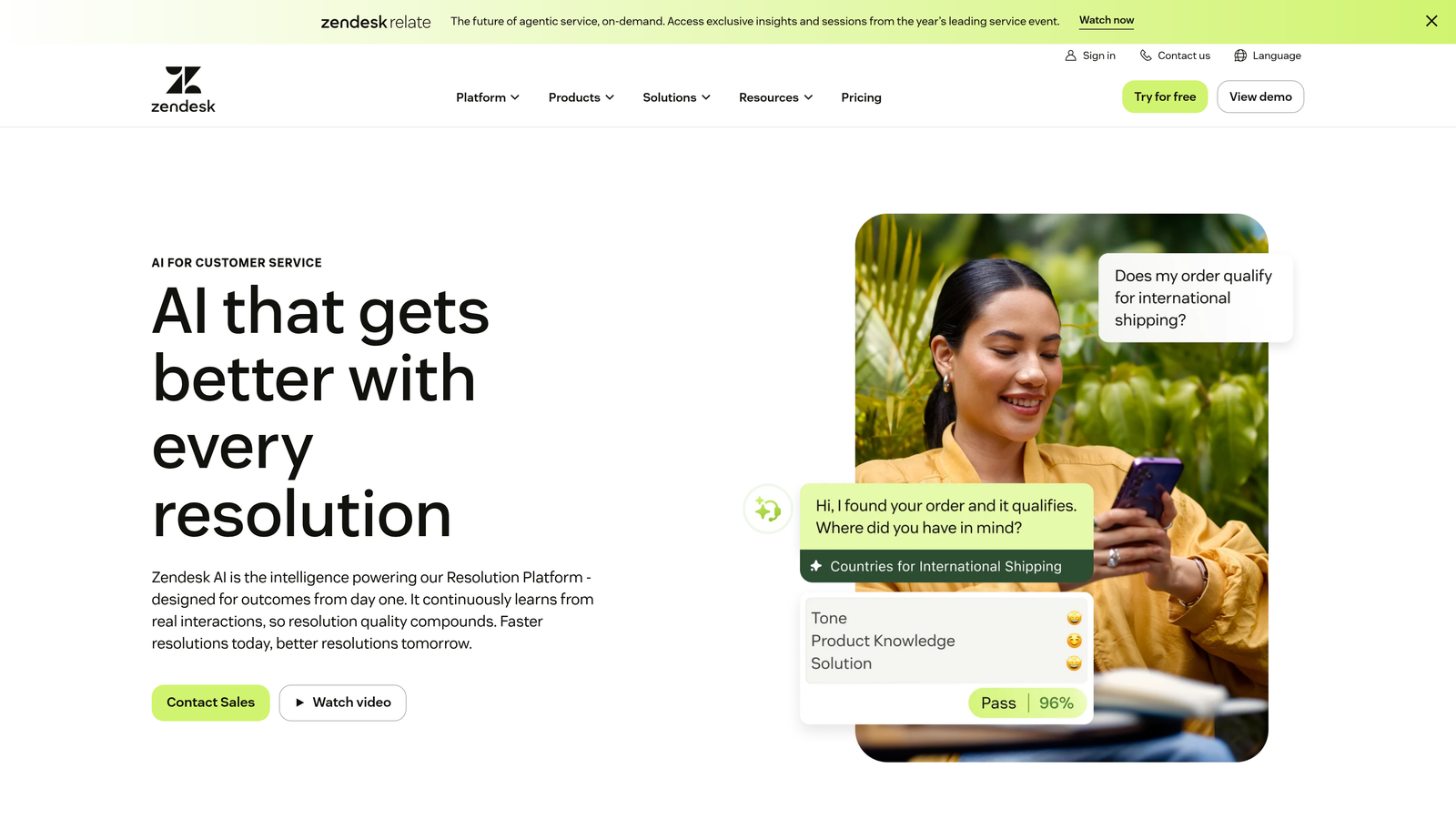
Zendesk AI is a native AI layer embedded across the Zendesk Suite, covering AI agents, intelligent triage, and an agent copilot for human reps.
Where This Tool Shines
If your team is already living inside Zendesk, the path of least resistance for adding AI is right here. Zendesk has deeply integrated AI into its Suite product over the past few years, and the result is a cohesive experience where AI agents, routing logic, and agent assist tools all share the same data model.
The agent copilot is particularly useful for complex tickets where full automation isn't appropriate. It surfaces suggested replies, next-best-action recommendations, and relevant knowledge base articles without requiring agents to context-switch.
Key Features
AI Agents: Automated ticket resolution across chat, email, and messaging channels without human involvement for common queries.
Intelligent Triage and Routing: Classifies incoming tickets by intent and sentiment, then routes them to the right team or workflow automatically.
Agent Copilot: Suggested replies and next-best-action guidance for human agents handling complex tickets.
Built-In Analytics and QA: Quality assurance tools and reporting built into the platform without third-party add-ons.
App Marketplace: Extensive ecosystem of integrations for teams with complex tech stacks.
Best For
Mid-market and enterprise teams already invested in the Zendesk ecosystem. Less compelling as a greenfield choice if you're evaluating platforms from scratch, where AI-first alternatives may offer more flexibility.
Pricing
Bundled with Zendesk Suite plans; Suite Team starts at approximately $55 per agent per month. AI features are available on higher tiers. Contact Zendesk for current enterprise pricing.
3. Intercom Fin
Best for: Companies with well-maintained knowledge bases seeking high resolution rates on tier-1 queries.
Intercom Fin is Intercom's dedicated AI agent, powered by large language models and trained on your help center content to resolve customer queries conversationally.
Where This Tool Shines
Fin's strength is conversational resolution quality. Because it's powered by large language models and grounded in your actual support content, it handles nuanced questions better than rule-based bots. Teams with comprehensive knowledge bases tend to see strong resolution rates on common tier-1 queries.
The handoff experience is also well-executed. When Fin can't resolve a query, the transition to a human agent is smooth, with full conversation context preserved so customers don't have to repeat themselves.
Key Features
LLM-Powered Resolution: Trained on your help center content and custom answers for contextually accurate responses.
Seamless Human Handoff: Escalates to a live agent with full conversation history when AI resolution isn't possible.
Multilingual Support: Handles queries in multiple languages out of the box without additional configuration.
Multichannel Deployment: Works across Intercom Messenger, email, and other connected channels.
Resolution-Based Pricing: You pay per resolved conversation rather than per seat, which aligns cost with value delivered.
Best For
Companies already on Intercom with a solid knowledge base. The per-resolution pricing model works well at moderate volumes but can become expensive at scale, so run the numbers before committing.
Pricing
Approximately $0.99 per resolution. A base Intercom plan is required separately. Pricing can add up quickly at high volumes.
4. Freshdesk Freddy AI
Best for: SMBs and growing teams in the Freshworks ecosystem looking for accessible AI across support and service.
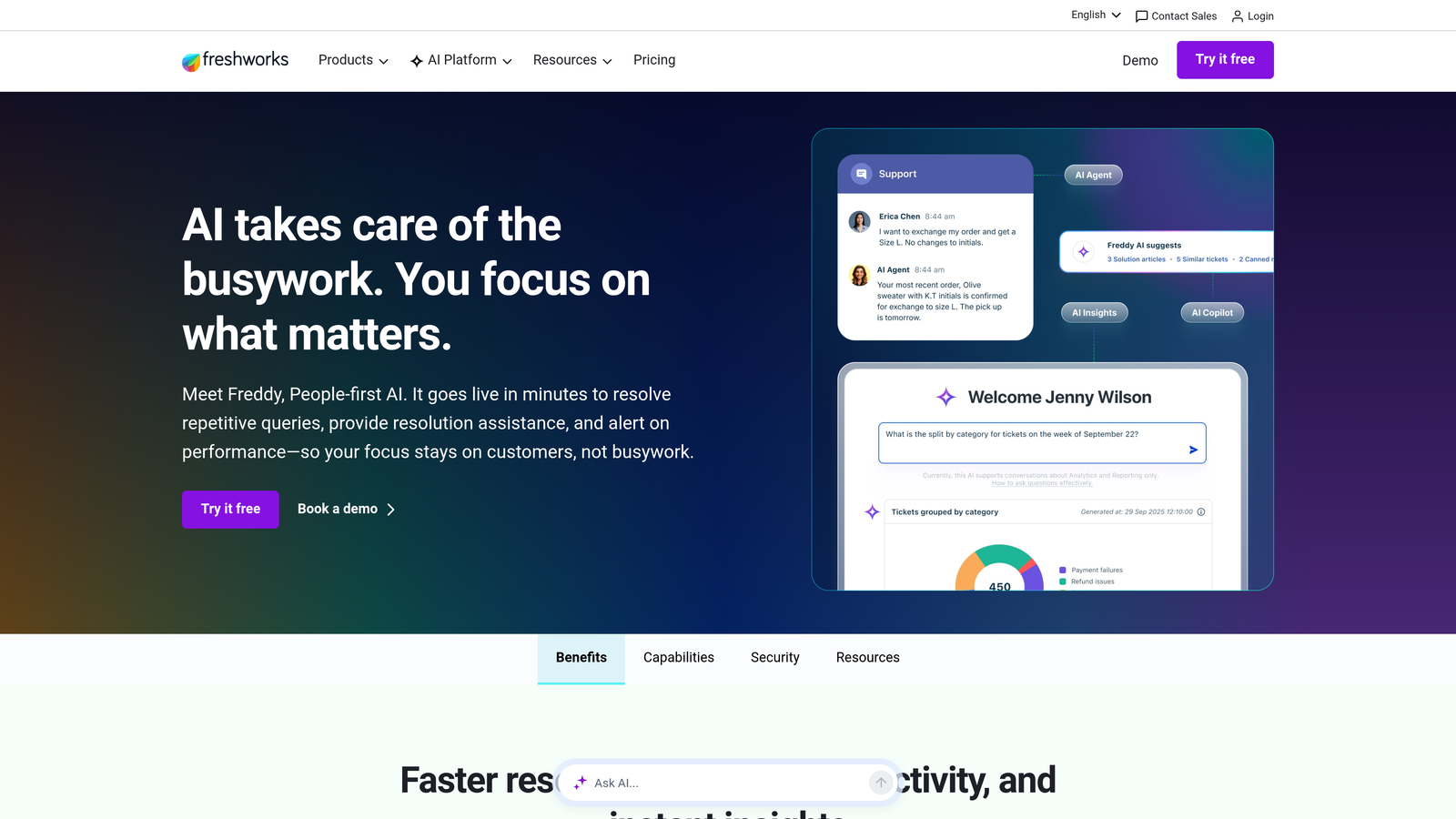
Freshdesk Freddy AI is Freshworks' AI layer spanning Freshdesk, Freshchat, and Freshservice, covering self-service bots, agent assist, and predictive support features.
Where This Tool Shines
Freddy AI's appeal is breadth at an accessible price point. It spans multiple Freshworks products, so teams using Freshdesk for tickets, Freshchat for live chat, and Freshservice for IT support get a consistent AI layer across all three without stitching together separate tools.
The predictive analytics through Freddy Insights is a standout feature for SMBs that typically don't have dedicated data teams. Anomaly detection and trend identification surface in a digestible format without requiring custom dashboards.
Key Features
Freddy Self Service: Customer-facing AI chatbot for deflecting common queries before they reach the queue.
Freddy Copilot: Agent assist with suggested replies, ticket summaries, and next-step recommendations.
Freddy Insights: Predictive analytics and anomaly detection across support volume and customer behavior.
Cross-Product Coverage: Consistent AI features across Freshdesk, Freshchat, and Freshservice.
SMB-Friendly Pricing: More accessible pricing tiers compared to enterprise-tier alternatives.
Best For
SMBs and mid-market teams already in the Freshworks ecosystem, or those evaluating Freshworks as their first helpdesk. Less compelling for teams outside the Freshworks stack.
Pricing
Freddy AI Copilot add-on starts at approximately $29 per agent per month on top of a base Freshdesk plan. Check Freshworks' pricing page for current tier details.
5. Salesforce Einstein for Service Cloud
Best for: Large enterprises needing unified AI across support, sales, and marketing on a single CRM platform.
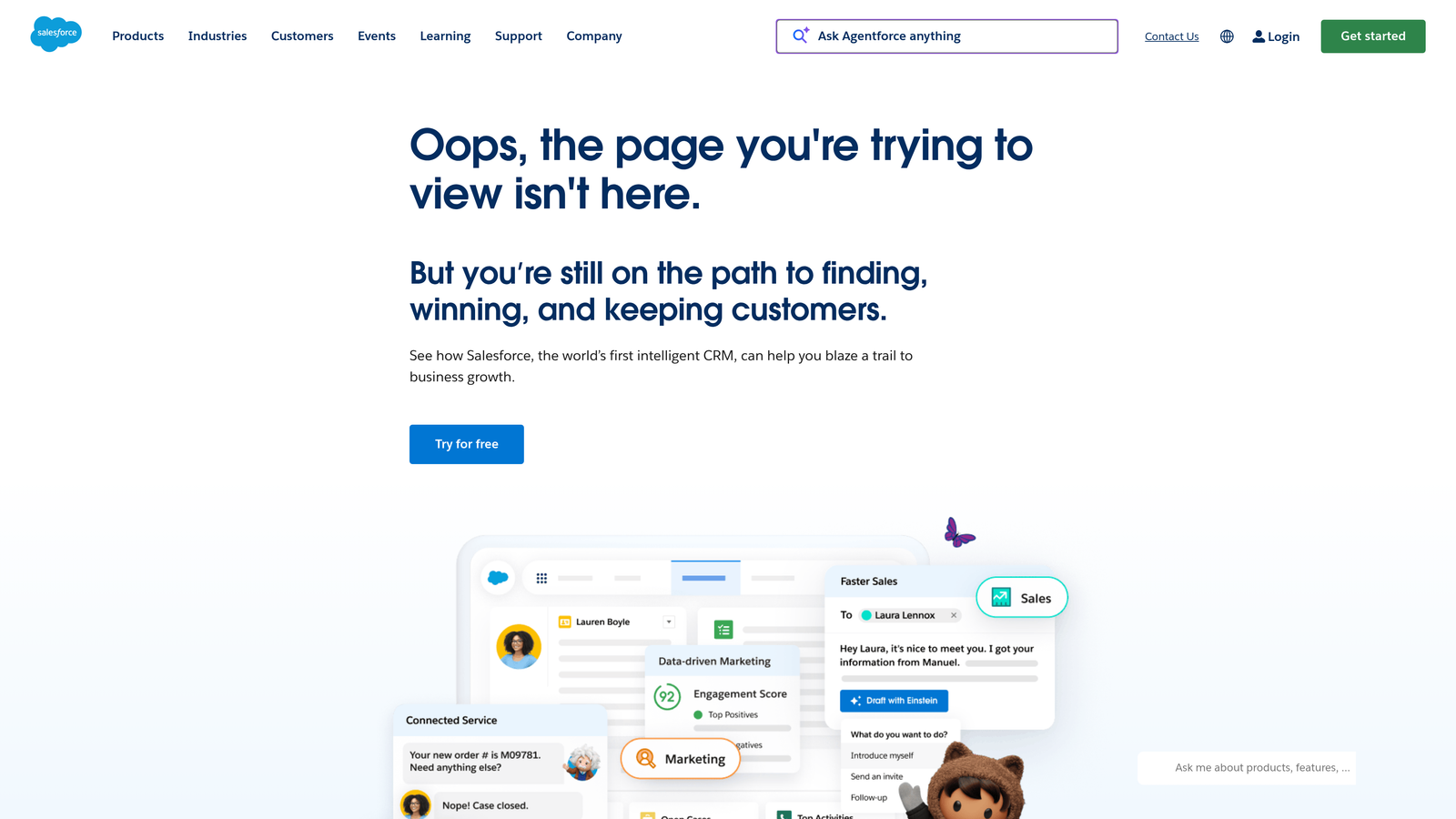
Salesforce Einstein for Service Cloud brings generative AI, case summarization, and next-best-action recommendations to enterprise support teams with deep CRM integration.
Where This Tool Shines
Einstein's defining advantage is access to the full Salesforce data model. When an AI agent or human rep handles a support case, they're working with unified context spanning sales history, marketing engagement, contract data, and prior support interactions. That level of context is difficult to replicate outside the Salesforce ecosystem.
For enterprises where support, sales, and customer success all need to operate from the same customer record, Einstein for Service Cloud is one of the few tools that genuinely delivers on that promise without heavy custom integration work.
Key Features
Einstein Copilot for Service: AI assistant for agents with full CRM context informing every suggestion and response.
Case Summarization: Auto-generated summaries and reply drafts reduce the time agents spend on documentation.
AI-Powered Routing and Classification: Intelligent case assignment based on content, history, and agent capacity.
Unified Customer Data: Sales, marketing, and service data combined in a single customer view.
Einstein Bots: Self-service automation for common queries with escalation paths to live agents.
Best For
Large enterprises already on Salesforce with dedicated Salesforce administrators. The implementation complexity and cost make it a poor fit for smaller teams or those without existing Salesforce infrastructure.
Pricing
Service Cloud plans start at approximately $25 per user per month (Starter). Einstein AI features require higher tiers. Contact Salesforce for enterprise pricing.
6. Help Scout AI
Best for: Smaller teams that want AI to make human agents faster, not replace them entirely.
Help Scout AI takes a deliberately human-first approach, using AI to augment agent productivity rather than automate tickets end-to-end.
Where This Tool Shines
Help Scout's AI features are practical and focused. AI Summarize condenses long email threads into the key points an agent needs to understand the situation quickly. AI Assist drafts reply suggestions that agents review and send. These aren't flashy features, but they solve real problems for teams handling high email volume.
The philosophy here is worth noting: Help Scout is explicitly not trying to remove humans from support. If your team values the human touch and sees AI as a productivity tool rather than a replacement, this alignment of values matters in practice.
Key Features
AI Summarize: Condenses long email threads into concise summaries so agents can get up to speed instantly.
AI Assist: Drafts reply suggestions for agents to review, edit, and send rather than generating fully automated responses.
AI Article Suggestions: Surfaces relevant knowledge base articles directly in the inbox as agents work on tickets.
Docs AI: Improves knowledge base search so customers find answers faster in self-service.
Human-First Design: AI supports and accelerates agents rather than operating autonomously.
Best For
Startups, small teams, and values-driven companies where the human support experience is a deliberate brand choice. Not the right fit for teams seeking high-volume autonomous resolution.
Pricing
Help Scout plans start at approximately $20 per user per month (Standard). AI features are included on Plus and Pro plans.
7. Tidio Lyro
Best for: Small businesses and e-commerce teams wanting affordable conversational AI with minimal setup.
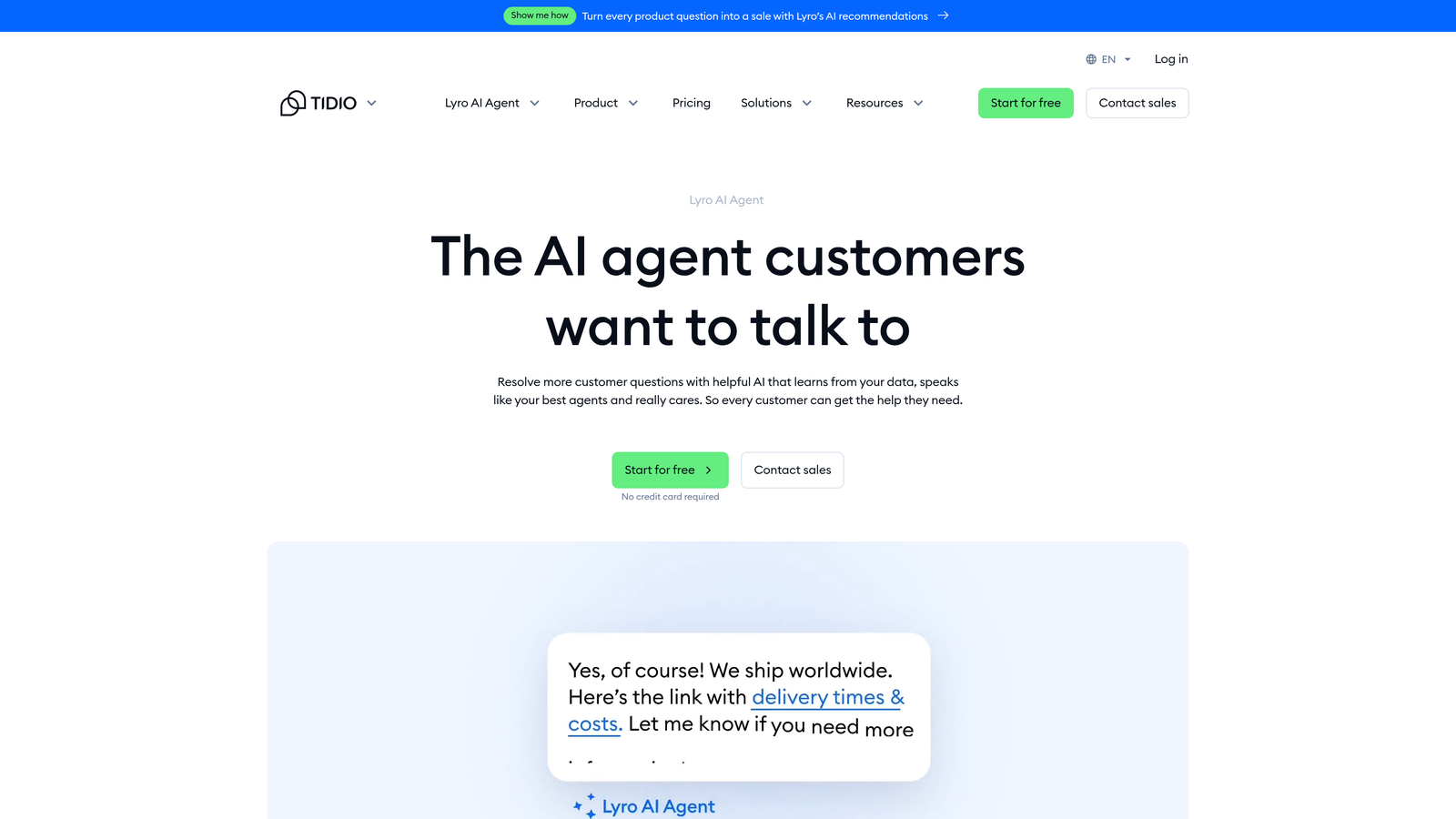
Tidio Lyro is Tidio's conversational AI product built for small businesses and e-commerce teams, offering low-code setup and accessible pricing to handle common customer queries automatically.
Where This Tool Shines
Lyro's biggest selling point is accessibility. You don't need an engineering team to deploy it. The setup process is designed for business owners and support managers who need something working quickly, trained on existing FAQ content and support documentation.
For e-commerce teams in particular, the Shopify and WooCommerce integrations mean Lyro can handle order status queries, return policy questions, and product information requests without any agent involvement. That covers a significant chunk of typical e-commerce support volume.
Key Features
Conversational AI: Trained on your FAQ and support content to handle common queries in natural language.
Low-Code Setup: Deployable without engineering resources, designed for non-technical teams.
Live Chat Fallback: Seamlessly transfers to a human agent when AI cannot resolve the query.
E-Commerce Integrations: Native connections to Shopify and WooCommerce for order and product context.
Affordable Entry Pricing: One of the most accessible price points on this list for small teams.
Best For
Small businesses, e-commerce stores, and teams with straightforward FAQ-style support needs. Less suited to complex B2B SaaS support scenarios requiring deep product context or business intelligence.
Pricing
Lyro AI is available from approximately $29 per month on Tidio's Growth plan. Conversation volume limits apply at lower tiers.
8. Kustomer AI
Best for: D2C and consumer brands with high repeat-contact rates needing full customer timeline context.
Kustomer AI layers AI features onto a CRM-first helpdesk platform, giving AI agents and human reps a complete view of every customer interaction across channels and time.
Where This Tool Shines
Kustomer's differentiator is its customer timeline model. Rather than treating each ticket in isolation, every interaction lives in a unified customer record spanning chat, email, social, SMS, and voice. When AI processes an incoming query, it has access to the customer's full history, which makes responses more contextually relevant.
For consumer brands where customers contact support repeatedly across their lifecycle, this historical context is genuinely valuable. An AI that knows a customer had a frustrating experience last month can calibrate its response accordingly.
Key Features
AI-Powered Intent Detection and Routing: Classifies incoming contacts by intent and routes them to the appropriate workflow or team.
Full Customer Timeline: Complete interaction history across all channels informs both AI and human agent responses.
Automated Workflows: AI classification triggers downstream automations for common contact types.
AI-Assisted Reply Drafting: Suggested responses for agents with full customer context factored in.
Omnichannel Coverage: Unified inbox across chat, email, social, SMS, and voice.
Best For
D2C and consumer brands with high-volume, repeat-contact support patterns. The CRM-first model is less relevant for B2B SaaS teams where ticket context is more product-centric than relationship-centric.
Pricing
Kustomer plans start at approximately $89 per user per month (Enterprise). Contact Kustomer for volume pricing.
9. Forethought
Best for: Enterprise teams with significant existing helpdesk investment who want AI augmentation without platform migration.
Forethought is an AI layer that plugs into existing helpdesks, including Zendesk, Salesforce, and ServiceNow, adding intelligent triage, routing, and resolution capabilities on top of your current platform.
Where This Tool Shines
Forethought's value proposition is additive rather than replacement. If your team has years of workflow configuration, custom fields, and institutional knowledge built into Zendesk or Salesforce, the prospect of migrating to a new platform is daunting. Forethought lets you keep what you have and add meaningful AI capabilities on top.
The Discover AI component is particularly useful for operations teams. It identifies the top drivers of ticket volume and surfaces knowledge gaps, giving support leaders data to make decisions about documentation investment and product improvements.
Key Features
Triage AI: Classifies and routes incoming tickets automatically on arrival before any human touches them.
Solve AI: Resolves common queries without agent involvement using your existing knowledge base content.
Assist AI: Surfaces relevant knowledge and suggested replies for agents handling complex tickets.
Discover AI: Identifies top ticket drivers and knowledge gaps to guide documentation and product decisions.
Broad Helpdesk Integrations: Connects with Zendesk, Salesforce, ServiceNow, and other major platforms without requiring migration.
Best For
Enterprise support teams with deep existing helpdesk investments who want to add AI capabilities without disrupting established workflows. Less relevant for teams evaluating their first support platform.
Pricing
Contact Forethought for pricing. Typically enterprise-tier and usage-based. Not publicly listed.
Which Tool Is Right for Your Team
The right help desk AI tool depends less on feature checklists and more on where your team sits today and where you're trying to go.
If you're building or scaling a B2B SaaS support operation and want an AI-first architecture with page-aware context, business intelligence, and deep integrations across your product stack, Halo AI is the strongest starting point. It's built for the specific challenges SaaS teams face, not adapted from a generic helpdesk model.
For teams with existing platform investments, here's a quick orientation by use case:
Enterprise Zendesk shops: Zendesk AI is the natural path forward without platform disruption.
High-volume tier-1 deflection: Intercom Fin delivers strong conversational resolution rates when your knowledge base is well-maintained.
SMB teams on a budget: Freshdesk Freddy AI and Tidio Lyro both offer accessible entry points with meaningful AI capability.
CRM-heavy enterprise teams: Salesforce Einstein for Service Cloud is the logical choice when support needs to share data with sales and marketing.
Agent productivity focus without full automation: Help Scout AI is purpose-built for teams that want to make humans faster, not remove them.
Stack augmentation without migration: Forethought adds AI on top of what you already have.
Consumer and D2C brands: Kustomer AI's full customer timeline model fits high-volume, repeat-contact support patterns well.
Your support team shouldn't scale linearly with your customer base. Let AI agents handle routine tickets, guide users through your product, and surface business intelligence while your team focuses on complex issues that need a human touch. See Halo in action and discover how continuous learning transforms every interaction into smarter, faster support.