9 Best Help Desk Automation Vendors in 2026
This guide evaluates nine leading help desk automation vendors in 2026, comparing AI capability, integration depth, and deployment ease to help B2B support teams move beyond manual triage toward end-to-end ticket resolution—whether you're implementing your first automation layer or upgrading from legacy infrastructure.
 Matt PattoliFounder14 min read
If your support team is drowning in repetitive tickets, slow response times, and manual triage, the problem isn't headcount—it's tooling. Help desk automation vendors have matured significantly, moving well beyond simple rule-based macros into AI-driven agents that resolve tickets end-to-end, detect patterns across conversations, and hand off to humans only when it truly matters.
But not all vendors are built the same. Some bolt AI onto legacy helpdesk infrastructure. Others are built AI-first from the ground up. Some excel at enterprise-scale routing; others are purpose-built for fast-growing SaaS teams. The right choice depends on your stack, your ticket volume, and how much autonomous resolution you actually want.
This list covers nine of the strongest help desk automation vendors available in 2026, evaluated on AI capability, integration depth, ease of deployment, and real-world fit for B2B product teams. Whether you're evaluating your first automation layer or replacing a legacy platform, this guide will help you cut through the noise. For deeper context on why this matters, see our guides on customer support team capacity limits and rising support costs.
1. Halo AI
Best for: B2B SaaS teams wanting AI-first autonomous support without a legacy helpdesk foundation
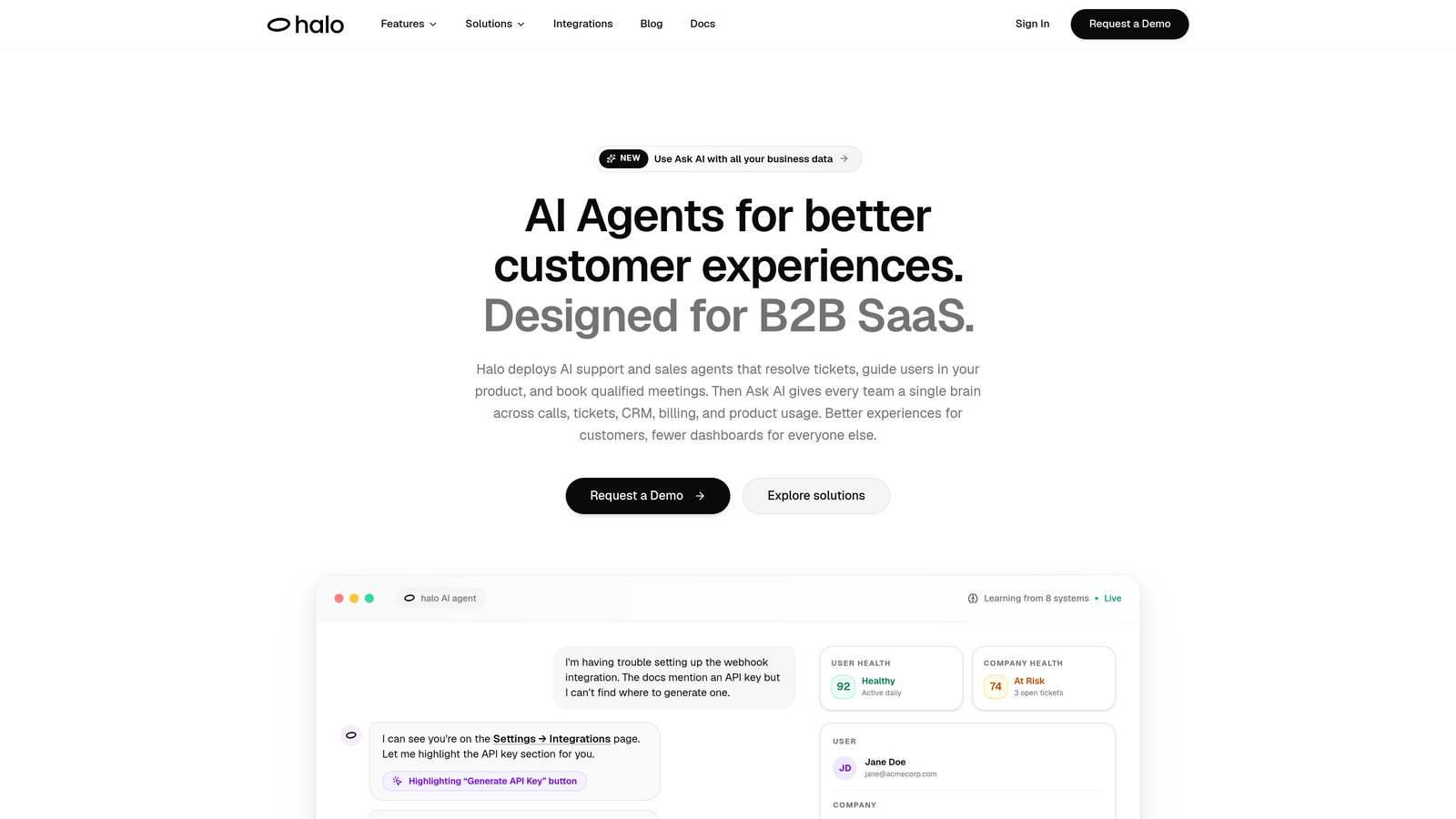
Halo AI is an AI-first customer support platform that deploys autonomous agents to resolve tickets, guide users through your product in real time, and surface business intelligence across your entire customer base.
Where This Tool Shines
What sets Halo apart from most vendors on this list is architectural. Rather than layering AI onto an existing ticketing system, Halo was built AI-first from the ground up. That distinction matters in practice: the platform doesn't just suggest replies or categorize tickets—it resolves them autonomously, learning from every interaction to get smarter over time.
The page-aware chat widget is a genuinely differentiated capability. The AI agent sees exactly what the user sees inside your product, enabling contextual, visual guidance that goes far beyond generic knowledge base answers. Combined with a smart inbox that surfaces customer health signals, revenue anomalies, and product friction patterns, Halo functions as a business intelligence layer, not just a support tool.
Key Features
Page-Aware Chat Widget: The AI agent sees the user's current in-app context, enabling precise, visual guidance rather than generic answers.
Autonomous Ticket Resolution: AI agents close tickets end-to-end with continuous learning from every resolved interaction, improving accuracy over time.
Auto Bug Ticket Creation: Automatically generates and routes bug reports directly to engineering tools like Linear, eliminating manual handoffs.
Smart Inbox with Business Intelligence: Surfaces customer health signals, revenue anomalies, and product friction patterns beyond standard support metrics.
Live Agent Handoff: Escalates to human agents with full conversation context preserved, so nothing gets lost in the transition.
Deep Integration Stack: Connects natively with Linear, Slack, HubSpot, Intercom, Stripe, Zoom, PandaDoc, and Fathom.
Best For
Halo is best suited for B2B SaaS companies and product-led teams that want genuine autonomous resolution rather than agent-assist features. It's particularly strong for teams whose support work overlaps with product, engineering, and revenue functions—where the smart inbox and bug-routing capabilities deliver value well beyond the support queue.
Pricing
Contact Halo AI directly at haloagents.ai for current pricing. Given the platform's AI-first architecture and business intelligence capabilities, pricing is best discussed based on your team's specific volume and use case.
2. Zendesk
Best for: Mid-market to enterprise teams wanting a proven, omnichannel helpdesk with AI add-ons
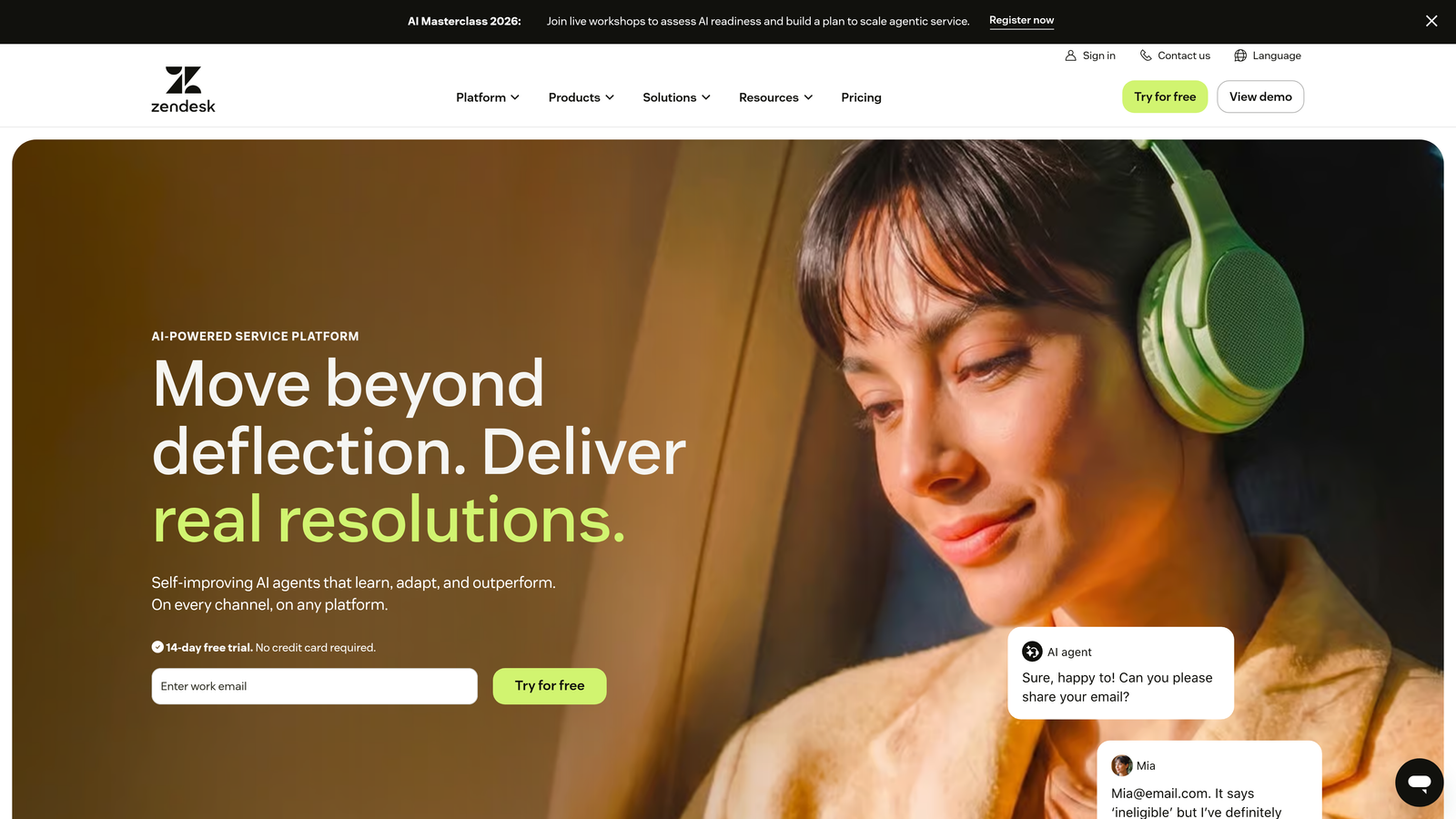
Zendesk is one of the most established helpdesk platforms globally, now with Zendesk AI layered on top of its core ticketing infrastructure for intelligent triage, sentiment analysis, and AI-generated replies.
Where This Tool Shines
Zendesk's primary strength is its maturity. The platform has been refined over many years, and its workflow capabilities, reporting dashboards, and omnichannel support coverage are genuinely comprehensive. For teams that need proven reliability at scale, it remains a strong foundation.
The app marketplace is another real advantage. With hundreds of integrations available, Zendesk can connect to most modern business stacks without custom development. The trade-off is complexity: at scale, Zendesk can require significant admin overhead to configure and maintain effectively.
Key Features
Zendesk AI: Provides intelligent triage, intent detection, and sentiment analysis to route and prioritize tickets automatically.
AI-Generated Reply Suggestions: Assists agents with draft responses based on ticket context and knowledge base content.
Extensive App Marketplace: Hundreds of pre-built integrations covering CRM, analytics, communication, and productivity tools.
Advanced Reporting Dashboards: Detailed analytics on ticket volume, resolution time, agent performance, and customer satisfaction.
Omnichannel Support: Unified inbox across email, chat, voice, and social media channels.
Best For
Zendesk is a strong fit for mid-market and enterprise teams that need a battle-tested, omnichannel platform and are comfortable with the configuration investment required. Teams already deep in the Zendesk ecosystem will benefit most from its AI add-ons.
Pricing
Suite plans start at approximately $55 per agent per month. AI features are available as an add-on, which increases the total cost of ownership meaningfully at larger team sizes.
3. Freshdesk
Best for: Growing teams wanting solid omnichannel support with built-in AI at accessible price points
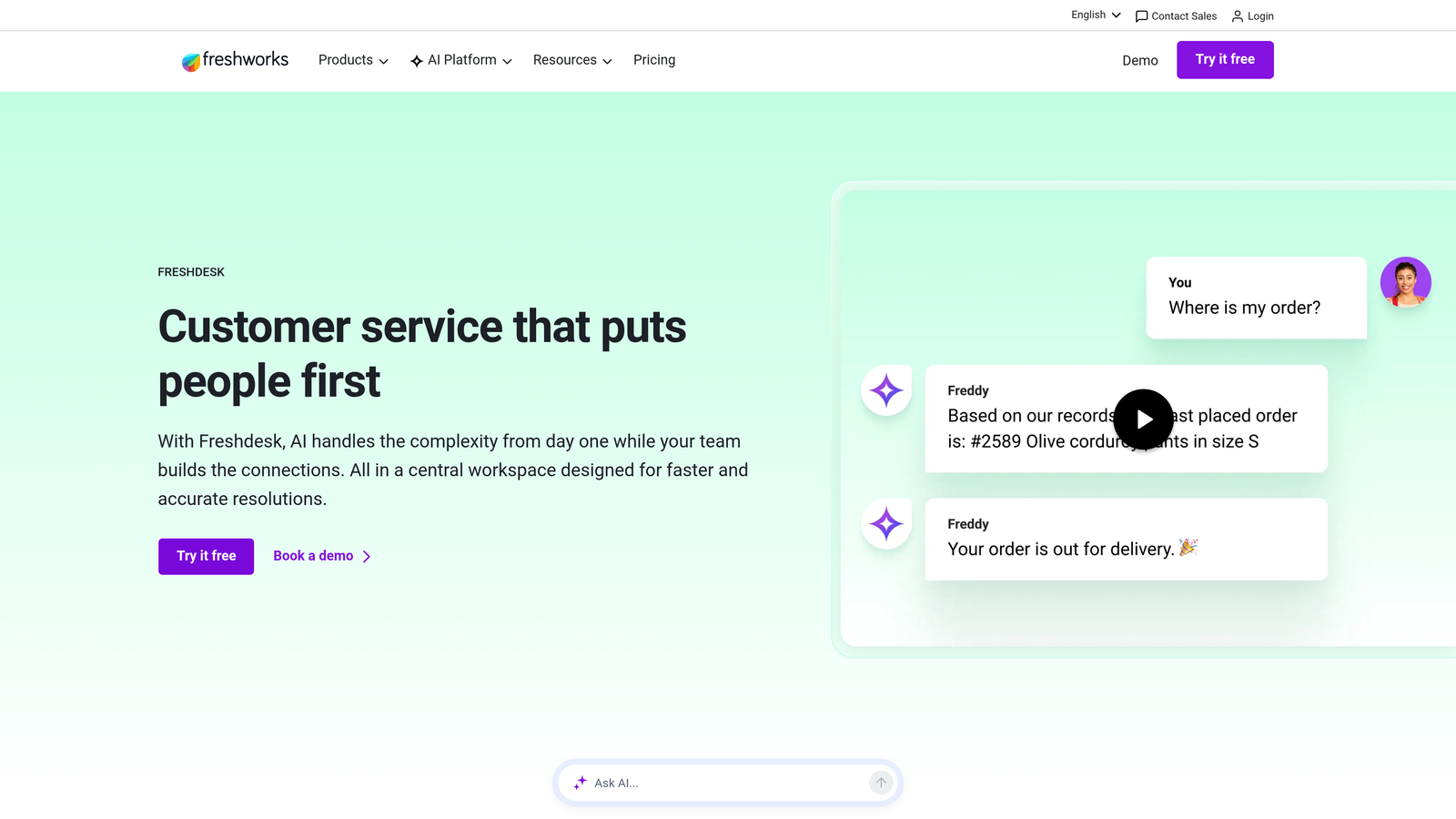
Freshdesk is a widely-used helpdesk platform with Freddy AI built in for auto-triage, suggested responses, and self-service bot deflection—offering strong value for teams scaling beyond basic email support.
Where This Tool Shines
Freshdesk's value proposition centers on accessible pricing combined with a meaningful feature set. Freddy AI handles the core automation tasks—categorizing tickets, assigning priorities, suggesting knowledge base articles during agent replies—without requiring a separate add-on purchase on most paid tiers.
The Freddy Self Service chatbot adds a deflection layer that can handle common queries before they reach an agent. For teams moving from purely manual email support to their first automation layer, Freshdesk offers a relatively smooth on-ramp with a free tier to get started.
Key Features
Freddy AI Triage: Automatically categorizes incoming tickets and assigns priority based on content and context.
Freddy Self Service: A chatbot for deflecting common support queries before they enter the agent queue.
AI-Suggested Knowledge Articles: Recommends relevant knowledge base content to agents while they're composing replies.
Free Tier: Available for small teams to get started without upfront cost commitment.
Best For
Freshdesk works well for teams in the SMB to mid-market range that want a complete omnichannel helpdesk with AI assistance built in. It's particularly appealing for teams price-sensitive about per-agent costs who still want meaningful automation capabilities.
Pricing
A free plan is available for small teams. Paid plans start from approximately $15 per agent per month, with Freddy AI features unlocked on higher tiers.
4. Intercom
Best for: Product-led SaaS companies wanting in-app messaging, proactive support, and autonomous AI resolution in one platform
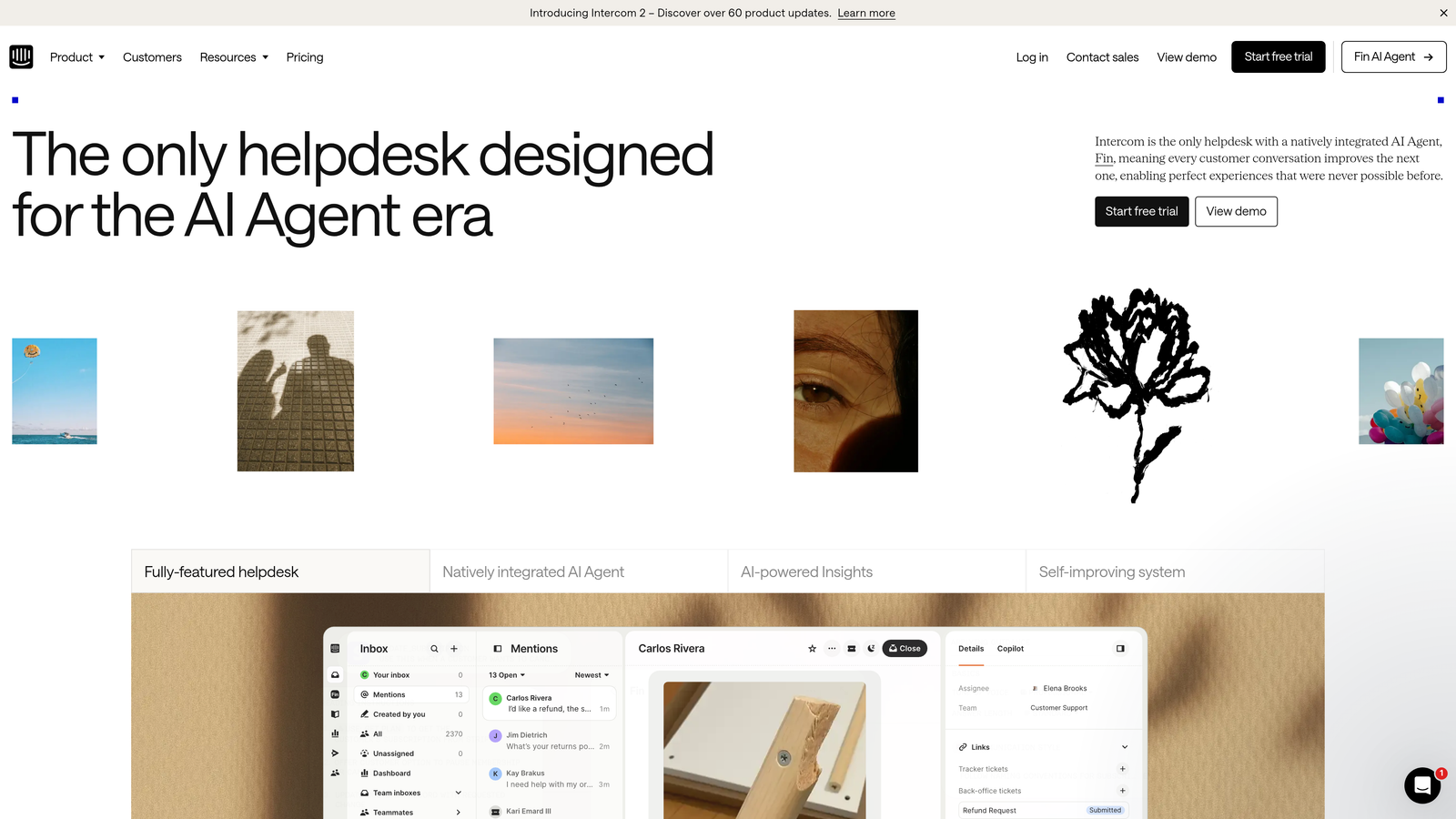
Intercom is a messaging-first customer platform with Fin AI Agent—an LLM-powered agent designed to resolve support conversations autonomously through the Intercom messenger.
Where This Tool Shines
Intercom's strength is the combination of support and product engagement in a single platform. Beyond resolving tickets, it supports product tours, proactive outbound messages, and in-app tooltips—making it useful for onboarding and retention workflows alongside reactive support. Fin AI Agent brings genuine autonomous resolution capability to that messenger experience.
The deep integration with product analytics and user data means Fin can access user context when resolving conversations, which improves answer relevance. For teams evaluating Intercom specifically, our comparison of Intercom vs. AI support agents is worth reading before you decide.
Key Features
Fin AI Agent: LLM-powered autonomous agent that resolves support conversations end-to-end through the Intercom messenger.
In-App Messaging and Product Tours: Supports proactive onboarding and engagement workflows alongside reactive support.
Product Analytics Integration: User data and behavior context available during support interactions.
AI-Assisted Drafts and Summaries: Shared inbox features to help human agents work faster on complex conversations.
Usage-Based Fin Pricing: Fin AI Agent is priced per resolution, linking cost directly to value delivered.
Best For
Intercom suits product-led SaaS teams that want a single platform for in-app messaging, proactive engagement, and AI-powered support. Teams already using Intercom for product communications will find the support layer a natural extension.
Pricing
Base plans start from approximately $39 per month. Fin AI Agent is priced per resolution, so costs scale with usage volume—worth modeling carefully for high-volume teams.
5. Salesforce Service Cloud
Best for: Enterprise teams deeply invested in the Salesforce ecosystem needing CRM-enriched support automation
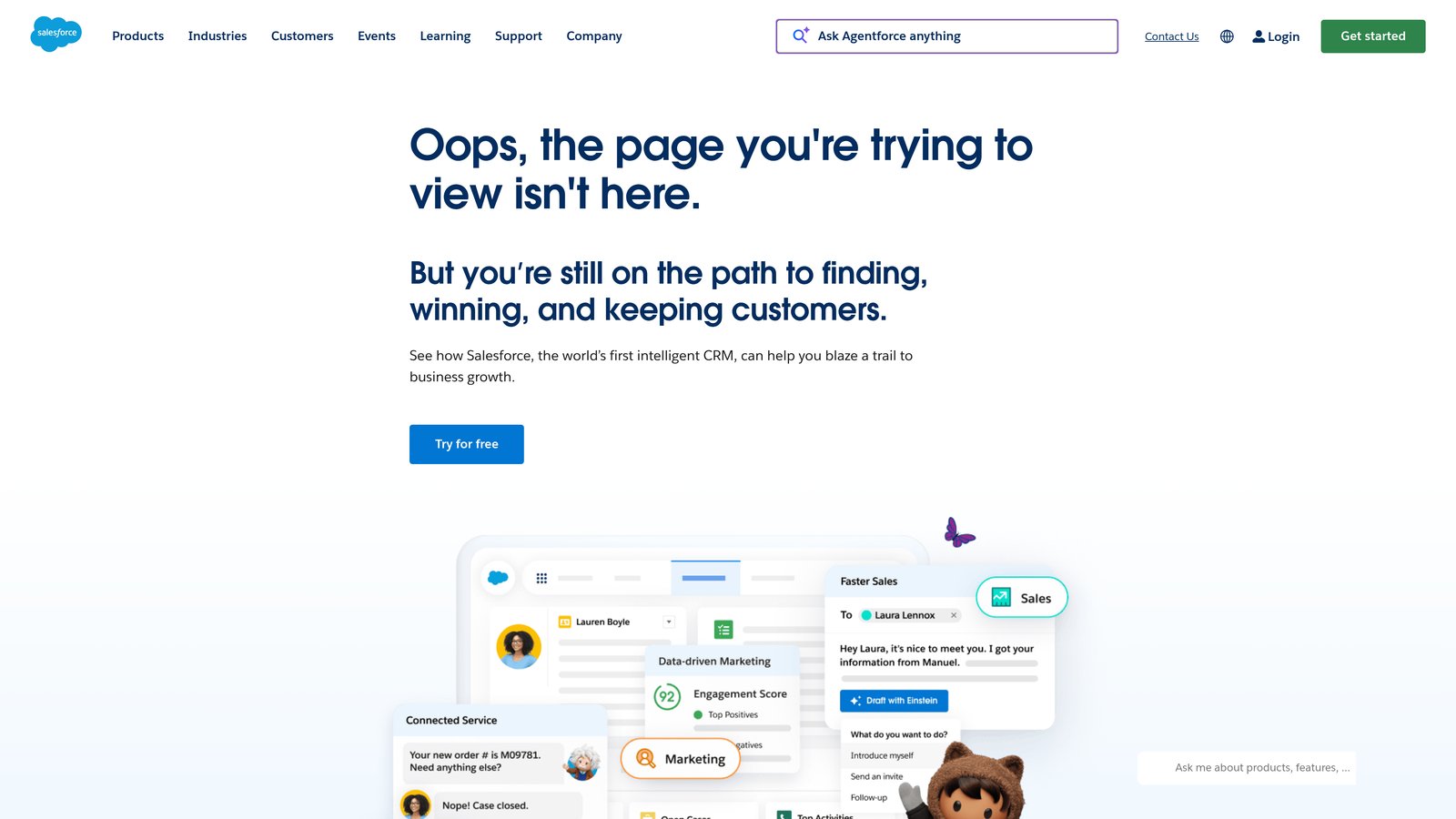
Salesforce Service Cloud is an enterprise-grade service platform with Einstein AI deeply integrated into the Salesforce CRM, enabling context-rich automation powered by full account and sales history.
Where This Tool Shines
The core advantage of Service Cloud is CRM depth. Every support interaction is enriched with account history, deal stage, and relationship context from Salesforce—something that typically requires custom integration work in other platforms. For enterprise sales-led organizations, that context changes what's possible in support automation.
Agentforce, Salesforce's autonomous AI agent product, extends this further by enabling complex, multi-step automated workflows that can span support, sales, and operations. The platform's power comes with corresponding complexity and cost, making it best suited for organizations already committed to the Salesforce ecosystem.
Key Features
Einstein AI: Case classification, next best action recommendations, and knowledge article suggestions powered by Salesforce data.
Agentforce: Autonomous AI agent workflows that operate across support and broader business processes.
Native CRM Integration: Every ticket enriched with full Salesforce CRM, Sales Cloud, and Marketing Cloud data.
Advanced SLA Management: Sophisticated escalation routing and service level agreement tracking for enterprise needs.
Flow Builder: Enterprise-scale workflow automation with conditional logic across the Salesforce platform.
Best For
Service Cloud is the right choice for large enterprises where support, sales, and account management share data in Salesforce. Teams outside the Salesforce ecosystem will find the cost and implementation overhead difficult to justify.
Pricing
Enterprise plans start from approximately $165 per user per month, with pricing varying significantly based on configuration, add-ons, and negotiated contracts at enterprise scale.
6. HubSpot Service Hub
Best for: Revenue-aligned teams where support and sales share customer context in HubSpot CRM
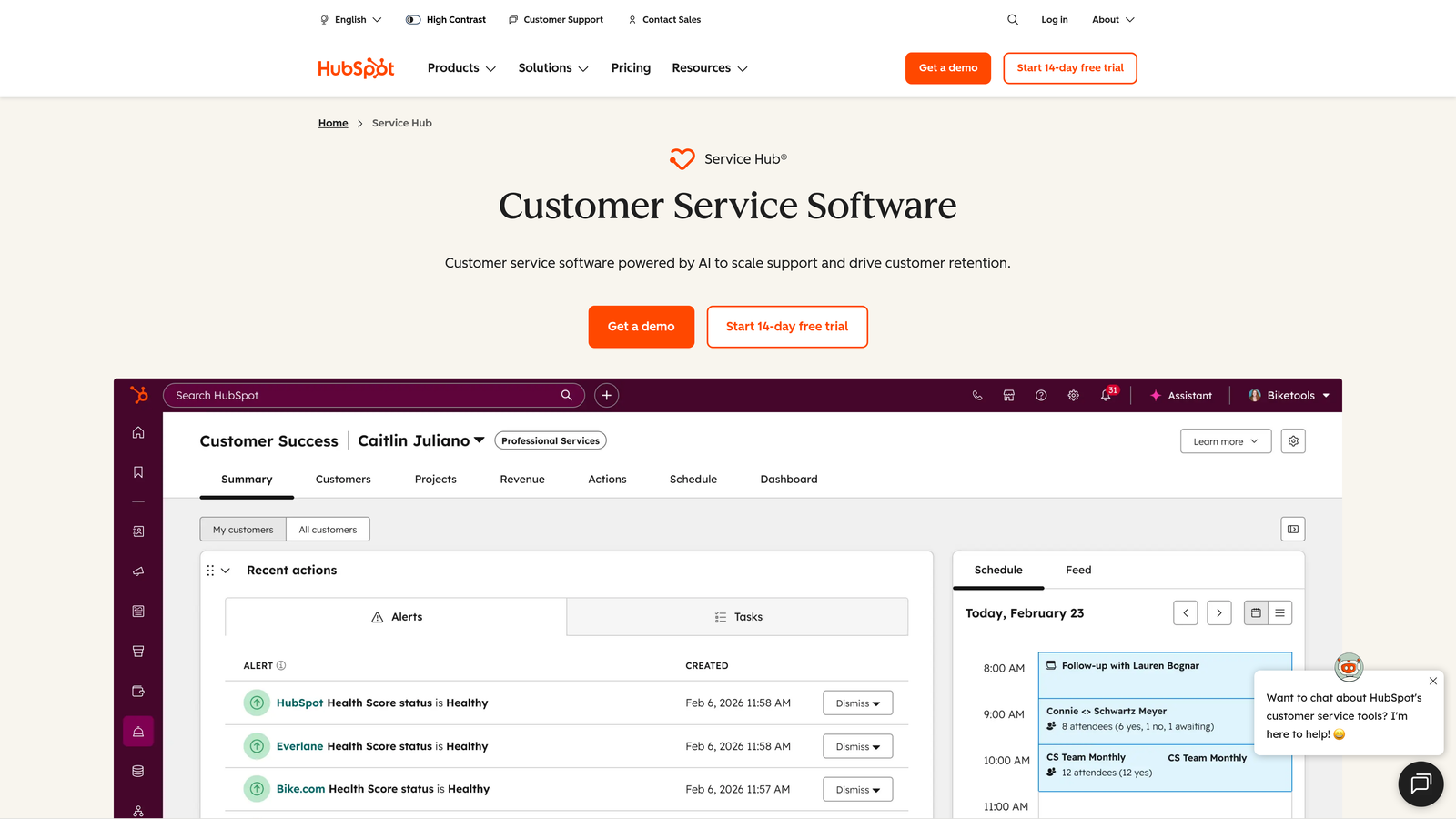
HubSpot Service Hub sits natively on top of HubSpot CRM, giving support teams full customer context—deal history, lifecycle stage, contact data—on every ticket without any integration work required.
Where This Tool Shines
Service Hub's strongest argument is context without complexity. Because it lives inside HubSpot CRM, every support ticket automatically carries contact data, company information, deal history, and lifecycle stage. For teams where support and sales are tightly aligned, that eliminates a significant category of integration work and data silos.
The AI features—conversation summaries, AI-assisted reply drafts, and a chatbot builder with conditional logic—are practical rather than flashy. They speed up agent workflows without requiring heavy configuration. For teams already using HubSpot for marketing or sales, adding Service Hub is a natural, low-friction expansion.
Key Features
Native CRM Integration: Every ticket automatically enriched with HubSpot contact, company, and deal data—no integration required.
AI Conversation Summaries: Condenses long threads so agents get up to speed quickly without reading full histories.
AI-Assisted Reply Drafts: Generates draft responses agents can refine and send, reducing time per ticket.
Chatbot Builder: Visual, no-code chatbot with conditional logic and live agent handoff capability.
Customer Feedback Tools: CSAT and NPS surveys tied directly to contact records in the CRM.
Best For
HubSpot Service Hub is ideal for teams already using HubSpot for sales or marketing who want to extend that platform into support. It's particularly strong where customer success, support, and sales need to share context without custom integrations.
Pricing
Free tools are available for basic use. Paid tiers start from approximately $15 per month, with advanced AI features unlocked on Professional and Enterprise plans.
7. Tidio
Best for: Small SaaS teams and e-commerce businesses wanting fast deployment with conversational AI
Tidio is a lightweight, fast-to-deploy customer communication platform with Lyro AI—a conversational chatbot designed to handle common support queries with minimal setup time.
Where This Tool Shines
Tidio's defining characteristic is speed to value. Teams can typically have Lyro AI live and handling conversations within hours rather than weeks. For small teams without dedicated technical resources or complex infrastructure requirements, that deployment simplicity is a genuine differentiator.
Lyro AI is trained on your existing support content, which means it can start resolving common queries without extensive manual configuration. The visual chatbot flow builder lets non-technical team members customize conversation paths without writing code.
Key Features
Lyro AI Chatbot: Conversational AI trained on your support content for autonomous handling of common queries.
Visual Flow Builder: Drag-and-drop chatbot customization accessible to non-technical team members.
Unified Inbox: Live chat, email, and social media conversations managed in a single interface.
E-Commerce Integrations: Native Shopify integration and connections to common e-commerce platforms.
Fast Deployment: Typically live within hours, with no complex technical setup required.
Best For
Tidio is best suited for small SaaS teams, e-commerce businesses, and early-stage companies that want conversational AI without the implementation overhead of enterprise platforms. It's a strong starting point for teams handling relatively predictable, high-frequency query types.
Pricing
A free plan is available. Lyro AI is included on paid plans starting from approximately $29 per month, making it one of the more accessible AI-enabled options on this list.
8. Zoho Desk
Best for: Teams in the Zoho ecosystem wanting feature-rich automation at competitive pricing
Zoho Desk is a feature-rich helpdesk with Zia AI for sentiment analysis, anomaly detection, and response suggestions—particularly strong for teams already using Zoho's broader business suite.
Where This Tool Shines
Zoho Desk delivers a strong feature set relative to its price point, which makes it appealing for cost-conscious teams that don't want to compromise on capability. Zia AI goes beyond basic triage: its anomaly detection alerts teams to unusual ticket volume spikes or satisfaction drops before they become visible problems.
The Blueprint workflow automation is worth highlighting for teams with complex, multi-step support processes. It enables conditional, rule-based workflows that can span multiple teams and stages—without requiring developer involvement. For teams already using Zoho CRM or Zoho Analytics, the native integrations eliminate a category of data sync work entirely.
Key Features
Zia AI: Sentiment analysis, automatic ticket tagging, anomaly alerts, and response suggestions in a single AI assistant.
Blueprint Workflow Automation: Multi-step, conditional process automation for complex support workflows without coding.
Zoho Ecosystem Integration: Deep native connections with Zoho CRM, Analytics, and SalesIQ.
Omnichannel Support: Email, chat, phone, social media, and web forms in a unified inbox.
Competitive Pricing: Consistently priced below comparable tiers at Zendesk and Freshdesk.
Best For
Zoho Desk is the natural choice for teams already using other Zoho products. It also suits cost-conscious teams at the SMB to mid-market level who need solid automation and omnichannel coverage without enterprise-level pricing.
Pricing
A free plan is available for up to three agents. Paid plans start from approximately $14 per agent per month, making it one of the more affordable full-featured options on this list.
9. Help Scout
Best for: Small to mid-size teams that prioritize a human, collaborative support experience with AI working quietly in the background
Help Scout is a deliberately simple, human-feeling helpdesk that uses AI to assist agents behind the scenes—AI Summarize and AI Drafts speed up responses without making support feel robotic.
Where This Tool Shines
Help Scout occupies a distinct position in this list: it's intentionally not trying to automate everything. The platform is designed for teams that want to maintain a personal, human tone in their support while using AI to reduce the mechanical overhead—reading long threads, drafting initial responses, searching the knowledge base. That philosophy resonates strongly with teams where brand voice and customer relationship quality matter as much as resolution speed.
The shared inbox is clean and collaboration-focused, with customer profiles and full conversation history visible on every thread. For teams that have been burned by overly complex helpdesks, Help Scout's simplicity is a deliberate feature, not a limitation.
Key Features
AI Summarize: Condenses long email threads into quick context so agents can get up to speed without reading everything.
AI Drafts: Generates reply suggestions that agents can refine and send, preserving a human voice in responses.
Docs Knowledge Base: Built-in knowledge base with AI-powered search for self-service support.
Clean Shared Inbox: Collaboration-first inbox design without the complexity of enterprise ticketing systems.
Customer Profiles: Full conversation history and contact data visible on every support thread.
Best For
Help Scout works best for small to mid-size teams—particularly in SaaS, agencies, or professional services—where support quality and brand voice are priorities alongside efficiency. Teams that find enterprise helpdesks overwhelming will appreciate its deliberately simple approach.
Pricing
Plans start from approximately $22 per user per month. There is no free tier, though the pricing is competitive for the quality of the product at small team sizes.
Which Tool Is Right for Your Team?
The right help desk automation vendor depends less on feature checklists and more on where your team sits today and where you're trying to go.
If you're a B2B SaaS team that wants genuine autonomous resolution—not just agent-assist—and you need your support layer to connect with engineering, product, and revenue tools, Halo AI is built for exactly that. Its AI-first architecture, page-aware guidance, and business intelligence capabilities make it the strongest option for product teams that want support to be a growth lever, not just a cost center.
For teams already deep in Salesforce, Service Cloud is the obvious choice given the CRM depth it provides. For HubSpot-first teams, Service Hub delivers similar CRM-native advantages at a lower price point. If you're on a budget and need something live quickly, Tidio and Zoho Desk both offer strong value without heavy implementation overhead.
Zendesk and Freshdesk remain solid choices for teams that need proven omnichannel infrastructure and are comfortable with traditional helpdesk models. Intercom is worth a close look if in-app messaging and proactive support are as important as reactive ticket resolution. And for teams that prioritize simplicity and human-feeling support above all else, Help Scout delivers a clean, focused experience that doesn't try to automate everything.
Your support team shouldn't scale linearly with your customer base. Let AI agents handle routine tickets, guide users through your product, and surface business intelligence while your team focuses on complex issues that need a human touch. See Halo in action and discover how continuous learning transforms every interaction into smarter, faster support.