9 Best Helpdesk AI Automation Platforms in 2026
Helpdesk AI automation platforms have become essential B2B infrastructure, but the gap between AI-first and bolt-on solutions is significant. This guide ranks the 9 best helpdesk AI automation platforms of 2026, evaluating each on autonomous ticket resolution, integration depth, deployment ease, and suitability for B2B SaaS support teams.
 Matt PattoliFounder13 min read
Customer support teams are under more pressure than ever. Ticket volumes are climbing, customer expectations are rising, and most teams are working with the same headcount they had two years ago. Helpdesk AI automation platforms have moved from a nice-to-have to a core piece of B2B infrastructure, giving teams the ability to resolve tickets autonomously, surface business intelligence, and scale support without scaling costs.
But not all platforms are built the same. Some bolt AI onto legacy helpdesk infrastructure as an afterthought. Others are built AI-first, with autonomous agents that learn from every interaction and integrate deeply into your product stack. That architectural difference matters enormously when you're choosing a long-term foundation for your support operations.
Here are the top helpdesk AI automation platforms available in 2026, evaluated on autonomous resolution capability, integration depth, ease of deployment, and how well they serve B2B SaaS teams specifically.
1. Halo AI
Best for: B2B SaaS teams that want support to generate product and revenue intelligence, not just close tickets.
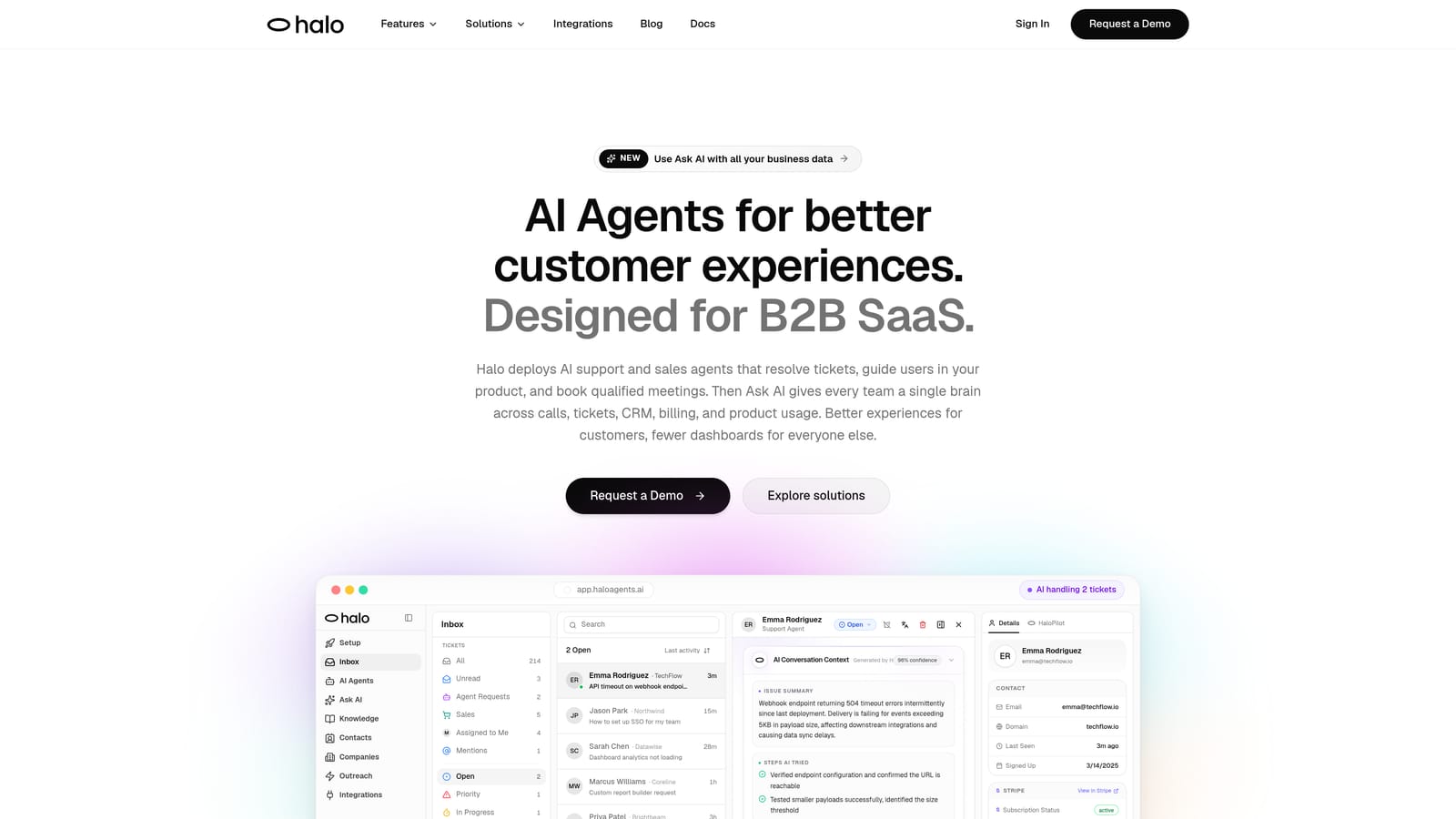
Halo AI is an AI-first customer support platform built from the ground up for autonomous ticket resolution, product guidance, and business intelligence.
Where This Tool Shines
What sets Halo apart from legacy helpdesks with AI bolted on is its architecture. Every feature, from the chat widget to the smart inbox, is designed around autonomous resolution rather than assisted resolution. The platform doesn't just suggest responses for agents to approve. It resolves tickets end-to-end, learns from each interaction, and gets measurably smarter over time.
The page-aware chat widget is a particularly strong differentiator. It understands what page a user is on and what they're looking at, so the AI can provide visual UI guidance that's actually contextual rather than generic. For SaaS products with complex interfaces, this is a meaningful upgrade over standard chatbots that respond to keywords without any product context.
Key Features
Page-Aware Chat Widget: The AI sees what the user sees, enabling visual UI guidance and contextually relevant support rather than one-size-fits-all responses.
Autonomous Ticket Resolution with Live Agent Handoff: Handles routine and complex tickets end-to-end, with intelligent escalation to human agents when issues genuinely require it.
Auto Bug Ticket Creation: Automatically generates and routes bug reports directly to Linear, eliminating the manual step between customer report and engineering queue.
Smart Inbox with Business Intelligence: Surfaces customer health signals, revenue anomalies, and product insights from support interactions, turning your helpdesk into a source of strategic intelligence.
Deep Integration Stack: Connects natively with Slack, HubSpot, Intercom, Stripe, Zoom, PandaDoc, and Fathom, giving it access to your full business context.
Continuous Learning Loop: Every resolved interaction feeds back into the model, so the platform compounds its value over time rather than staying static.
Best For
B2B SaaS companies that want more from their support platform than ticket deflection. Particularly strong for product-led growth teams where support interactions carry signals about user activation, churn risk, and feature adoption. If you want your helpdesk to generate business intelligence alongside resolving tickets, Halo is purpose-built for that.
Pricing
Contact for pricing. A demo is available at haloagents.ai, which is the right starting point for evaluating fit with your team's specific needs.
2. Intercom
Best for: Teams with high in-app chat volume who want mature conversational AI with proactive messaging capabilities.
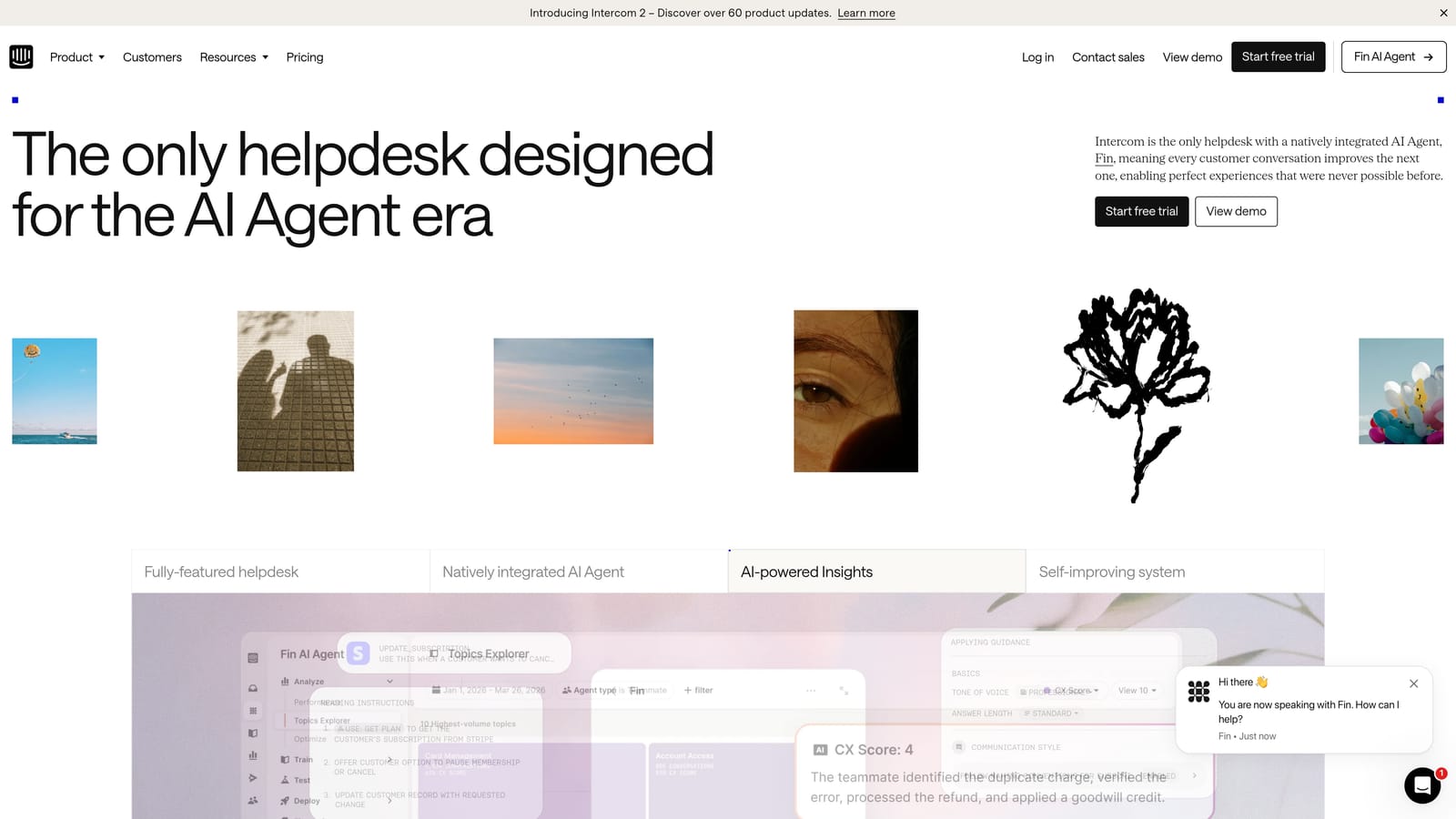
Intercom is a messaging-first support platform with Fin AI Agent handling autonomous conversational resolution across chat, email, and in-app experiences.
Where This Tool Shines
Intercom has been building toward AI-native support for years, and Fin AI Agent represents a genuinely capable autonomous resolution layer. It handles end-to-end conversational support, pulls from your knowledge base, and escalates to human agents when needed. For teams that live in the Intercom ecosystem already, adding Fin is a natural progression.
The proactive messaging capabilities are among the best in the category. Intercom can trigger in-app messages based on user behavior, helping deflect tickets before they're created. That's a meaningful advantage for SaaS teams focused on reducing inbound volume rather than just resolving it faster.
Key Features
Fin AI Agent: Handles end-to-end conversational ticket resolution across chat and email without requiring human involvement for routine queries.
Proactive Messaging: Behavior-triggered in-app messages that address user questions before they become support tickets.
Multi-Channel Inbox: Unified inbox across chat, email, and social channels with AI-generated summaries and suggested replies.
AI Conversation Summaries: Automatically summarizes long conversations so agents have full context when they take over from Fin.
App Marketplace: Extensive integrations across CRM, analytics, and product tools.
Best For
Teams with high conversational support volume, particularly those already using Intercom for customer engagement and marketing. Less suited to teams with complex, technical B2B ticket workflows where deeper product context is required.
Pricing
Starts at approximately $39 per seat per month. Fin AI Agent is billed per resolution, which can add up quickly at high volume. Worth modeling out your expected resolution count before committing.
3. Zendesk
Best for: Large enterprise teams with complex multi-channel routing needs and existing Zendesk infrastructure.
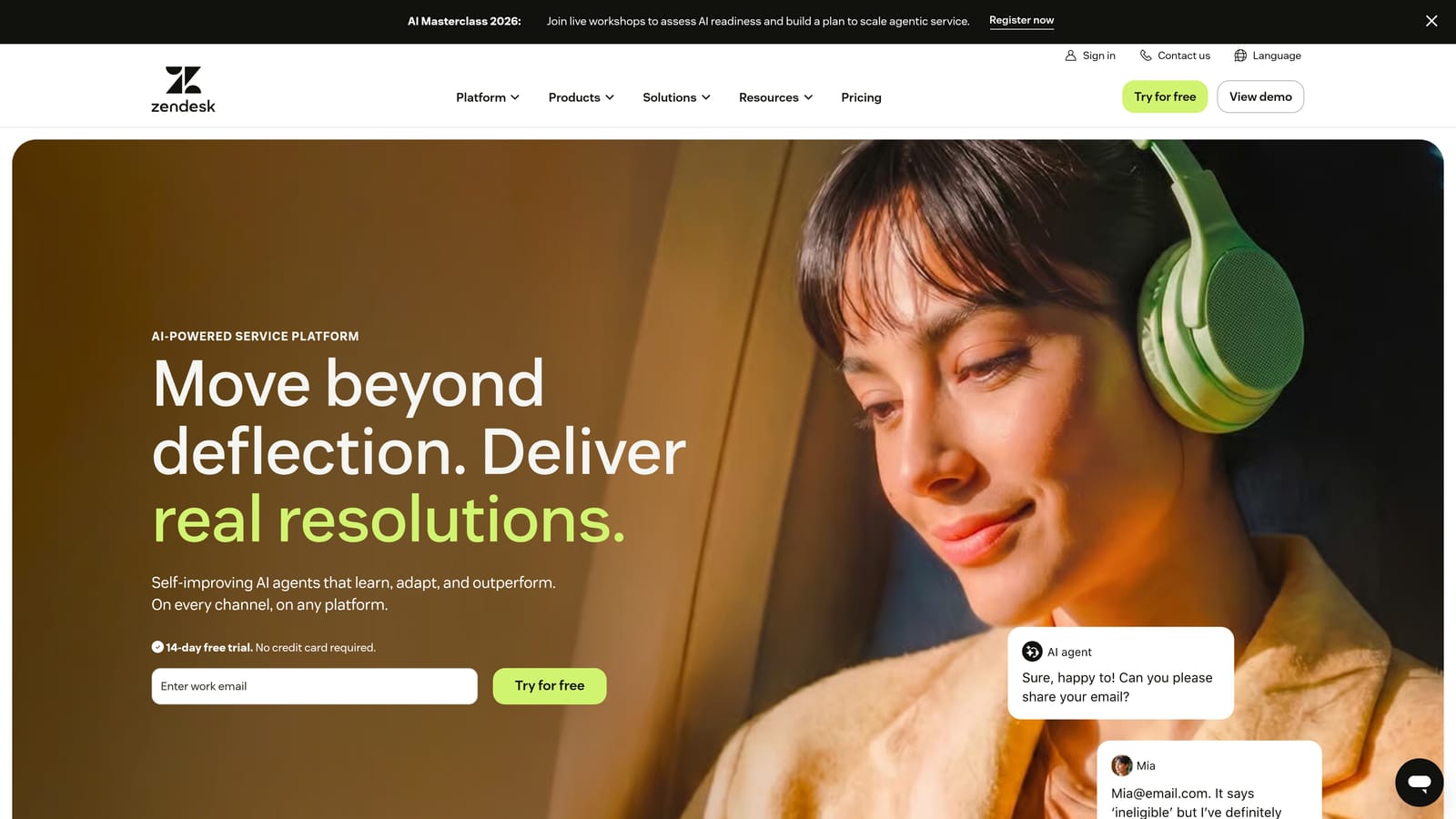
Zendesk is the enterprise helpdesk incumbent, now with AI Agents layered across its multi-channel ticket management platform following its acquisition of Ultimate.ai.
Where This Tool Shines
Zendesk's strength is scale. The platform handles enormous ticket volumes across email, chat, voice, and social, with intelligent triage and routing that has improved significantly as the AI Agents layer has matured. For large support organizations with complex routing logic and established workflows, Zendesk remains a reliable foundation.
The app marketplace is unmatched in breadth, with over a thousand integrations covering virtually every tool a support team might use. If you need to connect Zendesk to something, there's almost certainly a way to do it.
Key Features
AI Agents: Automated ticket resolution across channels, built on technology acquired from Ultimate.ai and iterated through 2025.
Intelligent Triage and Routing: Intent and sentiment-based routing that directs tickets to the right queue or agent automatically.
Massive App Marketplace: 1,000+ integrations covering CRM, analytics, e-commerce, and more.
Multi-Channel Support: Unified handling across email, chat, voice, social, and messaging platforms.
Advanced Analytics Suite: Detailed reporting on ticket volume, resolution times, agent performance, and CSAT.
Best For
Enterprise teams with large support organizations, complex routing requirements, and existing Zendesk infrastructure. The AI capabilities are improving but remain layered on top of legacy architecture rather than foundational to the platform's design.
Pricing
Suite Team starts at approximately $55 per agent per month. Full AI Agent capabilities are available on higher tiers, which adds meaningfully to the total cost at scale.
4. Freshdesk
Best for: SMB and mid-market teams looking for AI-assisted support at accessible price points.
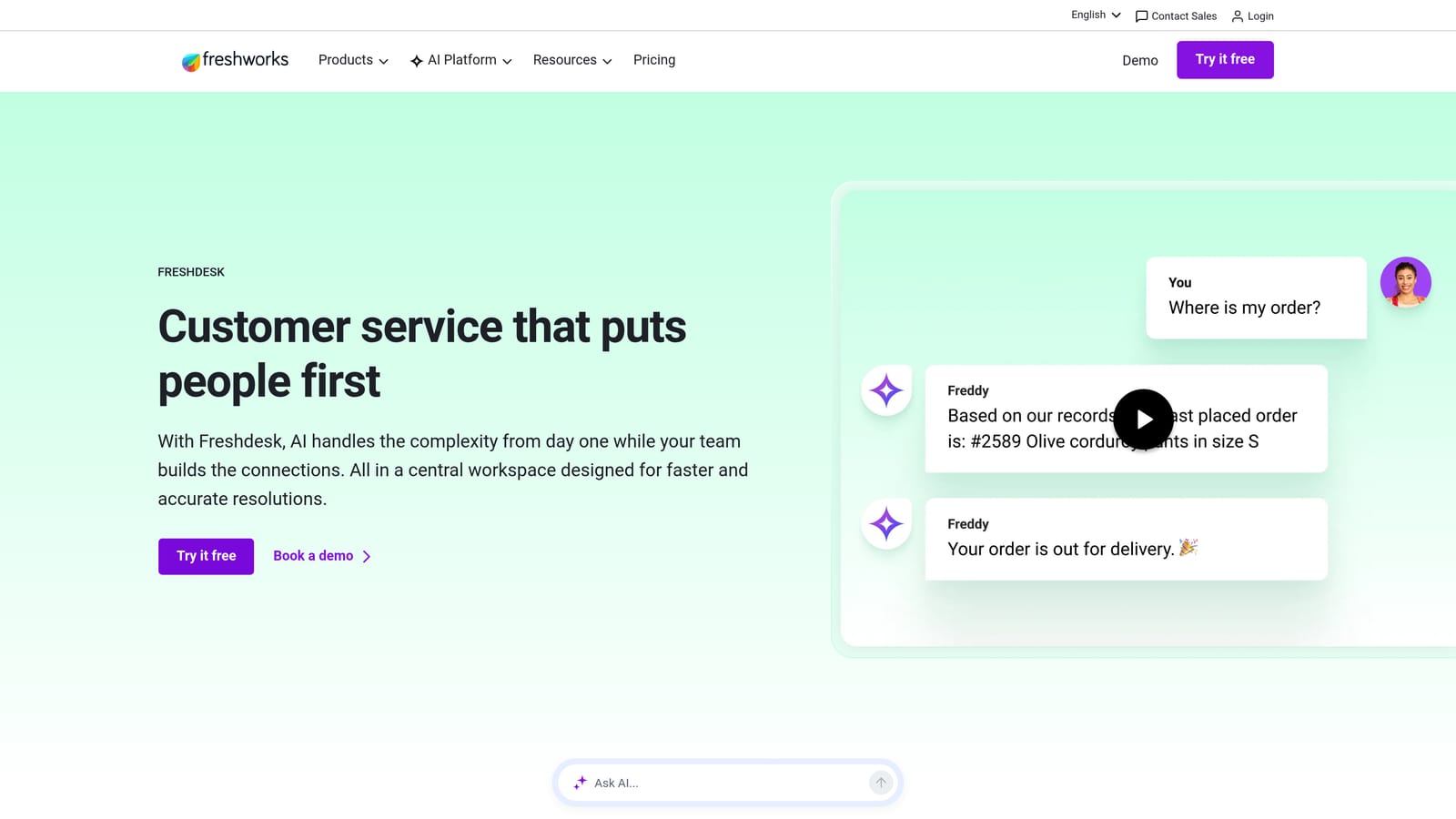
Freshdesk is Freshworks' helpdesk platform with Freddy AI providing auto-triage, suggested responses, sentiment analysis, and bot-driven self-service.
Where This Tool Shines
Freshdesk's value proposition is solid AI assistance at a price point that doesn't require an enterprise budget. Freddy AI handles the high-frequency, lower-complexity tasks well: categorizing incoming tickets, suggesting responses to agents, detecting sentiment, and running self-service bot flows for common queries. For teams new to AI automation, the learning curve is gentle.
The omnichannel coverage is comprehensive for the price, bringing email, chat, phone, and social into a single inbox. Teams that need broad channel coverage without a large per-seat investment will find Freshdesk a strong fit.
Key Features
Freddy AI Auto-Triage: Automatically categorizes and routes incoming tickets based on content and intent.
Freddy Self Service Bot: Deflects common queries through automated conversational flows before they reach agents.
Sentiment Analysis: Detects emotional tone in incoming tickets to help prioritize urgent or frustrated customers.
Agent Assist Suggestions: Recommends responses and knowledge base articles to agents in real time.
Omnichannel Inbox: Unified view of email, chat, phone, and social interactions.
Best For
SMB and mid-market teams that want meaningful AI automation without enterprise pricing. Less suited for complex B2B SaaS support environments where deep product context and autonomous resolution of technical queries is a priority.
Pricing
Free plan available. Growth plan starts at approximately $15 per agent per month. AI features require Pro tier or above, so budget accordingly if Freddy's capabilities are central to your evaluation.
5. Tidio
Best for: E-commerce and SMB teams that need fast deployment and high-volume simple query deflection.
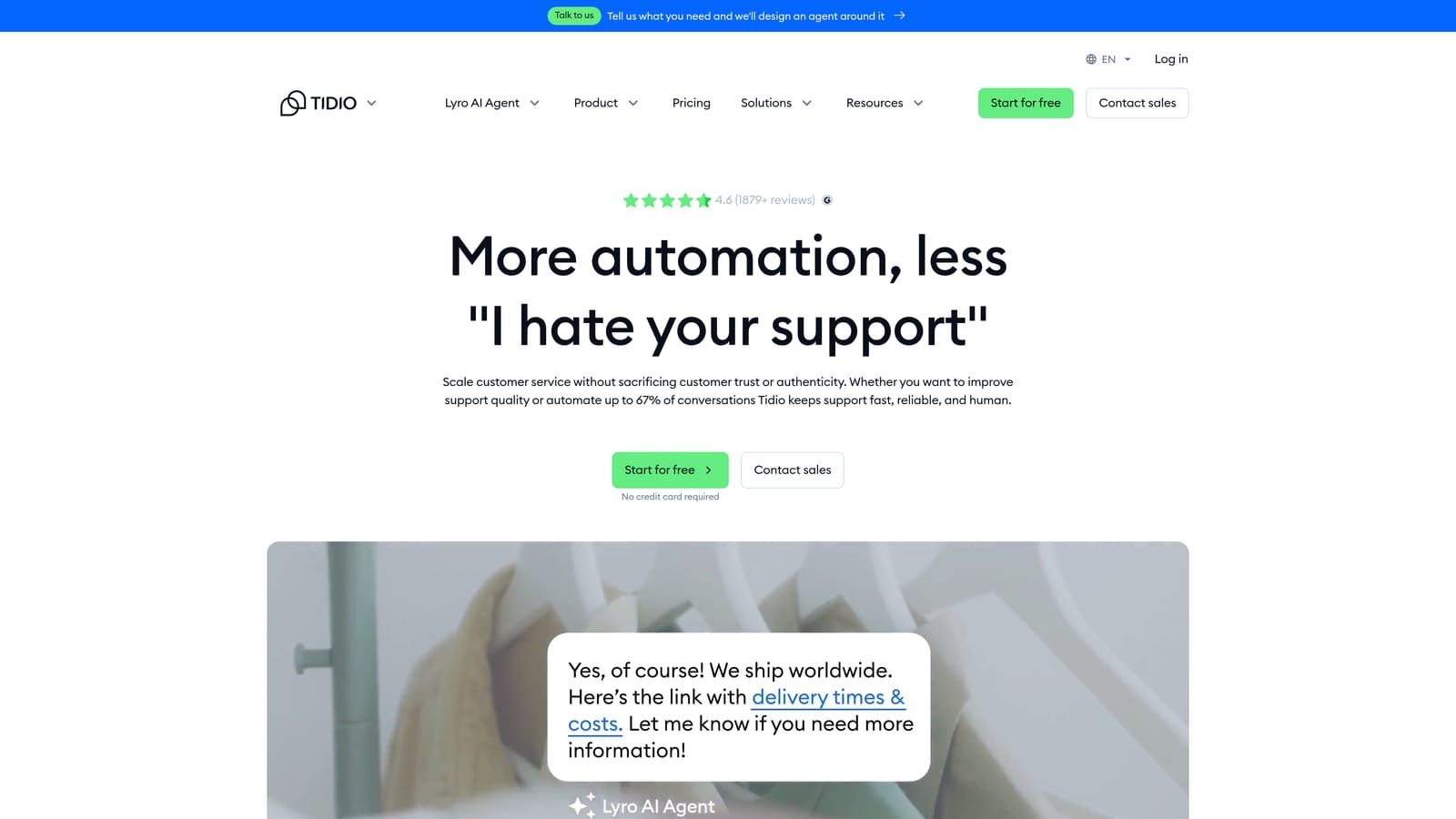
Tidio is a lightweight AI chat platform built around Lyro, its conversational AI chatbot, designed for quick setup and efficient deflection of repetitive queries.
Where This Tool Shines
Tidio's biggest advantage is speed to value. Lyro can be deployed quickly, requires no coding, and starts deflecting common questions almost immediately. For teams that are overwhelmed by repetitive, simple queries and need relief fast, Tidio delivers a fast path to meaningful deflection.
The no-code chatbot builder with visual flow editor makes it accessible to teams without technical resources. Agents can build and adjust conversation flows without engineering involvement, which reduces deployment friction considerably.
Key Features
Lyro AI Chatbot: Conversational AI that handles common queries autonomously without requiring human involvement.
No-Code Flow Builder: Visual editor for building chatbot conversation flows without any coding knowledge.
AI-Assisted Live Chat: Suggests responses to agents during live conversations to speed up handling time.
E-Commerce Integrations: Native connections with Shopify and WooCommerce for order and customer data context.
Analytics Dashboard: Basic reporting on conversation volume, deflection rate, and chatbot performance.
Best For
E-commerce businesses and SMBs with high volumes of simple, repetitive queries. Not well-suited for complex B2B SaaS support where technical depth, product context, and sophisticated routing are required.
Pricing
Free plan available. Lyro AI starts at approximately $29 per month, priced by conversation volume. Pricing scales with usage, so high-volume teams should model costs before committing.
6. Kustomer
Best for: Subscription and D2C businesses that want every support interaction informed by full customer history.
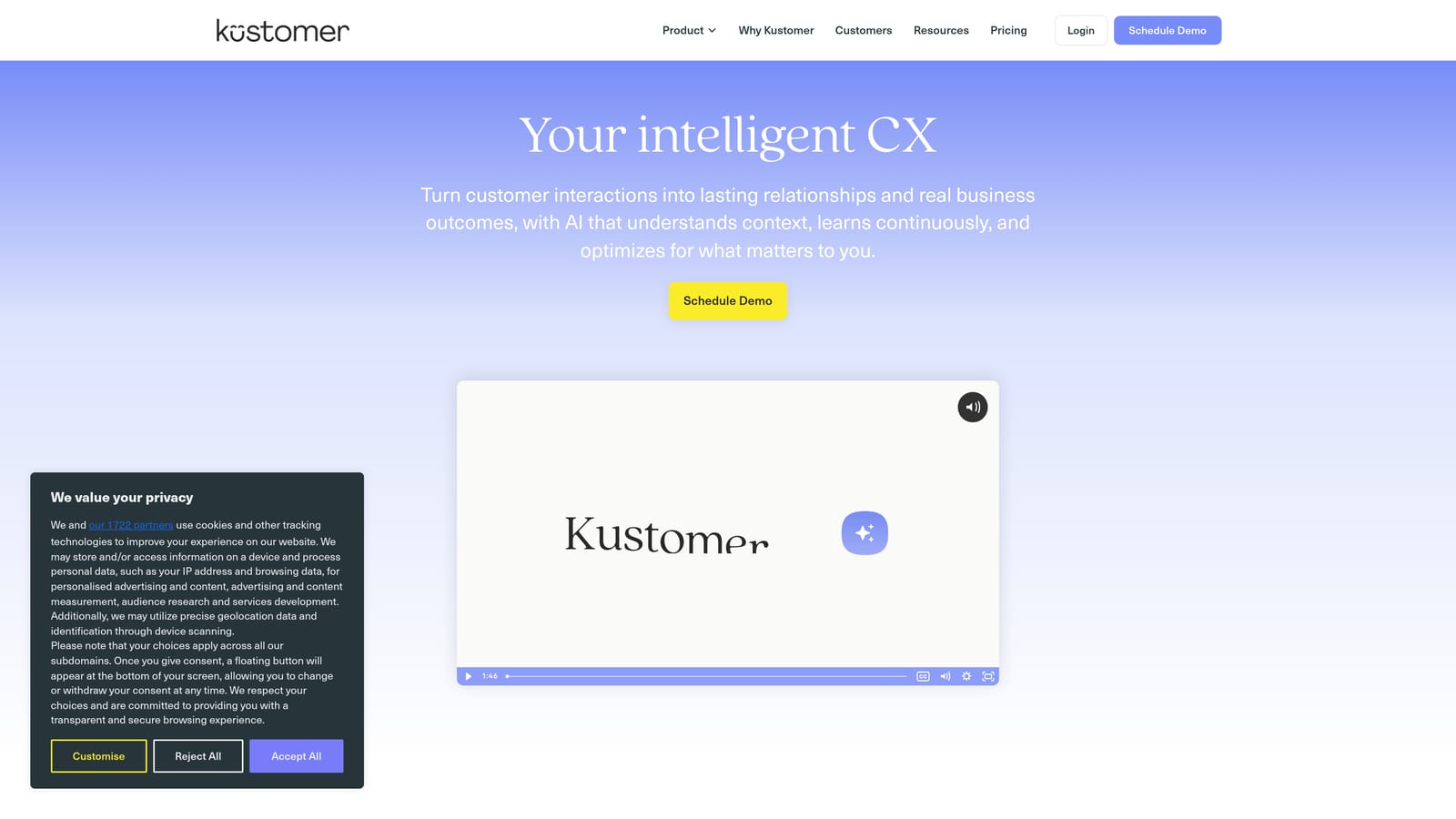
Kustomer is a CRM-first support platform owned by Meta, where AI automation is powered by rich customer history, making every interaction context-aware from the first message.
Where This Tool Shines
Kustomer's differentiation is its data model. Rather than treating each ticket as an isolated event, Kustomer surfaces the full customer timeline: every order, every conversation, every interaction across channels. When AI automation runs on top of that context, it produces meaningfully more relevant responses than platforms working from ticket data alone.
The automated workflow engine is flexible and powerful, allowing teams to trigger actions based on customer attributes, lifetime value, order history, or behavior patterns. For businesses where customer context is critical to support quality, this architecture is compelling.
Key Features
CRM-Powered AI: Every ticket and AI response is informed by the complete customer history, not just the current conversation.
Automated Workflows: Trigger actions and routing rules based on customer attributes, behavior, and history.
Omnichannel Timeline View: Single view of every customer interaction across all channels, in chronological order.
Intent Detection and Routing: AI-powered classification that routes tickets to the right team based on detected intent.
Self-Service Bots with CRM Context: Bots that can reference customer data to provide personalized automated responses.
Best For
D2C brands, subscription businesses, and companies where customer lifetime value and order history are central to support decisions. Less commonly adopted in pure B2B SaaS contexts where the CRM-first model is less directly applicable.
Pricing
Enterprise plans start at approximately $89 per agent per month, positioning Kustomer firmly in the mid-to-enterprise segment.
7. Help Scout
Best for: Teams that want to maintain a personal, human support feel while getting AI assistance for agents.
Help Scout is a human-first support platform with lightweight AI assistance that augments agents rather than replacing them for routine queries.
Where This Tool Shines
Help Scout is intentionally not trying to be an autonomous resolution platform. Its AI features, including AI Summarize, AI Assist, and the Beacon widget, are designed to make human agents faster and more effective rather than to remove them from the equation. For teams where the personal support relationship is a brand differentiator, that philosophy is a genuine strength.
The UX is consistently praised for its simplicity. Agents can get up to speed quickly, and the shared inbox with collision detection prevents the common problem of two agents responding to the same ticket simultaneously.
Key Features
AI Summarize: Instantly summarizes long conversation threads so agents have full context without reading every message.
AI Assist: Helps agents draft, refine, and improve replies without requiring them to write from scratch.
Beacon Widget: In-app help widget for proactive messaging and self-service knowledge base access.
Shared Inbox with Collision Detection: Prevents duplicate responses by showing when another agent is already working on a ticket.
Clean, Minimal UX: Low learning curve that makes onboarding new agents fast and straightforward.
Best For
Small to mid-sized teams that prioritize a warm, human support experience and want AI to assist agents rather than operate autonomously. Not the right choice if autonomous ticket resolution is a core requirement.
Pricing
Standard plan starts at approximately $22 per user per month, making it one of the more accessible options in this list for teams that don't need full AI automation.
8. Salesforce Service Cloud
Best for: Enterprise organizations already invested in the Salesforce ecosystem who need deep CRM-support integration.
Salesforce Service Cloud is an enterprise-grade support platform with Einstein AI and Agentforce deeply embedded across case management, routing, and predictive analytics.
Where This Tool Shines
Service Cloud's power comes from its position within the Salesforce ecosystem. When your support platform has direct access to Sales Cloud data, account history, opportunity status, and contract details, the AI can make significantly more informed decisions about prioritization and routing. For enterprise teams where sales and support are tightly coupled, this integration depth is hard to replicate elsewhere.
Agentforce, Salesforce's autonomous AI agent layer, brings genuine autonomous case handling to the platform. Combined with Einstein AI's classification and next-best-action capabilities, Service Cloud has matured into a serious AI automation contender for large organizations.
Key Features
Einstein AI: Case classification, intelligent routing, and next-best-action recommendations powered by machine learning across your Salesforce data.
Agentforce: Autonomous AI agent handling for cases that don't require human involvement, with escalation pathways for complex issues.
Deep CRM Integration: Full access to Sales Cloud data, enabling support decisions informed by account value, opportunity stage, and contract status.
Omni-Channel Routing: Intelligent routing across all support channels based on agent availability, skill, and case priority.
AI-Powered Analytics and Forecasting: Predictive reporting on case volume, resolution trends, and team capacity.
Best For
Large enterprise organizations already running Salesforce CRM. Implementation complexity and cost are significant, so this is not a practical choice for teams outside the Salesforce ecosystem or those without dedicated admin resources.
Pricing
Starter Suite from approximately $25 per user per month. Full AI capabilities require Enterprise tier or above, and total implementation cost can climb substantially depending on configuration requirements.
9. Zoho Desk
Best for: Cost-conscious teams within the Zoho ecosystem that want solid AI assistance without premium pricing.
Zoho Desk is a full-featured helpdesk with Zia AI providing sentiment analysis, anomaly detection, auto-tagging, and response suggestions at a highly competitive price point.
Where This Tool Shines
Zoho Desk punches above its price point on AI features. Zia's anomaly detection is a particularly useful capability: it flags unusual spikes in ticket volume before they become crises, giving support managers time to respond proactively. Combined with sentiment analysis and auto-tagging, Zia handles a meaningful share of the manual work that typically slows support teams down.
For teams already using Zoho CRM, Zoho Analytics, or other Zoho products, the native integration depth is a real advantage. Data flows between products without the custom connector work that cross-platform integrations often require.
Key Features
Zia Sentiment Analysis: Detects emotional tone and urgency in incoming tickets to help agents prioritize appropriately.
Anomaly Detection: Flags unusual ticket volume spikes so managers can respond before queues become unmanageable.
Auto-Tagging and Categorization: Automatically classifies incoming tickets to reduce manual triage work.
AI-Suggested Responses: Recommends relevant replies and knowledge base articles to agents in real time.
Zoho Ecosystem Integration: Deep native connections with Zoho CRM, Zoho Analytics, and the broader Zoho suite.
Best For
Budget-conscious teams, particularly those already using other Zoho products. A strong option when cost efficiency is the primary constraint and cutting-edge autonomous resolution is less critical than solid AI assistance at a low per-seat cost.
Pricing
Free plan for up to 3 agents. Standard plan starts at approximately $14 per agent per month, making it among the most affordable options in this category with meaningful AI capabilities included.
Which Platform Is Right for Your Team?
The right helpdesk AI automation platform depends on where your team is today and where you're trying to go. Here's a quick way to think through the decision.
If you're a B2B SaaS team that wants support to do more than close tickets, and you want a platform built AI-first rather than AI-retrofitted, Halo AI is the clearest choice. Its page-aware context, continuous learning loop, and business intelligence output make it purpose-built for product-led teams that treat support as a strategic function.
If you have high in-app chat volume and are already invested in Intercom's ecosystem, Fin AI Agent is a natural extension. For large enterprise teams with complex routing needs and existing Zendesk infrastructure, staying with Zendesk and enabling AI Agents is a pragmatic path. Freshdesk and Zoho Desk are the right calls for teams where budget is the primary constraint. Help Scout works well when maintaining a personal support feel matters more than autonomous resolution.
Kustomer fits D2C and subscription businesses where customer history drives support quality. Salesforce Service Cloud belongs in the conversation only if you're already deeply embedded in the Salesforce ecosystem. And Tidio is the right starting point for e-commerce teams that need fast deflection of simple, repetitive queries.
Your support team shouldn't scale linearly with your customer base. Let AI agents handle routine tickets, guide users through your product, and surface business intelligence while your team focuses on complex issues that need a human touch. See Halo in action and discover how continuous learning transforms every interaction into smarter, faster support.