9 Best Helpdesk AI Tools for Enterprises in 2026
Helpdesk AI for enterprises demands far more than basic chatbot functionality—it requires deep tech stack integration, continuous learning, and intelligent agent handoffs that hold up under thousands of daily tickets. This guide evaluates the 9 strongest enterprise-grade helpdesk AI platforms available in 2026, comparing them on AI depth, scalability, analytics capabilities, and fit for complex B2B support environments.
 Matt PattoliFounder12 min read
Enterprise support teams operate in a fundamentally different environment than smaller businesses. We're talking thousands of tickets per day, multi-product complexity, strict SLA obligations, and leadership that expects AI to actually move the needle, not just deflect a few FAQs. Generic chatbots and bolt-on automation fall short fast at this scale.
The right helpdesk AI for enterprises has to do more than answer common questions. It needs to integrate deeply with your existing tech stack, learn continuously from every interaction, surface actionable intelligence from support data, and hand off to human agents without losing context. That's a high bar, and not every platform clears it.
Here are the strongest enterprise-grade helpdesk AI platforms available in 2026, evaluated on AI depth, integration ecosystem, scalability, analytics, and fit for complex B2B environments.
1. Halo AI
Best for: B2B SaaS teams that want AI-first support with deep product context and business intelligence.
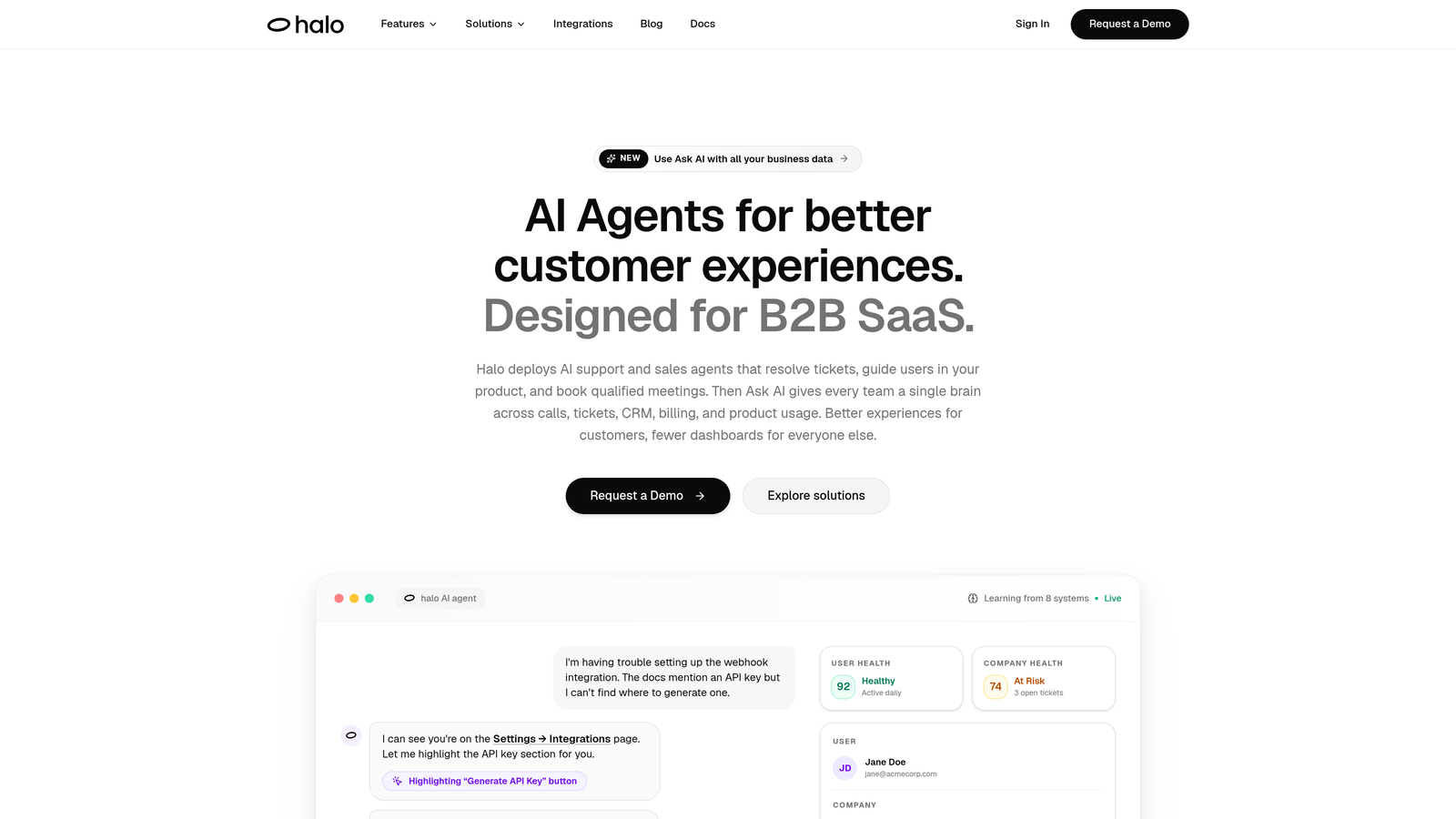
Halo AI is an AI-native customer support platform built specifically for B2B SaaS teams who need support that scales without scaling headcount.
Where This Tool Shines
What separates Halo from most helpdesk AI tools is its architecture. This isn't a traditional helpdesk with AI features added on top. The AI is the foundation, which means every part of the platform, from ticket resolution to agent handoff to analytics, is built around intelligent automation from the ground up.
The page-aware chat widget is a particularly strong differentiator. Halo's AI can see what page and product state a user is in, allowing it to provide contextual guidance rather than generic answers. Combined with continuous learning from every resolved interaction, the system genuinely gets smarter over time rather than staying static.
Key Features
Page-Aware Context: The chat widget sees what the user sees, enabling UI guidance and contextual help based on their exact product state.
Intelligent AI Agents: Resolve tickets autonomously and escalate to live agents with full conversation context preserved.
Auto Bug Ticket Creation: Automatically generates bug reports from support conversations and routes them directly to engineering workflows.
Smart Inbox with Business Intelligence: Surfaces customer health signals, revenue anomalies, and product insights from support data, going well beyond standard ticket metrics.
Deep Integration Ecosystem: Connects natively with Linear, Slack, HubSpot, Stripe, Zoom, PandaDoc, Fathom, and Intercom.
Continuous Learning Architecture: Every resolved interaction improves the AI's future performance, building institutional knowledge over time.
Best For
B2B SaaS companies that want an AI-first support platform rather than an AI-augmented legacy helpdesk. Particularly well-suited for product-led growth teams where support context needs to connect directly to product usage, customer health, and revenue signals.
Pricing
Contact for enterprise pricing at haloagents.ai. Custom plans available based on team size and usage.
2. Zendesk AI
Best for: Enterprises already running on Zendesk Suite who want native AI without a platform migration.
Zendesk AI is the native AI layer built into one of the most widely deployed enterprise helpdesk platforms in the world.
Where This Tool Shines
If your team is already on Zendesk, the AI capabilities slot in without disruption. Intelligent triage, automated routing, and AI agents all work within the same interface your team already uses. That zero-migration advantage is significant for large enterprises where platform changes are slow and expensive.
The Agent Copilot feature is genuinely useful for complex support environments, surfacing suggested replies and next-best-action recommendations that help agents handle higher volumes without sacrificing quality. Enterprise compliance posture is also strong, with SOC 2, GDPR, and HIPAA-ready configurations available.
Key Features
Intelligent Triage: Automatically routes tickets based on intent, sentiment, and priority signals.
AI Agents: Handle customer-facing resolution autonomously for common request types.
Agent Copilot: Provides suggested replies and next-best-action guidance to human agents in real time.
Native Suite Integration: Works seamlessly across Zendesk Support, Talk, Chat, and Guide.
Enterprise Compliance: SOC 2, GDPR, and HIPAA-ready configurations for regulated industries.
Best For
Enterprises already invested in the Zendesk ecosystem. Less compelling for teams not on Zendesk, since the AI capabilities are tightly coupled to the platform itself rather than designed to work independently.
Pricing
Included in Zendesk Suite plans; enterprise pricing available on request.
3. Intercom Fin
Best for: Teams using Intercom Messenger who want an LLM-powered AI agent for autonomous conversation resolution.
Intercom Fin is Intercom's LLM-powered AI agent, designed to resolve customer conversations autonomously within the Intercom Messenger experience.
Where This Tool Shines
Fin's conversational quality stands out. Because it's built on large language model technology and trained against your knowledge base and help content, it handles nuanced, multi-part questions in a way that feels natural to end users. The multi-step reasoning capability means it doesn't just pattern-match to FAQs; it can work through more complex scenarios before deciding to escalate.
The Fin Insights dashboard is a practical addition for enterprise teams, showing resolution rates and surfacing knowledge gaps so content teams know exactly where to invest in documentation improvements.
Key Features
LLM-Powered Resolution: Uses your knowledge base and help content to resolve conversations autonomously.
Multi-Step Reasoning: Handles complex, multi-part customer questions rather than just simple FAQ matching.
Seamless Handoff: Transfers to human agents within the Intercom Messenger without breaking the conversation flow.
Fin Insights Dashboard: Tracks resolution rates and identifies gaps in your knowledge base.
Multi-Channel Support: Works across web, mobile, and email channels.
Best For
Teams already using Intercom as their primary customer communication platform. The resolution-based pricing model works well for lower-volume environments but can scale unpredictably for high-volume enterprise support teams.
Pricing
Resolution-based pricing per resolved conversation, layered on top of the Intercom base plan. Enterprise pricing available on request.
4. Freshdesk Freddy AI
Best for: Enterprises using multiple Freshworks products who want a unified AI layer across support, CRM, and ITSM.
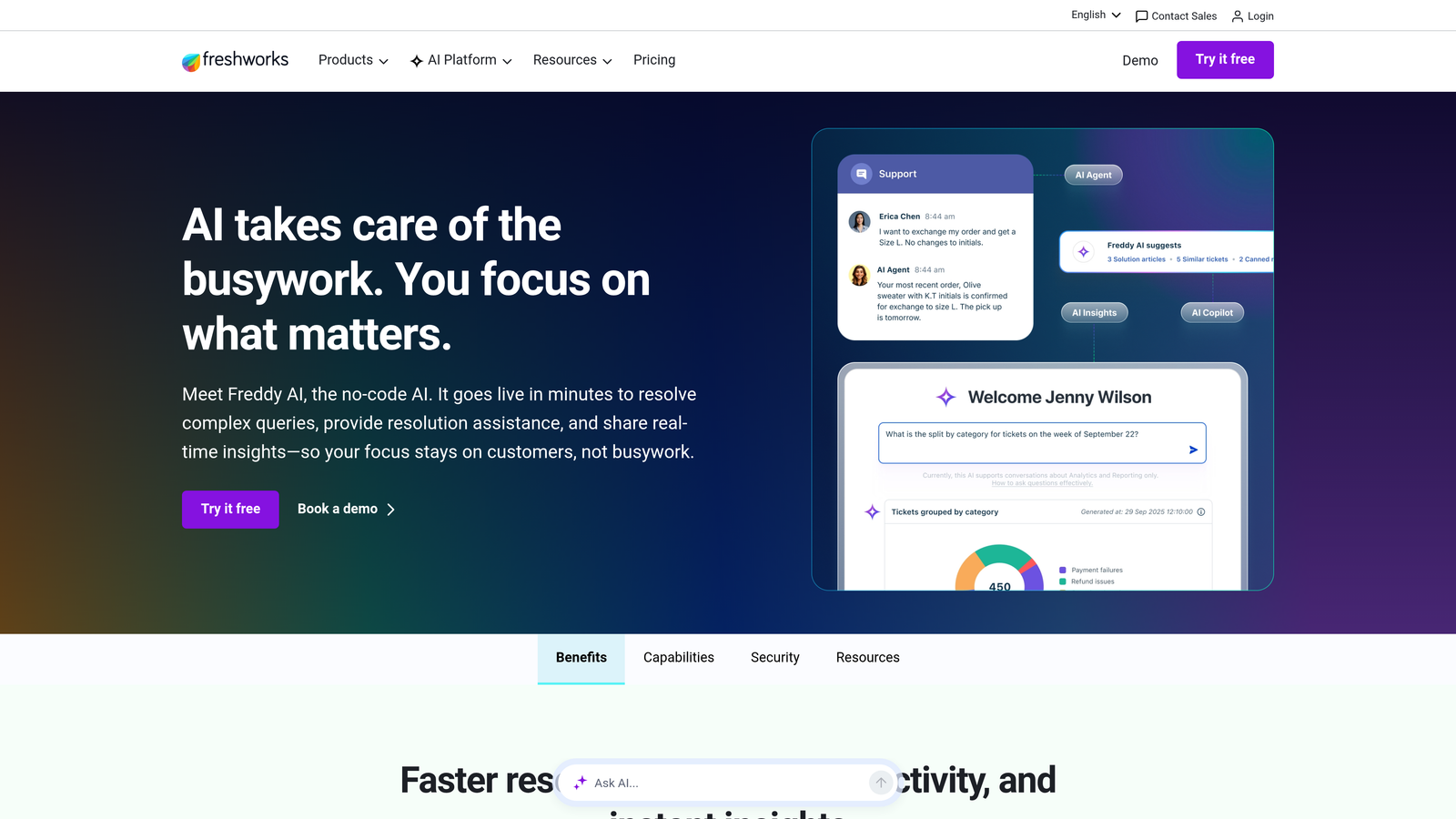
Freshdesk Freddy AI is Freshworks' cross-product AI layer, spanning customer support, CRM, and IT service management under a single intelligence framework.
Where This Tool Shines
The cross-product scope is Freddy's clearest differentiator. If your organization uses Freshdesk for support, Freshsales for CRM, and Freshservice for ITSM, Freddy AI connects intelligence across all three. That means anomaly detection, support trend analysis, and agent assistance aren't siloed by product line.
Freddy Copilot is well-regarded for agent productivity, offering suggested replies, conversation summarization, and recommended next steps without requiring agents to leave their existing workflow. Freddy Insights adds proactive alerting when support trends deviate from normal patterns.
Key Features
Freddy Self Service: Autonomous customer-facing ticket resolution without agent involvement.
Freddy Copilot: Agent assistance with suggested replies, summarization, and next-step recommendations.
Cross-Product AI Intelligence: Unified AI layer spanning support, sales, and IT service management.
Freddy Insights: Proactive anomaly detection and support trend analysis.
Enterprise Security: Enterprise-grade compliance and security across all Freshworks products.
Best For
Enterprises already running on multiple Freshworks products. Teams outside the Freshworks ecosystem will find less compelling reasons to choose Freddy over purpose-built alternatives.
Pricing
Freddy AI is available as an add-on across Freshworks plans; enterprise pricing on request.
5. Salesforce Agentforce
Best for: Enterprises where Salesforce is the system of record and CRM data needs to power AI support decisions.
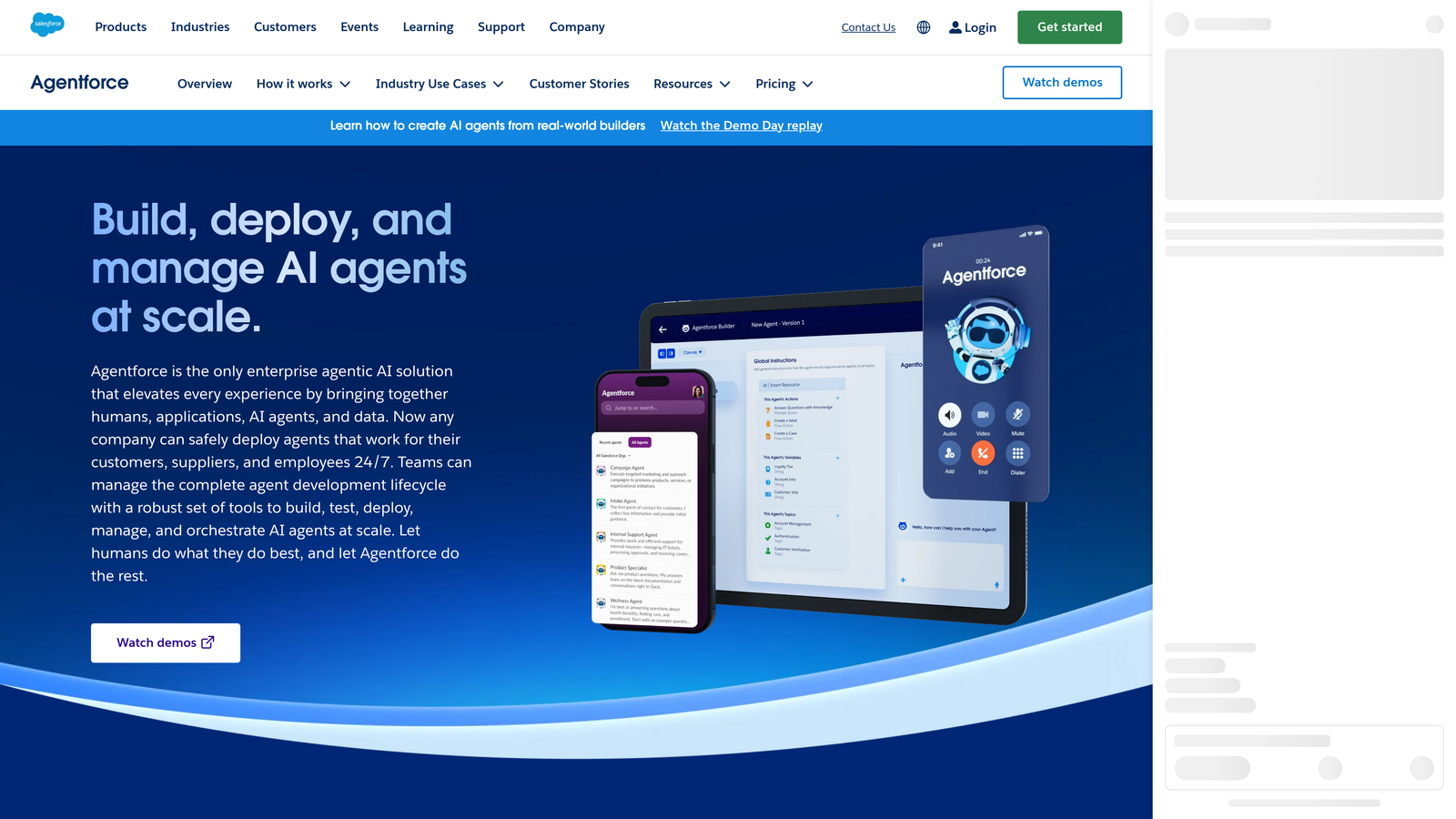
Salesforce Agentforce is Salesforce's autonomous AI agent platform, built natively into the Salesforce ecosystem with full access to CRM data.
Where This Tool Shines
Agentforce's core advantage is data access. When your AI agent can see a customer's full CRM history, open opportunities, past cases, billing status, and product usage, it can make significantly more informed decisions than a context-blind chatbot. For enterprises where Salesforce is the central system of record, this is a meaningful differentiator.
The low-code Agent Builder allows operations and IT teams to customize agent behaviors without deep engineering resources. Enterprise governance features, including full audit trails and compliance controls, make it viable for regulated industries where AI decision-making needs to be traceable.
Key Features
Native CRM Data Access: AI agents draw on complete Salesforce customer history, cases, and records.
Agent Builder: Low-code tool for customizing agent behaviors and workflows.
Autonomous Action-Taking: Agents can update records, create cases, and trigger workflows without human intervention.
Enterprise Governance: Full audit trails and compliance controls for regulated environments.
Deep Platform Integration: Connects across Service Cloud, Sales Cloud, and Data Cloud natively.
Best For
Large enterprises where Salesforce is the operational hub. Implementation complexity and cost can be significant, so teams without existing Salesforce investment should weigh the total cost of ownership carefully.
Pricing
Consumption-based pricing per conversation; requires an existing Salesforce platform subscription. Contact Salesforce for enterprise quotes.
6. ServiceNow AI Agents
Best for: Large enterprises focused on internal IT service management, HR service delivery, and employee experience automation.
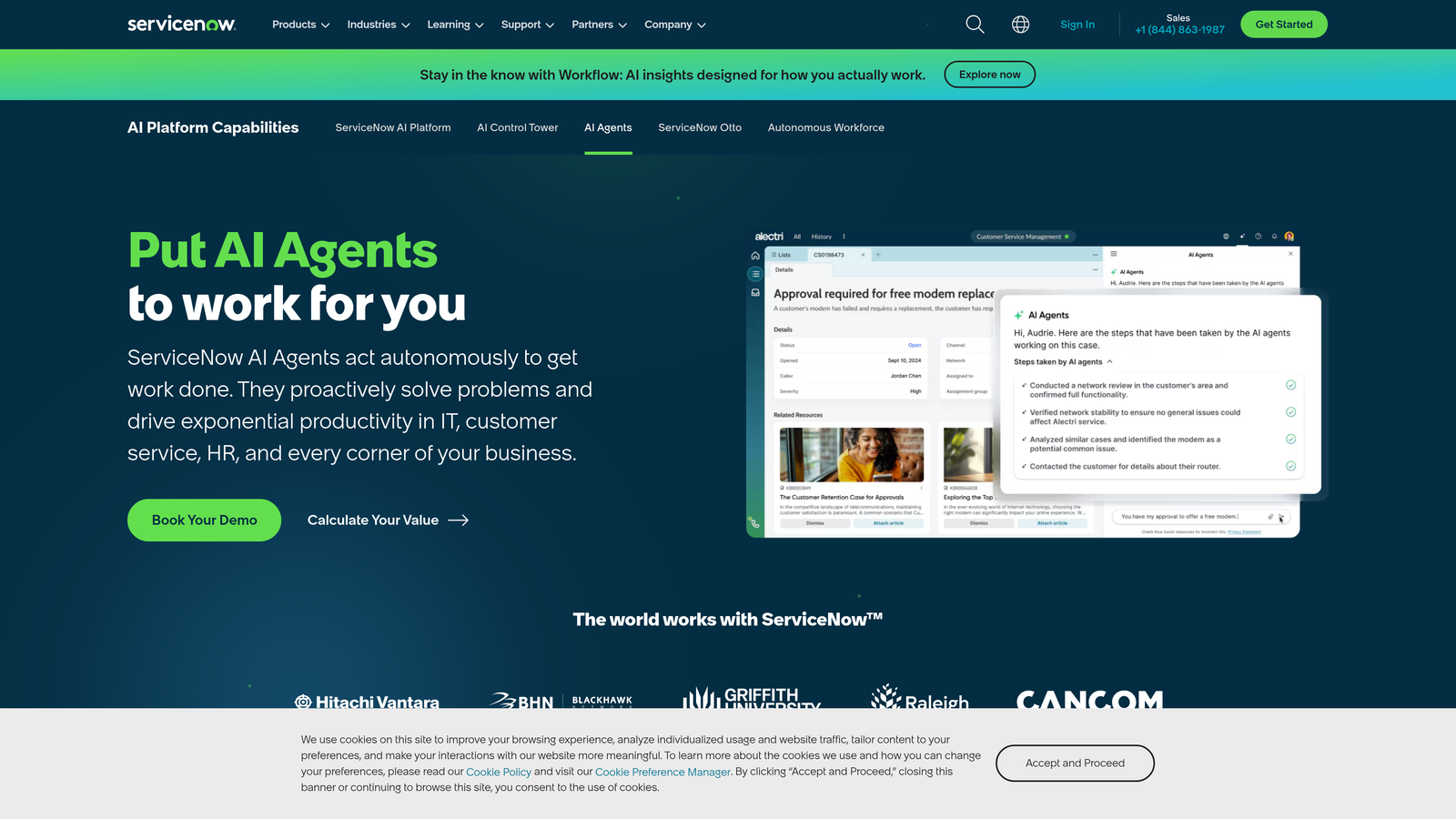
ServiceNow AI Agents bring autonomous automation to enterprise ITSM and HR service delivery at a scale few platforms can match.
Where This Tool Shines
ServiceNow is the dominant ITSM platform for large enterprises, and its AI agents are built to operate within that context. The workflow orchestration capabilities are particularly strong: AI agents don't just answer questions, they can trigger multi-step ITSM processes, route incidents through approval chains, and resolve common IT requests end-to-end without human involvement.
For enterprises in regulated industries, the audit and reporting capabilities are a practical requirement, and ServiceNow delivers here. Integration with enterprise directory systems, SSO, and LDAP is well-established, making deployment into complex IT environments more straightforward than many alternatives.
Key Features
Autonomous ITSM Agents: Handle IT incident resolution, HR requests, and employee self-service without manual intervention.
Workflow Orchestration: Deep process automation across multi-step ITSM and HR workflows.
Now Assist Copilot: Agent assistance for service desk staff across IT and HR functions.
Enterprise Directory Integration: Connects with LDAP, SSO, and enterprise identity systems.
Audit and Compliance Reporting: Strong capabilities for regulated industries requiring traceable AI decisions.
Best For
Large enterprises with mature ITSM practices and significant internal service desk volume. Less focused on external customer support; teams needing both internal and external AI coverage will likely need to pair ServiceNow with another platform.
Pricing
Enterprise licensing model; contact ServiceNow directly for pricing based on organizational size and use case.
7. Forethought
Best for: Enterprises that want AI augmentation on top of their existing helpdesk without a platform migration.
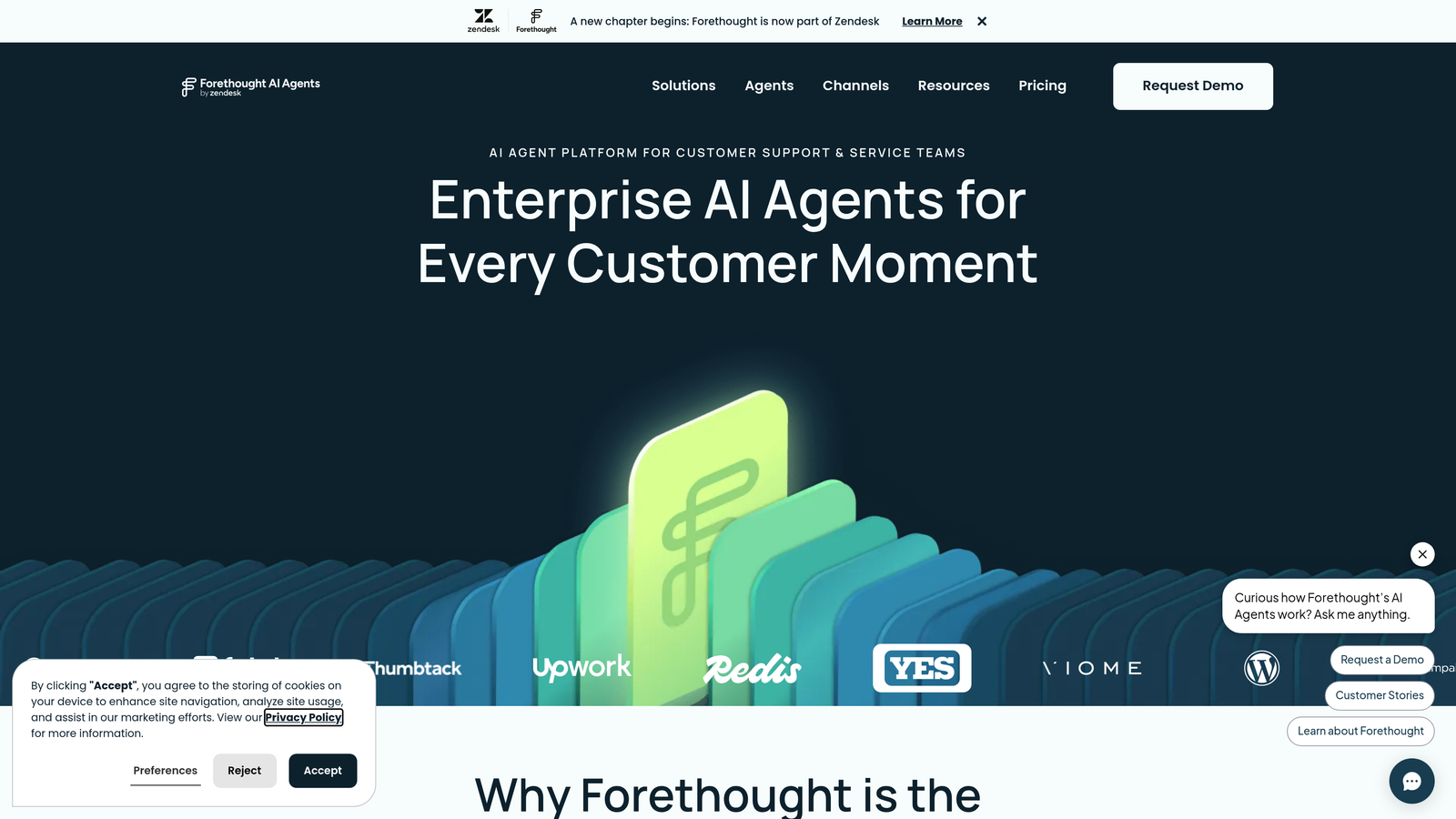
Forethought is an AI platform that sits as an intelligent layer above existing helpdesks like Zendesk, Salesforce Service Cloud, and Freshdesk.
Where This Tool Shines
The no-migration pitch is Forethought's strongest selling point. If your team has years of investment in Zendesk or Salesforce and isn't ready to replace the underlying platform, Forethought adds meaningful AI capability without touching your existing infrastructure. It reads your current ticket data to train its models, which means it can get relevant quickly.
The three-product structure, Solve for autonomous resolution, Triage for intelligent routing, and Assist for agent copilot, allows enterprises to deploy selectively based on where AI will have the most immediate impact rather than adopting an all-or-nothing platform switch.
Key Features
Solve: Autonomous AI agent for customer-facing ticket resolution without human intervention.
Triage: Intelligent ticket routing based on intent, priority, and agent expertise matching.
Assist: Agent copilot that surfaces relevant knowledge and suggested responses in real time.
Platform Agnostic: Works on top of Zendesk, Salesforce Service Cloud, Freshdesk, and others.
Training on Existing Data: Learns from your historical ticket data to become relevant faster.
Best For
Enterprises with significant existing helpdesk investment that want AI augmentation without platform disruption. Strong fit for high-volume B2B support environments running on established helpdesk platforms.
Pricing
Enterprise pricing on request at forethought.ai.
8. Capacity
Best for: Enterprises wanting to consolidate both external customer support and internal employee helpdesk under a single AI-powered platform.
Capacity is a unified support automation platform that handles customer-facing support and internal employee helpdesk through one system.
Where This Tool Shines
Most enterprise AI support tools focus exclusively on external customer support or internal IT/HR service delivery. Capacity handles both from a single platform, which is a meaningful operational simplification for enterprises running separate systems for each. The knowledge base automation is particularly well-developed, with intelligent article suggestions and gap detection that helps content teams keep documentation current.
The workflow automation builder supports multi-step processes without requiring engineering resources, making it accessible for operations and support teams who need to build complex routing and escalation logic independently.
Key Features
Dual-Use AI Helpdesk: Serves both external customers and internal employees across IT, HR, and operations.
Knowledge Base Automation: Intelligent article suggestions and gap detection to keep documentation accurate.
Workflow Automation Builder: No-code tool for building multi-step support processes and escalation logic.
Multi-Channel Support: Handles live chat, email, and SMS from a single unified platform.
Broad Integration Ecosystem: Connects with over 1,000 enterprise tools via native connectors and Zapier.
Best For
Enterprises looking to consolidate customer support and internal employee helpdesk automation under one platform. Also well-suited for teams that want strong knowledge base management alongside AI resolution capabilities.
Pricing
Plans start from approximately $49/month; enterprise pricing available on request.
9. Kustomer AI
Best for: High-volume customer service environments where a unified CRM timeline and omnichannel support are the priority.
Kustomer is a CRM-native customer service platform with AI capabilities built around the complete customer conversation history and interaction timeline.
Where This Tool Shines
Kustomer's design philosophy centers on the customer timeline. Every interaction, order, support conversation, and transaction is visible in a single unified view, which gives both AI agents and human agents significantly more context than a standard ticket-based system. For high-volume environments where customer history is essential to resolution quality, this is a genuine advantage.
The omnichannel coverage is comprehensive: email, chat, SMS, social, and voice all flow into a single platform. AI-powered routing and prioritization use that full CRM context to make smarter decisions about which agent or AI flow should handle each incoming request.
Key Features
CRM-Native AI Routing: Routing and prioritization decisions draw on the full customer CRM context, not just the current ticket.
Unified Customer Timeline: All interactions, orders, and history consolidated in a single agent view.
Autonomous AI Agents: Self-service resolution across web and messaging channels.
Intelligent Agent Assistance: Suggested replies and conversation summaries surfaced in real time.
Full Omnichannel Coverage: Email, chat, SMS, social, and voice from one platform.
Best For
High-volume B2C environments such as retail, direct-to-consumer, and subscription businesses where customer history depth matters most. Less common in pure B2B SaaS environments, where the CRM-centric model may be more than necessary.
Pricing
Enterprise pricing on request; typically structured as per-agent monthly licensing.
Finding the Right Fit for Your Enterprise
No two enterprise support environments are identical, and the right platform depends heavily on your existing stack, your primary use case, and how ambitious your AI roadmap is.
If you're already deeply invested in Zendesk, Salesforce, or Freshworks, the native AI layers for each platform offer the lowest-friction path to AI augmentation. Zendesk AI, Agentforce, and Freddy AI all deliver meaningful capability without requiring your team to migrate away from familiar infrastructure.
For enterprises that want AI on top of their existing helpdesk without replacing it, Forethought is the most purpose-built option for that specific scenario. ServiceNow AI Agents and Capacity are strong choices when internal employee service delivery is as important as external customer support.
If you're evaluating platforms from a clean slate, or if your current helpdesk is showing its age, the more interesting question is whether you want a helpdesk with AI added, or an AI-first platform built for how support actually works in 2026. Kustomer and Intercom Fin both bring strong AI capabilities within their respective ecosystems. Halo AI takes the most differentiated approach: AI-native architecture, page-aware context that understands what your users are doing in your product, business intelligence that goes beyond ticket metrics, and continuous learning that compounds over time.
Your support team shouldn't scale linearly with your customer base. Let AI agents handle routine tickets, guide users through your product, and surface business intelligence while your team focuses on complex issues that need a human touch. See Halo in action and discover how continuous learning transforms every interaction into smarter, faster support.