9 Best Helpdesk AI Software Options Compared by Cost in 2026
This comprehensive comparison of helpdesk AI software cost breaks down nine leading platforms by pricing model, features, and ideal use case, helping support teams avoid hidden fees and choose the right billing structure. Whether you're a startup scaling support efficiency or an enterprise replacing legacy systems, understanding per-seat versus resolution-based pricing can significantly impact your ROI.
 Matt PattoliFounder14 min read
If you're evaluating helpdesk AI software, pricing is rarely straightforward. Most vendors bury their costs behind demo requests, per-seat fees, resolution-based billing, and add-on charges that only surface after you've committed. This guide cuts through the noise by comparing leading helpdesk AI platforms on what actually matters: what you get, what it costs, and who it's built for.
Whether you're a lean SaaS startup trying to scale support without scaling headcount, or an enterprise team looking to replace a legacy helpdesk with something smarter, the right pricing model makes a significant difference in ROI. Before diving in, it's worth understanding the two dominant pricing models in this space: per-seat/agent pricing and resolution-based or usage-based pricing. Choosing the wrong model for your support volume can mean overpaying significantly.
1. Halo AI
Best for: B2B SaaS teams that want AI-first support with built-in business intelligence
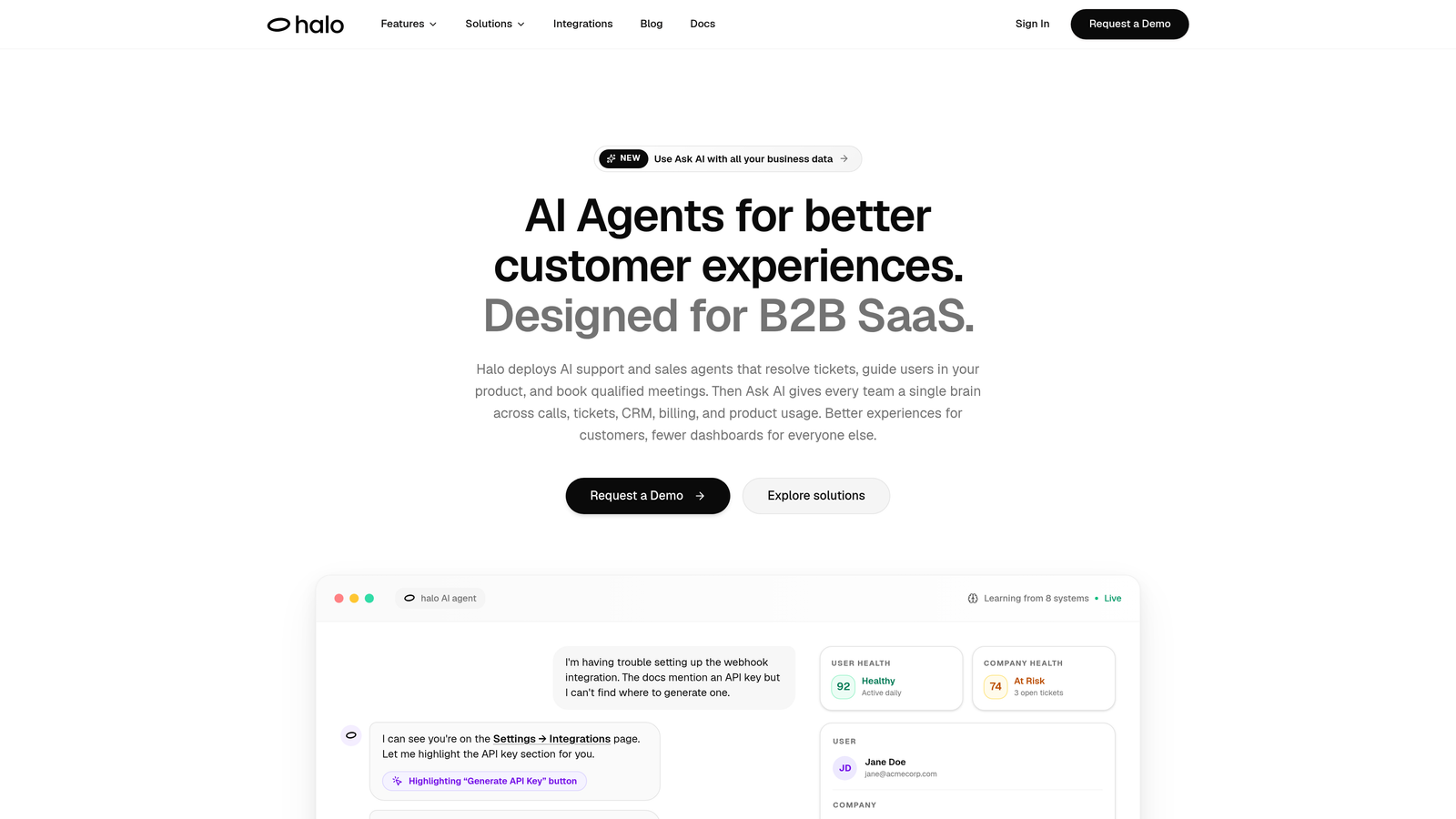
Halo AI is an AI-first customer support platform that deploys intelligent agents to resolve tickets, guide users through your product with page-aware context, and surface business intelligence signals — all without bolt-on complexity.
Where This Tool Shines
Most helpdesk AI tools are retrofitted onto existing platforms. Halo is built AI-first, which means the intelligence isn't a feature layer — it's the foundation. The standout capability is page-aware context: Halo's agents can see what a user is looking at in real time and deliver guidance specific to that exact moment in the product experience. That's a meaningful leap beyond generic chatbot responses.
Beyond ticket resolution, Halo surfaces business intelligence signals that most support tools ignore entirely. Customer health trends, revenue anomalies, and support pattern shifts are surfaced directly in the smart inbox, turning your support queue into a source of strategic insight rather than just a list of problems to close.
Key Features
Page-Aware AI Agents: The AI sees what users are looking at and delivers contextual guidance specific to their current product view.
Smart Inbox with Business Intelligence: Surfaces customer health signals, revenue anomalies, and support trends alongside your ticket queue.
Auto Bug Ticket Creation: Automatically routes bug reports to Linear or Jira without any manual intervention from your support team.
Live Agent Handoff: Escalates complex issues to human agents with full conversation context preserved, so nothing gets repeated.
Deep Integrations: Connects natively with Zendesk, Freshdesk, Intercom, Slack, HubSpot, Stripe, Zoom, PandaDoc, and Fathom.
Continuous Learning: The AI improves from every resolved interaction, getting smarter the longer it runs.
Best For
Product-led SaaS companies and B2B teams that want support AI to do more than deflect tickets. Particularly strong for teams that need their support layer to connect to engineering workflows (bug routing), revenue systems (Stripe, HubSpot), and product analytics in a single coherent platform.
Pricing
Visit haloagents.ai for current plan details. Pricing is not published in this guide as rates may change — check directly for the most accurate information.
2. Zendesk AI
Best for: Established enterprise teams with complex routing needs and large agent teams
Zendesk AI is an AI capability layer built on top of one of the most established helpdesk platforms in the market, with advanced autonomous resolution available as a premium add-on to Suite plans.
Where This Tool Shines
Zendesk's strength is its depth. The platform has been around long enough to accumulate a massive app marketplace, sophisticated routing logic, and enterprise-grade reporting that most newer platforms are still building toward. If your support operation has complex escalation paths, multi-brand setups, or strict SLA requirements, Zendesk's infrastructure handles that well.
The AI features — intelligent triage, sentiment-based routing, and AI-generated reply suggestions — integrate directly into the agent workspace. For teams with large agent pools, the productivity gains from AI-assisted responses can be substantial even before you enable autonomous resolution.
Key Features
Intelligent Triage: Routes tickets based on intent, sentiment, and topic classification without manual rule-building.
AI-Generated Macros and Replies: Suggests responses and automations based on ticket content to speed up agent handling time.
Advanced AI Add-On: Enables autonomous resolution capabilities beyond agent-assist, available as a separate purchase.
Extensive App Marketplace: Hundreds of pre-built integrations for CRM, billing, and product tools.
Deep Reporting Suite: Granular analytics across ticket volume, resolution time, CSAT, and agent performance.
Best For
Mid-market and enterprise teams with established support operations, multiple agents, and complex workflow requirements. Less ideal for small teams or startups where per-seat pricing compounds quickly and the platform's depth becomes overhead rather than advantage.
Pricing
Suite plans start at approximately $55 per agent per month (billed annually); Advanced AI is a separate add-on with its own cost. Verify current pricing at zendesk.com as rates change regularly.
3. Intercom Fin AI
Best for: Teams with high ticket volume who want to pay only for what the AI actually resolves
Intercom Fin AI is Intercom's standalone AI agent that handles customer conversations autonomously and charges only when it successfully resolves a ticket — making the pricing model fundamentally different from most competitors.
Where This Tool Shines
The resolution-based pricing model is Fin's most compelling differentiator. You're not paying for seats, you're not paying for conversations that go nowhere — you pay when the AI closes a ticket. For teams with a high proportion of repetitive, answerable queries, this aligns cost directly with value delivered.
Setup is also notably low-friction. Fin trains on your existing help center content without requiring manual configuration or custom training workflows. For teams that already have solid documentation, that means a faster path to live deflection.
Key Features
Resolution-Based Pricing: Pay per successfully resolved conversation, not per seat or per interaction attempt.
Automatic Training: Fin learns from your existing help center content with no manual setup required.
Seamless Human Handoff: Escalates to human agents when Fin reaches the limits of what it can resolve.
Multilingual Support: Handles conversations across major languages without separate configuration.
Platform Flexibility: Can operate alongside or independently of the broader Intercom platform.
Best For
SaaS and tech companies with well-documented help centers and high volumes of repetitive queries. The resolution-based model is most cost-effective when deflection rates are moderate — teams with very high AI resolution rates may find the per-resolution cost adds up faster than a flat per-seat alternative.
Pricing
Per-resolution pricing model; the base Intercom platform is required separately. Verify current per-resolution rates at intercom.com.
4. Freshdesk Freddy AI
Best for: SMBs and growing teams looking for affordable AI-assisted and autonomous support
Freshdesk Freddy AI is Freshworks' AI layer for Freshdesk, offering both agent-assist (Freddy Copilot) and autonomous resolution (Freddy AI Agent) capabilities at tiered price points that make AI accessible without enterprise-level spend.
Where This Tool Shines
Freshdesk has one of the most accessible entry points in the market, and Freddy AI extends that affordability into the AI tier. The distinction between Copilot (AI that helps agents) and AI Agent (AI that resolves tickets without human involvement) gives teams flexibility to start with assisted AI and scale toward autonomous resolution as confidence grows.
The omnichannel coverage is solid for the price point — email, chat, and social are handled within a single interface, and the built-in knowledge base integration means AI training doesn't require a separate content management workflow.
Key Features
Freddy AI Copilot: Provides AI-assisted suggestions, reply drafts, and conversation summaries for human agents.
Freddy AI Agent: Handles autonomous ticket resolution without requiring human agent involvement.
Affordable Entry Point: AI features accessible from mid-tier plans without enterprise pricing requirements.
Knowledge Base Integration: AI trains directly from your existing Freshdesk knowledge base content.
Omnichannel Coverage: Unified inbox across email, live chat, and social channels.
Best For
SMBs and mid-market teams that want a proven helpdesk platform with AI capabilities at a competitive price. A natural choice for teams that have outgrown free tiers but aren't ready for Zendesk-level complexity or cost.
Pricing
Freshdesk plans start free; Freddy AI features are available from the Pro tier at approximately $49 per agent per month. Verify current plan details at freshdesk.com.
5. Help Scout AI
Best for: Small teams that want AI productivity features without disrupting a human-first support culture
Help Scout AI integrates AI features directly into Help Scout's clean, inbox-style interface, augmenting human agents rather than replacing them — and without adding a separate AI cost layer.
Where This Tool Shines
Help Scout has always prioritized simplicity and a human-centered support experience. Its AI additions follow that same philosophy: Summarize, Assist, and Drafts are tools that make agents faster and more effective, not tools designed to remove them from the conversation. That's a deliberate positioning choice that resonates strongly with teams where relationship quality matters as much as resolution speed.
The fact that AI features are included in standard plans rather than sold as add-ons is a meaningful cost advantage. There's no separate AI tier to budget for, which simplifies procurement and keeps total cost predictable.
Key Features
AI Summarize: Generates instant conversation summaries so agents can pick up context without reading entire threads.
AI Assist: Adjusts tone, translates messages, and expands brief reply notes into full responses.
AI Drafts: Suggests complete responses based on previous conversations and help content.
Included in Standard Plans: No separate AI add-on purchase required — AI features come with the subscription.
Human-First Design: AI augments agents rather than operating autonomously, keeping the human relationship intact.
Best For
Small to mid-sized teams, agencies, and service businesses where support quality and personal tone matter. Less suitable for teams seeking autonomous ticket deflection at scale — Help Scout AI is built to make humans better, not to operate without them.
Pricing
Plans start at approximately $22 per user per month (Standard), with AI features included at no extra cost. Verify current pricing at helpscout.com.
6. Tidio Lyro AI
Best for: SMBs and e-commerce teams that want low-cost conversational AI with a free entry point
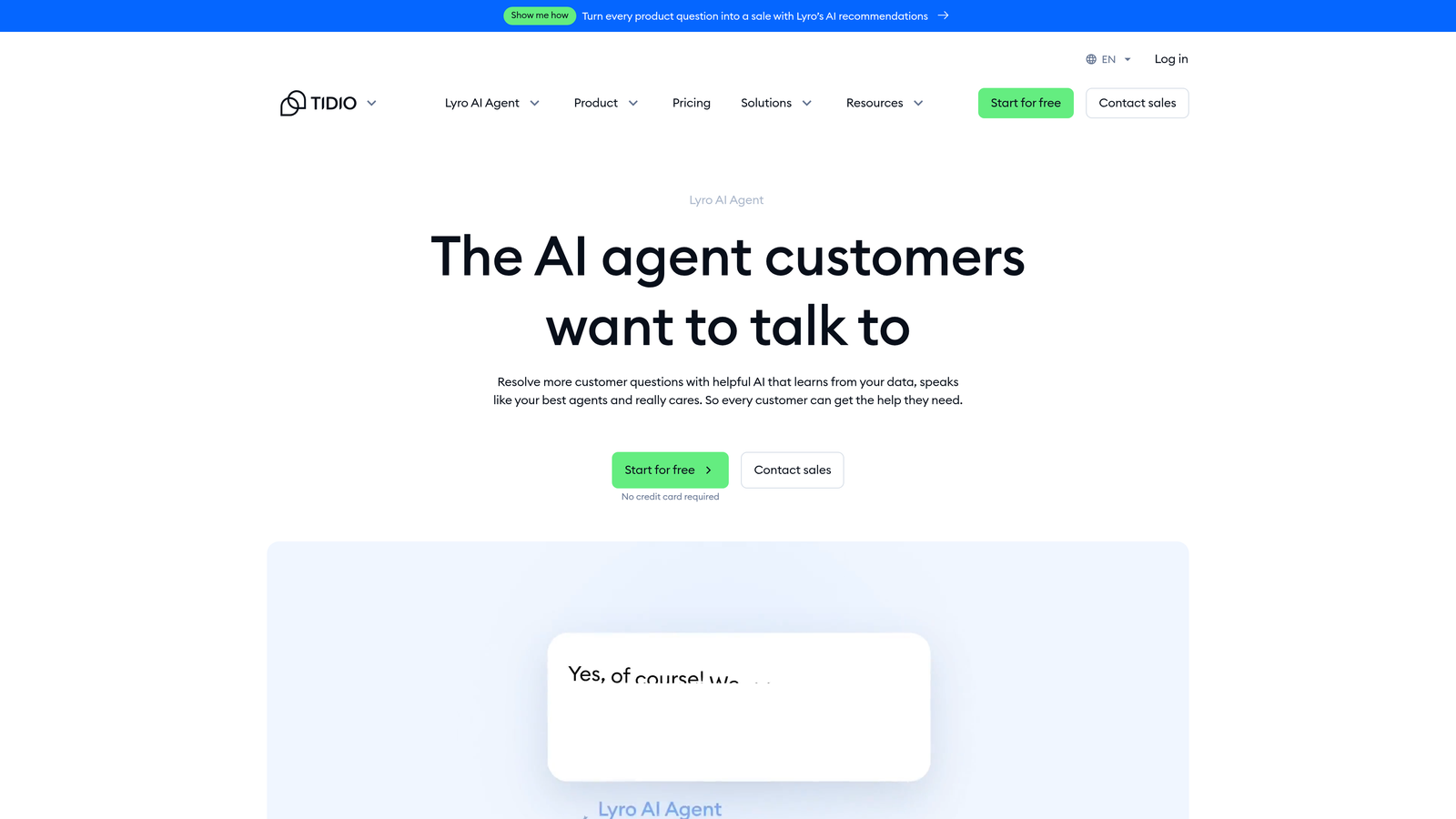
Tidio Lyro AI is a conversational AI agent designed for smaller teams and e-commerce businesses, with a free tier and conversation-based pricing that keeps early costs minimal while the team tests AI deflection.
Where This Tool Shines
Lyro's free tier is one of the most accessible entry points in the entire helpdesk AI market. For teams that want to experiment with AI deflection before committing budget, that's a genuine advantage. Setup is simple: Lyro trains on your FAQ and help content automatically, so you're not building training datasets from scratch.
For e-commerce and SMB use cases where the query types are predictable and repetitive (order status, return policies, shipping questions), Lyro handles a solid proportion of inbound volume without human involvement. The live chat fallback ensures nothing falls through the cracks when Lyro hits its limits.
Key Features
Free Tier Available: Low-volume teams can test Lyro's capabilities without any upfront cost commitment.
Automatic Training: Lyro trains on your FAQ and help content without requiring manual data preparation.
Conversation-Based Pricing: Costs scale with conversation volume rather than agent headcount.
Live Chat Fallback: Seamlessly hands off to human agents when Lyro reaches the boundaries of its knowledge.
Simple Setup: No technical implementation required — accessible to teams without dedicated IT resources.
Best For
Small e-commerce businesses, early-stage startups, and SMBs with predictable, repetitive support queries. Teams with complex B2B support needs or highly technical queries will likely find Lyro's capabilities limiting at higher volumes.
Pricing
Free tier available for low conversation volumes; paid Lyro plans scale by conversation volume. Verify current tier details at tidio.com.
7. Kustomer AI
Best for: High-volume B2C support teams that need full customer history context alongside AI capabilities
Kustomer AI is a CRM-native helpdesk with AI capabilities and conversation-based pricing, built for brands managing high-volume customer interactions who need the full customer timeline visible in every support interaction.
Where This Tool Shines
Kustomer's core differentiator is the CRM-native architecture. Every support interaction sits within a full customer timeline — purchase history, previous conversations, account details — which means agents and AI alike have complete context before they respond. For B2C brands where customer history shapes how you handle an issue, that context is invaluable.
The conversation-based pricing model also means your cost doesn't scale with team size, which is attractive for operations that use a mix of AI deflection and human agents. As AI handles more volume, the per-agent cost pressure typical of traditional helpdesks disappears.
Key Features
Conversation-Based Pricing: Cost scales with interaction volume rather than agent headcount — advantageous as AI handles more tickets.
Full CRM Timeline: Every customer interaction, purchase, and account detail visible in a single unified view.
AI-Powered Routing and Suggestions: Intelligent routing, reply suggestions, and ticket deflection built into the platform.
Omnichannel Coverage: Email, chat, SMS, social, and voice handled within a single platform.
Automation Builder: Visual workflow builder for complex support routing and escalation logic.
Best For
High-volume B2C brands, retail, and subscription businesses where customer history context drives support quality. Enterprise pricing makes it less accessible for smaller teams, and the platform's depth may be more than early-stage companies need.
Pricing
Conversation-based enterprise pricing model. Verify current rates at kustomer.com — pricing is typically discussed through a sales process.
8. Gorgias AI
Best for: E-commerce brands on Shopify that want ticket-based pricing with built-in automation
Gorgias AI is an e-commerce-native helpdesk built around Shopify workflows, with ticket-based pricing that creates a direct financial incentive to automate: the more routine queries the AI handles, the lower your monthly bill.
Where This Tool Shines
The pricing model itself is the story here. Because you pay per ticket rather than per agent, automating routine queries directly reduces your cost — not just your workload. That alignment between automation and cost savings is a powerful motivator for teams to actually configure and use the AI features rather than letting them sit unused.
The Shopify-native integration depth is also a genuine competitive advantage for e-commerce teams. Order status lookups, return initiations, and shipping queries are handled automatically using live order data, which covers a substantial portion of typical e-commerce support volume without any custom development.
Key Features
Ticket-Based Pricing: Pay per ticket, not per agent — AI automation directly reduces your monthly invoice.
E-Commerce Automation: Handles order status, returns, and shipping queries automatically using live Shopify data.
Deep Platform Integrations: Native connections to Shopify, BigCommerce, and WooCommerce out of the box.
Revenue Attribution: Ties support interactions to revenue outcomes, showing the business impact of your support team.
AI Deflection: Reduces billable ticket count by resolving routine queries before they reach a human agent.
Best For
Shopify-first e-commerce brands of all sizes. The pricing model and automation depth are purpose-built for e-commerce workflows. Teams outside of e-commerce will find the platform's specialization limiting rather than advantageous.
Pricing
Starter plans from approximately $10 per month for 50 tickets, scaling by ticket volume. Verify current tier details at gorgias.com.
9. Zoho Desk Zia AI
Best for: Teams already in the Zoho ecosystem who want cost-effective AI without additional add-on spend
Zoho Desk Zia AI is Zoho's AI assistant embedded in Zoho Desk's mid-to-upper tier plans, making it one of the most cost-accessible AI helpdesk options — particularly for teams already running Zoho CRM or other Zoho products.
Where This Tool Shines
Zia's inclusion in standard Zoho Desk plans rather than as a separate add-on is a meaningful cost advantage. You're not paying an AI surcharge on top of your helpdesk subscription — the intelligence is part of the package. For budget-conscious teams, that simplicity in pricing has real value.
The broader Zoho ecosystem integration is the other standout. If your team is already using Zoho CRM, Zoho Analytics, or other Zoho products, Zia's insights flow across those systems naturally. That cross-platform intelligence — connecting support data to CRM records and business analytics — is difficult to replicate with point solutions.
Key Features
Zia AI Included in Plans: AI capabilities come with Professional and Enterprise tiers — no separate add-on cost required.
Sentiment Analysis: Zia detects customer sentiment and flags tickets that need priority attention.
Anomaly Detection: Surfaces unusual patterns in ticket volume or response times before they become operational problems.
AI Reply Suggestions: Recommends responses and knowledge base articles based on ticket content.
Zoho Ecosystem Integration: Connects natively with Zoho CRM, Zoho Analytics, and the broader Zoho product suite.
Best For
Small to mid-market teams already invested in the Zoho ecosystem, and budget-conscious buyers who want AI capabilities without paying add-on pricing. Teams without existing Zoho infrastructure may find less compelling reasons to choose Zoho Desk over more specialized alternatives.
Pricing
Professional plans from approximately $23 per agent per month; Enterprise from approximately $40 per agent per month. Verify current pricing at zoho.com/desk.
Which Tool Is Right for Your Team?
The right helpdesk AI platform depends less on feature lists and more on two things: your pricing model tolerance and your support team's growth trajectory. Here's a quick way to think about it.
If you want AI-first architecture with business intelligence: Halo AI is the standout choice for B2B SaaS teams. The page-aware context, smart inbox signals, and deep integration with product and revenue tools make it more than a support platform — it's an operational intelligence layer.
If you're an enterprise team with complex routing needs: Zendesk AI offers the depth and marketplace ecosystem to handle sophisticated support operations, though the per-seat plus add-on cost structure requires careful budgeting.
If you want to pay only for resolved tickets: Intercom Fin's resolution-based pricing is compelling for teams with high volumes of answerable queries. Just model out your expected resolution rate before committing.
If budget is the primary constraint: Freshdesk Freddy AI and Zoho Desk Zia offer the most accessible AI entry points on a per-agent basis. Tidio Lyro's free tier is the lowest-friction starting point of all.
If you're in e-commerce: Gorgias AI is purpose-built for Shopify workflows, and the ticket-based pricing model creates a direct financial reward for automation.
The broader takeaway: your support team shouldn't scale linearly with your customer base. AI agents can handle routine tickets, guide users through your product, and surface business intelligence while your human team focuses on the complex issues that genuinely need a person. See Halo in action and discover how continuous learning transforms every interaction into smarter, faster support.