9 Best Helpdesk AI Software Tools for Growing Teams in 2026
Growing B2B support teams face mounting ticket volume without proportional headcount growth — and not every AI helpdesk tool is built for that reality. This guide evaluates nine helpdesk AI software platforms for growing teams on AI capability, scalability, integration breadth, and budget fit, so you can find the right solution for where your team is headed.
 Grant CooperFounder13 min read
Growing B2B teams face a familiar paradox: support ticket volume scales with your customer base, but headcount can't always keep pace. Helpdesk AI software bridges that gap, automating routine resolutions, surfacing business intelligence, and freeing human agents to focus on complex, high-value conversations.
But not every AI helpdesk tool is built for teams in growth mode. Some are enterprise-only behemoths with pricing to match. Others are lightweight chatbots that can't handle real ticket complexity. This list cuts through the noise.
We evaluated nine platforms on AI capability depth, scalability, integration breadth, and how well they serve teams growing fast without unlimited budgets or headcount. Whether you're running a lean support operation on Zendesk, migrating off a legacy system, or building your first AI-native support stack, you'll find a clear recommendation here. For a broader look at the category, our guide to AI helpdesk software covers the fundamentals worth knowing before you buy.
1. Halo AI
Best for: B2B SaaS teams that want AI-native, autonomous ticket resolution with business intelligence built in.
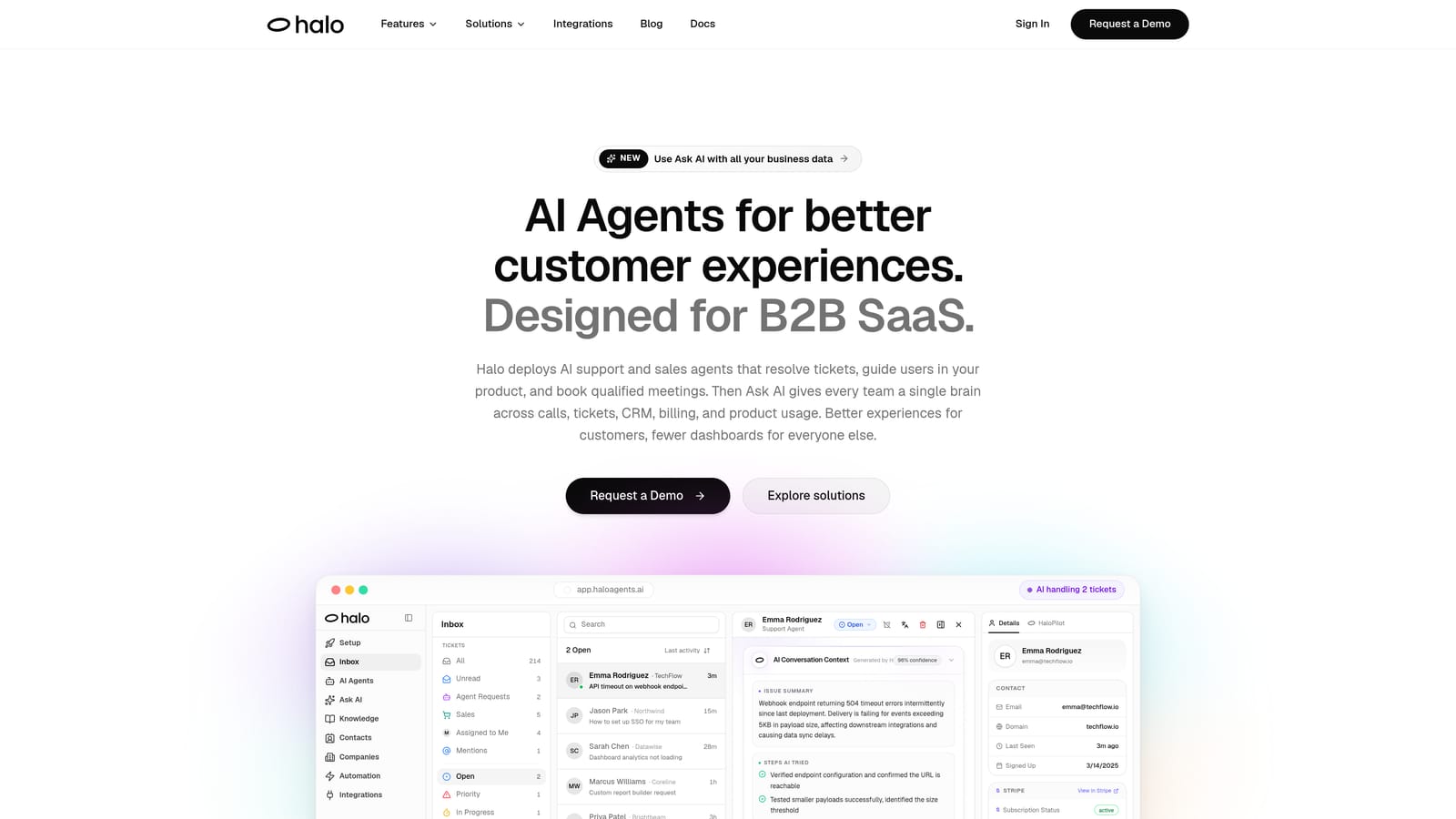
Halo AI is an AI-first customer support platform that deploys intelligent agents to resolve tickets, guide users through your product, and surface business intelligence — all while continuously learning from every interaction.
Where This Tool Shines
Most helpdesk platforms bolt AI onto an existing ticket workflow. Halo was built the other way around: AI is the architecture, not the add-on. That distinction matters enormously for growing teams. You're not configuring rules for an AI layer on top of a legacy system; you're deploying agents that actually close tickets autonomously and escalate only what genuinely needs a human.
The page-aware chat widget is a standout capability. It sees what your user sees in real time, which means it can offer contextual, visual guidance rather than generic knowledge base links. Pair that with a continuous learning loop where every resolved interaction makes the AI smarter, and you get a support operation that improves automatically as your team scales.
Key Features
Autonomous AI Agents: Resolve support tickets end-to-end and escalate complex issues to live agents with full context preserved.
Page-Aware Chat Widget: Understands the user's current product context to deliver precise, visual guidance rather than generic answers.
Smart Inbox with Business Intelligence: Surfaces customer health signals, revenue intelligence, and anomaly detection beyond standard support metrics.
Auto Bug Ticket Creation: Detects product issues and automatically routes bug reports to engineering tools like Linear.
Deep Integrations: Connects to Slack, HubSpot, Intercom, Stripe, Zoom, PandaDoc, and Fathom for a unified support and business stack.
Best For
B2B SaaS companies at the growth stage that need autonomous ticket resolution, not just agent assist. Particularly strong for product teams that want their support layer to generate business intelligence, not just close tickets.
Pricing
Contact for pricing. Built specifically for B2B SaaS teams at growth stage; not a one-size-fits-all subscription.
2. Intercom
Best for: Teams already invested in Intercom's messaging infrastructure who want AI resolution layered in.
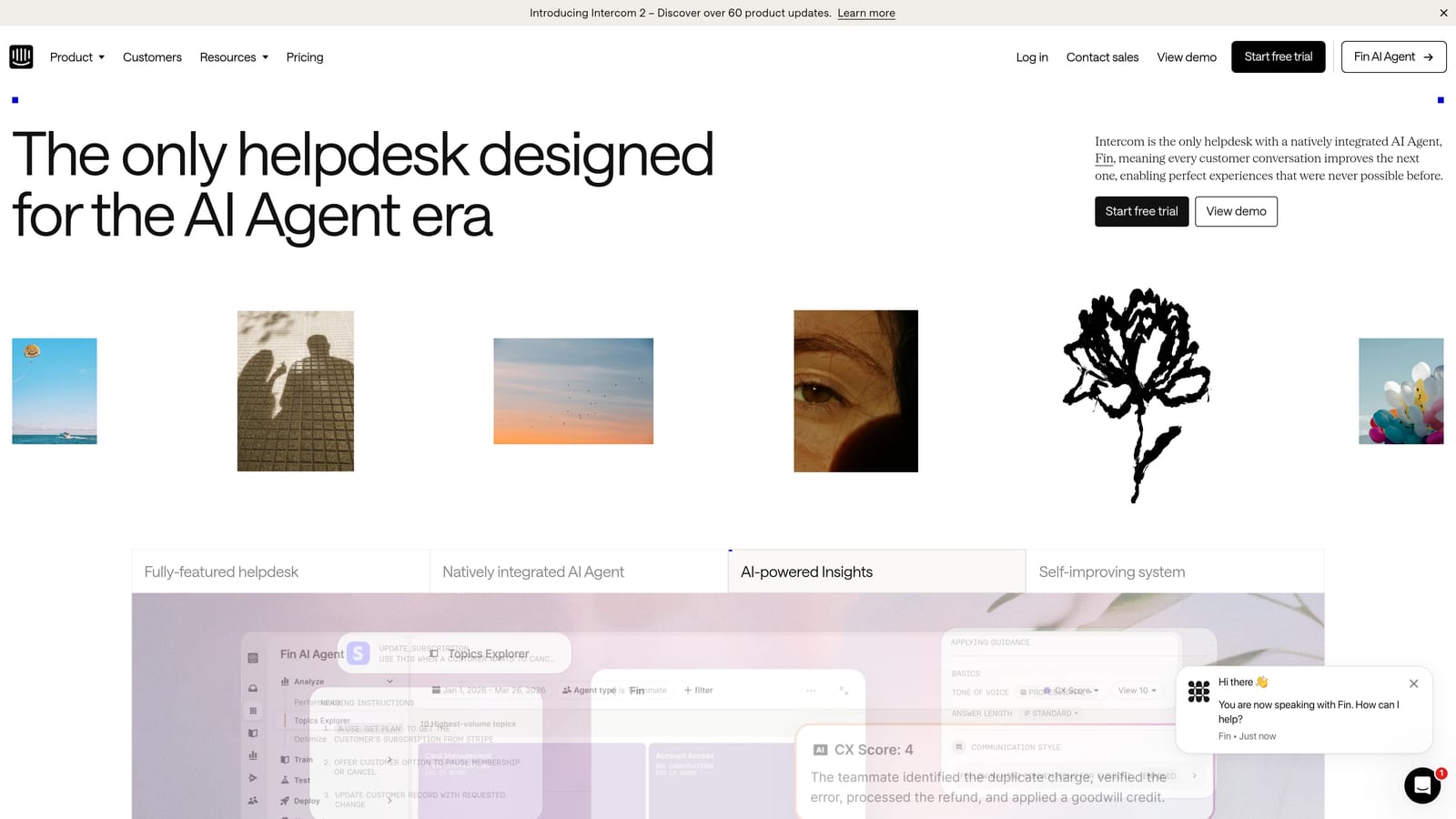
Intercom is a mature conversational support platform with Fin AI Agent handling automated ticket resolution on top of a well-established messaging foundation.
Where This Tool Shines
Intercom's Fin AI Agent draws from your existing knowledge base and help center content to resolve queries without human intervention. For teams that have already invested in building out Intercom's infrastructure, this is a natural evolution rather than a platform migration.
The omnichannel coverage is solid, spanning chat, email, and in-app messaging. The AI Copilot feature also helps live agents move faster with suggested responses and context summaries. The main consideration: Fin is billed per resolution, which can add up quickly at higher ticket volumes.
Key Features
Fin AI Agent: Automated resolution using knowledge base content, with human handoff for unresolved queries.
Omnichannel Messaging: Unified inbox covering chat, email, and in-app channels.
AI Copilot: Suggested replies and context for live agents handling escalated tickets.
App Marketplace: Extensive integration library with broad third-party connectivity.
Per-Resolution Pricing for Fin: Pay only for tickets Fin actually resolves, though this model requires volume forecasting.
Best For
Teams already operating within the Intercom ecosystem who want to activate AI resolution without switching platforms. Less ideal for teams starting fresh who want AI-native architecture from the ground up.
Pricing
Starts at approximately $39 per seat per month; Fin AI is billed separately on a per-resolution basis.
3. Zendesk AI
Best for: Established teams already on Zendesk who want to layer AI across triage, agent assist, and self-service.
Zendesk AI is the incumbent enterprise helpdesk platform with AI features built across ticket routing, agent productivity, and self-service automation.
Where This Tool Shines
If your team is already running on Zendesk, the AI layer is the path of least resistance. Intelligent triage handles intent detection, sentiment tagging, and auto-routing without requiring a platform migration. The agent copilot features, including suggested replies, ticket summarization, and next-best-action prompts, can meaningfully reduce handle time for experienced support teams.
The breadth of Zendesk's integration ecosystem is genuinely hard to match. Over 1,500 apps means your existing stack likely connects. The tradeoff: full AI capabilities require the Suite Professional tier or above, and configuration complexity can slow initial deployment for lean teams.
Key Features
Intelligent Triage: Auto-routing, intent detection, and sentiment tagging across incoming tickets.
AI Copilot for Agents: Suggested replies, ticket summarization, and next-best-action recommendations.
AI-Powered Self-Service Bots: Automated deflection for common queries before they reach the queue.
Advanced Analytics Suite: Comprehensive reporting across support performance metrics.
Integration Ecosystem: 1,500+ app marketplace connections for broad stack compatibility.
Best For
Teams already on Zendesk who want AI features without a platform switch. Less suited for teams starting fresh who find Zendesk's pricing and configuration overhead disproportionate to their current scale.
Pricing
AI features available on Suite Professional and above; pricing available on request from Zendesk's sales team.
4. Freshdesk Freddy AI
Best for: SMB and mid-market teams that want AI-assisted support at a more accessible price point than enterprise alternatives.
Freshdesk Freddy AI is Freshworks' AI layer embedded across their helpdesk product, covering self-service deflection, agent productivity, and support analytics.
Where This Tool Shines
Freddy AI is structured across three distinct capabilities: Self Service for deflection, Copilot for agent productivity, and Insights for analytics. This modular approach means you can activate the layers most relevant to your current growth stage without overpaying for features you're not ready to use.
For teams comparing Freshdesk to Zendesk, the pricing difference is often the deciding factor. Freshdesk tends to offer comparable core AI features at a lower per-agent cost, making it a strong contender for teams watching their support budget closely during a growth phase.
Key Features
Freddy Self Service: AI-powered deflection and chatbot handling common queries before they reach agents.
Freddy Copilot: Response drafting, thread summarization, and tone adjustment for live agents.
Freddy Insights: AI-driven analytics with anomaly detection across support performance data.
Omnichannel Ticketing: Unified inbox across email, chat, phone, and social channels.
Competitive Pricing Tiers: AI features accessible at mid-market price points rather than enterprise-only tiers.
Best For
SMB and mid-market teams that need capable AI features without enterprise-level investment. Also a natural fit for teams already using other Freshworks products who want a unified vendor relationship.
Pricing
Plans start at approximately $15 per agent per month; Freddy AI features are available on higher tiers.
5. Help Scout
Best for: Teams that prioritize brand voice and relationship quality over full AI automation.
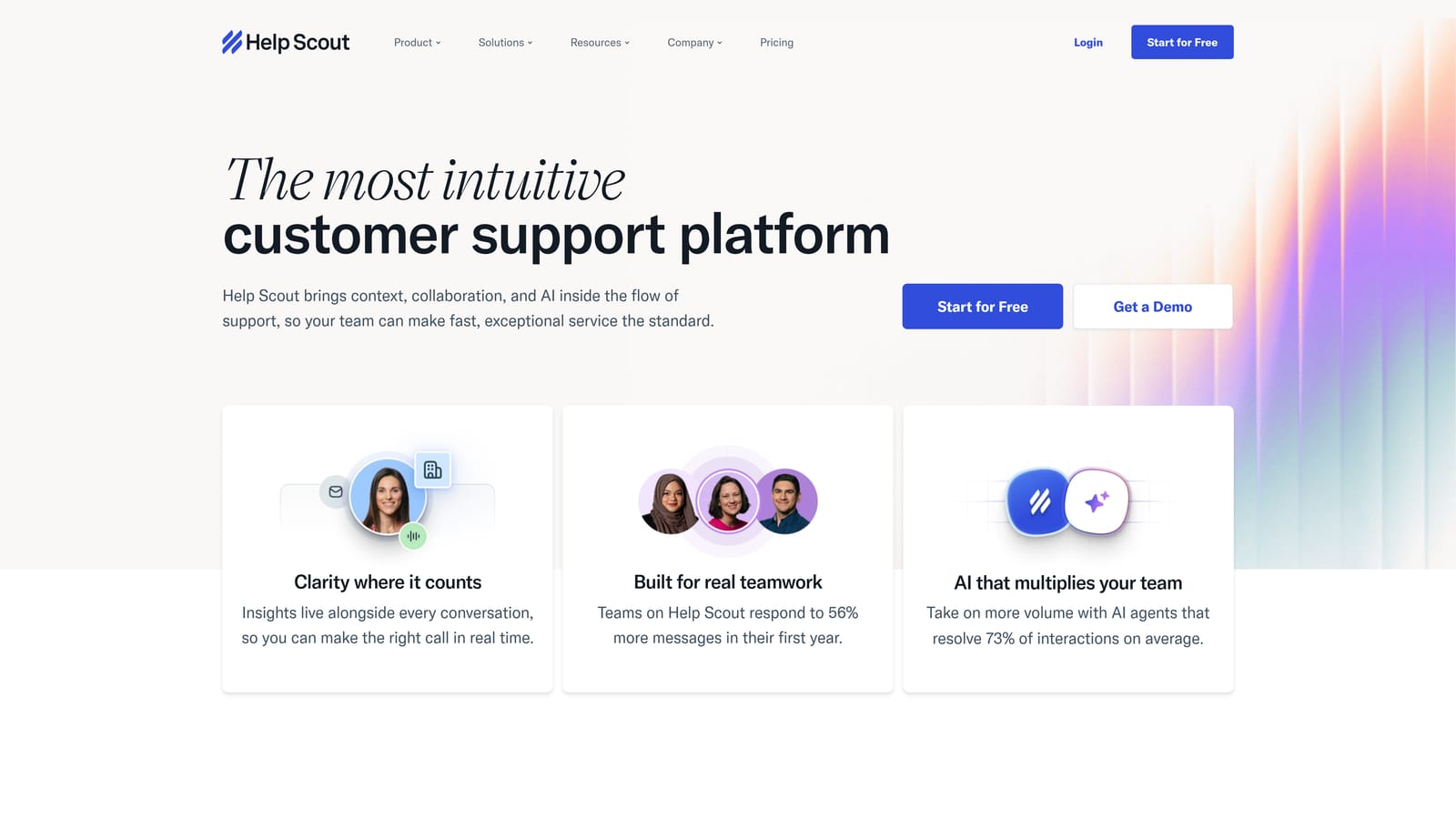
Help Scout is a human-first helpdesk platform where AI features are designed to assist agents rather than replace them, with a focus on preserving the quality and tone of customer relationships.
Where This Tool Shines
Help Scout takes a deliberately different philosophy from AI-native platforms. Rather than autonomous resolution, the AI generates draft replies for agents to review, summarizes long threads for faster context, and powers a self-service bot that draws from your documentation. Agents stay in control; AI just makes them faster.
This approach resonates strongly with teams where brand voice matters. If your support is a differentiator and you're worried about AI-generated responses sounding generic, Help Scout's agent-assist model keeps a human in the loop on every outbound message. The tradeoff is lower deflection rates compared to platforms with fully autonomous AI agents.
Key Features
AI Drafts: Generates reply suggestions for agents to review, edit, and send rather than auto-sending.
AI Summarize: Condenses long conversation threads so agents get context instantly.
AI Answers: Self-service bot drawing from your existing documentation for common queries.
Shared Inbox: Collision detection and internal notes to prevent duplicate responses across the team.
Clean Onboarding: Minimal UI designed for fast team adoption without lengthy implementation cycles.
Best For
Teams that want AI to enhance agent output rather than replace it. Strong fit for companies where support tone and relationship quality are core to the brand experience.
Pricing
Starts at approximately $22 per user per month on the Standard plan.
6. Tidio
Best for: Small teams and e-commerce brands that need fast AI deflection deployment without complex implementation.
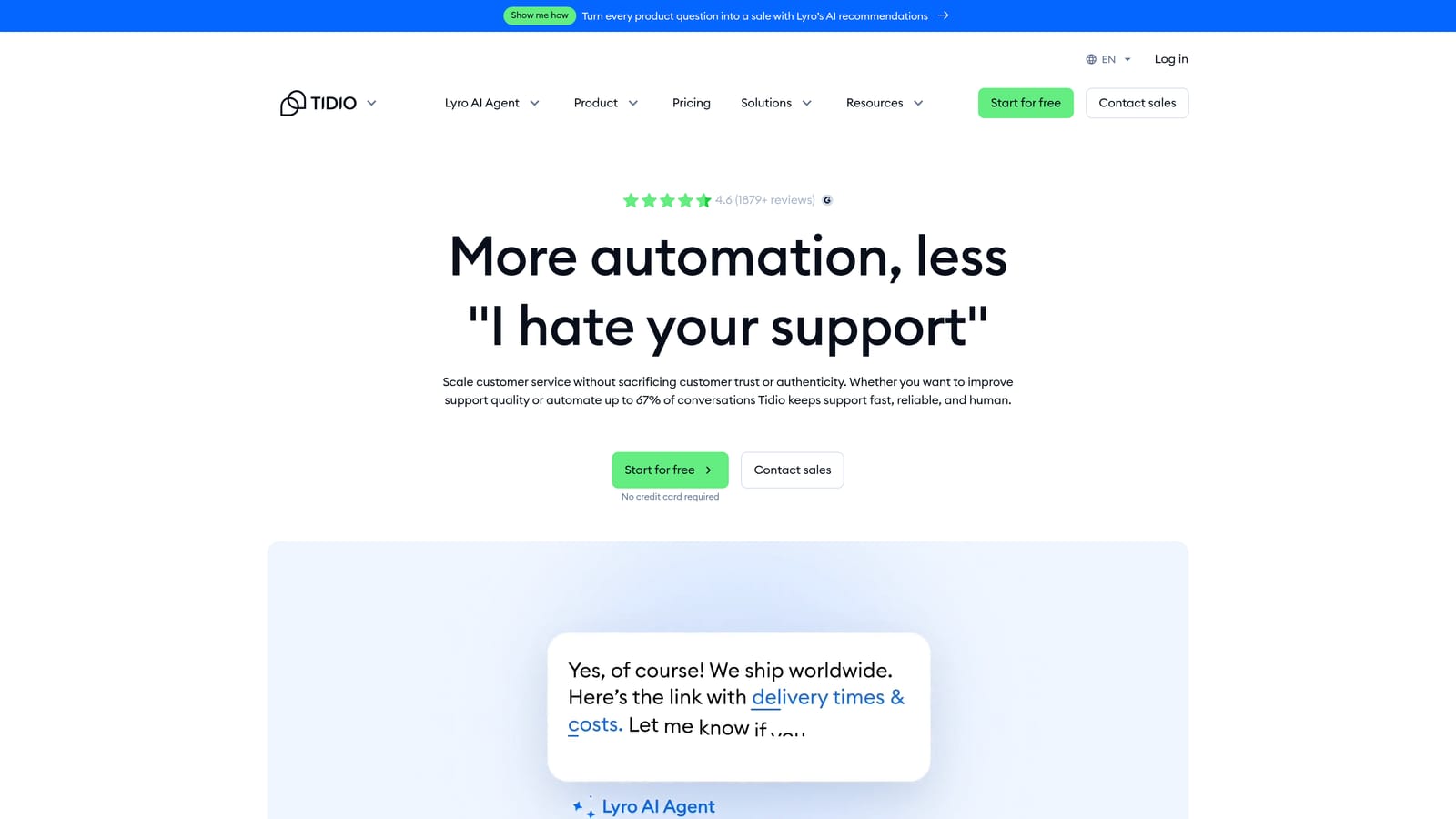
Tidio is a fast-to-deploy AI chatbot and live chat platform powered by Lyro AI, well-suited for smaller teams that need immediate deflection capability up and running quickly.
Where This Tool Shines
Tidio's headline advantage is speed. Most teams can go from signup to live AI chatbot within hours, not weeks. Lyro AI handles FAQ-style queries and common support requests, with smooth agent takeover when conversations need a human. For e-commerce teams in particular, the Shopify and WooCommerce integrations make it easy to connect order data to support conversations.
It's worth being clear about scope: Tidio excels at deflecting high-volume, repetitive queries at small-team scale. It's less suited for complex B2B SaaS ticket resolution where AI needs deep product context, multi-step troubleshooting logic, or business intelligence integration.
Key Features
Lyro AI Chatbot: Automated resolution for FAQ-style queries and common support requests.
Live Chat with Agent Takeover: Smooth handoff from AI to human when conversations require escalation.
E-Commerce Integrations: Native connections to Shopify, WooCommerce, and BigCommerce.
Visual Flow Builder: No-code chatbot customization for teams without technical resources.
Fast Setup: Designed to be live within hours of signup, not weeks of implementation.
Best For
Small teams, early-stage startups, and e-commerce brands that need immediate AI deflection without implementation overhead. Less suited for complex B2B SaaS support environments.
Pricing
Free tier available; Lyro AI starts at approximately $29 per month.
7. Zoho Desk
Best for: Teams already operating within the Zoho ecosystem who want unified CRM and support intelligence.
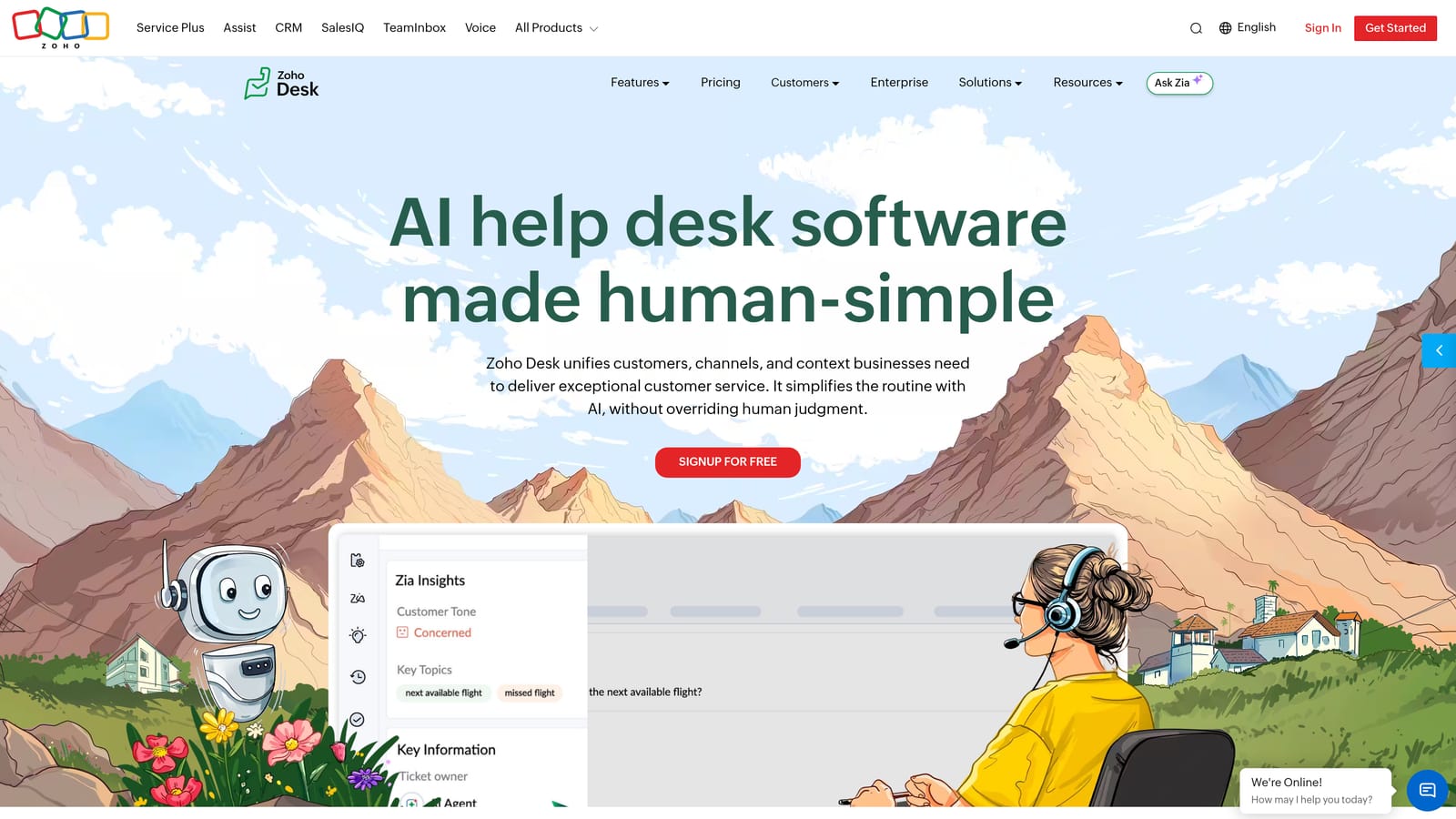
Zoho Desk is a feature-rich helpdesk platform with Zia AI built in, offering strong value for teams that want support intelligence connected to their broader Zoho stack.
Where This Tool Shines
Zia AI covers a solid range of capabilities: sentiment analysis on incoming tickets, automatic tagging and routing, anomaly detection in support patterns, and response suggestions for agents. For teams already using Zoho CRM, the native integration means customer data flows directly into support context without custom API work.
The value proposition is compelling within the Zoho ecosystem. Outside of it, the picture is more nuanced. Zoho Desk can feel siloed if you're running tools from other vendors, and the Zia AI features are gated behind the Enterprise tier, which is worth factoring into your total cost comparison.
Key Features
Zia AI: Sentiment analysis, ticket tagging, anomaly detection, and response suggestions across the support workflow.
Native Zoho Integration: Direct connection to Zoho CRM, Analytics, and SalesIQ without third-party middleware.
Omnichannel Support: Email, chat, phone, social, and web form tickets unified in one inbox.
Blueprint Workflow Automation: Process enforcement tools to keep support workflows consistent as teams grow.
Competitive Pricing: Strong feature density per tier compared to enterprise-oriented alternatives.
Best For
Teams already running Zoho CRM or other Zoho products who want support intelligence that connects naturally to their existing stack. Less compelling for teams operating outside the Zoho ecosystem.
Pricing
Starts at approximately $14 per agent per month; Zia AI features available on the Enterprise tier at approximately $40 per agent per month.
8. Kustomer
Best for: Teams with complex, multi-touch customer relationships who need AI resolution backed by rich interaction history.
Kustomer is a CRM-first AI helpdesk that threads all customer interactions into a unified timeline, giving AI models richer context for more accurate resolution.
Where This Tool Shines
Kustomer's core insight is that AI resolution quality depends on context quality. By maintaining a complete customer timeline across every channel and interaction, the AI has significantly more signal to work with when routing, responding, or automating. For teams whose customers have long, multi-touch histories, this context richness translates to more relevant, accurate responses.
The workflow automation engine is also robust, supporting conditional branching for complex support scenarios. The main consideration is pricing: Kustomer is firmly enterprise-oriented, and the per-user cost reflects that. Growing teams should model their expected seat count carefully before committing.
Key Features
Customer Timeline View: Full interaction history across all channels in a single unified view for agents and AI alike.
AI-Powered Routing and Intent Detection: Automated ticket classification and routing based on customer context and query type.
Conditional Workflow Automation: Branching logic for complex support scenarios that simple rule-based systems can't handle.
Deep CRM Data Integration: Customer data feeds directly into AI context for more accurate, personalized responses.
Omnichannel Coverage: Email, chat, SMS, social, and voice in a single unified interface.
Best For
Teams with complex, multi-touch customer relationships where interaction history is a meaningful input to support quality. Enterprise-oriented pricing makes it less suited for early-stage teams watching costs closely.
Pricing
Starts at approximately $89 per user per month; enterprise-oriented pricing model.
9. Gladly
Best for: Experience-focused teams that compete on support quality and want AI-assisted routing without losing the human thread.
Gladly is a people-centric support platform that organizes conversations by customer rather than ticket number, with AI-assisted routing and response suggestions for teams where experience quality is a strategic differentiator.
Where This Tool Shines
Gladly's structural difference is philosophical: there are no ticket numbers. Every conversation is threaded by person, giving agents a complete lifetime history of every interaction regardless of channel. This model makes AI-assisted routing more meaningful, because the system can factor in the full relationship context when deciding who handles a conversation.
Sidekick AI handles self-service and automated resolution for common queries, while the agent-facing tools surface relevant history and suggested responses. Gladly tends to attract brands that view support as a brand expression, not a cost center. The enterprise pricing reflects that positioning.
Key Features
Person-Based Conversation Threading: No ticket numbers; full lifetime interaction history organized by customer across all channels.
AI-Assisted Routing: Routes conversations to the right agent based on skills, availability, and customer context.
Sidekick AI: Self-service and automated resolution for common queries before they reach the agent queue.
Omnichannel in One View: Chat, email, voice, SMS, and social handled from a single unified interface.
Performance and CSAT Analytics: Built-in agent performance tracking and customer satisfaction measurement.
Best For
Experience-focused brands that compete on support quality and want AI to enhance rather than commoditize their customer relationships. Enterprise pricing means it's best suited for teams with the budget to match the ambition.
Pricing
Enterprise pricing; contact Gladly directly for a quote.
Which Tool Is Right for Your Growing Team?
The right helpdesk AI platform depends less on feature checklists and more on where you are in your growth trajectory and what kind of AI you actually need.
If you want autonomous ticket resolution with a continuous learning loop and business intelligence built in, Halo AI is the strongest fit for B2B SaaS teams. It's built AI-first, not AI-added, and the page-aware context and smart inbox capabilities go well beyond what traditional helpdesks offer even with AI layers on top.
If you're already deep in an existing platform, the calculus shifts. Teams on Zendesk or Intercom will find the least friction activating AI within those ecosystems. Freshdesk Freddy AI offers comparable capabilities at a friendlier price point for SMB and mid-market teams. Help Scout is the right call when brand voice and agent control matter more than deflection rates.
For e-commerce and smaller teams, Tidio gets you live fast without implementation overhead. For teams inside the Zoho ecosystem, Zoho Desk with Zia AI is the natural choice. Kustomer and Gladly serve more specialized profiles: complex multi-touch relationships and experience-first brands respectively, both at enterprise price points.
Your support team shouldn't scale linearly with your customer base. Let AI agents handle routine tickets, guide users through your product, and surface business intelligence while your team focuses on complex issues that need a human touch. See Halo in action and discover how continuous learning transforms every interaction into smarter, faster support.