9 Best Helpdesk AI Tools for Startups in 2026
Startups need fast, high-quality customer support without the overhead of a full support team — and the right helpdesk AI tools make that possible. This guide evaluates 9 top solutions on startup-relevant criteria including ease of setup, pricing transparency, AI quality, and scalability, so you can find the best fit whether you're a two-person team or a fast-growing Series A company.
 Matt PattoliFounder14 min read
Startups face a unique support paradox: customers expect fast, high-quality responses, but lean teams can't afford to hire a full support department to deliver them. That's where helpdesk AI tools come in. They let small teams punch well above their weight by automating ticket resolution, surfacing insights, and handling routine queries around the clock.
But not every AI helpdesk tool is built with startups in mind. Some are enterprise-heavy, overpriced, or so feature-bloated they take months to configure. Others lack the integrations or intelligence needed to scale with you.
This list cuts through the noise. We evaluated these tools on startup-relevant criteria: ease of setup, pricing transparency, AI quality, integration depth, and how well they grow with your team. Whether you're a two-person founding team or a Series A company scaling fast, there's a tool here that fits where you are today — and where you're headed.
1. Halo AI
Best for: B2B SaaS startups that want AI-native support with product intelligence baked in
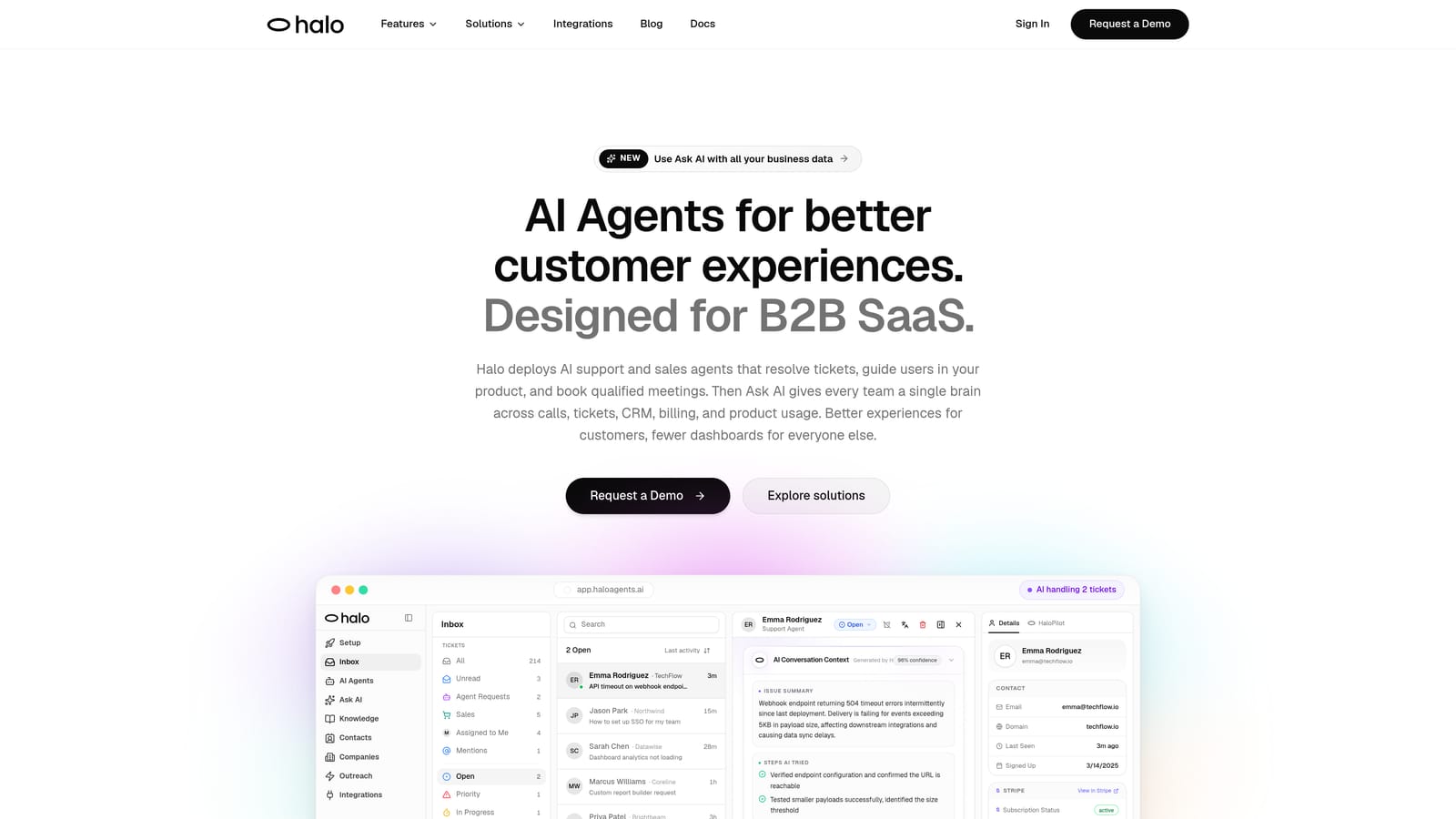
Halo AI is an AI-first customer support platform built specifically for B2B SaaS teams who need more than a ticketing system.
Where This Tool Shines
Most helpdesk tools treat AI as a feature. Halo treats it as the foundation. The platform is architected around autonomous resolution from the ground up, which means the AI isn't a layer on top of a legacy system — it's the core of how support actually works.
What sets Halo apart for startups is the depth of context it brings to every interaction. The page-aware chat widget sees what your user is looking at inside your product, so the AI can guide them through exactly what they're struggling with rather than offering generic help articles. That level of contextual intelligence is rare, and it matters enormously for B2B SaaS products where support is directly tied to adoption and retention.
Key Features
Page-Aware Chat Widget: The AI sees what users are viewing in your product and provides contextually relevant guidance without them having to explain their situation.
Autonomous Ticket Resolution: AI agents resolve tickets end-to-end and continuously learn from every interaction, improving accuracy over time without manual retraining.
Auto Bug Ticket Creation: When users report issues, Halo automatically creates and routes bug tickets to Linear or equivalent tools, closing the loop between support and engineering.
Smart Inbox with Business Intelligence: Goes beyond support metrics to surface churn signals, revenue anomalies, and product insights from customer conversations — giving founders and product teams visibility they'd otherwise miss.
Live Agent Handoff: Complex issues escalate seamlessly to human agents with full context preserved, so nothing gets lost in the handoff.
Deep Integration Stack: Connects natively with Linear, Slack, HubSpot, Intercom, Stripe, Zoom, PandaDoc, and Fathom — tools that growing SaaS teams actually use.
Best For
Seed to Series B B2B SaaS teams that want AI to do real work — not just suggest responses. Particularly valuable for founders who want support intelligence feeding back into product decisions and customer health monitoring.
Pricing
Contact for pricing. Built for scaling B2B SaaS teams, so pricing is structured around your growth rather than a rigid per-agent model.
2. Intercom
Best for: Product-led growth companies wanting conversational support with strong in-app messaging
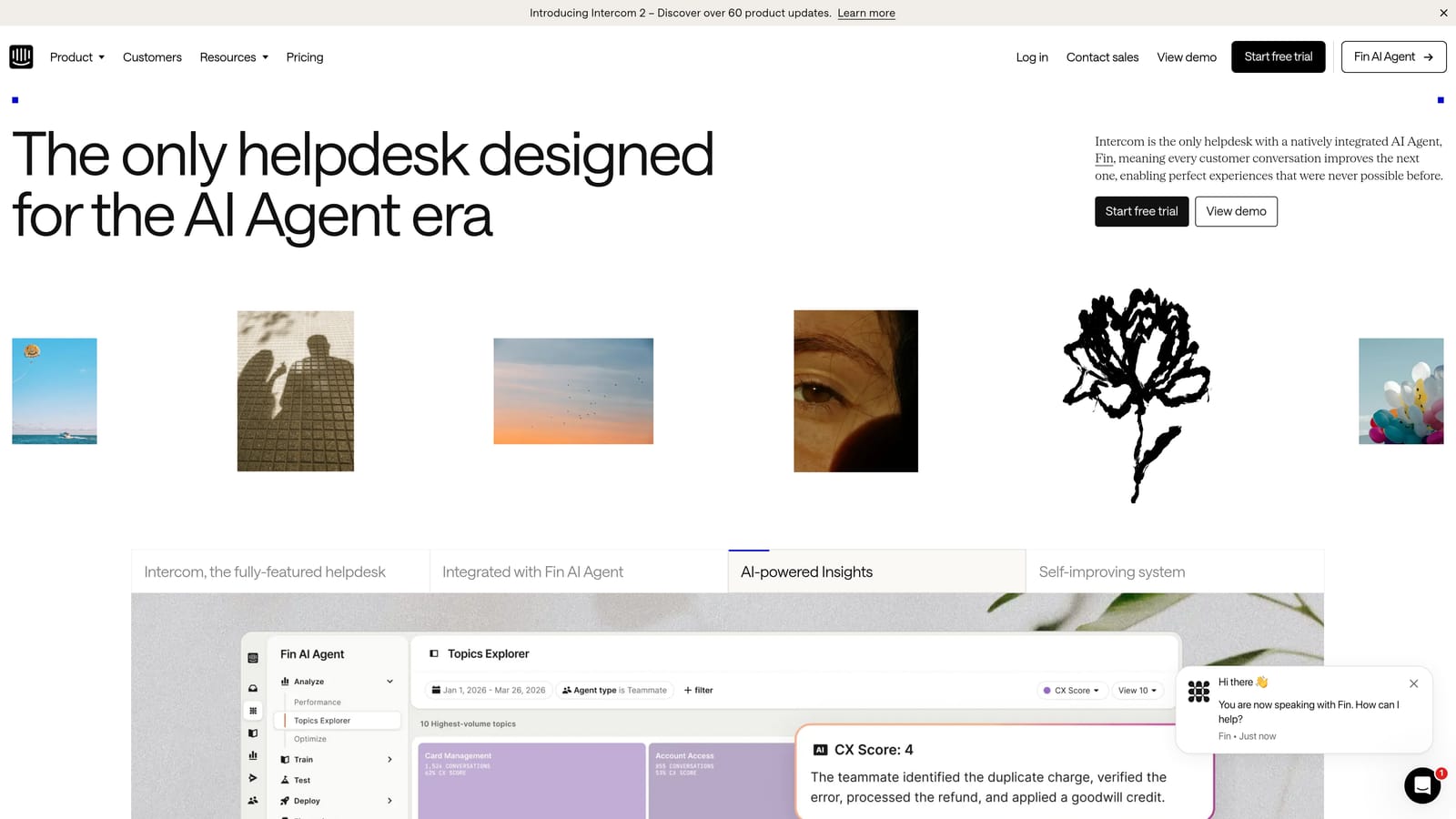
Intercom is a conversational support platform with a well-established AI agent, Fin, that handles query resolution autonomously across chat and messaging channels.
Where This Tool Shines
Intercom's strength is the in-app messenger experience. It's polished, familiar to users, and deeply integrated into the product surface. For PLG companies where the product itself is the primary growth engine, that in-product support experience matters a lot.
Fin, Intercom's AI agent, is built on large language models and handles multi-turn conversations reasonably well. It can resolve common queries without human involvement and escalates when it can't. The workflow automation builder also gives non-technical teams a way to build logic without writing code.
Key Features
Fin AI Agent: Handles autonomous conversation resolution across channels using large language models, with multi-turn dialogue support.
In-App Messenger: Rich media support and a polished chat UI that integrates directly into your product experience.
Workflow Automation Builder: Visual builder for creating support logic, routing rules, and automated sequences without engineering involvement.
Product Tours and Proactive Messaging: Goes beyond reactive support to guide users through features and trigger messages based on behavior.
Reporting and CSAT Tracking: Built-in analytics for tracking resolution rates, response times, and customer satisfaction scores.
Best For
Startups with a product-led motion where in-app engagement and onboarding are as important as support. Works well for teams that want a single platform for support, engagement, and user communication.
Pricing
Starts around $39/month for basic plans; Fin AI usage-based pricing applies on top, which can escalate as conversation volume grows. Worth modeling your expected usage before committing.
3. Freshdesk
Best for: Early-stage teams that need a capable omnichannel helpdesk with a free starting point
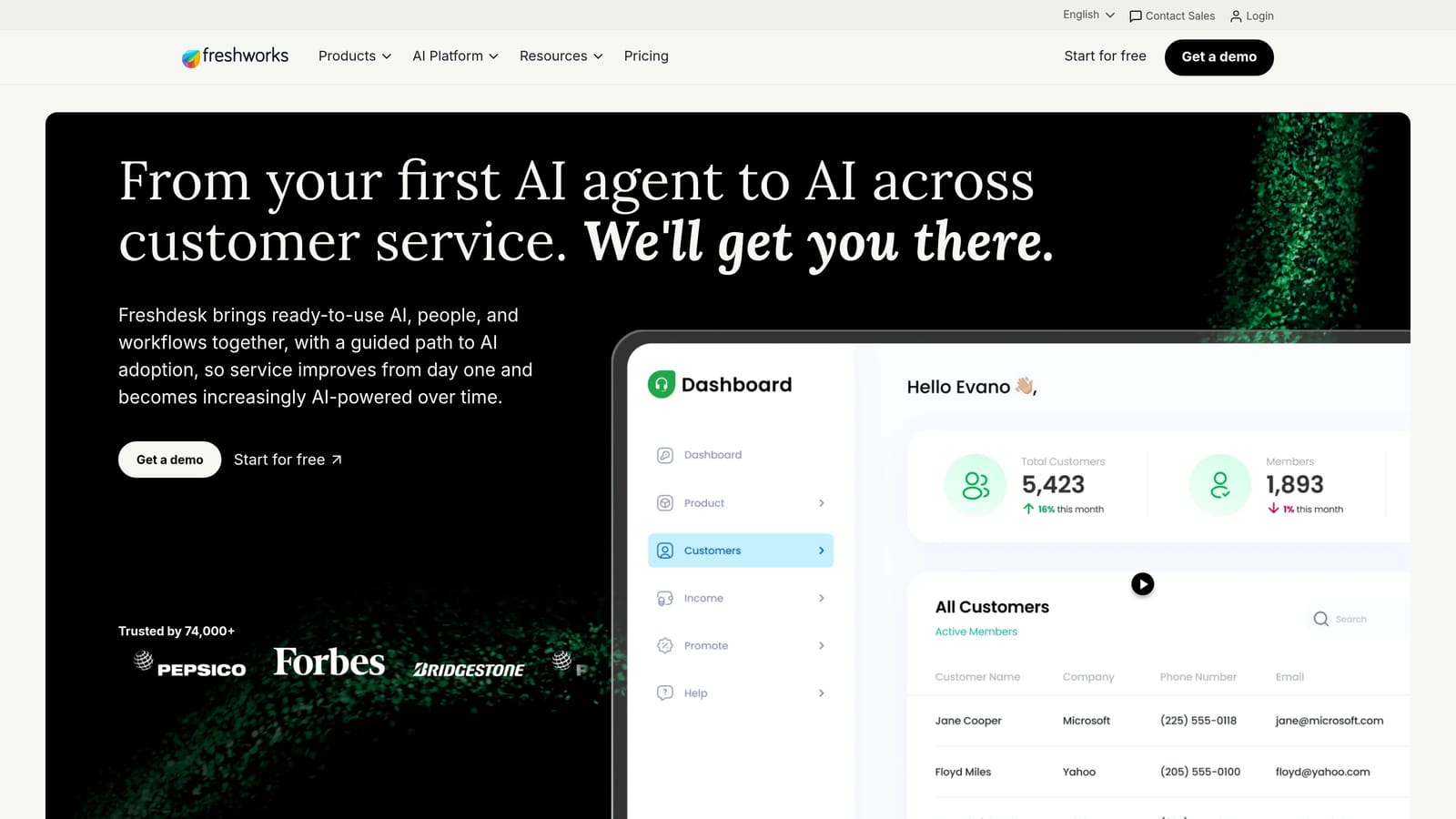
Freshdesk is an omnichannel helpdesk with Freddy AI built in for triage, suggested responses, and CSAT prediction — with a genuinely useful free tier that makes it accessible from day one.
Where This Tool Shines
Freshdesk's free plan isn't just a trial with guardrails. It's a functional starting point that small teams can actually run on for a meaningful period. That matters for pre-seed teams who need real tooling without the budget commitment.
Freddy AI handles the practical, day-to-day AI tasks well: auto-triaging incoming tickets, suggesting replies based on similar past tickets, recommending relevant help articles, and predicting CSAT scores before a conversation ends. It's not the most sophisticated AI in this list, but it's well-integrated and easy to use for teams new to helpdesk software.
Key Features
Freddy AI: Covers auto-triage, suggested replies, article recommendations, and CSAT prediction out of the box.
Omnichannel Support: Handles email, chat, phone, and social media from a unified inbox without requiring separate tools.
Free Plan: A functional free tier for small teams — not just a time-limited trial.
Collision Detection: Prevents two agents from working the same ticket simultaneously, reducing duplicated effort and customer confusion.
1,000+ Marketplace Integrations: Connects with a wide range of tools, though the depth of native integrations varies.
Best For
Very early-stage teams that need a structured helpdesk immediately, or growing teams that want omnichannel coverage without a large upfront investment. Strong documentation and onboarding resources make it approachable for first-time helpdesk buyers.
Pricing
Free plan available for small teams; paid plans start from approximately $15/agent/month, making it one of the more affordable options at small scale.
4. Zendesk
Best for: Well-funded startups with dedicated support ops who need enterprise-grade infrastructure
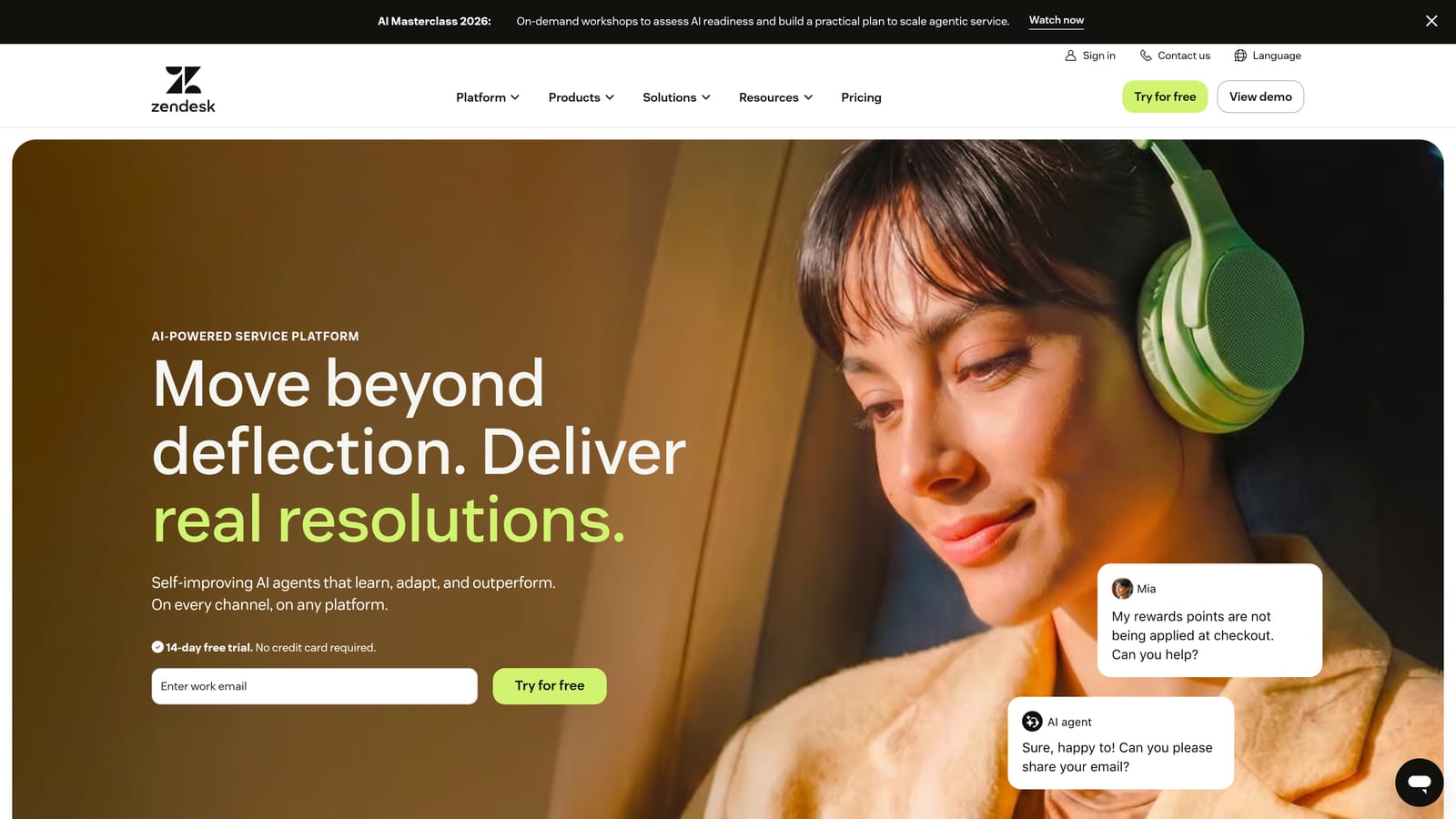
Zendesk is the category-defining omnichannel helpdesk with AI agents, intelligent triage, and one of the largest integration marketplaces in the space.
Where This Tool Shines
Zendesk's breadth is genuinely impressive. If you can imagine a support workflow, Zendesk can probably handle it. The platform covers every channel, offers deep reporting, and connects to virtually any tool your team uses through its 1,000+ app marketplace.
The caveat for startups is real: Zendesk is built for scale, and that complexity shows up in setup time, pricing, and the learning curve. Teams that don't have a dedicated support operations person may find it more platform than they need in the early stages. That said, for startups that have crossed into meaningful customer volume and need serious infrastructure, Zendesk delivers.
Key Features
AI Agents: Automated ticket resolution for common queries, with intelligent escalation to human agents when needed.
Intelligent Triage and Routing: Routes tickets based on intent, urgency, and agent skill — reducing manual sorting overhead.
1,000+ App Marketplace: One of the deepest integration ecosystems in the helpdesk category.
Advanced Reporting and Analytics: Granular reporting on team performance, ticket trends, and customer satisfaction.
Omnichannel Coverage: Email, chat, voice, social, and messaging channels unified in one platform.
Best For
Series A and beyond startups with a growing support team and the operational maturity to configure and maintain a complex platform. Less suited to solo founders or teams without dedicated support staff.
Pricing
Starts around $55/agent/month; AI features are available on higher tiers, which can push the total cost up significantly for small teams.
5. Help Scout
Best for: Teams that want AI assistance for agents without replacing the human touch entirely
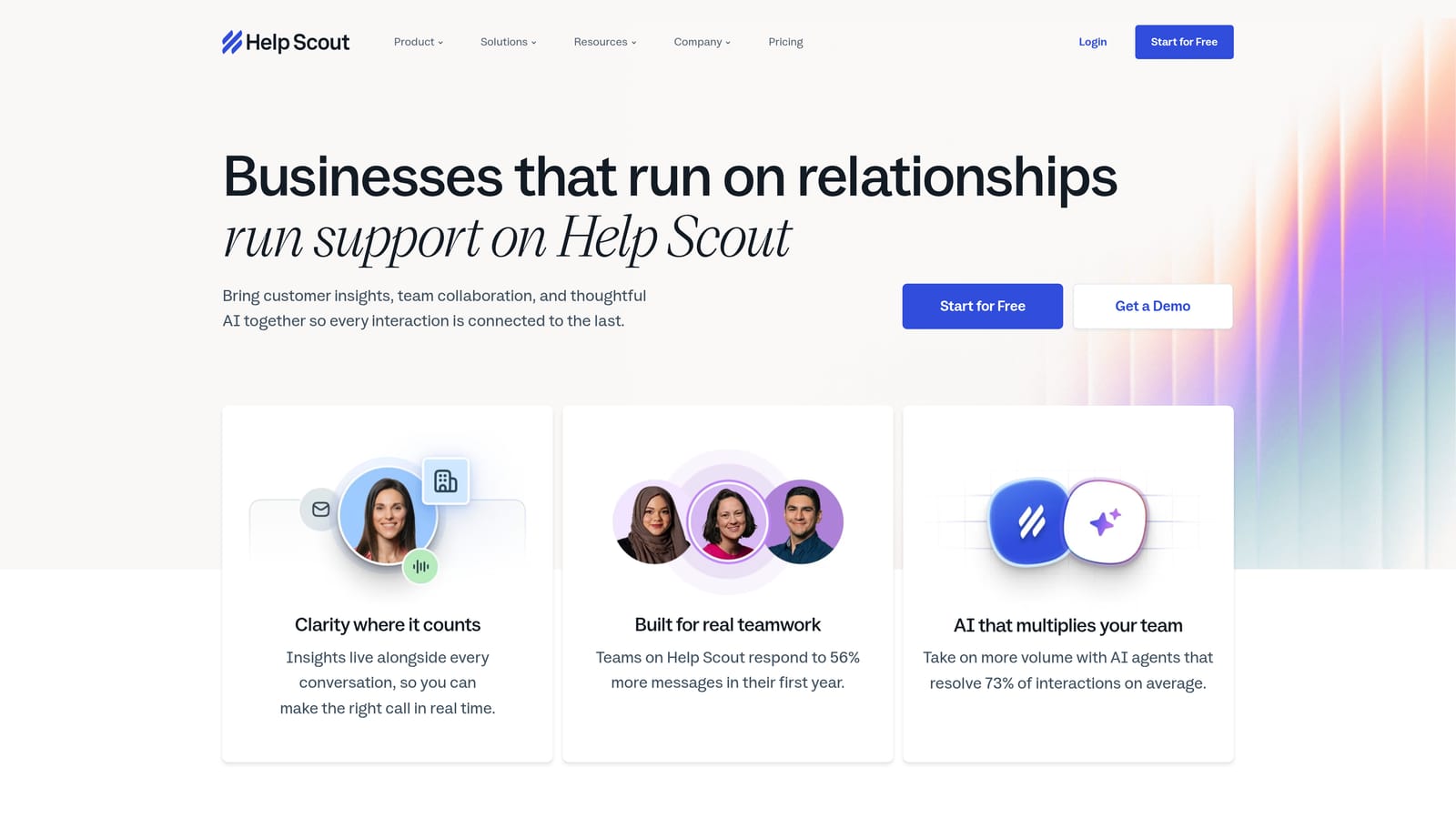
Help Scout is a human-first support platform with AI Drafts and AI Summarize features designed to make agents faster rather than replace them.
Where This Tool Shines
Help Scout occupies a specific and intentional position: it believes great support feels human, and its AI features are built to reinforce that rather than automate it away. AI Drafts suggests context-aware responses that agents can edit and send, while AI Summarize condenses long conversation threads so agents can get up to speed in seconds. The result is faster support that still sounds like a person wrote it.
The UX is notably clean. Help Scout is one of the fastest platforms to get up and running, which makes it a strong fit for early-stage teams that can't afford a week of configuration before they can answer a single ticket.
Key Features
AI Drafts: Generates context-aware response suggestions for agents based on the conversation thread and customer history.
AI Summarize: Condenses long email threads into a quick summary so agents can jump in without reading the full history.
Beacon In-App Widget: Delivers contextual help content inside your product without requiring users to leave what they're doing.
Shared Inbox with Collision Detection: Prevents duplicate responses and gives teams visibility into who's handling what.
Clean, Minimal UI: Designed for fast onboarding — teams are typically productive within hours, not days.
Best For
Startups that value relationship-driven support and want AI to enhance agent performance rather than replace it. A natural fit for teams where brand voice and customer relationships are a competitive differentiator.
Pricing
Starts at $22/user/month on the Standard plan. Straightforward pricing with no surprise usage-based charges.
6. Tidio
Best for: Early-stage teams that need fast, affordable AI chat without a complex setup
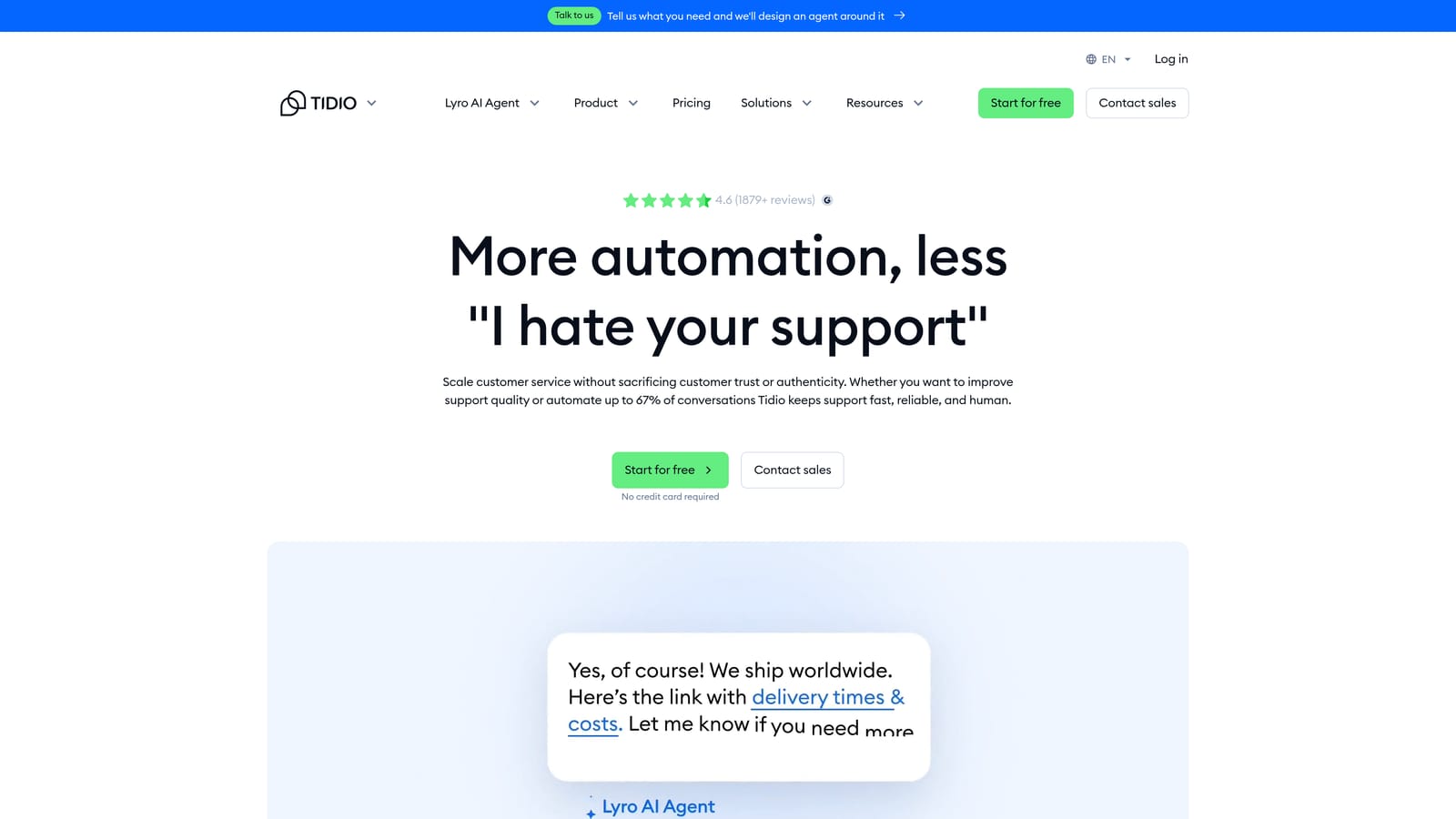
Tidio is a live chat and AI chatbot platform with Lyro AI for autonomous query handling — popular with early-stage teams for its speed of setup and accessible pricing.
Where This Tool Shines
Tidio's headline advantage is simplicity. Teams regularly report being live within an hour of signing up. Lyro, Tidio's AI chatbot, handles common queries autonomously and passes conversations to human agents when it hits the edge of its knowledge. For startups that need something working today, that matters.
The trade-off is depth. Tidio is better suited to B2C and e-commerce contexts than complex B2B SaaS support. If your customers are asking nuanced product questions that require product context, Lyro may struggle more than more sophisticated AI agents. But for straightforward FAQs and first-response automation, it punches above its price point.
Key Features
Lyro AI Chatbot: Handles common queries autonomously and escalates to human agents when needed, with a conversational interface.
Live Chat with Agent Takeover: Agents can jump into any conversation in real time when the situation calls for it.
Email and Messenger Integration: Extends beyond website chat to cover email and Facebook Messenger.
Visual Chatbot Flow Builder: Drag-and-drop builder for creating custom conversation flows without writing code.
Fast Setup: Often live within an hour — one of the fastest onboarding experiences in this list.
Best For
Pre-seed and early seed-stage teams that need a working AI chat solution quickly and affordably. Best for simpler support scenarios; may need to be supplemented or replaced as product complexity grows.
Pricing
Free plan available; Lyro AI starts from approximately $29/month, making it one of the most accessible entry points in the category.
7. Zoho Desk
Best for: Teams already in the Zoho ecosystem that want AI-enhanced support without switching platforms
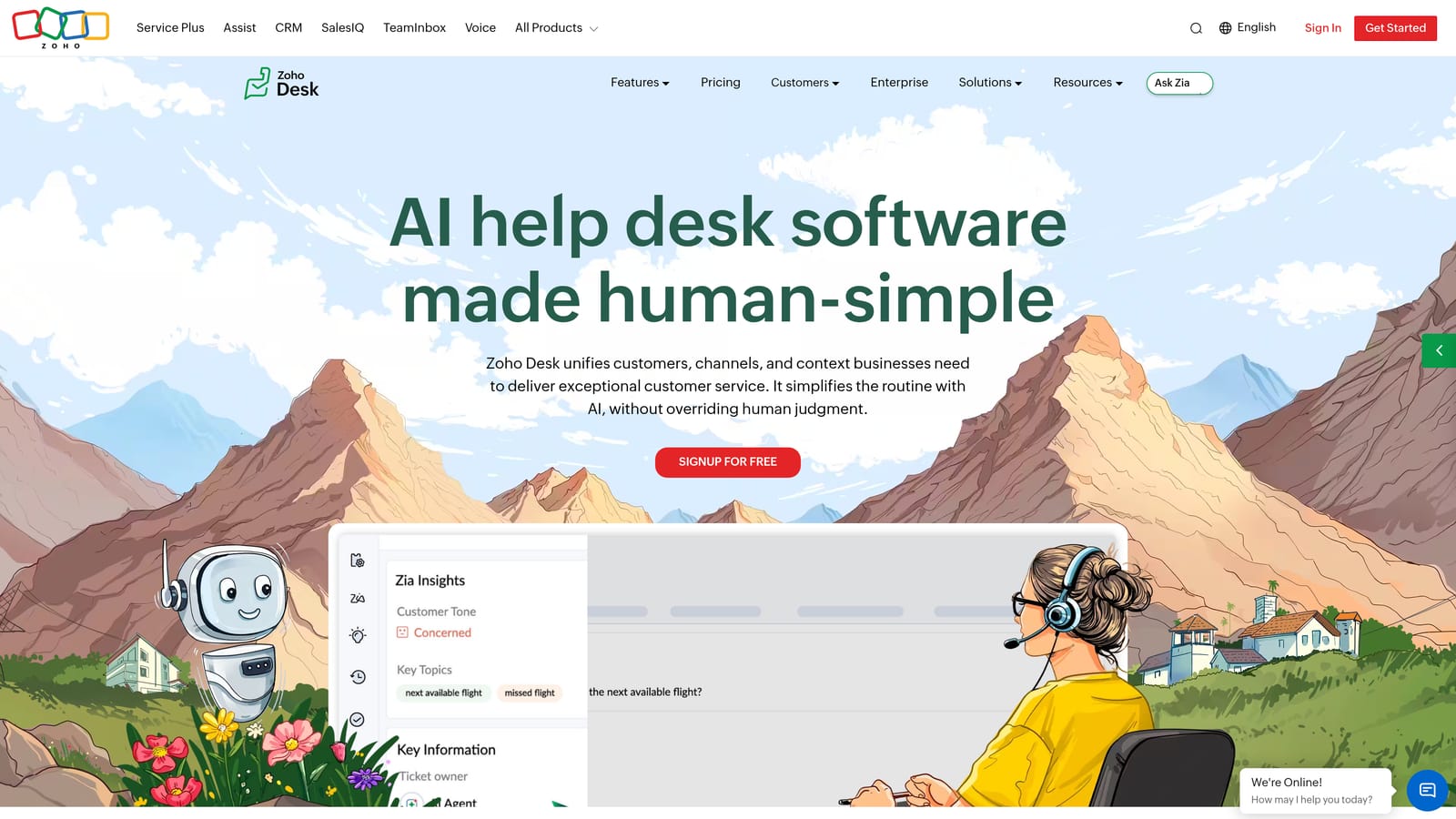
Zoho Desk is a full-featured helpdesk with Zia AI for sentiment analysis, anomaly detection, and response suggestions — and it's particularly compelling for startups already using Zoho CRM.
Where This Tool Shines
Zia, Zoho's AI engine, does things that many helpdesk AI tools overlook. Beyond suggesting responses, it analyzes the sentiment of incoming tickets, detects anomalies in ticket volume or patterns, and automatically tags tickets for routing. That gives support managers a layer of operational intelligence that's genuinely useful.
The value proposition sharpens considerably if your team already uses Zoho CRM. The native integration means customer data flows between sales and support without any custom configuration, giving agents full context on every customer they're talking to. For startups that have standardized on Zoho, it's a natural extension rather than a new tool to learn.
Key Features
Zia AI: Sentiment analysis, anomaly detection, automatic tag suggestions, and response recommendations built into the platform.
Zoho Ecosystem Integration: Deep native connection with Zoho CRM and the broader Zoho suite — no custom integration work required.
Omnichannel Coverage: Email, chat, phone, and social media channels in a unified inbox.
Blueprint Workflow Automation: Visual workflow builder for automating multi-step support processes and escalation rules.
Competitive Pricing: One of the more affordable full-featured helpdesks available, especially at small team sizes.
Best For
Startups that have built their operations on Zoho, or cost-conscious teams that want solid AI features without paying premium prices. Teams not in the Zoho ecosystem may find the integration story less compelling.
Pricing
Free for up to 3 agents; paid plans start from approximately $14/agent/month, making it one of the strongest value options in the category.
8. Kustomer
Best for: High-volume support teams that need a unified customer timeline and CRM-native context
Kustomer is a CRM-native helpdesk that brings every customer interaction into a single timeline, with AI automation layered across all channels.
Where This Tool Shines
Kustomer's core differentiator is the unified customer timeline. Every email, chat, SMS, social interaction, and purchase history is visible in one place when an agent opens a conversation. That context eliminates the frustrating "can you tell me your order number?" moments and lets agents get straight to solving the problem.
The built-in CRM means you don't need a separate CRM integration to get that customer context — it's native to the platform. For high-volume support environments where agents handle dozens of conversations per day, that efficiency compounds quickly. One note for startups evaluating vendor stability: Kustomer was acquired by Meta and subsequently sold to become independent again, so it's worth factoring that history into your long-term platform decision.
Key Features
Unified Customer Timeline: Every touchpoint across all channels consolidated into a single, chronological view per customer.
AI-Powered Automation and Routing: Intelligent routing and automated responses across channels based on intent and customer data.
Omnichannel Coverage: Email, chat, SMS, social media, and voice in one platform.
Built-In CRM: Full customer data management without requiring a separate CRM tool or integration.
Proactive Outreach: Trigger outbound messages based on customer behavior or data signals, not just reactive support.
Best For
Well-funded startups or growth-stage companies with high support volume where customer context and agent efficiency are the primary constraints. The pricing makes it better suited to teams with meaningful revenue rather than very early-stage operations.
Pricing
Starts around $89/agent/month, placing it at the higher end of this list. Best evaluated when you have the volume and team size to justify the investment.
9. Forethought
Best for: Teams locked into an existing helpdesk that want to add AI without migrating
Forethought is an AI layer that sits on top of existing helpdesks like Zendesk and Freshdesk, adding intelligent triage, auto-resolution, and support analytics without requiring a platform migration.
Where This Tool Shines
Forethought solves a real problem: you've already invested in a helpdesk, your team knows it, and migrating feels like a distraction. Rather than forcing a switch, Forethought adds AI capabilities on top of what you already have. That's a meaningful value proposition for teams that are happy with their helpdesk's core functionality but want smarter automation layered in.
The three-product structure — Solve for auto-resolution, Triage for intelligent routing, and Discover for analytics — lets teams adopt selectively. You don't have to buy the whole platform if you only need one capability. That modularity suits startups that want to solve a specific problem without committing to a full platform overhaul.
Key Features
Solve: AI auto-resolution for common tickets, deflecting routine queries before they reach an agent.
Triage: Intelligent routing based on ticket intent and urgency, reducing manual sorting and improving response times.
Discover: Support analytics and knowledge gap identification — surfaces what customers are asking that your help content doesn't cover.
Native Helpdesk Integrations: Works directly with Zendesk, Salesforce Service Cloud, and Freshdesk without requiring migration.
No Helpdesk Migration Required: Adds AI capabilities to your existing stack rather than replacing it.
Best For
Startups and growth-stage teams already using Zendesk or Freshdesk that want to improve AI performance without switching platforms. Also a strong option for teams that want to test AI-driven deflection before committing to a full platform change.
Pricing
Custom pricing — contact Forethought for a quote based on your volume and use case.
Which Tool Is Right for Your Startup?
The right helpdesk AI tool depends less on feature checklists and more on where your startup is right now — and where you're headed in the next 12 months.
Pre-seed and bootstrapped teams should start with Help Scout or Tidio. Both offer fast setup, transparent pricing, and enough AI capability to handle early-stage support volume without overcomplicating your stack. Help Scout is the better fit if customer relationships are central to your brand; Tidio if you need something live today with minimal configuration.
Seed-stage B2B SaaS teams ready to invest in genuine AI automation should evaluate Halo AI or Freshdesk. Freshdesk offers a solid omnichannel foundation with accessible pricing. Halo AI goes further: it's built for the specific dynamics of B2B SaaS support, where every conversation is a signal about product adoption, customer health, and potential churn. If support intelligence matters as much as ticket deflection, Halo is the more purposeful choice.
Well-funded startups with dedicated support operations should look at Zendesk or Kustomer. Both are built for scale, offer deep customization, and can handle complex team structures and high ticket volumes. The trade-off is setup complexity and cost — worth it when you have the team to manage it.
Teams already locked into a helpdesk should consider Forethought. It adds meaningful AI without requiring a migration, which is often the most pragmatic path when your team is already productive on an existing platform.
Your support team shouldn't scale linearly with your customer base. Let AI agents handle routine tickets, guide users through your product, and surface business intelligence while your team focuses on the complex issues that need a human touch. See Halo in action and discover how continuous learning transforms every interaction into smarter, faster support.