9 Best Helpdesk Automation Platform Features to Look For in 2026
This guide breaks down the nine most important helpdesk automation platform features B2B SaaS and product teams should evaluate in 2026, from AI-native ticket triage to deep integrations with tools like Linear, Zendesk, and Intercom. Whether you're choosing your first automation platform or benchmarking your current stack, it highlights what separates purpose-built AI solutions from legacy systems with bolted-on automation.
 Matt PattoliFounder13 min read
If your support team is still manually triaging tickets, copying bug reports into Linear, or hunting for customer context before every reply, your helpdesk is working against you. The right helpdesk automation platform doesn't just speed up existing workflows—it fundamentally changes what your team can accomplish.
But not all automation is created equal. Some platforms bolt AI onto legacy ticketing systems; others are built from the ground up with intelligence at the core. This guide breaks down the most important features to evaluate and the platforms that do each one best.
Whether you're evaluating your first helpdesk automation tool or benchmarking your current stack against newer AI-native alternatives, this list is focused specifically on B2B SaaS and product teams—particularly those already using or considering tools like Zendesk, Freshdesk, or Intercom.
1. Halo AI
Best for: B2B SaaS and product teams wanting AI-native support with business intelligence baked in.
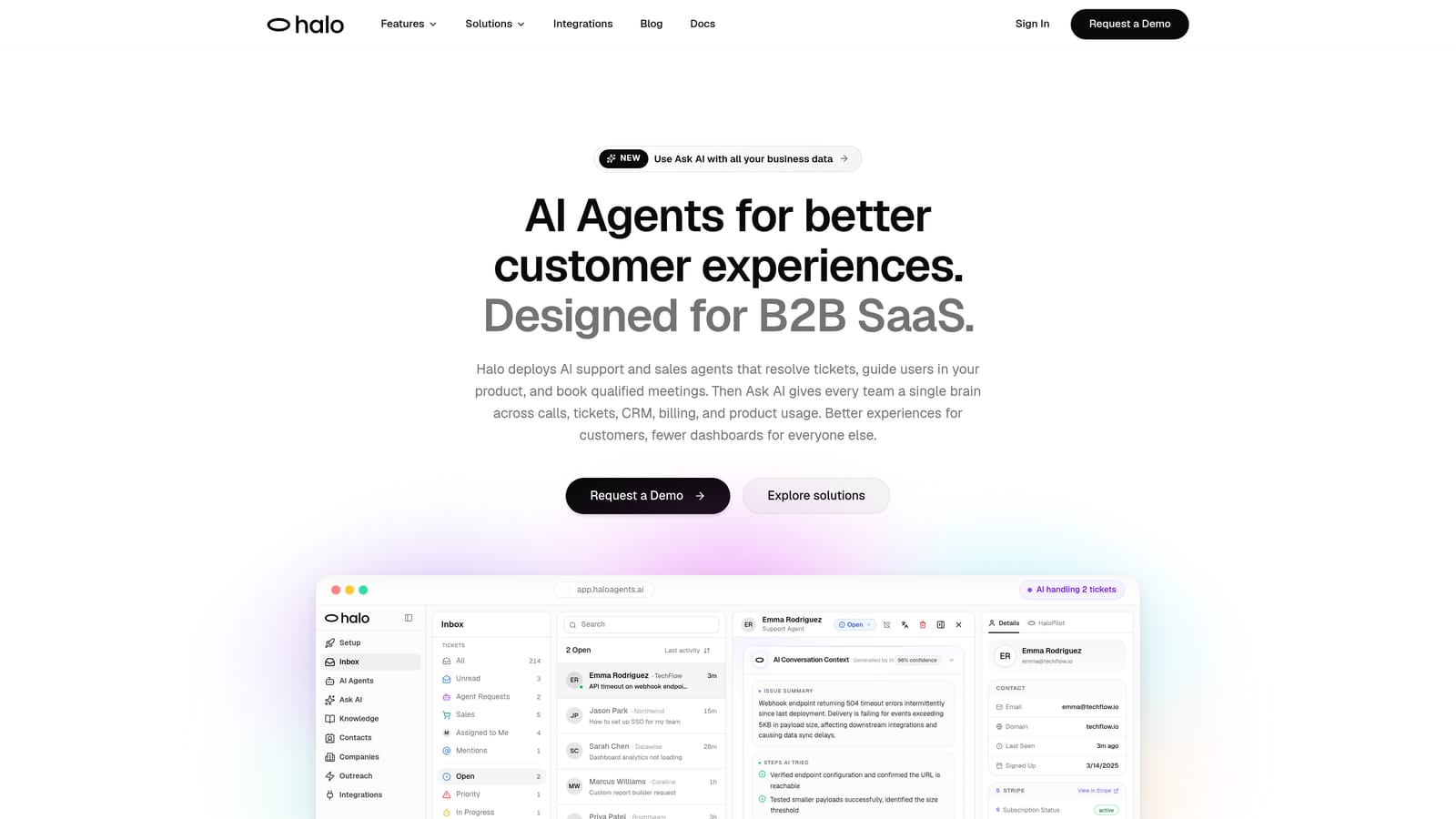
Halo AI is an AI-first customer support platform that deploys intelligent agents to resolve tickets, guide users through your product, and surface actionable business intelligence—all while learning from every interaction.
Where This Tool Shines
Halo isn't a legacy helpdesk with AI bolted on afterward. It's built from the ground up around intelligent agents that handle the full support lifecycle: autonomous resolution, in-product guidance, bug triage, and escalation to a live agent when the situation genuinely calls for it.
What sets Halo apart for product-led SaaS companies is the combination of page-aware context and business intelligence. The platform doesn't just see the ticket—it sees what the user sees, understands where they are in your product, and surfaces signals like churn indicators and revenue anomalies from within your support data.
Key Features
Intelligent AI Agents: Autonomous ticket resolution with built-in live agent handoff when complexity requires a human, preserving full conversation context throughout.
Page-Aware Chat Widget: The in-product chat widget understands which page a user is on and what they're looking at, enabling precise contextual guidance rather than generic responses.
Auto Bug Ticket Creation: Automatically generates and routes bug reports to Linear or your existing engineering workflow, eliminating manual copy-paste between tools.
Smart Inbox with Business Intelligence: Surfaces customer health signals, revenue anomalies, and churn indicators from support interactions—turning your inbox into a strategic data source.
Deep Integrations: Connects to Linear, Slack, HubSpot, Intercom, Stripe, Zoom, PandaDoc, and Fathom, so support data flows across your entire business stack.
Continuous Learning Architecture: Every resolved interaction makes the AI smarter, improving resolution quality over time without manual retraining.
Best For
Product-led SaaS companies that want support to do more than close tickets. Ideal for teams that need deep product integrations, want AI agents that improve autonomously, and need support data to inform decisions beyond the support queue.
Pricing
Contact for pricing via a demo-first sales model. Given the depth of integrations and AI capabilities, pricing is tailored to team size and use case.
2. Zendesk
Best for: Enterprise teams needing mature, rule-based automation with a large integration ecosystem.
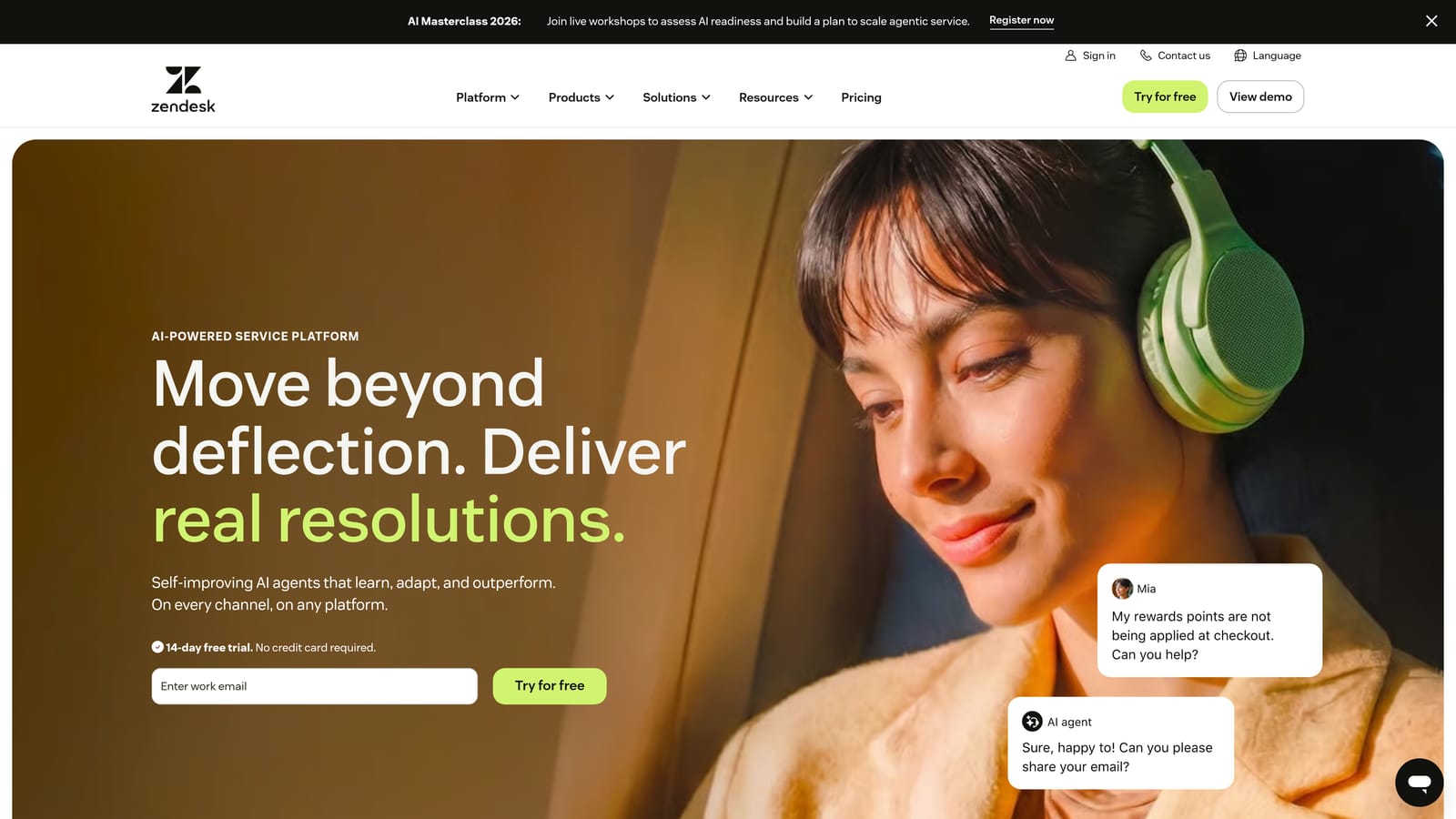
Zendesk is the market-leading enterprise helpdesk platform with decades of workflow automation, AI-powered triage, and one of the largest app marketplaces in the category.
Where This Tool Shines
Zendesk's strength is its maturity. Triggers, macros, and automation rules give operations teams fine-grained control over ticket routing, SLA management, and escalation logic. For large enterprise support organizations with complex workflows, that configurability is genuinely valuable.
The platform has added Zendesk AI on top of its existing infrastructure to handle intelligent triage and suggested replies. It works, though teams evaluating it should understand this is AI layered onto a legacy architecture rather than an AI-native design.
Key Features
Triggers, Macros, and Automation Rules: Granular control over ticket routing, priority assignment, and SLA enforcement across large agent teams.
Zendesk AI: Intelligent triage and suggested replies powered by AI, with classification trained on Zendesk's large dataset of support interactions.
App Marketplace: Hundreds of integrations covering CRM, billing, engineering, and communication tools.
Advanced Reporting: Customizable dashboards and analytics for SLA performance, agent productivity, and ticket trends.
Omnichannel Support: Unified inbox across email, chat, voice, and social channels.
Best For
Enterprise support organizations with established processes, large agent teams, and a need for extensive customization and compliance features. Can feel heavyweight for smaller or faster-moving SaaS teams.
Pricing
Suite Team starts at approximately $19/agent/month. Enterprise plans vary significantly based on features and scale.
3. Freshdesk
Best for: Growing mid-market teams wanting AI-assisted automation at a competitive price point.
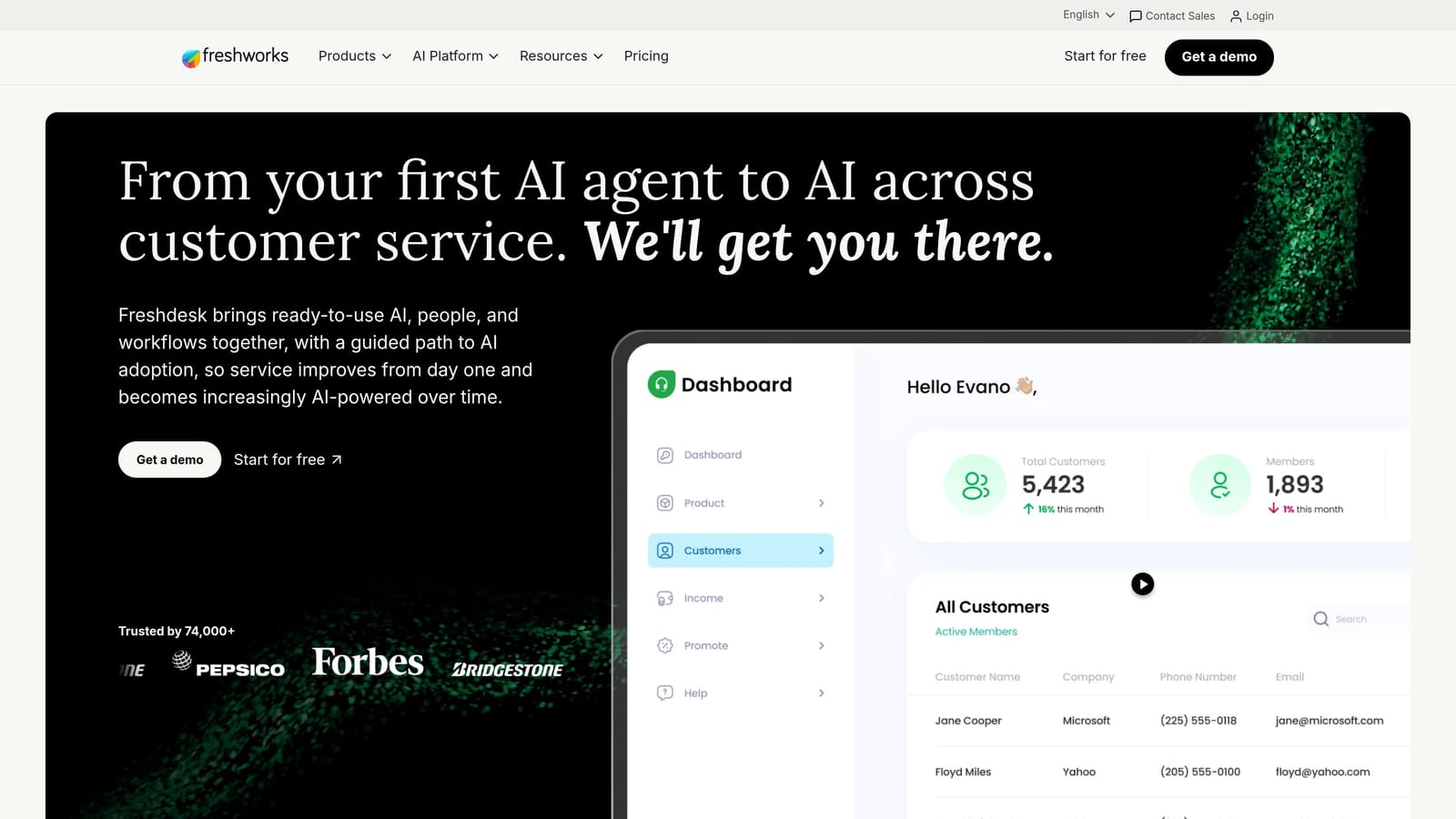
Freshdesk is a Freshworks helpdesk product offering Freddy AI-powered automation, omnichannel support, and pricing tiers that make it accessible for teams scaling beyond basic email support.
Where This Tool Shines
Freshdesk hits a useful middle ground between lightweight shared inboxes and heavyweight enterprise platforms. Freddy AI handles suggested replies, auto-triage, and sentiment detection without requiring significant configuration overhead, making it faster to get value from than some alternatives.
The Freddy Self Service layer adds bot-driven ticket deflection, which can meaningfully reduce inbound volume for teams with a well-maintained knowledge base. Collision detection is a practical feature that prevents two agents from drafting responses to the same ticket simultaneously.
Key Features
Freddy AI: Suggested replies, automatic triage, and sentiment detection to prioritize urgent or frustrated customers faster.
Freddy Self Service: Bot-driven deflection that handles common queries before they reach a human agent.
Omnichannel Inbox: Email, phone, chat, and social media in a unified interface.
Collision Detection: Alerts agents when a colleague is already working on the same ticket, preventing duplicated effort.
Flexible Pricing: A free plan for small teams and paid tiers that scale with team size and feature needs.
Best For
Mid-market teams that need more than a shared inbox but aren't ready for enterprise-level complexity. Particularly strong for teams already in the Freshworks ecosystem.
Pricing
Free plan available for small teams. Paid plans start at approximately $15/agent/month, with higher tiers unlocking Freddy AI features.
4. Intercom
Best for: SaaS teams prioritizing conversational support, proactive messaging, and in-app onboarding flows.
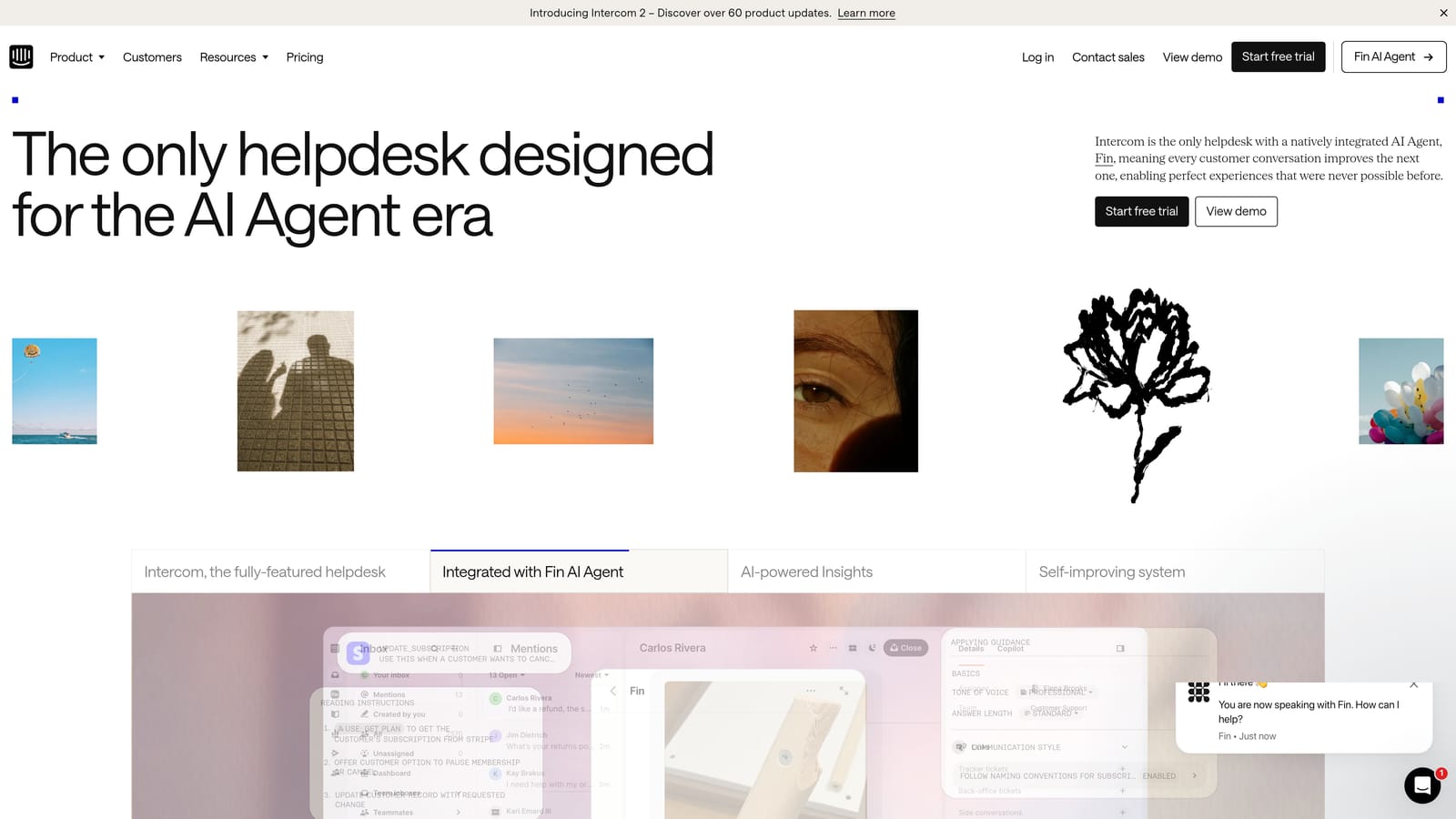
Intercom is a conversational support platform combining proactive in-app messaging, product tours, and the Fin AI agent for autonomous query resolution.
Where This Tool Shines
Intercom's differentiation has always been around the in-product experience. Product tours, behavioral triggers, and proactive messages make it a strong choice for SaaS teams that want support and onboarding to feel like part of the product rather than a separate channel.
Fin, Intercom's AI agent, handles a meaningful portion of inbound queries autonomously by drawing on your help center content. It's worth noting that Halo AI integrates directly with Intercom, so teams using Intercom for messaging don't necessarily have to choose one or the other.
Key Features
Fin AI Agent: Autonomous handling of common support queries using your existing help center content as its knowledge base.
Proactive Messaging and Product Tours: Behavioral triggers and guided tours for onboarding, feature adoption, and retention campaigns.
In-App Chat Widget: Contextual chat triggered by user behavior or page location within your product.
Shared Inbox: Conversation routing and assignment rules for human agent teams.
Help Center Builder: Integrated knowledge base that feeds both self-service and Fin AI responses.
Best For
SaaS teams where support and product engagement overlap significantly. Less ideal for high-volume B2B support operations where deep ticket management and engineering integrations are priorities.
Pricing
Starts at approximately $39/seat/month. Fin AI resolution fees apply separately, which can make total cost unpredictable at higher volumes.
5. Help Scout
Best for: Teams where brand voice and a personal, human support experience are non-negotiable.
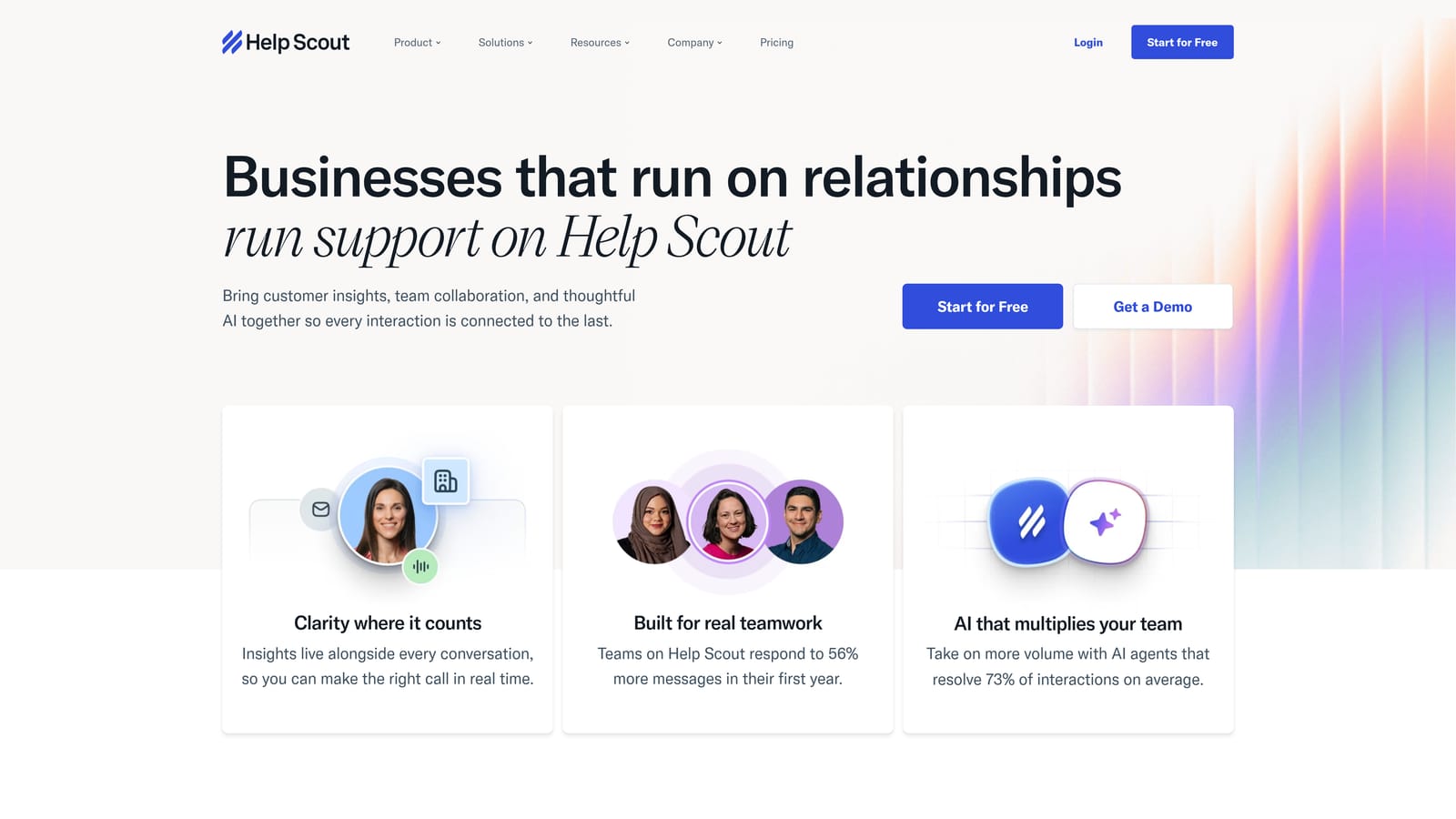
Help Scout is a human-centered support platform built around a shared inbox experience that deliberately feels like email rather than a ticket system.
Where This Tool Shines
Help Scout is designed for teams that prioritize tone and relationship over throughput. The shared inbox removes ticket numbers and queue language, keeping conversations feeling personal. For brands where every customer interaction is a brand moment, that distinction matters.
Recent versions have added AI-powered reply drafts and conversation summarization, which help agents move faster without sacrificing the human feel. The Beacon widget provides in-app contextual help and chat for product teams that want embedded support without heavy infrastructure.
Key Features
Shared Inbox: Designed to feel like collaborative email rather than a traditional ticket queue, preserving conversational tone.
Beacon Widget: In-app help widget for contextual support and live chat embedded directly in your product.
Automation Rules: Tagging, routing, and follow-up automation for common workflow tasks.
AI Reply Drafts and Summarization: AI-assisted drafting and conversation summaries to help agents respond faster.
Docs Knowledge Base: Built-in self-service content hub integrated with the Beacon widget for deflection.
Best For
Smaller teams and brands where voice, empathy, and relationship quality matter more than autonomous resolution rates. Less suited for high-volume operations that need AI to handle tickets end-to-end.
Pricing
Starts at approximately $20/user/month on the Standard plan.
6. Zoho Desk
Best for: Teams already in the Zoho ecosystem wanting AI-assisted support with deep CRM integration.
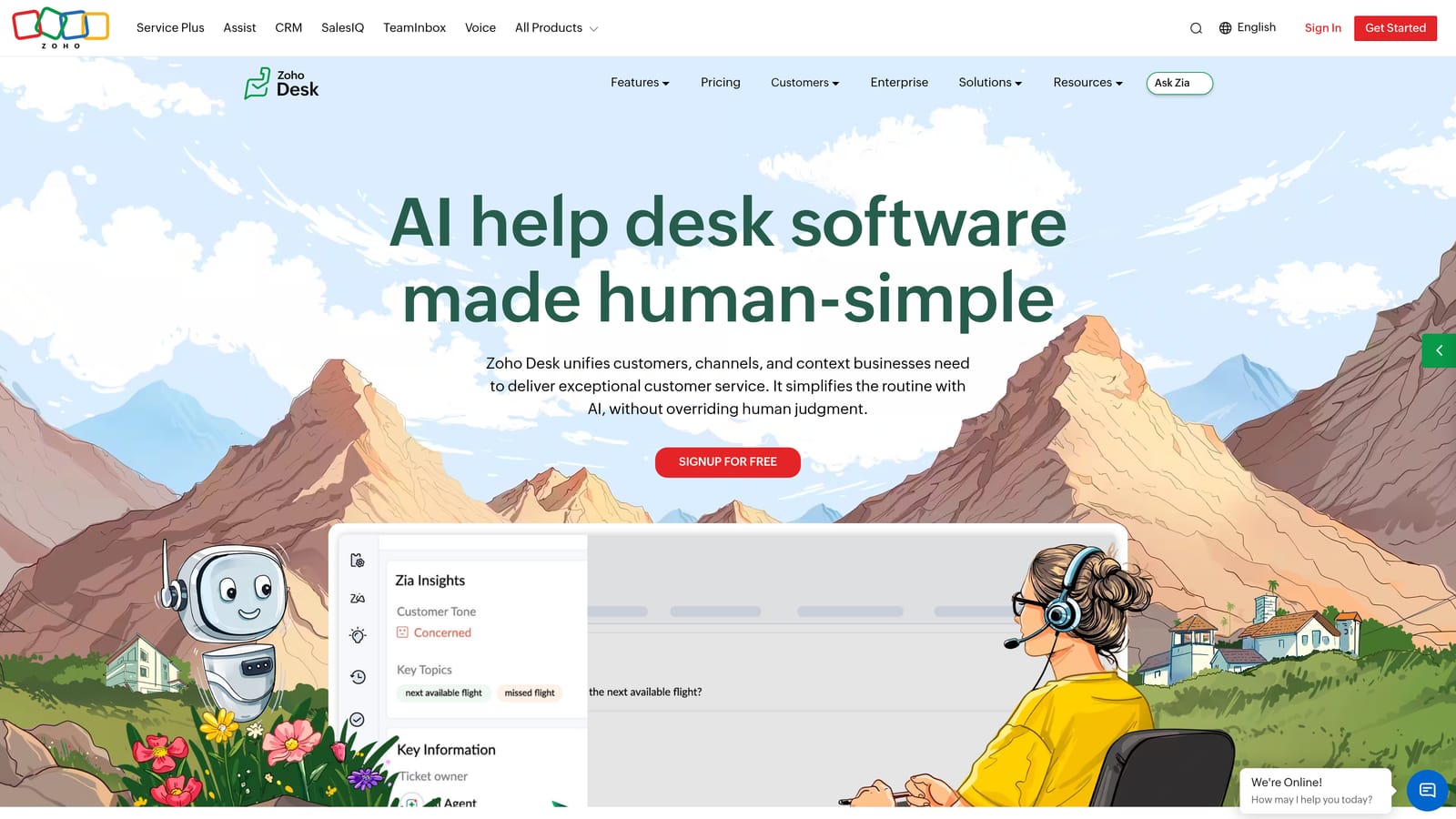
Zoho Desk is a context-aware helpdesk platform featuring Zia AI and native integration with Zoho CRM and the broader Zoho business suite.
Where This Tool Shines
For teams running their business on Zoho, Desk is the natural support layer. Customer data from Zoho CRM flows automatically into every ticket, giving agents context on deal stage, account history, and relationship health without switching tools. That context-awareness is a genuine productivity advantage.
Zia, Zoho's AI layer, handles sentiment analysis, ticket volume anomaly detection, and reply suggestions. The anomaly detection feature is particularly useful for operations teams that want an early warning system when ticket volume spikes unexpectedly.
Key Features
Zia AI: Sentiment analysis, anomaly detection in ticket volume, and reply suggestions to assist agents in real time.
Zoho CRM Integration: Automatic customer context pulled from CRM data into every support ticket.
Blueprint Workflow Automation: Multi-step process automation for complex support workflows with conditional logic.
Ticket Volume Anomaly Alerts: Zia flags unusual spikes in ticket volume so teams can respond proactively.
Multi-Brand and Multi-Department Support: Manage multiple brands or business units from a single Zoho Desk instance.
Best For
Teams already using Zoho CRM or other Zoho products. The value proposition weakens considerably if you're not in the Zoho ecosystem, where the integration depth is the primary differentiator.
Pricing
Free plan available for up to 3 agents. Paid plans start at approximately $14/agent/month, making it one of the more affordable options with AI features.
7. Tidio
Best for: E-commerce and SMB teams wanting fast deployment with conversational AI at a low entry cost.
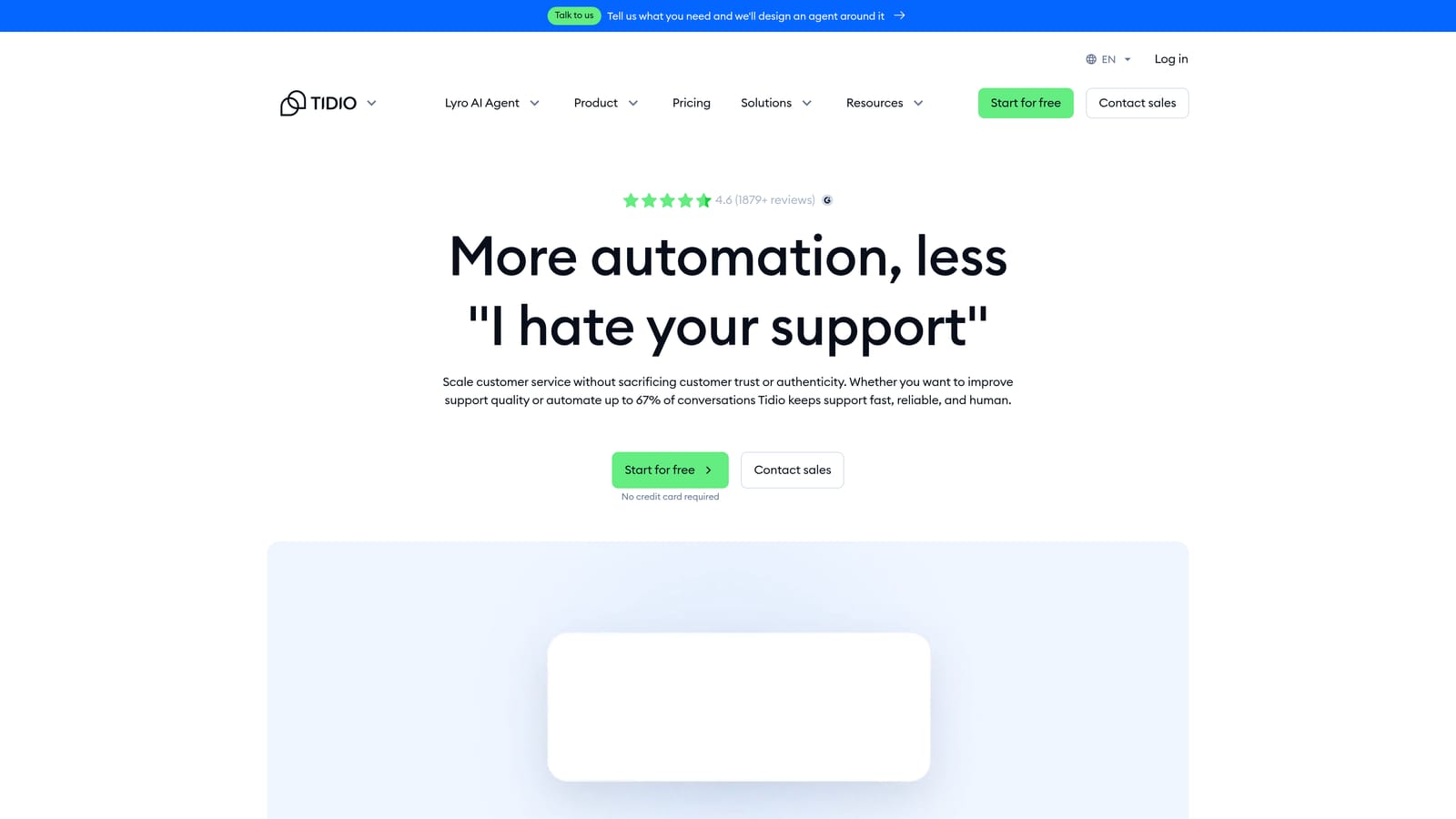
Tidio is a live chat and AI chatbot platform powered by Lyro AI, designed for quick deployment and strong integrations with Shopify and WooCommerce.
Where This Tool Shines
Tidio's biggest advantage is speed-to-value. The visual chatbot flow builder requires no coding, Lyro AI handles common queries conversationally out of the box, and the Shopify and WooCommerce integrations mean e-commerce teams can be up and running quickly without custom development work.
For B2B SaaS teams evaluating this list, Tidio is worth understanding as a category reference point, but it's primarily designed for e-commerce and SMB use cases. Complex product support, engineering integrations, or business intelligence requirements are outside its core design.
Key Features
Lyro AI Chatbot: Conversational AI that handles common customer queries using your support content as a knowledge source.
Native E-Commerce Integrations: Direct Shopify and WooCommerce connections for order and customer data in chat.
Visual Flow Builder: No-code chatbot design for creating custom conversation paths without engineering resources.
Live Chat with Operator Takeover: Agents can step into any AI conversation in real time when escalation is needed.
Multi-Channel Support: Email and Messenger channels alongside the core live chat experience.
Best For
E-commerce brands and SMBs that need fast deployment, accessible pricing, and solid chatbot automation without complex configuration. Not the right fit for B2B SaaS teams with deep integration or intelligence requirements.
Pricing
Free plan available. Lyro AI plans start at approximately $29/month, making it one of the most accessible entry points on this list.
8. Kustomer
Best for: High-volume support operations that need full customer timeline context across every channel.
Kustomer is a CRM-native support platform offering a complete customer timeline view, omnichannel routing, and AI automation designed for organizations handling significant support volume.
Where This Tool Shines
Kustomer's defining feature is the customer timeline: a single view aggregating every interaction a customer has had across every channel, from first contact through their most recent conversation. For support teams where customer history is critical context, this eliminates the constant context-switching that slows agents down.
The business rules engine is genuinely powerful for teams with complex routing logic. AI-powered classification and suggested replies reduce manual triage work, and the reporting on customer lifetime value alongside support outcomes helps connect support activity to business results.
Key Features
Customer Timeline View: Aggregated history of every customer interaction across all channels in a single unified view.
Omnichannel Routing: Intelligent routing across email, chat, voice, SMS, and social with assignment rules.
AI Classification and Suggested Replies: Automated ticket classification and reply recommendations to accelerate agent response.
Business Rules Engine: Complex conditional workflow automation for sophisticated routing and escalation logic.
LTV and Outcome Reporting: Reporting that connects support activity to customer lifetime value and business outcomes.
Best For
High-volume B2C or subscription businesses where customer history context is essential and support teams handle thousands of interactions daily. The pricing tier reflects its enterprise positioning.
Pricing
Starts at approximately $89/agent/month at the Enterprise tier, making it one of the higher-priced options on this list.
9. Gorgias
Best for: E-commerce brands, particularly Shopify merchants, that want order data inside every support ticket.
Gorgias is a helpdesk platform built specifically for e-commerce brands, pulling Shopify order and customer data directly into support conversations with revenue attribution built in.
Where This Tool Shines
Gorgias solves a specific problem exceptionally well: e-commerce support agents spend a disproportionate amount of time looking up order status, shipping information, and return eligibility. Gorgias eliminates that by surfacing Shopify data directly in the ticket, so agents have everything they need without switching tabs.
Revenue attribution is a standout differentiator. The platform tracks which support conversations lead to purchases, giving e-commerce brands a direct line of sight between support investment and sales outcomes. For B2B SaaS teams, this is context rather than a recommendation—Gorgias is purpose-built for e-commerce and isn't designed for product-led SaaS support workflows.
Key Features
Native Shopify Data Pull: Order status, shipping details, and return eligibility surfaced directly inside every support ticket.
Macro Automation: Pre-built response templates for common e-commerce query types like order status and refund requests.
Revenue Attribution: Tracks which support conversations lead directly to purchases, connecting support to sales outcomes.
Omnichannel Inbox: Email, chat, social, and SMS in a unified interface designed for e-commerce workflows.
Auto-Close and Auto-Respond Rules: Automatically handles and closes routine order status queries without agent involvement.
Best For
Shopify-first e-commerce brands that want deep order data integration and revenue attribution. Not designed for B2B SaaS use cases and lacks the product integrations, engineering workflows, and business intelligence features that SaaS teams typically need.
Pricing
Starts at approximately $10/month on the Starter plan, with pricing scaling by ticket volume rather than agent seats.
Which Platform Is Right for Your Team?
The right helpdesk automation platform depends heavily on where your team sits today and where you're trying to go. Here's a quick way to think through it.
If you're a B2B SaaS or product-led growth company that wants AI to handle tickets autonomously, surface business intelligence, and connect to your engineering and revenue stack, Halo AI is the most purpose-built option on this list. Its page-aware context, auto bug ticket creation, and continuous learning architecture address problems that legacy platforms weren't designed to solve.
If you're in a large enterprise with established processes and a need for mature workflow configuration, Zendesk's depth and marketplace breadth remain hard to match. For growing mid-market teams on a tighter budget, Freshdesk offers a solid balance of AI features and accessibility. If conversational in-app engagement and proactive messaging are your priority, Intercom is the natural fit—and it integrates with Halo AI for teams that want both.
For teams where brand voice and personal touch are the priority, Help Scout is worth a look. Zoho Desk makes sense if you're already running on Zoho. And for e-commerce brands specifically, Gorgias and Tidio serve their respective niches well.
Your support team shouldn't scale linearly with your customer base. Let AI agents handle routine tickets, guide users through your product, and surface business intelligence while your team focuses on complex issues that need a human touch. See Halo in action and discover how continuous learning transforms every interaction into smarter, faster support.