9 Best Helpdesk Software with AI Agents in 2026
This guide ranks the 9 best helpdesk software with AI agents in 2026, evaluating each platform on how effectively its AI resolves tickets end-to-end — not just whether an AI feature exists. Whether you're replacing a legacy system or building a support stack from scratch, it cuts through the "AI-powered" marketing noise to surface the tools genuinely worth your time.
 Matt PattoliFounder14 min read
The era of ticket queues and canned responses is giving way to something smarter. Helpdesk software no longer just manages support requests; the best platforms now actively resolve them, with AI agents handling everything from first-touch triage to full ticket closure.
But not all "AI-powered" helpdesks are created equal. Some bolt a chatbot onto a legacy system and call it intelligent. Others are built AI-first from the ground up. The difference shows up fast: in resolution rates, in escalation quality, and in how much your team still has to babysit the automation.
This list covers helpdesk platforms with genuine AI agent capabilities, evaluated on how well the AI actually works, not just whether it exists. Whether you're replacing a legacy system or building your support stack from scratch, here's what's worth your time in 2026.
1. Halo AI
Best for: B2B SaaS teams that want AI agents resolving tickets end-to-end, not just deflecting them
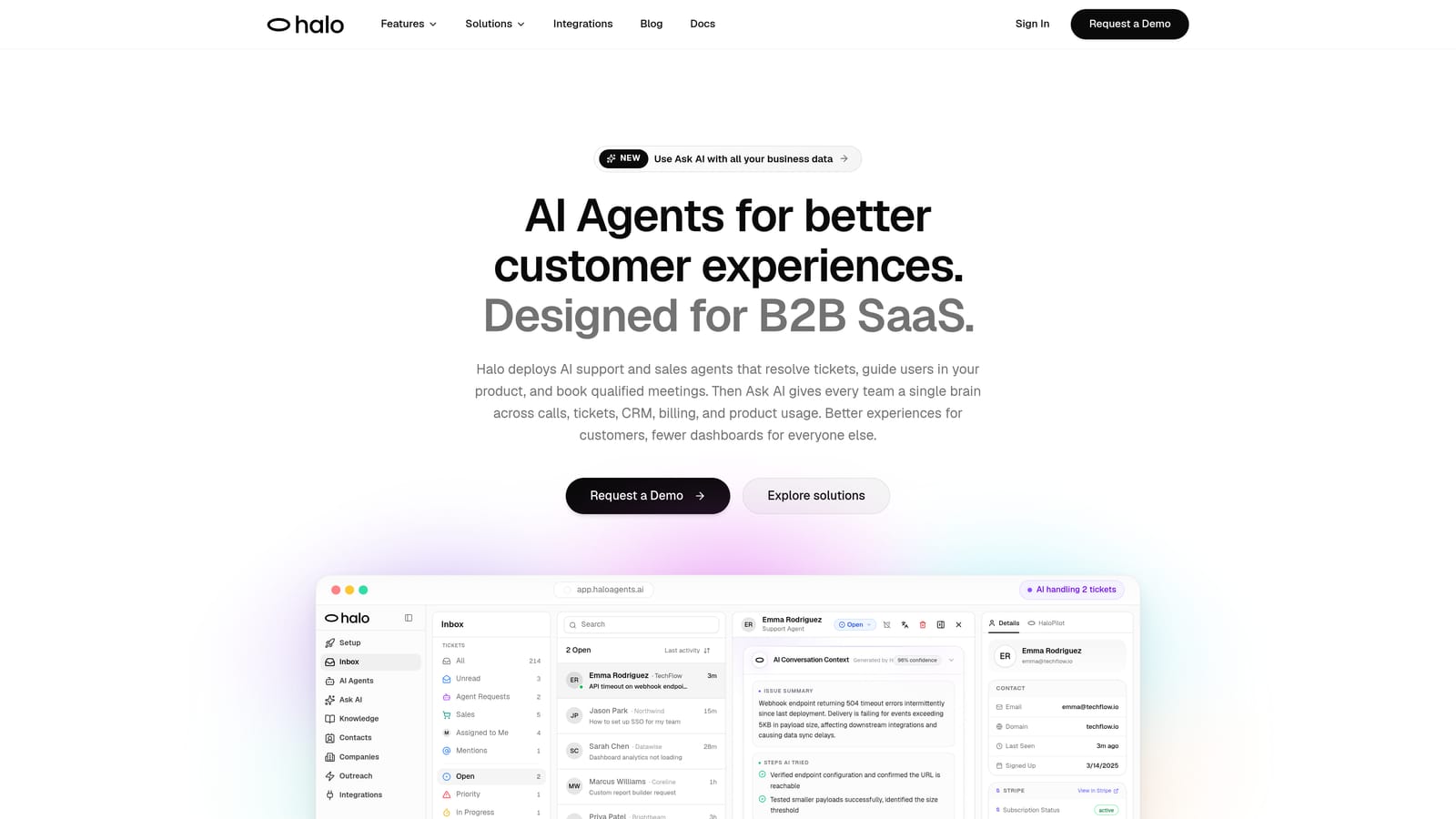
Halo AI is an AI-first customer support platform built specifically for B2B SaaS teams who need more than a smarter inbox.
Where This Tool Shines
What separates Halo from most platforms on this list is the architecture. The AI agent isn't layered on top of a traditional ticketing system; it's the primary resolution engine. That means the AI isn't suggesting what a human should do next. It's doing the work, resolving tickets autonomously, guiding users through your product with visual UI assistance, and escalating to humans only when the situation genuinely requires judgment.
The page-aware chat widget is a genuinely differentiating feature. Halo's AI sees what the user sees on screen, enabling it to provide contextual, step-by-step guidance rather than generic help center links. Pair that with a smart inbox that surfaces customer health signals, revenue anomalies, and trend detection, and you're getting business intelligence alongside support operations. That's a level of signal most helpdesks simply don't produce.
Key Features
Page-Aware AI Chat Widget: The AI sees the user's current screen context and provides visual UI guidance, not just text-based answers.
Autonomous Ticket Resolution: AI agents resolve tickets end-to-end, learning from every interaction to improve over time.
Smart Inbox with Business Intelligence: Surfaces customer health signals, revenue intelligence, and anomaly detection beyond standard support metrics.
Auto Bug Ticket Creation: Automatically generates structured bug reports from user-reported issues and connects them directly to Linear.
Live Agent Handoff: Escalates complex issues to human agents with full conversation context preserved, so nothing gets lost in the transfer.
Broad Integration Stack: Connects to HubSpot, Slack, Stripe, Intercom, Zoom, PandaDoc, Fathom, and Linear out of the box.
Best For
Halo is the strongest fit for B2B SaaS product teams that want AI handling the full support lifecycle, not just the easy tickets. If your team is spending time on repetitive resolution, bug triage, or lacks visibility into customer health signals, Halo is worth a close look. Less suited for e-commerce or consumer-facing support at high volume.
Pricing
Contact for pricing. A demo is available at haloagents.ai, and the team works with companies to scope the right plan based on support volume and use case.
2. Zendesk
Best for: Enterprise teams needing a mature, deeply configurable helpdesk with AI layered in
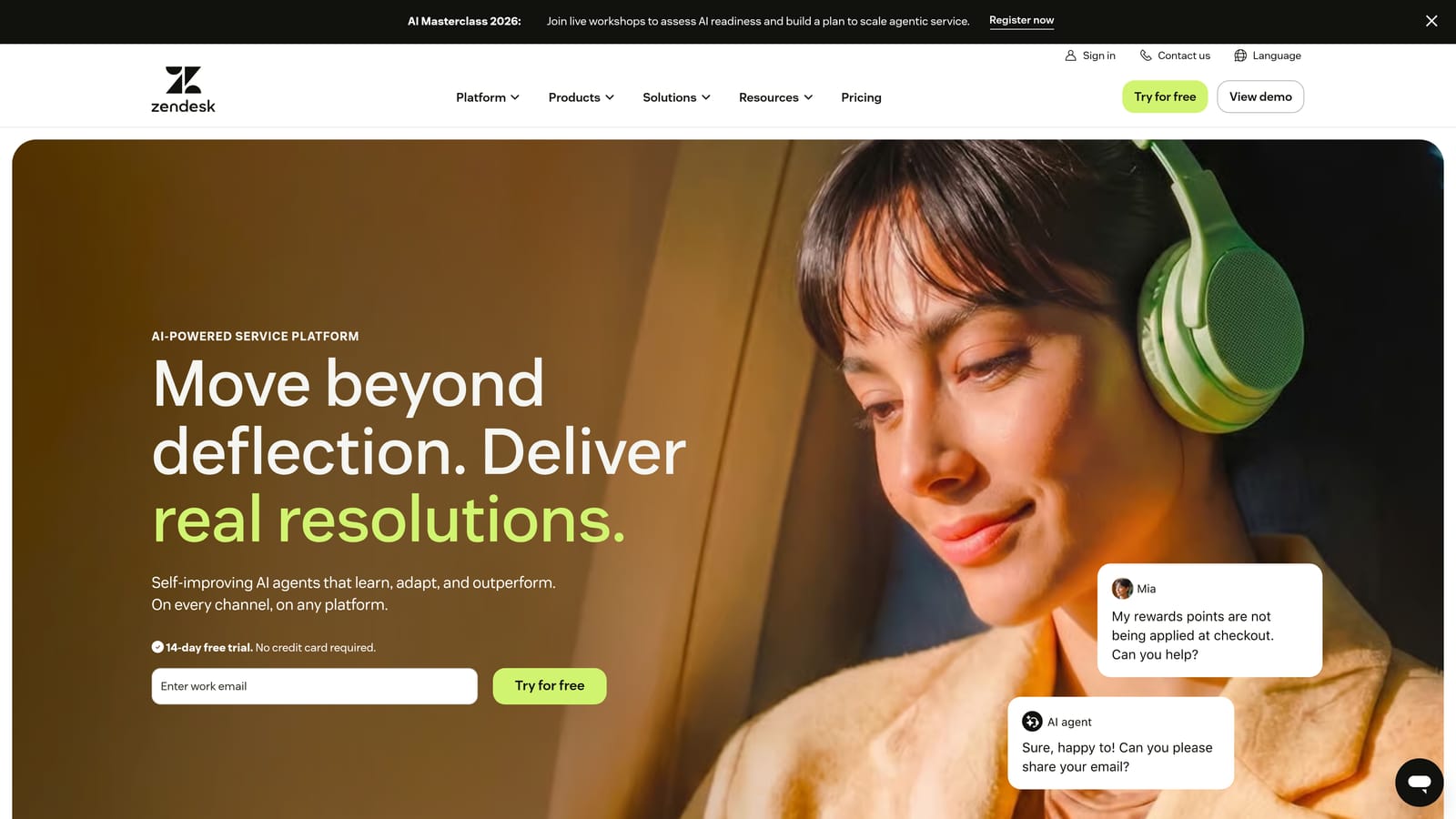
Zendesk is the enterprise helpdesk standard, now with AI Copilot for agent assistance and intelligent triage built onto its mature ticketing foundation.
Where This Tool Shines
Zendesk's strength is its depth. After years of market leadership, the platform has an extensive ecosystem, a highly configurable workflow engine, and reporting capabilities that can accommodate even the most complex support operations. For enterprise teams with dedicated ops resources, that configurability is a genuine advantage.
The AI additions, including AI Copilot for response suggestions and ticket summaries, are solid but primarily agent-assist rather than fully autonomous. Zendesk's AI helps your agents work faster; it doesn't replace the agent loop. That's a meaningful distinction if your goal is full ticket resolution without human intervention.
Key Features
AI Copilot: Suggests responses, summarizes ticket threads, and guides agents through next steps in real time.
Intelligent Triage: Automatically categorizes and routes incoming tickets based on intent and priority signals.
Extensive Marketplace: Hundreds of third-party integrations across CRM, billing, analytics, and communication tools.
Mature Reporting Suite: Deeply configurable analytics for teams with complex reporting requirements.
Workflow Automation: Highly flexible automation rules for routing, escalation, and SLA management.
Best For
Enterprise support teams with complex workflows, dedicated ops resources, and a need for deep configurability. Less ideal for smaller teams or those looking for autonomous AI resolution out of the box, where the complexity-to-value ratio can work against you.
Pricing
Suite plans start at approximately $55 per agent per month. AI features are available on higher tiers; costs can increase significantly at enterprise scale.
3. Intercom
Best for: SaaS teams wanting autonomous AI resolution tightly integrated with in-app messaging
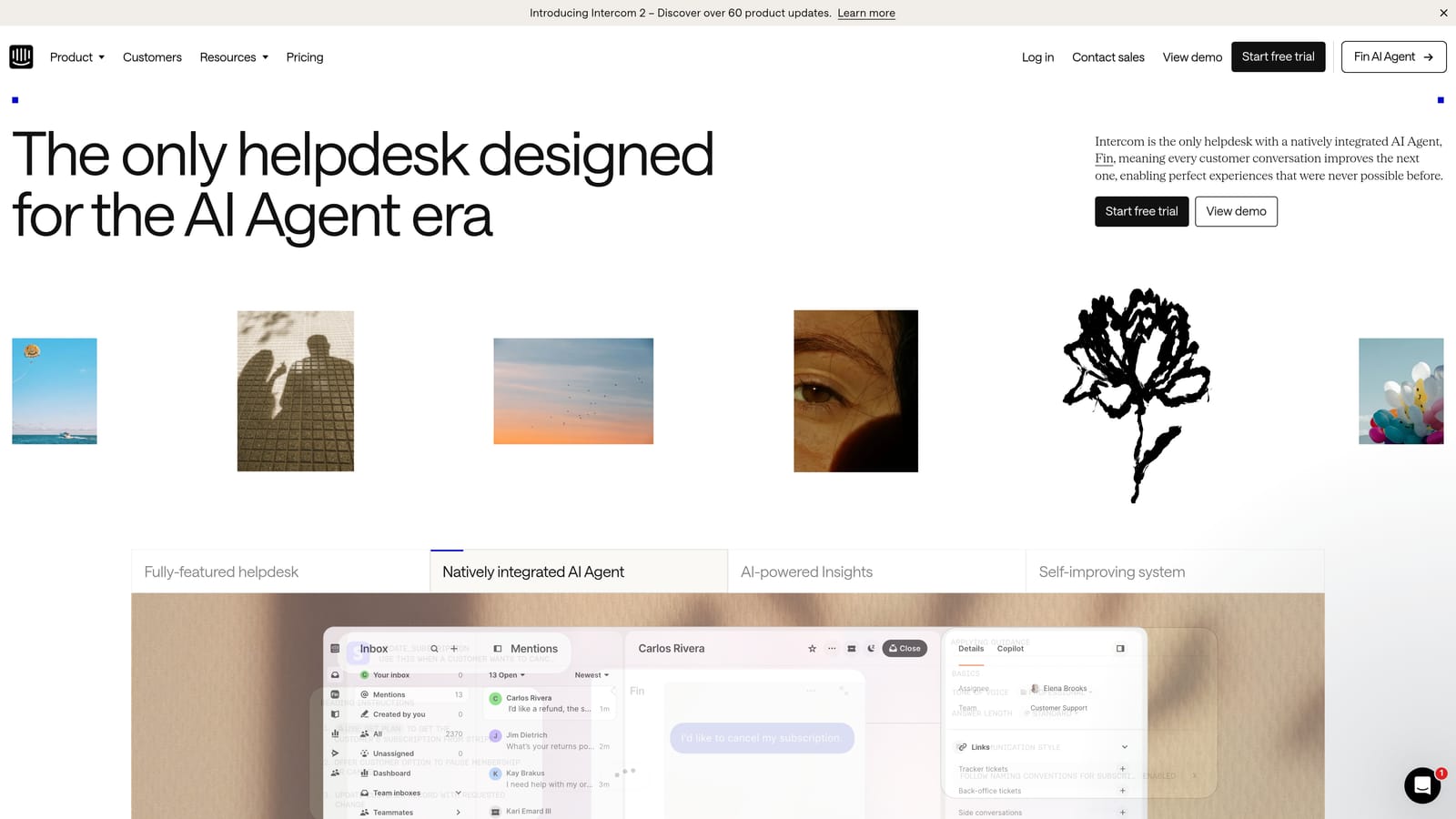
Intercom is a customer communications platform with Fin, one of the market's more capable autonomous AI agents, tightly woven into its in-app messaging and product tour infrastructure.
Where This Tool Shines
Fin is genuinely autonomous in a way that many "AI agents" aren't. It handles a meaningful share of support queries without human intervention, and Intercom publishes resolution rate data on their website for transparency. For SaaS teams where support conversations happen inside the product, the in-app context awareness is a real advantage: the AI understands where the user is and what they're trying to do.
The integration between support, outbound messaging, and product tours also means Intercom can serve as a unified customer communications layer, not just a helpdesk. That breadth is valuable, though it also means the platform can feel complex for teams that only need the support component.
Key Features
Fin AI Agent: Handles a substantial share of support queries autonomously using your knowledge base and conversation history.
In-App Context Awareness: Understands the user's current product context for more relevant, accurate responses.
Unified Communications: Connects support, product messaging, and outbound campaigns in a single platform.
Smooth Escalation Path: Transitions from AI to human agents with conversation history intact.
AI Resolution Analytics: Detailed reporting on what Fin resolved, what it escalated, and where gaps exist.
Best For
SaaS teams where support happens in-product and where unifying support with messaging and engagement is a priority. Pricing has increased in recent years, so it's worth modeling costs carefully at scale.
Pricing
Starts at approximately $39 per seat per month. Fin AI agent usage is billed separately on a per-resolution basis, which can add up at high volume.
4. Freshdesk
Best for: Mid-market teams wanting omnichannel AI-assisted support at a price below Zendesk
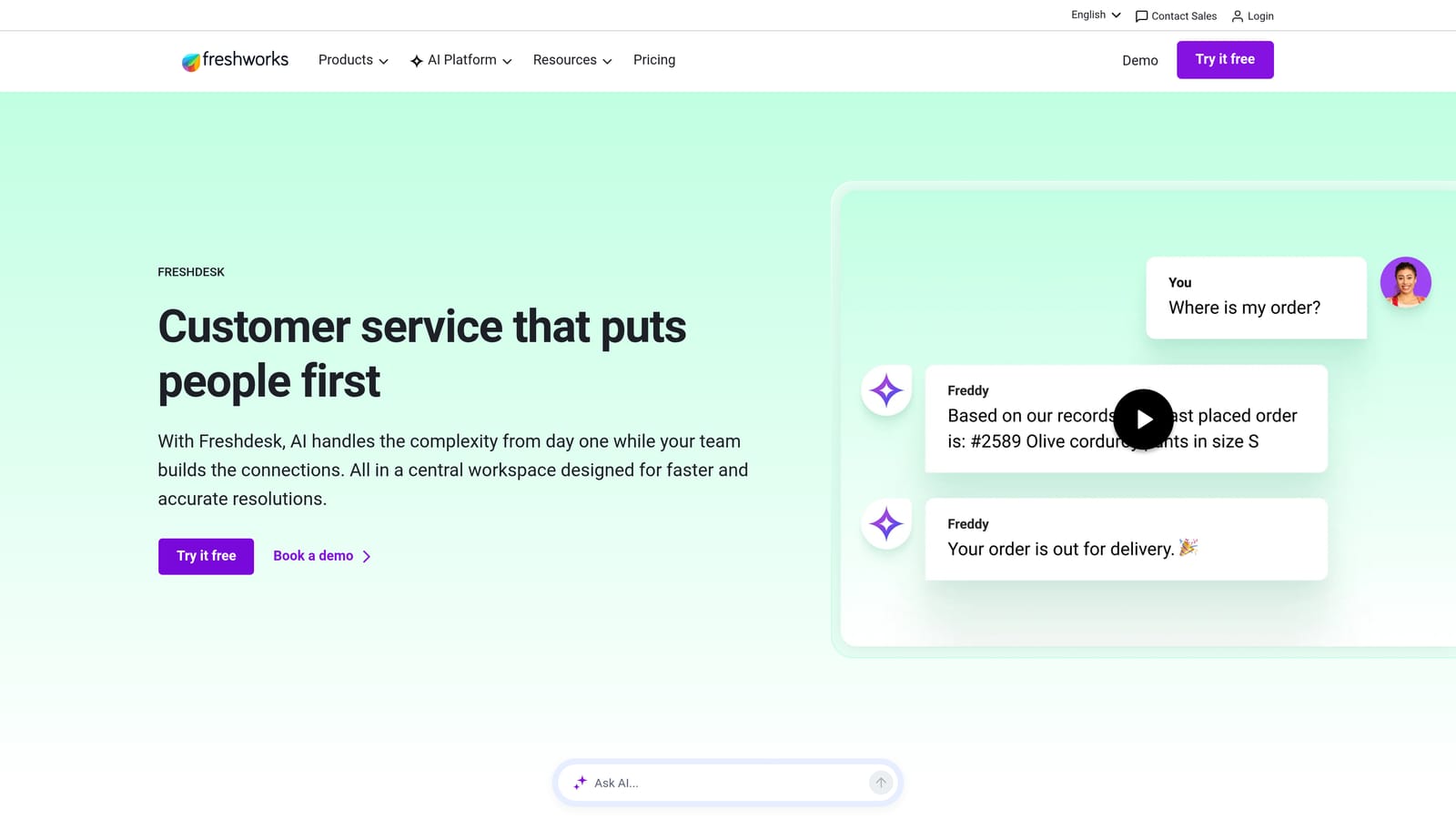
Freshdesk is a full-featured omnichannel helpdesk with Freddy AI powering self-service, agent assistance, and analytics at a more accessible price point.
Where This Tool Shines
Freshdesk's value proposition is breadth at a competitive price. Freddy AI covers three distinct layers: customer-facing self-service, agent-side assistance, and analytics that surface patterns in support data. That's solid coverage for teams that want AI involvement across the full support workflow without committing to a premium price tag.
Freddy AI has improved meaningfully in recent years, though it's generally considered less autonomous than Intercom's Fin or purpose-built AI agent platforms. Think of it as AI assistance at every stage rather than AI-led resolution. For teams not yet ready to fully commit to AI-first architecture, that middle ground can be a comfortable starting point.
Key Features
Freddy Self Service: AI-powered customer-facing resolution using your knowledge base and past ticket data.
Freddy Copilot: Assists agents with suggested replies, ticket summaries, and next-step recommendations.
Freddy Insights: Surfaces patterns, anomalies, and trends in your support data for operational visibility.
Omnichannel Coverage: Handles email, chat, phone, and social media in a unified inbox.
Competitive Pricing: Delivers comparable feature depth to higher-cost alternatives at a lower per-agent price.
Best For
Budget-conscious mid-market teams that want AI assistance across the support workflow without the cost or complexity of enterprise platforms. Also a strong choice for teams managing support across multiple channels.
Pricing
Free plan available. Paid plans start at approximately $15 per agent per month. AI features are available on higher tiers.
5. Help Scout
Best for: Teams that prioritize relationship-driven support with AI as a speed layer, not a replacement
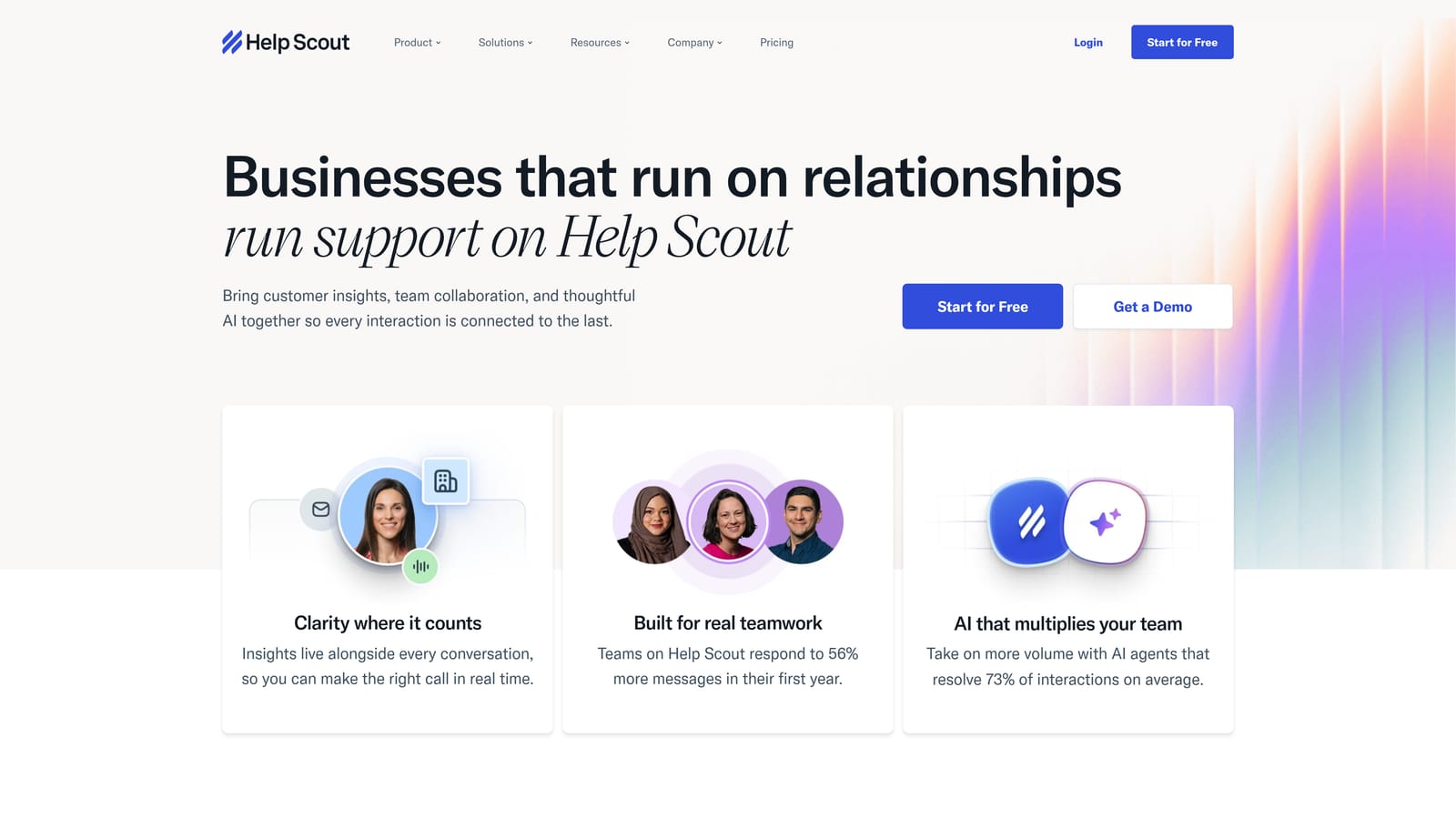
Help Scout is a human-first helpdesk that uses AI to help agents work faster, through drafts, summaries, and tone assistance, without removing the human from the conversation.
Where This Tool Shines
Help Scout is deliberately not trying to automate your way out of human support. The AI features are designed to reduce the friction of composition and context-switching, not to replace the agent. AI Drafts generates suggested replies that agents review and send. AI Summarize condenses long threads. AI Assist helps with tone and clarity. It's AI as a writing partner, not an autonomous resolver.
That philosophy resonates with teams where the quality of the human response is the differentiator. The interface is also notably clean and low-friction, which means shorter onboarding and less time spent configuring the tool itself.
Key Features
AI Drafts: Generates suggested replies for agents to review, edit, and send, reducing composition time significantly.
AI Summarize: Condenses long conversation threads into quick context for agents picking up mid-thread.
AI Assist: Helps agents adjust tone, clarity, and phrasing before sending responses.
Beacon Widget: In-app self-service and proactive messaging for customers who prefer to find answers themselves.
Clean Interface: Low training overhead and minimal configuration required to get a team productive.
Best For
Teams where human-to-human support quality is a core brand value and AI is a productivity tool rather than a resolution engine. Not the right choice if autonomous ticket resolution is the primary goal.
Pricing
Starts at approximately $22 per user per month on the Standard plan. Competitive for smaller teams focused on quality over volume.
6. Tidio
Best for: E-commerce SMBs wanting fast-deploying AI chat with Shopify integration
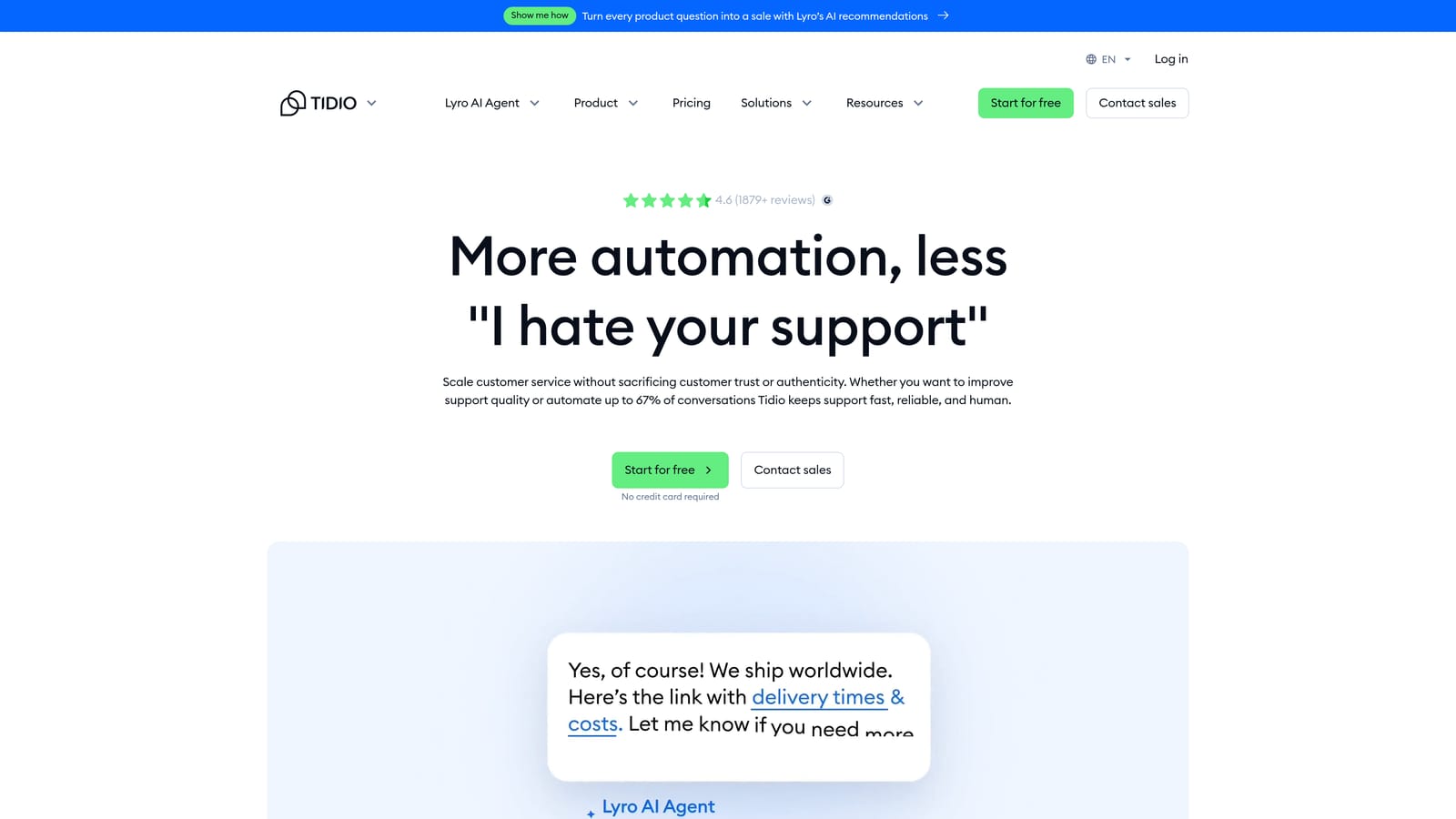
Tidio is an accessible AI chat platform built for SMBs and e-commerce teams, with Lyro AI handling common queries autonomously and quick integrations with platforms like Shopify and WooCommerce.
Where This Tool Shines
Tidio's core advantage is speed to value. For e-commerce teams, the Shopify and WooCommerce integrations mean Lyro AI can be handling customer queries about order status, returns, and product FAQs within hours of setup. That's a meaningful difference from enterprise platforms that require weeks of configuration before they're useful.
Lyro AI performs well for high-frequency, low-complexity queries, the kind that make up the bulk of e-commerce support volume. It uses your knowledge base to resolve common questions autonomously, routing to a human only when the query falls outside what it can handle confidently.
Key Features
Lyro AI Agent: Resolves common customer queries autonomously using your knowledge base content.
E-Commerce Integrations: Fast deployment with Shopify and WooCommerce, with product and order data accessible to the AI.
Unified Inbox: Live chat, email, and social media conversations in a single interface.
Simple Setup: Designed for teams without dedicated IT resources; minimal configuration required.
Automation Flows: Routing, tagging, and escalation automation for common support patterns.
Best For
E-commerce SMBs and small support teams handling high volumes of repetitive queries. Less suited for complex B2B support workflows or organizations needing deep multi-system integrations.
Pricing
Free plan available. Lyro AI starts at approximately $29 per month, with pricing that scales based on conversation volume.
7. Drift (Salesloft)
Best for: B2B teams where support and sales conversations overlap significantly
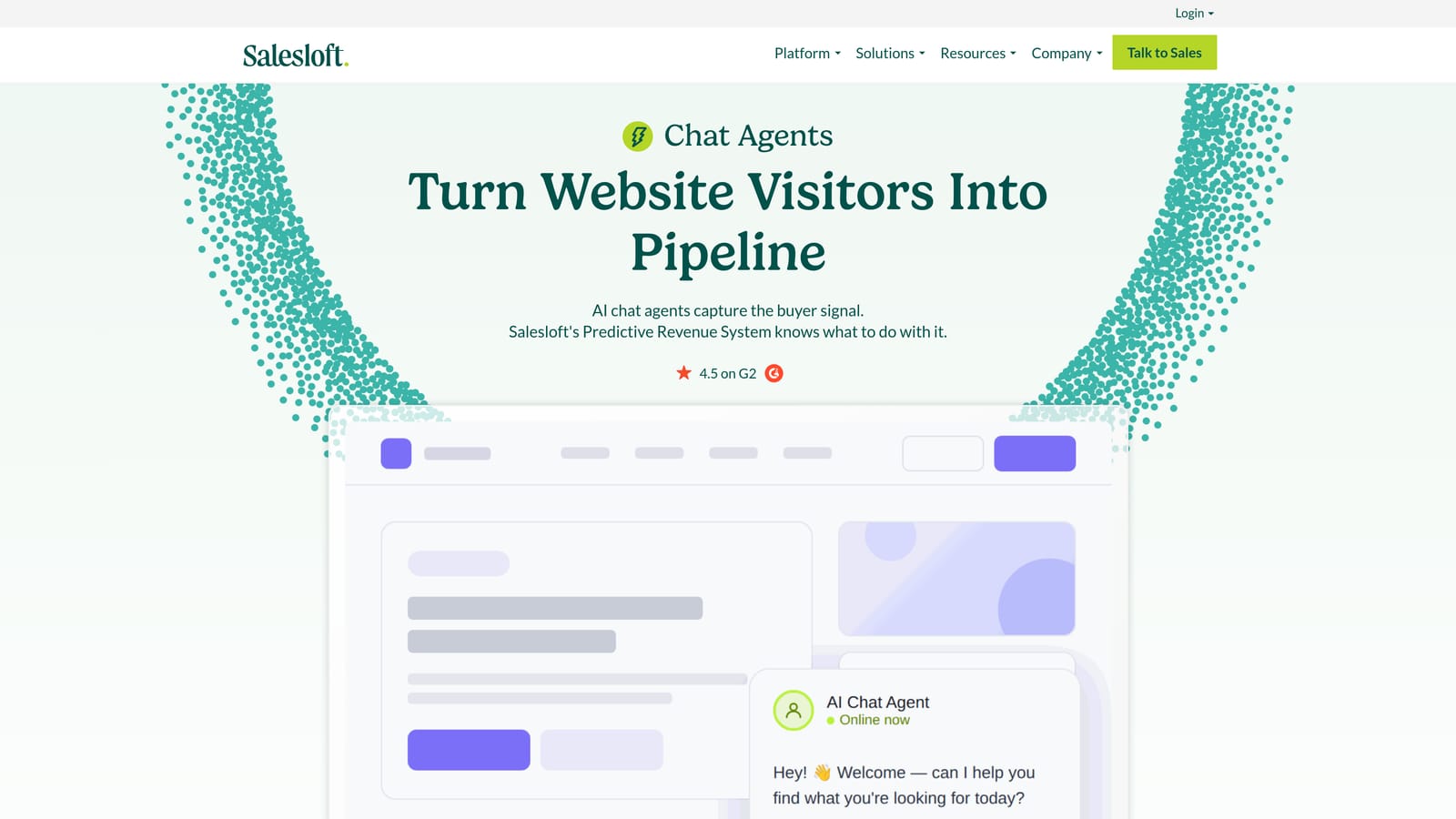
Drift is a conversational AI platform now part of Salesloft, oriented toward revenue conversations: qualifying leads, routing to the right rep, and booking meetings, making it useful where support and sales share the same front door.
Where This Tool Shines
Drift occupies a specific niche: the B2B company where a support conversation is also a buying signal. When a prospect asks a detailed product question, Drift's AI can detect intent, qualify the conversation, and route it to a sales rep or book a meeting, all without a human having to monitor the queue. That's a meaningful capability for sales-led GTM motions.
The integration with Salesloft means Drift fits naturally into existing revenue workflows. If your team already runs on Salesloft, adding Drift as the conversational layer is a logical extension. For pure support teams without a sales overlap, though, the value proposition narrows considerably.
Key Features
AI-Led Qualification and Routing: AI agents handle qualification, routing, and meeting booking without human intervention.
Intent Detection: Identifies buying signals embedded in support and product conversations.
Salesloft Integration: Connects directly to Salesloft for full revenue workflow coverage.
Conversation Playbooks: Automates common conversation paths with structured, branching logic.
Account-Based Targeting: Personalizes AI interactions based on account data and visitor identity.
Best For
B2B companies with a meaningful overlap between support conversations and sales pipeline, particularly those already using Salesloft. Less suited for teams running pure support operations without a revenue component.
Pricing
Custom pricing. Contact Salesloft or Drift directly for current plan details and packaging.
8. Kustomer
Best for: High-volume consumer brands needing a CRM-native helpdesk with full customer history
Kustomer is a CRM-native helpdesk with a full customer timeline view and AI-powered intent detection, built for high-volume consumer support operations across multiple channels.
Where This Tool Shines
Kustomer's defining feature is the customer timeline: a single view of every interaction a customer has had across every channel, from email to chat to voice to social. For consumer support teams handling large volumes where context from past purchases and interactions is critical to resolution quality, that unified view is genuinely valuable.
The AI features, including intent detection and automated routing, are built to work with that rich CRM data rather than in isolation. That integration means the AI isn't just routing by keyword; it's routing based on the full customer context. Note that Kustomer is owned by Meta, which is worth factoring into data and privacy considerations for enterprise buyers.
Key Features
Customer Timeline View: Aggregates all interactions across channels into a single, chronological customer record.
AI Intent Detection: Automatically routes and prioritizes tickets based on detected intent and customer history.
Behavior-Triggered Workflows: Automation triggered by specific customer actions or history patterns.
Omnichannel Coverage: Handles email, chat, voice, social, and SMS in a unified environment.
Deep CRM Integration: Support context is enriched by full purchase history, account data, and interaction records.
Best For
D2C and consumer brands running high-volume support operations where customer history and cross-channel context drive resolution quality. Less suited for B2B SaaS teams or smaller organizations where the pricing and complexity may not be warranted.
Pricing
Starts at approximately $89 per user per month on the Enterprise plan. Best evaluated as part of a broader CRM and support stack investment.
9. Zoho Desk
Best for: Cost-conscious teams already using Zoho CRM or other Zoho products
Zoho Desk is a cost-competitive helpdesk with Zia AI for sentiment analysis, ticket tagging, and agent suggestions, delivering the strongest value for teams embedded in the Zoho ecosystem.
Where This Tool Shines
Zoho Desk's clearest advantage is the ecosystem fit. If your team is already running on Zoho CRM, Zoho Analytics, or other Zoho products, the native integrations between them are tight and require minimal configuration. Support data flows into your CRM context, and CRM data enriches your support context, without needing a third-party connector.
Zia AI covers the practical fundamentals well: sentiment analysis on incoming tickets, automatic tagging, anomaly detection in ticket volume, and suggestions to agents based on similar past tickets. It's not the most autonomous AI on this list, but it handles the high-value, low-complexity AI tasks reliably and at a price point that's hard to argue with.
Key Features
Zia AI: Handles sentiment analysis, automatic ticket tagging, anomaly detection, and volume trend identification.
Agent Suggestions: Surfaces relevant past tickets and knowledge base articles to help agents resolve faster.
Zoho Ecosystem Integration: Deep native connectivity with Zoho CRM, Zoho Analytics, and the broader Zoho product suite.
Blueprint Workflow Automation: Structured process automation for teams with defined, repeatable support workflows.
Competitive Pricing: Generous free tier and low per-agent pricing make it accessible for budget-conscious teams.
Best For
Teams already using Zoho CRM or other Zoho products who want to extend into helpdesk without adopting a separate platform. Also a strong option for cost-conscious teams that need solid AI assistance without premium pricing. Less compelling for teams outside the Zoho ecosystem.
Which Tool Is Right for Your Team?
The right helpdesk depends less on feature checklists and more on where your team sits on the autonomy spectrum: how much you want AI doing independently versus assisting humans who stay in the loop.
Here's a quick-reference guide by use case:
Halo AI is the strongest fit for B2B SaaS teams that want AI resolving tickets end-to-end, with page-aware context, business intelligence signals, and a stack that connects to the tools product teams already use.
Zendesk is the natural choice for enterprise teams with complex workflows, large agent teams, and the ops resources to configure and maintain a sophisticated system.
Intercom works well for SaaS teams where support happens in-product and where unifying support with messaging and engagement matters.
Freshdesk is a solid mid-market option for teams that want AI assistance across the support workflow without the cost of Zendesk or Intercom.
Help Scout is the right call for teams where human-quality responses are the brand differentiator and AI is a productivity tool, not a resolution engine.
Tidio fits e-commerce SMBs that need fast deployment, Shopify integration, and AI handling high-frequency, low-complexity queries.
Drift makes sense for B2B teams where support conversations are also buying signals and the sales-support boundary is intentionally blurry.
Kustomer is built for high-volume consumer brands where full customer history across channels is the foundation of good support.
Zoho Desk delivers the best value for teams already inside the Zoho ecosystem who want solid AI assistance at a competitive price.
A few questions worth asking before you decide: Do you want AI resolving tickets autonomously, or assisting agents who stay in control? Does your support team need business intelligence beyond support metrics? How important is context awareness, knowing what page a user is on, what their account looks like, what they've done before?
Your support team shouldn't scale linearly with your customer base. AI agents can handle routine tickets, guide users through your product, and surface business intelligence while your team focuses on complex issues that need a human touch. See Halo in action and discover how continuous learning transforms every interaction into smarter, faster support.