9 Best Helpdesk Software with AI Capabilities in 2026
This guide reviews the 9 best helpdesk software with AI capabilities in 2026, comparing platforms that go beyond basic ticket storage to offer autonomous resolution, contextual understanding, and intelligent triage. Ideal for B2B and product teams managing high ticket volumes, it helps you identify whether your current helpdesk truly leverages AI or simply adds it as an afterthought.
 Grant CooperFounder13 min read
Support tickets don't wait. They pile up overnight, flood in after a product update, and multiply the moment your team is understaffed. For B2B teams and product organizations tired of manual triage and growing backlogs, the answer increasingly comes down to one question: does your helpdesk actually think, or does it just store tickets?
The market has shifted. AI is no longer a premium add-on that justifies a higher pricing tier. It's the baseline expectation. But there's a meaningful difference between helpdesks that bolt AI features onto a traditional ticket queue and platforms built with intelligence at the core from day one.
This list focuses on tools with genuine AI capabilities: autonomous resolution, contextual understanding, business intelligence signals, and integrations that connect support to the rest of your stack. Whether you're evaluating options for the first time or reconsidering your current setup, these are the platforms worth your attention in 2026.
1. Halo AI
Best for: B2B SaaS teams that want AI as the foundation, not a feature
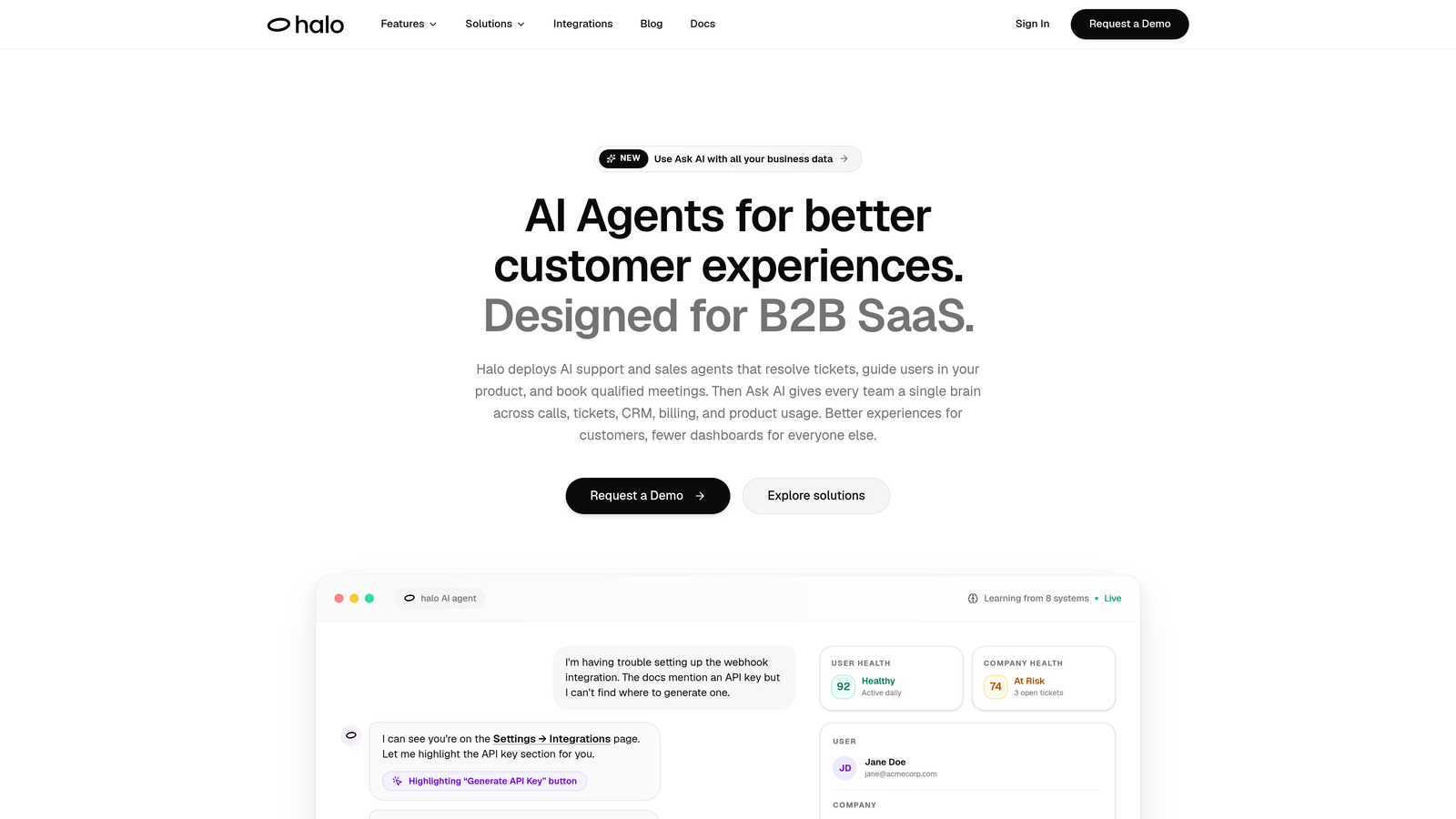
Halo AI is an AI-native customer support platform built specifically for B2B SaaS teams who need more than a smarter inbox.
Where This Tool Shines
Halo is built differently from the ground up. Rather than layering AI onto a traditional helpdesk, the intelligence is the product. Its page-aware AI agents see exactly what a user sees in your product, which means guidance is contextual and precise rather than generic. That alone separates it from most tools on this list.
Beyond resolution, Halo surfaces business intelligence that most support platforms never touch: customer health signals, revenue anomalies, and churn risk indicators that give product and success teams an early warning system embedded in everyday support interactions.
Key Features
Page-Aware AI Agents: Agents understand the user's current context in your product, enabling step-by-step visual guidance that's relevant to where the user actually is.
Autonomous Bug Ticket Creation: Automatically identifies and routes bug reports directly to Linear, removing manual handoffs between support and engineering.
Smart Inbox with Business Intelligence: Surfaces customer health signals, revenue anomalies, and churn risk alongside standard support metrics — turning your inbox into a strategic data layer.
Live Agent Handoff: Seamlessly escalates complex or sensitive issues to human agents without losing conversation context.
Deep Integration Stack: Connects natively with Slack, HubSpot, Intercom, Stripe, Zoom, PandaDoc, and Fathom — covering the full B2B SaaS toolchain.
Continuous Learning: Every resolved ticket improves the model, so resolution quality compounds over time rather than staying static.
Best For
Product teams and B2B SaaS companies that want AI to handle routine ticket resolution autonomously, surface meaningful signals from support data, and integrate tightly with their existing engineering and revenue stack. Especially strong for teams that have outgrown bolt-on AI features and want intelligence built into every layer of support.
Pricing
Contact for pricing. Visit haloagents.ai for details and to request a demo.
2. Zendesk
Best for: Enterprise teams needing a mature, scalable platform with broad AI coverage
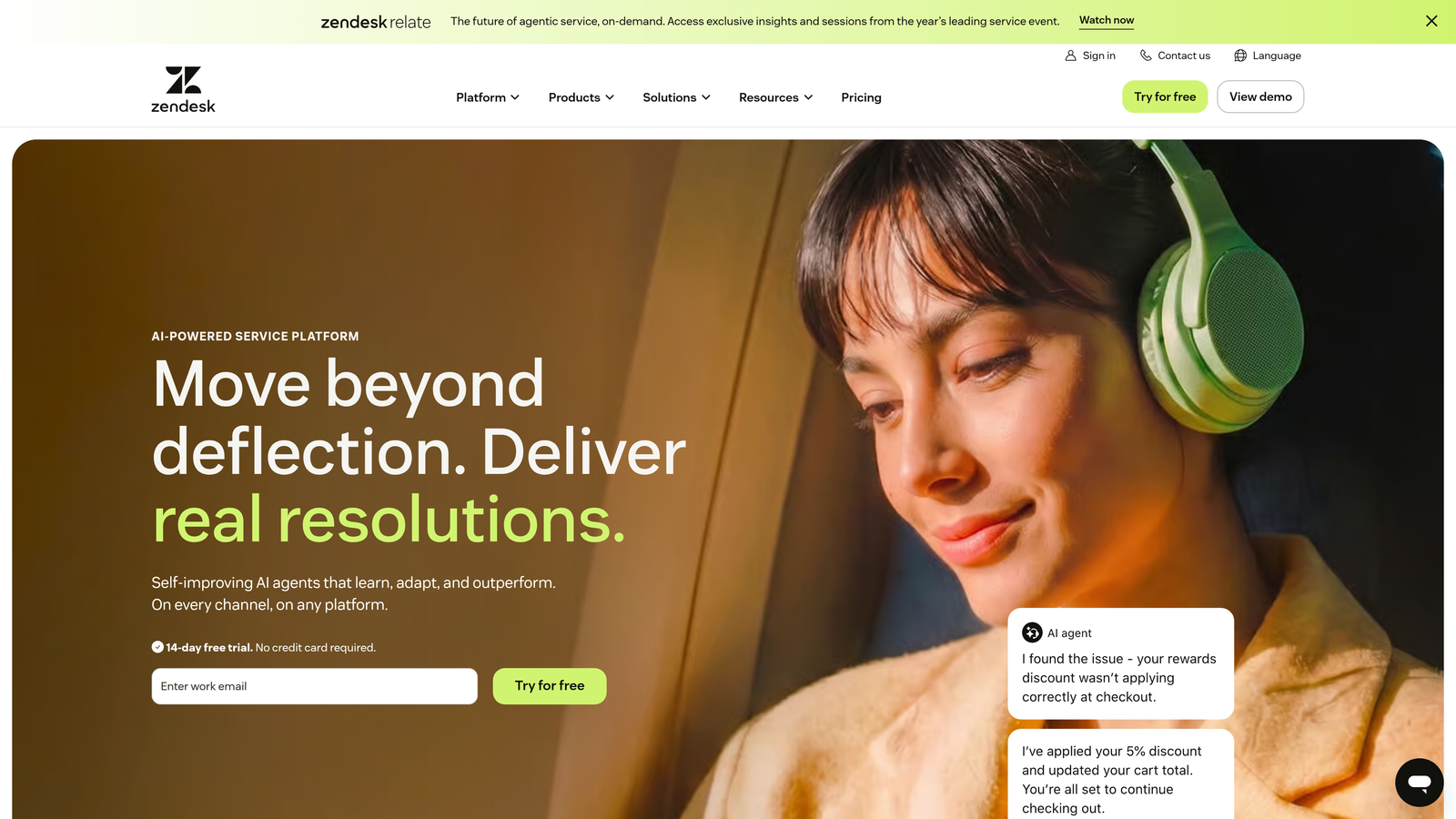
Zendesk is one of the most established helpdesk platforms available, with a comprehensive AI suite built through years of product development and strategic acquisitions.
Where This Tool Shines
Zendesk's strength is breadth. Its AI suite covers triage, intent detection, sentiment analysis, and an agent copilot that suggests responses and next-best-action steps in real time. For large support teams handling high ticket volumes across multiple channels, that coverage matters.
The app marketplace with over 1,000 integrations means Zendesk can fit into almost any enterprise stack. The tradeoff is complexity: implementation and ongoing configuration require real investment, and AI features are gated behind higher-tier plans.
Key Features
AI-Powered Triage and Intent Detection: Automatically categorizes and routes incoming tickets based on detected intent and priority.
Agent Copilot: Provides agents with suggested responses and next-best-action recommendations to speed up resolution.
Sentiment Analysis: Detects customer tone across ticket channels to help prioritize urgent or at-risk conversations.
1,000+ App Marketplace: Extensive integration options covering CRM, analytics, communication, and productivity tools.
Advanced Reporting Dashboards: Customizable analytics for team performance, CSAT, and resolution metrics.
Best For
Mid-market to enterprise teams with complex support operations, multiple channels, and the resources to implement and manage a sophisticated platform. Strong fit for organizations that need proven scalability and a large integration ecosystem.
Pricing
Suite Team starts at approximately $19 per agent per month. AI features are available on higher-tier plans. Pricing scales significantly for enterprise configurations.
3. Freshdesk
Best for: Growing SMBs that want accessible AI without enterprise-level complexity
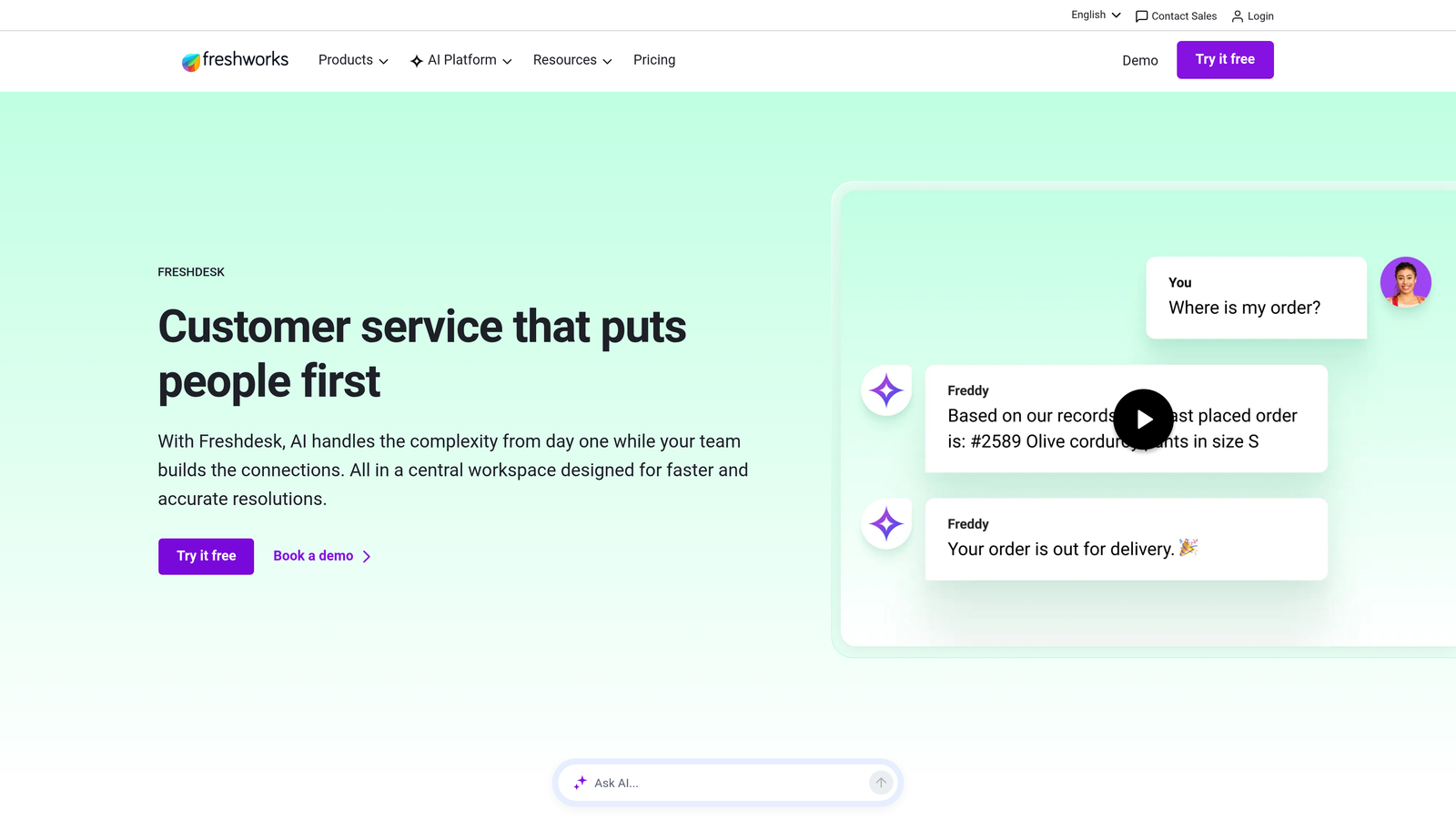
Freshdesk is a popular helpdesk from Freshworks that packages AI capabilities through its Freddy AI suite at pricing that works for smaller and growing teams.
Where This Tool Shines
Freddy AI handles the fundamentals well: auto-triage, suggested responses, ticket summarization, and a no-code bot builder for deflection. For teams that don't have dedicated operations staff to manage complex configurations, Freshdesk's relative ease of setup is a genuine advantage over heavier platforms.
The no-code Freddy Self Service bot builder deserves specific mention. Teams can build deflection flows without engineering involvement, which matters when support and product resources are stretched thin.
Key Features
Freddy AI Auto-Triage: Automatically assigns, categorizes, and prioritizes incoming tickets based on content and context.
Freddy Self Service: No-code bot builder that enables teams to create deflection workflows without developer resources.
Ticket Summarization: Condenses long ticket threads so agents can get up to speed quickly when context-switching.
Freddy Copilot and Freddy Insights: Advanced AI tiers available as add-ons for teams that need deeper automation and analytics.
Competitive Pricing Structure: Accessible entry points make it viable for teams that need AI capabilities without a large per-seat budget.
Best For
SMBs and mid-market teams that want solid AI-assisted support without the implementation overhead of enterprise platforms. A natural fit for teams already using other Freshworks products like Freshsales or Freshservice.
Pricing
Free plan available. Paid plans start at approximately $15 per agent per month. Freddy AI capabilities are available as add-ons at additional cost.
4. Intercom
Best for: SaaS companies prioritizing conversational, in-product support experiences
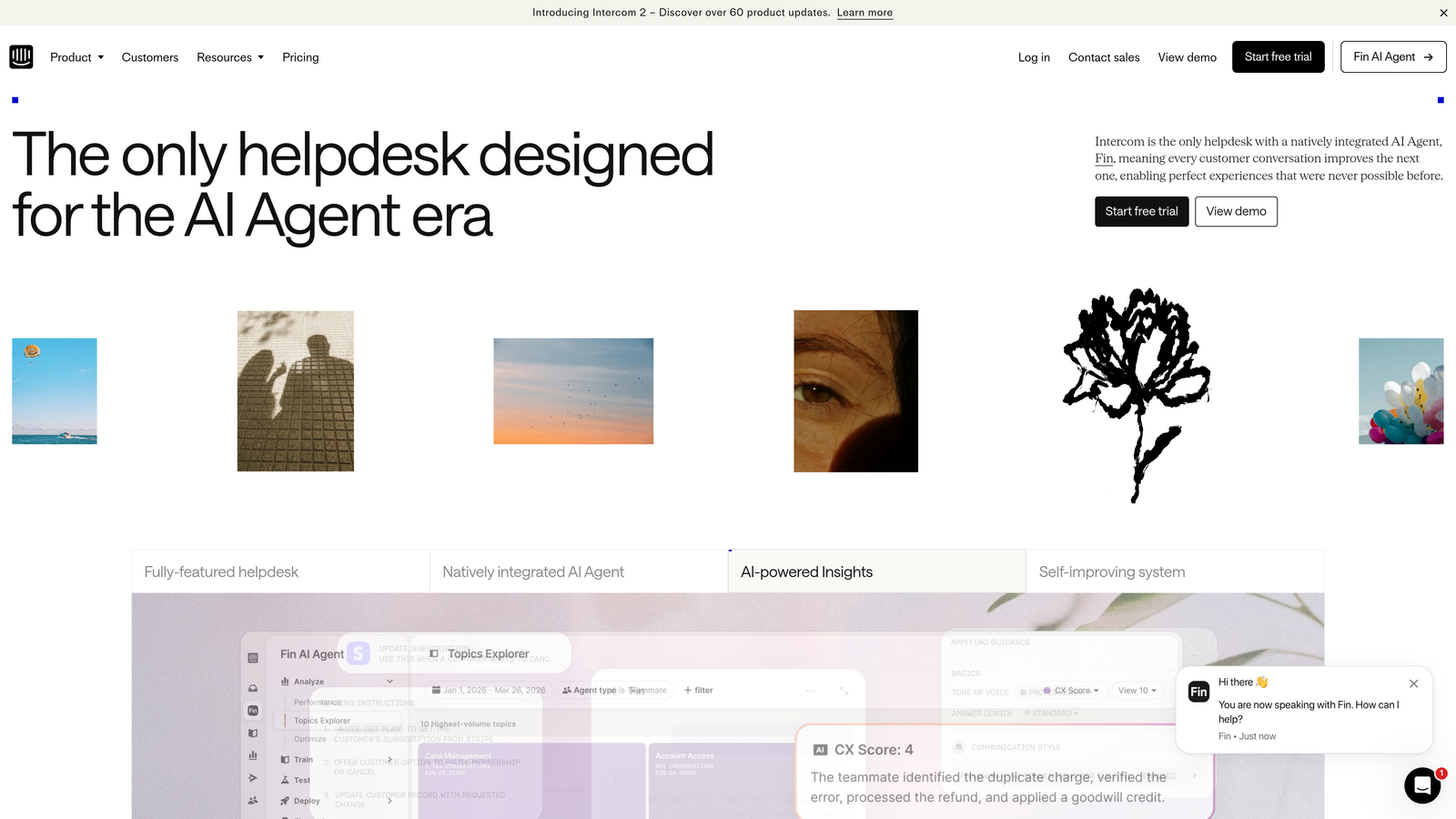
Intercom positions itself as a customer service AI platform built around conversation, with its Fin AI Agent handling frontline resolution autonomously using your existing knowledge base.
Where This Tool Shines
Fin AI Agent is Intercom's flagship capability: an AI that resolves queries end-to-end without agent involvement, drawing on your knowledge base to generate accurate, contextual answers. For SaaS teams with in-product support needs, the combination of in-app messaging, product tours, and AI resolution in one platform is genuinely compelling.
Intercom also handles proactive support well. Targeted messaging workflows let teams reach users before they hit a support wall, which can reduce inbound volume meaningfully over time.
Key Features
Fin AI Agent: Handles frontline query resolution autonomously, using your knowledge base to provide accurate, conversational answers.
In-App Messaging and Product Tours: Enables in-product guidance and onboarding flows alongside reactive support.
AI-Powered Inbox: Includes conversation summaries and AI-assisted triage to help agents manage volume.
Proactive Support Workflows: Targeted messaging based on user behavior to address issues before they become tickets.
Strong API: Flexible integration options for teams with custom stack requirements.
Best For
SaaS companies that want AI-driven frontline resolution combined with in-product messaging and onboarding in a single platform. Particularly strong for product-led growth teams where support and activation overlap.
Pricing
Starts at approximately $39 per seat per month. Fin AI Agent is priced on usage-based terms in addition to base seat costs.
5. Salesforce Service Cloud
Best for: Enterprise organizations already invested in the Salesforce ecosystem
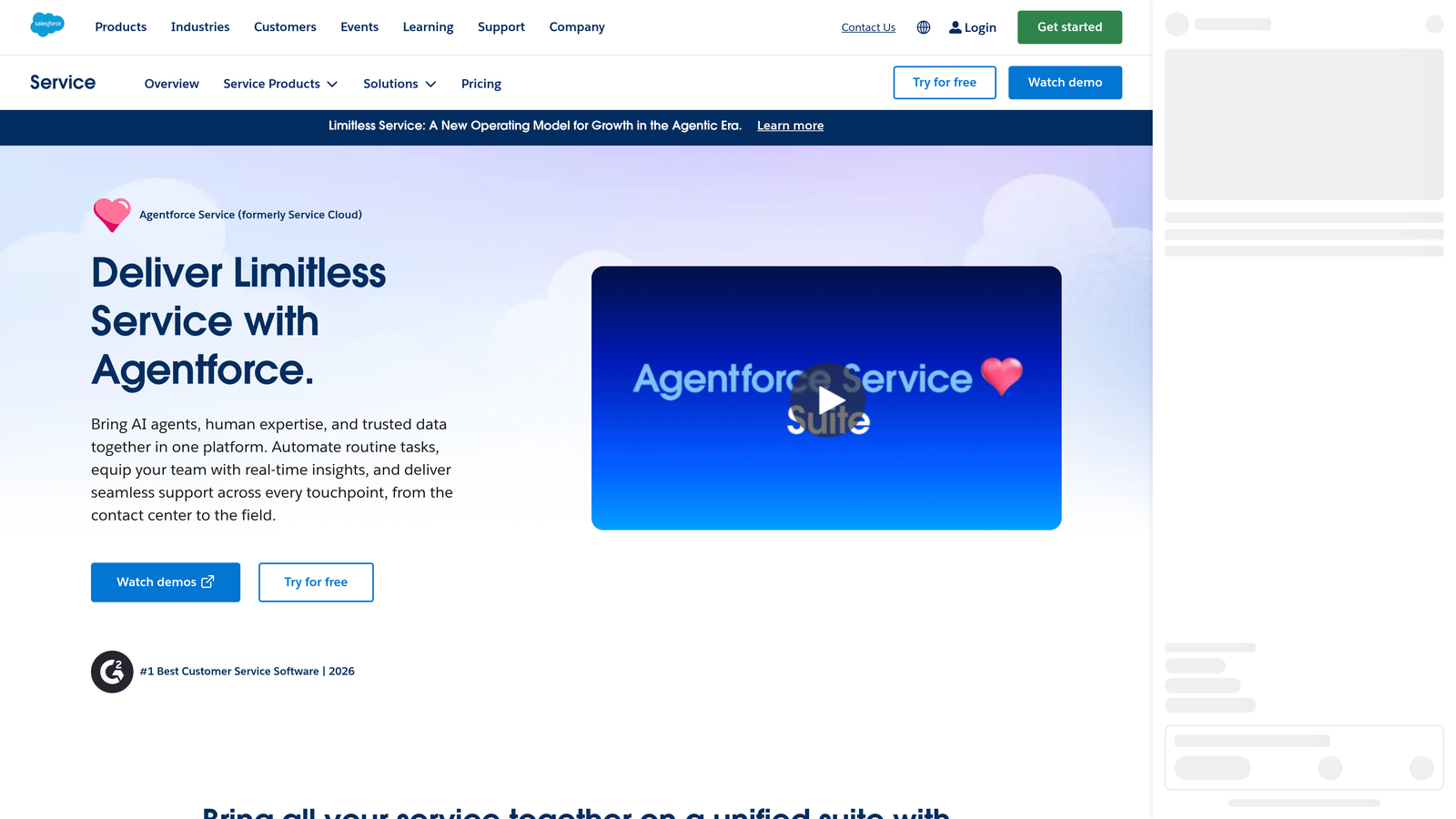
Salesforce Service Cloud is an enterprise-grade support platform that uses Einstein AI to power case classification, knowledge suggestions, and next-best-action recommendations within the broader Salesforce data layer.
Where This Tool Shines
The core advantage of Service Cloud is its data integration with Salesforce CRM. When support and sales share a unified customer record, agents can see account history, deal stage, and relationship context without switching tools. Einstein AI builds on that foundation with intelligent routing and recommendations that leverage the full depth of your Salesforce data.
Omnichannel routing across email, chat, voice, and social is mature and well-tested at enterprise scale. For organizations already running Salesforce, the switching cost of moving to a different support platform is significant — Service Cloud is the natural continuation.
Key Features
Einstein AI Case Classification: Automatically classifies and routes incoming cases based on content and historical patterns.
Next-Best-Action Recommendations: Surfaces contextual guidance for agents based on case details and CRM data.
Knowledge Article Suggestions: Recommends relevant knowledge base articles to agents based on case context in real time.
Unified Support and CRM Data Layer: Full visibility into customer relationship history alongside support interactions.
Omnichannel Routing: Manages inbound volume across email, chat, voice, and social from a single interface.
Best For
Enterprise teams with complex support operations that are already using Salesforce for sales and CRM. The platform rewards teams that can invest in implementation and ongoing administration.
Pricing
Starter plans begin at approximately $25 per user per month. Enterprise and higher tiers are significantly more expensive. Full pricing requires direct contact with Salesforce.
6. HubSpot Service Hub
Best for: Teams already on HubSpot that want support connected to marketing and sales data
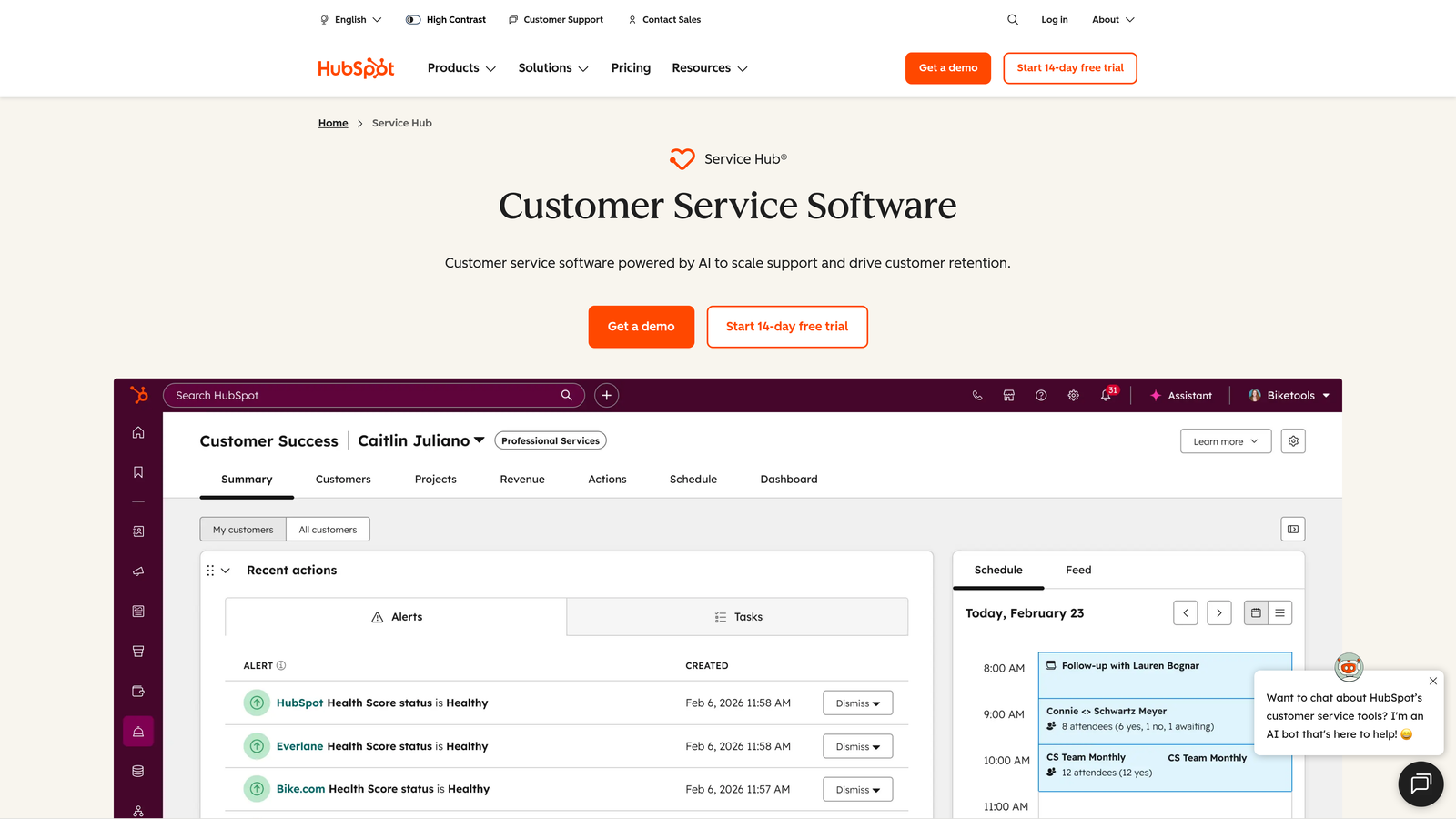
HubSpot Service Hub is support software built within the HubSpot platform, offering AI-assisted knowledge base creation, ticket summaries, and chatbot automation tied directly to HubSpot CRM data.
Where This Tool Shines
The genuine advantage of Service Hub is the unified HubSpot data model. When support, marketing, and sales share the same contact and company records, teams can see the full customer journey without stitching together data from multiple tools. AI features like ticket summaries and knowledge base generation add practical productivity value on top of that foundation.
For teams that aren't already in the HubSpot ecosystem, the AI depth may feel lighter than dedicated AI-first platforms. But for HubSpot-native teams, Service Hub removes the friction of managing a separate support tool entirely.
Key Features
AI Content Assistant: Generates knowledge base articles from prompts, reducing the time needed to build and maintain self-service content.
AI Ticket and Conversation Summaries: Automatically condenses ticket threads so agents can get context quickly without reading full histories.
CRM-Connected Chatbot Builder: Creates automated chat flows that personalize responses using HubSpot contact and deal data.
Unified Data View: Support, marketing, and sales data in one place, enabling full customer journey visibility.
SLA Management and Customer Feedback Tools: Built-in tools for tracking response commitments and gathering CSAT data.
Best For
SMB and mid-market teams already using HubSpot CRM or Marketing Hub who want support integrated into their existing platform rather than managed separately.
Pricing
Free tools available. Paid plans start at approximately $15 per seat per month for the Starter tier. More advanced AI features are available on higher plans.
7. Help Scout
Best for: Lean teams that want clean, human-centered support with practical AI productivity tools
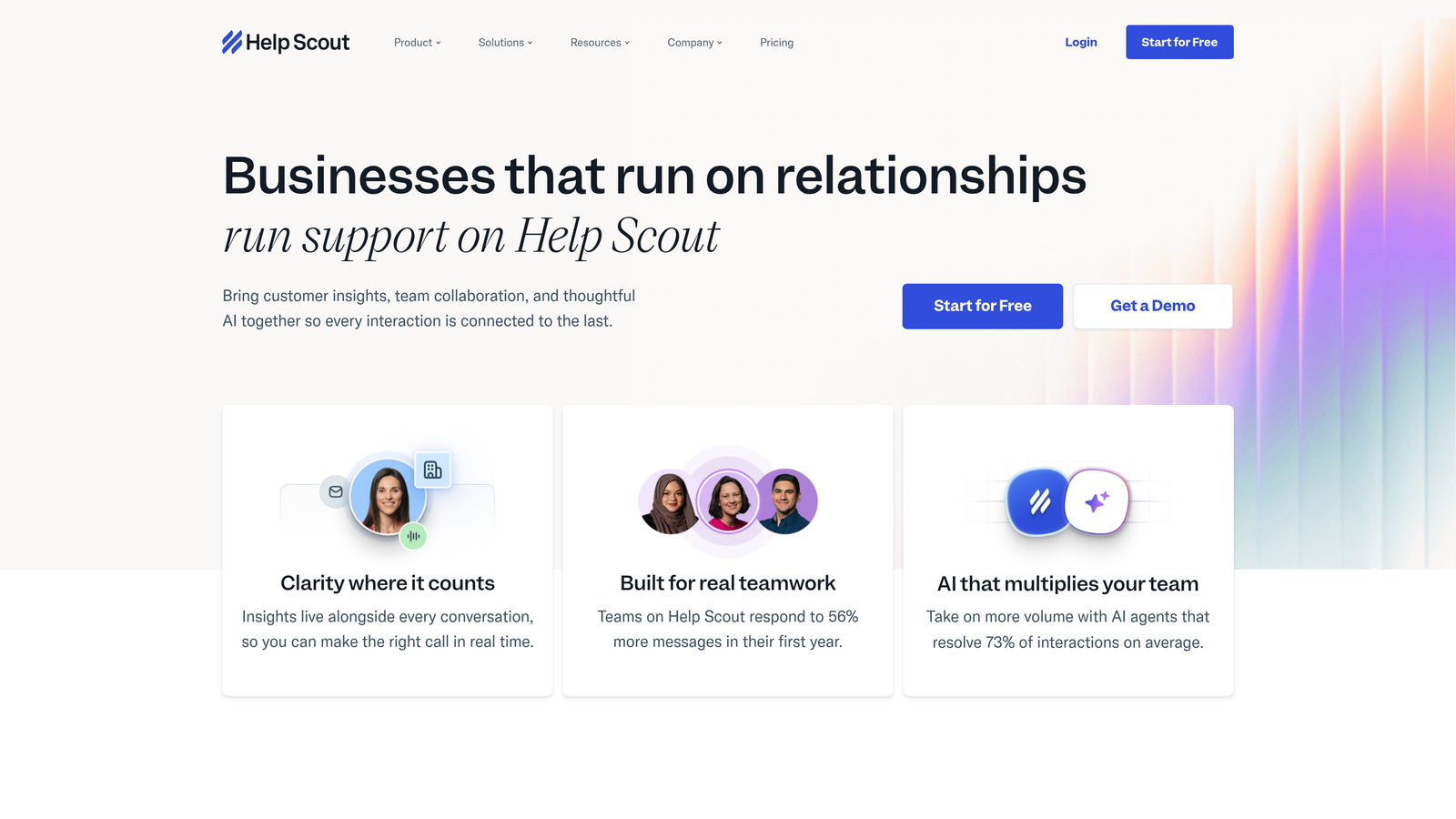
Help Scout is a deliberately simple support platform that has introduced AI capabilities without abandoning the clean, focused experience that made it popular with lean teams.
Where This Tool Shines
Help Scout's philosophy is to add AI where it genuinely helps agents work faster, without burying the team in features they'll never use. AI Drafts generates contextual reply suggestions, and AI Summarize condenses long email threads into a quick brief. Both features reduce the cognitive load of handling a full inbox without requiring configuration or training.
The pricing model is also worth noting: transparent, per-mailbox pricing makes budgeting predictable in a way that per-seat models with AI add-ons often aren't.
Key Features
AI Drafts: Generates contextual reply suggestions based on the conversation, giving agents a strong starting point rather than a blank reply box.
AI Summarize: Condenses long email threads into a concise summary, so agents can get context in seconds rather than minutes.
Shared Inbox with Clean UX: Distraction-free interface designed to keep agents focused on conversations rather than navigating complex toolbars.
Docs Knowledge Base: Built-in self-service documentation with AI-assisted search to help customers find answers independently.
Transparent Pricing: Per-mailbox pricing model that avoids the unpredictability of usage-based AI add-ons.
Best For
Small to mid-sized teams that prioritize simplicity and clean UX over feature volume. A strong fit for companies where support is handled by a small team that needs productivity tools, not a complex AI platform.
Pricing
Standard plans start at approximately $20 per user per month. Pricing is transparent and accessible relative to enterprise-tier alternatives.
8. Zoho Desk
Best for: Mid-market teams in the Zoho ecosystem that want broad AI features at competitive pricing
Zoho Desk is part of the Zoho product ecosystem, offering Zia AI for sentiment analysis, ticket volume anomaly detection, auto-tagging, and response suggestions at a price point that works for mid-market budgets.
Where This Tool Shines
Zia's anomaly detection is an underappreciated capability: it flags unusual spikes in ticket volume before they become a crisis, giving teams time to respond proactively. Combined with sentiment analysis and auto-tagging, Zia handles a meaningful portion of the manual categorization work that typically slows support teams down.
For teams already using Zoho CRM or Zoho Analytics, the integration depth is a genuine advantage. Data flows between products without custom connectors, which keeps implementation overhead low.
Key Features
Zia Sentiment Analysis: Detects customer mood across conversations to help prioritize emotionally charged or at-risk tickets.
Anomaly Detection: Flags unusual ticket volume patterns in real time, enabling proactive staffing and response.
Auto-Tagging and Response Suggestions: Automatically categorizes tickets and surfaces relevant response options to speed up agent workflows.
Zoho Ecosystem Integration: Deep native connections with Zoho CRM, Zoho Analytics, and other Zoho products for a unified data layer.
Multi-Channel Support: Handles email, chat, social, and phone from a single interface.
Best For
Mid-market teams that want a broad set of AI features at competitive pricing, particularly those already using other Zoho products. A strong value option for teams that don't need enterprise-level scale.
Pricing
Free plan available for up to three agents. Paid plans start at approximately $14 per agent per month. Zia AI features are available on higher tiers.
9. Kustomer
Best for: High-volume teams handling complex, multi-touch customer journeys that outgrow ticket-centric models
Kustomer is a CRM-helpdesk hybrid that layers AI automation on a unified customer timeline, making it a strong fit for teams where traditional ticket queues create more friction than they solve.
Where This Tool Shines
The unified customer timeline is Kustomer's defining feature. Rather than treating each interaction as an isolated ticket, every conversation, purchase, and touchpoint appears in a single chronological view. AI automation for routing, tagging, and suggested responses builds on that foundation to reduce manual work without losing context.
KustomerIQ adds predictive and proactive support capabilities, enabling teams to act on patterns before customers escalate. For high-volume teams handling complex, multi-touch journeys, this architecture is more natural than forcing everything into a ticket queue.
Key Features
Unified Customer Timeline: All interactions, channels, and data points in a single chronological view rather than isolated ticket threads.
AI-Powered Routing, Tagging, and Suggested Responses: Automates the mechanical work of ticket management to keep agents focused on resolution.
Workflow Automation: Handles complex, multi-step support processes without requiring manual intervention at each stage.
KustomerIQ: Predictive and proactive support features that surface patterns and opportunities before they become problems.
Omnichannel Inbox: Manages email, chat, SMS, social, and voice from a unified interface.
Best For
High-volume support teams at companies with complex customer journeys, multiple touchpoints, and a need for context that spans more than a single ticket. Particularly strong for teams that find traditional helpdesks too rigid for their workflows.
Pricing
Enterprise plans start at approximately $89 per user per month. Contact Kustomer directly for full pricing details across tiers.
Which Tool Is Right for Your Team
Every platform on this list has genuine AI capabilities. The real question is whether you need AI as a feature layered onto a traditional helpdesk, or AI as the foundation that everything else is built on.
Here's a quick guide by use case to help narrow the decision:
For AI-first B2B SaaS teams: Halo AI is purpose-built for this. Page-aware agents, autonomous bug routing, business intelligence signals, and continuous learning put it in a different category from platforms that added AI after the fact.
For enterprise scale with an existing stack: Zendesk or Salesforce Service Cloud are the natural choices. Both have mature AI suites and the integration depth to fit complex enterprise environments, though implementation investment is significant.
For SMB teams on a budget: Freshdesk and Zoho Desk offer solid AI capabilities at pricing that doesn't require an enterprise contract. Help Scout is worth considering if simplicity and clean UX matter more than feature volume.
For CRM-integrated support: HubSpot Service Hub works best for teams already in the HubSpot ecosystem. Salesforce Service Cloud is the equivalent for Salesforce-native organizations. Kustomer is the right call when complex, multi-touch journeys make a ticket-centric model feel limiting.
For in-product, conversational support: Intercom's Fin AI Agent and in-app messaging make it a strong fit for product-led SaaS companies where support and activation overlap.
Your support team shouldn't scale linearly with your customer base. Let AI agents handle routine tickets, guide users through your product, and surface business intelligence while your team focuses on complex issues that need a human touch. See Halo in action and discover how continuous learning transforms every interaction into smarter, faster support.