9 Best Helpdesk Ticket Automation Tools in 2026
Discover the 9 best helpdesk ticket automation tools in 2026, evaluated across AI capability, integration depth, and scalability to help support teams move beyond basic routing and achieve true end-to-end ticket resolution. Whether you're a small team or enterprise operation, this guide covers platforms that reduce manual workload, surface actionable insights, and handle repetitive queries automatically—freeing agents to focus on complex customer issues.
 Matt PattoliFounder13 min read
Manual ticket handling is expensive, slow, and doesn't scale. When support teams spend hours triaging, routing, and responding to repetitive queries, they're burning capacity that should go toward complex customer problems. The good news: helpdesk ticket automation has matured well beyond basic routing rules. Today's best tools can resolve tickets end-to-end, surface business intelligence, and learn from every interaction.
But not all automation is equal. There's a meaningful difference between a platform that routes tickets automatically and one that actually resolves them. This list covers both categories, along with vertical-specific tools built for e-commerce support. Selection criteria include AI capability, integration depth, scalability, pricing transparency, and fit across team sizes.
Whether you're exploring automated customer support for the first time or evaluating purpose-built AI helpdesk software to replace an aging system, this breakdown covers the tools worth your time in 2026.
1. Halo AI
Best for: B2B SaaS teams that want AI-first ticket resolution without building on top of a legacy helpdesk.
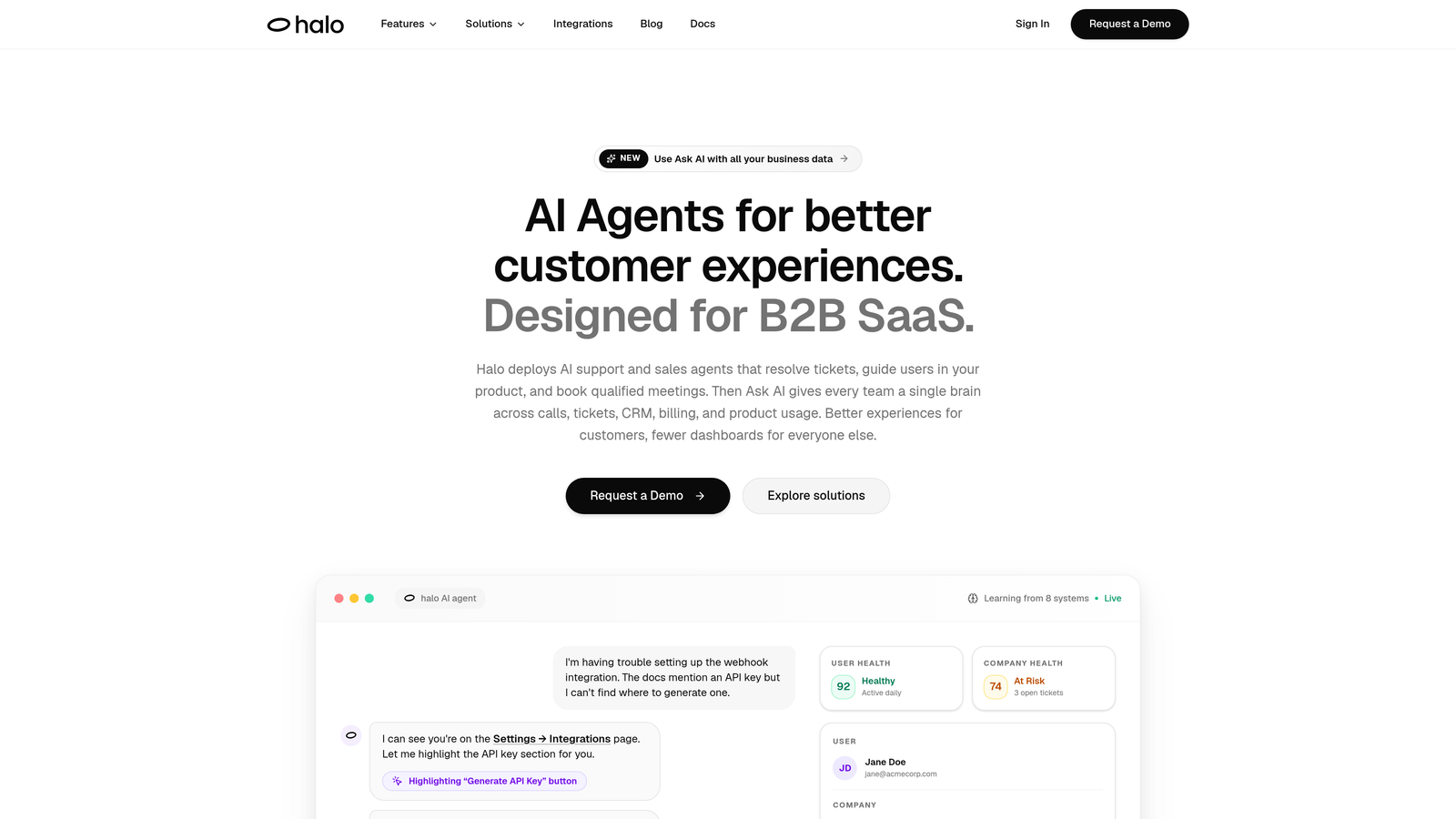
Halo AI is an AI-first customer support platform that deploys intelligent agents to resolve tickets autonomously, guide users through your product with page-aware context, and surface business intelligence signals across your support operation.
Where This Tool Shines
Most helpdesks add AI as a layer on top of an existing workflow engine. Halo is built the other way around: the AI agent is the foundation, not the feature. This means it doesn't just categorize or route tickets, it handles the full resolution lifecycle, escalating to a human only when the situation genuinely calls for it.
The page-aware chat widget is a standout differentiator. The AI agent sees what the user sees on screen, enabling contextual visual guidance rather than generic responses. Pair that with continuous learning from every resolved interaction, and the system gets meaningfully smarter over time rather than staying static.
Key Features
Autonomous ticket resolution: AI agents handle tickets end-to-end, not just assign them to a queue.
Page-aware chat widget: The agent understands the user's current screen context, enabling precise, visual product guidance.
Smart inbox with business intelligence: Surfaces customer health signals, revenue anomalies, and trend detection beyond standard support metrics.
Auto bug ticket creation: Automatically logs issues directly to Linear when a bug pattern is detected, closing the loop between support and engineering.
Live agent handoff: Seamlessly escalates complex issues to human agents when autonomous resolution isn't appropriate.
Deep integrations: Connects natively with Slack, HubSpot, Intercom, Stripe, Zoom, PandaDoc, and Fathom.
Best For
B2B SaaS companies and product teams that want a support layer built around AI resolution rather than a traditional helpdesk retrofitted with AI features. Particularly strong for teams that need support intelligence to feed back into product, engineering, and customer success workflows.
Pricing
Contact for pricing. Halo is designed for B2B SaaS teams and positions as a full support platform, not an add-on to an existing system.
2. Zendesk
Best for: Enterprise and mid-market teams that need a proven, feature-complete helpdesk with mature automation and a massive integration ecosystem.
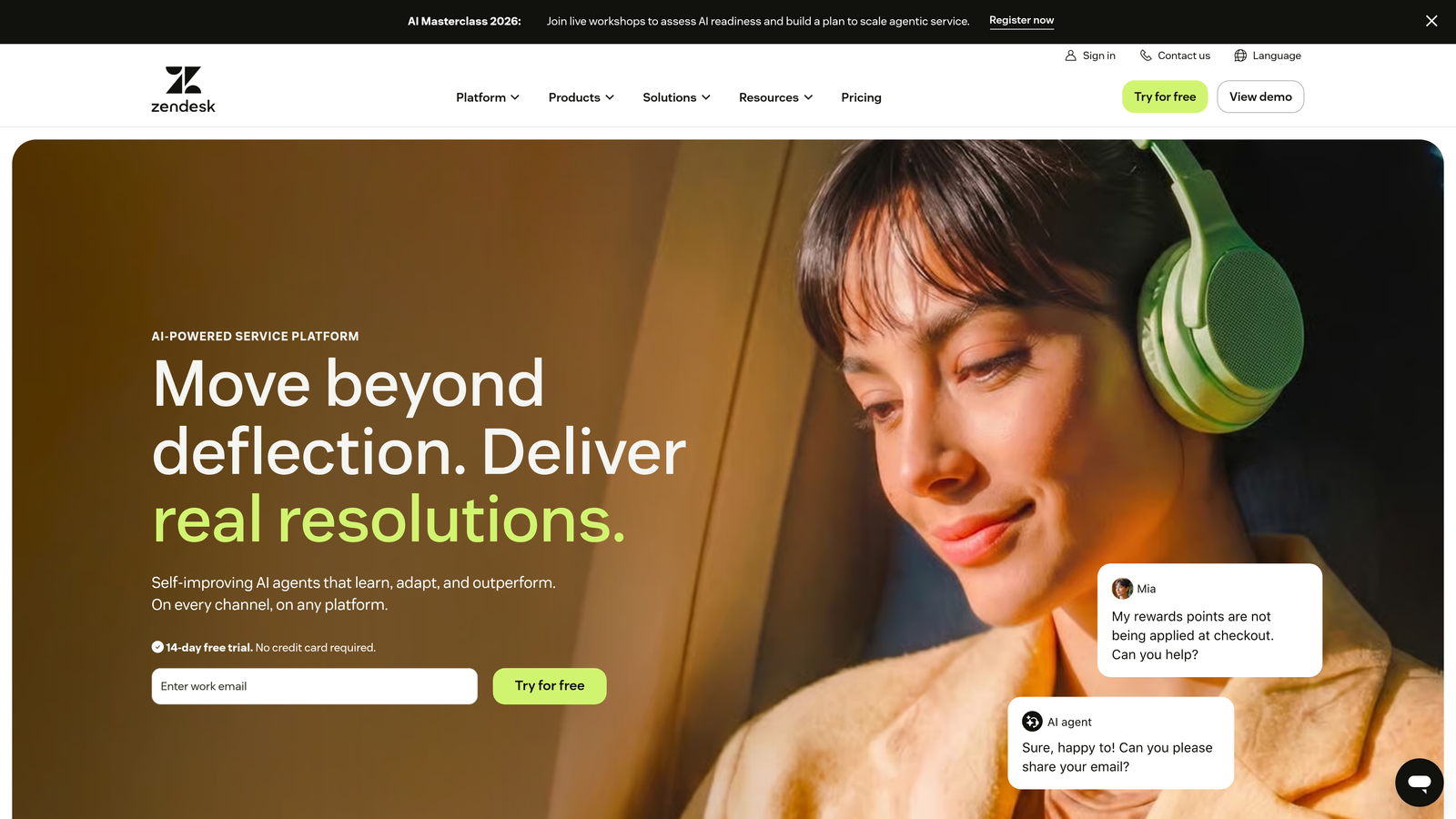
Zendesk is the industry-standard enterprise helpdesk platform with a mature automation engine and AI capabilities via Zendesk AI.
Where This Tool Shines
Zendesk's automation engine is battle-tested. Triggers fire on ticket events, macros batch-apply actions, and automations handle time-based rules. For teams with complex routing logic and multi-channel support needs, this configuration flexibility is genuinely valuable.
Zendesk AI, powered by OpenAI, adds intelligent triage, suggested replies, and an AI agent layer on top. It's effective, though the AI features are gated behind higher pricing tiers, which matters when building a business case. The app marketplace with over 1,000 integrations means you can connect Zendesk to almost anything.
Key Features
Triggers, macros, and automations: Rule-based ticket routing and updates with granular condition logic.
Zendesk AI: Intelligent triage, suggested replies, and an AI agent built on top of the core platform.
1,000+ app marketplace: Extensive integration ecosystem covering CRMs, analytics, communication tools, and more.
Advanced SLA management: Configurable SLA policies with escalation rules and reporting.
Omnichannel support: Unified inbox across email, live chat, phone, and social channels.
Best For
Enterprise teams and established mid-market companies with complex support operations, multiple channels, and a need for deep configurability. Also well-suited for teams with existing Zendesk investments looking to layer in AI capabilities.
Pricing
Suite Team starts at $55 per agent per month. AI features require higher-tier plans, so total cost can climb significantly for teams wanting full AI functionality.
3. Freshdesk
Best for: Growing mid-market teams that want Zendesk-level features at a more accessible price point, with built-in AI from Freddy.
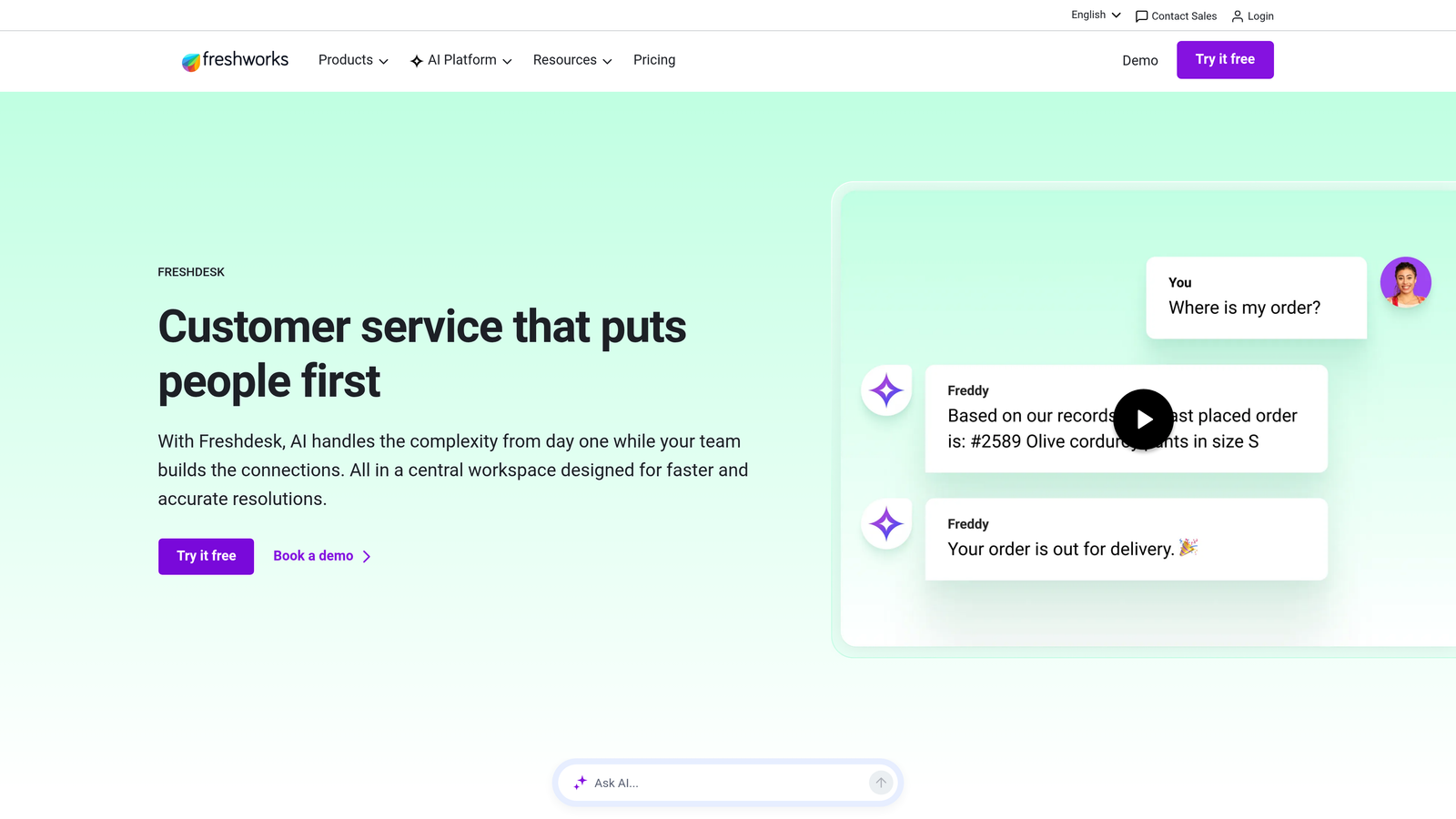
Freshdesk is a mid-market helpdesk platform from Freshworks with Freddy AI built in for intelligent triage, suggested responses, and self-service automation.
Where This Tool Shines
Freshdesk's scenario automations are a strong feature: multi-step ticket actions triggered by conditions, letting you chain together tagging, assignment, status changes, and notifications in a single rule. For teams that need structured workflows without developer resources, this is a practical middle ground.
Freddy AI handles ticket summarization, auto-triage, and response suggestions. Freddy Self Service powers an AI-driven knowledge base that deflects tickets before they reach an agent. The free plan also makes Freshdesk accessible for early-stage teams testing the waters.
Key Features
Freddy AI: Ticket summarization, auto-triage, and suggested replies built into the platform.
Scenario automations: Multi-step, condition-triggered ticket actions without requiring manual configuration each time.
Freddy Self Service: AI-powered knowledge base that deflects common queries before they become tickets.
Collision detection: Prevents multiple agents from working the same ticket simultaneously.
Free plan: Available for small teams with basic helpdesk needs.
Best For
Mid-market SaaS and service teams looking for a cost-effective alternative to Zendesk, particularly those already using other Freshworks products like Freshsales or Freshchat.
Pricing
Free plan available. Growth plan from $15 per agent per month. Freddy Copilot and Freddy Self Service are priced as separate add-ons, so factor those in when comparing total cost.
4. Intercom
Best for: SaaS companies that want an AI agent deeply embedded in their in-app messaging layer, with usage-based pricing for resolutions.
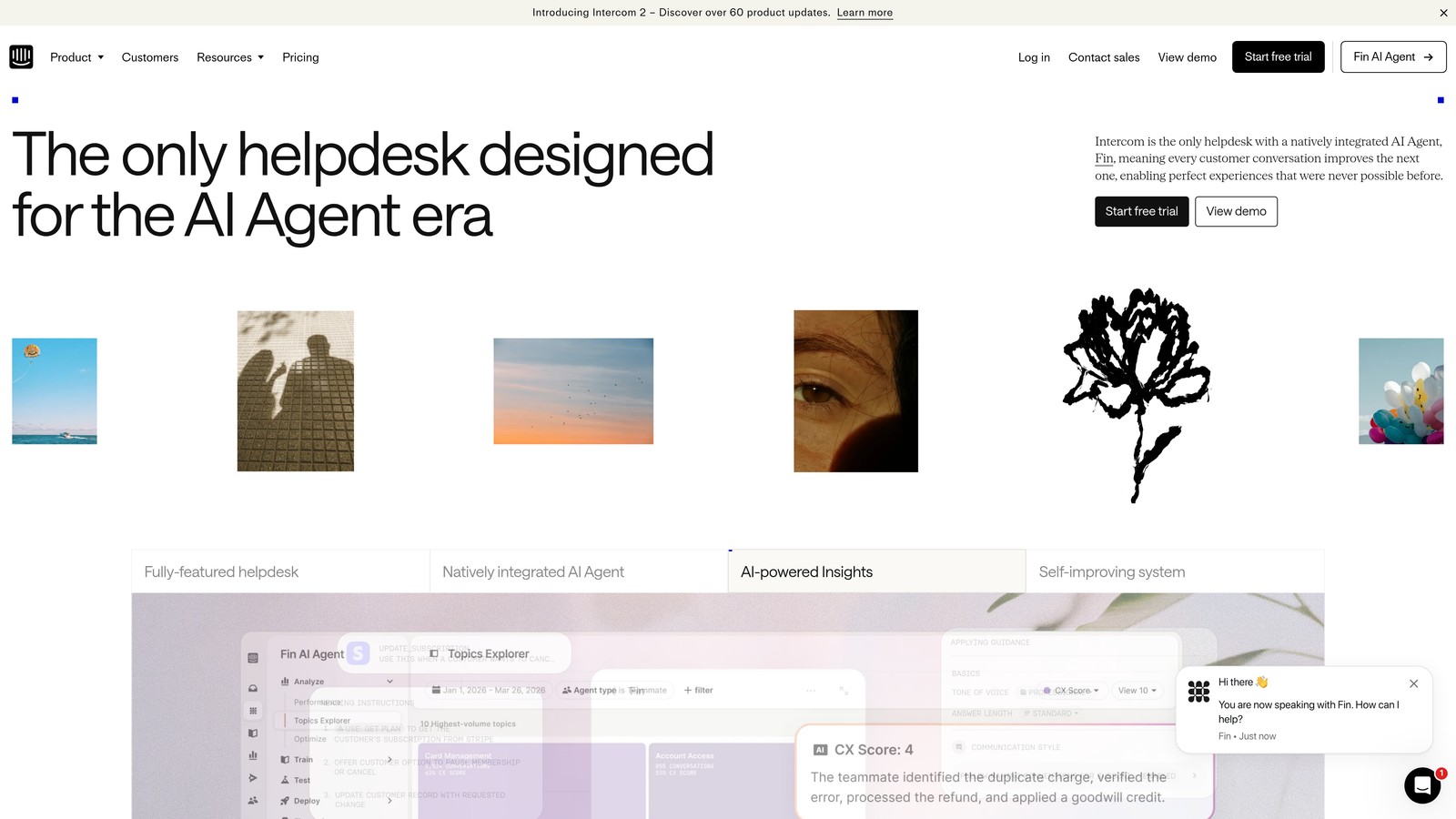
Intercom is a customer messaging platform with Fin, an AI agent that resolves support tickets end-to-end within the Intercom conversation layer.
Where This Tool Shines
Fin is one of the more capable AI agents in this category. It pulls from your knowledge base to answer queries autonomously, handles follow-up questions in context, and escalates to a human when it can't resolve. For SaaS companies already using Intercom for in-app messaging, adding Fin is a natural extension rather than a separate deployment.
The workflow builder handles routing, tagging, and escalation logic, while the unified platform covers inbox, tickets, and help center in one place. The usage-based pricing for Fin resolutions is worth modeling carefully: it scales with volume in ways that can surprise teams during high-traffic periods.
Key Features
Fin AI agent: Resolves queries autonomously using knowledge base content, with contextual follow-up handling.
Usage-based Fin pricing: Pay per resolved conversation rather than per seat for AI resolutions.
In-app messaging integration: Tight connection to the in-product experience for SaaS teams.
Workflow builder: Visual routing, tagging, and escalation automation.
Unified platform: Inbox, tickets, and help center managed in a single interface.
Best For
SaaS companies already invested in the Intercom ecosystem, particularly those with high volumes of repetitive queries that Fin can handle autonomously. Teams with unpredictable support volume should model Fin's per-resolution pricing carefully before committing.
Pricing
Essential plan from $29 per seat per month. Fin AI resolutions are billed separately per resolved conversation, in addition to the base seat cost.
5. Help Scout
Best for: Teams that prioritize a clean, human-feeling support experience with lightweight automation and transparent pricing.
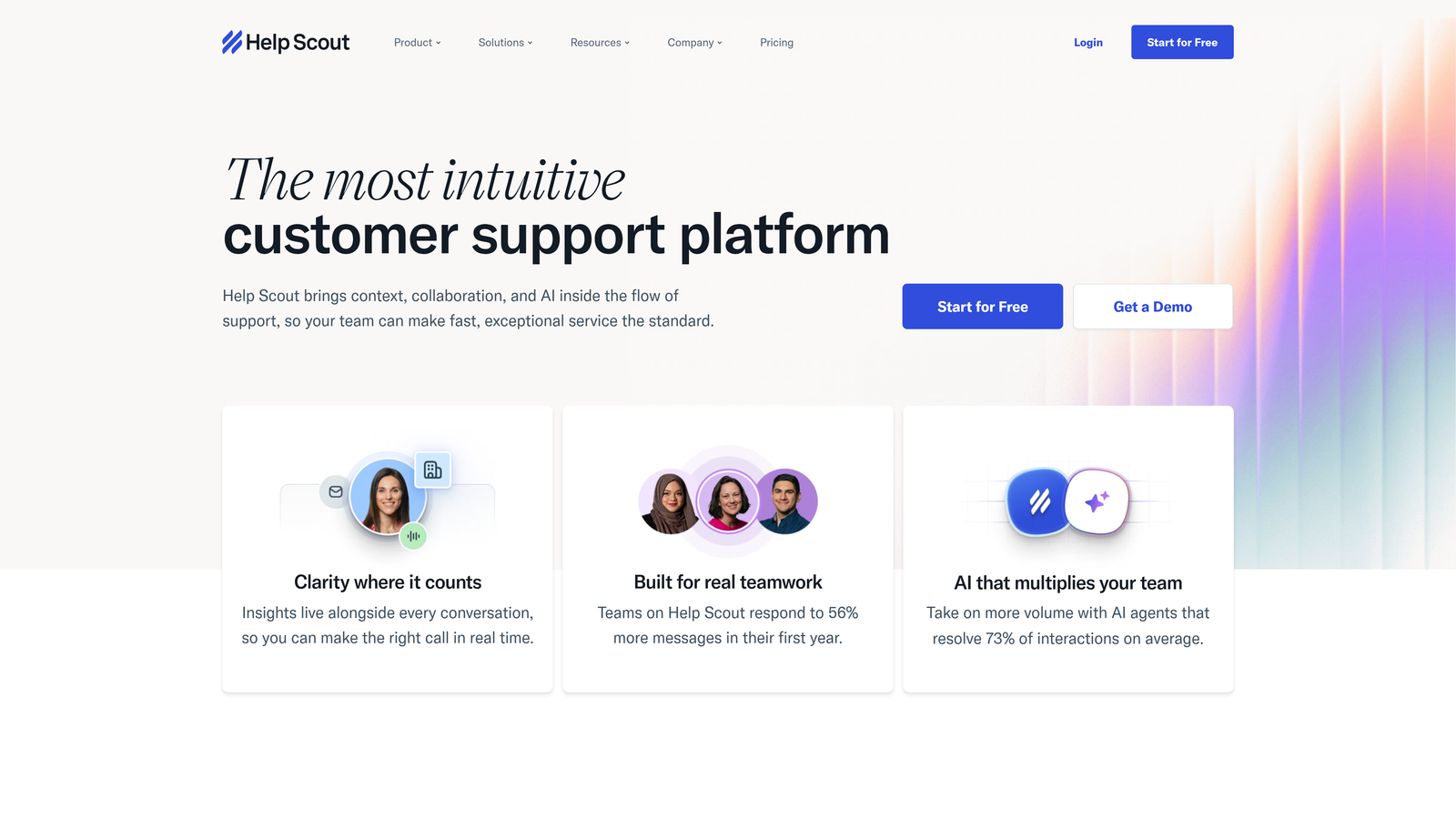
Help Scout is a clean, email-first helpdesk with lightweight automation workflows and AI writing assistance, built for teams that value simplicity over configuration depth.
Where This Tool Shines
Help Scout's interface is genuinely pleasant to work in. The email-like inbox removes the sterile ticket-number feel that can make support feel transactional. Workflows handle routing, tagging, and status updates automatically, covering the most common automation needs without requiring a dedicated admin to configure them.
The AI features, including Summarize, Assist, and Drafts, focus on helping agents respond faster rather than replacing them entirely. If your support philosophy centers on human connection with AI as a productivity tool, Help Scout fits that model well. Pricing is also refreshingly straightforward, with no per-feature add-on complexity.
Key Features
Workflows: Automated routing, tagging, and status updates based on conditions.
AI Summarize, Assist, and Drafts: Agent-facing AI tools for faster, more consistent responses.
Saved replies: Quick, consistent responses to common questions without losing the human tone.
Beacon chat widget: In-app help content and chat without a heavy implementation lift.
Transparent pricing: No per-feature add-on complexity or surprise tier requirements for core functionality.
Best For
Small to mid-sized teams that want a clean, email-first support experience with enough automation to reduce manual work, without the overhead of a complex enterprise platform. Strong fit for companies where support tone and human connection matter as much as efficiency.
Pricing
Standard plan from $20 per user per month. Plus plan from $40 per user per month. All core features included without add-on complexity.
6. Zoho Desk
Best for: Companies already using Zoho CRM that want a tightly integrated helpdesk with strong workflow automation and AI from Zia.
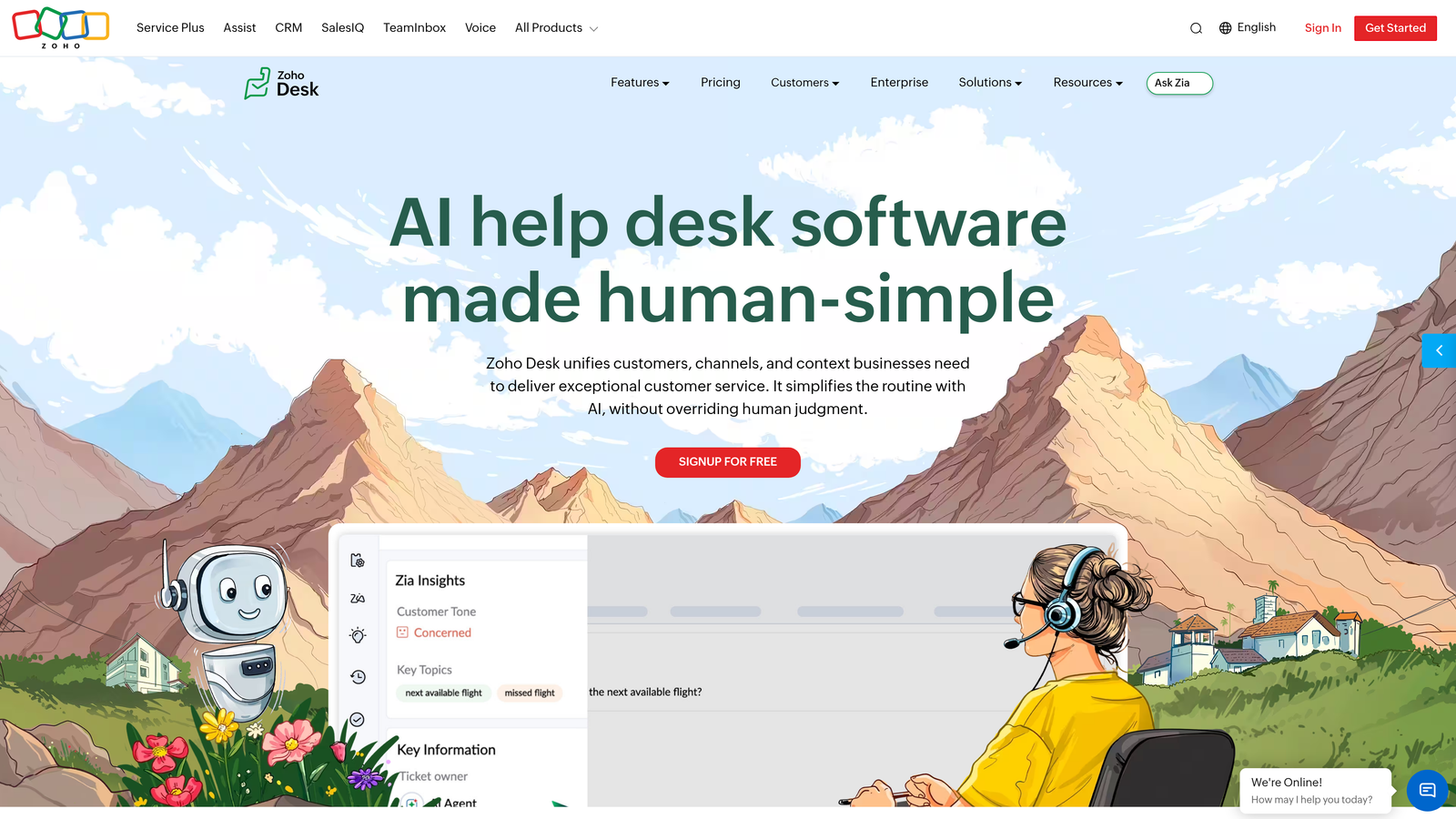
Zoho Desk is a CRM-connected helpdesk platform with Zia AI and Blueprint workflow automation, best suited for teams already in the Zoho ecosystem.
Where This Tool Shines
Blueprint is Zoho Desk's standout feature: a visual workflow builder for multi-step, conditional ticket processes. You can map out exactly how a ticket should progress through your support operation, with mandatory fields, approvals, and time-bound actions at each stage. For teams with structured support processes, this is more powerful than simple trigger-based automation.
Zia adds AI-driven sentiment analysis, ticket tagging, anomaly detection, and response suggestions. The deep Zoho CRM integration means agents see full customer context, including deal history and account status, without switching tools. The value proposition is strongest for existing Zoho customers.
Key Features
Zia AI: Sentiment analysis, ticket tagging, anomaly detection, and response suggestions.
Blueprint: Visual workflow builder for multi-step, conditional ticket processes with mandatory fields and approvals.
Zoho CRM integration: Unified customer context including deal history and account status directly in the ticket view.
Auto-assignment rules: Assign tickets based on agent skills, current load, or round-robin logic.
Multi-department and multi-brand support: Manage multiple support operations from a single platform.
Best For
Companies already using Zoho CRM or other Zoho products, and teams with complex, multi-step support workflows that benefit from Blueprint's visual process design.
Pricing
Standard plan from $14 per agent per month. Professional plan from $23 per agent per month. Strong value relative to feature depth, especially for Zoho ecosystem users.
7. ServiceNow CSM
Best for: Large enterprises that need ITSM-grade workflow orchestration extended to customer-facing support operations.
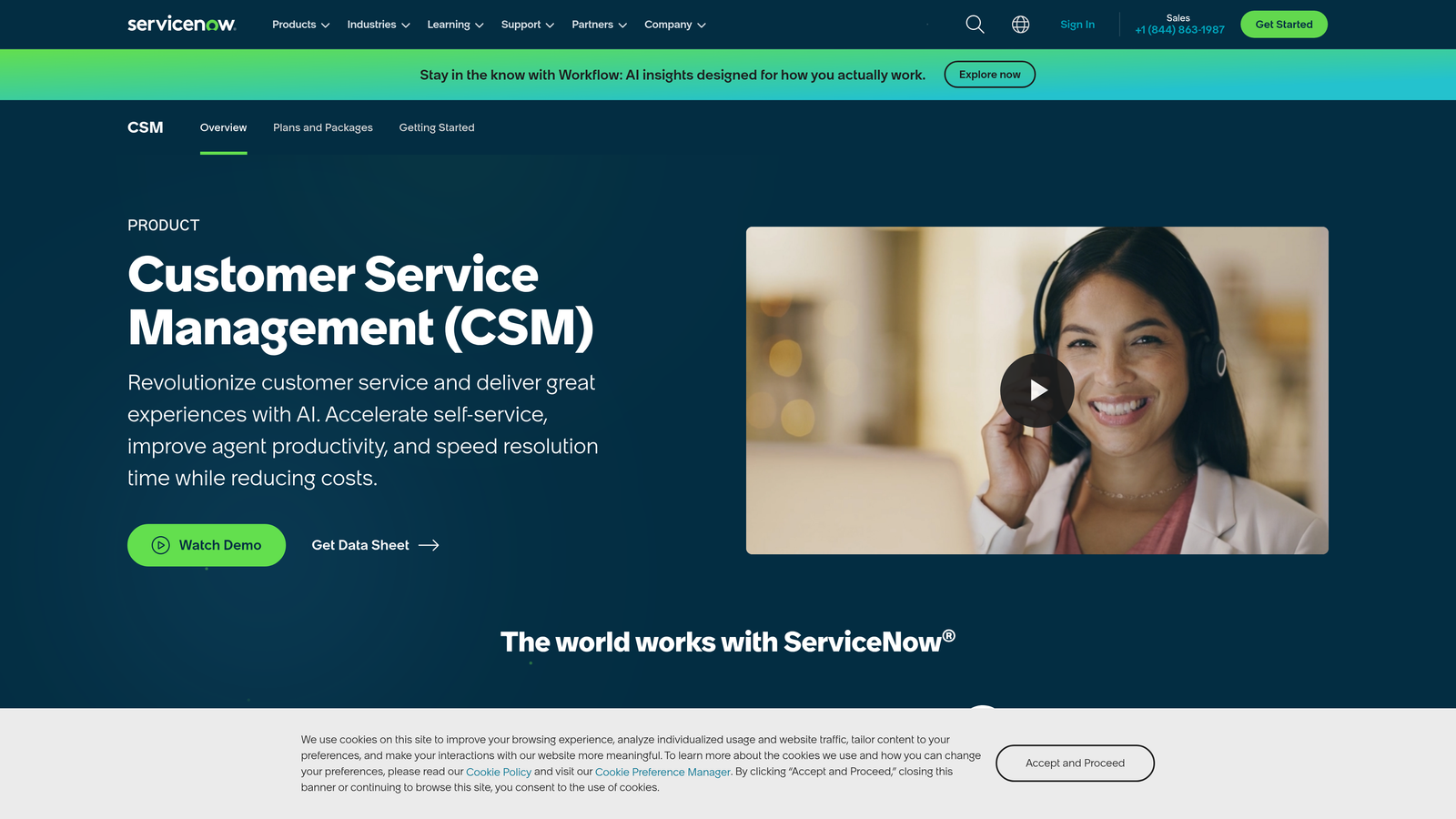
ServiceNow CSM is an enterprise-grade customer service management platform with ITSM-level workflow orchestration across departments, built for large organizations with complex support operations.
Where This Tool Shines
ServiceNow CSM is in a different category from most tools on this list. Where others focus on ticket resolution, ServiceNow orchestrates workflows across departments: customer service, IT, operations, and field service can all be connected under one platform. For organizations where customer issues frequently involve backend IT incidents or cross-functional resolution, this orchestration capability is genuinely powerful.
Now Assist AI handles case summarization, resolution notes, and agent guidance. Proactive case creation based on monitoring events means the system can open a case before a customer even reports an issue. This is enterprise-grade automation, with enterprise-grade implementation complexity to match.
Key Features
Cross-department workflow orchestration: End-to-end case management linking customer service, IT, operations, and field service.
Now Assist AI: Case summarization, resolution notes, and agent guidance powered by AI.
Proactive case creation: Automatically opens cases based on monitoring events and triggers before customers report issues.
ITSM integration: Links customer-facing issues directly to backend IT incidents for unified resolution tracking.
Advanced SLA management: Granular SLA policies with escalation workflows and reporting dashboards.
Best For
Large enterprises with complex, cross-departmental support operations, particularly those already using ServiceNow for IT service management. Requires dedicated admin and developer resources to implement and maintain effectively.
Pricing
Enterprise pricing only. Contact ServiceNow directly for a custom quote. Not suited for teams without dedicated implementation resources.
8. Tidio
Best for: Small businesses and e-commerce teams that need affordable, quick-to-deploy AI-powered first-response automation.
Tidio is an accessible chat and helpdesk platform with Lyro AI agent, designed for smaller teams needing fast setup and affordable AI-driven first-response handling.
Where This Tool Shines
Tidio's core strength is accessibility. Lyro AI handles common queries using your knowledge base content, and the setup process doesn't require technical expertise or a lengthy implementation project. For small teams that need AI-powered first-response automation without a dedicated ops person to configure it, Tidio removes most of the friction.
The unified inbox covers live chat, email, and Messenger, and chatbot flows handle lead capture and ticket deflection alongside Lyro. Shopify and WordPress integrations make it a natural fit for e-commerce and content businesses. It's not built for complex B2B support workflows, but it doesn't try to be.
Key Features
Lyro AI agent: Handles common queries autonomously using your knowledge base, with no technical setup required.
Quick deployment: Live in hours, not weeks, without developer resources.
Unified inbox: Live chat, email, and Messenger managed in one place.
Chatbot flows: Visual builder for lead capture and ticket deflection automations.
Shopify and WordPress integrations: Native connections for e-commerce and content platforms.
Best For
Small businesses, e-commerce brands, and early-stage teams that need affordable AI-powered first-response automation with minimal setup time. Less suited for complex B2B support environments with multi-step escalation requirements.
Pricing
Free plan available. Lyro AI from $29 per month, priced by conversation volume rather than per seat.
9. Gorgias
Best for: E-commerce brands on Shopify, BigCommerce, or Magento that want automated resolution of order-related tickets without agent involvement.
Gorgias is a helpdesk built exclusively for e-commerce brands, with deep platform integrations that enable automated resolution of order-related queries at scale.
Where This Tool Shines
Gorgias solves a specific problem exceptionally well: the flood of order status, tracking, and refund requests that hit e-commerce support teams at volume. By pulling order data directly from Shopify, BigCommerce, and Magento into the ticket context, Gorgias can automatically respond to and close these tickets without a human agent touching them.
The rules engine handles tagging, routing, and closing tickets based on order conditions, and the AI Agent layer extends autonomous handling to a broader range of common e-commerce scenarios. Revenue statistics show how support interactions connect to sales outcomes, which is a useful framing for teams making the case for support investment internally.
Key Features
Deep e-commerce integrations: Order data pulled directly into ticket context from Shopify, BigCommerce, and Magento.
Automated order query resolution: Auto-responds to order status, tracking, and refund requests without agent involvement.
Rules engine: Tagging, routing, and ticket closing based on order conditions and customer data.
AI Agent: Autonomous handling of common e-commerce support scenarios beyond order queries.
Revenue statistics: Reporting that connects support activity to sales impact.
Best For
E-commerce brands with high volumes of order-related support queries. Gorgias is purpose-built for this use case and not a fit for non-e-commerce businesses or complex B2B support workflows.
Pricing
Starter from $10 per month for 50 tickets. Pricing scales by ticket volume rather than per seat, which works well for high-volume e-commerce operations.
Which Tool Is Right for Your Team?
The most important distinction to carry out of this list is the difference between tools that route tickets and tools that resolve them. Most traditional helpdesks with automation layers do the former well. Fewer do the latter without significant human involvement.
For startups and early-stage SaaS teams: Freshdesk's free plan or Help Scout's Standard tier offer a solid starting point with enough automation to reduce manual work. Tidio works well if chat is your primary support channel.
For mid-market SaaS teams: Halo AI is worth serious evaluation if you want AI-first resolution rather than a helpdesk with AI bolted on. Intercom Fin is a strong option if you're already embedded in the Intercom ecosystem. Freshdesk and Zoho Desk offer competitive feature depth at reasonable price points.
For enterprise teams: Zendesk's maturity, integration ecosystem, and configurability make it a defensible choice for complex operations. ServiceNow CSM is the right call when customer support needs to orchestrate across IT, operations, and field service under one platform.
For e-commerce brands: Gorgias is the clear specialist. No other tool on this list matches its depth of order data integration and automated resolution for e-commerce-specific queries.
Your support team shouldn't scale linearly with your customer base. Let AI agents handle routine tickets, guide users through your product, and surface business intelligence while your team focuses on complex issues that need a human touch. See Halo in action and discover how continuous learning transforms every interaction into smarter, faster support.
For a deeper look at building autonomous support operations, explore our guides on AI support agents and understanding chatbot ROI before making your final decision.