9 Best High Ticket Volume Solutions for B2B Support Teams in 2026
B2B support teams drowning in daily ticket queues will find this guide to the 9 best high ticket volume solutions for 2026 essential reading. The roundup evaluates AI-native platforms, enterprise helpdesks, and specialized support tools based on automation depth, integration capabilities, and real-world scalability—helping teams resolve tickets faster and more intelligently whether they're handling 500 or 50,000 requests per day.
 Matt PattoliFounder13 min read
When your support queue spirals into hundreds or thousands of tickets daily, the problem isn't your team's effort. It's the architecture beneath them. High ticket volume isn't just an operational headache; it's a signal that your current support stack can't scale with your product.
The right solution doesn't just process tickets faster. It resolves them autonomously, surfaces patterns, and hands off intelligently when humans are needed. This list covers the best tools built to handle serious ticket volume in 2026, evaluated on automation depth, integration breadth, AI capability, and real-world scalability.
Whether you're managing 500 tickets a day or 50,000, there's a solution here calibrated to your scale. We've included tools ranging from AI-native platforms to enterprise helpdesks to specialized support layers, so you can find the right fit regardless of where you are in your support maturity journey.
1. Halo AI
Best for: B2B SaaS teams that need autonomous ticket resolution with deep product and business context.
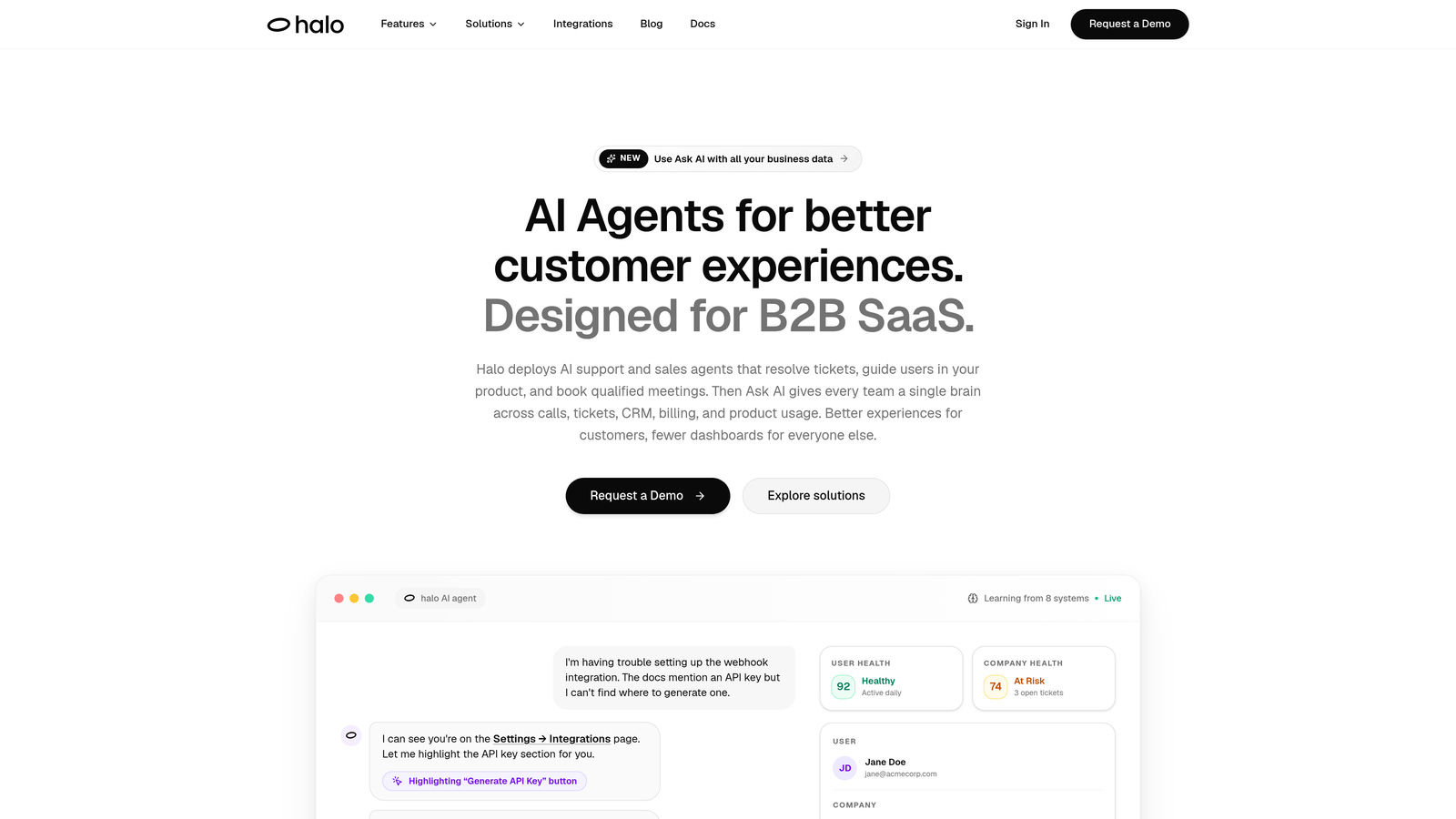
Halo AI is an AI-native customer support platform that autonomously resolves tickets, guides users through products with page-aware context, and delivers business intelligence from every support interaction.
Where This Tool Shines
Most support tools add AI as a layer on top of an existing helpdesk model. Halo is built AI-first from the ground up. The platform's page-aware chat widget is a genuine differentiator: the AI sees exactly what the user sees on screen, allowing it to provide visual UI guidance rather than generic instructions. That context closes the gap between "I sent a help article" and "I actually solved the problem."
The continuous learning architecture means the system gets meaningfully smarter with every resolved ticket. Over time, Halo builds a working model of your product's friction points and your customers' patterns, which feeds directly into its Smart Inbox. Beyond support metrics, the Smart Inbox surfaces customer health signals, revenue intelligence, and anomaly detection, turning your support queue into a source of business insight rather than just a cost center.
Key Features
Autonomous Ticket Resolution: AI agents resolve support tickets end-to-end, learning continuously from every interaction to improve accuracy over time.
Page-Aware Chat Widget: The AI understands the user's current screen context and delivers visual UI guidance, not just text-based answers.
Smart Inbox with Business Intelligence: Surfaces customer health signals, anomaly detection, and revenue insights directly within the support workflow.
Auto Bug Ticket Creation: Automatically identifies and routes bug reports to engineering tools like Linear, removing a manual handoff step entirely.
Live Agent Handoff: Escalates complex issues to human agents with full context preserved, so the customer never has to repeat themselves.
Full Stack Integrations: Connects across HubSpot, Slack, Intercom, Stripe, Zoom, PandaDoc, and Fathom for end-to-end workflow coverage.
Best For
Product-led SaaS companies and B2B support teams that want AI to do more than triage. Halo is particularly well-suited for teams managing complex products where context matters, where bug reporting is a frequent ticket type, and where leadership wants support data to inform product and revenue decisions.
Pricing
Contact for pricing at haloagents.ai. Given the platform's AI-native architecture and business intelligence capabilities, pricing is tailored to team size and usage volume.
2. Zendesk
Best for: Large support organizations with established processes that need enterprise-grade SLA management and omnichannel coverage.
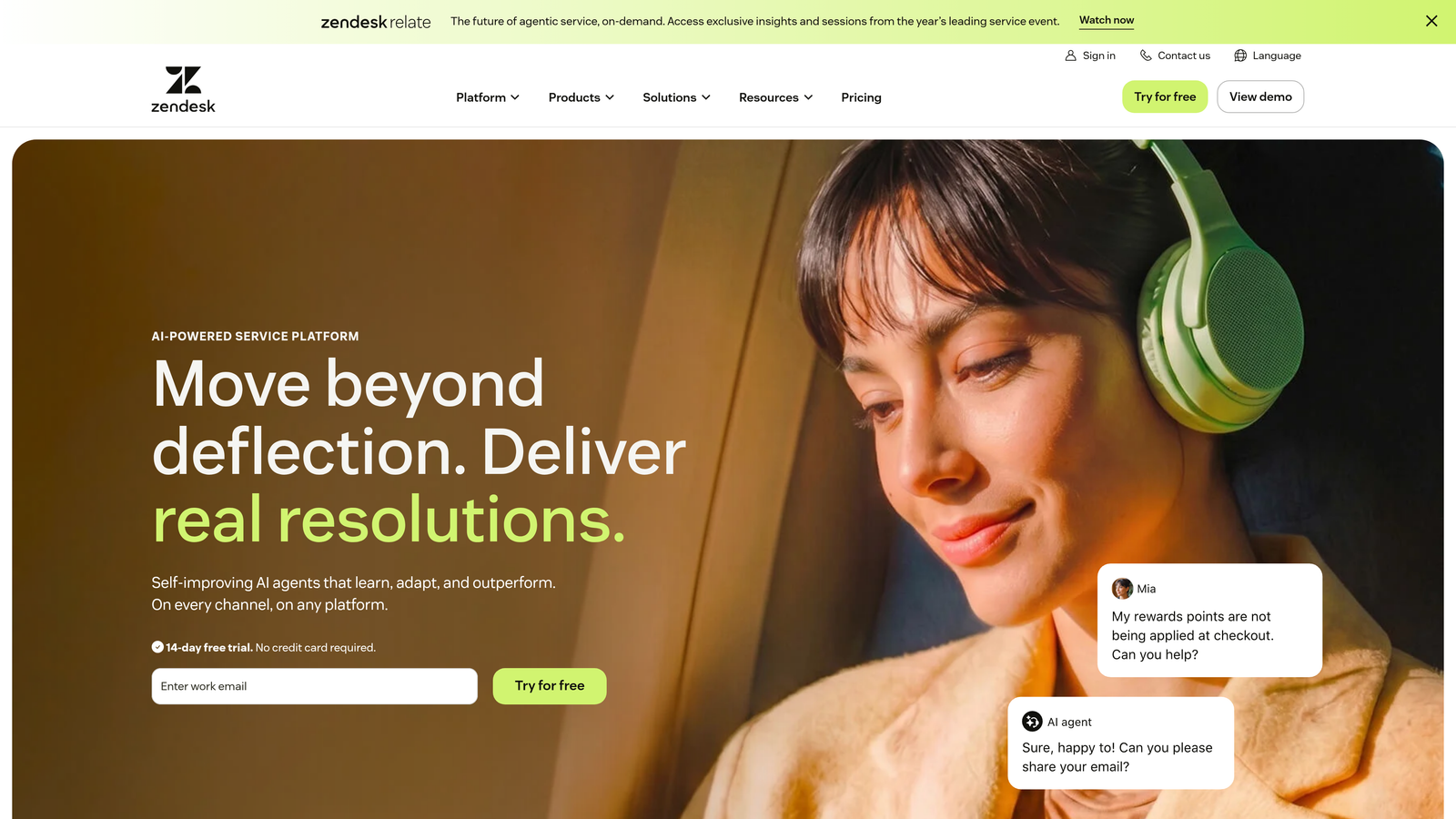
Zendesk is one of the most widely deployed enterprise helpdesk platforms globally, combining AI-powered triage with robust workflow automation and a massive integration marketplace.
Where This Tool Shines
Zendesk's strength is its maturity. For teams that need predictable SLA management, complex escalation workflows, and a proven omnichannel infrastructure, it delivers. Zendesk AI, which evolved from the platform's earlier Intelligent Triage capabilities, handles intent detection and ticket classification at scale, routing tickets before a human ever touches them.
The app marketplace is genuinely extensive, with over a thousand integrations available. For enterprise teams that have already standardized on specific CRM, billing, or communication tools, Zendesk likely connects to all of them. The tradeoff is that AI features feel more like additions to a traditional helpdesk than a native architecture, which can limit how deeply autonomous the system becomes.
Key Features
Zendesk AI: Handles intelligent triage, intent detection, and automated routing before tickets reach agents.
SLA Management: Robust SLA tracking with configurable escalation workflows and breach alerts.
Omnichannel Support: Unified coverage across email, chat, voice, and social channels.
App Marketplace: 1,000+ integrations with CRM, billing, analytics, and communication tools.
Advanced Reporting: Detailed CSAT analytics and team performance dashboards.
Best For
Enterprise support teams with high volumes and complex SLA requirements. Zendesk is a strong fit for organizations that already have established support processes and need a reliable, scalable platform to run them at scale rather than a greenfield AI implementation.
Pricing
Suite plans start at $55 per agent per month billed annually. AI add-ons are available separately. Enterprise pricing requires a custom quote.
3. Intercom
Best for: SaaS companies with chat-heavy support that want to combine proactive user engagement with autonomous ticket resolution.
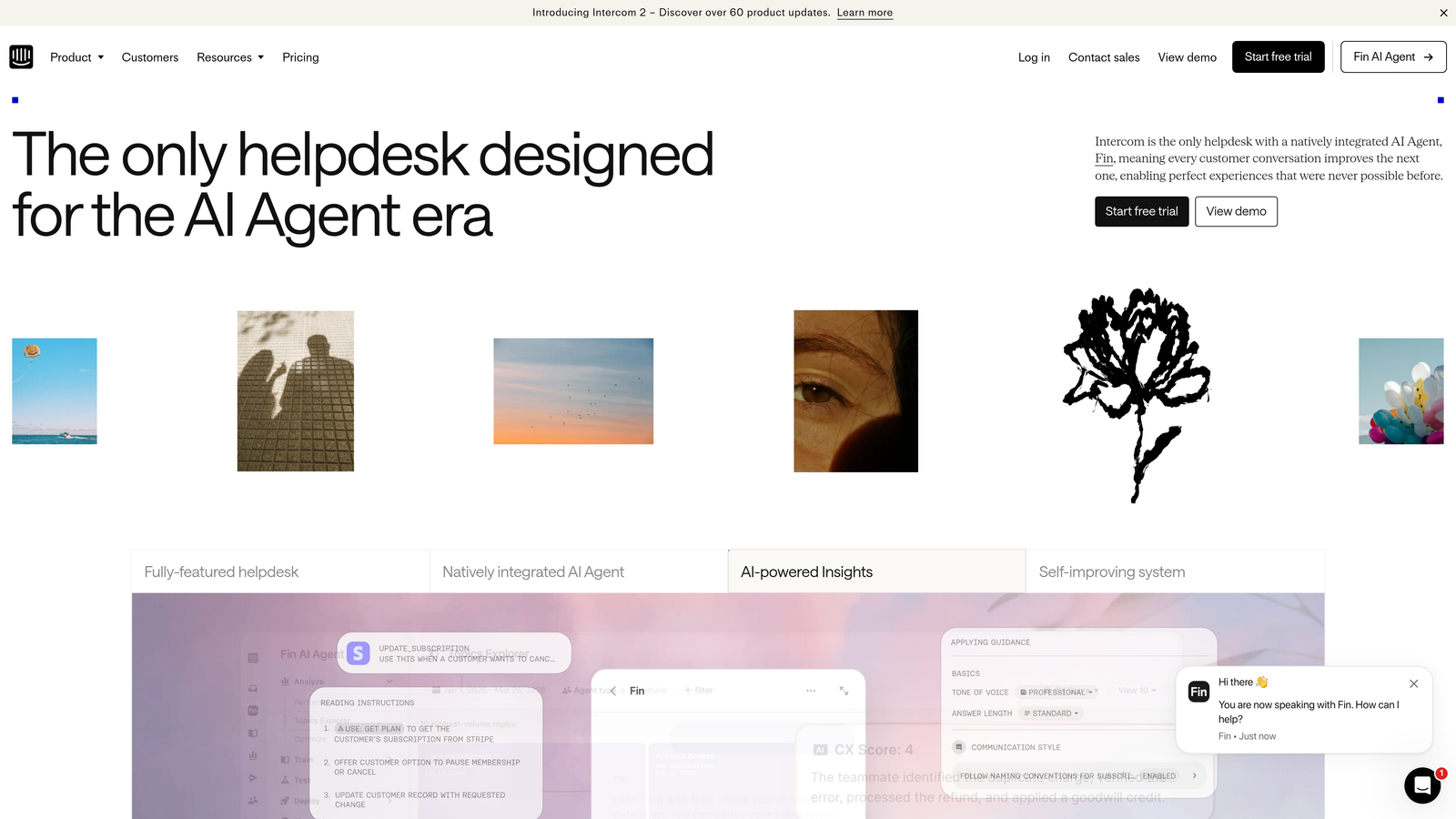
Intercom is a unified customer messaging platform that merges proactive engagement tools with reactive support, anchored by its Fin AI Agent for conversational resolution.
Where This Tool Shines
Intercom's model is built around the idea that the best support interaction is one you prevent. Proactive messaging, product tours, and in-app guidance reduce inbound ticket volume before it accumulates. When tickets do arrive, Fin AI Agent handles resolution using your company's knowledge base, drawing on documented answers to resolve queries conversationally without routing to a human.
The unified inbox is genuinely clean to work in, consolidating chat, email, and in-app messages into a single workspace. For SaaS teams with onboarding-heavy workflows, the combination of proactive messaging and reactive AI resolution is a compelling pairing. Pricing scales with usage and seat count, so it's worth modeling costs carefully as volume grows.
Key Features
Fin AI Agent: Resolves queries autonomously using company knowledge bases with conversational accuracy.
Unified Inbox: Consolidates chat, email, and in-app messages into a single agent workspace.
Proactive Messaging: In-app messages and product tours reduce inbound volume by addressing issues before they become tickets.
Conversation Routing: Configurable assignment rules direct tickets to the right team or agent automatically.
Resolution Reporting: Tracks resolution rates, CSAT, and Fin AI performance over time.
Best For
SaaS companies where chat is the primary support channel and where onboarding and proactive engagement are part of the support strategy. Less optimal for teams with heavy email-based workflows or complex B2B ticket types that require deep product context.
Pricing
Essential plan starts at $29 per seat per month. Fin AI usage is billed per resolution, so costs scale with automation volume.
4. Freshdesk
Best for: Mid-market teams that need a solid omnichannel helpdesk with AI assist features and competitive pricing.
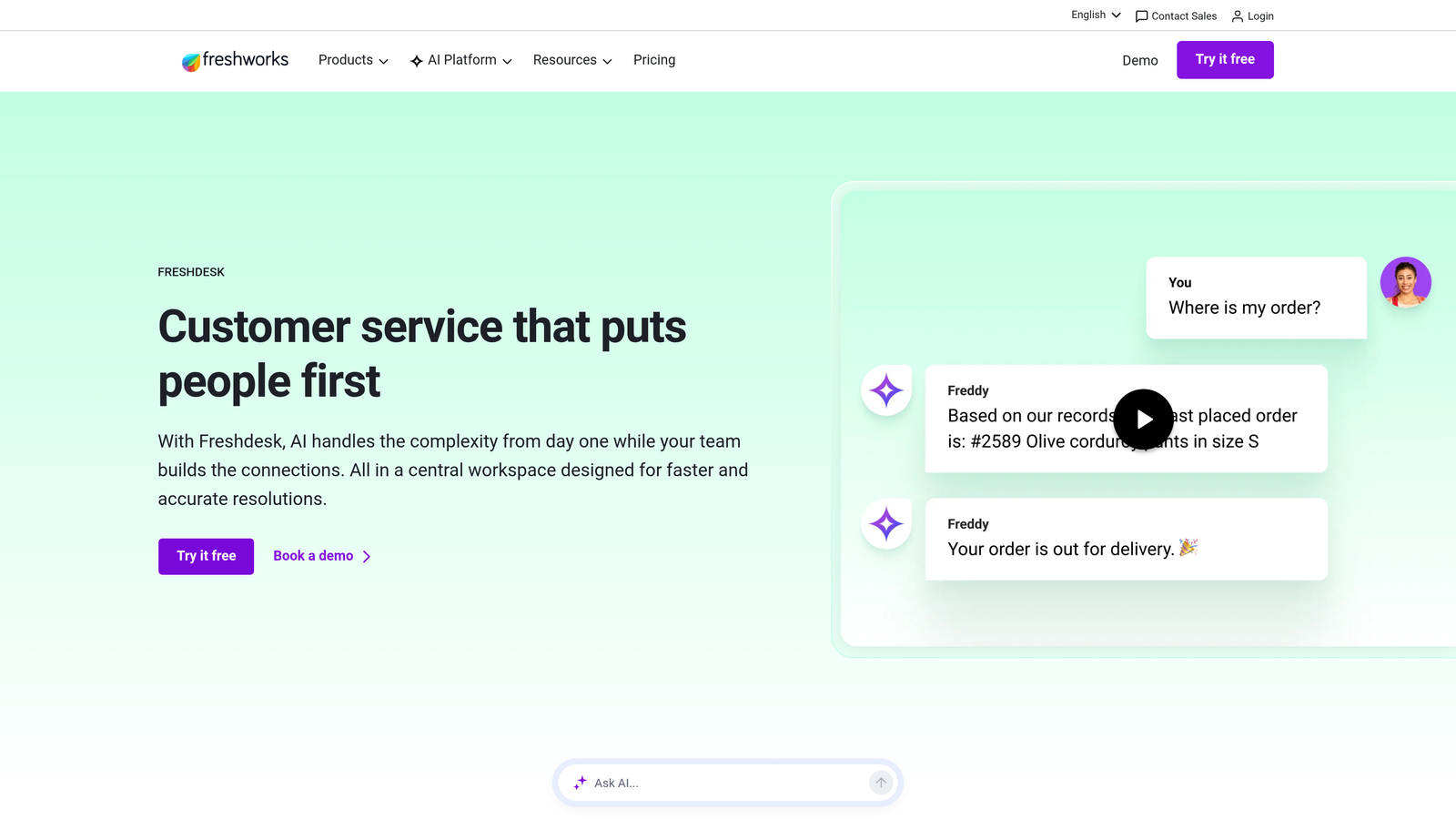
Freshdesk is Freshworks' helpdesk product, offering Freddy AI for auto-triage, agent assist, and workload balancing across email, chat, phone, and social channels.
Where This Tool Shines
Freshdesk hits a practical sweet spot for growing support teams. Freddy AI handles ticket classification and suggests responses to agents, reducing the cognitive load on support staff without requiring a full AI-native architecture overhaul. The omnichannel workspace is intuitive, and the automation rules for routing and SLA management are easy to configure without deep technical expertise.
Collision detection, which prevents two agents from responding to the same ticket simultaneously, is a small feature that makes a real operational difference at volume. The free plan makes Freshdesk accessible for teams just starting to build out their support infrastructure, while the Growth plan's pricing is competitive for the feature set delivered.
Key Features
Freddy AI: Classifies tickets automatically and suggests responses to speed up agent resolution time.
Omnichannel Workspace: Unified agent interface across email, chat, phone, and social channels.
Automation Rules: Configurable routing and SLA management without requiring technical setup.
Collision Detection: Prevents duplicate agent responses on the same ticket.
Marketplace Integrations: Connects with CRM and billing tools through a broad integration library.
Best For
Mid-market support teams that want meaningful AI assistance without the complexity or cost of enterprise platforms. A good fit for teams transitioning from basic email-based support to a more structured, omnichannel workflow.
Pricing
Free plan available. Growth plan starts at $15 per agent per month billed annually. Higher tiers unlock additional AI and analytics features.
5. Salesforce Service Cloud
Best for: Enterprise teams already in the Salesforce ecosystem that need support tightly integrated with sales, account, and contract data.
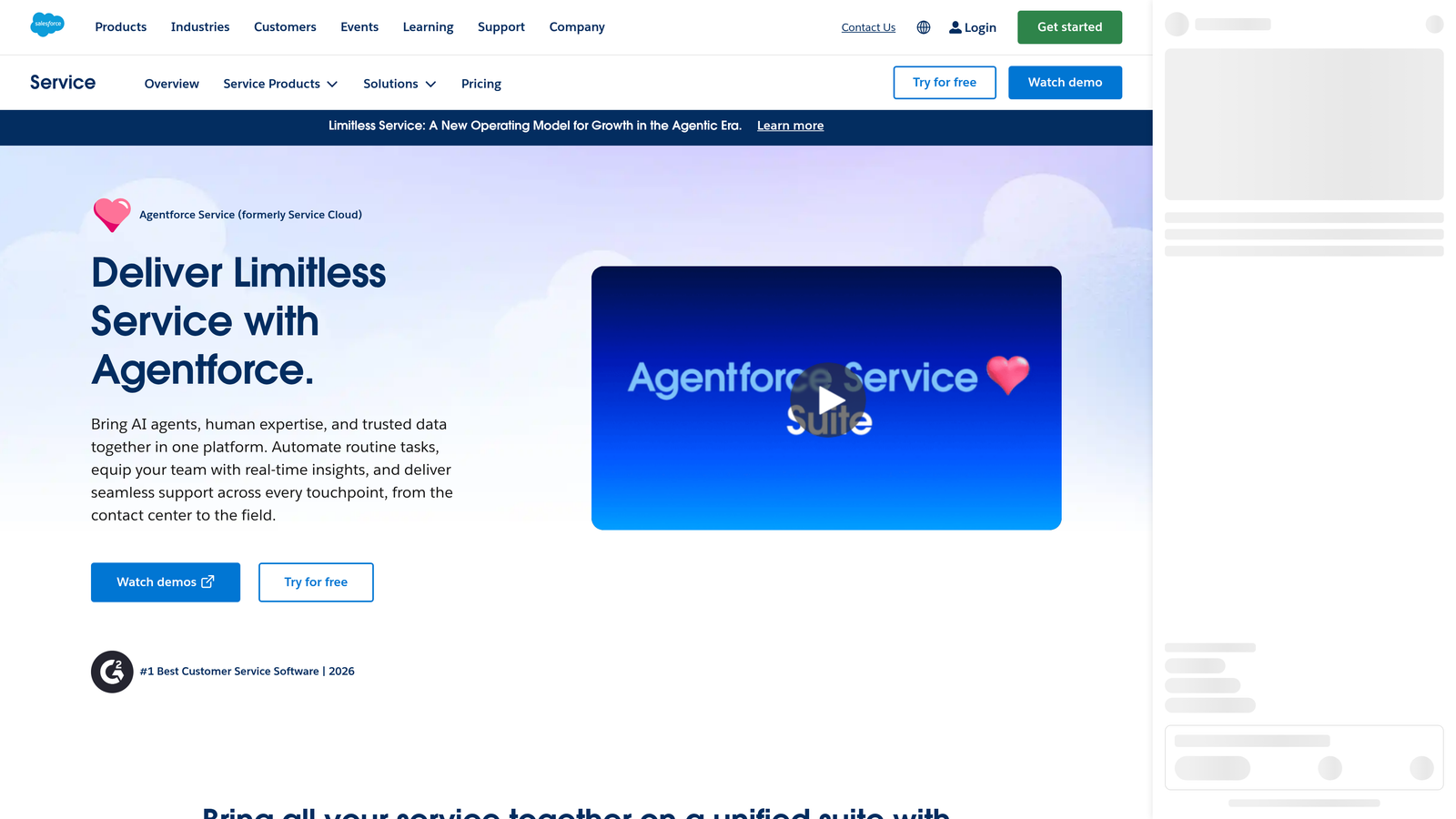
Salesforce Service Cloud is an enterprise support platform deeply integrated with Salesforce CRM, using Einstein AI for case classification, routing, and next-best-action recommendations.
Where This Tool Shines
When a support interaction needs full account context, including open deals, contract status, and customer health, Service Cloud delivers that in a way standalone helpdesks can't match. Einstein AI handles case classification and routing, but the real value is that every support interaction sits inside the same data model as sales and marketing activity. That context enables next-best-action recommendations that go beyond "here's a knowledge article."
Implementation complexity is real and shouldn't be underestimated. Service Cloud is best for organizations that already operate within the Salesforce ecosystem and have the technical resources to configure it properly. For teams starting fresh, the setup investment is significant before meaningful value is realized.
Key Features
Einstein AI: Case classification, intelligent routing, and next-best-action recommendations powered by CRM context.
Full CRM Integration: Every support interaction includes account, contract, and deal data from Salesforce.
Omnichannel Routing: Covers voice, chat, email, and social with configurable routing logic.
AI-Suggested Knowledge Articles: Surfaces relevant documentation during case resolution.
Custom Dashboards: Advanced analytics with flexible reporting across support and account data.
Best For
Enterprise organizations that are already invested in the Salesforce platform and need support to connect directly to their sales and account management workflows. Not the right fit for teams outside the Salesforce ecosystem given the implementation overhead.
Pricing
Starter Suite from $25 per user per month. Enterprise plans require a custom quote. Implementation costs should be factored separately.
6. Tidio
Best for: Smaller teams that need fast AI chatbot deployment with meaningful deflection rates and accessible pricing.
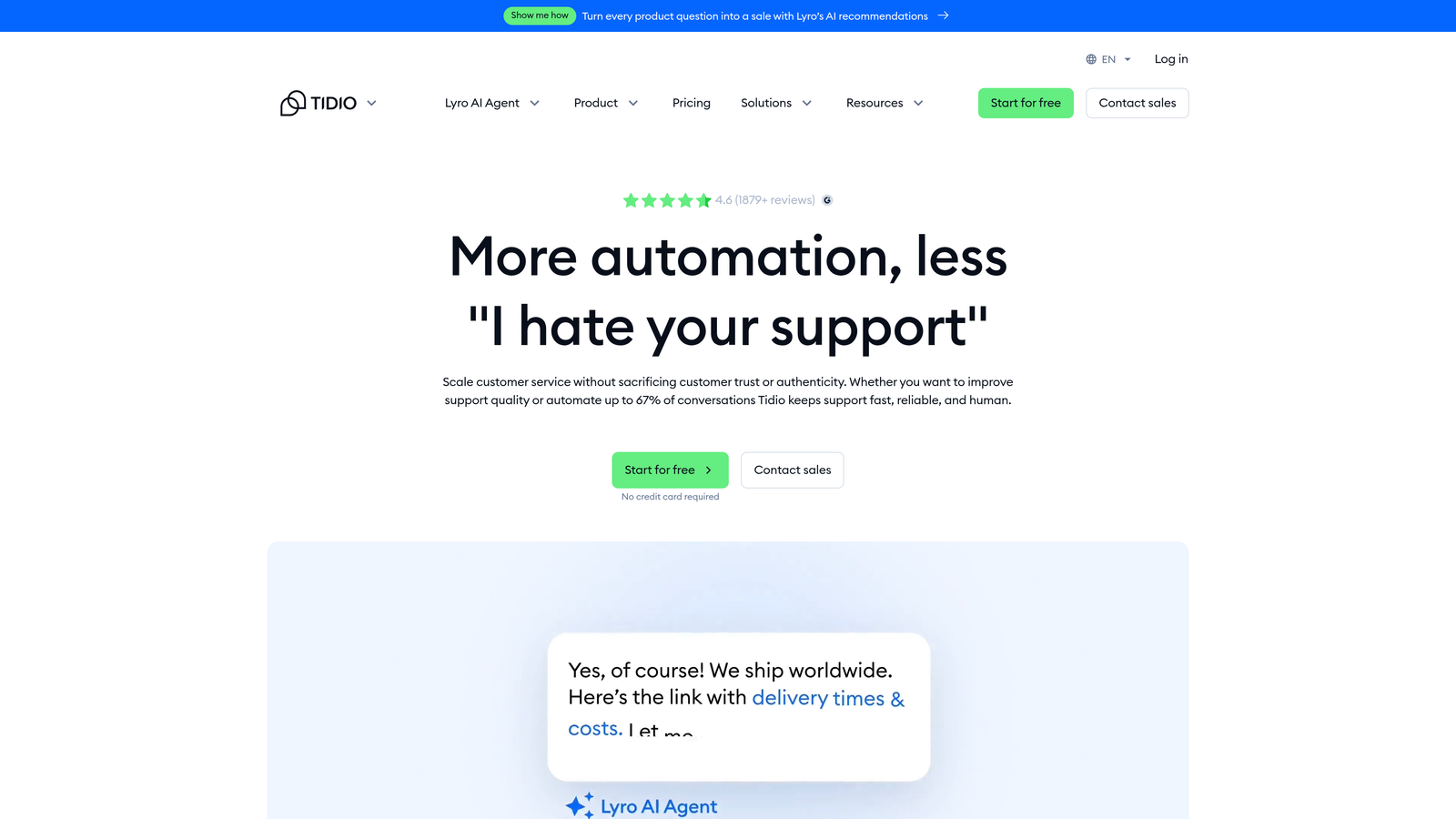
Tidio is an AI chatbot and live chat platform with Lyro AI for autonomous query resolution, designed for fast deployment without a lengthy configuration cycle.
Where This Tool Shines
Tidio's primary advantage is speed to value. Lyro AI can be deployed without engineering resources, making it accessible for smaller teams that need deflection quickly without a long implementation runway. For repetitive, high-frequency queries, Lyro handles resolution autonomously and hands off to a live agent when the query exceeds its capability.
The platform's e-commerce integrations with Shopify and WooCommerce make it well-suited for DTC brands. For pure B2B SaaS support with complex ticket types, Tidio's depth may feel limited compared to purpose-built enterprise tools, but for teams in earlier stages of support maturity, it punches above its price point.
Key Features
Lyro AI: Handles repetitive queries autonomously with conversational accuracy and live agent handoff.
No-Code Setup: Deployable without engineering resources, reducing time to first resolution.
Live Chat: Seamless escalation from AI to human agent within the same conversation thread.
E-Commerce Integrations: Native connections to Shopify and WooCommerce for order-related support.
Deflection Analytics: Tracks bot performance and deflection rates to quantify automation impact.
Best For
Smaller support teams and e-commerce brands that need fast AI deployment and meaningful ticket deflection without enterprise-level investment. Less suited to complex B2B support scenarios that require deep product or account context.
Pricing
Free plan available. Lyro AI plans start at $29 per month, scaling with usage volume.
7. Help Scout
Best for: Teams where relationship quality and human judgment are central to the support experience, with AI accelerating agents rather than replacing them.
Help Scout is a human-first support platform with AI assist features that make agents faster without removing them from the resolution loop.
Where This Tool Shines
Help Scout takes a deliberate philosophical position: AI should augment agents, not replace them. AI Summarize condenses long conversation threads so agents can get up to speed instantly without reading through an entire history. AI Assist drafts replies and adjusts tone, reducing the time it takes to compose a thoughtful response. The result is faster resolution without sacrificing the human element.
The shared inbox model is clean and intuitive, and collision detection prevents the embarrassing scenario of two agents responding to the same customer simultaneously. For teams where customer relationships and communication quality are as important as resolution speed, Help Scout's approach is refreshingly grounded.
Key Features
AI Summarize: Condenses long conversation threads so agents can get up to speed without reading the full history.
AI Assist: Drafts replies and refines tone to speed up agent composition time.
Shared Inbox: Collaborative agent workspace with collision detection to prevent duplicate responses.
Docs Knowledge Base: Built-in documentation hub with AI-powered search for self-service deflection.
Performance Reporting: CSAT tracking and team performance analytics.
Best For
Support teams in relationship-driven businesses where communication quality matters as much as resolution speed. A strong fit for companies that want to scale support capacity without fully automating the customer interaction.
Pricing
Standard plan starts at $22 per user per month billed annually. Higher tiers add advanced reporting and integrations.
8. Kustomer
Best for: High-volume omnichannel support teams that need full customer context consolidated across every channel in a single view.
Kustomer is a CRM-native omnichannel support platform with a timeline-based customer view that merges all interactions for faster, context-rich resolution.
Where This Tool Shines
Kustomer's timeline view is the platform's defining feature. Rather than treating each ticket as an isolated event, Kustomer consolidates every customer interaction across email, chat, voice, social, and SMS into a single chronological thread. Agents arrive at every conversation with full context, which dramatically reduces the "can you explain the issue again?" dynamic that frustrates customers and slows resolution.
AI-powered intent detection and auto-routing handle initial triage, directing tickets to the right team or workflow before human involvement. The deep CRM data accessible within each conversation makes Kustomer particularly effective for teams handling complex, multi-touchpoint customer relationships at high volume.
Key Features
Timeline View: Consolidates all customer interactions across every channel into a single chronological thread.
AI Intent Detection: Identifies ticket intent and routes automatically before agent involvement.
Omnichannel Coverage: Email, chat, voice, social, and SMS managed in a unified workspace.
Workflow Automation: Configurable automation for repetitive ticket types and routing logic.
CRM Data Access: Full customer data accessible within every conversation without switching tools.
Best For
High-volume support teams managing complex, multi-channel customer relationships where historical context is critical to resolution quality. Particularly effective for teams that have struggled with fragmented customer data across disconnected support tools.
Pricing
Enterprise plans from $89 per user per month. Contact Kustomer directly for exact pricing based on team size and volume.
9. Gorgias
Best for: E-commerce brands with high ticket volumes driven by order inquiries, returns, and post-purchase support.
Gorgias is an e-commerce-focused helpdesk with deep Shopify and BigCommerce integrations, allowing agents to take order actions directly within the ticket interface.
Where This Tool Shines
Gorgias solves a specific and common e-commerce problem: agents spending most of their time switching between a helpdesk and an order management system to handle returns, refunds, and cancellations. By integrating directly with Shopify, BigCommerce, and Magento, Gorgias allows agents to issue refunds, edit orders, and cancel subscriptions without leaving the ticket view. That single workflow change can meaningfully reduce average handle time for order-heavy support queues.
The AI auto-responder handles common order-related queries autonomously, and macros and rules manage high-volume repetitive ticket types efficiently. For pure B2B SaaS support, Gorgias is less relevant, but for DTC and e-commerce brands dealing with serious order inquiry volume, it's purpose-built for exactly that problem.
Key Features
E-Commerce Integrations: Direct Shopify, BigCommerce, and Magento integration for in-ticket order actions including refunds and cancellations.
AI Auto-Responder: Handles common order-related queries autonomously without agent involvement.
Omnichannel Inbox: Consolidates email, chat, social, and SMS in a unified workspace.
Revenue Statistics: Ties support interactions to revenue impact for business-level visibility.
Macros and Rules: Streamlines high-volume repetitive ticket handling with templated responses and routing logic.
Best For
DTC brands and e-commerce companies with high order inquiry volume. Gorgias is not a natural fit for B2B SaaS support teams, but for its intended use case, it's one of the most focused and effective tools available.
Pricing
Starter plan from $10 per month covering up to 50 tickets. Pricing scales by ticket volume rather than seat count, which makes cost modeling straightforward as volume grows.
Which Tool Is Right for Your Team?
The honest answer is that the right choice depends on where your support complexity actually lives. Not every team needs the same solution, and the wrong fit at scale gets expensive fast.
If you're a B2B SaaS company that wants AI to do the heavy lifting autonomously while also surfacing business intelligence from every interaction, Halo AI is built specifically for that problem. The page-aware context, continuous learning, and smart inbox put it in a different category from tools that treat AI as an add-on.
For enterprise teams in the Salesforce ecosystem: Service Cloud delivers unmatched CRM integration but comes with meaningful implementation overhead.
For large organizations with established processes: Zendesk provides proven SLA management and omnichannel coverage at scale.
For SaaS teams with chat-heavy support: Intercom's combination of proactive messaging and Fin AI Agent is a strong pairing.
For mid-market teams on a budget: Freshdesk offers solid AI assist features and omnichannel coverage at competitive pricing.
For e-commerce brands: Gorgias is purpose-built for order inquiry volume and nothing else comes close on Shopify integration depth.
Your support team shouldn't scale linearly with your customer base. Let AI agents handle routine tickets, guide users through your product, and surface business intelligence while your team focuses on complex issues that need a human touch. See Halo in action and discover how continuous learning transforms every interaction into smarter, faster support.