9 Best AI Support Software Tools to Consider in 2026
Choosing the right AI support software is one of the most consequential decisions a B2B team can make — the right platform deflects tickets and scales capacity, while the wrong one becomes a costly burden. This guide evaluates nine AI support platforms across automation depth, integration breadth, learning capability, escalation handling, and total cost of ownership to give teams a clear, honest starting point.
 Matt PattoliFounder14 min read
Choosing AI support software has become one of the most consequential decisions a B2B team can make. The right platform can deflect a meaningful portion of incoming tickets, surface revenue signals hidden in support conversations, and scale your support capacity without adding headcount. The wrong one becomes an expensive chatbot that frustrates customers and burdens your team with maintenance.
This guide cuts through the noise. We evaluated nine AI support platforms across criteria that actually matter for B2B teams: depth of automation, integration breadth, learning capability, escalation handling, and total cost of ownership. Whether you're migrating off a legacy helpdesk, building support infrastructure from scratch, or trying to understand what separates genuine AI-first platforms from bolt-on features, this list gives you a clear, honest starting point.
We've included Halo AI at the top because it's built specifically for this use case. But every tool here has genuine strengths worth understanding before you decide.
1. Halo AI
Best for: B2B SaaS teams wanting AI-first support with product-aware context and business intelligence
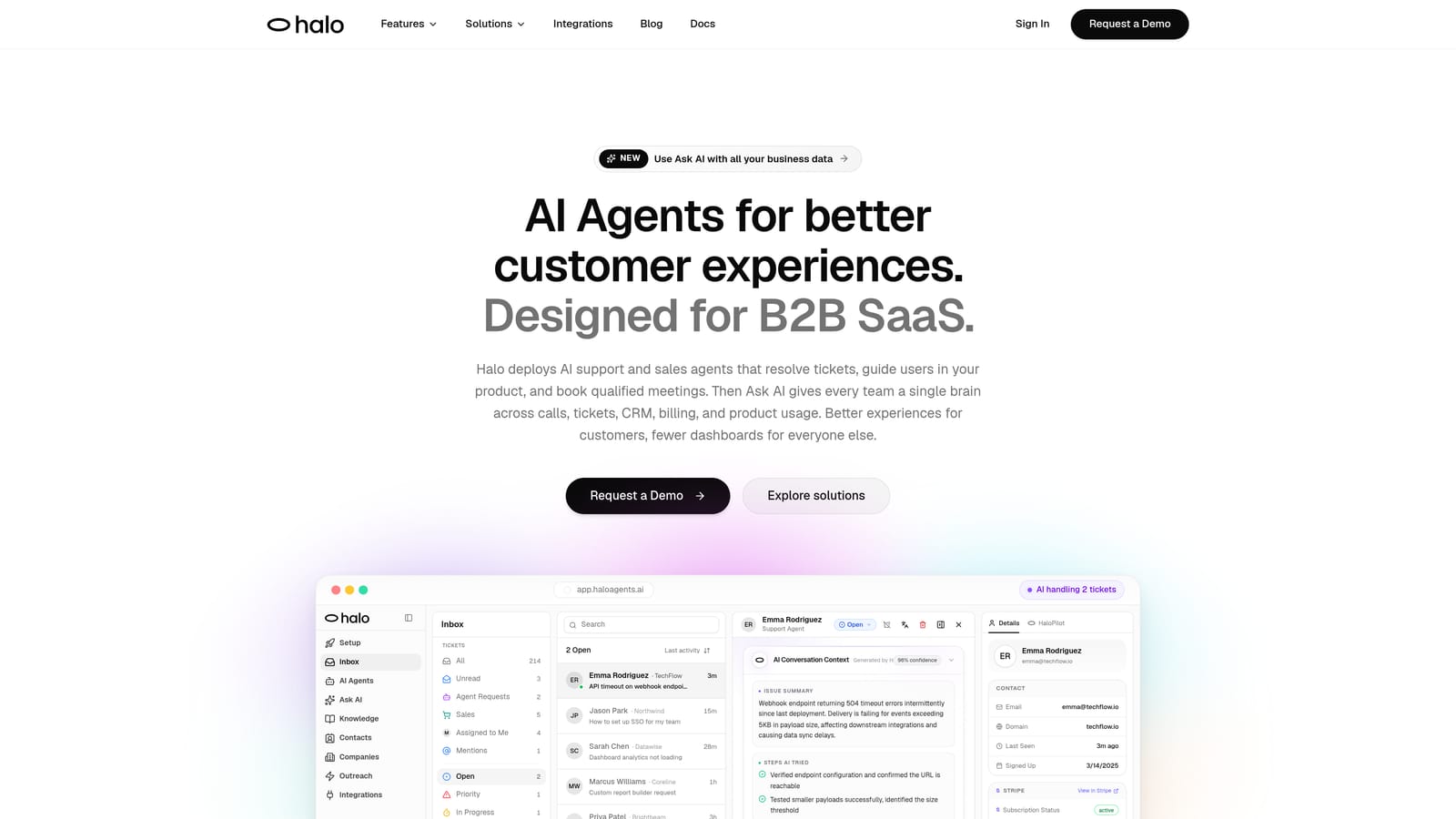
Halo AI is an AI-first customer support platform that resolves tickets autonomously, guides users through your product, and surfaces business intelligence signals from every support interaction.
Where This Tool Shines
Most AI support tools are built on top of existing helpdesk infrastructure, which means the AI is constrained by the data model and UX of whatever platform sits underneath it. Halo was designed the other way around: automation is the core architecture, not a feature added later. That distinction shows up in the details.
The most distinctive capability is page-aware context. Halo's AI agents can see what a user is looking at inside your product and provide visual UI guidance specific to that moment. This is a meaningful departure from generic chatbots that respond to keywords without understanding where the user actually is in their journey. Combine that with continuous learning from every resolved interaction, and the system gets demonstrably smarter over time without requiring manual retraining.
Key Features
Page-Aware AI Agents: Agents understand the user's current location in your product and deliver contextually relevant guidance and visual UI walkthroughs.
Autonomous Ticket Resolution with Human Escalation: Handles tickets end-to-end and escalates gracefully to live agents when complexity warrants it, with full conversation context preserved.
Auto Bug Ticket Creation: Automatically identifies and routes bug reports to Linear or your engineering tool of choice, closing the loop between support and product teams without manual triage.
Smart Inbox with Business Intelligence: Surfaces customer health signals, revenue anomalies, and churn indicators derived from support conversations — intelligence that typically lives buried in ticket data.
Broad Integration Stack: Connects to Linear, Slack, HubSpot, Intercom, Stripe, Zoom, PandaDoc, and Fathom, giving the AI access to cross-functional context rather than just support history.
Best For
Product-led B2B SaaS teams that want support AI to do more than deflect tickets. Particularly valuable for companies where support conversations contain revenue signals and where the product team needs a direct feedback loop from customer issues.
Pricing
Contact for pricing. A demo is available at haloagents.ai. Custom pricing based on team size and usage volume.
2. Intercom
Best for: Teams already using Intercom's CRM and messenger ecosystem who want integrated AI
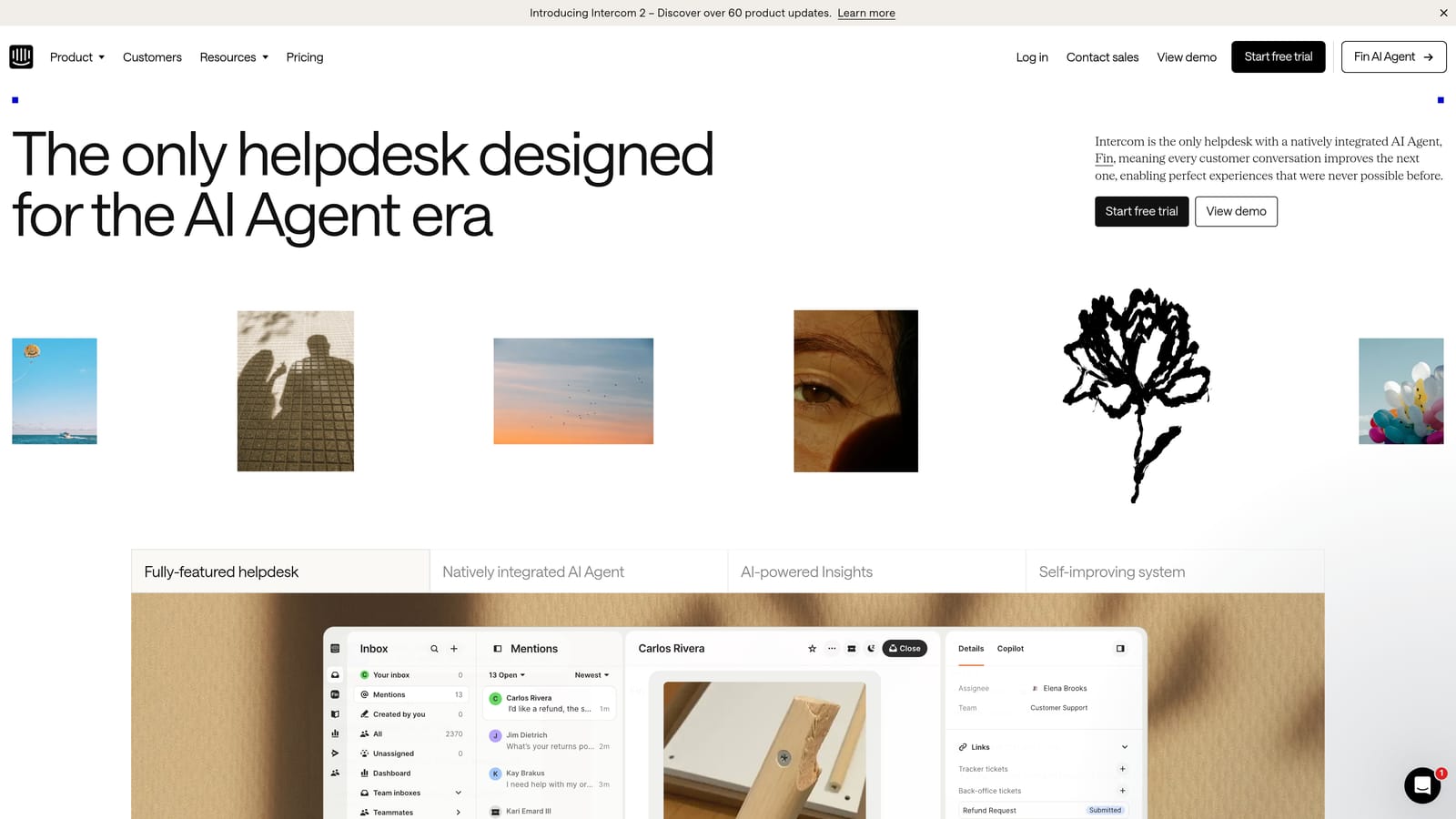
Intercom is a mature customer messaging platform featuring Fin, its AI agent built on large language models capable of handling a broad range of support queries.
Where This Tool Shines
Intercom's biggest advantage is ecosystem depth. If your team already lives inside Intercom for CRM, segmentation, and customer messaging, adding Fin AI is a natural extension rather than a platform migration. Fin is genuinely capable of resolving a meaningful portion of repetitive queries without agent involvement.
The unified inbox that combines chat, email, and social channels is well-executed, and the AI-powered conversation summaries help agents get up to speed quickly when a handoff happens. Where Intercom can feel limiting is when you need AI that connects deeply to engineering tools or surfaces product-level intelligence. It's a strong messaging-first platform with solid AI, rather than an AI-first platform with messaging.
Key Features
Fin AI Agent: Autonomous query resolution using large language models trained on your help content and support history.
Unified Inbox: Combines chat, email, and social conversations in a single agent workspace.
AI Conversation Summaries: Automatically summarizes conversations and suggests replies to reduce agent effort during handoffs and escalations.
CRM and Segmentation: Rich customer data and behavioral segmentation that feeds into conversation targeting and routing logic.
App Marketplace: Extensive integration library covering CRMs, analytics tools, and communication platforms.
Best For
Teams already embedded in the Intercom ecosystem, or companies where customer messaging and support are tightly linked. Less ideal for teams that need deep product-engineering integrations or AI that reasons across billing and subscription data.
Pricing
Starts at approximately $39 per seat per month. Fin AI usage is billed per resolution, so costs scale with automation volume. Verify current pricing at intercom.com.
3. Zendesk AI
Best for: Large enterprise support teams augmenting human agents with AI assistance and intelligent routing
Zendesk AI is the AI layer built into Zendesk's industry-leading helpdesk platform, offering intelligent triage, an AI copilot for agents, and automated workflows across mature enterprise support infrastructure.
Where This Tool Shines
Zendesk's core strength is the depth of its enterprise feature set. Compliance, SLA management, advanced reporting, and security controls are all battle-tested at scale. The AI features, particularly intelligent triage and the agent copilot, are well-integrated into a workflow that large agent teams already know.
The honest trade-off is that Zendesk AI is augmentation-first, not automation-first. It's designed to make agents faster and more accurate rather than to replace agent involvement entirely. For organizations with large, established support teams where AI works alongside humans, this is a reasonable fit. For teams trying to maximize autonomous resolution rates without scaling headcount, the architecture has natural limits.
Key Features
Intelligent Triage: Automatically classifies and routes incoming tickets based on intent, sentiment, and topic without manual configuration.
AI Copilot: Provides real-time suggestions, auto-fill responses, and next-best-action guidance to agents during live conversations.
Generative AI for Content: Assists with creating macros, help center articles, and response templates at scale.
Advanced Analytics: Comprehensive reporting across agent performance, ticket volume, SLA compliance, and customer satisfaction.
Enterprise Compliance: Robust security, data residency, and compliance controls suited for regulated industries.
Best For
Enterprise organizations with large, established agent teams where AI augments human performance rather than replaces it. Teams with complex compliance requirements will find Zendesk's governance features difficult to match elsewhere.
Pricing
Suite plans start at approximately $55 per agent per month. AI features are add-ons with separate pricing. Total cost can rise significantly at scale. Verify current pricing at zendesk.com.
4. Freshdesk Freddy AI
Best for: SMB and mid-market teams wanting an all-in-one helpdesk with accessible AI pricing
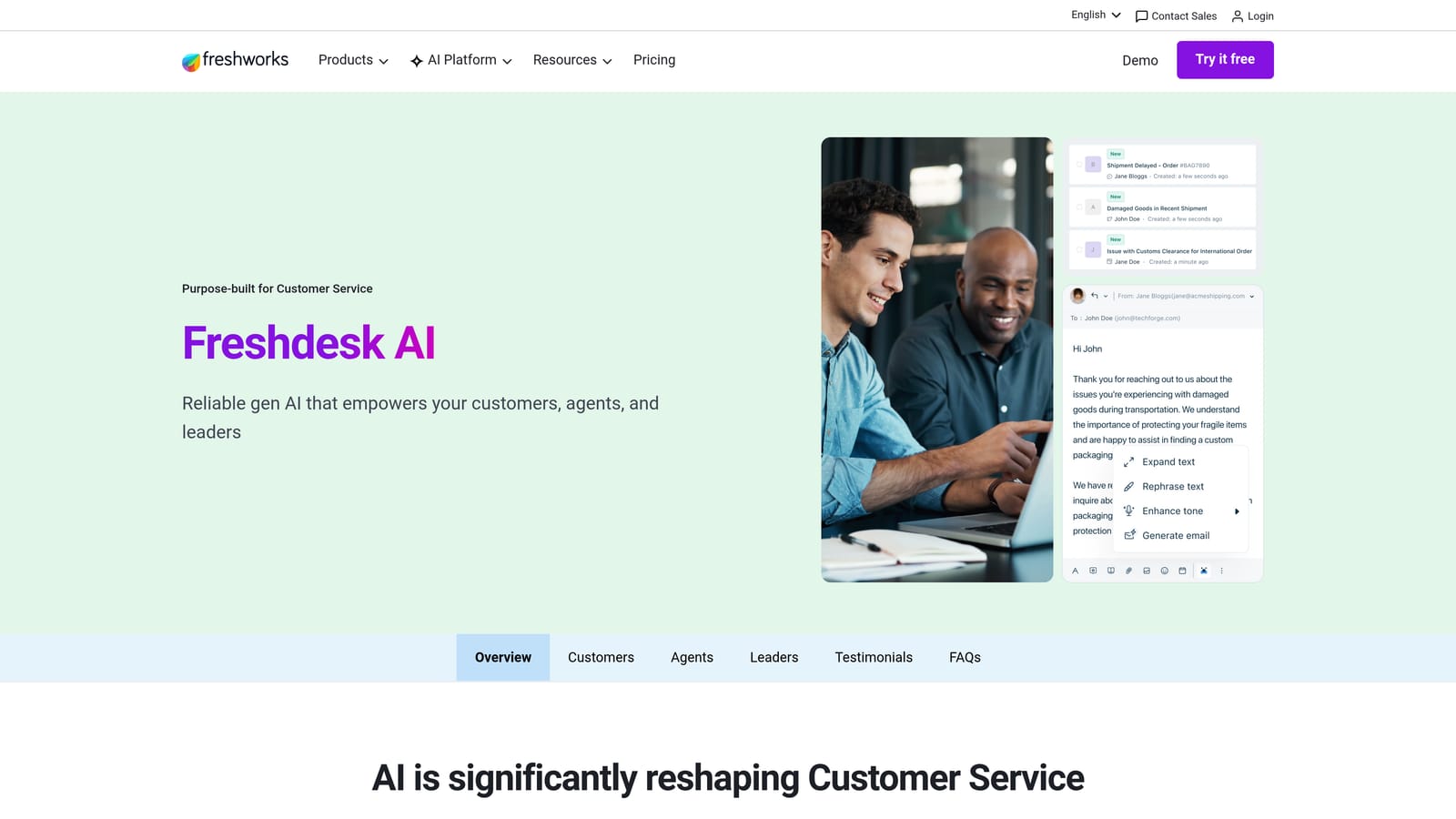
Freshdesk Freddy AI is Freshworks' AI suite spanning self-service automation, agent assistance, and analytics within the Freshdesk helpdesk platform.
Where This Tool Shines
Freddy AI's architecture is worth understanding because it's actually three distinct products working together. Freddy Self Service handles customer-facing automation, Freddy Copilot assists agents in real time, and Freddy Insights surfaces analytics and trend detection. That modular structure means teams can adopt the pieces they need without paying for capabilities they don't use yet.
The pricing accessibility is a genuine differentiator compared to Zendesk and enterprise-tier alternatives. For teams that want solid AI capabilities without enterprise complexity or cost, Freshdesk represents a practical middle ground. The omnichannel support across email, chat, phone, and social is well-executed for the price point.
Key Features
Freddy Self Service: AI-powered customer-facing automation that resolves common queries without agent involvement.
Freddy Copilot: Real-time agent assistance with suggested responses, conversation summarization, and knowledge retrieval.
Freddy Insights: AI-driven analytics that surface trends, anomalies, and performance patterns across your support operation.
Omnichannel Inbox: Unified support across email, chat, phone, and social channels within a single platform.
Accessible Pricing Tiers: Structured to serve SMBs and mid-market teams without requiring enterprise contract commitments.
Best For
SMBs and mid-market teams that want a comprehensive helpdesk with AI capabilities at a price point that doesn't require enterprise budget approval. Less suited for teams needing deep integrations with engineering or product tooling.
Pricing
Free plan available. Paid plans from approximately $15 per agent per month. AI add-ons priced separately. Verify current pricing at freshworks.com.
5. Tidio
Best for: SMBs and e-commerce teams wanting fast deployment with conversational AI chatbot capability
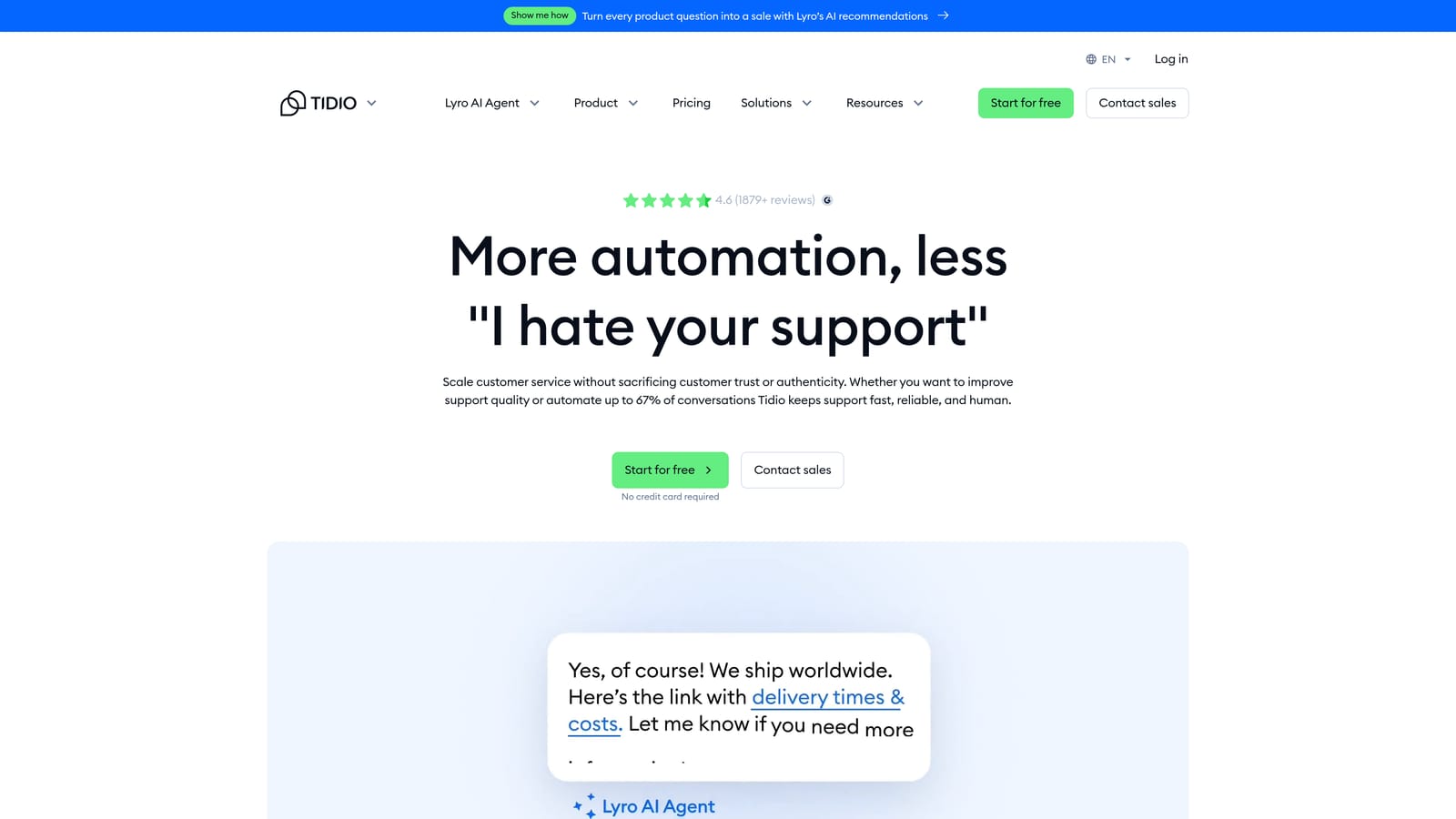
Tidio is a live chat and AI chatbot platform featuring Lyro, its conversational AI that handles customer queries using your existing knowledge base content.
Where This Tool Shines
Speed of deployment is Tidio's standout quality. Teams can typically go live within hours rather than weeks, which matters for small teams that need immediate relief from repetitive support volume. Lyro AI handles conversational queries by drawing on your existing help content without requiring complex configuration or engineering resources.
The visual flow builder makes no-code automation genuinely accessible for non-technical team members. Tidio's e-commerce integrations with Shopify and WooCommerce are well-built, making it a natural fit for online retail support. The honest limitation is that Tidio is optimized for straightforward, high-volume conversational queries. Complex B2B workflows, deep product integrations, or enterprise-grade compliance requirements push past what Tidio was designed for.
Key Features
Lyro AI Chatbot: Conversational AI that resolves customer queries using your knowledge base content without manual flow creation.
Visual Flow Builder: No-code automation builder for creating custom conversation flows and routing logic.
Live Chat with Agent Takeover: Seamless handoff from AI to human agents when conversations require personal attention.
E-commerce Integrations: Native connections to Shopify and WooCommerce for order status, returns, and product queries.
Fast Deployment: Designed to be operational within hours, not weeks.
Best For
E-commerce businesses, SMBs, and early-stage teams that need quick deployment and solid conversational AI without complex setup. Not the right fit for B2B SaaS teams needing deep product-engineering integrations.
Pricing
Free plan available. Lyro AI from approximately $29 per month based on conversation volume. Verify current pricing at tidio.com.
6. Drift (Salesloft)
Best for: Teams where support and sales conversations overlap and pipeline-aware routing matters
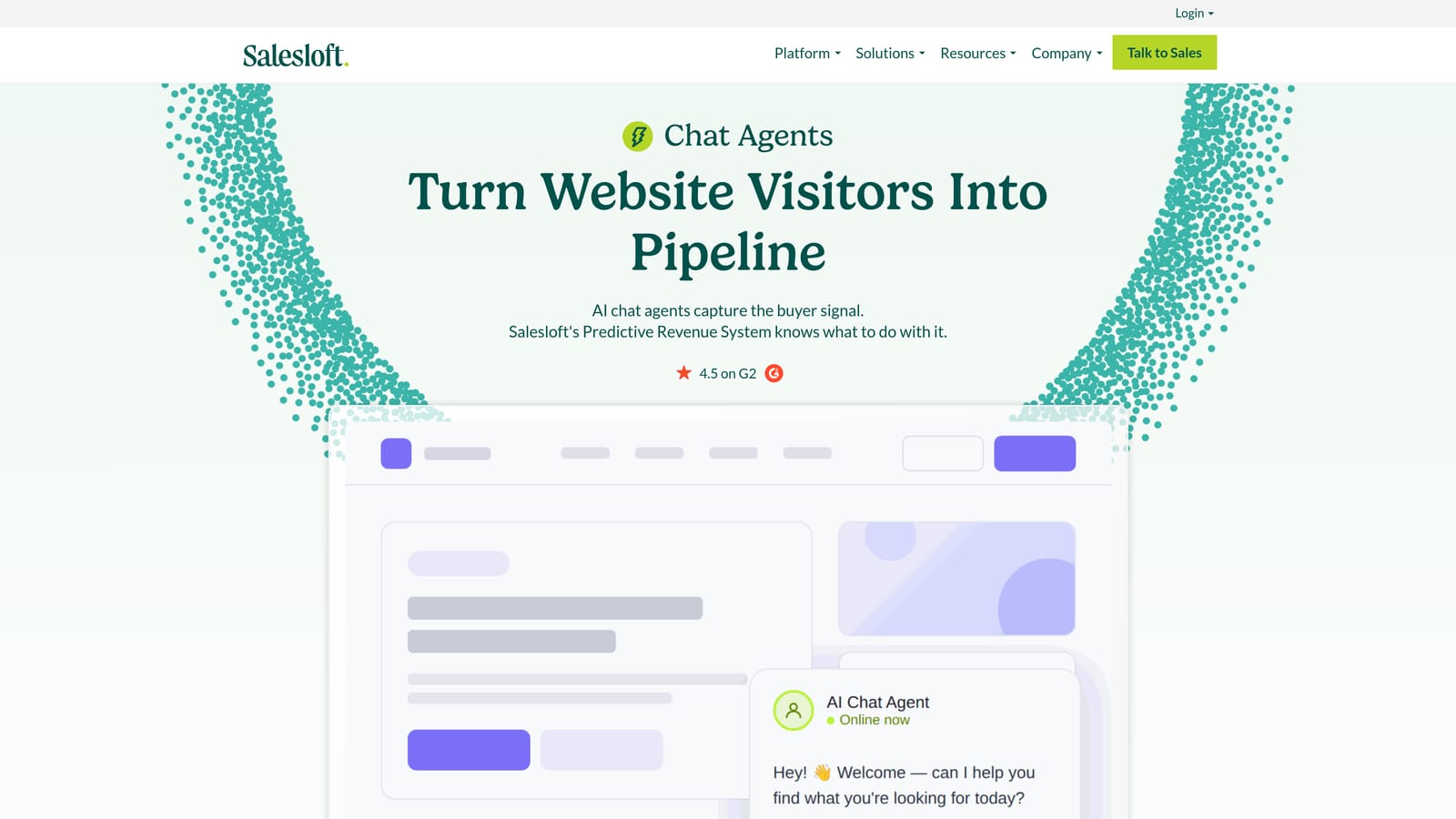
Drift is a conversational AI platform now part of Salesloft, designed for teams where support and sales conversations blur, with AI routing, account-based targeting, and pipeline-aware conversation handling.
Where This Tool Shines
Drift occupies a genuinely distinct position in this list because it was never designed purely as a support tool. Its strength is in the overlap between support and revenue: routing conversations based on account status, deal stage, or customer tier, and connecting those interactions to sales workflows within Salesloft. For teams where a support conversation might also be a renewal risk or an expansion opportunity, that context matters.
The account-based targeting capabilities allow for personalized conversation experiences based on who the visitor is and where they are in the customer lifecycle. If your support and sales teams share pipeline context, the Salesloft integration provides a unified view that few pure support platforms can match.
Key Features
AI-Powered Conversational Routing: Routes conversations based on account data, visitor identity, and pipeline stage rather than just topic keywords.
Playbooks: Automated workflows for qualification, support, and handoff scenarios that run without manual intervention.
Salesloft Integration: Unified sales and support context across the Salesloft platform for revenue-aware conversation handling.
Meeting Scheduling Automation: Books meetings with the right team member directly within the chat conversation.
Account-Based Targeting: Personalizes conversation experiences based on company, deal stage, or customer health data.
Best For
Revenue-focused teams where support conversations frequently connect to sales outcomes. Less suited for teams that need pure support automation without a sales motion, or those not already operating within the Salesloft ecosystem.
Pricing
Contact for pricing. Enterprise-focused with no public self-serve tier. Verify current pricing at drift.com.
7. Ada
Best for: Large consumer-facing brands needing multilingual AI automation with enterprise compliance controls
Ada is an enterprise no-code AI automation platform focused on large consumer-facing brands, offering multilingual support, strong compliance features, and a visual bot builder that doesn't require engineering resources.
Where This Tool Shines
Ada's primary differentiator is its combination of no-code accessibility and enterprise-grade governance. Non-technical teams can build and maintain sophisticated automation flows through the visual builder without opening a support ticket to engineering. For global brands managing support in many languages, Ada's multilingual capabilities out of the box are a meaningful operational advantage.
The compliance and data governance controls are built for organizations where regulatory requirements shape every technology decision. Ada is well-positioned for large consumer brands with global operations and compliance complexity. It's less focused on the B2B SaaS product support workflow, where deep integration with engineering tools and product-specific context matter more than multilingual breadth.
Key Features
No-Code Visual Bot Builder: Non-technical teams can build, test, and deploy automation flows without engineering involvement.
Multilingual Support: Handles customer conversations across many languages without separate configuration for each.
Enterprise Compliance Controls: Data governance, security, and compliance features suited for regulated industries and global operations.
AI-Powered Intent Detection: Understands customer intent and personalizes conversation paths based on context and history.
Helpdesk and CRM Integrations: Connects to major helpdesks and CRM platforms for unified customer data access.
Best For
Large consumer brands with global audiences, multilingual support requirements, and strict compliance needs. Less optimized for B2B SaaS teams that need product-aware AI or deep engineering tool integrations.
Pricing
Contact for pricing. Enterprise tier with custom quotes based on conversation volume and feature requirements. Verify current pricing at ada.cx.
8. Kustomer
Best for: High-volume B2C brands needing a CRM-native support platform with unified customer timelines
Kustomer is a CRM-native support platform owned by Meta that gives agents a unified customer timeline and layers AI automation on top of rich historical customer data.
Where This Tool Shines
Kustomer's core architectural decision sets it apart from traditional helpdesks: it's built as a CRM first, with support functionality layered on top of a complete customer data model. Every interaction, order, subscription event, and conversation is visible in a single timeline view. For agents handling complex customer situations, that context dramatically reduces the time spent piecing together history from multiple systems.
The AI automation sits on top of that rich data, which means routing and response suggestions are informed by actual customer history rather than just the current conversation. This works particularly well for high-volume B2C brands in retail, DTC, and subscription commerce where order history and lifecycle data are central to every support interaction. The platform is less optimized for B2B SaaS support, where product-specific context and engineering tool integrations matter more than transaction history.
Key Features
Unified Customer Timeline: Aggregates all interactions, orders, and events into a single chronological view for agents.
AI-Powered Automated Responses: Generates and routes responses based on customer history and conversation context.
Omnichannel Inbox: Handles email, chat, SMS, social, and voice within a single unified workspace.
Workflow Builder: Business process automation for routing, escalation, and follow-up without custom code.
E-commerce and Subscription Integrations: Deep connections to platforms where order and subscription data are central to support interactions.
Best For
High-volume B2C brands in retail, DTC, and subscription commerce where unified customer history is the primary support challenge. Less suited for B2B SaaS teams where product-aware AI and engineering integrations are the priority.
Pricing
Starts at approximately $89 per agent per month for the Enterprise plan. Verify current pricing at kustomer.com.
9. Forethought
Best for: Teams wanting smarter AI triage and routing without migrating away from their existing helpdesk
Forethought is an AI triage and routing layer designed to sit on top of your existing helpdesk, using predictive AI to classify tickets, route them intelligently, and assist agents in real time.
Where This Tool Shines
Forethought's value proposition is deliberately narrow: it makes your existing helpdesk smarter without requiring you to replace it. If your team has significant investment in Zendesk, Salesforce Service Cloud, or another major platform and migration isn't on the table, Forethought adds a meaningful AI layer without disrupting established workflows.
The predictive ticket classification is the headline capability. Rather than relying on keyword matching or manual routing rules, Forethought uses AI to understand ticket intent, urgency, and topic and routes accordingly. The Solve product handles automated deflection for repetitive queries, while the agent assist component surfaces relevant knowledge and suggested responses in real time. It's a practical choice for organizations where the helpdesk itself isn't the problem but the intelligence layer on top of it needs an upgrade.
Key Features
Predictive Ticket Classification: AI-powered intent detection that classifies and routes tickets without manual rule configuration.
Triage AI: Prioritizes tickets by urgency, topic, and complexity so agents work the highest-impact items first.
Agent Assist: Surfaces relevant knowledge articles and suggested responses within the agent's existing helpdesk interface.
Solve AI: Automated deflection for repetitive queries before they reach an agent queue.
Helpdesk Compatibility: Designed to work alongside Zendesk, Salesforce, and other major platforms without requiring migration.
Best For
Support teams with established helpdesk infrastructure that want AI-powered triage and routing improvements without a platform migration. Also useful as a bridge solution while evaluating a longer-term AI-first transition.
Pricing
Contact for pricing. Usage-based model with custom quotes. Verify current pricing at forethought.ai.
Which Tool Is Right for Your Team
The nine tools in this list cover a wide range of use cases, and the right choice depends more on your team's architecture than on feature checklists.
If you're a B2B SaaS team that wants AI to resolve tickets autonomously, guide users through your product with real context, and surface business intelligence from every support conversation, Halo AI is built specifically for that scenario. The page-aware context, continuous learning, and cross-functional integrations with Linear, Stripe, and HubSpot make it the strongest fit for product-led growth companies where support and product are closely connected.
For teams already embedded in Intercom's ecosystem, Fin AI is a natural extension. For large enterprise support organizations with hundreds of agents, Zendesk AI's augmentation-first approach and compliance depth are hard to match. Freshdesk Freddy AI is the practical choice for SMBs and mid-market teams that want solid AI without enterprise pricing. Tidio serves e-commerce and early-stage teams that need to be live quickly. Drift makes sense when support and sales conversations are inseparable. Ada fits global consumer brands with multilingual and compliance complexity. Kustomer is purpose-built for high-volume B2C retail and subscription brands. And Forethought is the right answer when you want smarter AI without abandoning your current helpdesk.
Your support team shouldn't scale linearly with your customer base. Let AI agents handle routine tickets, guide users through your product, and surface business intelligence while your team focuses on complex issues that need a human touch. See Halo in action and discover how continuous learning transforms every interaction into smarter, faster support.