9 Best In-App Customer Support Solutions in 2026
Discover the 9 best in-app customer support solutions for 2026, evaluated on AI capability, contextual awareness, and scalability for B2B SaaS teams. This guide helps you choose the right tool—from basic chat widgets to intelligent AI agents that resolve issues autonomously—whether you're upgrading a legacy system or building your support stack from scratch.
 Grant CooperFounder14 min read
When users hit a wall inside your product, the last thing they want is to leave it to find help. In-app customer support solutions solve this by embedding assistance directly into the user experience, reducing friction, improving retention, and cutting ticket volume before issues escalate.
But the market has matured significantly. The gap between a basic chat widget and a genuinely intelligent in-app support layer is enormous. Some tools simply surface an FAQ panel; others deploy AI agents that understand which page the user is on, resolve issues autonomously, and feed insights back to your product team.
This list covers the best in-app customer support solutions available in 2026, evaluated on AI capability, contextual awareness, integration depth, and scalability for B2B SaaS teams. Whether you're replacing a legacy helpdesk widget or building your support stack from scratch, you'll find a clear recommendation for your situation.
1. Halo AI
Best for: B2B SaaS teams that want AI-native, page-aware support with autonomous ticket resolution
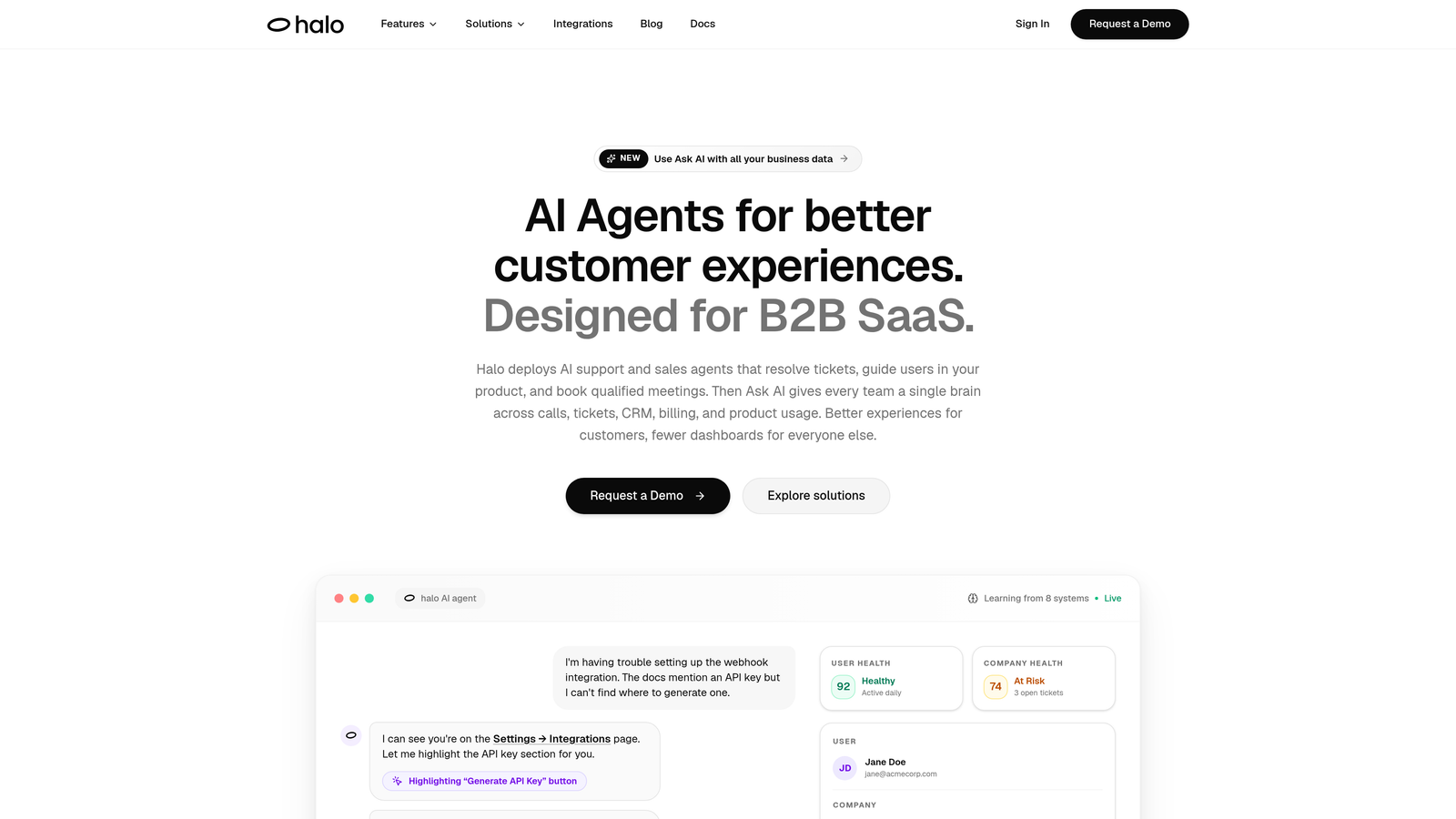
Halo AI is an AI-first in-app support platform that deploys intelligent agents to resolve tickets, guide users through your product, and surface business intelligence from every interaction.
Where This Tool Shines
Most in-app support tools were built as helpdesks first, with AI layered on afterward. Halo AI takes the opposite approach: it's architected AI-first, which means contextual awareness and autonomous resolution aren't features bolted on, they're the foundation. The page-aware chat widget actually understands which part of your product a user is viewing, allowing it to provide guidance that's relevant to that specific moment rather than generic knowledge base results.
What genuinely differentiates Halo is what happens after the conversation ends. The Smart Inbox doesn't just log tickets; it surfaces business intelligence signals like customer health trends, revenue anomalies, and early churn indicators. Your support layer becomes a source of product and revenue intelligence, not just a cost center.
Key Features
Page-Aware Chat Widget: Detects which page or feature the user is viewing and delivers contextually relevant guidance without requiring the user to describe their location in the product.
Autonomous AI Agents: Resolves support tickets without human intervention by drawing on your product knowledge and continuously improving from every interaction it handles.
Auto Bug Ticket Creation: Automatically generates and routes bug reports to Linear or your preferred issue tracker when a user encounters a reproducible problem.
Smart Inbox with Business Intelligence: Goes beyond support metrics to surface customer health signals, revenue anomalies, and churn indicators directly in your inbox view.
Live Agent Handoff: Smoothly escalates complex issues to human agents with full conversation context preserved, so users never have to repeat themselves.
Deep Integrations: Connects natively with Linear, Slack, HubSpot, Intercom, Stripe, Zoom, PandaDoc, and Fathom for a unified support and business stack.
Best For
Halo AI is built for B2B SaaS product and support teams that want to deflect routine tickets at scale, guide users through complex workflows in real time, and extract intelligence from support interactions rather than just managing them. It's particularly well-suited for teams that have outgrown bolt-on chat widgets and need a purpose-built AI layer.
Pricing
Contact for pricing. Halo AI is designed for B2B SaaS teams and pricing is scoped to your team's needs. Reach out via the website for a demo and custom quote.
2. Intercom
Best for: Mid-market SaaS teams wanting a mature messaging platform with a capable AI agent
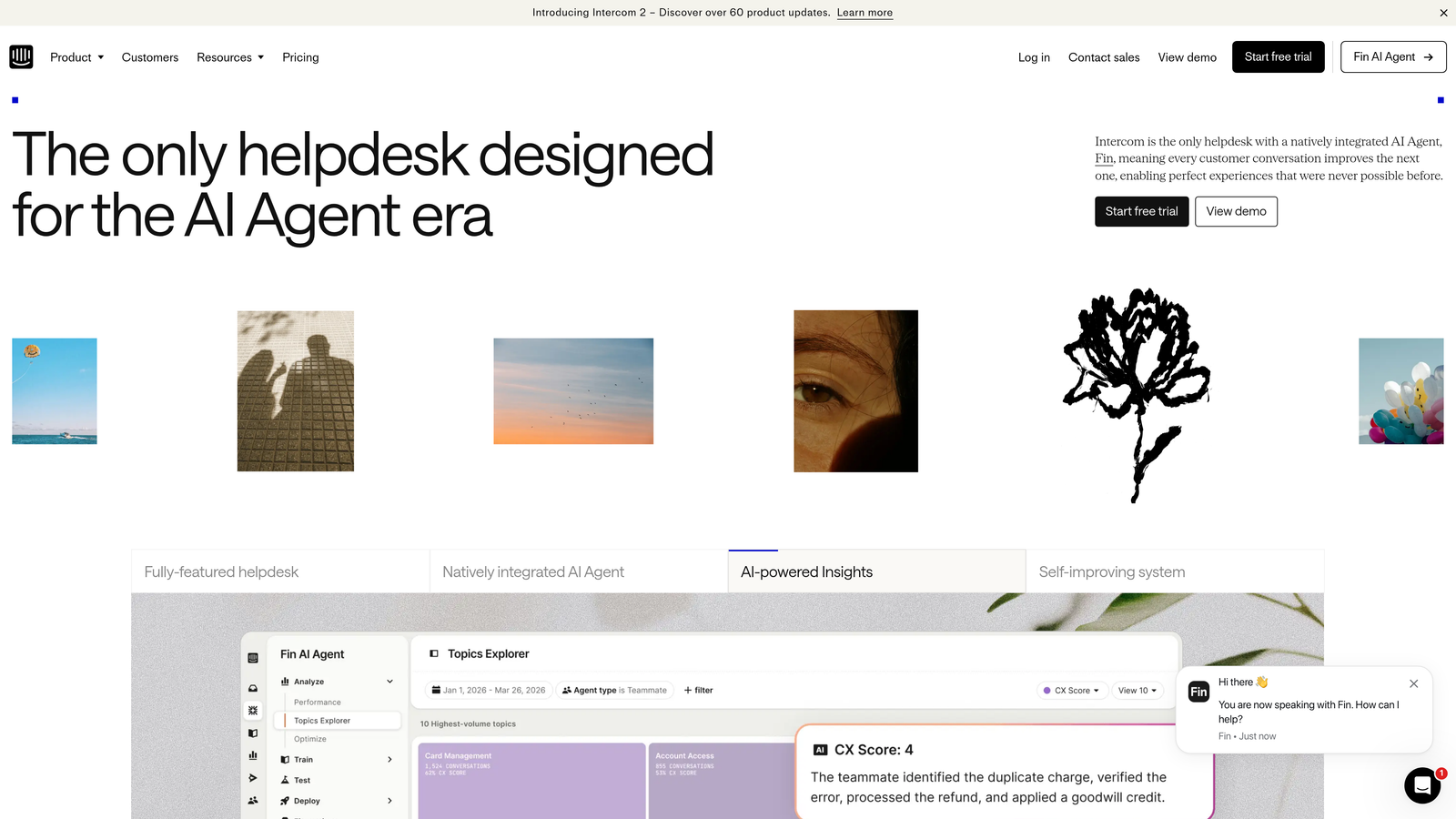
Intercom is a well-established in-app messaging and customer support platform with a powerful AI agent called Fin built on top of deep communication infrastructure.
Where This Tool Shines
Intercom's strength is its breadth. The platform has spent years building a robust customer data model, a rich in-app messenger, and a mature agent workspace, all of which now have Fin AI layered on top. For teams that want a single platform handling in-app chat, email, product tours, and customer segmentation, Intercom delivers that without requiring multiple vendors.
Fin uses large language models to autonomously resolve common queries, and the quality of those resolutions has improved considerably. The in-app messenger supports rich media, carousels, and product tours, making it more than just a chat window. That said, pricing can escalate quickly as usage and seat counts grow, which is worth factoring into any evaluation.
Key Features
Fin AI Agent: Autonomously resolves customer queries using large language models trained on your help content and conversation history.
Rich In-App Messenger: Supports media, carousels, and product tours directly within the chat widget for a more engaging support experience.
Customer Data Platform: Enables segmented messaging and targeting based on user behavior, plan type, and lifecycle stage.
Agent Inbox with AI Assist: Human agents get suggested replies, summaries, and context from AI to handle complex conversations more efficiently.
Integration Marketplace: Connects with hundreds of tools including Salesforce, Stripe, and HubSpot for a connected support workflow.
Best For
Mid-market SaaS companies that want a proven, all-in-one messaging and support platform. Particularly strong for teams that need both in-app support and outbound customer communication in the same tool.
Pricing
Starts at $39/month; scales with seats and usage. Enterprise pricing is available on request and can become significant for larger teams.
3. Zendesk
Best for: Enterprise teams already invested in the Zendesk ecosystem needing in-app widget functionality
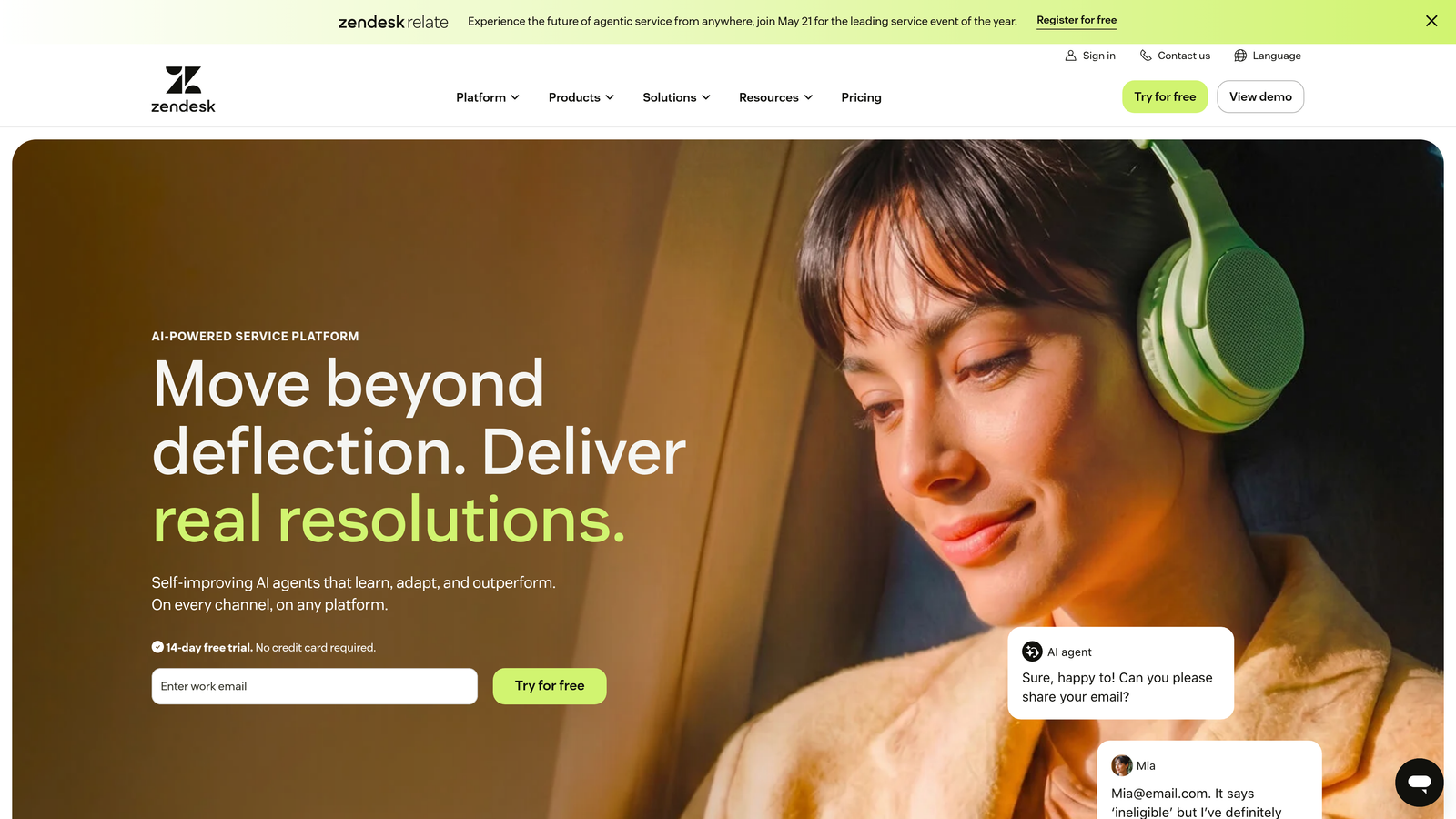
Zendesk is an enterprise-grade helpdesk platform with an in-app Web Widget that surfaces knowledge base content, chat, and ticketing within your product.
Where This Tool Shines
Zendesk's in-app Web Widget is a solid channel extension for teams that have already built their support operations on Zendesk's ticketing, SLA management, and reporting infrastructure. For enterprise teams with complex compliance requirements, multilingual support needs, and large agent workforces, Zendesk remains one of the most capable platforms available.
The AI Copilot feature helps human agents work faster by surfacing suggested replies and relevant knowledge base content. Where Zendesk is less differentiated is in contextual in-app awareness: the widget functions as a channel within a larger helpdesk, rather than a purpose-built in-app support layer that understands product context at a granular level.
Key Features
Web Widget (Messaging): Embeds in-app chat, self-service search, and ticket submission directly into your product interface.
AI Copilot: Assists human agents with suggested replies, conversation summaries, and knowledge base recommendations.
Ticketing and SLA Management: Robust backend for managing support queues, setting service level agreements, and tracking resolution metrics.
1,000+ Integrations: Extensive marketplace covering CRM, analytics, collaboration, and e-commerce tools.
Enterprise Compliance Features: Multilingual support, data residency options, and enterprise security controls for regulated industries.
Best For
Large enterprise teams with established Zendesk workflows who need in-app chat as one channel within a broader support operation. Less ideal for teams starting fresh who want AI-native in-app support as the primary architecture.
Pricing
Suite plans start at $55/agent/month. Enterprise pricing is available on request and varies based on agent count and feature requirements.
4. Freshdesk
Best for: Growing SMB and mid-market teams that need solid in-app support without enterprise pricing
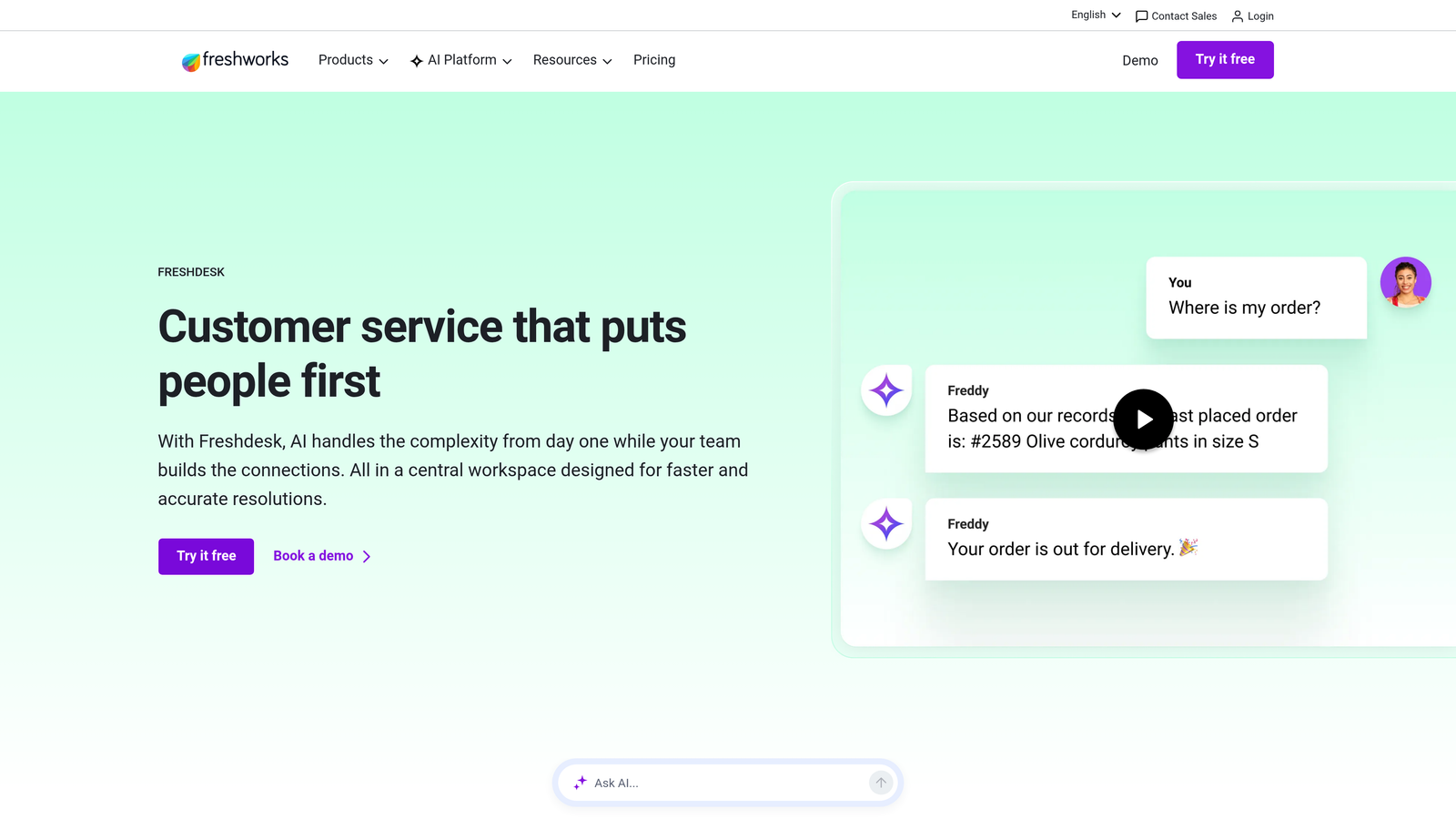
Freshdesk is an accessible helpdesk platform with in-app chat via Freshchat and Freddy AI automation, well-suited for teams that need functional in-app support at a competitive price point.
Where This Tool Shines
Freshdesk's value proposition is straightforward: you get a capable helpdesk with in-app chat, AI automation, and a unified inbox across channels without the pricing pressure of Zendesk or Intercom. Freddy AI handles common queries and ticket routing, and the free tier makes it accessible for early-stage teams testing in-app support for the first time.
The Freshchat widget integrates cleanly into web and mobile products, and the unified inbox across email, chat, and social channels reduces context-switching for support teams. For teams with simpler support needs or tighter budgets, Freshdesk delivers meaningful functionality without overcomplication.
Key Features
Freshchat In-App Widget: Provides live chat and bot interactions embedded in your product with a clean, configurable interface.
Freddy AI: Automates responses to common queries and handles ticket routing based on content and priority signals.
Unified Inbox: Consolidates email, chat, and social support channels into a single agent workspace.
Canned Responses and Knowledge Base: Speeds up agent replies and surfaces self-service content directly in the chat widget.
Free Tier: Functional free plan available for small teams, with paid tiers unlocking automation and advanced features.
Best For
SMBs and growing teams that need a reliable helpdesk with in-app chat and basic AI automation, without committing to enterprise-level pricing. Also a strong option for teams evaluating in-app support for the first time.
Pricing
Free plan available. Paid plans start at $15/agent/month, scaling with features and seat count.
5. Pendo
Best for: Product teams wanting to combine in-app support, onboarding, and product analytics in one layer
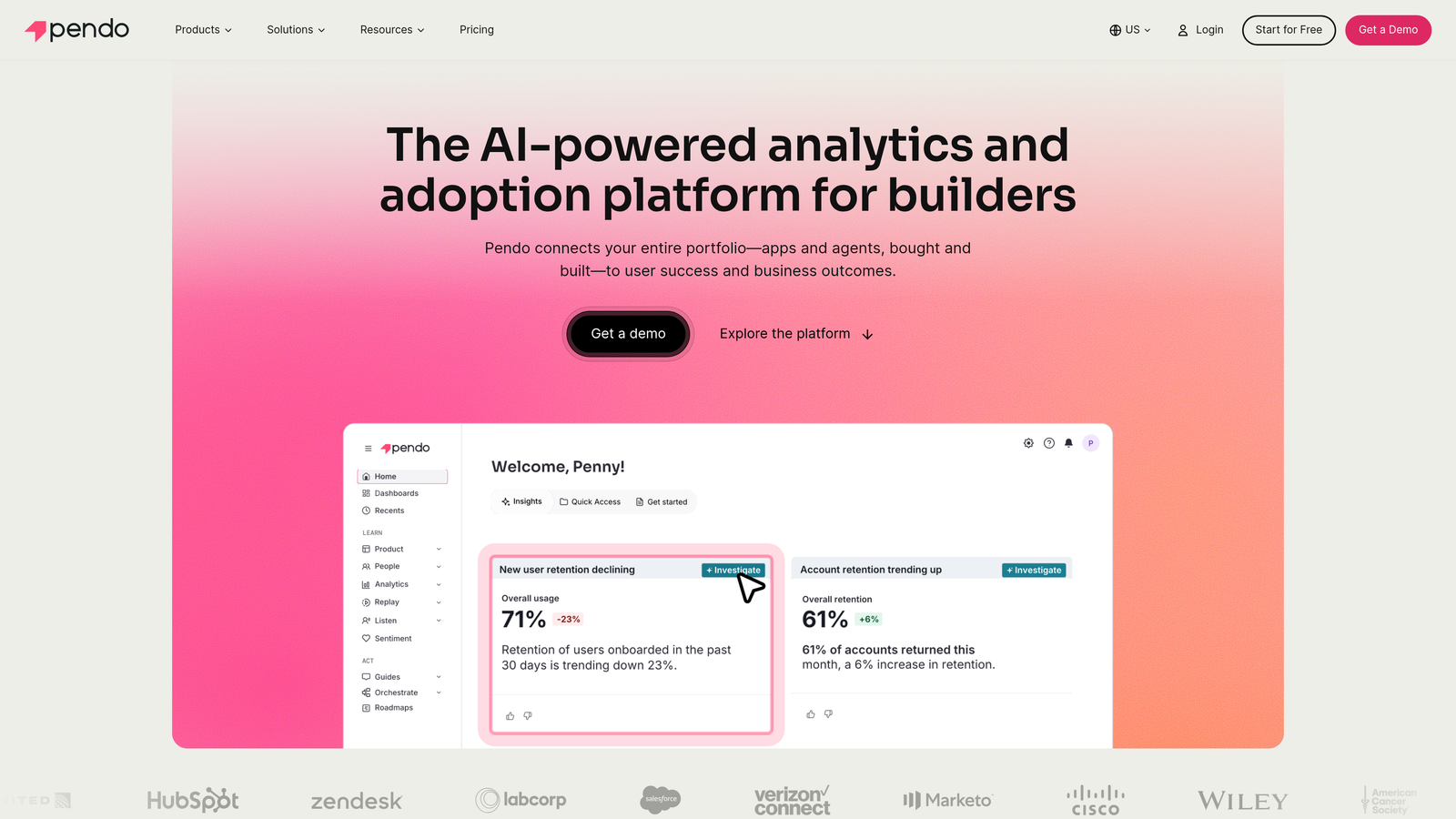
Pendo is a product experience platform that blends in-app guides, analytics, NPS surveys, and a Resource Center into a unified in-app layer that serves both support and product adoption goals.
Where This Tool Shines
Pendo occupies a unique position in this category because it doesn't think about support in isolation. The Resource Center gives users a self-service hub for help content, while product analytics tell your team exactly where users are struggling before they even raise a ticket. That combination of reactive support and proactive insight is genuinely valuable for product-led growth companies.
The in-app guide capabilities, including tooltips, walkthroughs, and feature announcements, allow teams to reduce inbound support volume by addressing confusion at the point of friction. It's worth noting that Pendo is not a traditional ticketing system; it works best as a complement to a support platform rather than a replacement for one.
Key Features
In-App Resource Center: Provides users with a self-service hub for help articles, guides, and announcements without leaving your product.
Product Tours and Tooltips: Proactively guides users through features and workflows to prevent support issues before they occur.
Product Analytics: Tracks user behavior to identify where friction, drop-off, and confusion are most common.
NPS and In-App Surveys: Collects user feedback at contextually relevant moments within the product experience.
Segmentation: Targets in-app messages and guides to specific user segments based on behavior, plan, or lifecycle stage.
Best For
Product and customer success teams at SaaS companies that want to reduce support load through proactive guidance and gain behavioral insight into where users struggle. Best used alongside a dedicated support platform.
Pricing
Free plan available for small teams. Paid plans are priced on request based on monthly active users.
6. Chameleon
Best for: Product teams reducing support volume through proactive in-app onboarding and contextual guidance
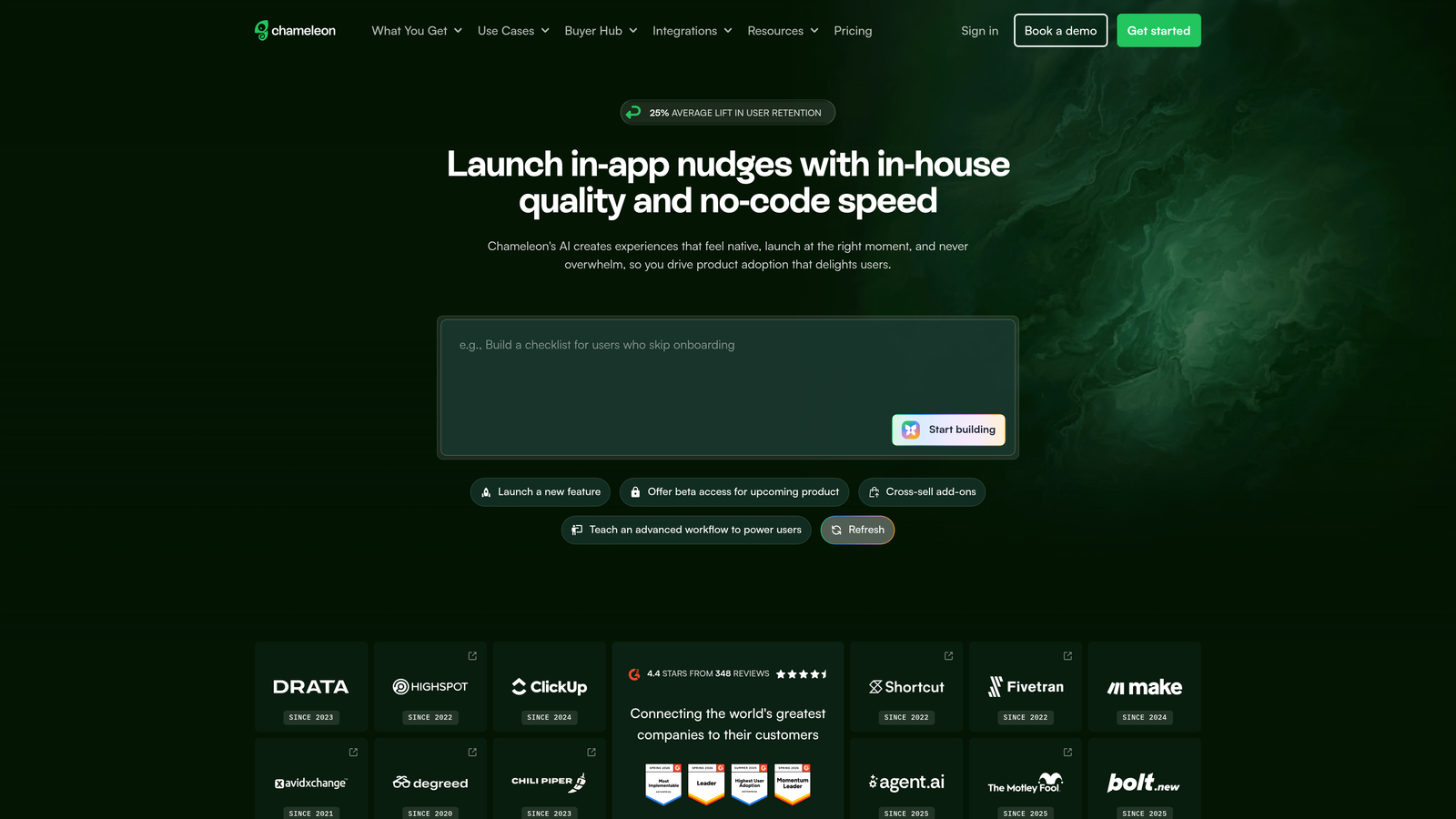
Chameleon is a no-code in-app experience builder focused on reducing support load through proactive onboarding flows, tooltips, checklists, and contextual microsurveys.
Where This Tool Shines
Chameleon's premise is that the best support ticket is the one that never gets created. By equipping product teams with a no-code builder for tours, tooltips, and checklists, Chameleon lets non-engineers deploy in-app guidance that preempts common support questions. The contextual targeting engine ensures guidance appears at the right moment based on user behavior and attributes, not just page URL.
The microsurvey capability is particularly useful for gathering in-app feedback without interrupting the user experience. Chameleon integrates well with Segment, HubSpot, Intercom, and Salesforce, making it a practical complement to an existing support stack rather than a standalone replacement.
Key Features
No-Code Builder: Lets product and customer success teams create tours, tooltips, and checklists without engineering involvement.
Contextual Targeting: Triggers in-app experiences based on user behavior, attributes, and lifecycle stage for relevant, timely guidance.
Microsurveys: Collects in-app feedback at specific moments without disrupting the user's workflow.
A/B Testing: Tests different in-app experiences to identify which guidance flows drive the best outcomes.
Stack Integrations: Connects with Segment, HubSpot, Intercom, and Salesforce for a connected data and communication workflow.
Best For
Product and growth teams that want to reduce inbound support volume by guiding users proactively. Works best as a complement to a dedicated support platform, not as a standalone solution for ticket management.
Pricing
Starts at $279/month. Higher tiers unlock advanced targeting, integrations, and increased usage limits.
7. Help Scout
Best for: Teams that prioritize simplicity, human-first support, and fast setup over heavy automation
Help Scout is a customer support platform known for its Beacon widget, a clean, human-first in-app tool that surfaces knowledge base articles, live chat, and email support within your product.
Where This Tool Shines
Help Scout earns its reputation for simplicity. The Beacon widget is genuinely easy to deploy and configure, and it covers the core in-app support use cases well: knowledge base search, live chat, and email fallback. For teams that want to be up and running quickly without navigating complex configuration, Help Scout is hard to beat.
The included Docs knowledge base is a practical bonus: you don't need a separate tool to host help content, and it surfaces directly in the Beacon widget. The AI Summarize and AI Assist features improve agent efficiency without turning the platform into something unfamiliar. It's a tool that stays out of the way and lets your team focus on helping customers.
Key Features
Beacon Widget: Embeds knowledge base search, live chat, and email support in a clean, lightweight in-app interface.
Docs Knowledge Base: Included in all plans, with content surfacing automatically in the Beacon widget for self-service support.
Shared Inbox: Enables team collaboration on support requests with assignment, notes, and collision detection.
AI Summarize and AI Assist: Helps agents summarize conversations and draft replies faster without overhauling the core workflow.
Fast Setup: Clean UI and straightforward configuration make deployment accessible for small and mid-sized teams.
Best For
Small to mid-sized teams that want a reliable, human-first in-app support experience without heavy automation or complex configuration. Particularly good for teams that value clean design and fast time-to-value.
Pricing
Starts at $50/month for up to 3 users. Pricing scales per user as team size grows.
8. Drift (Salesloft)
Best for: B2B teams where in-app support and sales pipeline conversations overlap significantly
Drift, now part of Salesloft, is a conversational AI platform that blends in-app chat support with sales pipeline conversations, suited for B2B teams where support and revenue generation share the same interface.
Where This Tool Shines
Drift's differentiation has always been the convergence of support and sales in a single chat interface. The conversational AI bot handles in-app queries while simultaneously qualifying leads and routing meetings, which makes it a compelling option for B2B SaaS companies where the same chat window serves both existing customers and prospective buyers.
Since the Salesloft acquisition, Drift's product direction has leaned more explicitly toward revenue intelligence and pipeline workflows. Teams evaluating Drift should assess how closely their support and sales motions overlap, as the platform is most valuable when both functions benefit from the same in-app conversation layer.
Key Features
Conversational AI Bot: Handles in-app chat queries and lead qualification simultaneously within the same interface.
Meeting Scheduling: Routes and books meetings directly from chat flows without leaving the product.
Playbooks: Delivers targeted in-app messaging to specific user segments based on behavior or account attributes.
CRM and Salesloft Integration: Connects with Salesforce, HubSpot, and Salesloft workflows for a unified revenue and support data model.
Revenue Intelligence Reporting: Provides insight into pipeline influence and conversation outcomes alongside support metrics.
Best For
Mid-market and enterprise B2B teams where customer support and revenue conversations happen in the same product context. Less suited for teams that need pure support automation without a sales overlay.
Pricing
Pricing available on request. Positioned for mid-market and enterprise B2B teams; expect investment at that tier.
9. Stonly
Best for: Complex products where users need guided, multi-step troubleshooting rather than simple FAQ search
Stonly is an interactive knowledge base and in-app guide platform that embeds decision-tree-style troubleshooters directly in your product, ideal for products with multi-step support scenarios.
Where This Tool Shines
Standard knowledge base widgets work well when a user's question has a single, clear answer. Stonly is built for the situations where it doesn't. The branching logic in Stonly's guides walks users through a decision tree: "Is the issue happening on mobile or desktop? Did the error appear before or after login?" This structured troubleshooting approach can meaningfully deflect tickets for complex products where generic articles fall short.
The AI-powered guide creation feature accelerates content building by generating interactive guides from existing documentation, which reduces the time investment typically associated with structured content. Stonly works well as a complement to Zendesk or Intercom, adding a self-service troubleshooting layer on top of an existing support platform.
Key Features
Interactive Step-by-Step Guides: Uses branching logic to walk users through multi-step troubleshooting based on their specific situation.
In-App Widget: Embeds the interactive troubleshooter directly in your product for seamless self-service support.
AI Guide Creation: Generates interactive guides from existing documentation to reduce content creation time.
Helpdesk Integrations: Connects with Zendesk, Intercom, and Freshdesk to complement existing support infrastructure.
Guide Analytics: Tracks usage, completion rates, and drop-off points so teams can identify where guides need improvement.
Best For
Product and support teams at companies with complex, multi-step workflows where users frequently need guided troubleshooting rather than simple search results. Best deployed alongside a primary support platform.
Pricing
Starts at $99/month. Enterprise plans are available on request for larger teams and higher usage volumes.
Which Tool Is Right for Your Team?
The right in-app customer support solution depends on a fundamental question: do you need in-app support as a channel, or as a core product experience? The answer shapes everything else.
Here's a quick way to think through the options:
AI-first autonomous support: Halo AI is the clearest choice for B2B SaaS teams that want page-aware context, autonomous ticket resolution, and business intelligence surfaced from every interaction.
Mature all-in-one messaging platform: Intercom offers the most complete combination of in-app chat, AI resolution, and customer data for mid-market teams willing to invest in a premium platform.
Enterprise helpdesk with in-app widget: Zendesk is the natural fit for large teams already operating within its ecosystem who need in-app chat as one channel among many.
Budget-conscious SMB: Freshdesk delivers solid functionality at a price point that makes sense for growing teams without enterprise requirements.
Product-led onboarding and support: Pendo or Chameleon work best for product teams that want to reduce ticket volume through proactive guidance and behavioral analytics.
Human-first simplicity: Help Scout is the cleanest option for teams that want fast setup, a reliable Beacon widget, and a support experience that stays out of the way.
Revenue and support convergence: Drift makes sense for B2B teams where the same in-app conversation serves both existing customers and prospective buyers.
Structured self-service content: Stonly is the right complement for complex products where users need guided, branching troubleshooting rather than keyword search.
For B2B SaaS teams serious about deflecting tickets, improving retention, and extracting intelligence from every support interaction, the architecture you choose matters as much as the features. A purpose-built AI layer is a meaningfully different starting point than a helpdesk widget.
Your support team shouldn't scale linearly with your customer base. Let AI agents handle routine tickets, guide users through your product, and surface business intelligence while your team focuses on complex issues that need a human touch. See Halo in action and discover how continuous learning transforms every interaction into smarter, faster support.