9 Best Intelligent Customer Service Software Platforms in 2026
Choosing the right intelligent customer service software can determine whether your support team scales efficiently or collapses under growing ticket volume. This guide evaluates the nine best AI-powered platforms for B2B companies in 2026, comparing them on AI capability, integrations, deployment ease, and their ability to resolve issues autonomously—helping teams scale support without proportionally scaling headcount.
 Grant CooperFounder14 min read
The gap between a support team that scales and one that buckles under ticket volume often comes down to one decision: which intelligent customer service software you choose. Unlike traditional helpdesks that simply route and track tickets, today's AI-powered platforms actively resolve issues, surface business insights, and learn from every interaction.
This list covers the nine best options for B2B companies and product teams in 2026, evaluated on AI capability depth, integration ecosystem, ease of deployment, and real-world utility for scaling support without scaling headcount. Whether you're migrating off a legacy helpdesk or building your support stack from scratch, here are the platforms worth your attention.
1. Halo AI
Best for: B2B SaaS teams wanting AI-first autonomous support with deep product and business intelligence integration.
Halo AI is an AI-native customer support platform built specifically for B2B SaaS teams who need more than ticket routing.
Where This Tool Shines
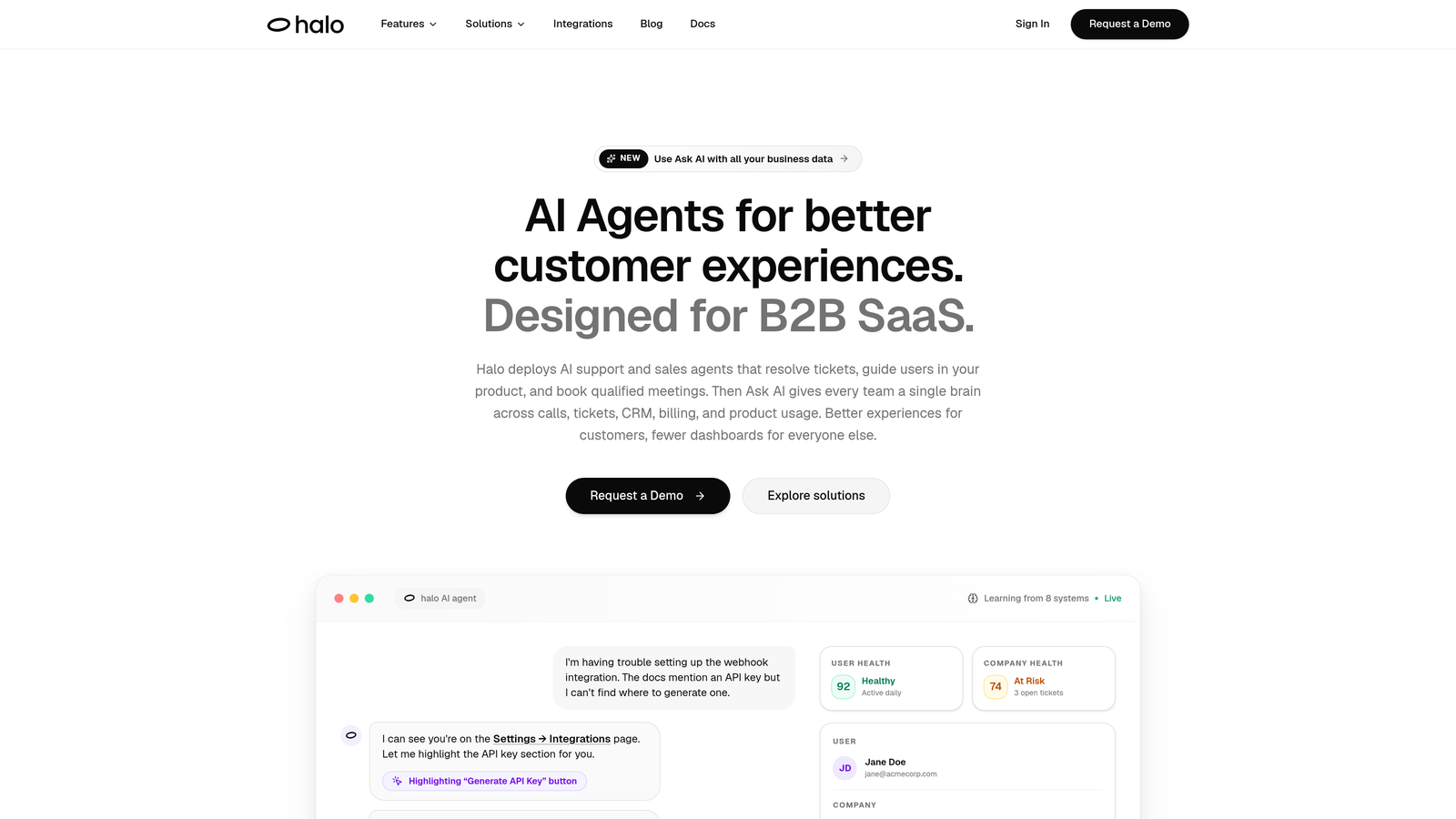
Most platforms added AI to an existing helpdesk architecture. Halo was built the other way around: AI is the core, not a layer on top. That distinction matters when you're dealing with complex product questions, multi-step troubleshooting, or support conversations that require real context about what a user is actually doing in your product.
The page-aware chat widget is the clearest example of this philosophy. Rather than serving generic responses, Halo's AI sees what the user sees on screen and delivers guidance tailored to that exact context. Combined with a smart inbox that surfaces customer health signals and revenue anomalies, Halo functions as business intelligence infrastructure, not just a support tool.
Key Features
Page-Aware Chat Widget: Understands the specific page a user is on and provides contextual visual guidance rather than generic answers.
Autonomous Ticket Resolution: AI agents handle routine tickets independently, escalating to live agents only when complexity warrants it.
Auto Bug Ticket Creation: Automatically generates and routes bug reports directly to Linear or Jira, closing the loop between support and engineering without manual handoff.
Smart Inbox with Business Intelligence: Surfaces customer health signals, churn indicators, and revenue anomalies from support conversation patterns.
Broad Integration Stack: Connects natively with Slack, HubSpot, Intercom, Stripe, Zoom, PandaDoc, and Fathom for a genuinely connected support operation.
Best For
Product-led SaaS companies that want support to do more than close tickets. Particularly well-suited for teams where engineering, success, and support need to stay in sync, and where understanding customer health at scale is as important as response time.
Pricing
Contact for pricing. Visit haloagents.ai to book a demo and see the platform in context for your team's specific use case.
2. Intercom
Best for: Teams wanting mature omnichannel messaging with an AI agent that works from existing help content.
Intercom is a well-established customer messaging platform with a native AI agent built on GPT-4 foundations for autonomous query resolution.
Where This Tool Shines
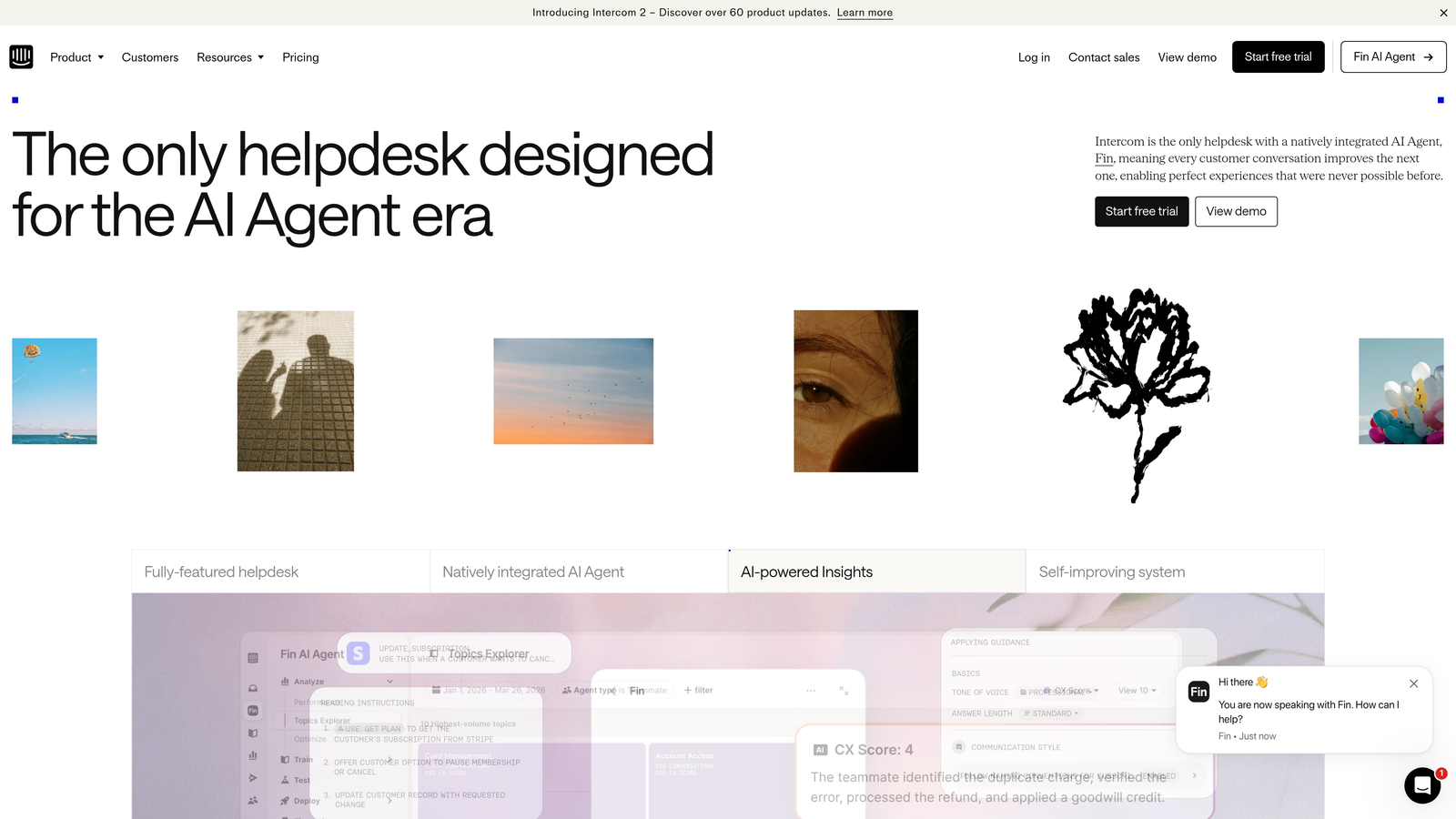
Intercom's Fin AI agent is one of the more production-ready autonomous agents on the market, trained directly from your existing help center content. For teams with a well-maintained knowledge base, Fin can handle a meaningful portion of incoming queries without additional configuration.
Beyond AI, Intercom's strength is its breadth. In-app chat, email, SMS, and social channels all feed into one workspace, and its customer data platform means support conversations are personalized based on what you already know about a user. The 300+ app marketplace also makes it easy to connect into most existing stacks.
Key Features
Fin AI Agent: Resolves customer queries autonomously using your existing knowledge base content, with handoff to human agents when needed.
Omnichannel Inbox: Manages in-app chat, email, SMS, and social conversations in a single unified workspace.
Customer Data Platform: Personalizes support interactions using behavioral and account data already in the system.
AI Copilot: Assists human agents with suggested replies and next-step guidance during live conversations.
App Marketplace: Over 300 integrations covering CRM, analytics, engineering, and communication tools.
Best For
Mid-market and growth-stage companies with established help content who want omnichannel coverage and a proven AI agent without heavy implementation overhead. Also a strong fit for teams already using Intercom for in-app messaging who want to layer in AI resolution.
Pricing
Base plans start at approximately $39 per seat per month. Fin AI resolution is usage-based pricing on top of the base plan. Verify current pricing at intercom.com.
3. Zendesk
Best for: Large enterprise support operations needing proven AI across triage, agent productivity, and self-service at scale.
Zendesk is the most established name in enterprise helpdesk software, with deeply integrated AI spanning every layer of the support workflow.
Where This Tool Shines
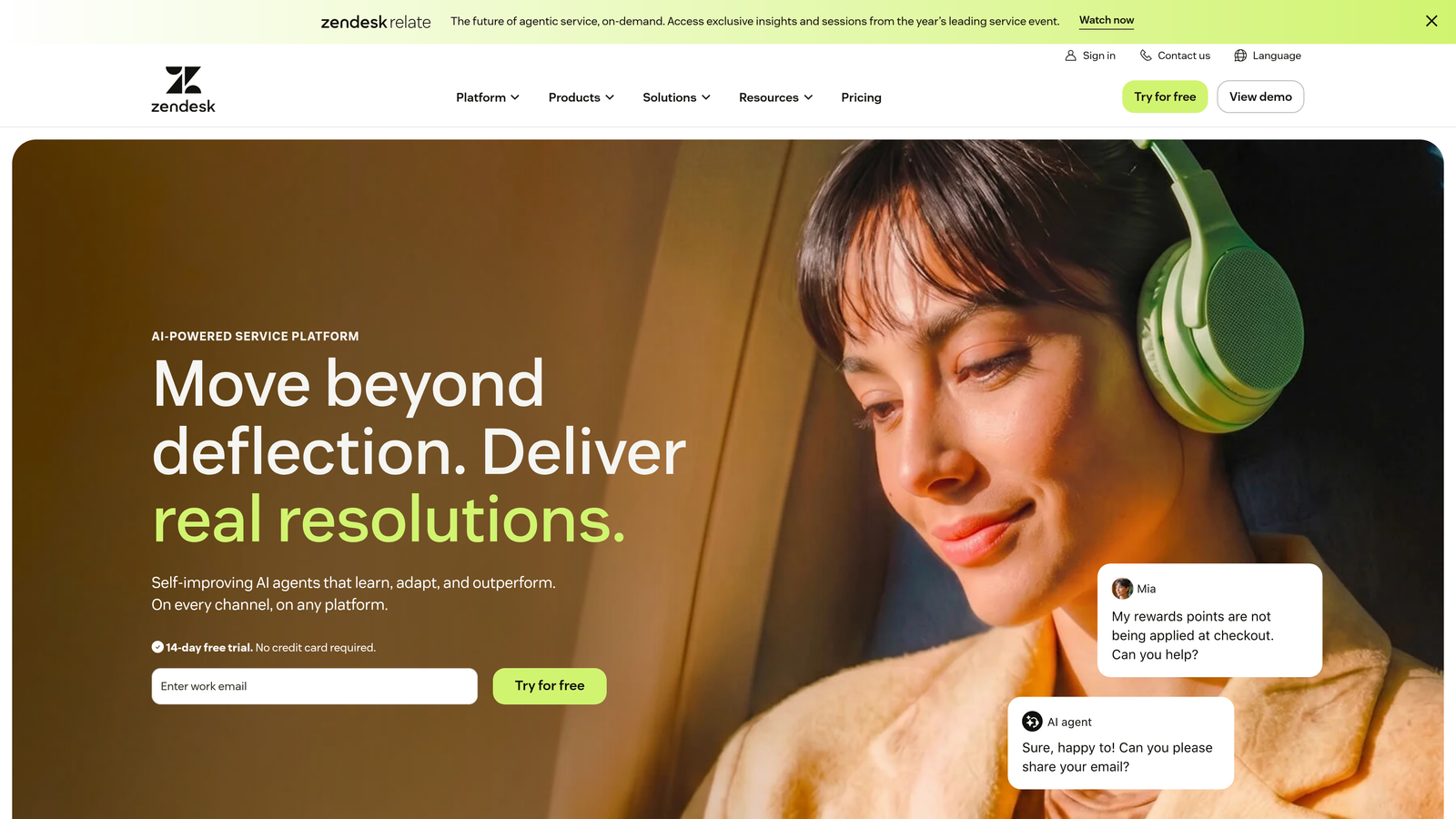
Zendesk's AI capabilities have matured considerably, particularly following its acquisition of Ultimate.ai. Intent detection, sentiment analysis, and automated triage now work across high-volume ticket environments where manual sorting would be impractical. For large teams, the Agent Copilot feature reduces time-to-resolution by surfacing macro suggestions and next-best-action guidance without requiring agents to search for answers.
The platform's real strength is operational depth. SLA management, advanced routing rules, and enterprise-grade reporting give large support organizations the control and visibility they need. If you're running a team of 50+ agents across multiple channels, Zendesk's infrastructure is hard to match.
Key Features
Zendesk AI Triage: Automatically detects intent, sentiment, and priority to route tickets without manual intervention.
Agent Copilot: Provides macro suggestions, knowledge base recommendations, and next-best-action guidance to speed up agent responses.
Intelligent Self-Service: AI-powered knowledge base surfacing helps customers find answers before reaching an agent.
Advanced Routing and SLA Management: Sophisticated rules engine for complex team structures and compliance requirements.
Unified Omnichannel Workspace: Voice, email, chat, and social managed in one agent interface.
Best For
Enterprise companies with large support teams, complex routing requirements, and a need for robust SLA enforcement. Also well-suited to organizations already invested in the Zendesk ecosystem who want to expand AI capabilities incrementally.
Pricing
Suite plans start at approximately $55 per agent per month. AI add-ons are priced separately. Enterprise tiers vary significantly. Verify current pricing at zendesk.com.
4. Freshdesk
Best for: Growing SMB teams wanting AI-assisted support across channels at an accessible price point.
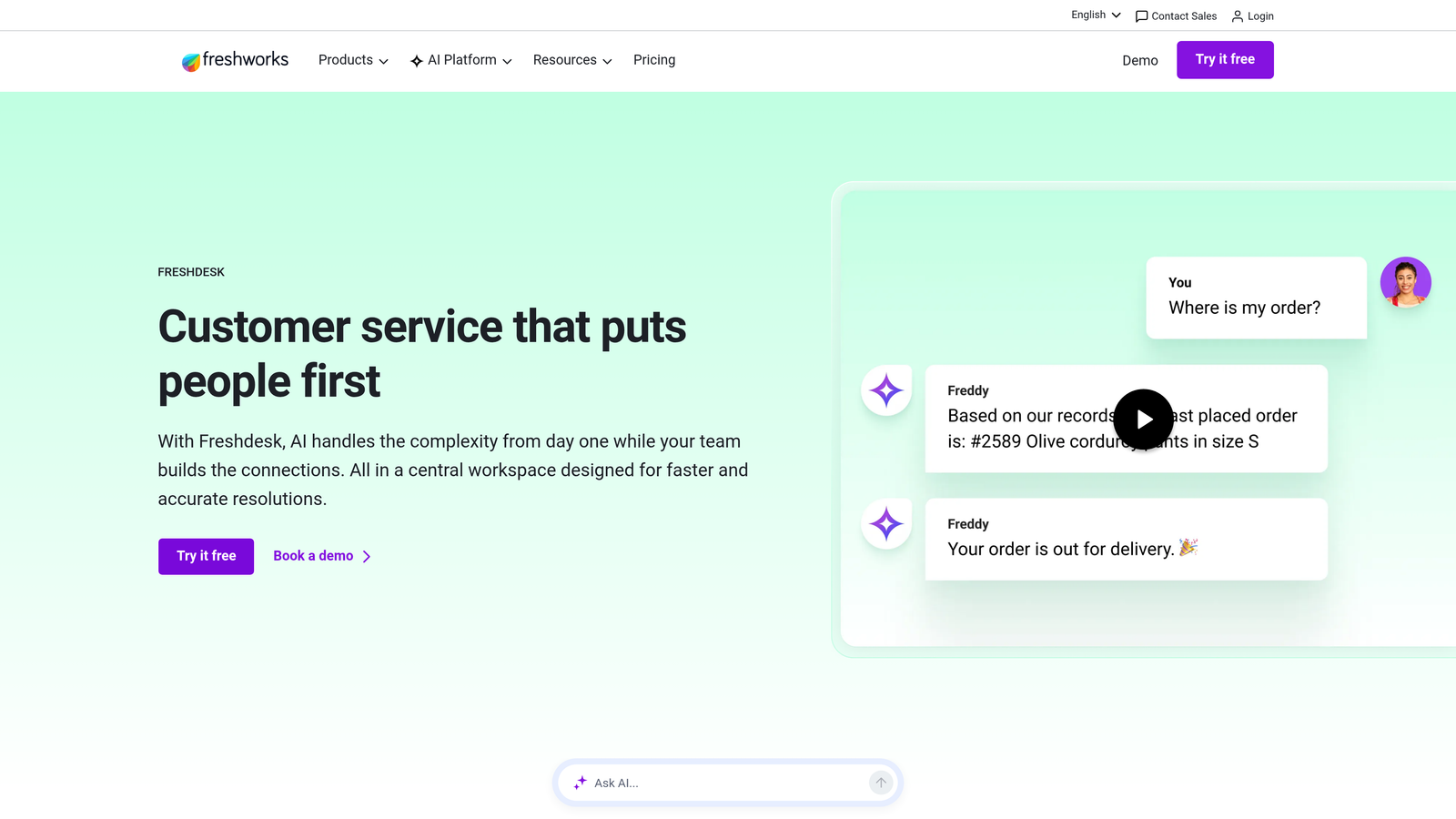
Freshdesk is a widely used helpdesk platform with Freddy AI handling triage, suggestions, and customer satisfaction prediction for teams that need capability without complexity.
Where This Tool Shines
Freshdesk's value proposition is straightforward: you get solid AI-assisted support across email, chat, phone, social, and WhatsApp without the enterprise price tag or implementation burden. Freddy AI handles the repetitive work, from auto-triaging incoming tickets to suggesting responses based on similar past cases.
Being part of the broader Freshworks suite is a genuine advantage for teams that also use Freshsales or Freshservice. Customer data flows between products, which reduces the context-switching that often slows support agents down. For SMBs that want a connected business stack without Salesforce-level complexity, this is a practical choice.
Key Features
Freddy AI Triage: Automatically categorizes, prioritizes, and routes incoming tickets based on content and history.
Smart Response Suggestions: Recommends replies based on ticket context and past successful resolutions.
CSAT Prediction: Identifies tickets likely to result in poor satisfaction scores before they escalate.
Freddy Self Service: AI-powered customer-facing bots for deflecting common queries without agent involvement.
Freshworks Suite Integration: Native connections to Freshsales CRM and Freshservice ITSM for a unified business platform.
Best For
SMBs and growing teams that need reliable omnichannel support with meaningful AI assistance but aren't ready for enterprise-level complexity or cost. Also a strong fit for companies already using other Freshworks products.
Pricing
Free plan available for small teams. Paid plans start at approximately $15 per agent per month. Verify current pricing at freshdesk.com.
5. Salesforce Service Cloud
Best for: Enterprises already in the Salesforce ecosystem wanting unified CRM and support on a single customer record.
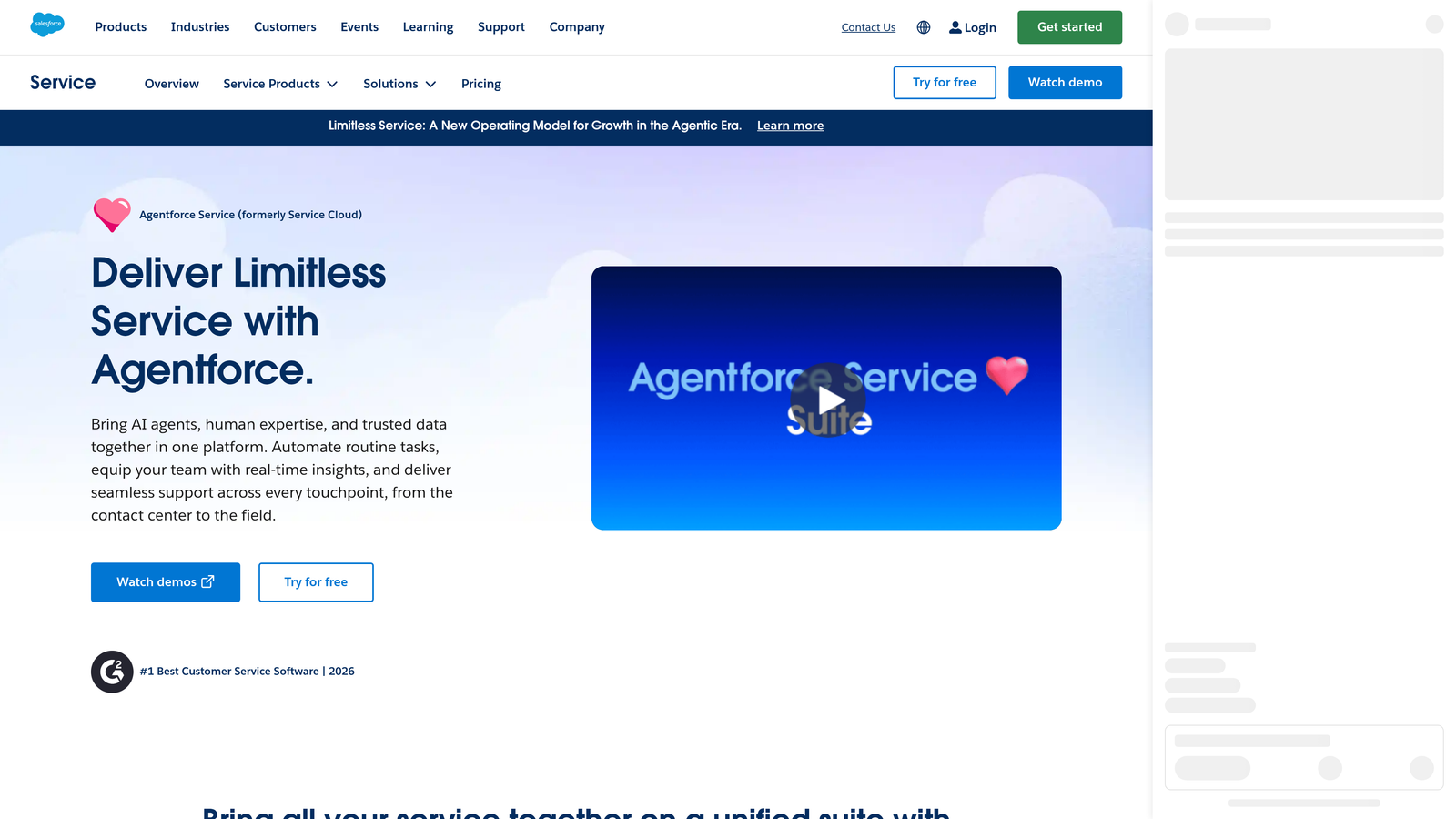
Salesforce Service Cloud is an enterprise support platform with Einstein AI embedded across case management, self-service, and field service operations.
Where This Tool Shines
The core advantage here is not the AI features in isolation but the fact that support data lives in the same system as sales, marketing, and account data. When a support agent opens a case, they see the full customer relationship: contract value, renewal date, recent sales activity, and every prior interaction. That context changes the quality of support fundamentally.
Einstein AI adds case classification, article recommendations, and next-best-action guidance on top of that data foundation. For organizations where sales and service teams need to operate from a shared understanding of the customer, no other platform offers this level of integration without significant custom development.
Key Features
Einstein Case Classification: Automatically categorizes and routes incoming cases based on historical patterns and content analysis.
Unified CRM and Support Record: Every support interaction sits alongside sales, billing, and account data in a single customer view.
Einstein Bots: Self-service automation for common queries, integrated with CRM data for personalized responses.
Next-Best-Action Guidance: AI-driven recommendations for agents based on customer context and business rules.
Extensive Customization: Flow automation and Apex development allow deep tailoring for complex enterprise requirements.
Best For
Large enterprises already using Salesforce CRM where unifying sales and service data is a strategic priority. The implementation complexity and total cost of ownership make it less practical for teams not already in the Salesforce ecosystem.
Pricing
Starter plans begin at approximately $25 per user per month. Enterprise tiers are significantly higher. Verify current pricing at salesforce.com.
6. Tidio
Best for: E-commerce and SMB teams wanting fast deployment with an AI agent that works from day one.
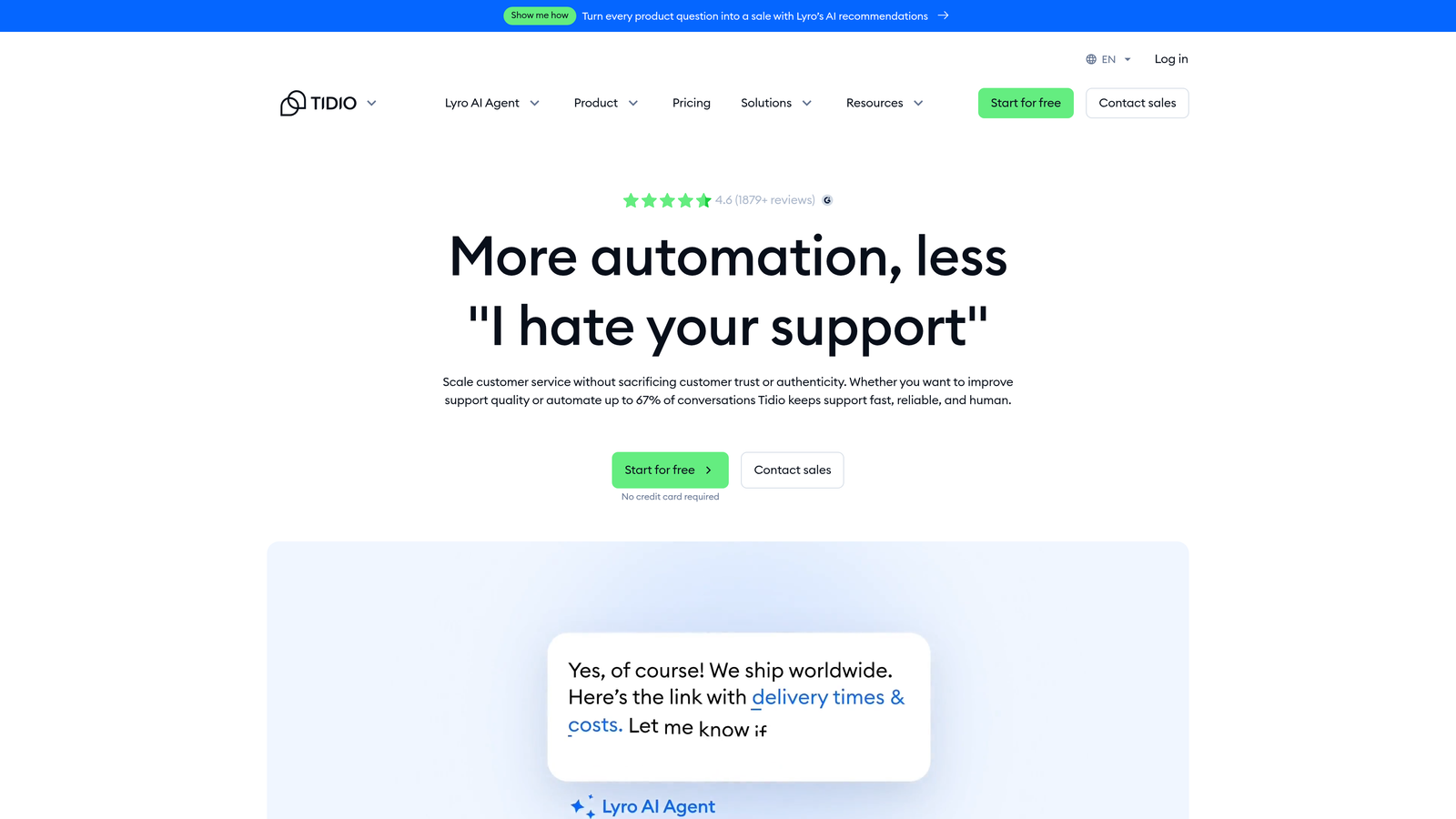
Tidio is a customer service platform with Lyro AI agent designed for quick time-to-value, particularly for businesses running on Shopify or WooCommerce.
Where This Tool Shines
Tidio's defining characteristic is speed of deployment. Where enterprise platforms require weeks of configuration, Tidio can be live and handling conversations in hours. Lyro AI is trained on your existing support content and handles conversational queries in a natural way without requiring technical setup beyond connecting your knowledge source.
The native Shopify and WooCommerce integrations make Tidio especially practical for e-commerce teams. Order status, return policies, product questions, and shipping queries are the bread and butter of e-commerce support, and Lyro handles these well. The visual chatbot builder also gives non-technical teams control over automation flows without writing a line of code.
Key Features
Lyro AI Agent: Conversational AI trained on your support content for autonomous query resolution without complex configuration.
Native E-Commerce Integrations: Direct connections to Shopify and WooCommerce for order and product context in support conversations.
Visual Chatbot Builder: No-code automation flow creation for teams without technical resources.
Proactive Engagement Triggers: Real-time visitor tracking that initiates conversations based on browsing behavior.
Unified Live Chat and Email: All channels managed in one interface alongside AI automation.
Best For
E-commerce businesses and SMBs that need an AI-capable support tool quickly, without a lengthy implementation process. Also well-suited to teams that want to test AI-assisted support before committing to a larger platform investment.
Pricing
Free plan available. Lyro AI starts at approximately $29 per month. Verify current pricing at tidio.com.
7. Kustomer
Best for: High-volume B2C brands managing complex, multi-touch customer journeys across many channels.
Kustomer is a CRM-first support platform that aggregates every customer interaction into a unified timeline, with KustomerIQ providing AI-powered routing and response assistance.
Where This Tool Shines
Kustomer's unified customer timeline is the product's defining feature. Rather than treating each support ticket as an isolated event, every email, chat, SMS, social message, and voice call appears in chronological order on a single customer record. For brands handling hundreds or thousands of daily interactions, this context makes support dramatically more efficient and personal.
KustomerIQ layers AI across this timeline, handling routing decisions, detecting sentiment shifts, and suggesting responses based on conversation history. The workflow automation capabilities also reduce the manual overhead that typically scales linearly with volume, making Kustomer particularly effective for teams managing high ticket counts without proportionally large headcount.
Key Features
Unified Customer Timeline: All cross-channel interactions aggregated into a single chronological customer view for every agent.
KustomerIQ Routing and Sentiment: AI-powered ticket routing and real-time sentiment detection to prioritize and direct conversations appropriately.
Workflow Automation: Rule-based and AI-driven automation to eliminate repetitive manual tasks at scale.
Omnichannel Coverage: Email, chat, SMS, social, and voice managed in one platform.
Customer Lifetime Value Reporting: Analytics connecting support activity to revenue impact and customer health metrics.
Best For
High-volume B2C brands, subscription businesses, and direct-to-consumer companies where understanding the full customer journey across many touchpoints is essential to delivering quality support at scale.
Pricing
Starts at approximately $89 per user per month. Verify current pricing at kustomer.com.
8. Help Scout
Best for: Teams that want AI productivity gains without sacrificing a personal, relationship-driven support experience.
Help Scout is a human-first support platform with AI tools layered in to improve agent efficiency while preserving the tone and warmth of genuine human interaction.
Where This Tool Shines
Not every support team wants to automate as much as possible. Some companies have built their reputation on personal, thoughtful responses, and the last thing they want is AI-generated replies that feel templated. Help Scout is built for exactly this philosophy: AI handles the productivity work (drafting, summarizing, searching) while humans remain in control of what actually gets sent.
AI Drafts generates response suggestions from conversation context, which agents can edit and personalize before sending. AI Summarize condenses long threads for fast handoffs. These features meaningfully reduce time-per-ticket without removing the human judgment that relationship-focused support requires. The shared inbox model also makes team collaboration feel natural rather than transactional.
Key Features
AI Drafts: Generates contextually relevant response drafts for agents to review, edit, and send rather than write from scratch.
AI Summarize: Condenses long conversation threads into quick summaries for efficient agent handoffs and ticket review.
AI Answers: Self-service resolution in the customer-facing widget, drawing from your Docs knowledge base.
Shared Inbox with Collision Detection: Prevents duplicate responses when multiple agents view the same conversation simultaneously.
Docs Knowledge Base: Built-in documentation tool with AI-powered search for both customers and agents.
Best For
Customer success teams, professional services companies, and any business where the quality and tone of individual responses matters as much as response speed. Also a strong fit for teams transitioning from email-based support who want structure without losing the personal feel.
Pricing
Starts at approximately $22 per user per month. Verify current pricing at helpscout.com.
9. Drift (Salesloft)
Best for: Revenue-focused B2B teams blending support conversations with sales qualification and pipeline acceleration.
Drift, now part of Salesloft, is a conversational AI platform built for B2B teams where support and sales conversations overlap significantly.
Where This Tool Shines
Drift occupies a distinct category on this list. It's less a traditional support platform and more a revenue conversation tool that happens to handle support queries as part of a broader engagement strategy. For B2B companies where website visitors might be prospects, existing customers, or at-risk accounts, Drift's ability to identify, route, and engage each type of visitor differently is genuinely valuable.
The Bionic Bots concept, combining AI automation with human playbooks, allows teams to create sophisticated conversation flows that adapt based on who's talking. Account-based targeting means a Fortune 500 prospect gets a different experience than a free-tier user, and meeting booking automation removes friction from the path to a sales conversation. If your support team regularly fields questions that turn into expansion opportunities, Drift bridges that gap.
Key Features
Conversational AI Bots: Handles qualification, routing, and common query resolution autonomously within chat.
Meeting Booking Automation: Allows prospects and customers to book meetings directly within the chat interface without leaving the conversation.
Account-Based Targeting: Personalizes chat experiences based on company identity, enabling different playbooks for different account segments.
Bionic Bots: Combines AI-driven responses with human-authored playbooks for nuanced, context-aware conversation flows.
CRM and Pipeline Integration: Native connections to Salesforce, HubSpot, and Salesloft for full pipeline visibility from support and sales conversations.
Best For
B2B companies with a significant overlap between support and sales conversations, particularly those running account-based marketing or sales motions where personalized engagement at scale is a priority. Less suited to teams primarily focused on reactive ticket resolution.
Pricing
Premium plan pricing is available on request. Enterprise-tier positioning. Contact Drift directly or visit drift.com for current pricing.
Which Intelligent Customer Service Software Is Right for Your Team?
Each platform on this list serves a different core need, and the right choice depends on where your priorities actually sit.
Halo AI is the strongest choice for B2B SaaS teams that want AI-first architecture, page-aware context, and business intelligence built into their support layer from the ground up. It's built for teams where support, product, and engineering need to stay connected.
Intercom is the go-to for omnichannel maturity and a production-ready AI agent that works from existing help content. Zendesk remains the default for large enterprise teams with complex routing and SLA requirements. Freshdesk offers the most accessible entry point for SMBs that need real capability without enterprise pricing.
Salesforce Service Cloud makes the most sense if you're already deep in the Salesforce ecosystem and want a single customer record across sales and service. Tidio is the fastest path to live AI-assisted support, especially for e-commerce teams on Shopify or WooCommerce. Kustomer is purpose-built for high-volume B2C brands that need a unified customer timeline across every channel.
Help Scout is the right call for teams that want AI efficiency without losing the human quality of their responses. And Drift fits B2B teams where support conversations regularly intersect with sales qualification and pipeline acceleration.
If you're evaluating platforms for a B2B SaaS context, the distinction between AI helpdesk software built natively around intelligence versus legacy tools with AI features added on top is worth examining closely. The architecture shapes what's actually possible at scale.
Your support team shouldn't scale linearly with your customer base. Let AI agents handle routine tickets, guide users through your product, and surface business intelligence while your team focuses on complex issues that need a human touch. See Halo in action and discover how continuous learning transforms every interaction into smarter, faster support.