9 Best Intelligent Customer Support Solutions for B2B Teams in 2026
This guide evaluates the 9 best intelligent customer support solution platforms available in 2026, helping B2B teams find the right fit based on AI capability, integration depth, and ease of deployment. From lean startup operations to scaling SaaS companies, it covers what each platform does best so teams can resolve more tickets faster without growing headcount.
 Grant CooperFounder14 min read
B2B support teams are under pressure to resolve more tickets, faster, with leaner headcount. The difference between a frustrated customer and a loyal one often comes down to how intelligently your support system responds, not just how quickly. Intelligent customer support solutions go beyond basic chatbots and ticket routing. They understand context, learn from past interactions, surface business insights, and hand off to humans at exactly the right moment.
This guide covers the top platforms available in 2026, evaluated on AI capability, integration depth, ease of deployment, and suitability for B2B product teams. Whether you're running a lean startup support operation or scaling a mid-market SaaS company, there's a solution here that fits. We've also written a detailed comparison of automated customer service software if you want to go deeper on the evaluation criteria before committing.
1. Halo AI
Best for: B2B SaaS teams wanting autonomous ticket resolution, page-aware guidance, and business intelligence from support interactions.
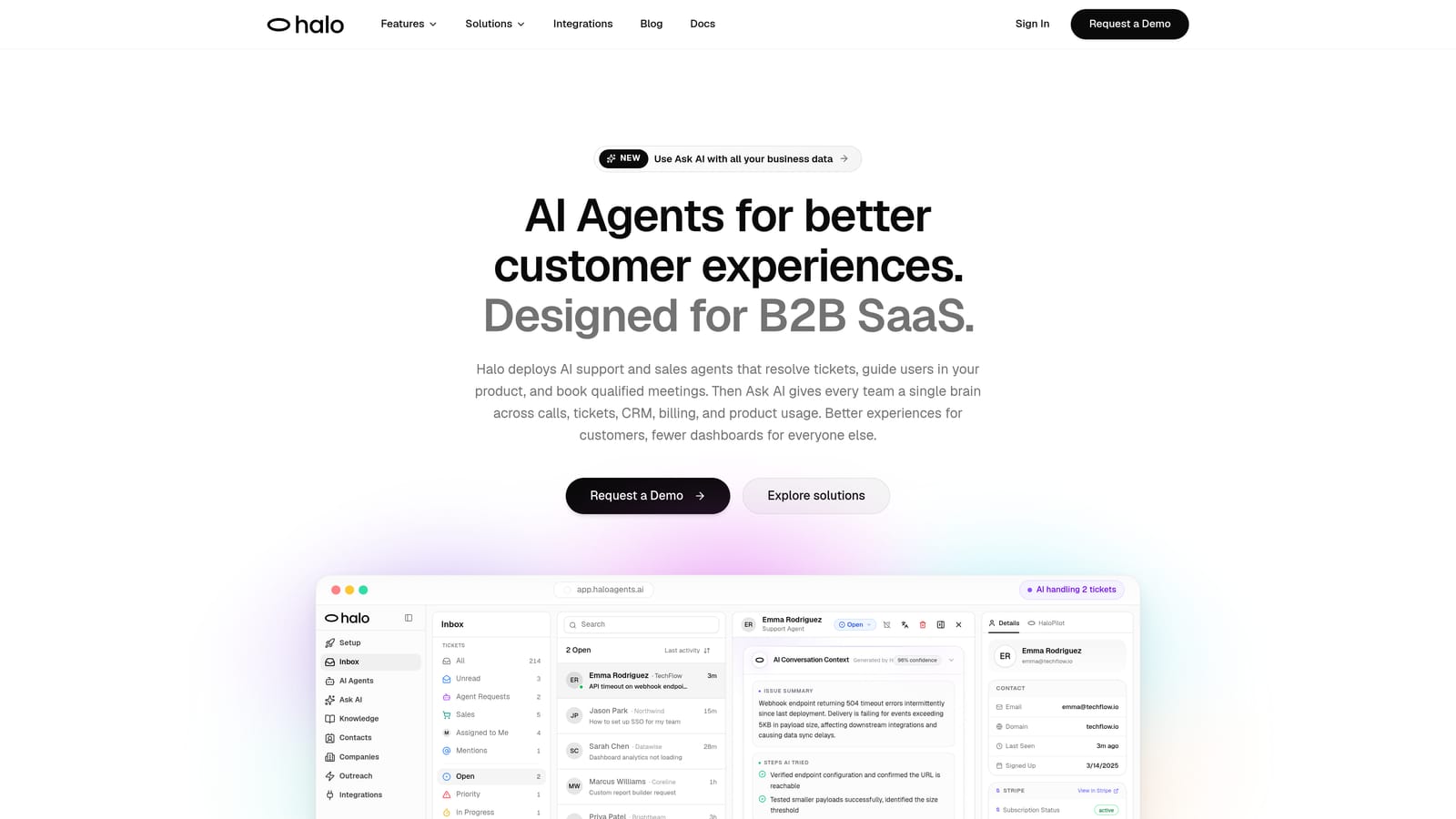
Halo AI is an AI-first customer support platform built specifically for B2B SaaS teams that want support to do more than close tickets.
Where This Tool Shines
Most platforms add AI on top of an existing helpdesk architecture. Halo was built AI-first from the ground up, which means the intelligence isn't a layer you configure, it's the foundation everything runs on. This distinction matters in practice: the system continuously learns from every interaction, getting measurably better at resolving tickets the longer it runs.
What genuinely sets Halo apart is its page-aware context engine. The AI sees what the user is looking at in your product, allowing it to provide contextual UI guidance rather than generic answers. Pair that with a smart inbox that surfaces customer health signals, revenue anomalies, and churn indicators, and support becomes a source of product intelligence, not just a cost center. If you want to understand the broader implications of this approach, Halo's own breakdown of AI-first vs. AI-enabled support is worth reading.
Key Features
Page-Aware Chat Widget: The AI sees what users see in your product and delivers contextual, UI-specific guidance rather than generic responses.
Autonomous Ticket Resolution: AI agents resolve tickets end-to-end with continuous learning baked in, improving with every interaction.
Auto Bug Ticket Creation: Product issues are automatically identified and routed as bug tickets directly to Linear or your engineering workflow.
Smart Inbox with Business Intelligence: Surfaces customer health signals, revenue anomalies, and churn indicators derived from support interactions.
Live Agent Handoff: Complex issues escalate to human agents with full conversation context preserved, so nothing gets repeated.
Deep Integration Stack: Connects with Linear, Slack, HubSpot, Intercom, Stripe, Zoom, PandaDoc, and Fathom.
Best For
B2B SaaS product teams that want AI to autonomously handle support while simultaneously generating business intelligence. Particularly strong for product-led growth companies where support interactions contain valuable signals about user friction, churn risk, and feature adoption. Less suited for teams that prefer a human-first support philosophy.
Pricing
Contact for pricing. Halo is designed for B2B SaaS teams and pricing is tailored to team size and support volume. Worth a direct conversation given the platform's scope.
2. Intercom
Best for: SaaS teams prioritizing conversational support UX with strong in-app messaging.
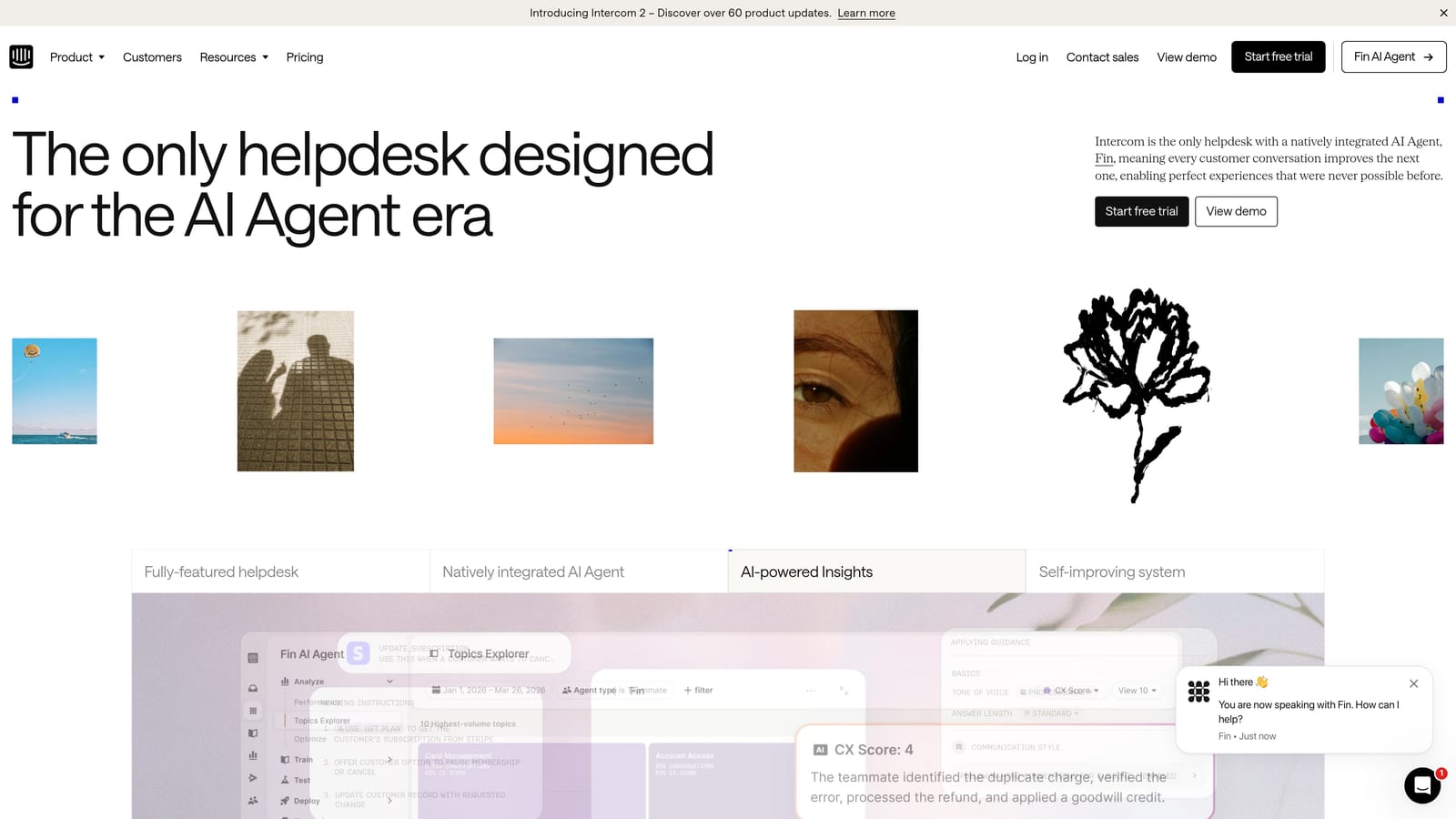
Intercom is a widely adopted conversational support platform with Fin, its AI agent built on large language models, designed to handle a significant portion of support queries without human involvement.
Where This Tool Shines
Intercom's in-app messenger is one of the most polished in the market, and Fin AI has matured into a capable autonomous agent that can resolve a meaningful share of incoming queries. If your team is already embedded in the Intercom ecosystem, the path to AI-assisted support is relatively smooth.
The platform's breadth of integrations and its reputation for strong conversational UX make it a natural choice for teams where the quality of the chat experience is a priority. It's worth noting that Intercom is also an integration partner for Halo AI, so the two can work in complementary ways depending on your stack.
Key Features
Fin AI Agent: Handles autonomous query resolution using large language models, reducing the volume of tickets that reach human agents.
In-App Messenger: Polished conversational interface widely recognized for quality UX in SaaS products.
AI-Powered Inbox Triage: Automatically routes and prioritizes incoming conversations for human agents.
Broad Integration Ecosystem: Connects with a wide range of CRM, analytics, and product tools.
Reporting and Analytics Dashboard: Tracks conversation volume, resolution rates, and team performance.
Best For
Teams already using Intercom who want to layer in AI resolution without switching platforms. Also a strong fit for SaaS companies where the in-app chat experience is a key part of the product's feel. Pricing can escalate at scale, so model costs carefully for high-volume operations.
Pricing
Starts at approximately $39/seat/month. Fin AI usage is billed per resolution, so total cost scales with query volume. Enterprise plans available.
3. Zendesk
Best for: Enterprise teams needing multi-channel support at scale with a mature integration marketplace.
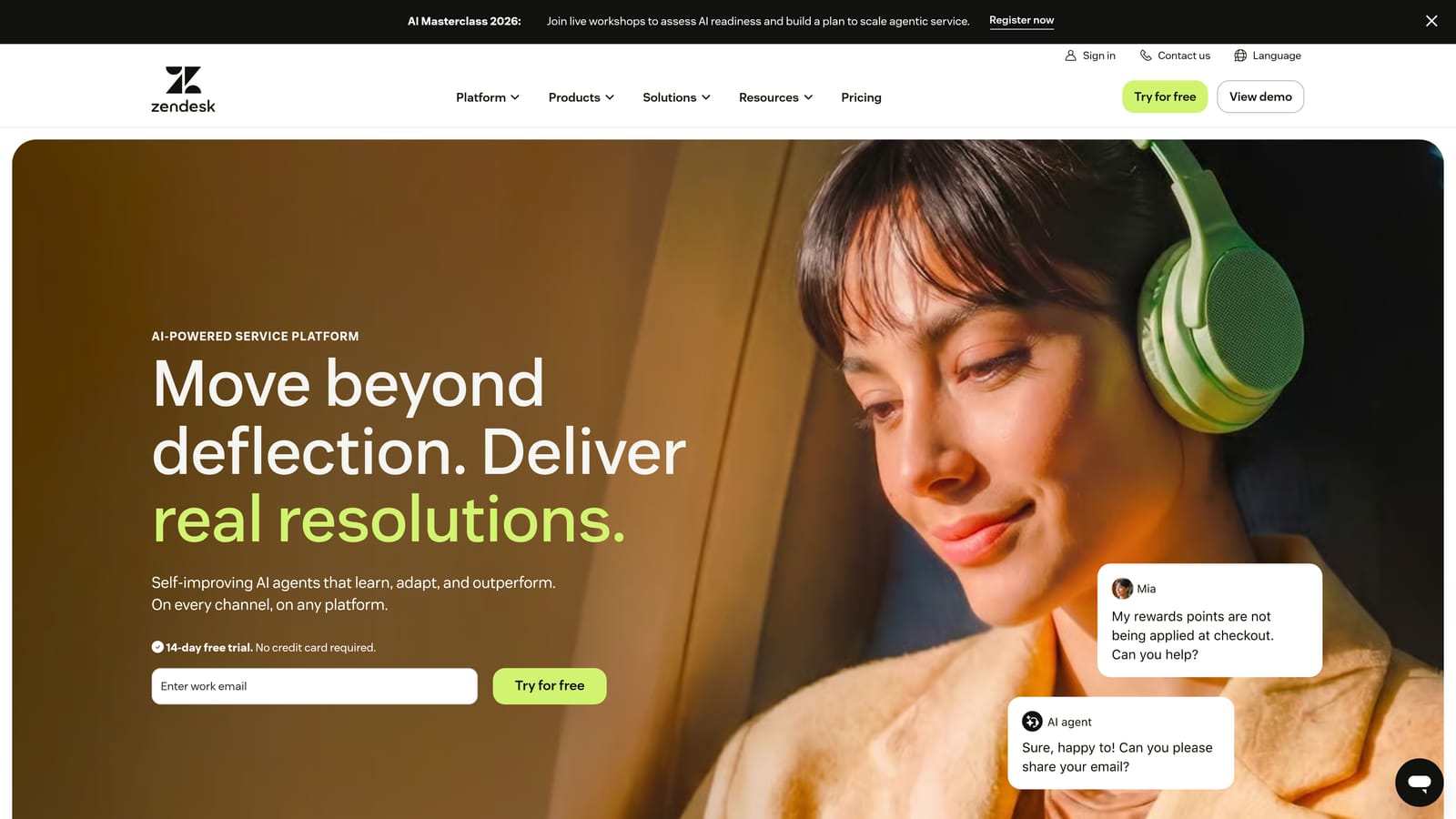
Zendesk is the market-leading enterprise helpdesk platform with AI capabilities layered across triage, agent assist, and self-service, backed by decades of adoption and a vast integration ecosystem.
Where This Tool Shines
Zendesk's strength is breadth. It handles email, chat, voice, social, and messaging in one platform, and its AI features, powered by OpenAI, cover triage, suggested macros, agent assist, and self-service deflection. For enterprise teams managing complex, multi-channel support operations, few platforms match its maturity.
The caveat is complexity. Zendesk's AI is layered onto a legacy architecture, which can make configuration feel heavyweight compared to newer AI-native platforms. If you're evaluating Zendesk specifically for automation, our breakdown of Zendesk automation vs. AI agents covers the tradeoffs in detail.
Key Features
Zendesk AI (OpenAI-Powered): Covers ticket triage, agent assist, intelligent macros, and self-service suggestions.
Multi-Channel Support: Handles email, chat, voice, social media, and messaging from a unified workspace.
Extensive Integration Marketplace: Hundreds of pre-built integrations with CRMs, billing tools, and product platforms.
Advanced Reporting and Workforce Management: Robust analytics and scheduling tools for large support teams.
AI-Powered Knowledge Base: Surfaces relevant articles to agents and customers automatically.
Best For
Enterprise organizations with complex, multi-channel support needs and the IT resources to configure and maintain the platform. Less well-suited for smaller teams or those looking for AI-native autonomous resolution without significant setup investment.
Pricing
Suite plans start at approximately $55/agent/month. AI add-ons are priced separately, so total cost can increase meaningfully for teams leaning on AI features.
4. Freshdesk
Best for: Growing SMB and mid-market teams needing omnichannel support at an accessible price point.
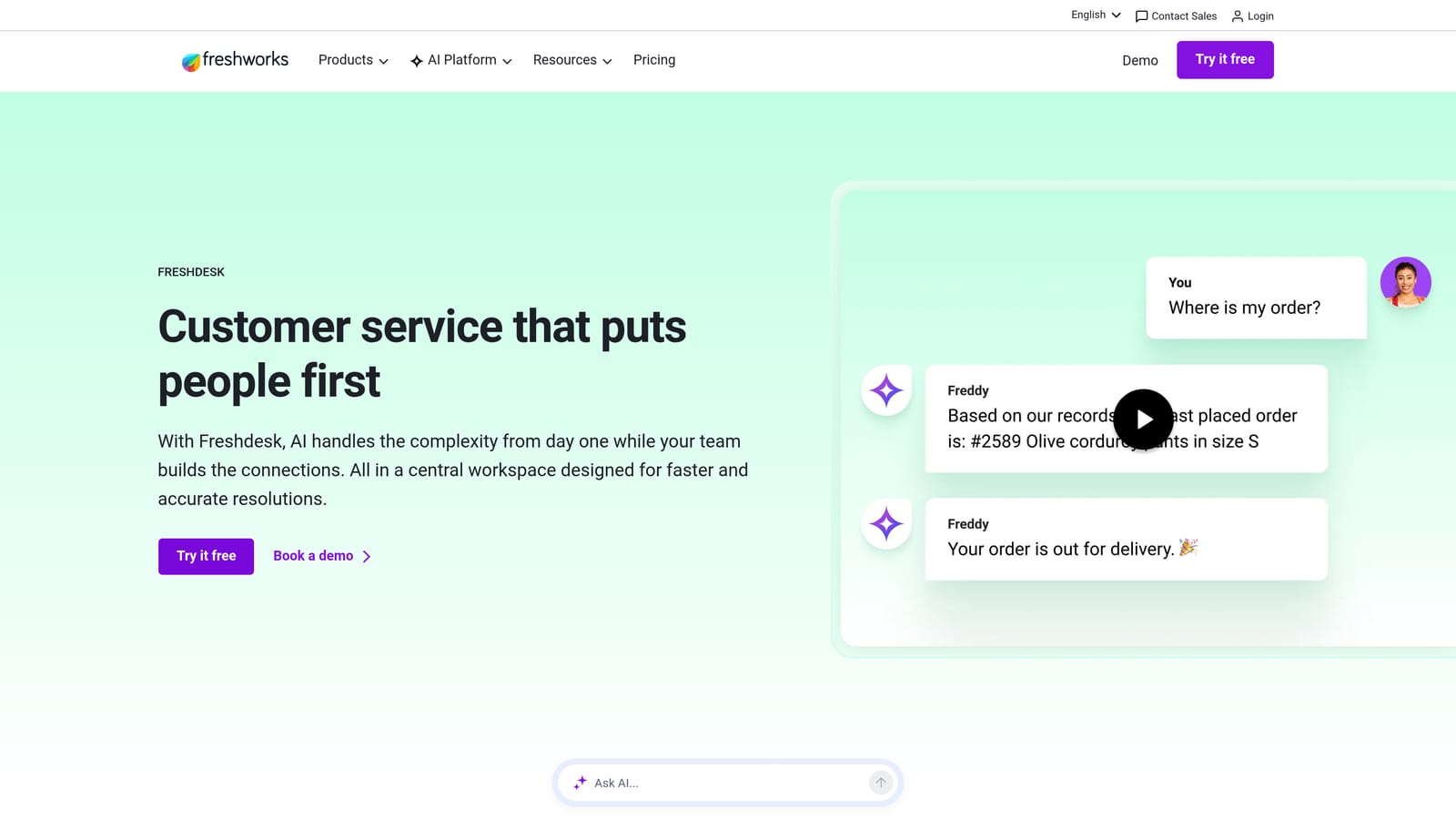
Freshdesk is an omnichannel helpdesk platform with Freddy AI providing auto-triage, suggested responses, and self-service deflection for teams that need capable AI support without enterprise pricing.
Where This Tool Shines
Freshdesk hits a sweet spot between functionality and affordability. Freddy AI handles the core AI workload, including ticket auto-triage, suggested replies, and article recommendations, well enough for most growing teams. The omnichannel coverage across email, chat, phone, and social is solid for the price tier.
Where Freshdesk falls short is in AI autonomy depth. Freddy is primarily an assist tool rather than a fully autonomous resolution engine. For teams comfortable with that tradeoff and prioritizing budget efficiency, it's a strong contender.
Key Features
Freddy AI: Handles ticket auto-triage, suggested replies, and knowledge article recommendations for agents and self-service.
Omnichannel Coverage: Supports email, chat, phone, and social channels from a single platform.
Self-Service Portal: AI-powered article suggestions help customers find answers without agent involvement.
Automation Rules and SLA Management: Configurable workflows for routing, escalation, and compliance.
Competitive Pricing: One of the most affordable full-featured helpdesk platforms in the market.
Best For
SMB to mid-market teams that need solid omnichannel helpdesk functionality with AI assist at a price point that doesn't require executive sign-off. Teams expecting deep autonomous AI resolution may find Freddy's capabilities limiting as they scale.
Pricing
Free plan available for small teams. Paid plans start at approximately $15/agent/month, making it one of the most cost-accessible options on this list.
5. Salesforce Service Cloud
Best for: Enterprise teams already operating within the Salesforce ecosystem who need AI with full CRM context.
Salesforce Service Cloud is an enterprise-grade support platform deeply integrated with Salesforce CRM, with Einstein AI providing case classification, next-best-action recommendations, and knowledge suggestions powered by full customer context.
Where This Tool Shines
The core advantage of Service Cloud is context. Because Einstein AI has access to the full Salesforce CRM record, it can make smarter recommendations than platforms working with support data alone. For enterprise teams where every support interaction involves a named account with a complex relationship history, that context is genuinely valuable.
The honest caveat: Service Cloud is expensive, complex to implement, and typically requires dedicated Salesforce expertise to configure well. For teams not already on Salesforce, the overhead is hard to justify. For teams already in the ecosystem, it's often the natural choice.
Key Features
Einstein AI: Provides case classification, next-best-action recommendations, and knowledge base suggestions using full CRM context.
Deep Salesforce CRM Integration: Every support interaction has access to the complete customer relationship record.
Omni-Channel Routing and Workforce Management: Intelligent routing across channels with scheduling and capacity management.
Knowledge Base with AI Recommendations: Surfaces relevant articles to agents and customers based on case context.
Advanced Analytics and Custom Reporting: Highly configurable reporting tied to CRM data.
Best For
Enterprise organizations already running Salesforce as their CRM backbone. The platform is powerful in that context and genuinely overkill outside of it. Implementation timelines and costs should be factored into any evaluation.
Pricing
Starts at approximately $25/user/month at the Starter tier. Enterprise tiers are significantly higher. Total cost of ownership including implementation is a key consideration.
6. Kustomer
Best for: High-volume, relationship-intensive support teams that need a unified customer timeline across all channels.
Kustomer is a CRM-native support platform that unifies the full customer conversation history into a single timeline, giving its AI automation engine rich context for complex, relationship-intensive support scenarios.
Where This Tool Shines
Kustomer's unified timeline is its defining feature. Rather than treating each ticket as an isolated event, the platform maintains a continuous view of the customer relationship across every channel and interaction. This gives both human agents and the AI automation engine a level of context that ticket-centric platforms can't easily replicate.
The platform's automation builder is also notably flexible, enabling complex multi-step workflows that go beyond basic routing rules. It's particularly well-suited for support operations where relationship history materially affects how issues should be handled.
Key Features
Unified Customer Timeline: Full conversation history across all channels in a single chronological view.
AI-Powered Automation Builder: Enables complex, multi-step workflow automation with contextual logic.
Omnichannel Support: Handles email, chat, phone, and social with full conversation history context preserved.
Intelligent Routing and Prioritization: Routes conversations based on customer attributes, history, and current context.
CRM-Native Architecture: Customer attributes and relationship data are first-class objects, not afterthoughts.
Best For
Mid-to-enterprise teams running high-volume, relationship-heavy support operations where customer history materially affects resolution quality. Less optimized for lean B2B SaaS teams looking for lightweight autonomous AI resolution.
Pricing
Starts at approximately $89/user/month, positioning it in the mid-to-enterprise tier. Pricing reflects the platform's CRM-native depth.
7. Tidio
Best for: Startups and early-stage B2B teams needing fast-to-deploy AI chat support without enterprise complexity.
Tidio is a fast-to-deploy AI chat support platform with Lyro, its conversational AI agent, built for smaller teams that need functional intelligent support without the overhead of enterprise configuration.
Where This Tool Shines
Speed of deployment is Tidio's primary advantage. Lyro can be set up and handling conversations quickly, with minimal technical configuration required. For early-stage companies that need something working now rather than after a months-long implementation, that matters a lot.
The live chat fallback is clean and reliable: when Lyro can't resolve a query, it hands off to a human agent gracefully. The platform's analytics are functional for the use case, though teams that outgrow basic reporting will likely need to migrate to a more capable platform as they scale.
Key Features
Lyro AI Chatbot: Handles autonomous conversational support with a relatively fast setup process.
Quick Deployment: Minimal technical configuration required to get the platform live and handling conversations.
Live Chat Fallback: Seamless handoff to human agents when AI cannot resolve a query.
Basic Analytics and Reporting: Conversation volume, resolution tracking, and basic performance metrics.
SaaS and E-Commerce Integrations: Connects with common tools used by early-stage companies.
Best For
Startups and early-stage B2B teams that need AI-powered chat support operational quickly and affordably. Teams that anticipate rapid growth should plan for a platform migration as their support complexity increases beyond what Tidio handles well.
Pricing
Free plan available. Lyro AI plans start at approximately $29/month, making it one of the most accessible entry points for AI-assisted support on this list.
8. Help Scout
Best for: Teams that prioritize the quality and warmth of human support interactions with AI as an assist layer.
Help Scout is a human-first support platform with AI assist features designed to augment agents rather than replace them, favored by teams where the human quality of support is a core brand value.
Where This Tool Shines
Help Scout has a clear philosophy: AI should make human agents better, not route around them. AI Summarize gives agents instant context on long conversations. AI Assist drafts reply suggestions and adjusts tone. The Beacon help widget enables in-app self-service before a conversation even starts. Together, these features meaningfully reduce agent effort without trying to eliminate the human from the loop.
The platform's UX is notably clean and minimal. Agents consistently report that Help Scout feels less overwhelming than enterprise helpdesks, which translates to faster onboarding and better adoption. If your team culture values the human touch in customer relationships, Help Scout's philosophy aligns well.
Key Features
AI Summarize: Instantly summarizes long conversation threads so agents can get up to speed without reading every message.
AI Assist: Drafts reply suggestions and adjusts tone based on context and conversation history.
Beacon Help Widget: In-app self-service widget that surfaces knowledge base articles before customers open a conversation.
Shared Inbox: Clean, minimal agent UX with strong team collaboration features built in.
Knowledge Base with AI Recommendations: Surfaces relevant articles to both agents and customers automatically.
Best For
Teams where human support quality is a deliberate brand differentiator and AI is wanted as an assist layer rather than an autonomous resolution engine. Not the right fit for teams whose primary goal is to maximize autonomous ticket resolution without human involvement.
Pricing
Starts at approximately $22/user/month. Transparent pricing with no separate AI add-on tiers, which simplifies budget planning.
9. Zoho Desk
Best for: Teams already using Zoho products who want solid AI-assisted support tightly integrated with the Zoho ecosystem.
Zoho Desk is an AI-assisted helpdesk platform with Zia AI handling sentiment analysis, ticket tagging, anomaly detection, and response suggestions, best positioned for teams operating within the broader Zoho suite.
Where This Tool Shines
Zoho Desk's strongest argument is ecosystem fit. If your team is already using Zoho CRM, Zoho Analytics, or other Zoho products, Desk integrates natively in ways that third-party tools can't easily replicate. Zia AI adds genuine value with sentiment analysis and anomaly detection, giving support managers visibility into emerging issues before they escalate.
Outside the Zoho ecosystem, the platform is competitive on price but less differentiated. Zia's AI capabilities are solid for the price point, though they don't match the autonomous resolution depth of newer AI-native platforms. For Zoho-native teams, the value proposition is clear.
Key Features
Zia AI: Provides sentiment analysis, automatic ticket tagging, anomaly detection, and response suggestions.
Deep Zoho Ecosystem Integration: Native connection with Zoho CRM, Zoho Analytics, and the broader Zoho product suite.
Multi-Channel Support: Handles email, chat, phone, and social media from a unified workspace.
Self-Service Portal: AI-powered article suggestions help customers resolve issues without agent involvement.
Competitive Pricing: Strong value within the Zoho ecosystem, particularly for teams already paying for Zoho products.
Best For
Teams operating within the Zoho ecosystem who want AI-assisted helpdesk functionality without adopting a separate platform. Teams outside the Zoho ecosystem will find better-differentiated options elsewhere on this list.
Pricing
Free plan available for small teams. Paid plans start at approximately $14/agent/month, making it one of the most affordable options for teams that can leverage the Zoho ecosystem benefits.
Which Platform Is Right for Your Team?
The right intelligent customer support solution depends heavily on where your team sits today and where you want support to take you. Here's a quick orientation by use case.
AI-first B2B SaaS teams wanting autonomous resolution and business intelligence: Halo AI is the standout choice. The page-aware context engine, smart inbox, and continuous learning architecture are genuinely differentiated for product-led growth companies that want support to generate intelligence, not just close tickets.
Conversational-first teams with existing Intercom workflows: Intercom's Fin AI agent is mature enough to handle a meaningful share of queries, and staying in an established ecosystem has real operational value. Model the per-resolution pricing carefully at scale.
Enterprise multi-channel complexity: Zendesk remains the default for large organizations managing support across many channels and regions. Its AI is layered rather than native, but the platform's maturity and integration depth are hard to match.
Growing teams on a budget: Freshdesk delivers solid omnichannel support with Freddy AI at a price point that doesn't require a budget fight. Expect to outgrow some AI capabilities as you scale.
Salesforce-native enterprises: Service Cloud with Einstein AI is the logical choice when your CRM is Salesforce and you need AI that has full customer context. The implementation overhead is real; plan accordingly.
Relationship-heavy, high-volume operations: Kustomer's unified timeline and flexible automation builder are well-suited for teams where customer history is central to resolution quality.
Startups needing fast deployment: Tidio gets you live quickly at a price that makes sense for early-stage budgets. Plan for a migration when support complexity grows.
Human-first teams: Help Scout's AI assist philosophy and clean UX make it the right fit when the quality of human support is a deliberate brand choice.
Zoho ecosystem users: Zoho Desk's native integrations and competitive pricing make it the obvious choice for teams already invested in the Zoho suite.
Your support team shouldn't scale linearly with your customer base. AI agents can handle routine tickets, guide users through your product, and surface business intelligence while your team focuses on complex issues that genuinely need a human touch. See Halo in action and discover how continuous learning transforms every interaction into smarter, faster support. You can also explore our deeper resources on intelligent support software for B2B and support automation for B2B platforms to continue your evaluation.