9 Best Intelligent Help Desk Software Platforms in 2026
Intelligent help desk software has evolved beyond ticket routing—today's AI-native platforms autonomously resolve issues, surface actionable insights, and scale B2B support without adding headcount. This guide evaluates the 9 top platforms in 2026 based on AI capability, integration depth, and suitability for B2B SaaS teams, helping you choose between truly AI-native solutions and traditional tools with AI features added on.
 Matt PattoliFounder13 min read
Traditional help desks were built to organize tickets, not to resolve them. As support volumes grow and customer expectations rise, B2B teams need platforms that don't just route requests but actively understand, respond, and learn from every interaction. Intelligent help desk software uses AI to automate ticket resolution, surface insights, and scale support without scaling headcount.
This list covers the top platforms in 2026, evaluated on AI capability, integration depth, ease of deployment, and suitability for B2B SaaS teams. Whether you're replacing a legacy helpdesk or layering AI on top of an existing workflow, there's an option here for your team. The most important distinction to keep in mind: AI-native versus AI-added. It shapes everything from how tickets get resolved to how much your team still needs to intervene.
1. Halo AI
Best for: B2B SaaS teams that want autonomous ticket resolution and business intelligence from support data.
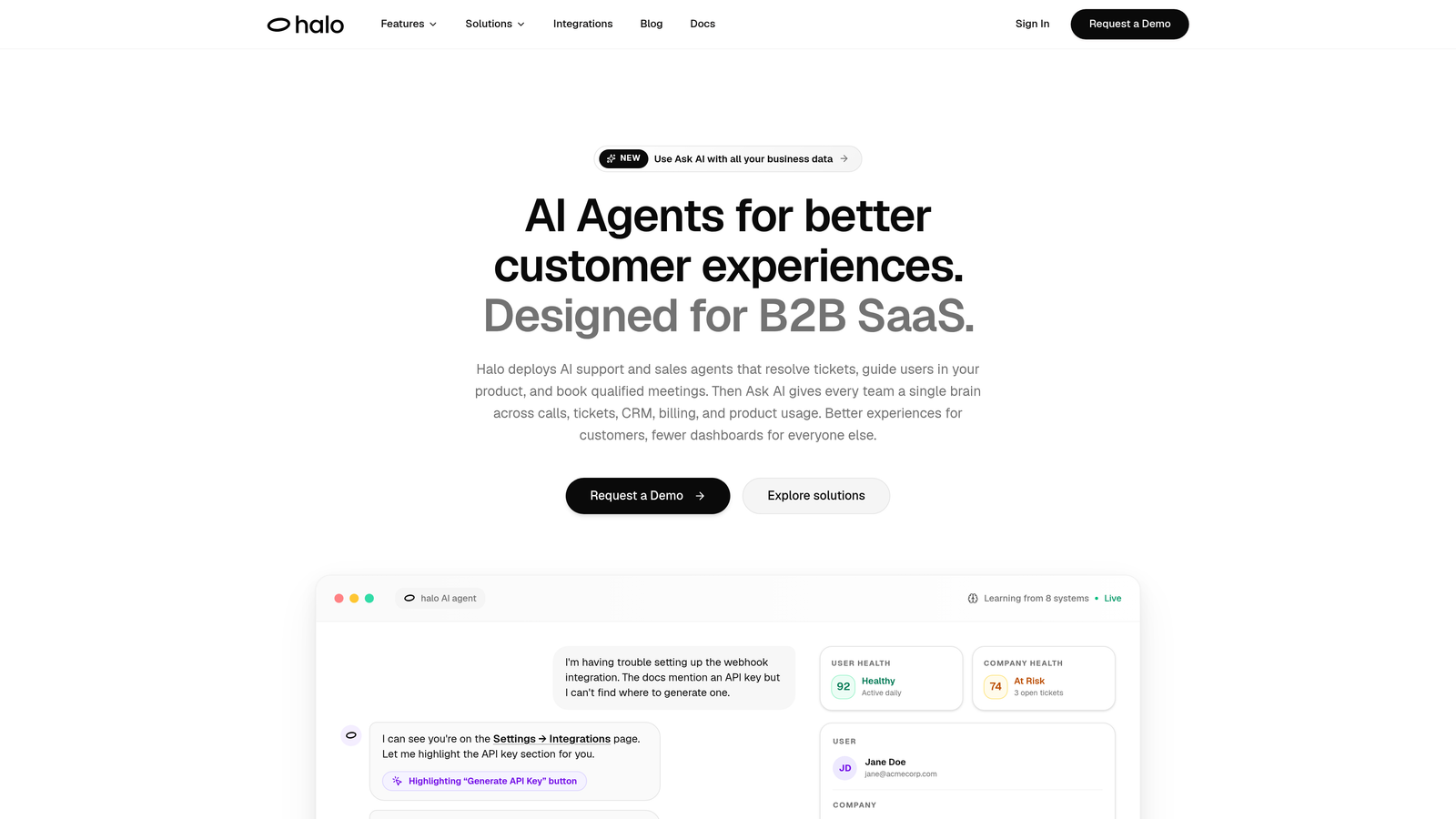
Halo AI is an AI-first customer support platform that deploys intelligent agents to resolve tickets autonomously, guide users through your product, and surface business intelligence from every support interaction.
Where This Tool Shines
What separates Halo AI from most tools on this list is its architecture. Rather than layering AI onto a traditional ticketing system, Halo was built around AI as the core resolution engine. Its page-aware chat widget sees what the user sees, allowing it to provide contextual, visual guidance rather than generic answers. That context-awareness is rare and genuinely useful for SaaS products with complex interfaces.
The smart inbox goes beyond ticket management. It surfaces customer health signals, flags revenue-relevant patterns, and detects anomalies in support behavior, turning your support queue into a source of business intelligence. For product and growth teams, that's a meaningful upgrade over a standard helpdesk dashboard.
Key Features
Page-Aware AI Agents: Agents understand which product page or feature the user is on and deliver in-context visual UI guidance accordingly.
Autonomous Ticket Resolution: AI agents resolve tickets end-to-end with continuous learning from every interaction, improving accuracy over time.
Smart Inbox with Business Intelligence: Surfaces customer health signals, revenue intelligence, and anomaly detection directly from support data.
Auto Bug Ticket Creation: Automatically generates and routes bug reports to engineering tools like Linear, reducing manual handoffs.
Live Agent Handoff: Escalates complex issues to human agents with full context preserved, so nothing gets lost in the transition.
Deep Integration Ecosystem: Connects natively with Slack, HubSpot, Intercom, Stripe, Zoom, PandaDoc, and Fathom.
Best For
Halo AI is best suited for B2B SaaS companies at growth or scale stage that want to reduce ticket volume without growing headcount. Product teams that need support data to feed back into product decisions will find the business intelligence layer especially valuable. It works well as both a primary helpdesk and as an augmentation layer on top of existing tools like Intercom.
Pricing
Contact for pricing. Halo AI is positioned for B2B SaaS teams at growth and scale stages, so pricing is tailored to team size and use case rather than offered as a flat per-seat rate.
2. Zendesk
Best for: Enterprise teams needing a proven, deeply customizable helpdesk with broad AI coverage.
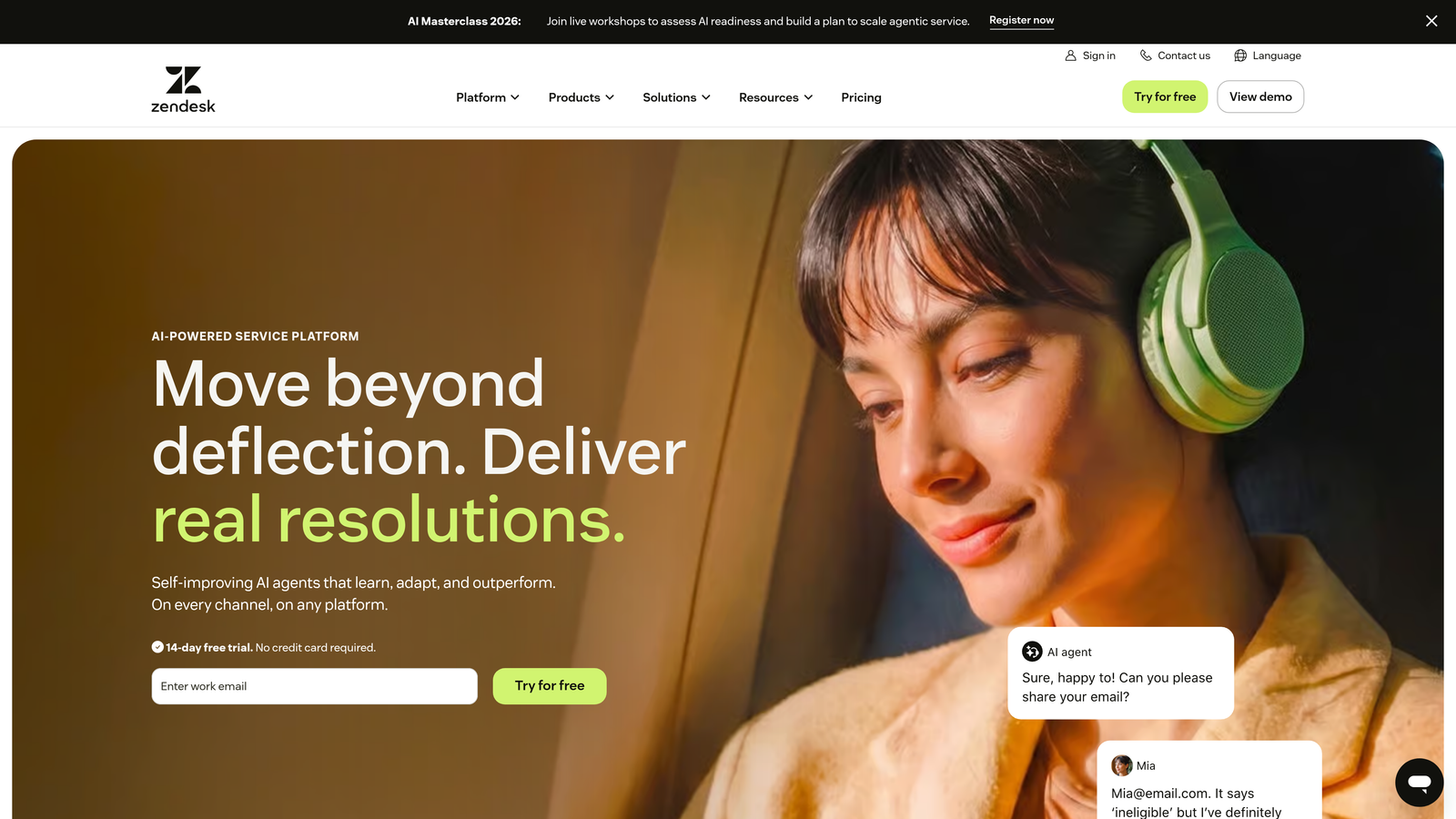
Zendesk is one of the most established enterprise helpdesk platforms, now with AI triage, AI agents, and a vast marketplace of integrations.
Where This Tool Shines
Zendesk's strength is breadth. With over 1,500 marketplace integrations, enterprise-grade compliance controls, and omnichannel coverage across email, chat, voice, and social, it handles complex support operations at scale. The reporting and analytics dashboards are among the most mature in the market.
Zendesk AI adds intelligent triage, intent detection, and suggested responses on top of that foundation. It's genuinely useful for improving agent productivity, though it's worth noting that AI features are add-ons on many plans, so the out-of-the-box experience depends heavily on which tier you're on.
Key Features
Zendesk AI: Handles intelligent triage, intent detection, and suggested responses to speed up agent workflows.
Omnichannel Support: Unified inbox across email, chat, voice, social media, and messaging platforms.
Advanced Reporting: Detailed analytics dashboards for SLA tracking, team performance, and customer satisfaction trends.
1,500+ Integrations: Extensive marketplace covering CRM, billing, product analytics, and engineering tools.
Enterprise Security: Compliance controls, data residency options, and role-based access for large organizations.
Best For
Zendesk is the go-to for enterprise teams with complex support operations, high agent counts, and a need for deep customization. It's less ideal for early-stage companies where setup overhead and per-seat pricing can feel heavy.
Pricing
Plans start at approximately $19/agent/month. AI features are available on higher tiers and may require additional add-ons. Verify current pricing on the Zendesk website before budgeting.
3. Freshdesk
Best for: Budget-conscious mid-market teams that want omnichannel support with built-in AI assistance.
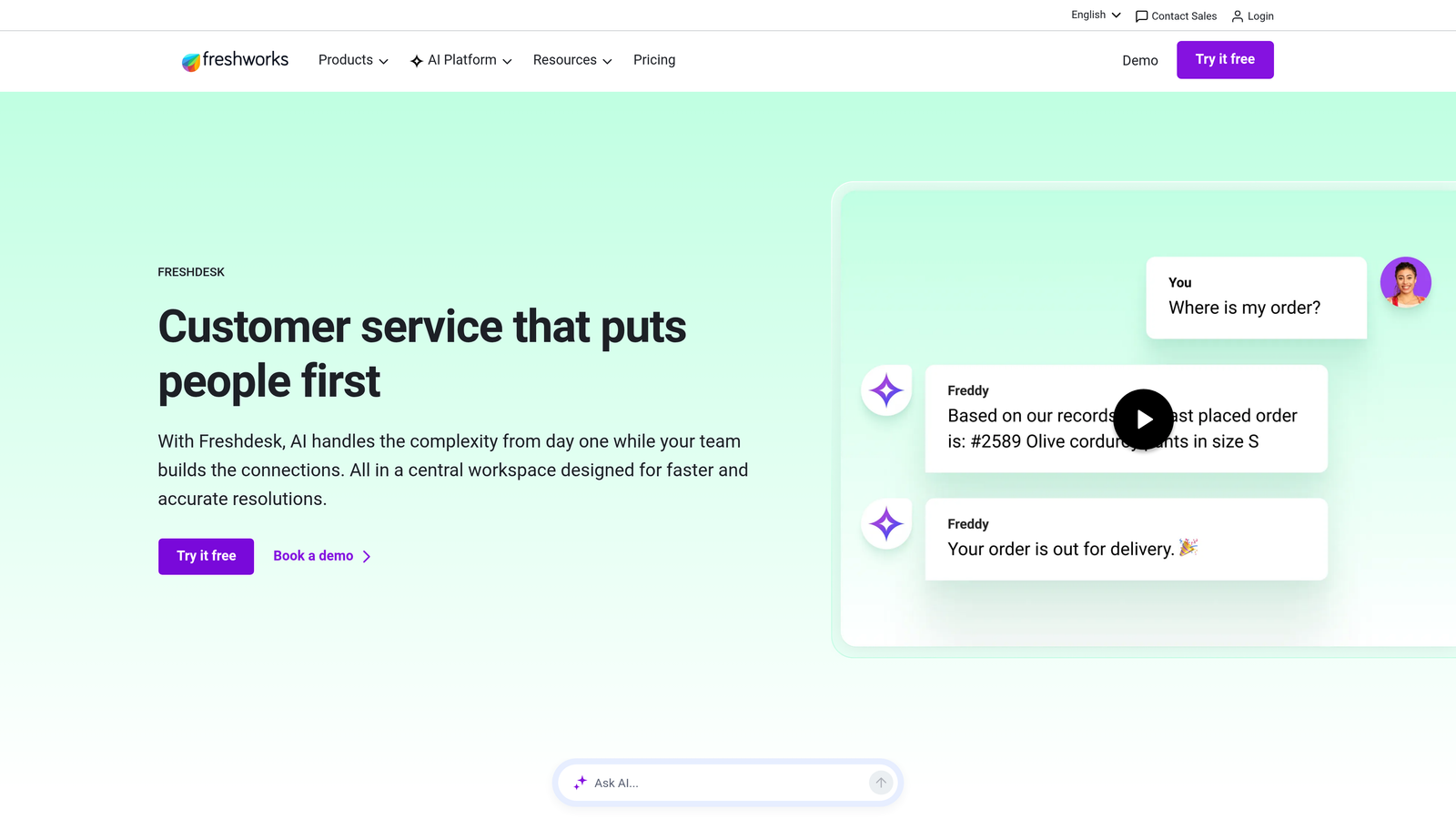
Freshdesk is a widely used omnichannel helpdesk from Freshworks with Freddy AI built in for automation, suggested replies, and self-service.
Where This Tool Shines
Freshdesk hits a strong value-to-feature ratio. Freddy AI handles auto-triage, suggests replies to agents, and powers a self-service bot, covering the most common AI use cases without requiring a premium-tier commitment. For teams coming from a purely manual helpdesk, it's a meaningful step up.
The collision detection feature is a practical standout: it prevents two agents from unknowingly working on the same ticket simultaneously, which is a surprisingly common pain point in shared inbox environments.
Key Features
Freddy AI: Provides auto-triage, suggested replies, and a self-service bot for deflecting common queries.
Omnichannel Inbox: Consolidates email, chat, phone, and social media into a single agent workspace.
Collision Detection: Alerts agents when someone else is already working on a ticket to prevent duplicate responses.
Parent-Child Ticketing: Breaks complex issues into linked sub-tickets for coordinated resolution across teams.
Free Plan: Available for small teams with basic ticketing needs, making it accessible for early evaluation.
Best For
Freshdesk works well for growing mid-market teams that need omnichannel coverage and AI assistance without Zendesk-level pricing. Teams already using other Freshworks products (CRM, ITSM) will benefit from native cross-product integration.
Pricing
Free plan available for basic use. Paid plans start at approximately $15/agent/month. AI-powered features are available on mid-tier and higher plans.
4. Intercom
Best for: SaaS teams that want support embedded in the product experience with a conversational AI agent.
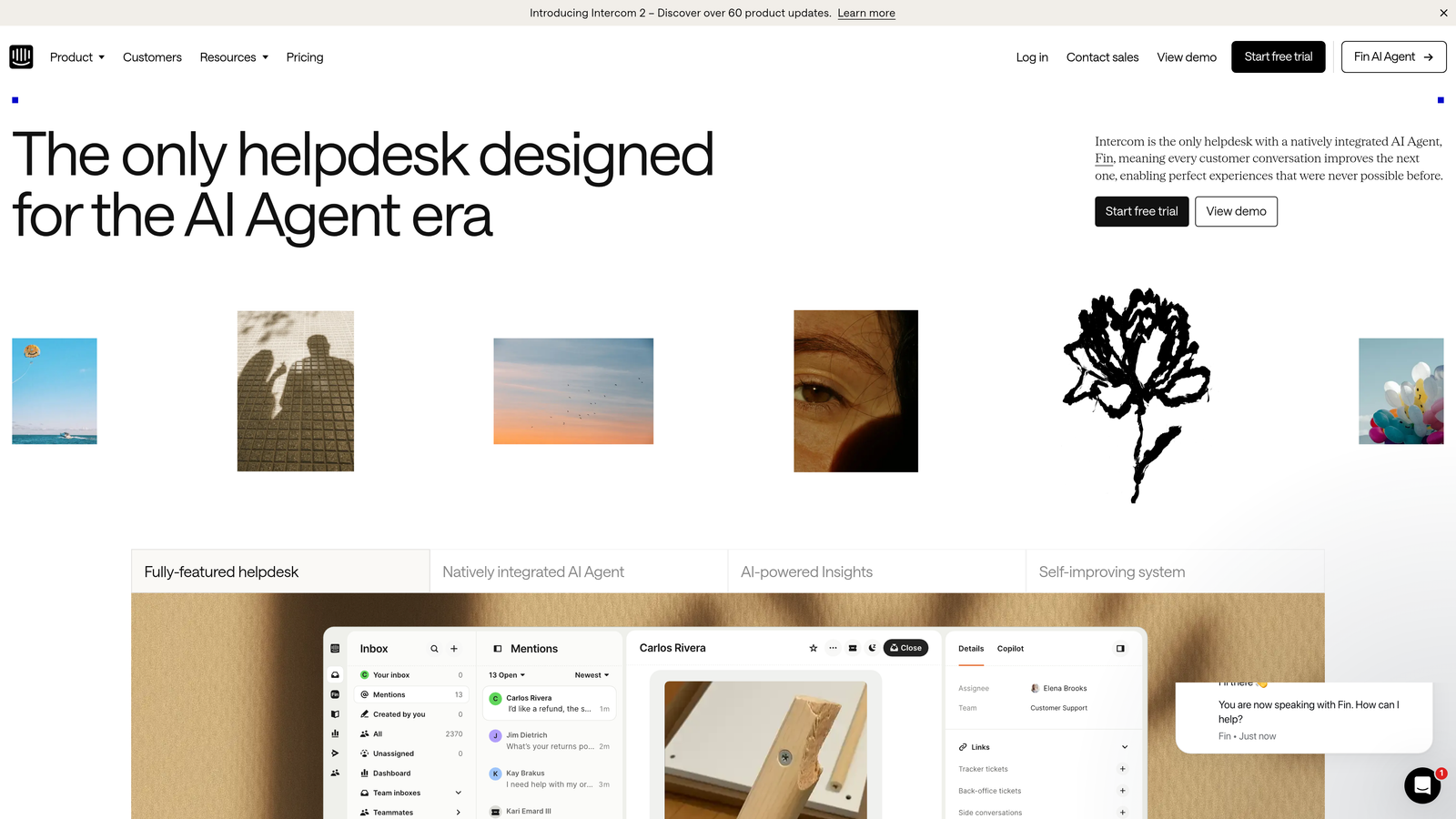
Intercom is a conversational support and engagement platform with Fin, an AI agent built on large language models, designed for in-product and messaging-first support.
Where This Tool Shines
Intercom's Fin AI agent is one of the more capable autonomous resolution tools on the market. Built on large language models, it can handle a meaningful portion of common queries without human intervention. For SaaS companies where support happens inside the product, that in-context experience is a significant advantage over email-first helpdesks.
Beyond support, Intercom functions as a lightweight CRM with behavioral event tracking. This makes it useful for product teams that want to connect support interactions to user behavior data, not just ticket counts.
Key Features
Fin AI Agent: Resolves common queries autonomously using large language models trained on your help content.
In-Product Messaging: Supports onboarding flows, proactive messages, and contextual support within your application.
Shared Inbox: AI summarization and smart routing for human agents handling escalated conversations.
Customer Data Platform: Tracks behavioral events to connect support activity with product usage patterns.
Broad Integrations: Connects with CRM tools, product analytics platforms, and engineering workflows.
Best For
Intercom is best for SaaS companies that prioritize in-product support and want a conversational AI agent handling tier-one queries. Teams that also need proactive messaging and onboarding flows will get more mileage from Intercom than from a pure helpdesk.
Pricing
Plans start at approximately $39/seat/month. Fin AI is priced on a usage basis in addition to the base plan. Costs can escalate with high conversation volumes, so model your expected usage before committing.
5. Help Scout
Best for: Small teams that want a human, email-like support experience with lightweight AI assistance.
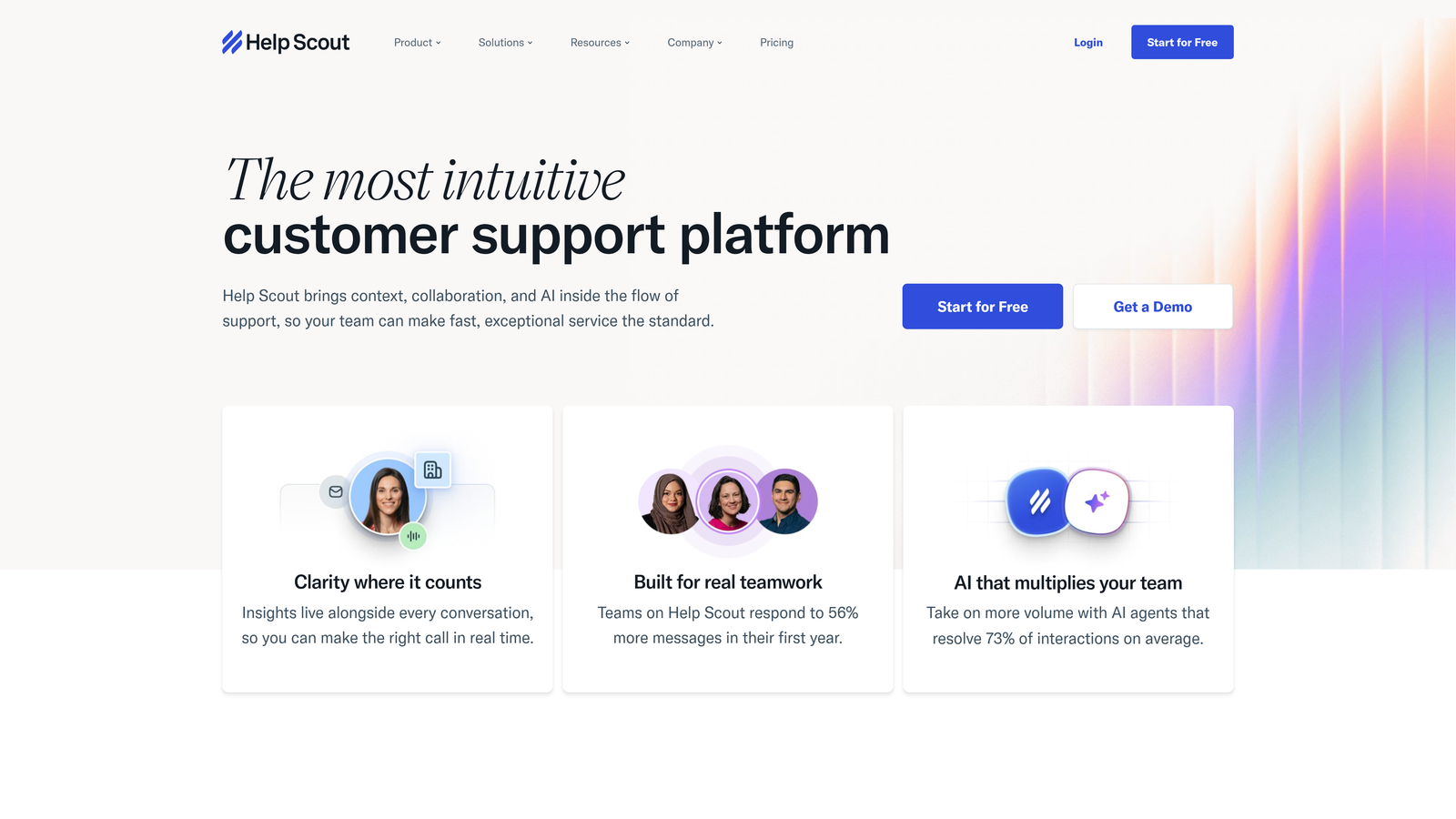
Help Scout is a shared inbox helpdesk built to feel like email, with AI Summarize and AI Assist features layered in for agent productivity.
Where This Tool Shines
Help Scout's philosophy is intentional: no ticket numbers, no robotic interfaces, no friction between your team and the customer. It's designed to make support feel like a genuine conversation rather than a queue. For teams where tone and relationship quality matter, that design choice has real impact on how agents work.
The AI additions are practical rather than transformative. AI Summarize gives agents an instant briefing on long conversation threads, and AI Assist helps draft and polish replies. These are productivity boosters rather than autonomous resolution tools, which is an honest fit for Help Scout's positioning.
Key Features
AI Summarize: Instantly condenses long conversation threads so agents can catch up without reading everything.
AI Assist: Drafts and improves agent replies, reducing time spent on phrasing and formatting.
No Ticket Numbers: Conversations stay conversational, with no ticket IDs visible to customers.
Docs Knowledge Base: Built-in knowledge base with AI-powered search to support self-service.
Customer Profiles: Full conversation history, notes, and customer data in a single sidebar view.
Best For
Help Scout is ideal for small to mid-sized teams that prioritize agent experience and customer tone over automation depth. It's a strong choice for companies where support is relationship-driven and where heavy automation would feel out of character.
Pricing
Plans start at approximately $20/user/month. Pricing is straightforward with no complex tier structures for core features.
6. Zoho Desk
Best for: Teams already in the Zoho ecosystem that want context-aware support with strong workflow automation.
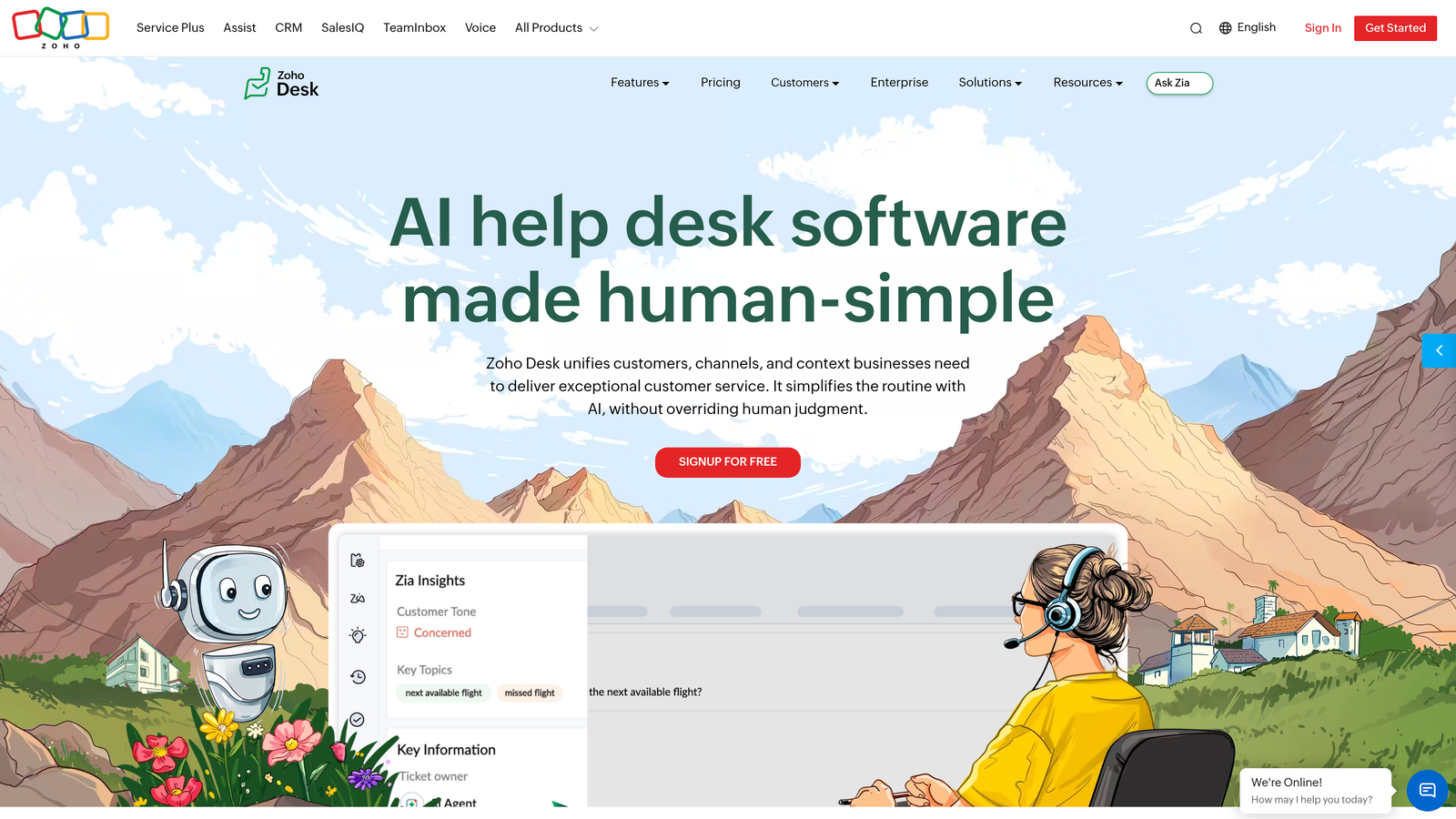
Zoho Desk is a context-aware helpdesk tightly integrated with the Zoho ecosystem, featuring Zia AI for sentiment analysis, anomaly detection, and workflow automation.
Where This Tool Shines
Zia, Zoho's AI assistant, brings a few capabilities that are genuinely differentiated. Sentiment analysis on incoming tickets lets teams prioritize based on customer frustration level, not just arrival time. Anomaly detection flags unusual spikes in ticket volume before they become a crisis, giving operations teams early warning signals.
For teams already using Zoho CRM, the integration is seamless. Agents get full customer context, purchase history, and CRM data surfaced directly in the ticket view, which reduces the tab-switching that slows down resolution times.
Key Features
Zia AI: Handles sentiment analysis, ticket tagging, response suggestions, and anomaly detection in ticket trends.
Zoho CRM Integration: Surfaces unified customer context, deal history, and account data within the support view.
Blueprint Automation: Visual workflow builder for creating multi-step support processes with conditional logic.
Anomaly Detection: Flags unusual ticket volume patterns so teams can respond proactively.
Multichannel Coverage: Handles email, chat, phone, social media, and web forms in one workspace.
Best For
Zoho Desk is the natural choice for teams running on the Zoho stack. It's also a strong value option for mid-market teams that want solid AI assistance and workflow automation without enterprise-tier pricing.
Pricing
Free plan available for up to 3 agents. Paid plans start at approximately $14/agent/month, making it one of the more accessible options on this list.
7. Gorgias
Best for: E-commerce brands that want AI automation tied directly to order data and revenue outcomes.
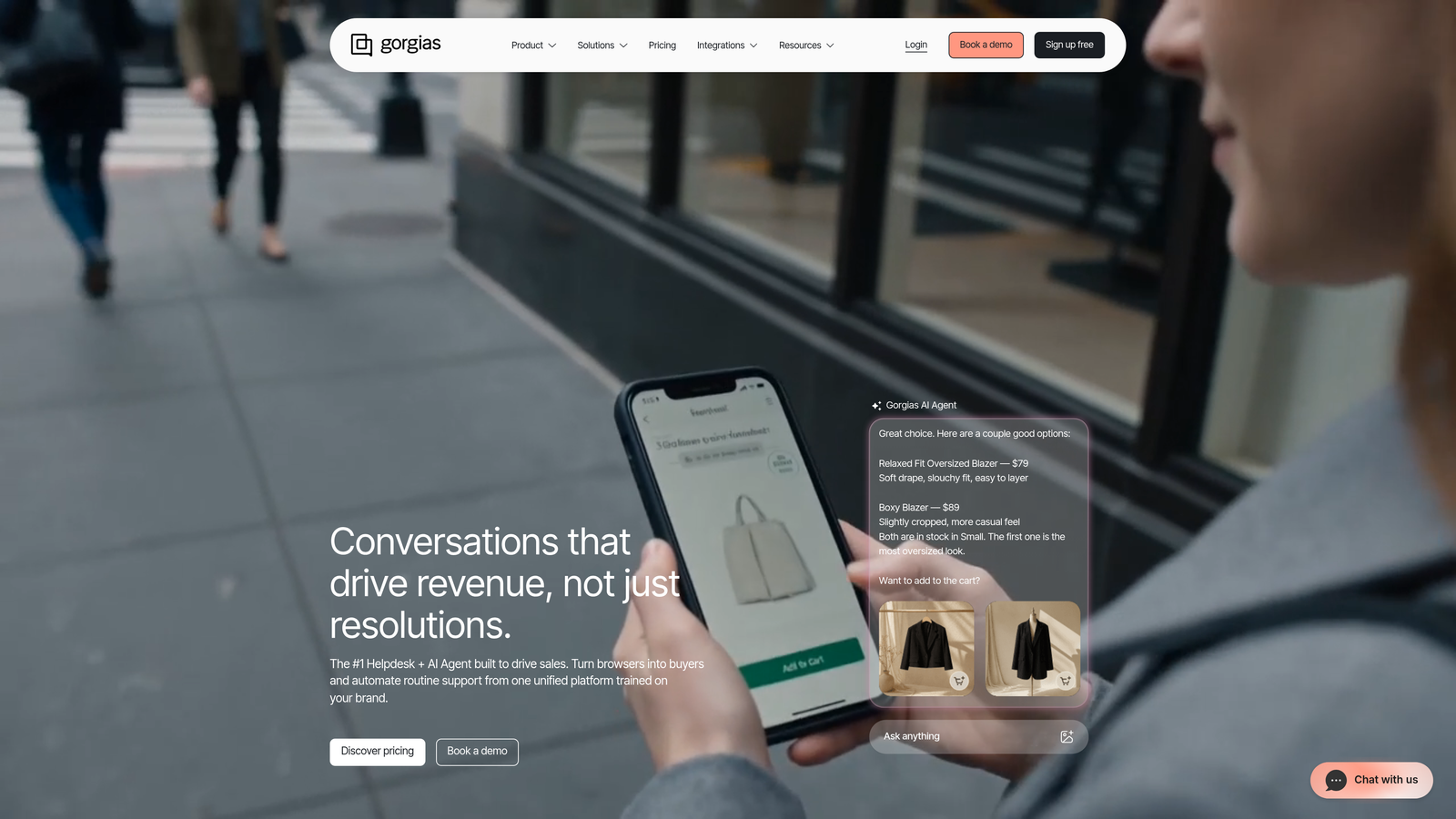
Gorgias is an e-commerce-focused helpdesk with AI automation built around order data, revenue attribution, and deep integrations with Shopify and other commerce platforms.
Where This Tool Shines
Gorgias solves a specific problem extremely well: high-volume, order-related support for e-commerce teams. Its revenue attribution feature ties support tickets to purchase outcomes, so teams can see which conversations drive conversions and which ones are pure cost. That kind of visibility is rare in the helpdesk category.
The Shopify integration runs deep. Agents can view order details, issue refunds, and modify orders directly from the ticket interface without switching tabs. For brands handling hundreds of order-related queries daily, that workflow compression adds up quickly.
Key Features
Revenue Attribution: Links support interactions to purchase outcomes, making support ROI visible to the business.
AI Automation: Handles order status, returns, and refund queries autonomously using order data as context.
Commerce Integrations: Deep native connections with Shopify, Magento, BigCommerce, and WooCommerce.
Macros and Rules: High-speed automation for repetitive query handling at volume.
Unified Inbox: Consolidates email, chat, social media, and SMS into a single agent view.
Best For
Gorgias is purpose-built for e-commerce and DTC brands. It's less relevant for pure B2B SaaS teams, but for any company with a significant commerce component, it's the most specialized tool on this list.
Pricing
Plans start at approximately $10/month on a ticket-based pricing model rather than per-seat, which can be cost-effective for small teams with moderate volume.
8. Tidio
Best for: Early-stage startups and lean teams that need fast AI chat deployment with minimal setup.
Tidio is an accessible AI chat and helpdesk platform with Lyro AI chatbot, designed for quick deployment and lean teams that need basic automation fast.
Where This Tool Shines
Tidio's primary advantage is speed to value. The visual chatbot flow builder requires no coding, and the Lyro AI chatbot can be live and handling queries within hours of setup. For teams that need something working today rather than a multi-week implementation, that matters.
Lyro handles automated query resolution using your existing FAQ and knowledge content. It's not the deepest AI on this list, but for early-stage companies with straightforward support needs, it covers the most common scenarios effectively without requiring a dedicated support engineer to configure.
Key Features
Lyro AI Chatbot: Resolves common queries automatically using your knowledge base content as its source.
Unified Inbox: Combines live chat, email, and Facebook Messenger in a single agent interface.
Visual Flow Builder: No-code chatbot designer for creating custom conversation flows without engineering support.
Visitor Tracking: Monitors active visitors and triggers proactive chat based on behavior rules.
Free Tier: Available with Lyro conversation limits, making it accessible for pre-revenue or early-stage teams.
Best For
Tidio is best for early-stage startups, small e-commerce businesses, or any team that needs functional AI chat deployed quickly. It's not built for complex B2B workflows or enterprise-scale operations, but it's an excellent starting point.
Pricing
Free plan available with Lyro conversation limits. Paid plans start at approximately $29/month, making it one of the most affordable options for teams just getting started with AI-assisted support.
9. Kustomer
Best for: High-volume mid-market and enterprise teams that need a CRM-native support experience with AI workflows.
Kustomer is a CRM-native intelligent helpdesk that organizes every support interaction on a unified customer timeline, with AI workflows and automation for high-volume teams.
Where This Tool Shines
Kustomer's defining feature is its customer timeline. Rather than organizing work by ticket, it organizes everything by customer, pulling together CRM data, order history, prior support conversations, and behavioral signals into a single chronological view. For agents handling complex, multi-touch customer relationships, that context is genuinely valuable.
The AI layer handles routing, classification, and suggested responses, reducing the manual triage burden on teams processing large volumes. Combined with the workflow automation engine, Kustomer can handle sophisticated business rules that simpler helpdesks can't accommodate.
Key Features
Unified Customer Timeline: Combines CRM data, order history, and all support conversations in a single chronological view per customer.
AI-Powered Routing: Automatically classifies, prioritizes, and routes incoming conversations based on content and customer context.
Omnichannel Coverage: Handles email, chat, voice, SMS, and social media in one unified agent workspace.
Workflow Automation: Business rules and triggers for automating multi-step processes across teams and systems.
Performance Reporting: Tracks team performance, CSAT scores, and resolution trends with configurable dashboards.
Best For
Kustomer is well-suited for mid-market and enterprise teams where agent context is critical and support volume is high. It's particularly strong for companies where support, sales, and customer success data need to live in the same place.
Pricing
Plans start at approximately $89/user/month, positioning Kustomer at the higher end of this list. Budget accordingly for teams with large agent counts.
Which Platform Is Right for Your Team?
The clearest way to choose is to start with one question: do you need AI that assists your agents, or AI that resolves tickets on its own? That distinction separates AI-added platforms from AI-native ones, and it should drive your evaluation more than any feature checklist.
Here's a quick orientation by use case:
Halo AI: Best for B2B SaaS teams that want autonomous resolution, page-aware guidance, and business intelligence from support data. Built AI-first from the ground up.
Zendesk: Best for enterprise teams with complex operations, high agent counts, and a need for deep customization and compliance controls.
Freshdesk: Best for budget-conscious mid-market teams that want omnichannel coverage and solid AI assistance without premium pricing.
Intercom: Best for SaaS companies that want support embedded in the product experience with a capable conversational AI agent.
Help Scout: Best for small teams where tone, relationship quality, and a human feel matter more than automation depth.
Zoho Desk: Best for teams already running on the Zoho ecosystem who want strong workflow automation and AI assistance at accessible pricing.
Gorgias: Best for e-commerce and DTC brands that want AI automation tied directly to order data and revenue attribution.
Tidio: Best for early-stage startups that need AI chat deployed quickly with minimal setup and a low cost of entry.
Kustomer: Best for high-volume mid-market and enterprise teams where CRM-native context and complex workflow automation are priorities.
If your goal is to scale support without scaling headcount, the architecture matters as much as the feature list. Platforms built around AI from the ground up tend to resolve tickets autonomously. Platforms that added AI later tend to make agents faster. Both are valuable, but they solve different problems.
Your support team shouldn't scale linearly with your customer base. Let AI agents handle routine tickets, guide users through your product, and surface business intelligence while your team focuses on complex issues that need a human touch. See Halo in action and discover how continuous learning transforms every interaction into smarter, faster support.