9 Best Intelligent Helpdesk Software Tools in 2026
This guide evaluates nine leading intelligent helpdesk software platforms on AI capability, integration depth, ease of deployment, and real-world scalability — with a focus on B2B SaaS teams. It shows how the right platform can autonomously resolve tickets, surface actionable business intelligence, and turn customer support into a genuine competitive advantage.
 Grant CooperFounder14 min read
Intelligent helpdesk software has moved well beyond ticket routing and canned responses. Today's leading platforms use AI to resolve issues autonomously, surface business intelligence from support interactions, and scale customer experience without adding headcount. Whether you're a B2B SaaS company drowning in support tickets or a product team looking to close the loop between bugs and customer feedback, the right intelligent helpdesk can transform support from a cost center into a competitive advantage.
This guide covers nine standout platforms, evaluated on AI capability, integration depth, ease of deployment, and real-world scalability. We've prioritized tools built for B2B teams using modern helpdesk stacks. We're also upfront that Halo AI is our own product and leads the list — but every tool here earns its place on genuine merit.
1. Halo AI
Best for: B2B SaaS teams that want autonomous AI resolution, product-aware support, and business intelligence from every ticket.
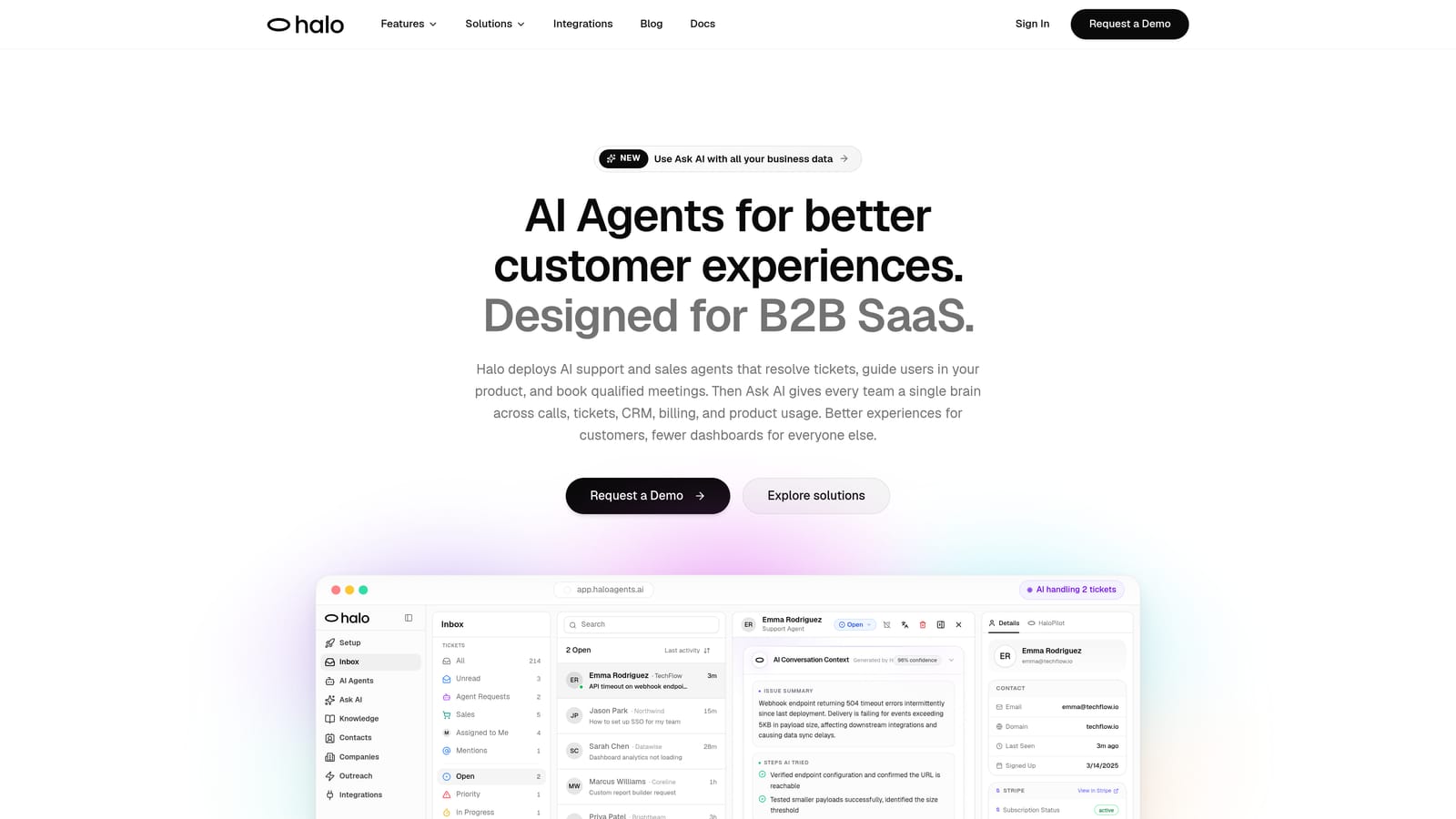
Halo AI is an AI-first customer support platform that deploys autonomous agents to resolve tickets, guide users through products, and surface actionable business intelligence.
Where This Tool Shines
Most helpdesk tools add AI as a layer on top of existing workflows. Halo is built the other way around: AI is the core architecture, and human escalation is the exception rather than the rule. The platform's page-aware chat widget is a standout feature — the AI understands which page a user is currently on, so it can guide them through the product visually rather than sending generic help articles.
What genuinely sets Halo apart is the intelligence layer that extends beyond support. The smart inbox surfaces customer health signals, revenue anomalies, and churn indicators from support interactions, turning your helpdesk into a source of business intelligence that product, sales, and success teams can actually use.
Key Features
Autonomous AI Agents: Resolve tickets end-to-end without human intervention, with continuous learning from every interaction to improve over time.
Page-Aware Chat Widget: The AI sees the user's current product context and delivers guidance relevant to exactly where they are in your application.
Smart Inbox with Business Intelligence: Surfaces customer health signals, churn indicators, and revenue anomalies directly from support data.
Auto Bug Ticket Creation: Automatically identifies and routes bug reports to engineering tools like Linear, closing the loop between support and product teams.
Live Agent Handoff: Seamlessly escalates complex issues to human agents with full conversation context preserved.
Deep Integration Stack: Connects natively with Slack, HubSpot, Intercom, Stripe, Zoom, PandaDoc, Fathom, and Linear.
Best For
B2B SaaS companies and product-led growth teams that want to scale support without scaling headcount. Particularly well-suited for teams that need their support data to feed back into product development, customer success, and revenue workflows rather than sitting siloed in a helpdesk.
Pricing
Contact for pricing. A demo is available at haloagents.ai to see the platform in context of your specific support stack.
2. Zendesk
Best for: Large enterprise support teams needing mature SLA management, complex routing, and a broad integration marketplace.
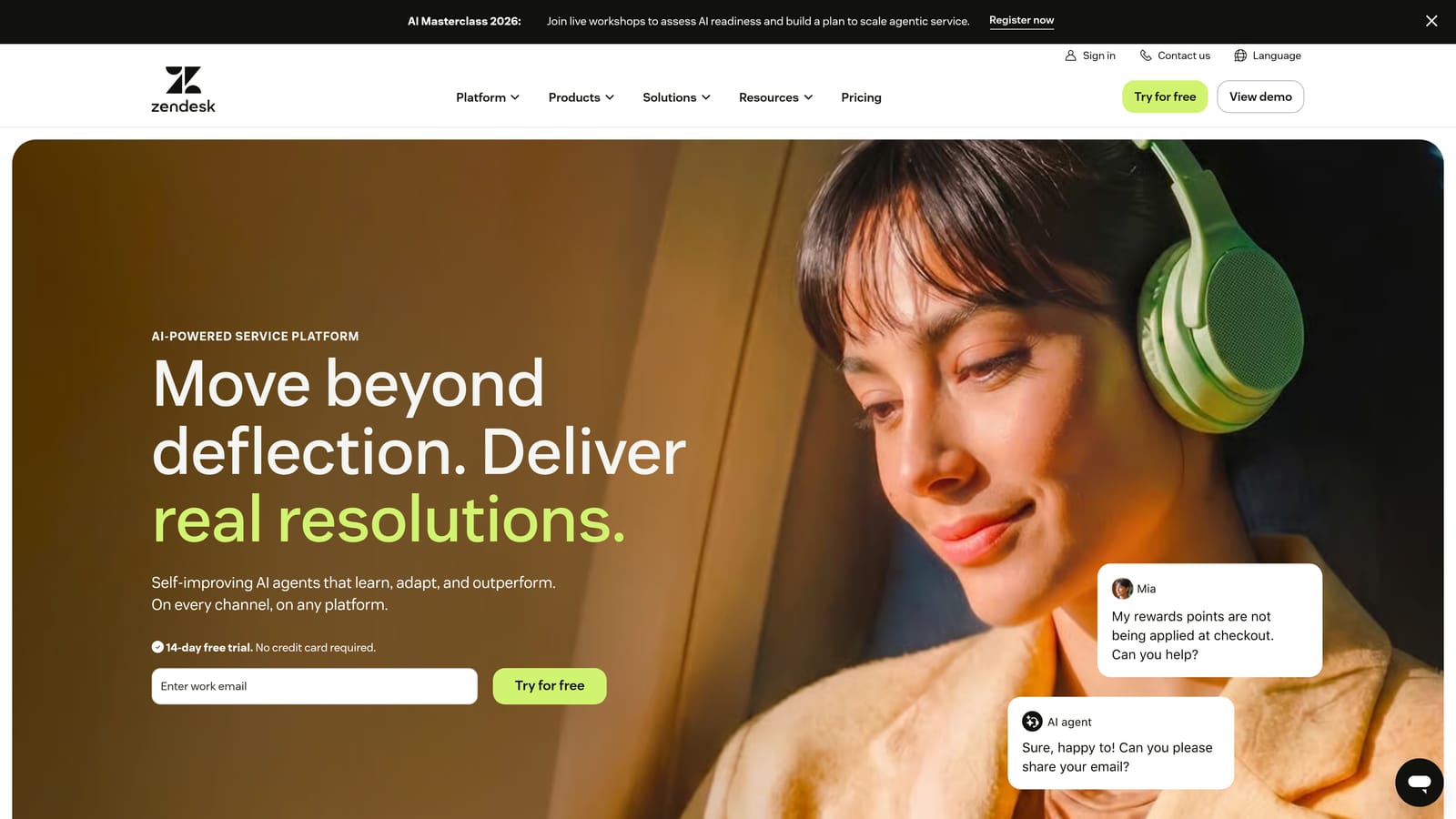
Zendesk is one of the most established helpdesk platforms available, with a comprehensive AI suite layered onto a mature ticketing and workflow engine.
Where This Tool Shines
Zendesk's depth is its biggest asset. Decades of development have produced a platform with extraordinarily granular SLA controls, complex routing logic, and an app marketplace that covers almost every integration a support team could need. For large organizations with established support processes, Zendesk can accommodate nearly any workflow configuration.
The AI Copilot feature assists agents with suggested responses and next-step recommendations, which is useful for teams with high agent counts. That said, Zendesk's AI capabilities are primarily agent-augmentation rather than full autonomous resolution — the AI helps humans work faster rather than replacing the human in the loop entirely.
Key Features
Zendesk AI Copilot: Provides agents with suggested responses, conversation summaries, and recommended actions in real time.
Advanced SLA Management: Highly configurable SLA rules and escalation paths for enterprise compliance requirements.
Extensive App Marketplace: Hundreds of pre-built integrations covering CRMs, communication tools, analytics platforms, and more.
Omnichannel Support: Unified management across email, chat, voice, social, and messaging channels.
Robust Analytics: Detailed reporting dashboards with customizable metrics for team performance and ticket trends.
Best For
Large enterprise support teams with established workflows, dedicated Zendesk admins, and the budget to unlock higher tiers where AI features become available. Less ideal for lean teams looking for out-of-the-box AI autonomy without significant configuration investment.
Pricing
Suite Team starts at approximately $55 per agent per month. AI features are available on higher tiers, which increases the total cost of ownership meaningfully for smaller teams.
3. Intercom
Best for: SaaS companies that use a unified messenger across sales, marketing, and support with strong AI resolution for common queries.
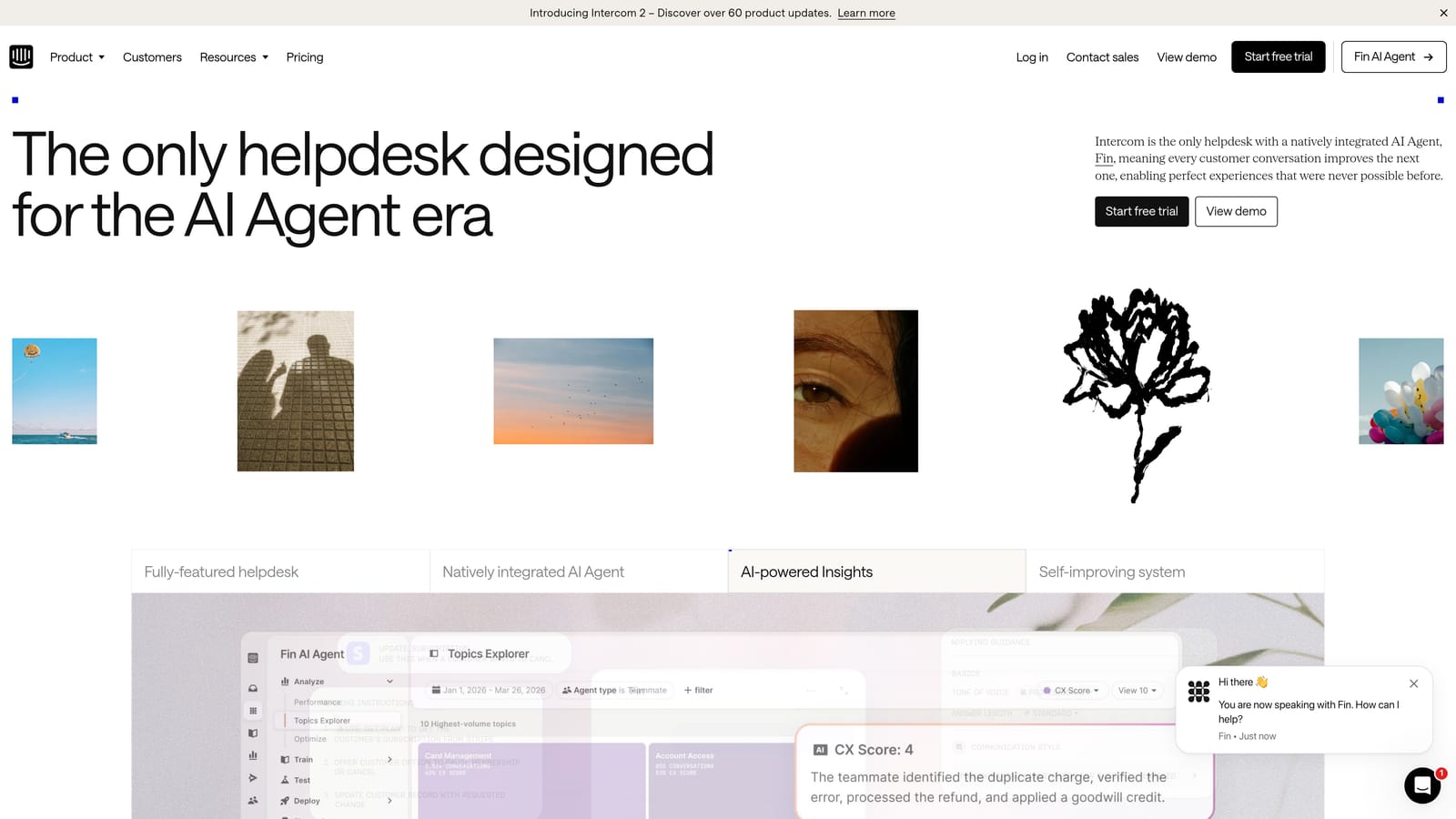
Intercom is a conversational support platform built around in-app messaging, with Fin AI agent as its flagship autonomous resolution tool.
Where This Tool Shines
Intercom's Fin AI agent is one of the more capable autonomous resolution tools in the market. It's designed to handle common queries before they reach a human agent, and the resolution quality is generally well-regarded among SaaS teams. The tight integration between Intercom's messenger and its support workflows makes it a natural choice for companies that already use Intercom for onboarding or sales engagement.
The platform's strength is the unified experience it creates across the customer journey. When sales, marketing, and support all live in the same messenger, handoffs feel seamless and customer context doesn't get lost between teams.
Key Features
Fin AI Agent: Handles autonomous query resolution before escalation, drawing on your knowledge base and product documentation.
Unified Messenger: Single interface for sales, marketing, and support conversations with consistent customer context throughout.
Proactive Messaging and Product Tours: Reaches users in-app before they need to submit a ticket, reducing inbound volume.
AI-Powered Inbox: Includes conversation summaries and intelligent prioritization for human agents handling escalations.
SaaS-Friendly Integrations: Strong connections with CRMs, product analytics tools, and the broader SaaS stack.
Best For
SaaS companies that want Intercom to serve as their primary customer communication layer across the full lifecycle, not just support. Teams already invested in Intercom for sales or marketing will find the support expansion natural and cost-effective.
Pricing
Essential plan starts at approximately $29 per seat per month. Fin AI usage-based pricing applies separately, so total costs scale with resolution volume.
4. Freshdesk
Best for: Mid-market teams needing solid omnichannel coverage and AI-assisted agents at a competitive price point.
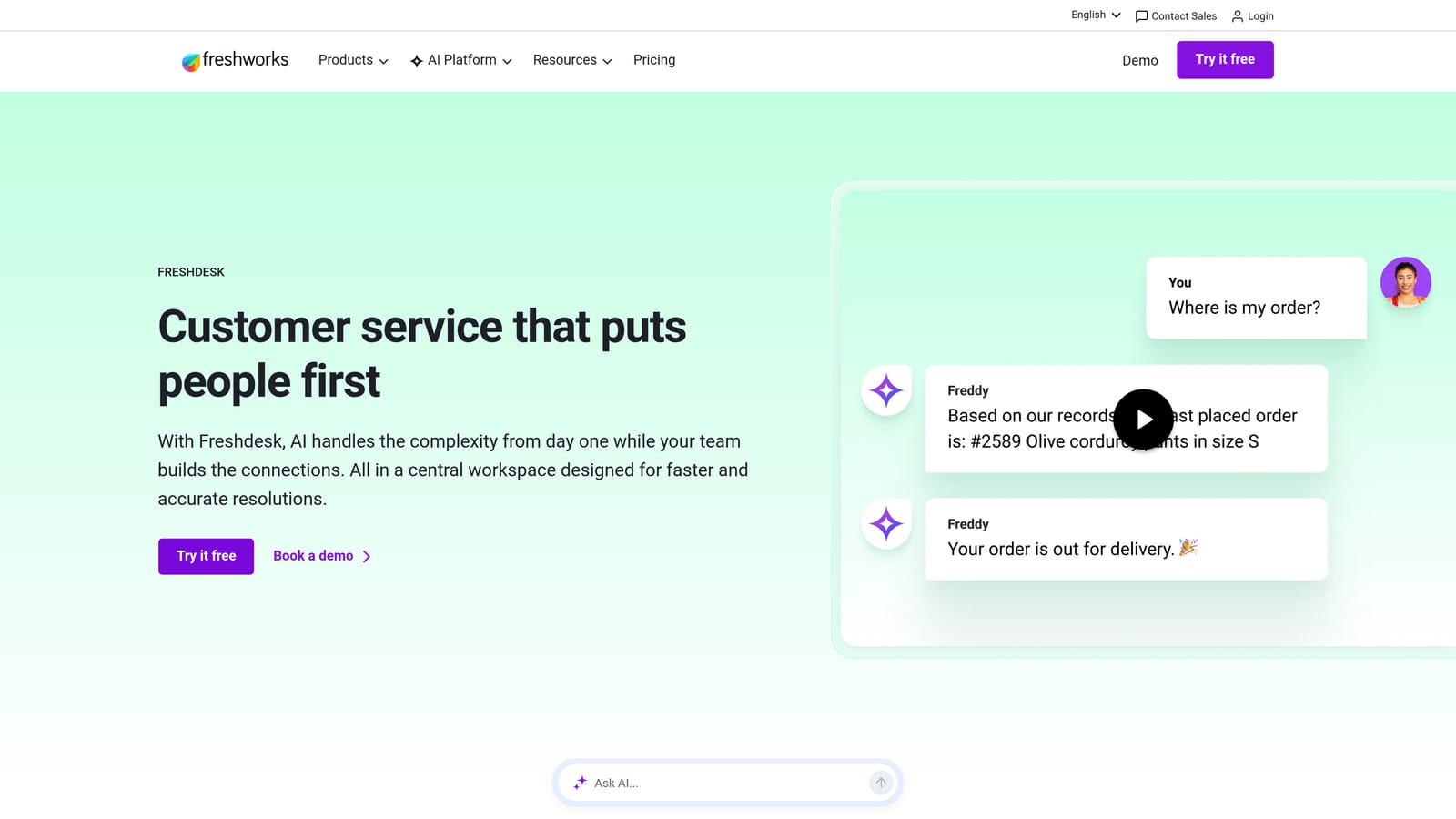
Freshdesk is a mid-market helpdesk from Freshworks, featuring Freddy AI for automated responses, agent assist, and omnichannel ticket management.
Where This Tool Shines
Freshdesk's value proposition is breadth at a competitive price. The platform covers email, chat, phone, and social channels in a single interface, and Freddy AI handles routine ticket responses and suggests next steps for agents handling more complex issues. For teams that need solid omnichannel coverage without the enterprise price tag of Zendesk, Freshdesk is a compelling option.
The Freshworks ecosystem is worth considering if your team also needs CRM or ITSM capabilities. The native connections between Freshdesk, Freshsales, and Freshservice can reduce integration overhead for growing teams managing multiple functions.
Key Features
Freddy AI: Provides automated ticket responses, agent suggestions, and AI-powered analytics across support workflows.
Omnichannel Coverage: Unified management across email, chat, phone, and social from a single agent workspace.
Collision Detection: Prevents multiple agents from responding to the same ticket simultaneously.
AI-Enhanced Knowledge Base: Intelligent search helps customers find answers before submitting tickets.
Freshworks Ecosystem Integration: Native connections to Freshsales CRM and Freshservice ITSM for teams using multiple Freshworks products.
Best For
Mid-market teams that need omnichannel support with AI assistance at a price point below Zendesk. Also a natural choice for teams already using other Freshworks products who want to consolidate their stack.
Pricing
Free plan available for small teams. Growth plan starts at approximately $15 per agent per month. AI features unlock on higher tiers.
5. HubSpot Service Hub
Best for: Teams already using HubSpot CRM who want native customer context on every support ticket without additional integration work.
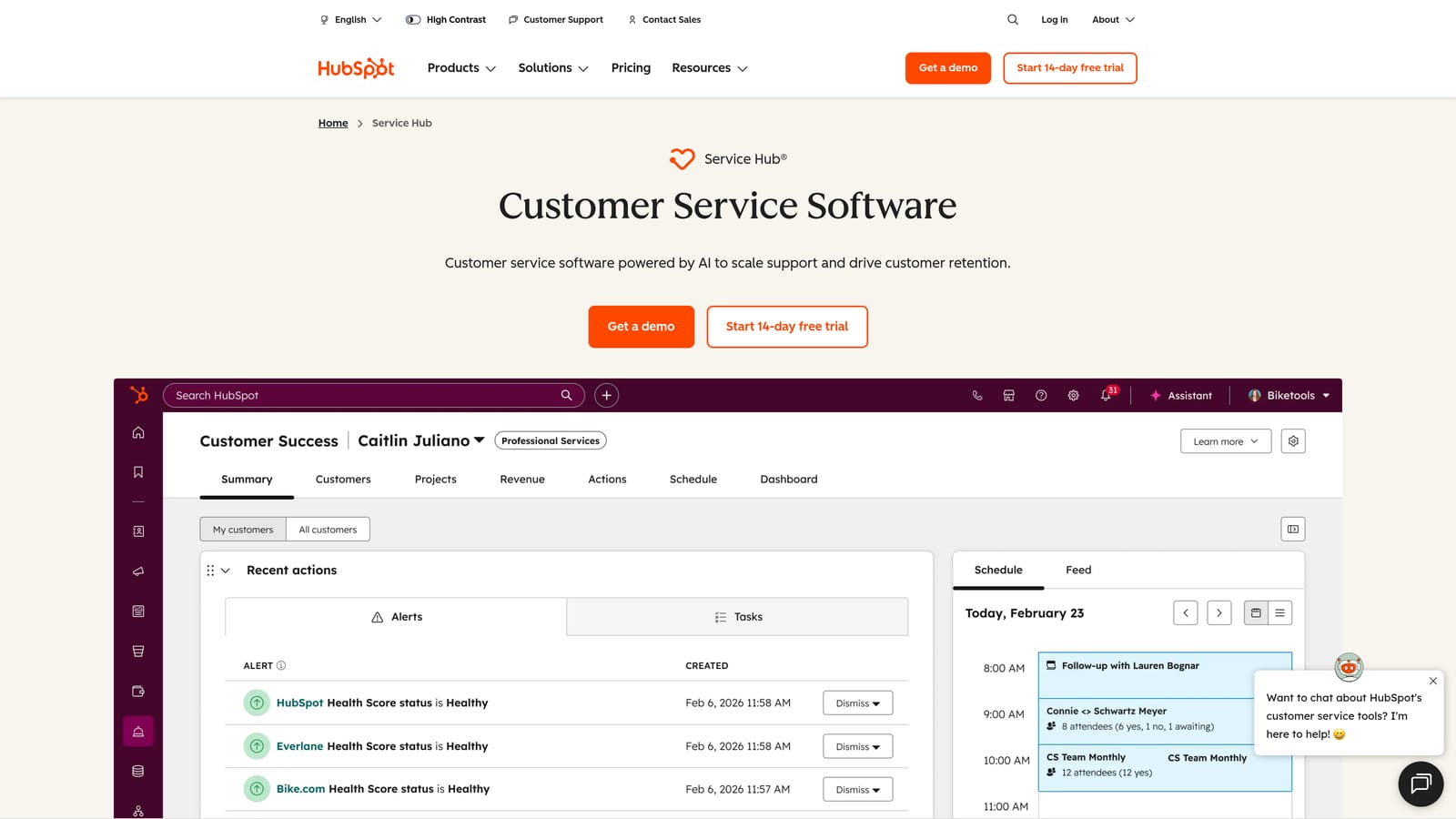
HubSpot Service Hub is HubSpot's customer service product, built natively on the HubSpot CRM so every support interaction carries full customer context automatically.
Where This Tool Shines
The core differentiator here is context without configuration. Because Service Hub sits on the same CRM as HubSpot's marketing and sales tools, agents see the complete customer picture the moment a ticket arrives: deal history, marketing engagement, previous conversations, and contact properties. No integration required, no data sync delays.
For teams that already live in HubSpot, this native context is genuinely valuable. The AI features — conversation intelligence and AI-generated reply drafts — are useful additions, though Service Hub is more of an AI-augmented agent tool than an autonomous resolution platform.
Key Features
Native CRM Context: Every ticket automatically includes full HubSpot CRM data with no integration or sync required.
AI Reply Drafts: Generates suggested responses based on conversation history and knowledge base content.
Customer Portal: Self-service portal where customers can track ticket status and access knowledge base articles.
SLA Management: Configurable SLA rules with ticket pipeline views for tracking team performance.
Cross-Team Handoff: Seamless escalation and context-sharing between marketing, sales, and support workflows.
Best For
Companies already invested in the HubSpot ecosystem who want support functionality that integrates natively rather than through third-party connectors. Less compelling for teams not already using HubSpot, where the CRM context advantage disappears.
Pricing
Starter from approximately $15 per month. Professional and Enterprise tiers unlock advanced AI features, automation, and reporting capabilities.
6. Salesforce Service Cloud
Best for: Large enterprises with existing Salesforce infrastructure that need highly customizable, CRM-native support workflows.
Salesforce Service Cloud is an enterprise-grade customer service platform deeply integrated with Salesforce CRM, featuring Einstein AI for intelligent case routing and agent assistance.
Where This Tool Shines
Service Cloud's power is its depth of customization and its native connection to the Salesforce data model. For organizations where Salesforce is the system of record for customer data, having support cases live natively in that environment eliminates a significant category of integration problems. Einstein AI adds predictive case routing and agent recommendations that leverage the full breadth of Salesforce customer data.
The trade-off is implementation complexity. Service Cloud typically requires dedicated Salesforce admins and meaningful configuration investment before it delivers value. It's not a tool you deploy in a week.
Key Features
Einstein AI: Delivers predictive case routing, auto-response suggestions, and agent recommendations powered by Salesforce CRM data.
Unified Agent Workspace: Full Salesforce CRM data visible alongside every support case in a single interface.
Flow Builder Automation: Highly customizable workflow automation for complex multi-step support processes.
Omnichannel Routing: Intelligent routing across voice, chat, email, and messaging with skills-based assignment.
Tableau Analytics Integration: Advanced reporting and visualization capabilities for enterprise support operations.
Best For
Large enterprises with existing Salesforce deployments, dedicated admin resources, and complex support workflows that require deep customization. Not well-suited for teams without Salesforce infrastructure or the resources to configure and maintain the platform.
Pricing
Starter Suite from approximately $25 per user per month. Enterprise AI features and advanced capabilities require significantly higher tiers.
7. Gorgias
Best for: E-commerce brands on Shopify or WooCommerce that need order data surfaced directly in support tickets.
Gorgias is a helpdesk purpose-built for e-commerce brands, pulling live order data and customer purchase history directly into support tickets.
Where This Tool Shines
Gorgias solves a very specific and very real problem for e-commerce support teams: agents constantly switching between their helpdesk and their order management system to answer questions about shipping, returns, and order status. Gorgias pulls that data directly into the ticket view, so agents have everything they need in one place.
The revenue-linked support metrics are a genuine differentiator in the e-commerce space. Being able to tie ticket resolution to retention and sales impact gives support teams a business case for investment that most helpdesks can't provide.
Key Features
E-Commerce Platform Integration: Deep native connections with Shopify, WooCommerce, and BigCommerce pull live order data into every ticket.
Order Data in Ticket View: Agents see order status, return history, and purchase data without leaving the helpdesk.
AI Agent for Order Queries: Handles autonomous resolution of common order-related questions before human escalation.
Revenue-Linked Metrics: Connects support activity to revenue impact, retention, and customer lifetime value.
Macros: High-speed response templates for repetitive queries like shipping updates and return policy questions.
Best For
E-commerce brands, particularly those on Shopify, with high volumes of order-related support queries. Not designed for B2B SaaS teams, but included here as the clear category leader for its specific use case.
Pricing
Starter plan from approximately $10 per month for 50 tickets. Pricing scales by ticket volume rather than agent seats, which suits high-volume e-commerce operations.
8. Kustomer
Best for: High-volume consumer support teams that need a unified customer timeline consolidating all touchpoints in one view.
Kustomer is a CRM-native helpdesk that consolidates all customer interactions into a unified timeline, with AI-powered routing and suggested responses for high-volume support teams.
Where This Tool Shines
Kustomer's unified customer timeline is its defining feature. Rather than showing agents a list of tickets, Kustomer shows a complete chronological history of every interaction a customer has had — across every channel — in a single scrollable view. For teams handling complex, multi-touch customer relationships, this context is invaluable.
The platform's flexible data modeling through custom objects allows teams to extend the data structure beyond standard contact and ticket fields, which is useful for businesses with non-standard customer data requirements. AI-powered routing and prioritization help high-volume teams direct work efficiently.
Key Features
Unified Customer Timeline: Complete chronological history of all customer touchpoints across every channel in a single view.
AI-Powered Routing: Intelligent ticket routing and prioritization based on customer history, issue type, and agent skills.
Workflow Automation: Multi-step process automation for complex support workflows that span multiple teams or systems.
Custom Objects: Flexible data modeling to accommodate non-standard customer data structures and business requirements.
Omnichannel Single View: Email, chat, social, and voice conversations consolidated into one agent workspace.
Best For
High-volume consumer support operations that handle complex, multi-touch customer relationships across many channels. Less common in pure B2B SaaS environments, but compelling for consumer-facing businesses with large support teams.
Pricing
Enterprise pricing model, typically starting around $89 per user per month. Best suited for teams where the platform's advanced capabilities justify the investment.
9. Help Scout
Best for: Small to mid-size teams that want a simple, human-feeling shared inbox with AI assistance rather than full AI autonomy.
Help Scout is a shared inbox and helpdesk platform with AI Summarize and AI Drafts to help agents work faster without losing the personal touch that defines their support experience.
Where This Tool Shines
Help Scout occupies a deliberate position in the market: it's not trying to be the most AI-powered platform, and that's a genuine feature rather than a limitation. The tool is designed for teams that believe great support is fundamentally human, and where the goal is to help agents respond faster and more thoughtfully rather than to remove them from the equation.
The clean, minimal interface means teams can deploy Help Scout quickly with little configuration overhead. AI Summarize helps agents catch up on long conversations instantly, while AI Drafts accelerates response composition without dictating tone or removing the agent's voice from the reply.
Key Features
AI Summarize: Instantly condenses long conversation threads so agents can catch up without reading every message.
AI Drafts: Generates response drafts for agents to review, edit, and send — keeping the human in control of the final message.
Shared Inbox with Collision Detection: Prevents duplicate responses when multiple agents are working the same queue.
Docs Knowledge Base: Built-in knowledge base builder for self-service content that integrates with the inbox experience.
Simple Configuration: Minimal setup required — teams can be productive within hours rather than weeks.
Best For
Small to mid-size teams, particularly in professional services or early-stage SaaS, where high-touch human support is a deliberate brand choice. Not the right fit for teams looking to scale through autonomous AI resolution.
Pricing
Standard plan from approximately $22 per user per month, making it one of the more accessible options on this list for smaller teams.
Choosing the Right Platform for Your Team
The best intelligent helpdesk isn't necessarily the most feature-rich one — it's the one that matches where your team is in its AI adoption journey and what you actually need support to do for your business.
Here's a quick way to think through the decision:
If you want autonomous AI resolution and business intelligence: Halo AI is built specifically for this. The AI-first architecture, page-aware context, and smart inbox intelligence layer make it the strongest option for B2B SaaS teams that want support to feed into product, success, and revenue workflows.
If you need enterprise-grade workflow complexity: Zendesk or Salesforce Service Cloud offer the deepest configuration options, though both require significant admin investment and budget to unlock their AI capabilities.
If your team lives in HubSpot: Service Hub's native CRM context is hard to replicate through third-party integrations. The AI features are useful additions for teams already in that ecosystem.
If you want conversational support across the full customer lifecycle: Intercom's Fin AI agent and unified messenger make it a natural choice for SaaS companies that use a single platform for sales, marketing, and support.
If simplicity and human touch matter most: Help Scout is the cleanest option for small teams that want AI assistance without AI autonomy.
If you're in e-commerce: Gorgias is the category leader and purpose-built for the use case — no other platform on this list comes close for Shopify-based operations.
One thing is clear across all of these platforms: the shift from AI-assisted to AI-first support is accelerating. Teams that evaluate tools on autonomous resolution capability, integration depth, and continuous learning — rather than just ticket management features — will be better positioned as support expectations continue to rise.
Your support team shouldn't scale linearly with your customer base. Let AI agents handle routine tickets, guide users through your product, and surface business intelligence while your team focuses on complex issues that need a human touch. See Halo in action and discover how continuous learning transforms every interaction into smarter, faster support.