9 Best Intelligent Support Automation Platforms in 2026
This guide evaluates the 9 best intelligent support automation platforms in 2026, comparing AI-first solutions that go beyond basic chatbots to autonomously resolve tickets, understand product context, and continuously learn from interactions. Assessed across AI capability depth, integration breadth, and B2B SaaS suitability, the list helps support teams identify the right platform to handle growing volume while delivering faster, more accurate customer responses.
 Matt PattoliFounder13 min read
Customer support used to be reactive by design: a ticket comes in, an agent responds, the queue drains (or doesn't). That model worked when support volume was manageable and customer expectations were lower. Today, B2B SaaS teams are dealing with a different reality: growing user bases, complex product surfaces, and customers who expect fast, accurate answers around the clock.
Intelligent support automation goes well beyond basic chatbots and canned-response flows. The best platforms today can autonomously resolve tickets, understand the context of where a user is in your product, learn from every interaction, and feed insights back into your broader business. The gap between a rule-based bot and a genuinely intelligent support agent is significant.
To build this list, we evaluated platforms across four dimensions: depth of AI capability, integration breadth, learning and improvement mechanisms, and suitability for B2B SaaS teams. The list covers both AI-first architectures and automation layers built on top of established helpdesks, so there's something here regardless of where you're starting from.
1. Halo AI
Best for: B2B SaaS teams that want AI-first support architecture with deep product and business context.
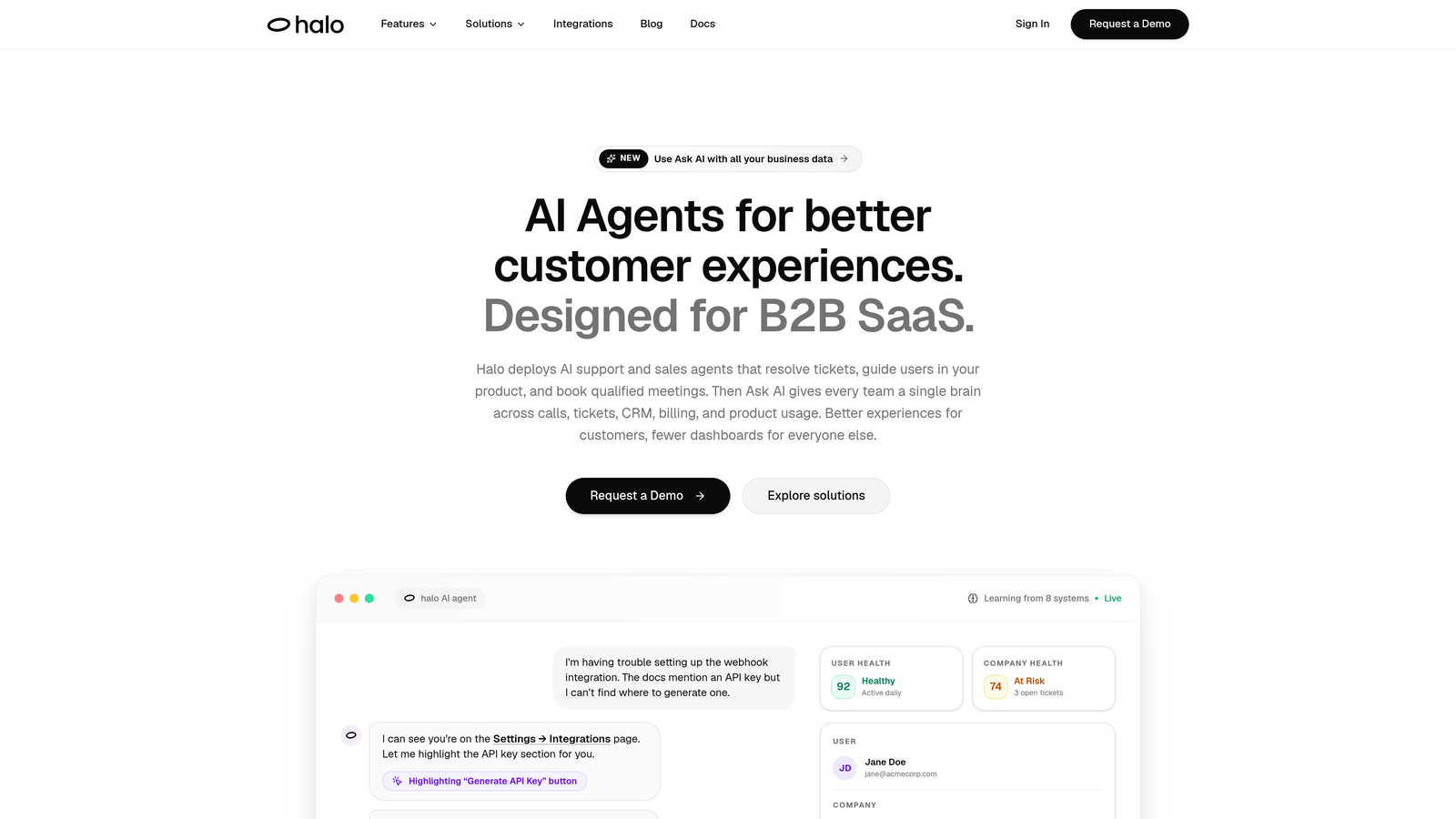
Halo AI is an AI-first customer support platform that deploys intelligent agents to resolve tickets, guide users through your product, and surface business intelligence — all while learning from every interaction.
Where This Tool Shines
What separates Halo from AI features bolted onto existing helpdesks is the architecture itself. Halo is built around the AI agent as the primary resolution layer, not as a supplementary tool sitting on top of a ticket queue. This means the learning loop is tighter, the context is richer, and the autonomous resolution capability is more substantive.
The page-aware chat widget is a standout capability. Rather than responding to what a user types, Halo's agent sees what the user sees: the specific page, UI state, and product context. This enables it to provide visual guidance rather than generic instructions, which is particularly valuable for complex SaaS products where "click the settings button" could mean five different things depending on where you are in the application.
Key Features
Page-Aware Chat Widget: The AI agent understands the user's current page and product state, delivering contextual UI guidance rather than generic support responses.
Autonomous Ticket Resolution with Continuous Learning: Every closed ticket feeds back into the system, making the AI progressively better at resolving similar issues without human intervention.
Auto Bug Ticket Creation: When the AI detects a bug or product issue, it automatically creates and routes a ticket directly to engineering tools like Linear, closing the loop between support and product teams.
Smart Inbox with Business Intelligence: Beyond ticket management, the inbox surfaces customer health signals, anomaly detection, and revenue intelligence, turning support data into company-wide insight.
Live Agent Handoff with Full Context: When a conversation requires a human, the handoff preserves the full interaction history and context so agents never start from scratch.
Broad Integration Stack: Connects to Slack, HubSpot, Intercom, Stripe, Zoom, PandaDoc, and Fathom, meaning support intelligence flows into the tools your team already uses.
Best For
Halo is best suited for B2B SaaS product teams that want AI embedded into the support architecture from the ground up, not added as an afterthought. If you're scaling a product and need support to grow without scaling headcount linearly, Halo's continuous learning model and business intelligence layer make it a strong fit.
Pricing
Contact for pricing. Visit haloagents.ai for details and to explore plan options for your team size.
2. Intercom
Best for: Teams wanting conversational AI resolution across chat, email, and in-product surfaces with a mature ecosystem.
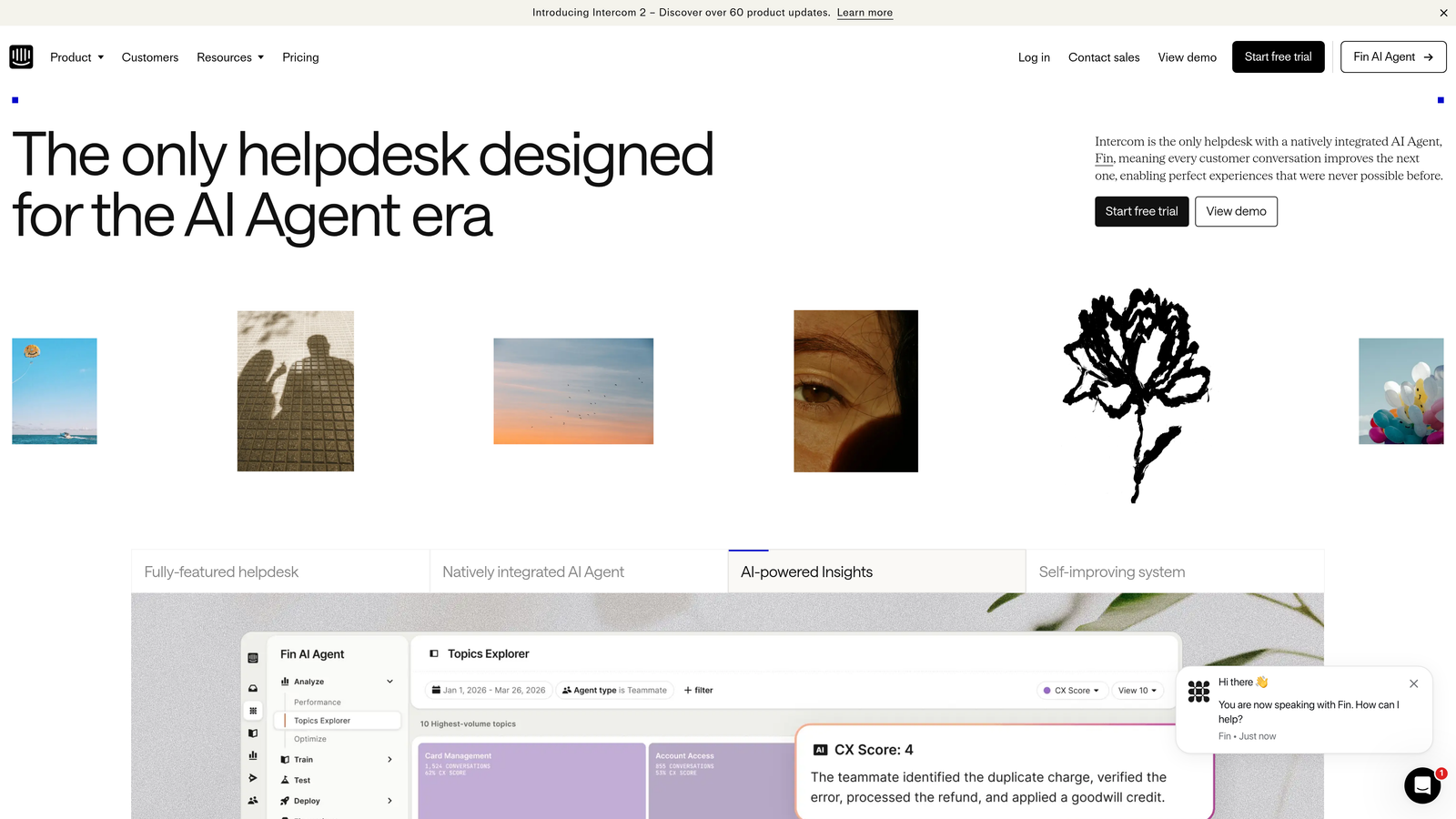
Intercom is a mature customer messaging and support platform with Fin, its LLM-powered AI agent, handling conversational resolution across multiple channels.
Where This Tool Shines
Intercom's strength has always been its messaging layer, and Fin AI builds on that foundation well. For teams that need conversational resolution with a polished user experience, Fin handles a meaningful portion of incoming queries without human involvement, particularly for FAQ-style and procedural questions.
The platform's breadth is also notable. With over 300 integrations and a well-established product tours feature, Intercom works well for teams that want to combine support automation with proactive onboarding and in-product messaging in a single platform.
Key Features
Fin AI Agent: LLM-powered conversational agent that autonomously resolves support queries across chat, email, and in-app surfaces.
Omnichannel Inbox: Combines chat, email, and in-app messaging into a unified workspace for support teams.
Intelligent Conversation Routing: Routes and hands off conversations to human agents based on complexity and intent.
300+ App Integrations: Extensive ecosystem covering CRM, billing, analytics, and product tools.
Product Tours and Proactive Messaging: Enables in-product onboarding flows alongside reactive support, useful for reducing inbound volume.
Best For
Intercom suits teams that want a well-rounded customer communications platform with AI resolution built in. It's particularly strong for product-led growth companies that want support and onboarding handled in one place. Pricing can scale significantly at higher volumes, so it's worth modeling usage costs carefully.
Pricing
Starts at approximately $39 per seat per month. Fin AI usage is billed separately per resolution, so total cost scales with AI interaction volume.
3. Zendesk AI
Best for: Large support organizations needing enterprise-grade AI triage, agent assist, and compliance within an established helpdesk.
Zendesk AI is the intelligent automation layer built into Zendesk's enterprise helpdesk, adding triage, agent assist, and generative AI to one of the most established ticketing systems in the market.
Where This Tool Shines
Zendesk's AI capabilities are most valuable for large support operations that already run on Zendesk infrastructure. Intelligent triage handles auto-categorization and priority scoring, while Agent Copilot provides suggested replies and next-best-action recommendations to speed up human agent responses without replacing them.
The compliance and security posture is enterprise-grade, which matters for regulated industries or organizations with strict data governance requirements. If your support team is large, your workflows are complex, and you need AI that fits into an existing structure rather than replacing it, Zendesk AI is a natural fit.
Key Features
Intelligent Triage: Automatically categorizes, routes, and scores tickets by priority without manual intervention.
Agent Copilot: Surfaces suggested replies and next-best-action recommendations directly within the agent workspace.
AI-Powered Self-Service: Knowledge base deflection that reduces inbound ticket volume by surfacing relevant articles before a ticket is created.
Advanced Analytics: Detailed reporting on support operations, team performance, and resolution trends.
Enterprise Security and Compliance: Extensive compliance certifications and customizable workflow controls suited for regulated environments.
Best For
Zendesk AI is best for enterprise support teams that need AI augmentation within an existing, established helpdesk environment. It's less suited for teams looking to replace their helpdesk with an AI-native architecture and better for those looking to make a large existing operation smarter.
Pricing
AI features are available on Suite plans from approximately $115 per agent per month. Advanced AI capabilities are available as a separately priced add-on.
4. Freshdesk (Freddy AI)
Best for: Growing teams that want embedded AI capabilities at an accessible price point without leaving the Freshworks ecosystem.
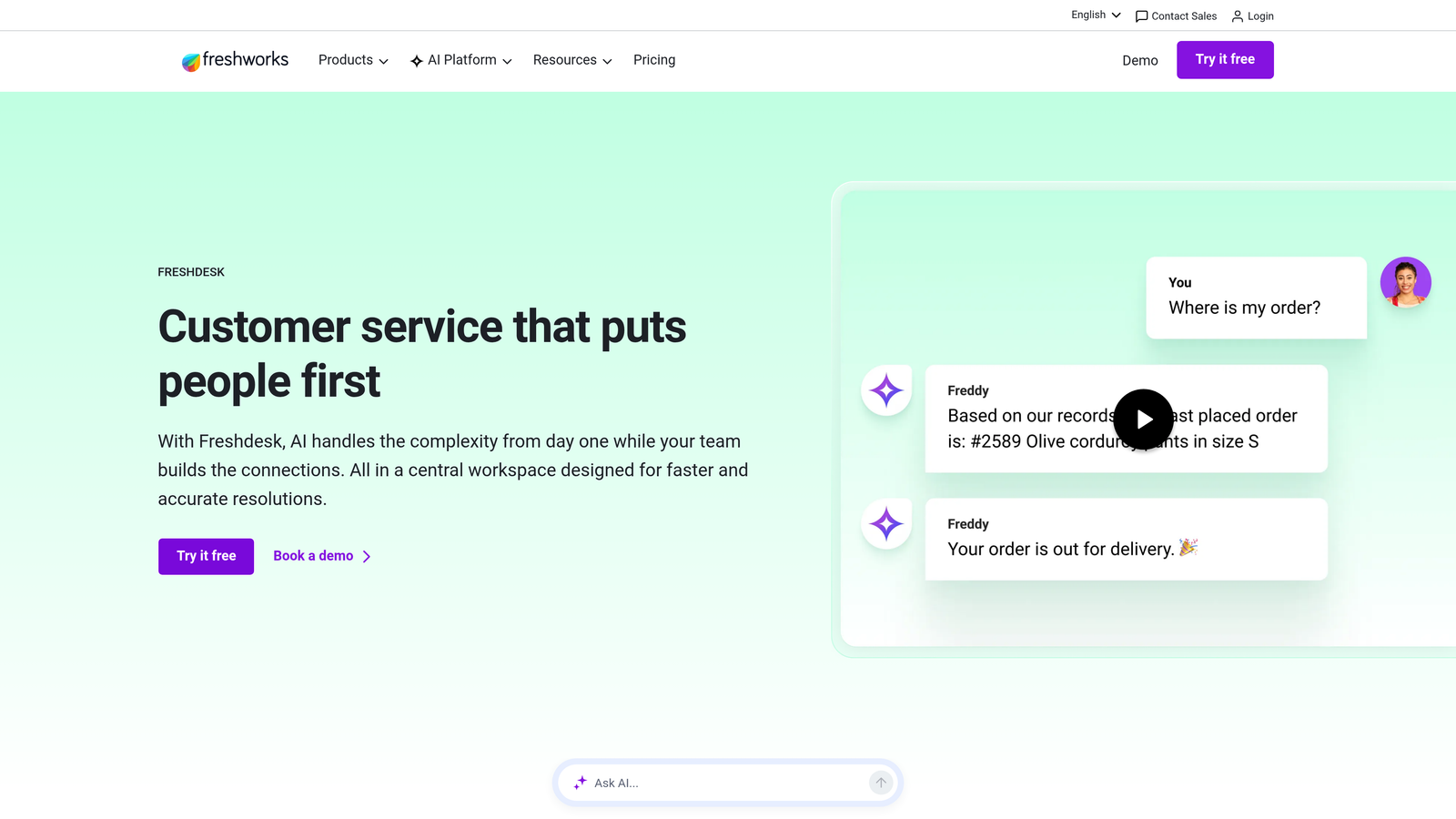
Freshdesk is Freshworks' helpdesk platform with Freddy AI embedded throughout, handling ticket categorization, suggested responses, and self-service deflection for teams that need solid AI capability without enterprise-level spend.
Where This Tool Shines
Freshdesk's primary advantage is accessibility. The combination of a free entry tier and AI features that come online as teams scale makes it a practical choice for companies that want to grow into automation rather than commit to enterprise pricing upfront.
Freddy AI has expanded its generative capabilities in recent product cycles, adding more sophisticated suggested responses and self-service flows alongside its core triage and categorization functions. For teams operating primarily within the Freshworks ecosystem (Freshsales, Freshchat, Freshservice), the integration depth is a genuine advantage.
Key Features
Freddy AI Auto-Triage: Automatically tags, categorizes, and routes incoming tickets to reduce manual sorting.
Freddy Self Service: AI-powered deflection and chatbot flows that handle common queries before they reach an agent.
Agent Assist: Surfaces suggested responses and relevant knowledge base articles within the agent workspace.
Omnichannel Support: Covers email, chat, phone, and social channels within a single platform.
Freddy Insights: Analytics and performance reporting on support operations and team productivity.
Best For
Freshdesk works well for SMBs and mid-market SaaS teams that want AI-assisted support without the cost or complexity of enterprise platforms. Teams already using other Freshworks products will find the ecosystem integration particularly compelling.
Pricing
Free plan available for small teams. Paid plans start at approximately $15 per agent per month. Freddy AI features unlock on higher-tier plans.
5. Salesforce Service Cloud (Einstein AI)
Best for: Enterprise organizations running Salesforce CRM that need support deeply integrated with sales and customer relationship data.
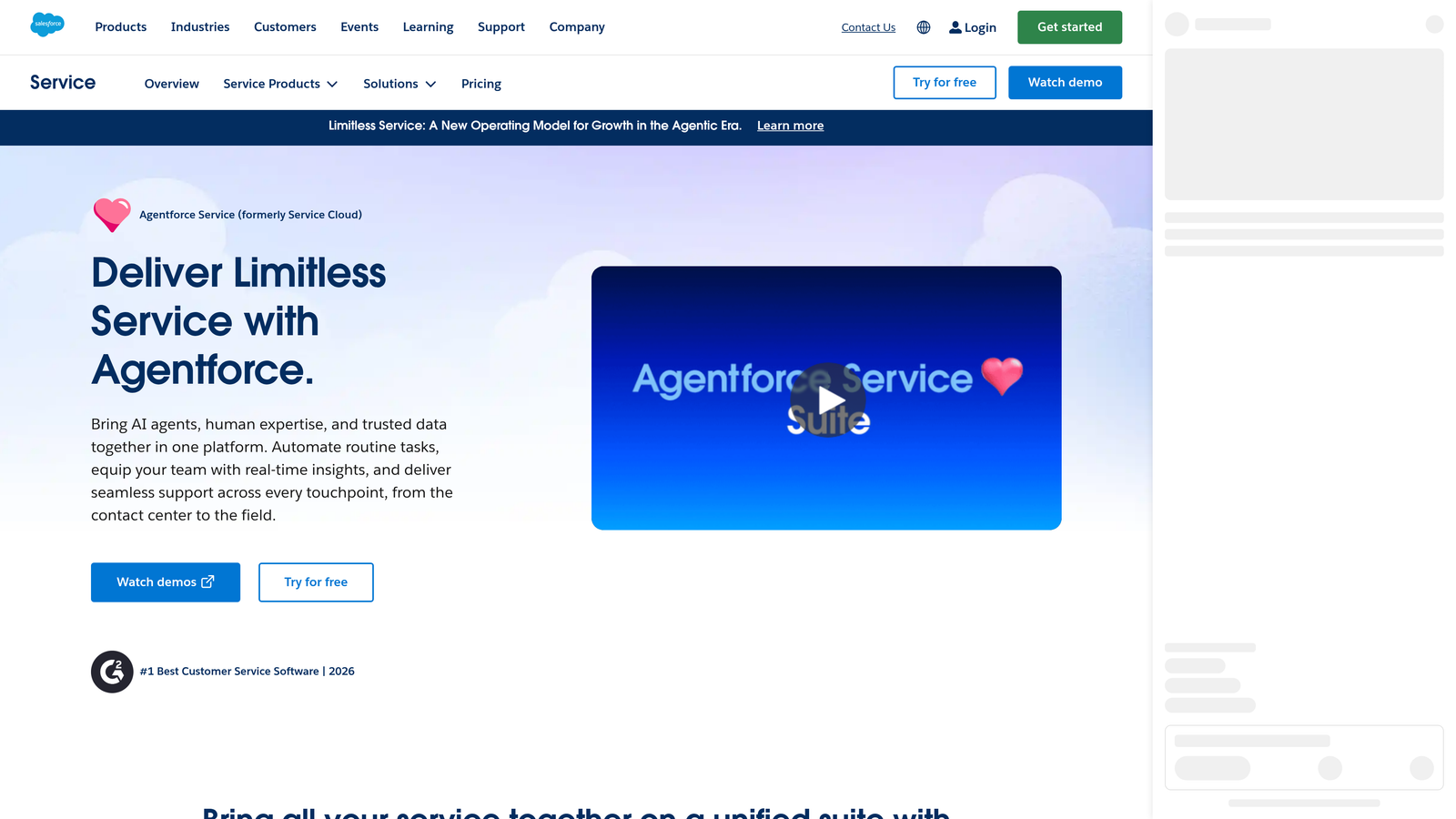
Salesforce Service Cloud is an enterprise support platform where Einstein AI surfaces full customer context, including purchase history, relationship data, and case history, inside every support interaction.
Where This Tool Shines
The core value proposition of Service Cloud is the CRM integration. When a support agent opens a ticket, they see not just the support history but the full customer relationship: account value, open opportunities, recent purchases, and sales interactions. For enterprise B2B teams where support and sales are deeply intertwined, this context is genuinely valuable and difficult to replicate elsewhere.
Einstein AI adds intelligent case classification, routing, and generative AI for reply drafting and knowledge article creation. The compliance and customization options are extensive, which is necessary for large enterprises with complex requirements.
Key Features
Einstein AI Case Classification: Automatically classifies and routes cases based on content and historical patterns.
Unified CRM and Service View: Combines sales, marketing, and support data into a single customer record accessible during every interaction.
Einstein Bots: Automated self-service and deflection flows that draw on CRM data for personalized responses.
Generative AI for Agents: Drafts replies and knowledge articles using generative AI within the agent workspace.
Enterprise Compliance and Customization: Extensive security controls and workflow customization for regulated industries and complex organizations.
Best For
Service Cloud is the right choice for large enterprises already invested in the Salesforce ecosystem. Implementation complexity and cost are higher than most alternatives on this list, so it's best suited for organizations with dedicated Salesforce administration resources.
Pricing
Starts at approximately $25 per user per month for the Starter tier. Enterprise plans are significantly higher. Einstein AI features are priced as separate add-ons.
6. Kustomer
Best for: High-volume omnichannel support teams that need a unified customer timeline with AI-powered workflow automation.
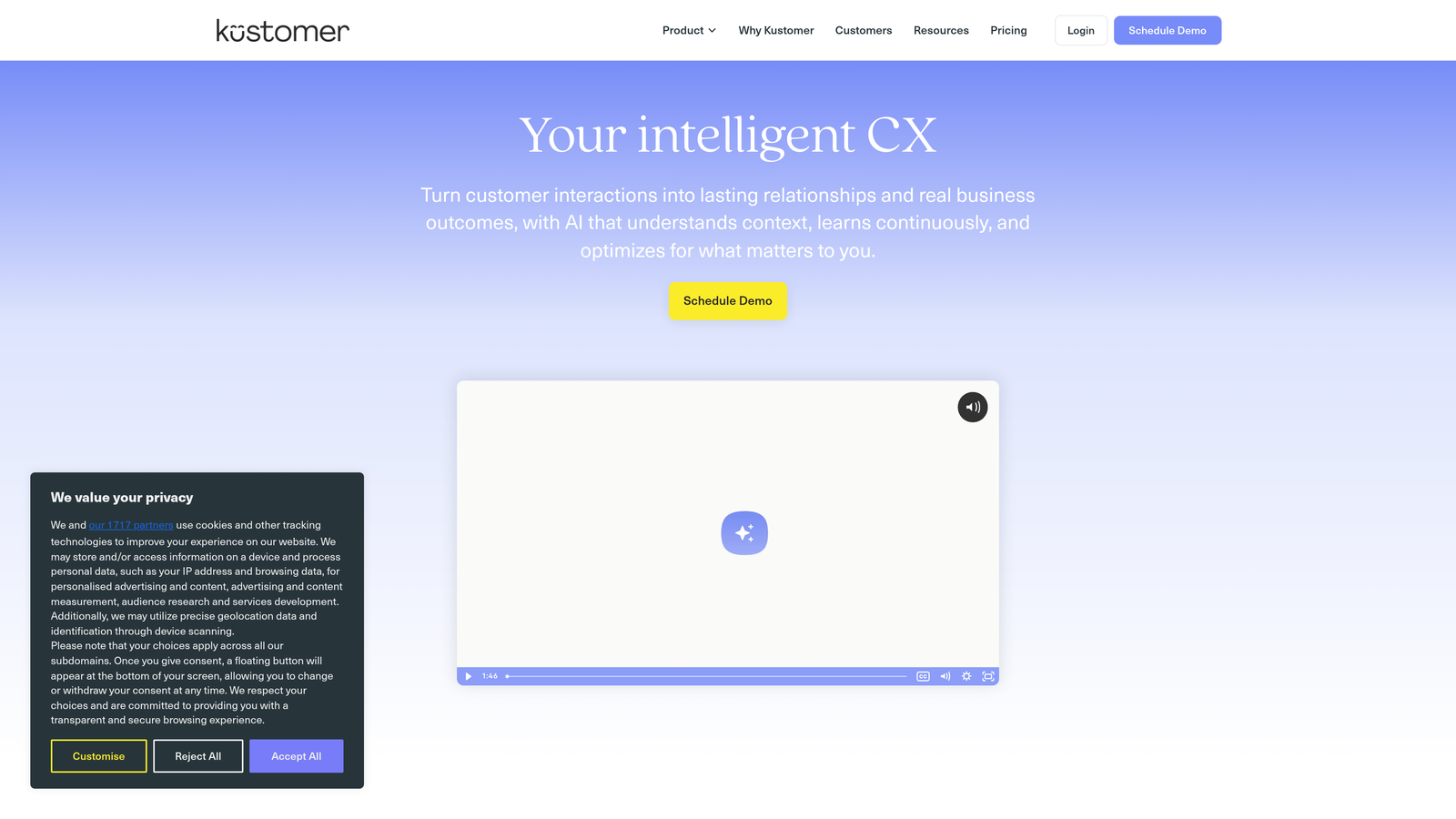
Kustomer is a CRM-native customer service platform that combines a unified customer timeline with AI-powered workflow automation, designed for environments where customers interact across many channels simultaneously.
Where This Tool Shines
Kustomer's defining feature is the unified customer timeline: a single view of every interaction a customer has had across email, chat, voice, social, and SMS. For support teams dealing with customers who switch channels frequently, this eliminates the fragmented context problem that plagues multi-channel support.
The built-in CRM removes the need for a separate customer data tool, which simplifies the stack and keeps all customer intelligence in one place. AI automation handles routing, tagging, and workflow triggers, reducing the manual overhead of managing high volumes across multiple channels.
Key Features
Unified Customer Timeline: Full interaction history across all channels displayed in a single, chronological view.
AI-Powered Routing and Tagging: Automatically routes and tags conversations based on content and customer context.
Omnichannel Support: Covers email, chat, voice, social, and SMS within a single platform.
KIQ AI: Self-service deflection and agent assist capabilities powered by AI.
Built-in CRM: Native customer data management that eliminates the need for a separate CRM tool for support teams.
Best For
Kustomer suits mid-market to enterprise teams running high-volume, omnichannel support operations where a unified customer view is a priority. The pricing reflects its enterprise positioning, making it less accessible for smaller teams.
Pricing
Starts at approximately $89 per user per month on the Enterprise plan.
7. Ada
Best for: Global enterprises that want to deploy multilingual AI agents alongside an existing helpdesk without replacing their current infrastructure.
Ada is a dedicated AI agent platform built to integrate alongside existing helpdesks, enabling enterprises to add autonomous self-service capability without overhauling their support stack.
Where This Tool Shines
Ada's positioning is distinct from most platforms on this list: it's designed to sit alongside your existing helpdesk rather than replace it. For organizations with significant investment in Zendesk, Salesforce, or Freshdesk, Ada extends AI self-service capability without requiring a platform migration.
The multilingual support across 50+ languages is a genuine differentiator for global enterprises. Combined with strong enterprise security certifications and a no-code builder for creating AI agent flows, Ada is built for governance-conscious organizations that need AI capability without sacrificing control.
Key Features
No-Code AI Agent Builder: Create and manage automated resolution flows without engineering resources.
Multilingual Support: Handles customer interactions in 50+ languages, making it viable for global support operations.
Helpdesk Integrations: Connects directly with Zendesk, Salesforce, Freshdesk, and other major helpdesk platforms.
Enterprise Security Certifications: SOC 2 and GDPR compliance for organizations with strict data governance requirements.
Coaching and Continuous Improvement Tools: Built-in tools for monitoring and improving AI agent performance over time.
Best For
Ada is well-suited for global enterprises that need multilingual AI self-service and have strong governance requirements. It's particularly valuable for teams that want to extend their existing helpdesk with AI rather than replace it entirely.
Pricing
Custom enterprise pricing. Contact Ada directly for a quote based on your organization's scale and requirements.
8. Tidio
Best for: Small businesses and early-stage SaaS teams that want fast AI chat deployment with minimal technical overhead.
Tidio is an accessible AI chat and live support platform combining Lyro AI with live chat fallback, designed for teams that need to get something working quickly without significant configuration.
Where This Tool Shines
Tidio's core appeal is simplicity and speed of deployment. For a small team that needs AI-assisted chat on their website without a complex implementation project, Tidio delivers a functional setup faster than most alternatives on this list.
Lyro AI handles conversational self-service and FAQ resolution, with a live chat fallback when the AI reaches the limits of what it can resolve. The visual chatbot flow builder requires no coding, and the e-commerce integrations with Shopify and WooCommerce make it particularly useful for product-led businesses with transactional support needs.
Key Features
Lyro AI: Conversational AI that handles self-service queries and FAQ resolution with a natural language interface.
Live Chat with Agent Fallback: Seamlessly transitions to a human agent when the AI cannot resolve a query.
Visual Chatbot Flow Builder: No-code builder for creating custom conversation flows without engineering involvement.
E-Commerce Integrations: Native integrations with Shopify and WooCommerce for transactional support use cases.
Multi-Channel Support: Covers website chat, email, and Messenger alongside the core live chat interface.
Best For
Tidio is best for small businesses, early-stage SaaS teams, and e-commerce companies that need a fast, low-cost entry into AI-assisted support. It's less suited for complex B2B support workflows or organizations that need deep integration with business intelligence tools.
Pricing
Free plan available. Lyro AI starts at approximately $29 per month. Paid plans scale with conversation volume.
Making the Right Choice for Your Support Stack
The most important question isn't which platform has the most features. It's whether you need AI built into your support architecture from the ground up, or layered on top of an existing helpdesk you're not ready to replace.
If you're building or rebuilding your support infrastructure and want AI as the primary resolution layer, Halo AI is the strongest fit for B2B SaaS teams. The page-aware context, continuous learning loop, and business intelligence layer give it capabilities that go well beyond ticket deflection. It's designed for teams that want support to generate insight, not just close tickets.
For enterprise teams with complex workflows and compliance requirements who aren't ready to leave Zendesk, Zendesk AI offers the most mature AI augmentation within an established helpdesk. Freshdesk with Freddy AI is the practical choice for growing teams that want meaningful AI capability without enterprise-level pricing. Ada stands out for global organizations that need multilingual AI and strong governance without replacing their current helpdesk. And Tidio remains the fastest path to functional AI chat for small teams with straightforward support needs.
The platforms in the middle of this list, including Intercom, Salesforce Service Cloud, and Kustomer, each excel in specific contexts: conversational messaging, CRM-integrated enterprise support, and high-volume omnichannel operations respectively.
Your support team shouldn't scale linearly with your customer base. Let AI agents handle routine tickets, guide users through your product, and surface business intelligence while your team focuses on complex issues that need a human touch. See Halo in action and discover how continuous learning transforms every interaction into smarter, faster support.