9 Best Intelligent Support Automation Tools in 2026
Discover the 9 best intelligent support automation tools in 2026, evaluated for AI capability, integration depth, and scalability to help B2B SaaS teams move beyond basic chatbots toward solutions that genuinely resolve customer issues. This guide breaks down each platform's real-world strengths so support teams can make informed decisions about automating intelligently rather than just deflecting tickets.
 Matt PattoliFounder13 min read
Support teams in 2026 are dealing with a fundamental shift. The old model, where agents manually triaged every ticket and chatbots handled only the most scripted queries, simply doesn't scale for growing B2B SaaS companies. The question is no longer whether to automate support, but how intelligently your tools can do it.
What separates an intelligent support automation tool from a basic chatbot? Real intelligence means understanding context, taking action, learning from every interaction, and surfacing insights that go beyond closing tickets. It's the difference between a tool that deflects questions and one that actually resolves them.
This list is built for B2B SaaS teams and product-led companies evaluating their options. We assessed each tool on AI capability, integration depth, scalability, and ease of deployment. Whether you're exploring AI-first support platforms or looking to layer intelligence onto an existing helpdesk, there's a fit for every stage and use case here.
1. Halo AI
Best for: Product-led B2B SaaS teams that want AI-first support with business intelligence built in
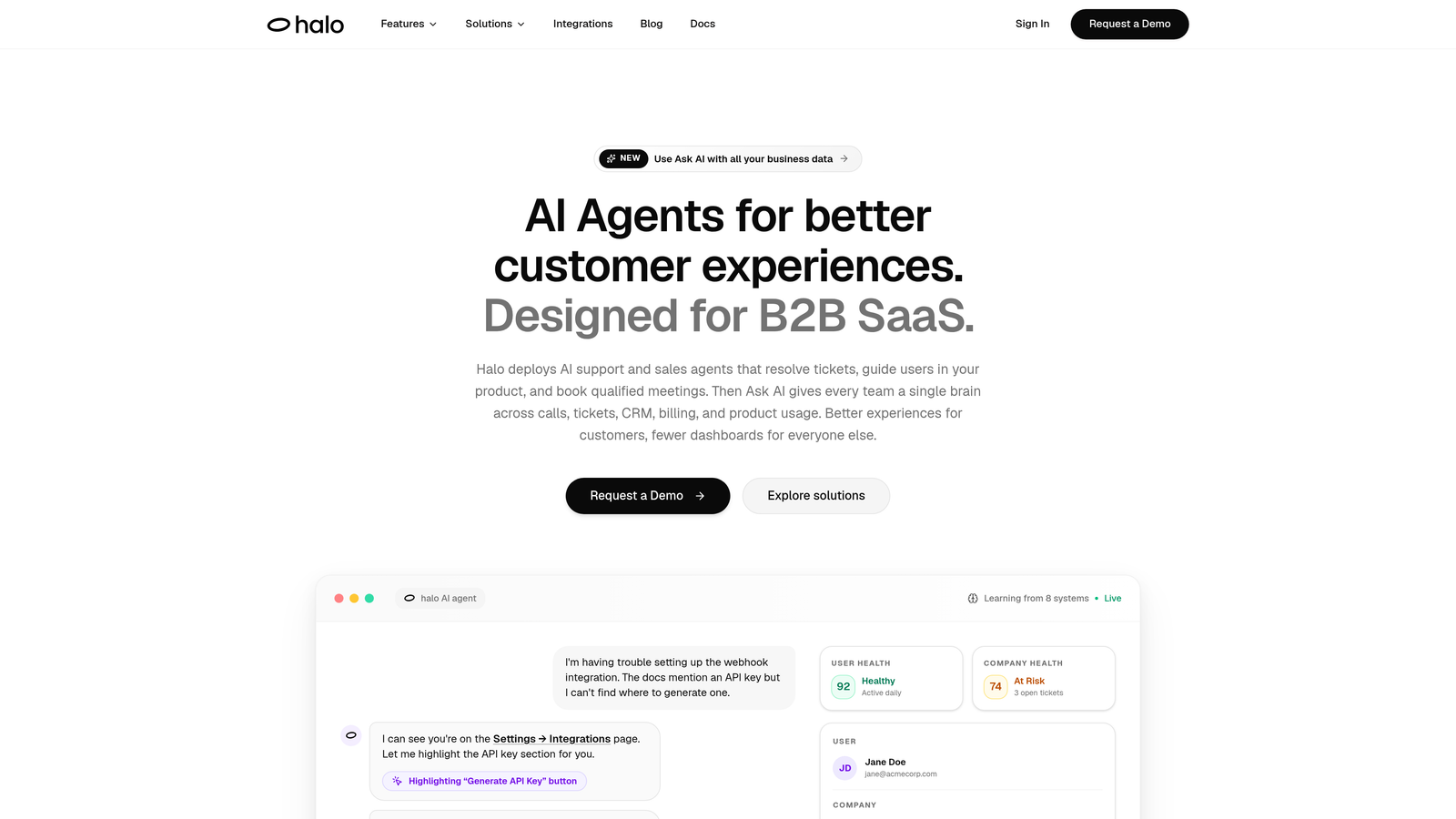
Halo AI is an AI-first customer support platform that deploys intelligent agents to resolve tickets, guide users through your product, and surface revenue and health signals without adding headcount.
Where This Tool Shines
Most AI support tools treat every conversation the same way regardless of where the user is in your product. Halo is different because its agents are page-aware: the AI understands what the user is currently looking at and responds with context that's actually relevant to that moment. It's the difference between a support agent who read your docs and one who can see your screen.
The continuous learning loop is the other major differentiator. Every resolved interaction improves the model, so your support quality compounds over time rather than staying static. For teams that care about support data feeding product decisions, Halo's smart inbox surfaces customer health signals, anomaly detection, and revenue intelligence alongside standard support metrics.
Key Features
Page-Aware AI Agents: The AI understands the user's current product context for responses that are accurate and situationally relevant, not generic.
Continuous Learning Loop: Every resolved ticket improves the model, so support quality gets smarter with every interaction over time.
Smart Inbox with Business Intelligence: Goes beyond ticket metrics to surface customer health scoring, anomaly detection, and revenue signals from support data.
Auto Bug Ticket Creation: Automatically routes bug reports to Linear without requiring human intervention, closing the loop between support and engineering.
Live Agent Handoff: Escalates to human agents with full conversation context preserved, so customers never have to repeat themselves.
Native Integrations: Connects to Slack, HubSpot, Intercom, Stripe, Zoom, PandaDoc, Fathom, and Linear out of the box.
Best For
Halo is the strongest fit for scaling B2B SaaS companies and product-led growth teams that want support automation to do more than close tickets. If you want your support layer to feed product intelligence and revenue decisions, and you'd rather build on an AI-first architecture than bolt AI onto a legacy helpdesk, Halo is purpose-built for that scenario.
Pricing
Contact for pricing. Halo is designed for scaling B2B SaaS teams. Reach out via haloagents.ai for a tailored quote.
2. Intercom Fin AI Agent
Best for: Teams already using Intercom as their primary support and engagement layer
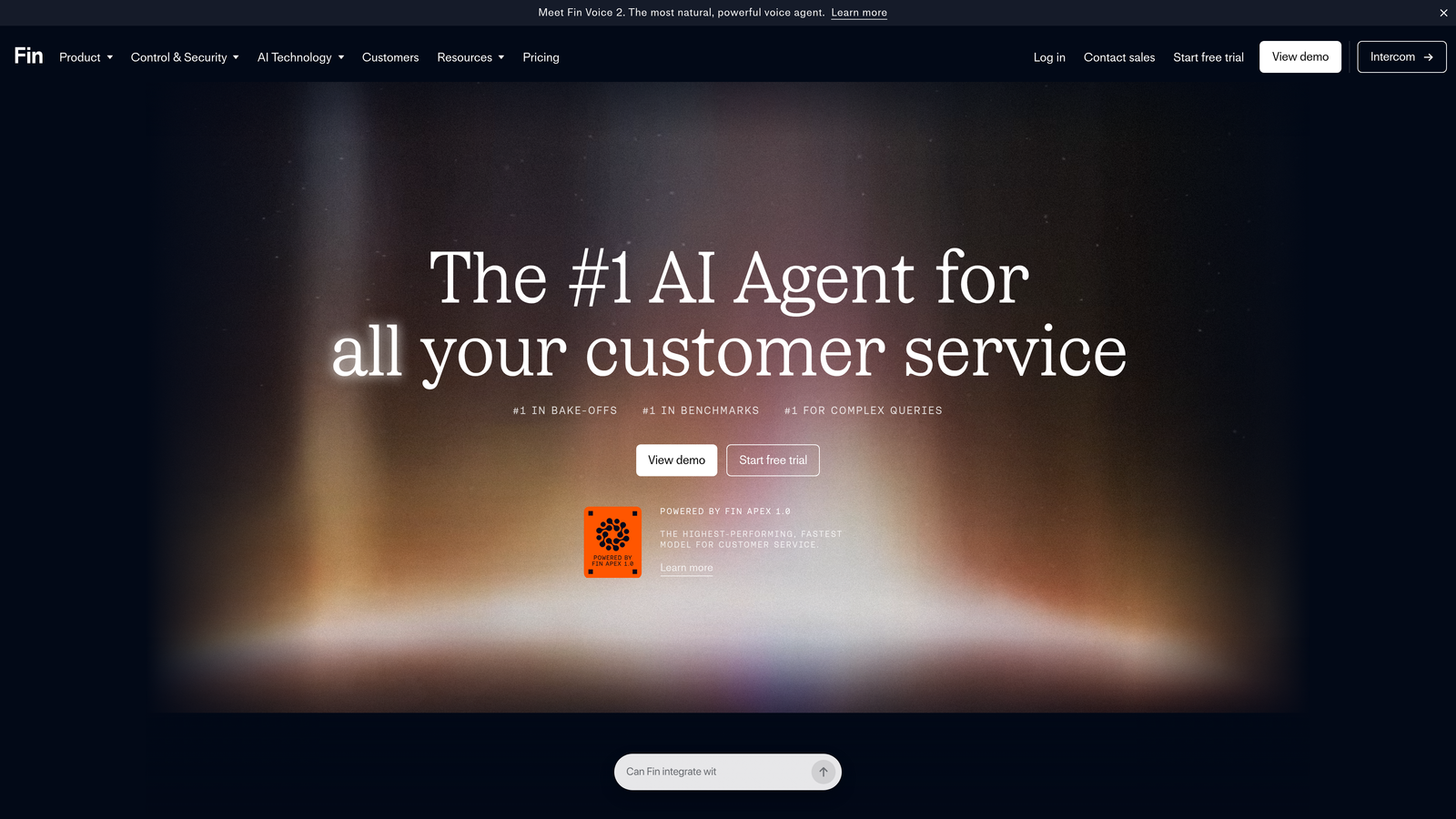
Intercom Fin is an LLM-powered AI agent that handles support conversations autonomously within the Intercom messenger before routing to human agents.
Where This Tool Shines
Fin's biggest advantage is how tightly it integrates with the broader Intercom ecosystem. If your team already lives in Intercom for customer messaging, onboarding, and support, Fin slots in without workflow disruption. It draws on your existing knowledge base and help content to resolve queries autonomously, which means the setup investment is relatively low for teams with well-maintained documentation.
The resolution-based pricing model is worth noting: you pay for what Fin actually resolves, not just what it attempts. That aligns the tool's cost with its value, which is a more honest model than flat per-agent pricing for AI features.
Key Features
Autonomous Conversation Handling: Resolves queries using your company's knowledge base and help content without requiring manual rules configuration.
Seamless Human Handoff: Routes conversations to the human inbox when AI confidence drops, with context intact.
Omnichannel Coverage: Works across chat, email, and in-product messaging within the Intercom platform.
Resolution Reporting: Built-in analytics on AI resolution rates and conversation quality to measure actual impact.
Best For
Teams that have already invested in Intercom as their customer communications platform and want to add autonomous AI resolution without switching tools. Less compelling as a standalone choice if you're not already in the Intercom ecosystem.
Pricing
Add-on to existing Intercom plans with pricing based on resolutions. Verify current rates at intercom.com.
3. Zendesk AI
Best for: Large enterprise support organizations with existing Zendesk infrastructure
Zendesk AI is a suite of AI capabilities embedded across the Zendesk platform, covering intelligent triage, agent assistance, automated workflows, and self-service at enterprise scale.
Where This Tool Shines
Zendesk's AI strength is breadth. It covers the full support workflow: intelligent triage routes tickets before an agent touches them, the Agent Copilot assists during resolution, and automated workflows handle follow-up and categorization. For large teams running complex support operations, having AI embedded at every stage of the ticket lifecycle reduces friction significantly.
The acquisition of Ultimate.ai has expanded Zendesk's conversational AI capabilities considerably. Teams that have built significant process and reporting infrastructure on Zendesk get meaningful AI uplift without a platform migration.
Key Features
Intent and Sentiment Detection: AI-powered triage identifies ticket intent and customer sentiment to route accurately from the start.
Agent Copilot: Provides suggested replies, ticket summarization, and next-best-action recommendations directly in the agent workspace.
Automated Workflow Triggers: Triggers workflow actions based on AI-detected context rather than manual rule configuration.
Tiered AI Access: Advanced AI features are available across Suite Professional and Enterprise tiers for teams that need deeper capability.
Best For
Enterprise support teams with significant existing investment in Zendesk who want AI capabilities without migrating platforms. The complexity and cost can be prohibitive for smaller teams starting fresh.
Pricing
Zendesk Suite plans start at approximately $55 per agent per month, with advanced AI features at higher tiers. Verify current pricing at zendesk.com.
4. Freshdesk Freddy AI
Best for: SMB and mid-market teams wanting accessible AI across support and IT service management
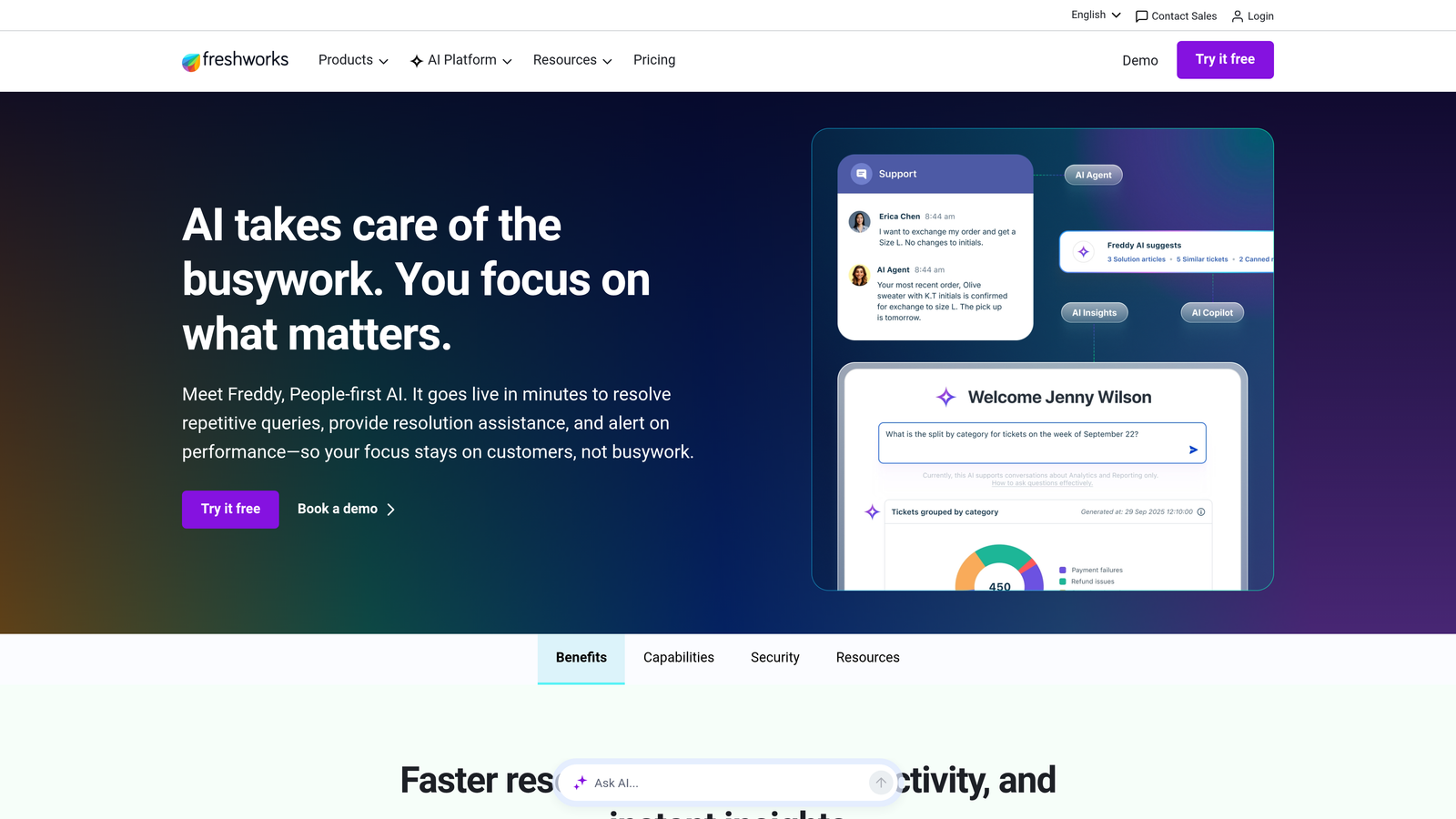
Freshdesk Freddy AI is Freshworks' AI layer spanning self-service automation, agent assistance, and analytics across the Freshdesk and Freshservice platforms.
Where This Tool Shines
Freddy AI is structured as three distinct layers: Self Service for autonomous resolution, Copilot for agent assistance, and Insights for analytics. That modular approach means teams can activate the pieces they need without paying for capabilities they won't use. For companies running both customer support and internal IT helpdesk on Freshworks, Freddy's cross-product coverage is a genuine efficiency advantage.
Freshworks has historically been more accessible on pricing than Zendesk, which makes Freddy a practical choice for mid-market teams that want meaningful AI capability without enterprise-tier investment.
Key Features
Freddy Self Service: Autonomous query resolution via chatbot trained on your knowledge base content.
Freddy Copilot: Agent-assist features including suggested replies, conversation summarization, and tone adjustment.
Freddy Insights: AI-generated analytics that surface support trends and performance patterns automatically.
Cross-Product AI: Consistent AI layer across Freshdesk, Freshservice, and other Freshworks products for unified intelligence.
Best For
SMB and mid-market teams on Freshworks products, or those considering Freshdesk as an alternative to Zendesk. Also strong for organizations managing both customer support and IT service management on a single platform.
Pricing
Freddy AI is available as an add-on with pricing that varies by product tier. Check current rates at freshworks.com.
5. Tidio Lyro AI
Best for: Small to mid-sized businesses that need fast AI deployment without a lengthy implementation
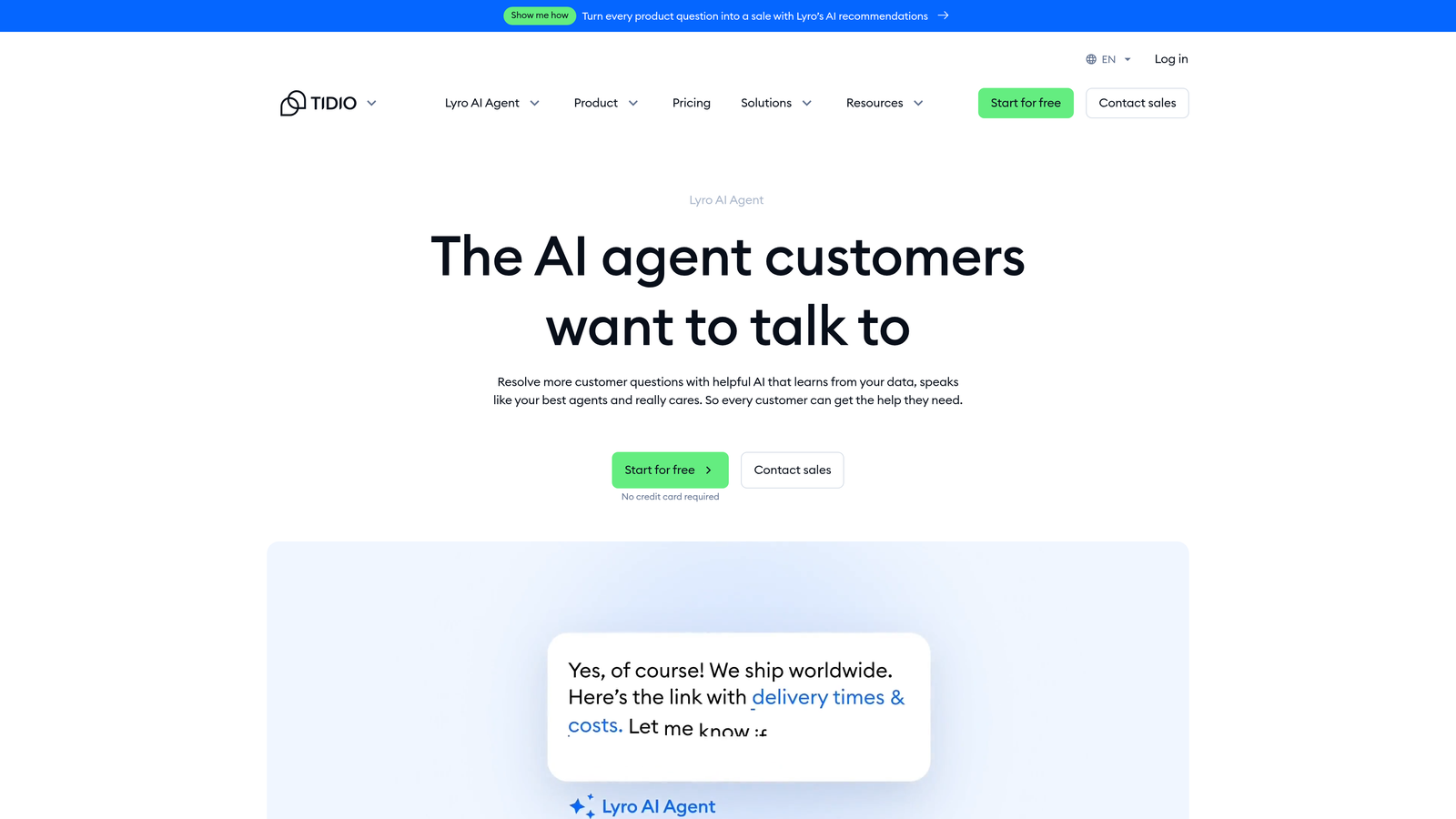
Tidio Lyro is a conversational AI agent that delivers autonomous customer conversations using your existing knowledge base content, with a setup timeline measured in hours rather than weeks.
Where This Tool Shines
Lyro's standout quality is speed to value. Most enterprise AI tools require significant configuration, training data preparation, and integration work before they're useful. Lyro learns from your existing FAQ and knowledge base content, which means a team with decent documentation can have autonomous AI conversations running the same day. That's genuinely useful for small teams without dedicated implementation resources.
The accessible pricing model also makes Lyro worth serious consideration for e-commerce businesses and early-stage SaaS companies that can't justify enterprise AI tool budgets but still want meaningful automation.
Key Features
Knowledge Base Training: Learns from your existing FAQ and help content without requiring manual intent mapping or rule building.
Rapid Deployment: Typically live within hours, making it one of the fastest AI support tools to activate.
Confidence-Based Handoff: Escalates to human agents when conversations exceed the AI's confidence threshold.
Accessible Entry Pricing: Free tier available with conversation-based limits, making it viable for smaller teams testing AI automation.
Best For
Small to mid-sized businesses, e-commerce teams, and early-stage SaaS companies that want autonomous AI conversations without a lengthy implementation or enterprise-level investment.
Pricing
Free tier available; Lyro AI conversations are priced separately from base Tidio plans. Check current rates at tidio.com.
6. Ada
Best for: Enterprise teams that need AI to complete transactions, not just answer questions
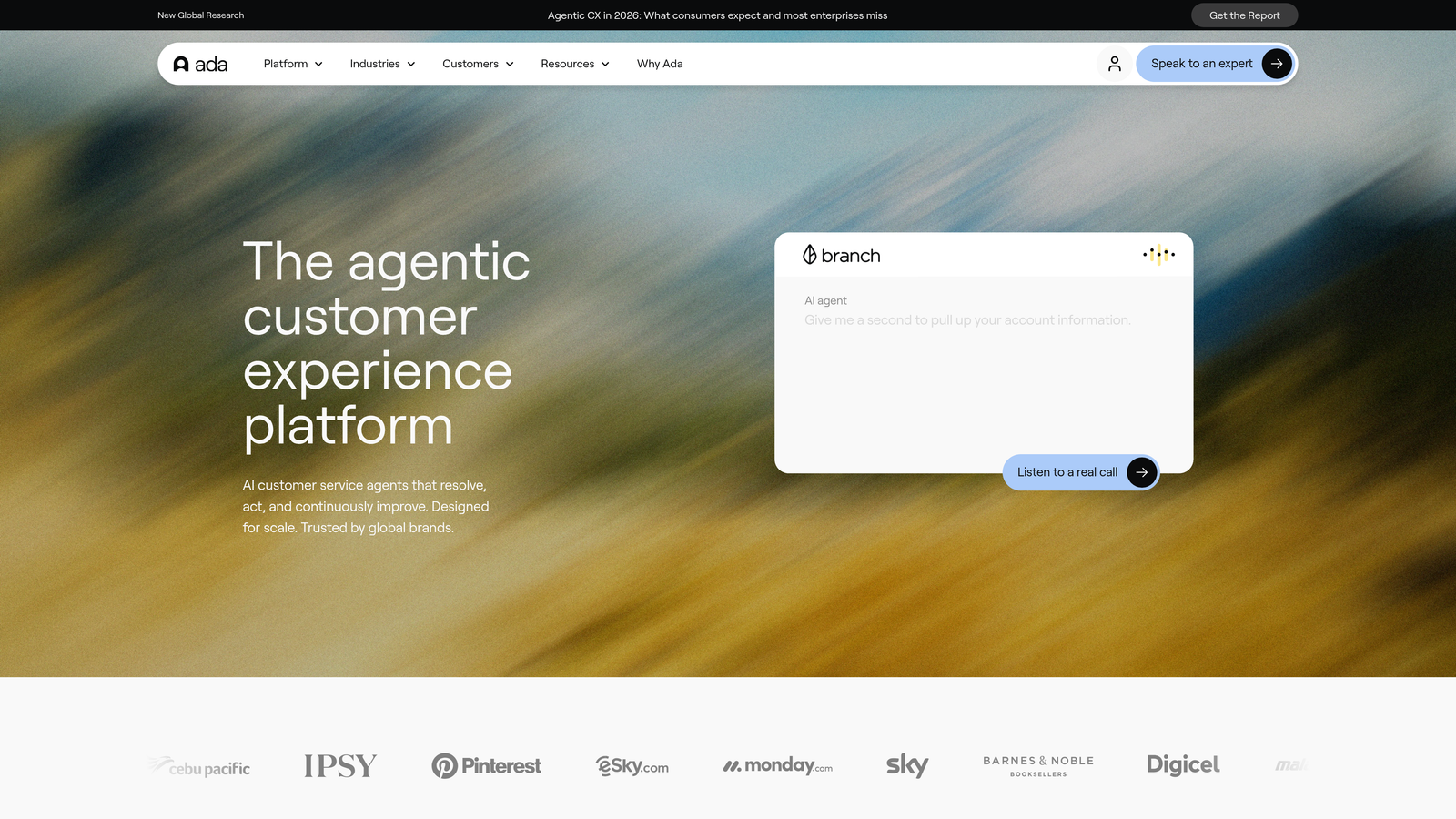
Ada is an enterprise-grade no-code AI agent platform focused on action AI, automating support interactions that require completing multi-step transactions rather than simply providing information.
Where This Tool Shines
Ada's core differentiation is the shift from informational AI to action AI. Most support automation tools answer questions. Ada can process refunds, update account details, and complete multi-step transactions by connecting directly to your backend systems. For consumer-facing businesses where support frequently involves account changes or order management, that distinction is significant.
The no-code agent builder is genuinely accessible to non-technical teams, which matters at enterprise scale where support operations teams often can't wait on engineering resources for every workflow change.
Key Features
Action-Oriented AI: Completes transactions like refunds and account updates rather than just providing information to customers.
No-Code Agent Builder: Accessible to non-technical teams for building and modifying AI agent workflows without engineering support.
Deep Integrations: Connects to major CRMs, ticketing systems, and backend data sources for full transactional capability.
Multilingual Support: Handles global enterprise deployments across multiple languages.
Best For
Large consumer brands and B2B enterprises where support interactions frequently involve completing transactions or updating account data. Requires more implementation investment than lighter tools, so it's best suited to teams with dedicated implementation resources.
Pricing
Enterprise pricing. Contact Ada directly for a quote at ada.cx.
7. Forethought AI (Agatha)
Best for: Enterprises that want AI intelligence layered on top of an existing helpdesk without migrating
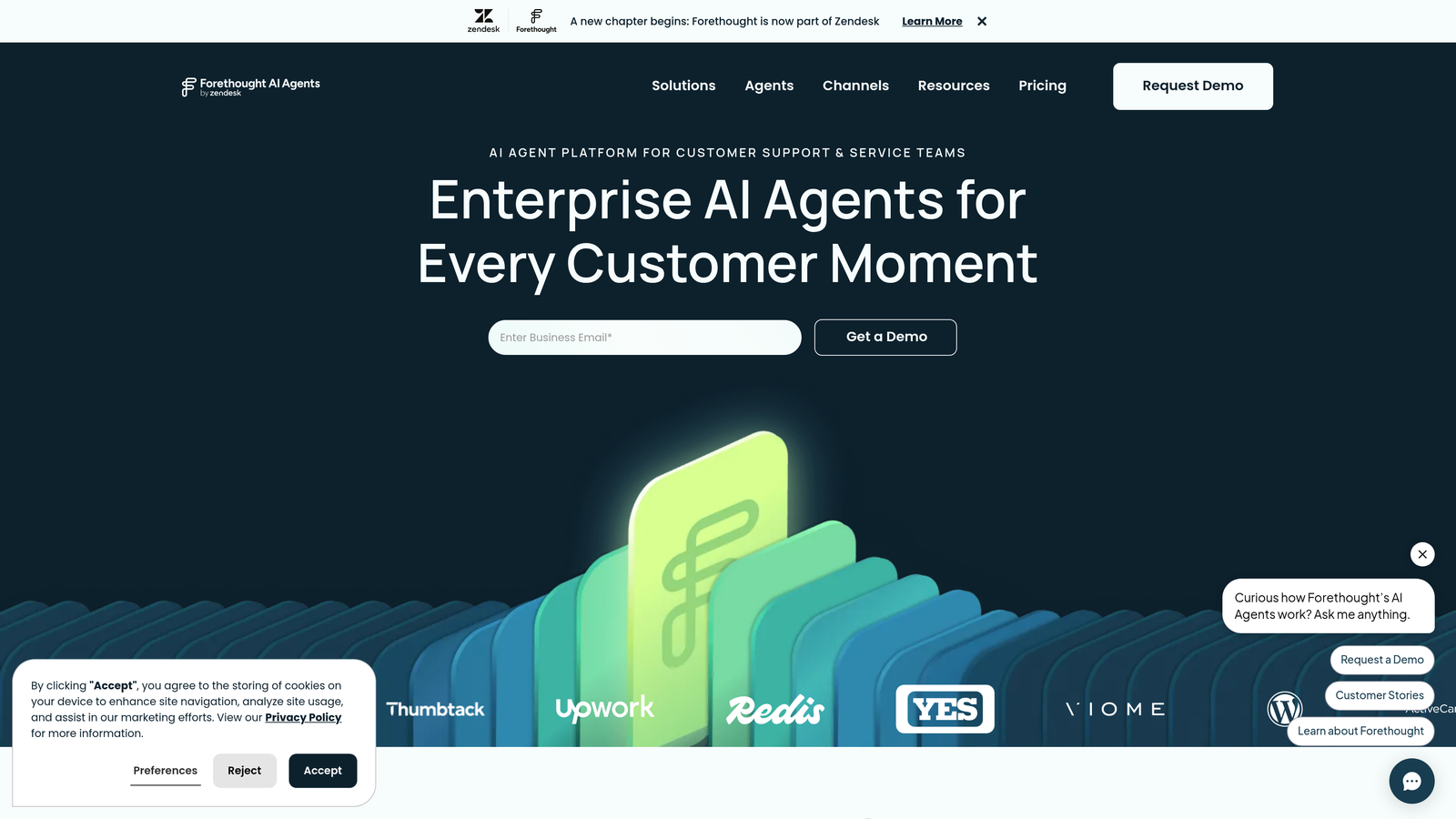
Forethought AI is an AI layer that augments existing helpdesks, adding intelligent triage, auto-tagging, and suggested responses on top of Zendesk, Salesforce Service Cloud, and ServiceNow.
Where This Tool Shines
The "overlay, not replacement" positioning is Forethought's most practical advantage. Large enterprises often have years of workflow configuration, reporting, and integrations built into their current helpdesk. Forethought brings SupportGPT-powered intelligence to those environments without requiring a platform migration, which removes the biggest barrier to AI adoption for established support orgs.
The auto-tagging and categorization capability is particularly valuable for teams where inconsistent ticket tagging has degraded reporting quality over time. Better categorization improves both routing accuracy and the analytics that support leaders rely on.
Key Features
SupportGPT Triage: Routes tickets based on detected intent and urgency rather than keyword matching or manual rules.
Automated Tagging: Categorizes tickets consistently to improve both routing accuracy and downstream reporting quality.
Suggested Response Generation: Surfaces relevant response suggestions for agents based on historical resolution patterns.
Helpdesk Overlay: Works on top of Zendesk, Salesforce Service Cloud, and ServiceNow without requiring platform migration.
Best For
Enterprise support teams with significant existing investment in Zendesk, Salesforce, or ServiceNow who want AI intelligence without the disruption of a platform change. Less relevant for teams starting fresh or using other helpdesk platforms.
Pricing
Enterprise pricing. Contact Forethought directly at forethought.ai for current rates.
8. Kustomer
Best for: High-volume B2C and subscription businesses that need full customer history driving AI decisions
Kustomer is a CRM-native customer service platform owned by Meta, with embedded AI that gives both agents and automation access to the complete customer history across every touchpoint.
Where This Tool Shines
Kustomer's fundamental architecture is different from ticket-based systems. Rather than organizing support around individual tickets, it organizes everything around the customer: every interaction across every channel appears in a single chronological timeline. When AI has access to that full context, routing decisions and suggested responses are informed by the complete relationship history, not just the current conversation.
For subscription businesses and high-volume B2C companies where customer lifetime value is high and context matters, that CRM-native approach can meaningfully improve both AI accuracy and agent effectiveness.
Key Features
People-Timeline View: All customer interactions across every channel in one chronological thread, giving AI and agents complete context.
Context-Informed AI: Routing and suggested replies are informed by full CRM history, not just the current ticket.
Omnichannel Coverage: Handles email, chat, social, SMS, and voice within a unified platform.
Workflow Automation: Automates high-volume repetitive interactions without requiring manual agent involvement.
Best For
High-volume B2C companies, subscription businesses, and teams where customer relationship history should drive AI and agent decisions. The per-agent pricing makes it a more significant investment than lighter tools.
Pricing
Starts at approximately $89 per agent per month. Verify current pricing at kustomer.com.
9. Gladly
Best for: Premium consumer brands where relationship quality and agent-assisted service matter most
Gladly is a people-based customer service platform that organizes support around customers rather than tickets, with AI features designed to assist human agents rather than replace them entirely.
Where This Tool Shines
Gladly takes a deliberately different philosophy from fully autonomous AI tools. Its AI assists agents rather than replacing them, which is the right call for premium brands where the quality of human interaction is part of the product experience. The lifelong conversation thread means every agent who interacts with a customer has the full relationship history immediately available, which reduces the friction that frustrates customers most.
Publicly listed customers like Crate and Barrel and Warby Parker reflect Gladly's sweet spot: premium consumer brands where support quality directly affects brand perception and customer retention.
Key Features
Lifelong Conversation Threading: All customer interactions across channels appear in one persistent timeline, accessible to every agent.
AI-Assisted Routing and Replies: Suggests responses and routes conversations intelligently without fully removing the human from the interaction.
Self-Service AI: Handles common queries autonomously with smooth escalation to human agents when needed.
People-Based Architecture: Organizes support around customer relationships rather than ticket queues.
Best For
Premium consumer brands where relationship quality is a competitive differentiator and where AI-assisted human agents are preferable to fully autonomous resolution. Less suited to teams prioritizing maximum autonomous resolution rates.
Pricing
Contact for pricing. Check current plans at gladly.com.
Which Tool Is Right for Your Team
The right choice depends heavily on where you are as a company and what you're optimizing for. Here's a practical way to think through it.
For scaling B2B SaaS and product-led growth teams: Halo AI is purpose-built for this use case. The page-aware context, continuous learning loop, and business intelligence signals make it the strongest fit for teams that want support automation to compound in value over time and feed product decisions, not just deflect tickets.
For startups and small businesses getting started fast: Tidio Lyro offers the fastest path to autonomous AI conversations with accessible pricing and minimal setup. It won't scale to enterprise complexity, but it's an excellent starting point.
For enterprises with existing Zendesk or Salesforce infrastructure: Zendesk AI or Forethought AI are the logical choices. Zendesk AI if you want AI embedded natively across the platform; Forethought if you want to add intelligence without touching your existing configuration.
For high-volume B2C and subscription businesses: Kustomer's CRM-native model, where AI decisions are informed by the full customer relationship history, offers a meaningful advantage over ticket-based alternatives. Gladly is the better fit when relationship quality and agent-assisted service matter more than autonomous resolution rates.
For enterprise teams needing action AI at scale: Ada's ability to complete transactions, not just answer questions, makes it the strongest option when support interactions frequently involve account changes, refunds, or multi-step workflows.
Your support team shouldn't scale linearly with your customer base. Let AI agents handle routine tickets, guide users through your product, and surface business intelligence while your team focuses on complex issues that need a human touch. See Halo in action and discover how continuous learning transforms every interaction into smarter, faster support.