9 Best Intelligent Support Bot Software Tools in 2026
Intelligent support bot software has evolved far beyond basic FAQ chatbots, with today's leading platforms autonomously resolving tickets, learning from interactions, and delivering actionable business insights. This guide evaluates the 9 best solutions available in 2026—covering AI resolution quality, integrations, analytics, and pricing—to help support teams of any size automate tier-1 support and scale efficiently without adding headcount.
 Grant CooperFounder14 min read
Support teams are drowning in repetitive tickets while customers expect instant, accurate answers around the clock. Intelligent support bot software has moved well beyond simple FAQ chatbots: today's platforms resolve tickets autonomously, learn from every interaction, and surface business intelligence that helps teams work smarter.
This guide covers the top intelligent support bot platforms available in 2026, evaluated on AI resolution quality, ease of deployment, native integrations, analytics depth, and pricing transparency. Whether you're a lean product team looking to automate tier-1 support or an enterprise scaling without adding headcount, there's a solution here for you.
One quick distinction worth keeping in mind as you read: some of these tools are AI-first platforms built from the ground up as autonomous agents, while others are AI layers added onto existing helpdesk infrastructure. That architectural difference matters more than it might seem, and we'll call it out for each tool.
1. Halo AI
Best for: B2B SaaS and product teams that want AI-first autonomous support with deep business intelligence.
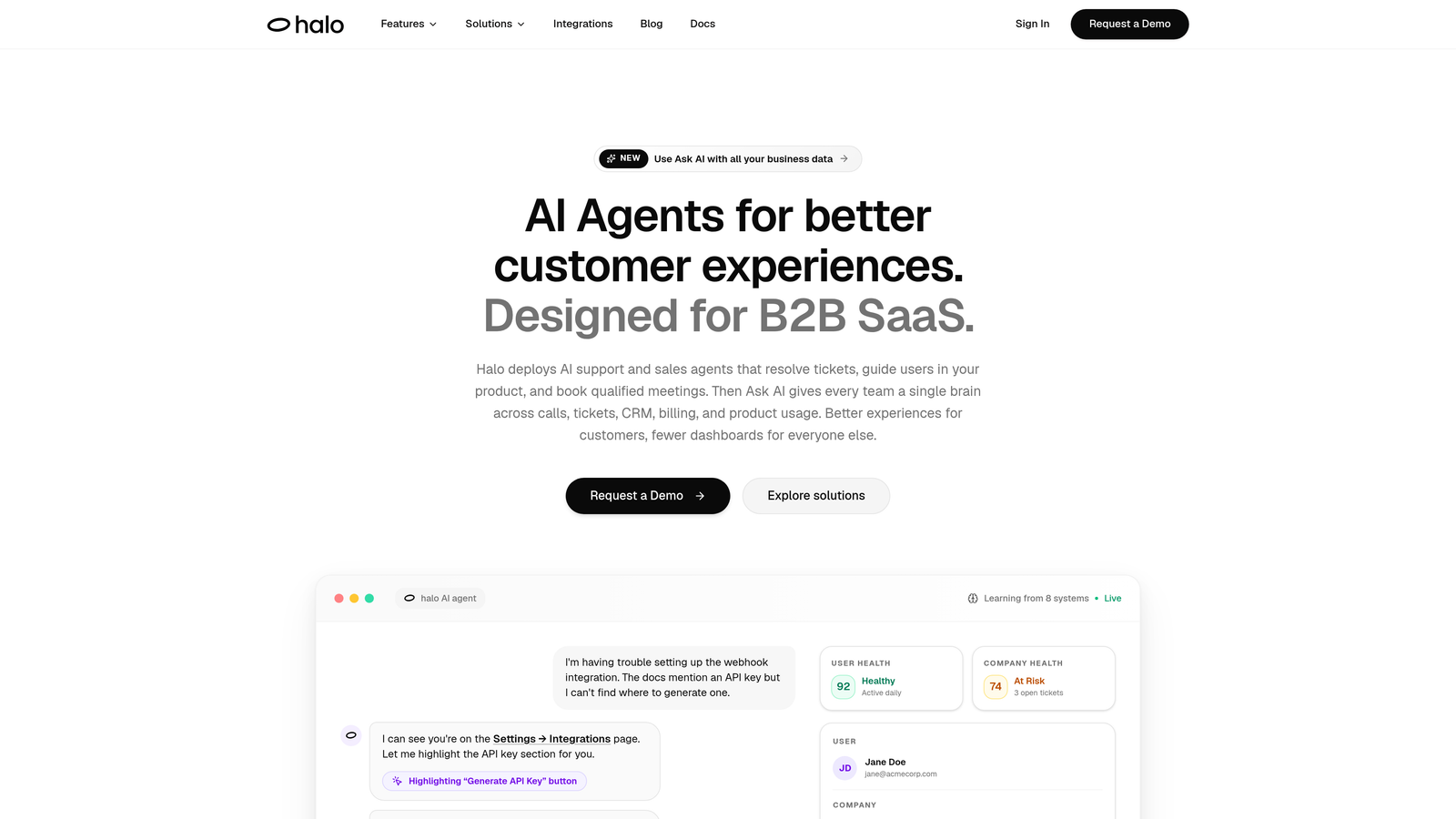
Halo AI is an AI-first customer support platform that deploys intelligent agents to resolve tickets, guide users through your product with page-aware context, auto-create bug reports, and surface business intelligence — all while learning continuously from every interaction.
Where This Tool Shines
What sets Halo apart from the rest of this list is its architecture. It wasn't built as a bolt-on to an existing helpdesk. It was designed from day one as an AI agent, which means the learning loops, integrations, and context awareness are native rather than retrofitted.
The page-aware chat widget is particularly noteworthy. Rather than only reading what a user types, Halo's widget understands where the user is in your product at that moment, giving it the context to provide guidance that's genuinely relevant. Combine that with a smart inbox that surfaces customer health signals, revenue intelligence, and anomaly detection, and you're getting business intelligence well beyond standard support metrics.
Key Features
Page-Aware Chat Widget: Sees what the user sees on screen, enabling contextual guidance based on their current location in your product.
Autonomous Ticket Resolution: AI agents resolve tier-1 tickets end-to-end, with continuous learning from every closed interaction to improve future responses.
Auto Bug Ticket Creation: Automatically generates and routes bug reports to Linear, reducing the manual handoff between support and engineering.
Smart Inbox with Business Intelligence: Surfaces customer health signals, revenue intelligence, and anomaly detection alongside standard support metrics.
Live Agent Handoff: Escalates complex issues to human agents seamlessly when the situation calls for a personal touch.
Integration Ecosystem: Connects natively with Linear, Slack, HubSpot, Intercom, Stripe, Zoom, PandaDoc, and Fathom.
Best For
Halo is an excellent fit for B2B SaaS companies and product teams that want more than deflection metrics. If you need an AI agent that learns continuously, connects to your entire business stack, and surfaces intelligence beyond support tickets, this is the platform to evaluate first.
Pricing
Visit haloagents.ai for current pricing details. The team offers demos for teams that want to see the platform in context before committing.
2. Intercom Fin
Best for: Teams already using Intercom who want AI resolution without switching platforms.
Intercom Fin is Intercom's native AI agent, powered by large language models and designed to resolve customer conversations using your existing help center content and custom answers.
Where This Tool Shines
If your team is already living inside Intercom, Fin is the path of least resistance to meaningful AI resolution. There's no new platform to learn, no complex migration, and no re-training your team on a different inbox. Fin uses your existing help center articles as its knowledge base and can be configured with custom answers for brand-specific responses.
The handoff experience is also well-executed. When Fin can't resolve a conversation, it transitions to a human agent within the same Intercom Messenger thread, preserving context throughout. The per-resolution pricing model on select plans is worth noting: it aligns cost directly with value delivered, which some teams find easier to justify internally.
Key Features
GPT-Powered Resolution: Uses large language models to resolve conversations from your existing help center content without manual configuration of every answer.
Custom Answers: Allows teams to define specific responses for brand-sensitive or frequently mishandled topics.
Seamless Human Handoff: Escalates to live agents within Intercom Messenger while preserving the full conversation context.
Resolution-Based Pricing: Available on select plans, charging per successful resolution rather than per seat or conversation.
Native Intercom Embedding: Fully embedded in the Intercom Messenger, requiring no additional widget or third-party script.
Best For
Teams already on Intercom who want to activate AI resolution quickly without adopting a new platform. Less ideal if you're looking to move away from Intercom or need intelligence beyond the Intercom ecosystem.
Pricing
Fin is included in some Intercom plans and available on a per-resolution basis on others. Check intercom.com for current tier details, as pricing structures have evolved.
3. Zendesk AI
Best for: Enterprise teams on Zendesk Suite who want AI to augment agents rather than replace tier-1 support entirely.
Zendesk AI is a suite of AI capabilities layered across the Zendesk helpdesk platform, covering intelligent triage, agent copilot suggestions, macro recommendations, and self-service bots.
Where This Tool Shines
Zendesk AI is best understood as an enhancement to an existing Zendesk investment rather than a standalone AI agent. Its strength is breadth: intelligent triage routes and tags tickets automatically, the agent copilot surfaces suggested replies and next-best actions in real time, and macro recommendations help teams standardize responses at scale.
For organizations with large agent teams already working in Zendesk, this is a low-friction way to layer AI into existing workflows. The tradeoff is that Zendesk AI is architecturally constrained by the Zendesk platform itself. Teams looking for autonomous resolution or deep integrations outside the Zendesk ecosystem may find it limiting.
Key Features
Intelligent Triage: Auto-tagging, routing, and priority scoring based on ticket content and historical patterns.
Agent Copilot: Provides suggested replies, next-best actions, and contextual knowledge surfacing directly in the agent workspace.
AI-Powered Self-Service Bot: Zendesk's bot handles common queries before tickets reach the queue.
Macro and Workflow Suggestions: Recommends templated responses and workflow adjustments based on ticket patterns over time.
Full Suite Integration: Deeply embedded across Zendesk Support, Guide, and Talk for consistent AI across channels.
Best For
Enterprise teams with a significant Zendesk investment who want to improve agent efficiency and automate triage without migrating platforms. Less suited to teams seeking AI-first autonomous resolution or cross-platform intelligence.
Pricing
Included in Zendesk Suite plans; advanced AI features are available on higher tiers. Enterprise pricing is custom. Check zendesk.com for current plan breakdowns.
4. Freshdesk Freddy AI
Best for: SMBs and growing teams on Freshdesk who want tiered AI capabilities at accessible price points.
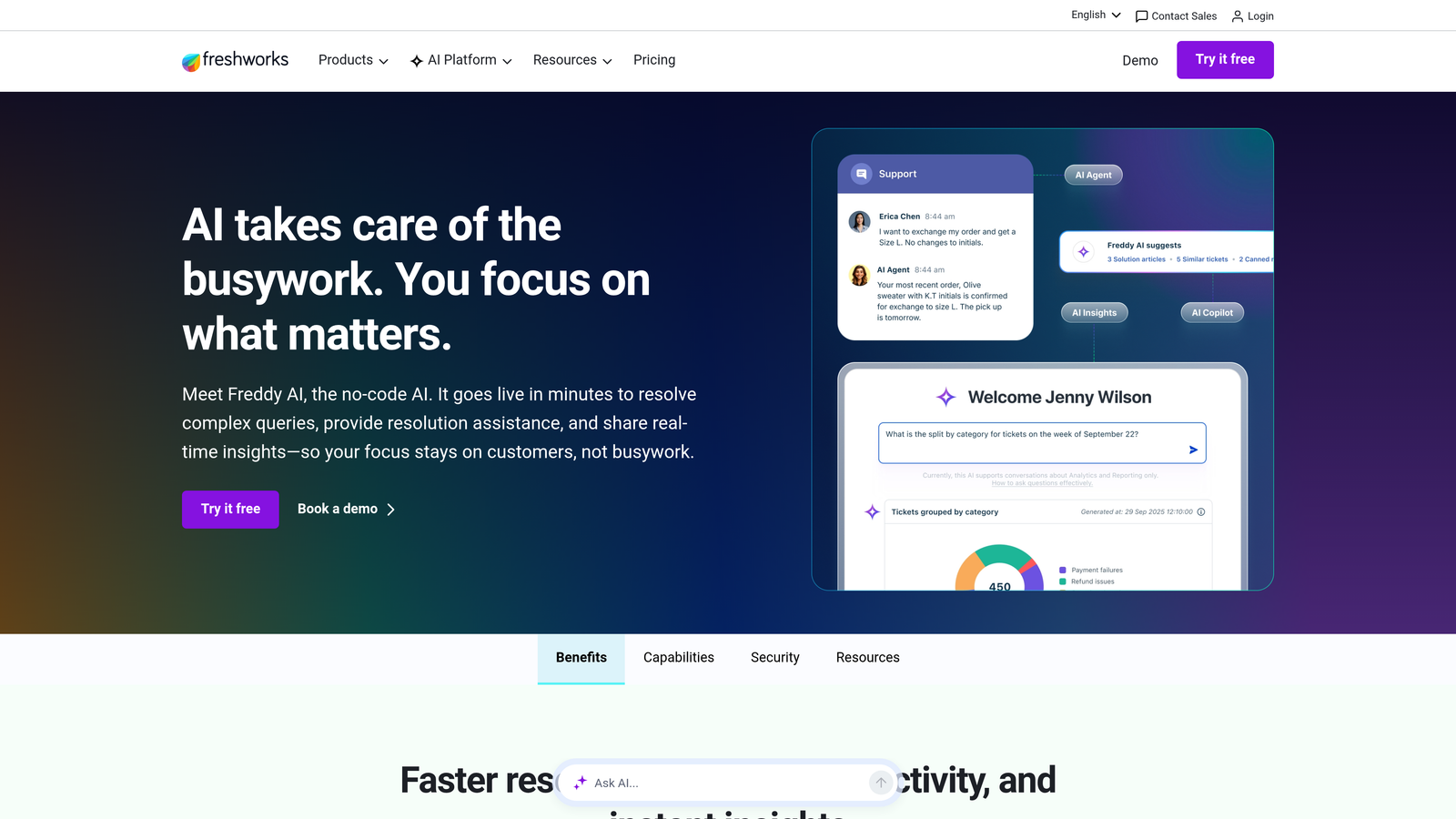
Freshdesk Freddy AI is Freshworks' AI layer for Freshdesk, offering three distinct products: Freddy Self-Service for bot automation, Freddy Copilot for agent assistance, and Freddy Insights for analytics.
Where This Tool Shines
Freddy's modular structure is its biggest practical advantage. Teams can start with Freddy Self-Service to deflect common queries, add Freddy Copilot to assist agents with reply suggestions and summaries, and layer in Freddy Insights for AI-driven reporting. That progression maps well to how support teams typically mature their AI adoption.
Multilingual support across bot interactions is a genuine differentiator for teams serving international customer bases. The pricing is also notably accessible compared to enterprise-focused competitors, making Freddy a realistic option for SMBs that don't have the budget for custom-quoted platforms.
Key Features
Freddy Self-Service: Conversational bot that deflects common queries before they reach the support queue.
Freddy Copilot: Suggests replies, generates summaries, and recommends next actions for human agents in real time.
Freddy Insights: AI-driven analytics and reporting that surface trends and performance patterns across the support operation.
Multilingual Bot Support: Handles conversations in multiple languages, useful for globally distributed customer bases.
Tiered Pricing: Freddy features are bundled into Freshdesk Growth, Pro, and Enterprise plans at accessible price points for SMBs.
Best For
SMBs and mid-market teams already on Freshdesk who want AI features without a major platform change or enterprise-level budget. Less suited to teams needing deep integrations outside the Freshworks ecosystem.
Pricing
Freddy features are bundled into Freshdesk plans starting at SMB-accessible rates. Check freshworks.com for current plan and feature tier details.
5. Tidio (Lyro AI)
Best for: E-commerce and SMB websites that need fast, low-code AI chat deployment with Shopify or WooCommerce.
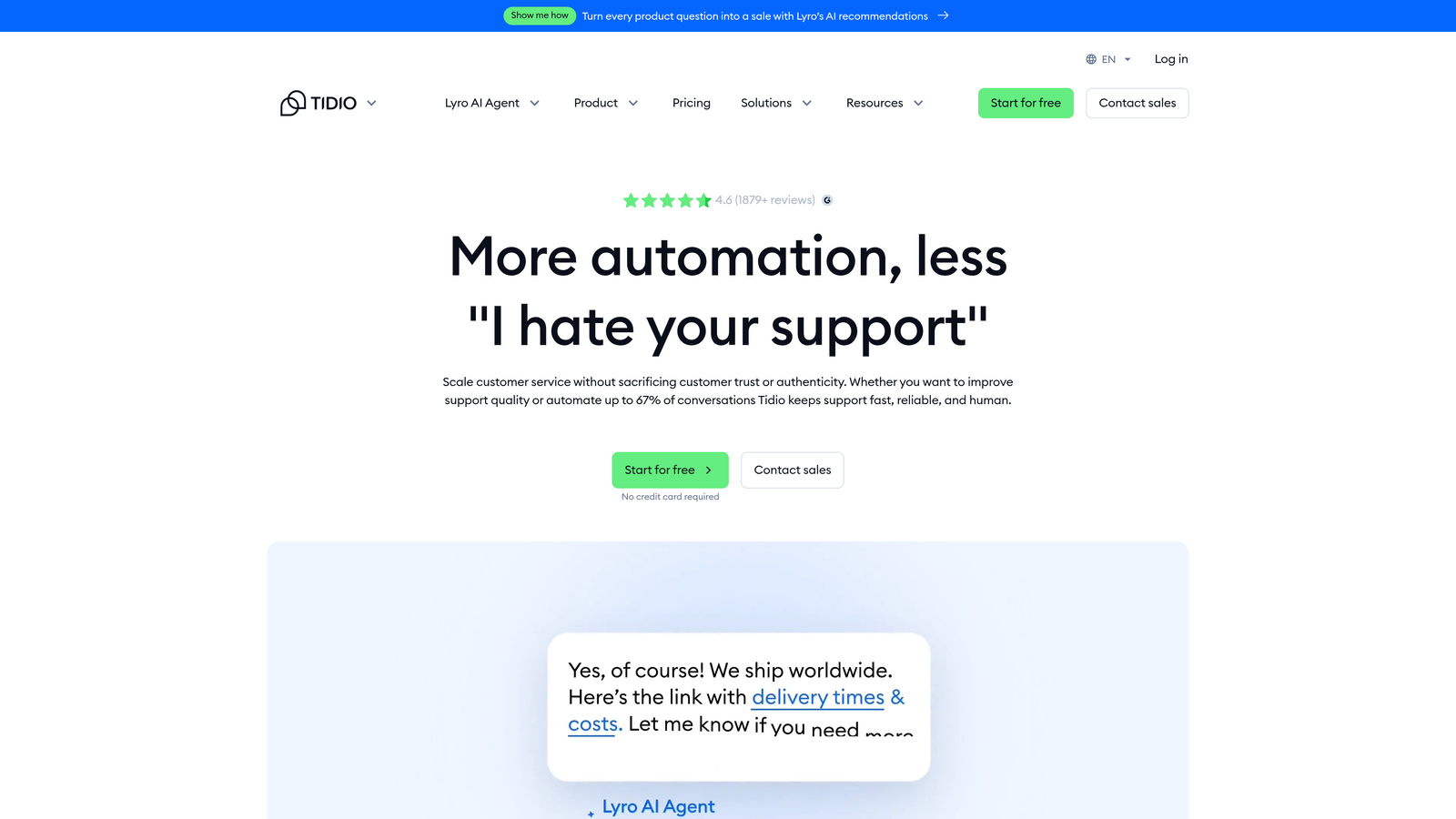
Tidio is a customer communication platform with Lyro as its conversational AI engine, designed for fast deployment on e-commerce and SMB websites with minimal technical setup.
Where This Tool Shines
Tidio's strongest suit is speed to value. Most teams can deploy Lyro on their website in a matter of hours, pointing it at existing FAQ content and letting it handle natural language conversations from day one. The native Shopify and WooCommerce integrations make it particularly well-suited to e-commerce operations where order status, returns, and product questions dominate the support queue.
The free tier is a genuine on-ramp for low-volume teams that want to test AI chat before committing to paid plans. That said, Tidio's architecture is optimized for B2C and e-commerce use cases. Teams running complex B2B SaaS support workflows will likely find the platform's depth limiting compared to AI-first alternatives.
Key Features
Lyro AI Engine: Handles natural language conversations using your existing FAQ content with minimal configuration required.
E-commerce Integrations: Native connections to Shopify and WooCommerce for order, product, and fulfillment queries.
Live Chat Fallback: Seamlessly hands off to a human agent when Lyro cannot resolve the conversation.
Visual Bot Builder: Drag-and-drop flow builder for teams that want to create custom conversation paths beyond FAQ resolution.
Free Tier: Available for low-volume use, making it accessible for early-stage businesses testing AI chat for the first time.
Best For
E-commerce stores and SMBs that need affordable, fast-to-deploy AI chat with strong Shopify integration. Not the right fit for complex B2B SaaS support or teams needing deep business intelligence from their support data.
Pricing
Free plan available for low-volume use; paid plans start at SMB-friendly rates. Check tidio.com for current pricing tiers.
6. Drift (Salesloft)
Best for: B2B teams that want a single conversational AI layer covering both sales qualification and support routing.
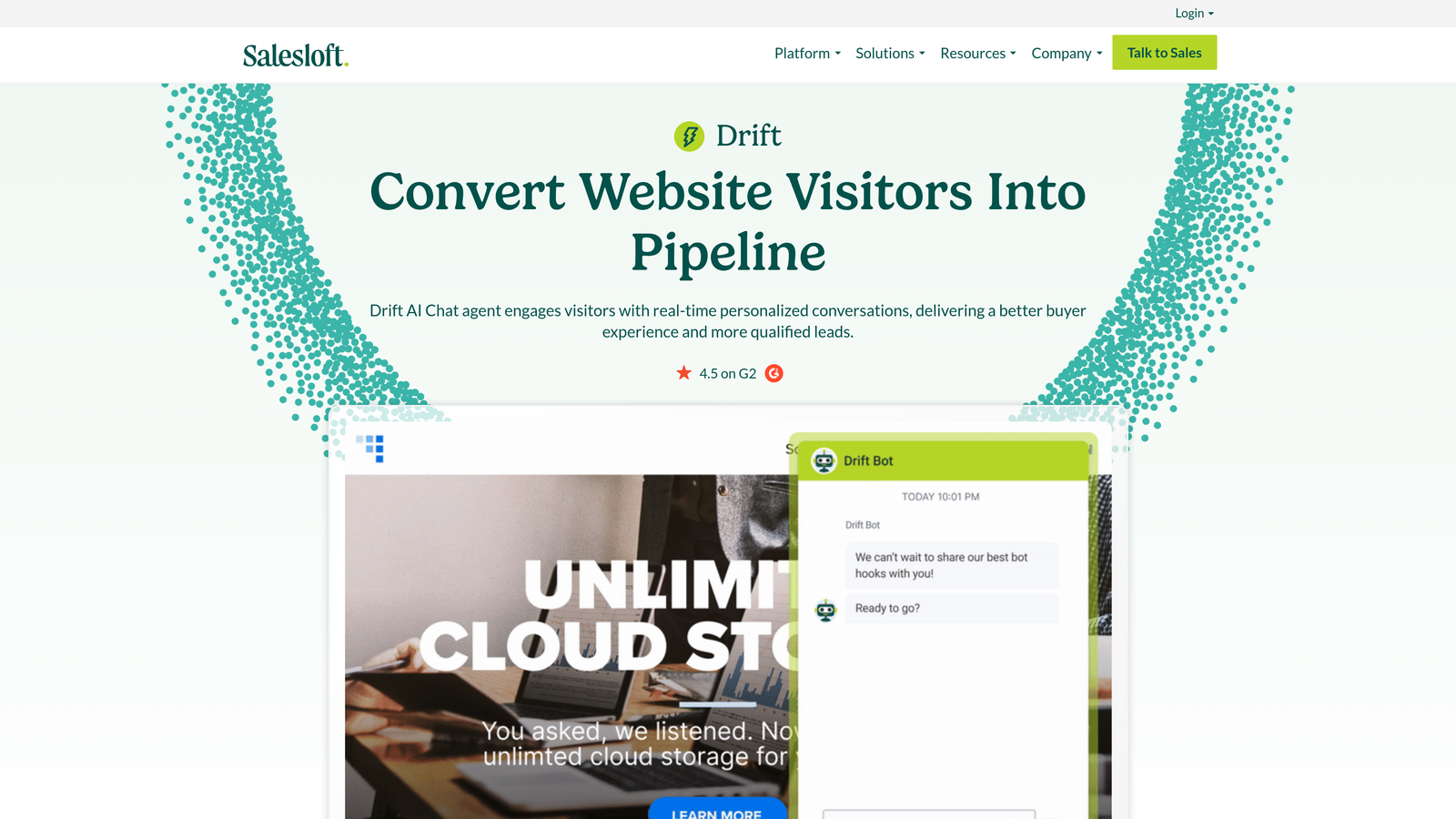
Drift is a conversational AI platform, now part of Salesloft, that blends sales qualification and support automation by routing website visitors to the right team based on intent signals.
Where This Tool Shines
Drift occupies a unique position in this list: it's less a pure support bot and more a revenue-oriented conversational platform that handles support as one of several use cases. For B2B teams where the same website visitor might be a prospect, an existing customer, or someone with a billing issue, Drift's intent-based routing is genuinely useful. It can direct conversations to sales, support, or account management based on who the visitor is and what they appear to need.
The Salesloft integration deepens the revenue intelligence angle, and meeting scheduling built directly into bot flows reduces friction for sales-adjacent conversations. Teams evaluating Drift purely for support automation may find it over-engineered for that use case, but for teams wanting to blur the line between support and revenue, it's worth a close look.
Key Features
Intent-Based Routing: Identifies visitor intent and routes conversations to the appropriate team: sales, support, or account management.
AI Conversation Summaries: Generates summaries of bot conversations before handoff to human agents or sales reps.
Account-Based Personalization: Recognizes known accounts and personalizes the bot experience based on company data.
Meeting Scheduling: Allows prospects and customers to book meetings directly within the bot conversation flow.
CRM Integrations: Connects with Salesforce, HubSpot, and Salesloft for revenue team workflows.
Best For
B2B companies where support and sales conversations overlap on the same website, and teams already using Salesloft for their revenue motion. Less ideal for teams seeking a dedicated, deep-learning support bot.
Pricing
Custom pricing. Contact Drift or Salesloft directly for a quote based on your team size and use case.
7. Ada
Best for: Global enterprises that need a no-code bot platform with strong multilingual capabilities and CX team ownership.
Ada is an enterprise-grade no-code AI bot platform that empowers CX teams to build, manage, and optimize automated support flows without engineering resources, with robust multilingual capabilities across dozens of languages.
Where This Tool Shines
Ada's core promise is autonomy for CX teams. Rather than requiring engineering resources every time a bot flow needs updating, Ada's no-code builder lets support managers and CX leads own the bot directly. That's a meaningful operational advantage at scale, where the ability to iterate quickly without a development queue can significantly improve bot performance over time.
The AI reasoning layer added in recent releases moves Ada beyond rigid decision trees into more dynamic, generative responses. Combined with A/B testing capabilities and robust analytics, Ada gives enterprise teams the tools to continuously optimize bot performance based on real conversation data.
Key Features
No-Code Bot Builder: Fully accessible to non-technical CX teams, enabling bot creation and management without engineering involvement.
AI Reasoning Layer: Enables more dynamic, generative responses that go beyond pre-scripted decision trees.
Multilingual Support: Handles conversations in dozens of languages, making it well-suited to global customer bases.
CRM and Helpdesk Integrations: Connects with Zendesk, Salesforce, and other major CRM and support platforms.
A/B Testing and Analytics: Built-in tools for testing bot variations and measuring performance against defined goals.
Best For
Global enterprises with multilingual customer bases that want CX teams to own bot management without relying on engineering. Ada's pricing reflects its enterprise positioning, so it's less suited to SMB budgets.
Pricing
Custom enterprise pricing. Contact Ada directly at ada.cx for a quote tailored to your team's scale and requirements.
8. Forethought
Best for: Teams that want modular AI adoption across deflection, intelligent routing, and agent assistance without replacing their existing helpdesk.
Forethought is a modular AI support platform with separate products for ticket deflection (Solve), intelligent routing (Triage), and agent assistance (Assist), designed to integrate with existing helpdesks rather than replace them.
Where This Tool Shines
Forethought's modular structure is its defining characteristic. Unlike platforms that require you to adopt a full suite, Forethought lets teams deploy one product at a time. A team struggling with routing accuracy can start with Triage. A team focused on deflection can deploy Solve. A team looking to improve agent efficiency can activate Assist. That flexibility reduces adoption risk and makes it easier to build a business case for each phase.
The integrations with Zendesk, Salesforce Service Cloud, and Freshdesk mean Forethought slots into existing workflows without requiring a platform migration. For teams that have invested heavily in their current helpdesk and don't want to abandon it, this is a meaningful advantage.
Key Features
Solve: AI-powered deflection and autonomous resolution that handles common queries before they reach the agent queue.
Triage: Intelligent ticket tagging, routing, and prioritization based on content, intent, and historical patterns.
Assist: In-context suggested replies and knowledge surfacing for agents actively working a ticket.
Helpdesk Integrations: Native integrations with Zendesk, Salesforce Service Cloud, and Freshdesk.
Modular Adoption: Deploy one product, two, or all three depending on your team's current priorities and budget.
Best For
Support teams on Zendesk, Salesforce, or Freshdesk that want to layer AI capabilities incrementally without committing to a full platform replacement. Strong fit for operations-focused teams with a clear focus on measurable deflection and routing efficiency.
Pricing
Custom pricing based on product selection and team size. Contact Forethought directly at forethought.ai for a quote.
9. Kustomer
Best for: High-volume, omnichannel support operations that need a unified customer timeline alongside AI-powered automation.
Kustomer is a CRM-first customer service platform that combines a unified customer timeline with AI-powered automation, suited to high-volume, omnichannel support operations where customer history context is critical to every interaction.
Where This Tool Shines
Kustomer's differentiator is the unified customer timeline. Rather than treating each support interaction as an isolated ticket, Kustomer surfaces the full history of every customer across all channels: email, chat, SMS, social, and voice. That context changes the nature of AI automation. When the bot or agent can see previous interactions, purchase history, and prior resolutions, the quality of automated responses improves meaningfully.
The built-in CRM eliminates the need for a separate customer data platform, which simplifies the tech stack for teams that would otherwise need to sync data between a helpdesk and a CRM. For high-volume operations handling thousands of omnichannel interactions daily, that consolidation has real operational value.
Key Features
Unified Customer Timeline: Aggregates all customer interactions across every channel into a single, chronological view for agents and AI alike.
AI-Powered Deflection and Workflows: Automated handling of common queries with intelligent workflow routing based on customer history and intent.
Omnichannel Support: Covers email, chat, SMS, social media, and voice from a single platform.
Intelligent Routing: Routes conversations based on customer history, intent signals, and agent availability.
Built-In CRM: Eliminates the need for a separate customer data platform by storing customer context natively within the support platform.
Best For
High-volume support operations with complex omnichannel needs where customer history context is central to resolution quality. Kustomer's enterprise pricing reflects its positioning, making it best suited to larger organizations with significant support volume.
Pricing
Enterprise pricing. Contact Kustomer at kustomer.com for a quote based on your team's volume and channel requirements.
Which Tool Is Right for Your Team?
The right intelligent support bot software depends heavily on where you're starting from and what you need AI to do for your business. Here's a quick breakdown to help you navigate the options.
AI-first SaaS teams: Halo AI is the strongest choice for product teams that want autonomous resolution, page-aware context, and business intelligence beyond standard support metrics. Its native integration ecosystem and continuous learning architecture make it particularly well-suited to B2B SaaS environments.
Existing Intercom users: Intercom Fin is the path of least resistance for teams already embedded in the Intercom ecosystem who want meaningful AI resolution without adopting a new platform.
Enterprise Zendesk operations: Zendesk AI makes sense for large agent teams that want to improve efficiency and automate triage without migrating away from a significant Zendesk investment.
SMB budgets on Freshdesk: Freshdesk Freddy AI offers a tiered, accessible entry point for growing teams that want to adopt AI incrementally within a platform they already know.
E-commerce and Shopify stores: Tidio with Lyro AI is purpose-built for this use case, with fast deployment and native e-commerce integrations that most other platforms on this list don't prioritize.
Revenue and support blend: Drift is worth evaluating for B2B teams where the same platform needs to qualify leads and handle support queries, particularly if Salesloft is already part of the revenue stack.
Global enterprises needing no-code control: Ada gives CX teams full ownership of bot management across dozens of languages without engineering dependency.
Modular AI adoption alongside an existing helpdesk: Forethought's three-product structure lets teams deploy AI incrementally without replacing Zendesk, Salesforce, or Freshdesk.
High-volume omnichannel operations: Kustomer's unified customer timeline and built-in CRM make it a strong fit for large support organizations handling complex, multi-channel customer relationships.
Your support team shouldn't scale linearly with your customer base. Let AI agents handle routine tickets, guide users through your product, and surface business intelligence while your team focuses on complex issues that need a human touch. See Halo in action and discover how continuous learning transforms every interaction into smarter, faster support.