9 Best Intelligent Support Chatbots for SaaS in 2026
Choosing the right intelligent support chatbot for SaaS requires more than basic automation—it demands contextual product awareness, deep integrations, and autonomous ticket resolution. This guide evaluates nine leading AI chatbot platforms specifically against SaaS criteria, including resolution quality, helpdesk compatibility, and learning capabilities, helping you identify which tool can deliver instant, in-product support that genuinely understands your users and reduces your team's ticket volume.
 Grant CooperFounder12 min read
SaaS companies face a support challenge that generic chatbot platforms weren't designed to solve. Your users expect instant, contextual help inside the product itself, not a static FAQ page or a 48-hour email queue. And they expect that help to understand what they're doing, where they are in your product, and what they're trying to accomplish.
An intelligent support chatbot goes well beyond scripted decision trees. It understands user intent, pulls context from your knowledge base and product data, and resolves tickets autonomously while escalating edge cases to human agents. But with dozens of AI chatbot platforms now competing for your attention, choosing the right one for a SaaS environment means evaluating integration depth, learning capabilities, analytics quality, and whether the tool truly understands your product — not just your documentation.
We evaluated these tools based on SaaS-specific criteria: AI resolution quality, product-awareness, helpdesk and tech stack integrations, analytics depth, and pricing transparency. Here are the best intelligent support chatbots for SaaS teams in 2026.
1. Halo AI
Best for: SaaS teams that need AI-native, product-aware support with built-in business intelligence.
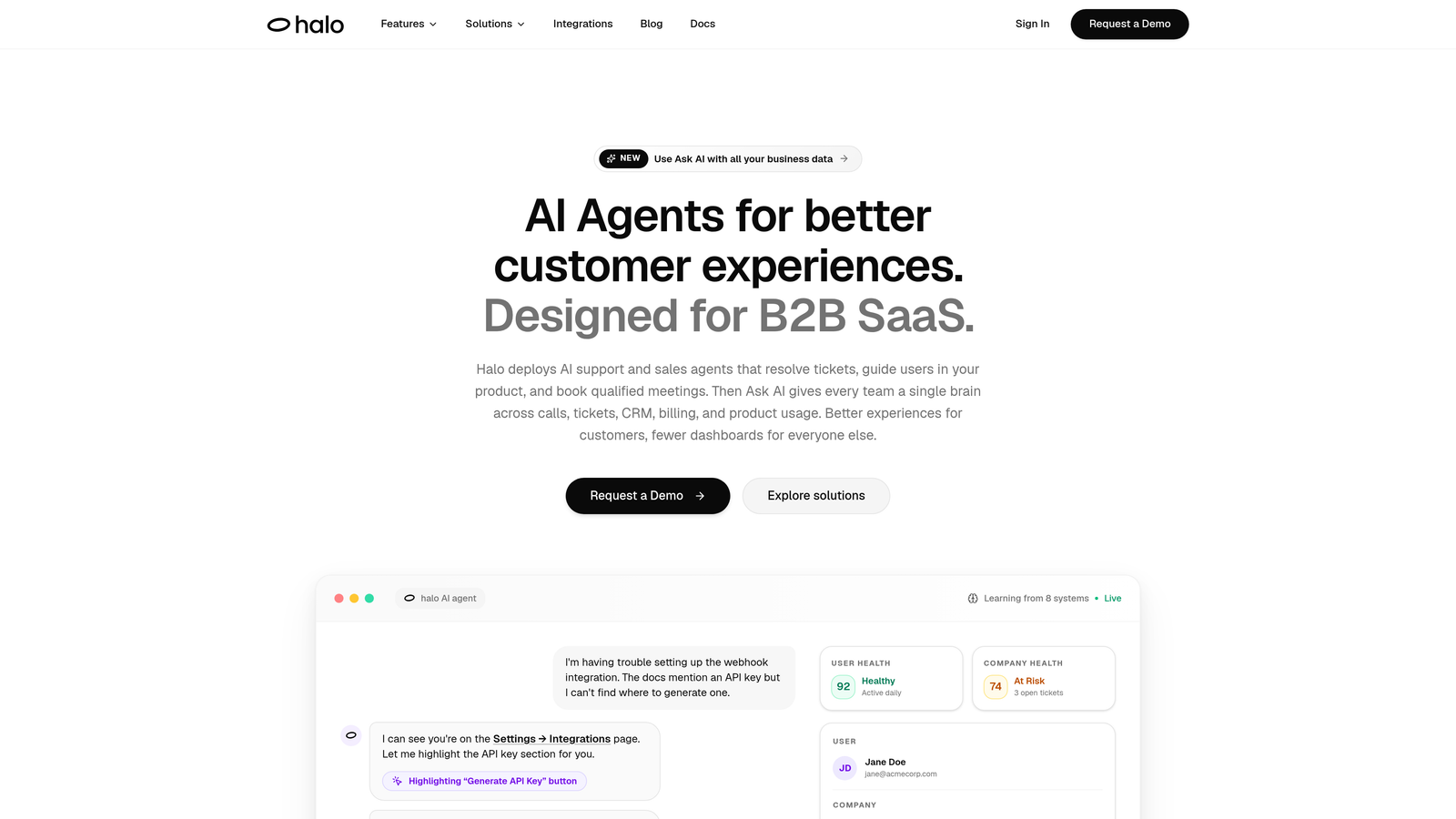
Halo AI is an AI-first customer support platform built specifically for SaaS teams who need more than ticket deflection.
Where This Tool Shines
Most chatbots know your docs. Halo AI knows your product. Its page-aware chat widget sees exactly what a user sees at the moment they ask for help, allowing the AI to provide visual UI guidance that's contextually relevant rather than generic. This is a meaningful differentiator for SaaS teams where users often struggle with specific workflows rather than broad conceptual questions.
What sets Halo apart further is the intelligence layer beyond support. Its smart inbox surfaces customer health signals, revenue intelligence, and anomaly detection, turning every support interaction into a business data point. Support stops being a cost center and starts informing churn prevention, product decisions, and sales conversations.
Key Features
Page-Aware Chat Widget: Sees what the user sees in real time, enabling visual UI guidance that's specific to where they are in your product.
Continuous Learning: The AI improves resolution quality with every interaction, getting smarter over time rather than staying static.
Auto Bug Ticket Creation: Automatically routes identified bugs to engineering tools like Linear, closing the loop between support and product teams.
Smart Inbox with Business Intelligence: Surfaces customer health signals, revenue intelligence, and anomaly detection directly from support data.
Deep Integrations: Connects to Slack, HubSpot, Intercom, Stripe, Zoom, PandaDoc, Fathom, and more for a genuinely connected tech stack.
Best For
SaaS product teams and customer success organizations that want AI-native support with genuine product awareness. Particularly valuable for companies that see support data as a strategic asset and want insights beyond ticket volume and CSAT scores.
Pricing
Contact for pricing. Halo is built for scaling SaaS teams, so pricing is tailored to your resolution volume and integration needs.
2. Intercom Fin
Best for: Teams already on Intercom who want instant AI resolution without switching platforms.
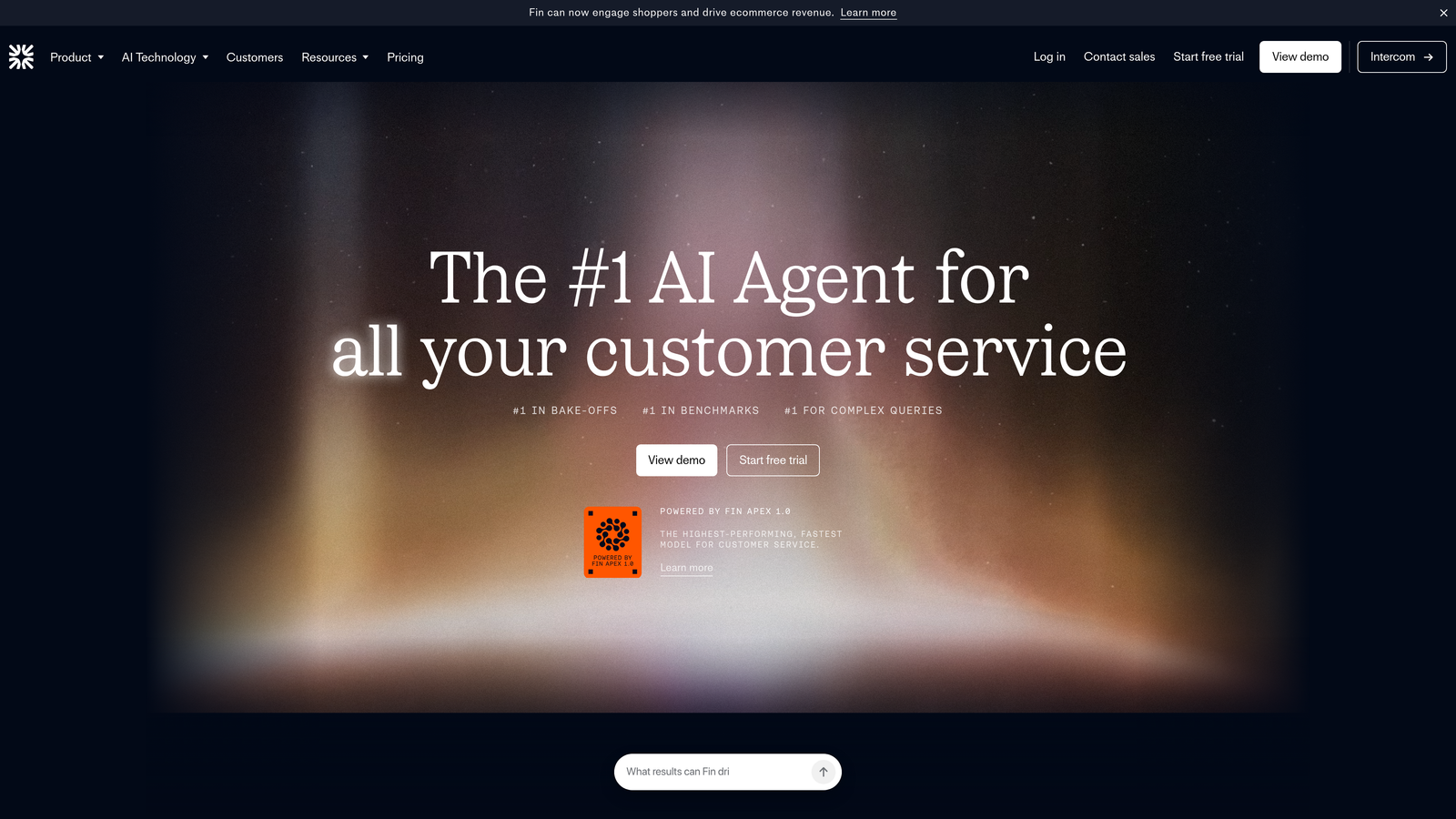
Intercom Fin is Intercom's native AI agent that resolves support questions using your help center and conversation history.
Where This Tool Shines
If your team is already living inside Intercom, Fin is the most frictionless path to AI-powered resolution. It draws on your existing help center content and past conversation history to generate accurate, grounded responses without requiring a separate platform or major migration effort.
The handoff experience is notably smooth. When Fin reaches the edge of what it can resolve, it passes full conversation context to a human agent, so customers don't have to repeat themselves. For teams where the handoff moment is a frequent pain point, this matters.
Key Features
Generative AI Responses: Answers are grounded in your help center content, reducing hallucination risk and keeping responses accurate.
Conversation Summarization: Automatically summarizes context for human agents at the point of handoff.
Native Intercom Integration: Works directly within Intercom's messenger, inbox, and workflow tools without additional setup.
Custom Answer Controls: Lets you define tone-of-voice settings and control which topics the AI handles autonomously.
Best For
Support teams already invested in the Intercom ecosystem who want to activate AI resolution quickly without platform changes or a lengthy implementation process.
Pricing
Per-resolution pricing model layered on top of an active Intercom plan. Costs can scale quickly at higher volumes, so model your expected resolution rate before committing.
3. Zendesk AI Agents
Best for: Enterprise SaaS teams with complex, high-volume support operations already running on Zendesk.
Zendesk AI Agents is an enterprise-grade AI layer built into Zendesk that auto-resolves tickets, triages incoming requests, and assists agents with suggestions.
Where This Tool Shines
Zendesk's AI capabilities are deeply embedded across the entire platform, from customer-facing resolution to backend triage and agent assistance. For large teams managing thousands of tickets across email, chat, and social channels, the breadth of automation coverage is hard to match.
The analytics integration with Zendesk Explore gives operations teams detailed visibility into AI performance, resolution rates, and deflection trends. For enterprise buyers who need to report on ROI, this reporting depth is a genuine advantage.
Key Features
Intent Detection and Triage: Automatically classifies and routes incoming tickets across channels based on detected intent.
AI-Generated Responses: Surfaces knowledge base content to resolve customer questions without agent involvement.
Agent Assist: Suggests macros and response drafts to human agents handling complex tickets.
Zendesk Explore Analytics: Deep reporting on AI performance, ticket trends, and deflection metrics built into the existing analytics suite.
Best For
Enterprise SaaS organizations with large support teams, complex multi-channel operations, and existing Zendesk infrastructure. Less ideal for smaller teams looking for a lightweight or standalone solution.
Pricing
AI capabilities are available as an add-on to Zendesk Suite plans. Enterprise pricing is available for larger deployments; contact Zendesk for volume-based quotes.
4. Ada
Best for: Scaling SaaS teams that need multilingual, no-code support automation across multiple channels.
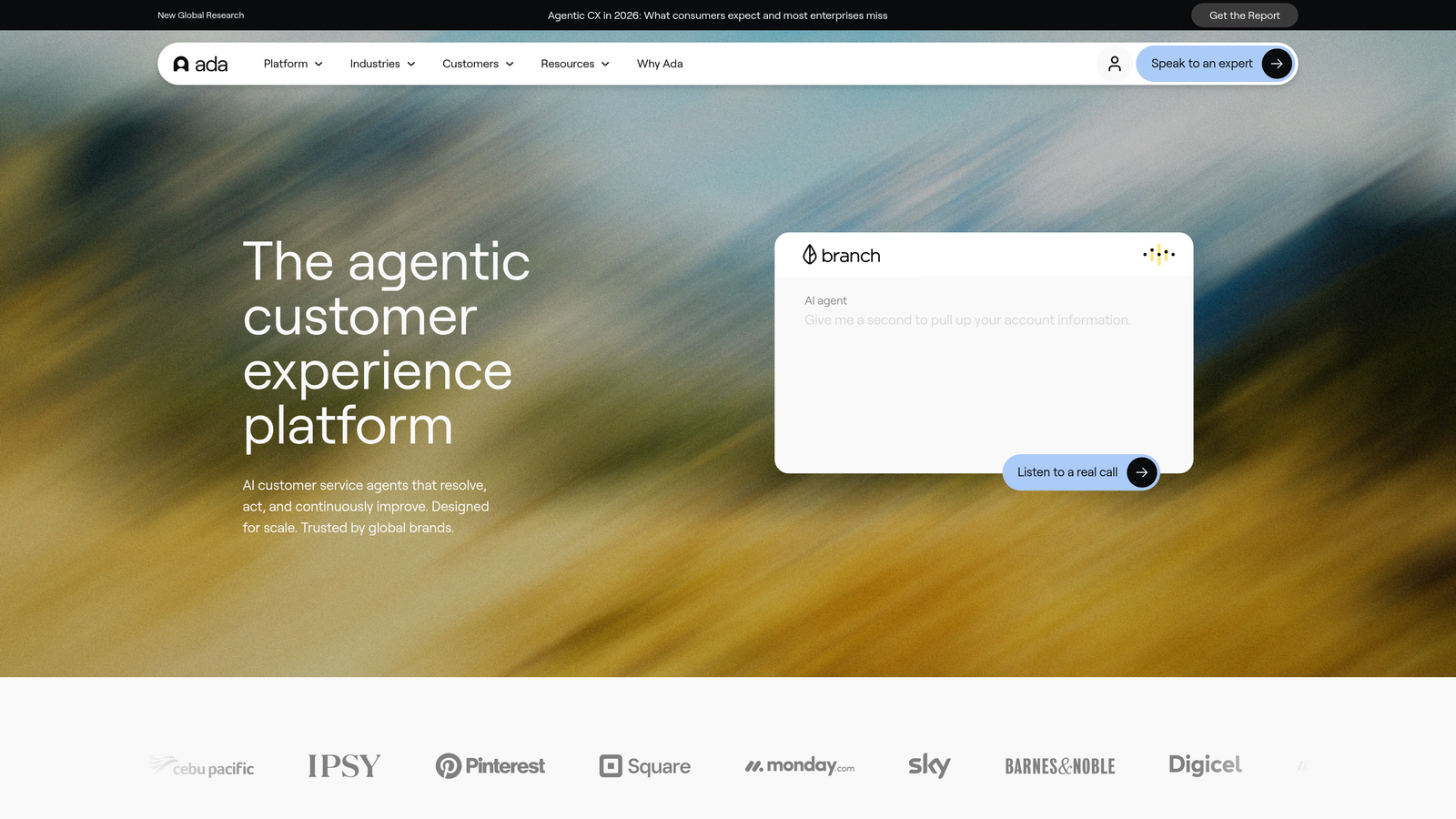
Ada is a no-code AI customer service automation platform built for scaling support across channels and languages without heavy engineering involvement.
Where This Tool Shines
Ada's no-code conversation builder is genuinely accessible to support teams without technical backgrounds. You can build, test, and iterate on AI-powered flows without filing engineering tickets, which means your support team owns the tool rather than depending on developers to maintain it.
The multilingual capability is a standout for SaaS companies with global user bases. Supporting customers across 50+ languages from a single platform reduces the operational complexity of managing region-specific support setups.
Key Features
No-Code Conversation Builder: Build and manage AI-powered resolution flows without engineering support.
Multilingual Support: Handles conversations across 50+ languages for global customer bases.
Proactive Messaging: Triggers in-app engagement based on user behavior or product context.
Broad Integrations: Connects with major CRMs, helpdesks, and e-commerce platforms for data-rich conversations.
Best For
Growing SaaS companies with international users who need scalable, multilingual automation that non-technical teams can manage and iterate on independently.
Pricing
Custom pricing based on resolution volume. Ada is typically positioned for mid-market and enterprise buyers; expect pricing conversations to focus on automation rates and projected ticket deflection.
5. Freshdesk Freddy AI
Best for: Budget-conscious SaaS teams on Freshdesk looking for accessible AI without a major platform change.
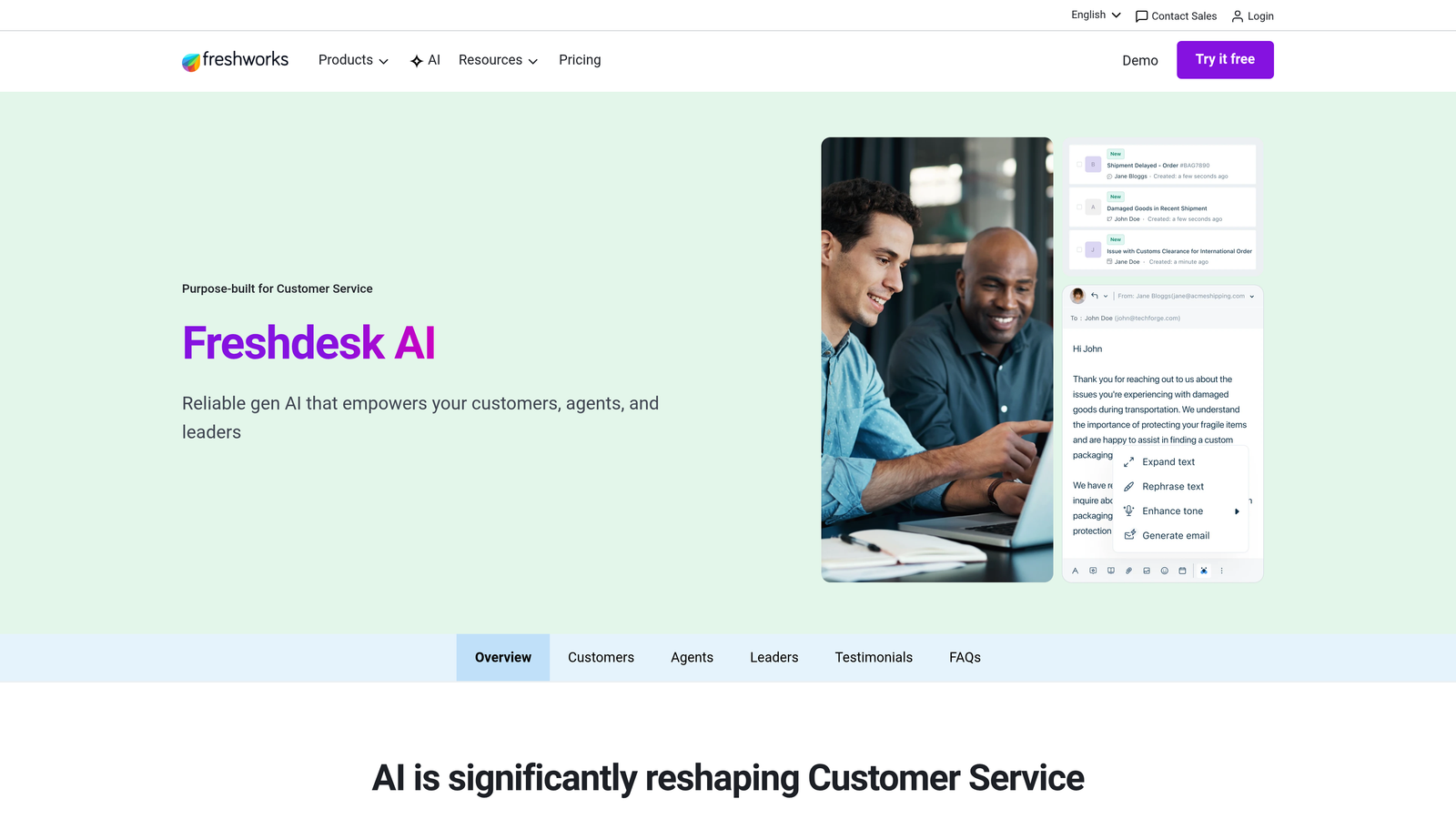
Freshdesk Freddy AI is Freshworks' AI engine embedded in Freshdesk for auto-triage, suggested responses, and customer-facing chatbot resolution.
Where This Tool Shines
Freddy AI covers the full support workflow: customer-facing self-service, intelligent ticket classification, and agent-assist suggestions all within a single platform. For teams already on Freshdesk, activating these capabilities requires minimal additional setup, making it one of the faster paths to AI-enhanced support.
The pricing structure is notably accessible compared to enterprise-focused competitors. Freddy AI capabilities are included in Freshdesk's Pro and Enterprise plans, which makes the ROI calculation straightforward for teams already paying for those tiers.
Key Features
AI Ticket Classification: Automatically categorizes and assigns incoming tickets based on content and intent.
Freddy Self Service Bot: Customer-facing chatbot that resolves common questions before they become tickets.
Canned Response Suggestions: Recommends relevant saved responses to agents during live conversations.
Affordable Tier Structure: AI features are bundled into existing Freshdesk plans rather than priced as a separate add-on at the higher end.
Best For
Smaller to mid-size SaaS teams on Freshdesk who want meaningful AI capabilities without enterprise-level pricing or a platform migration.
Pricing
Freddy AI is included in Freshdesk Pro and Enterprise plans. Entry-level tiers are available, making this one of the more accessible options in the market.
6. Tidio AI (Lyro)
Best for: Early-stage SaaS teams that need fast deployment and affordable AI without complex setup.
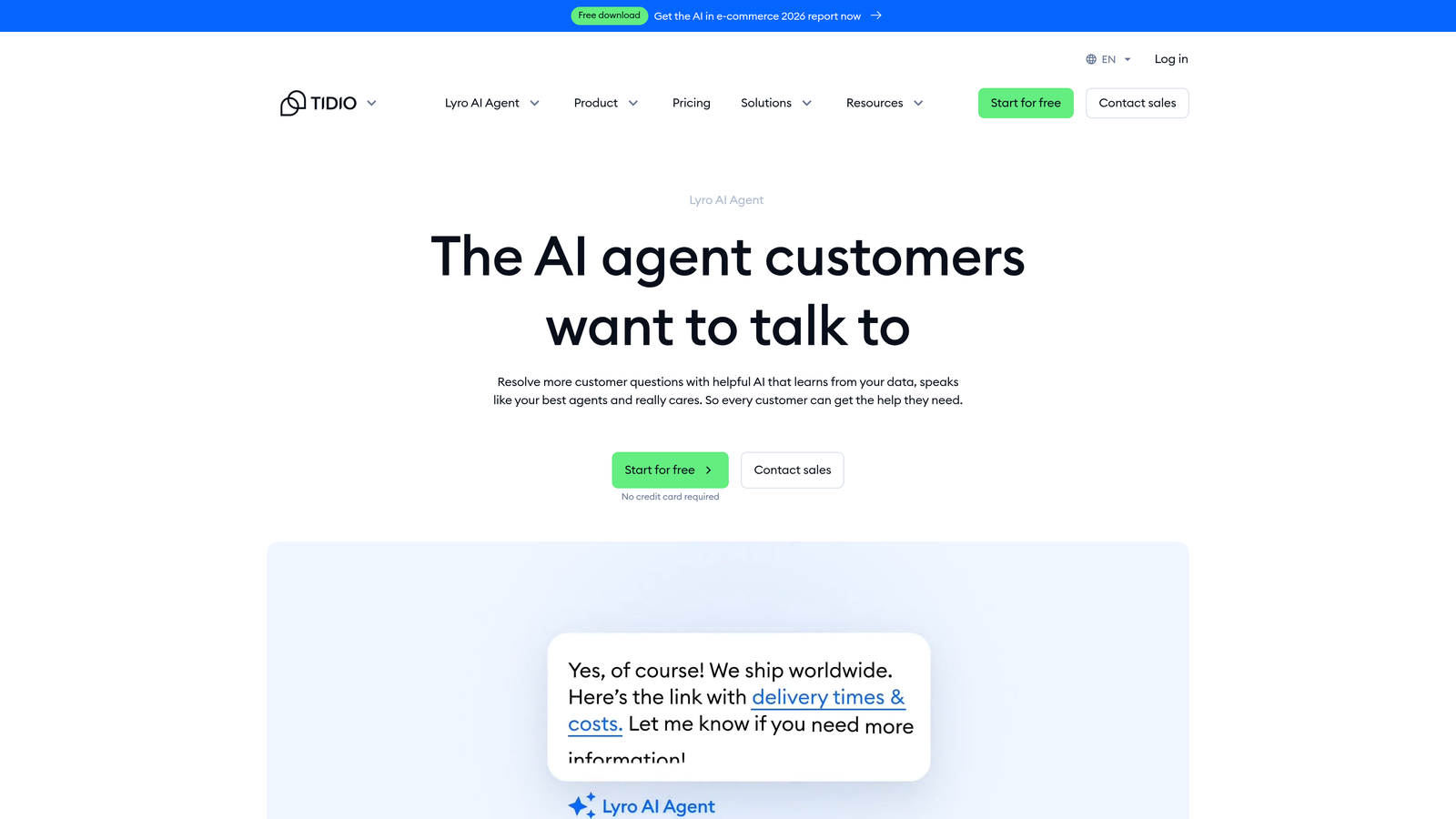
Tidio's Lyro AI is a conversational AI chatbot that learns from your FAQ and help content to answer customer questions instantly with minimal configuration time.
Where This Tool Shines
Lyro is designed for speed of deployment. You point it at your existing FAQ or knowledge base content, and it begins resolving conversations without an extended training or configuration period. For early-stage SaaS teams that don't have weeks to spend on implementation, this low-friction onboarding is a real advantage.
Tidio also combines the AI layer with a visual chatbot flow editor, giving teams the option to build structured decision-tree flows alongside AI-generated responses. This hybrid approach works well when you need predictable outcomes for specific scenarios while still benefiting from AI flexibility elsewhere.
Key Features
Knowledge Base Learning: Ingests FAQ and help content quickly, enabling fast deployment without extensive training data.
Live Agent Handoff: Escalates conversations to human agents when the AI reaches its resolution limits.
Visual Flow Editor: Drag-and-drop builder for structured conversation flows alongside AI responses.
Accessible Entry Pricing: Free tier available, with Lyro AI on a paid tier that scales with conversation volume.
Best For
Early-stage or bootstrapped SaaS teams that need to deploy an intelligent chatbot quickly without a large budget or dedicated implementation resources.
Pricing
Free tier available for basic use. Lyro AI starts at a paid tier with conversation limits; pricing scales with usage volume.
7. Drift (by Salesloft)
Best for: Product-led SaaS teams where buyer journeys and user support journeys overlap significantly.
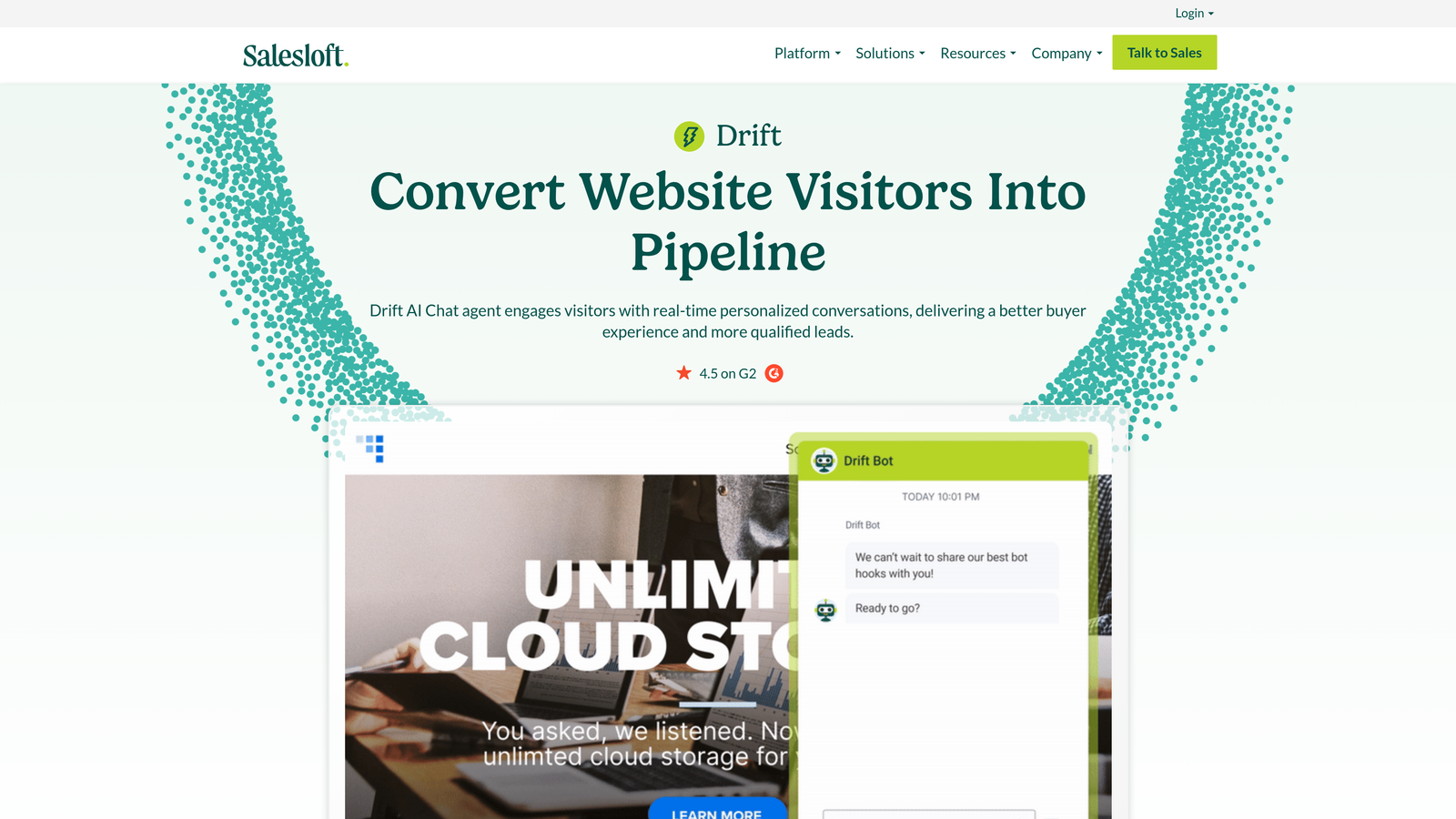
Drift is an AI-powered conversational platform that blends sales engagement and support, now operating under the Salesloft umbrella.
Where This Tool Shines
Drift occupies a unique position in this list: it's not a pure support tool, and that's precisely its value for certain SaaS teams. If your product has a strong self-serve or product-led growth motion where the same person might be evaluating, purchasing, and seeking support, Drift handles all of those conversations in a single flow.
The account-based marketing targeting is particularly useful for SaaS companies with named account strategies. Drift can personalize chat experiences based on company identity, deal stage, or existing customer status, which no pure-support chatbot can match.
Key Features
Unified Sales and Support Flow: Handles lead qualification and customer support in a single conversational interface.
ABM Targeting: Personalizes chat experiences based on account identity, deal stage, or customer status.
Meeting Scheduling: Embeds calendar booking directly into conversations to accelerate pipeline.
CRM Integrations: Native connections to Salesforce, HubSpot, and Salesloft workflows for full revenue context.
Best For
Mid-market and enterprise SaaS teams with product-led growth models where the lines between sales, marketing, and support conversations blur regularly.
Pricing
Custom pricing; typically positioned for mid-market and enterprise buyers. Expect pricing conversations to reflect the combined sales and support platform scope.
8. Forethought
Best for: SaaS support teams that need both customer-facing AI resolution and intelligent agent-assist in a single platform.
Forethought is an AI platform combining customer-facing generative chat with agent-assist tools for triage, classification, and response drafting.
Where This Tool Shines
Forethought's SupportGPT capability generates knowledge-grounded responses for customer-facing conversations, while its agent-assist layer simultaneously helps human agents draft replies and surface relevant articles. This dual-layer approach means AI is adding value whether a ticket is resolved autonomously or escalated to a person.
The intent and sentiment-based routing is a practical differentiator. Rather than routing tickets purely by category, Forethought can factor in how frustrated or urgent a customer appears to be, which helps prioritize the tickets that most need human attention.
Key Features
SupportGPT: Generative, knowledge-grounded responses for customer-facing chat and messaging.
Intelligent Triage and Routing: Routes tickets based on intent and sentiment signals, not just category.
Agent-Assist: Drafts responses and surfaces relevant knowledge for human agents handling escalated tickets.
AI Performance Analytics: Dashboard tracking resolution rates, deflection trends, and ticket insights.
Best For
SaaS support organizations that want AI working across the full ticket lifecycle: from autonomous resolution to assisted human handling, with analytics to measure both.
Pricing
Custom pricing based on ticket volume and modules selected. Forethought is typically positioned for mid-market and enterprise buyers with meaningful ticket volumes.
9. ChatBot (by LiveChat)
Best for: SaaS teams that want structured conversation design with AI enhancements and tight LiveChat ecosystem integration.
ChatBot is a visual chatbot builder with AI enhancements, tightly integrated with the LiveChat ecosystem for hybrid bot-to-human support workflows.
Where This Tool Shines
ChatBot gives teams direct control over conversation structure through a drag-and-drop visual flow builder. This is appealing when you need predictable, compliance-friendly conversation paths for specific scenarios, while still benefiting from AI-assisted response generation within those flows.
The integration with LiveChat, HelpDesk, and KnowledgeBase creates a cohesive ecosystem for teams that want a single vendor covering chat, ticketing, and knowledge management. Pre-built templates for common SaaS support scenarios also speed up initial deployment.
Key Features
Visual Flow Builder: Drag-and-drop conversation design for structured, predictable support flows.
AI-Assisted Responses: Generates responses within structured flows for more natural customer interactions.
LiveChat Ecosystem Integration: Native connections to LiveChat, HelpDesk, and KnowledgeBase for a unified support stack.
SaaS Templates: Pre-built conversation templates for common SaaS support scenarios to accelerate setup.
Best For
SaaS teams that value structured conversation control alongside AI capabilities, particularly those already using LiveChat or HelpDesk who want everything under one vendor.
Pricing
Starts at $52/month on the Starter plan. Pricing scales with the number of active chatbots and conversation volume.
Which Tool Is Right for Your SaaS Team?
The right intelligent support chatbot depends heavily on where your team is today and what you're optimizing for. Here's a quick way to think through the decision.
For AI-native, product-aware support: Halo AI is the standout choice. Its page-aware context, continuous learning, and business intelligence layer go beyond what any platform-native or general-purpose chatbot offers. If you want support that gets smarter over time and feeds insights back into your product and revenue teams, this is where to start.
For enterprise scale on existing infrastructure: Zendesk AI Agents or Intercom Fin are the natural choices if your team is already deeply invested in those platforms. The integration depth and reporting capabilities are hard to replicate with a standalone tool.
For budget-conscious teams: Freshdesk Freddy AI and Tidio Lyro offer meaningful AI capabilities at accessible price points, with Tidio being particularly well-suited for early-stage teams that need fast deployment.
For sales and support convergence: Drift is in a category of its own for product-led SaaS teams where buyer and user conversations happen in the same interface.
Your support team shouldn't scale linearly with your customer base. AI agents should handle routine tickets, guide users through your product, and surface business intelligence while your human team focuses on the complex issues that genuinely need a person. See Halo in action and discover how continuous learning transforms every interaction into smarter, faster support.