9 Best Intelligent Support Platforms Compared: Features, Pricing & Fit in 2026
This intelligent support platform features comparison evaluates nine leading solutions across six critical criteria—including AI resolution capability, integration depth, and escalation workflows—to help B2B support teams find the right fit for their specific needs and tech stack in 2026.
 Matt PattoliFounder13 min read
Choosing an intelligent support platform in 2026 is harder than it looks. The category has matured rapidly, and nearly every vendor now claims AI-powered resolution, smart routing, and seamless escalation. The challenge isn't finding a platform with a long feature list. It's finding one that actually fits how your team works, integrates with your existing stack, and gets smarter over time rather than just deflecting tickets.
This comparison is built for B2B product teams and support leaders evaluating platforms to automate ticket resolution without sacrificing customer experience. Each platform is assessed across six core criteria: AI resolution capability, context awareness and learning, integration depth, business intelligence, human escalation workflows, and pricing transparency.
If you're also exploring the broader landscape, our guides on AI helpdesk software and chatbot software comparison offer deeper dives into adjacent categories. For now, here are the top intelligent support platforms worth evaluating this year.
1. Halo AI
Best for: B2B teams that want an AI-first platform with deep integrations and business intelligence beyond support metrics.
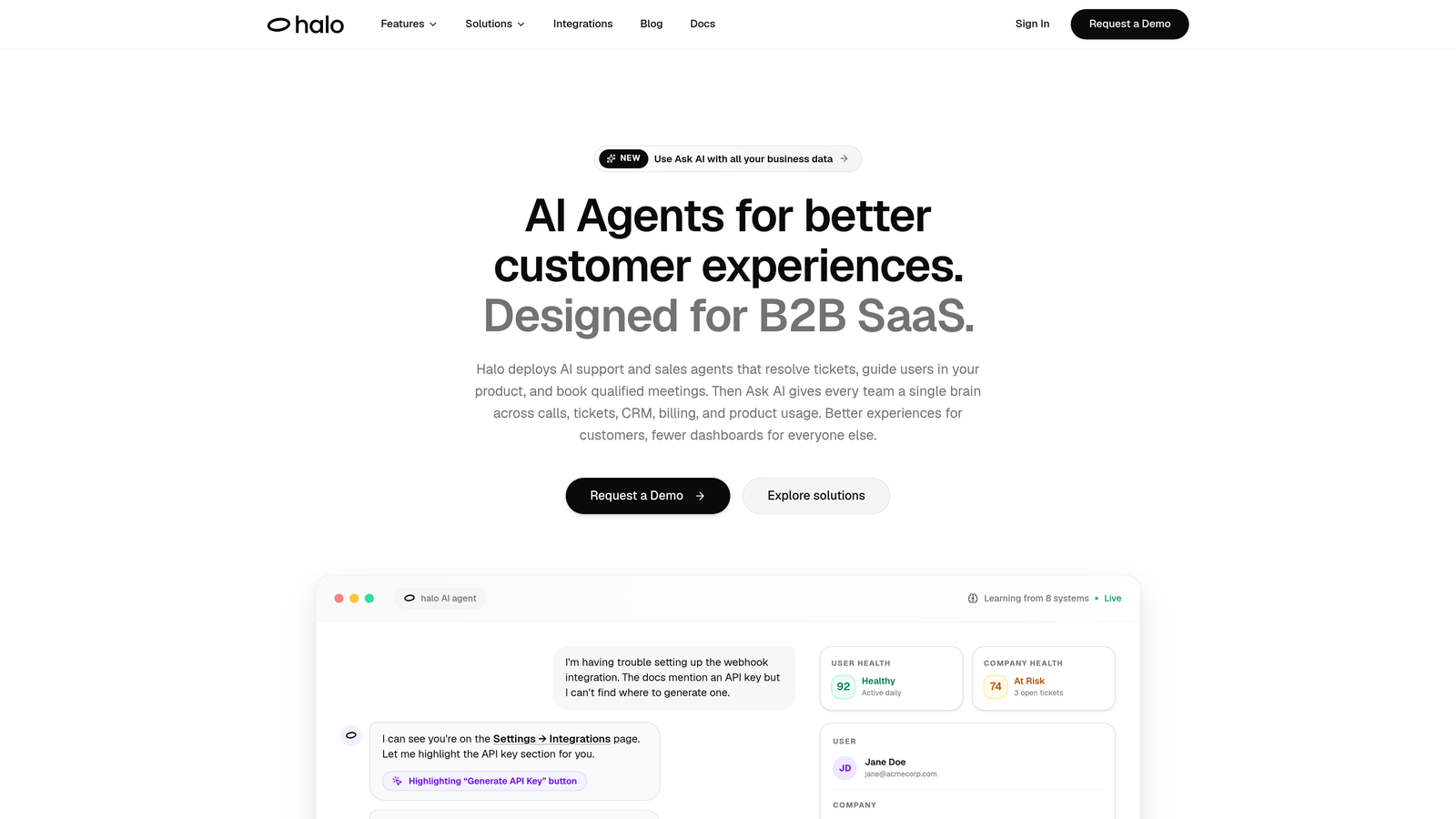
Halo AI is an AI-first customer support platform built around autonomous agents, page-aware chat, and continuous learning from every interaction.
Where This Tool Shines
What separates Halo from most platforms on this list is its architecture. It wasn't built as a layer on top of an existing helpdesk. It was designed from the ground up around autonomous AI agents, which means the intelligence is native rather than bolted on. That distinction shows up in how it handles context: Halo's agents can see what a user is looking at on-screen, making guidance genuinely situational rather than generic.
The smart inbox goes further than standard support analytics. It surfaces customer health signals, revenue intelligence, and anomaly detection, giving support leaders and product teams visibility into trends that typically require a separate data tool to uncover. For teams that want support to inform the broader business, this is a meaningful differentiator.
Key Features
Page-Aware AI Agents: Agents understand what the user is viewing in-product, enabling contextual guidance rather than generic FAQ responses.
Continuous Learning: Resolution quality improves autonomously over time as the system learns from every interaction without manual retraining.
Smart Inbox with Business Intelligence: Surfaces customer health signals, revenue intelligence, and anomaly detection alongside standard support metrics.
Auto Bug Ticket Creation: Automatically identifies and routes bug reports to engineering tools like Linear, closing the loop between support and product.
Deep Integration Stack: Connects to Slack, HubSpot, Intercom, Stripe, Zoom, PandaDoc, Fathom, and more for a unified view across the business.
Best For
B2B SaaS companies and product-led growth teams that want support automation to do more than deflect tickets. Particularly well-suited for teams scaling their customer base without proportionally scaling headcount, and for support leaders who want actionable business intelligence surfaced alongside resolution data.
Pricing
Contact for pricing. Halo is designed for B2B teams with meaningful support volume and a need for deep integrations. Visit haloagents.ai for details.
2. Intercom Fin
Best for: Teams already on Intercom who want native AI resolution without switching platforms.
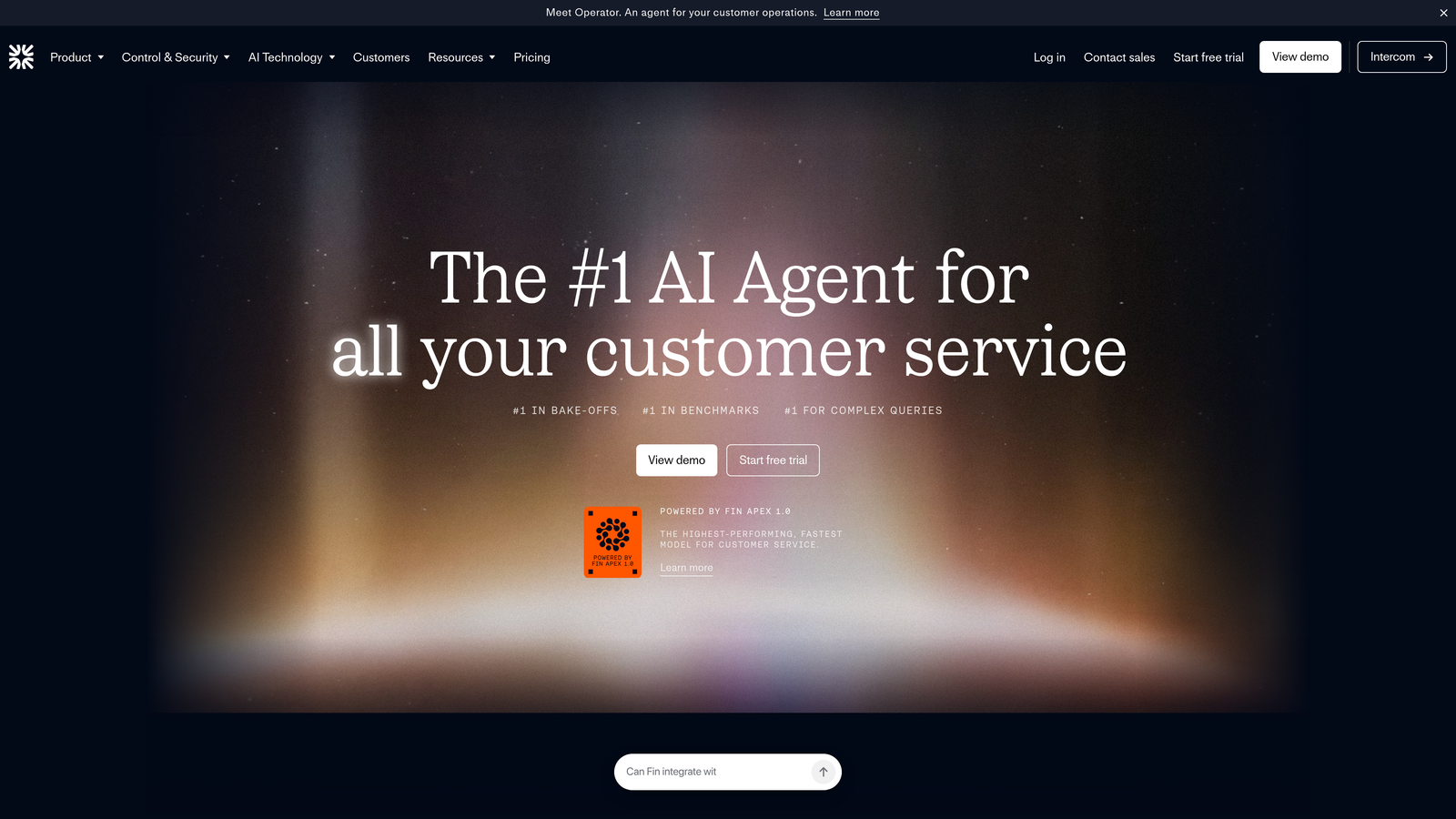
Intercom Fin is Intercom's native AI agent, resolving support questions using existing help content within the Intercom messenger ecosystem.
Where This Tool Shines
Fin's biggest advantage is how seamlessly it fits into the Intercom environment. If your team already lives in Intercom's inbox and your customers interact through the Intercom messenger, Fin adds AI resolution without any architectural change. Setup is relatively fast because it draws on your existing help center content and snippets.
The handoff experience is also well-executed. When Fin can't resolve an issue, it passes the conversation to a human agent with full context intact, which prevents the frustrating experience of customers having to repeat themselves. Multilingual support broadens its applicability for global teams.
Key Features
Native Intercom Integration: Works directly within Intercom's messenger, inbox, and product tours with no separate deployment needed.
Content-Grounded Answers: Pulls responses from your help center, snippets, and custom content sources.
Contextual Human Handoff: Passes full conversation context to live agents when escalation is needed.
Multilingual Support: Handles conversations in many languages without separate configuration.
Usage-Based Pricing: Charges per resolved conversation, making costs directly tied to value delivered.
Best For
Teams already invested in the Intercom ecosystem who want to add AI resolution without migrating platforms. Less suited for teams who need AI that connects deeply to engineering or billing tools outside the Intercom stack.
Pricing
Starts at approximately $0.99 per resolution on top of an existing Intercom plan. Pricing may vary; check the official Intercom site for current rates.
3. Zendesk AI
Best for: Enterprise teams that need AI layered onto a mature, compliance-ready ticketing infrastructure.
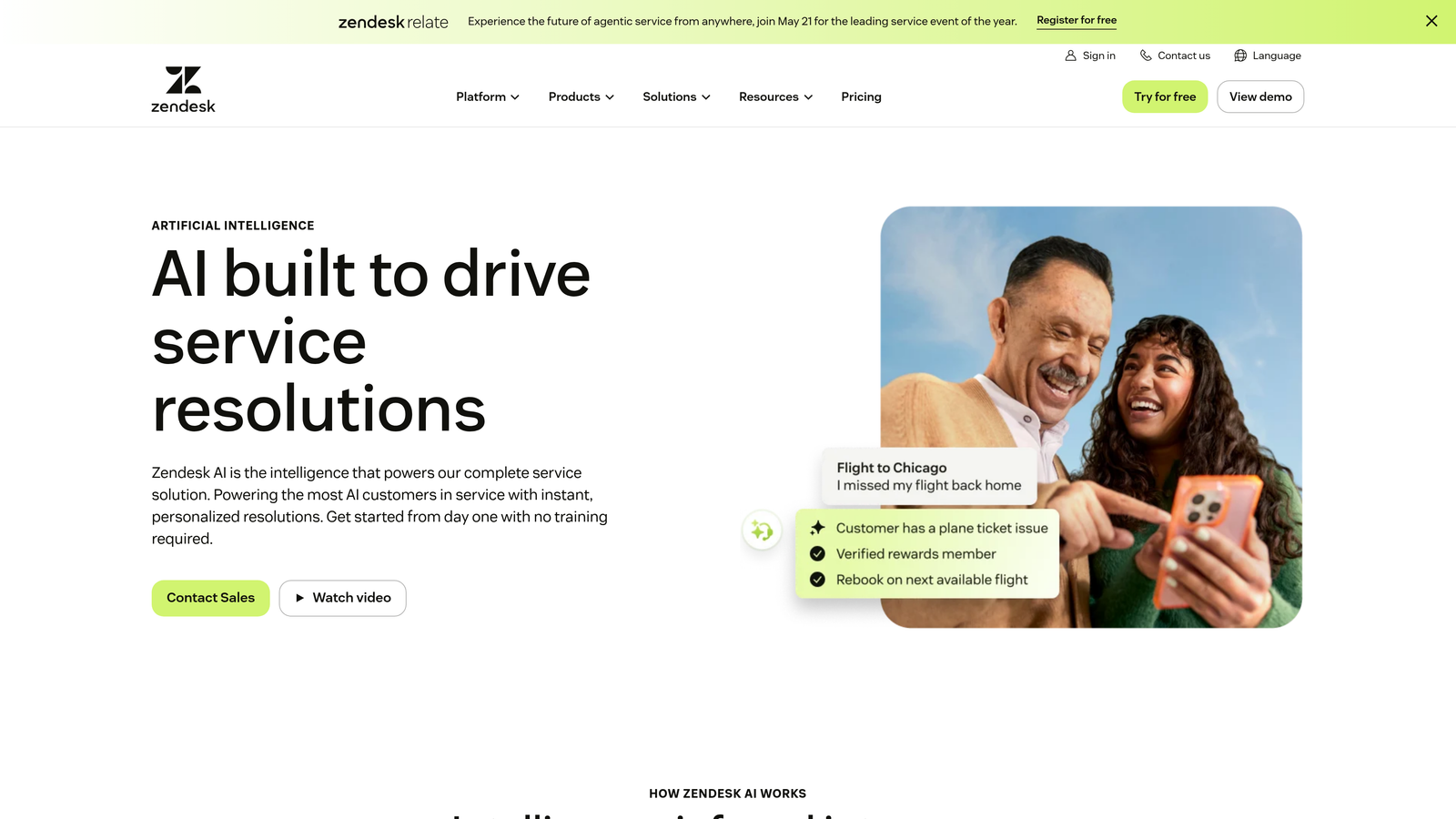
Zendesk AI brings AI-powered triage, agent assist, and generative response tools to Zendesk's established enterprise helpdesk platform.
Where This Tool Shines
Zendesk's strength has always been its enterprise-grade workflow engine, and the AI layer adds meaningful capability on top of that foundation. Intelligent triage with intent, sentiment, and language detection reduces the manual work of routing tickets correctly. The agent-assist features, including response drafting, tone adjustment, and summarization, help human agents work faster without removing them from the loop.
The integration marketplace with over 1,500 apps is a genuine asset for large organizations with complex tool stacks. If your support operation is already built on Zendesk, the AI features extend what you have rather than requiring a platform change.
Key Features
Intelligent Triage: Automatically detects intent, sentiment, and language to route tickets appropriately.
Generative Agent Assist: Drafts responses, adjusts tone, and summarizes conversations for human agents.
Massive App Marketplace: Over 1,500 integrations available for connecting to virtually any business tool.
SLA Management: Advanced SLA controls and compliance features suited for regulated industries.
Robust Analytics: Comprehensive reporting suite covering resolution rates, agent performance, and customer satisfaction.
Best For
Enterprise support organizations already on Zendesk, or those who need strong compliance controls and a wide integration marketplace. Teams looking for a greenfield AI-first architecture may find the layered approach less flexible.
Pricing
AI features are available on Suite Professional and above, starting around $115 per agent per month. Verify current pricing on the Zendesk website as tiers evolve.
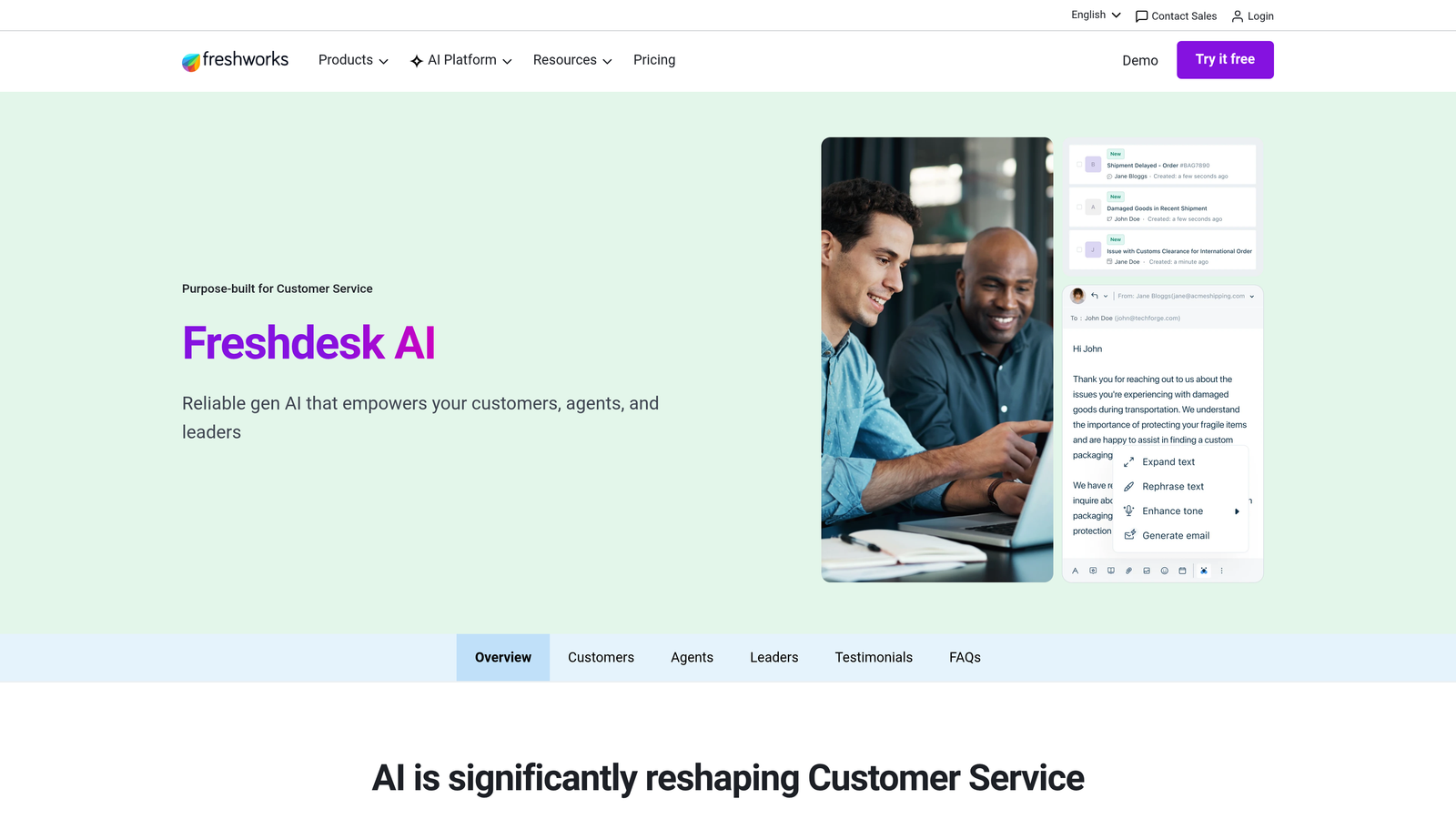
4. Freshdesk Freddy AI
Best for: Growing teams that want AI-powered support within a broader CX suite at a competitive price point.
Freshdesk Freddy AI is Freshworks' AI engine for automated ticket resolution, agent assist, and omnichannel support across the Freshworks ecosystem.
Where This Tool Shines
Freshdesk's value proposition is breadth at an accessible price. Freddy AI covers the core automation use cases, including automated responses, sentiment analysis, and canned response suggestions, while the broader Freshworks suite connects support to sales (Freshsales) and IT service management (Freshservice). For teams that want a single vendor across multiple business functions, this consolidation has real appeal.
The free tier is genuinely useful for smaller teams getting started, and the pricing ladder allows gradual adoption of AI features as needs grow. Omnichannel coverage across email, chat, phone, and social reduces the need for separate point solutions.
Key Features
Freddy AI Agent: Handles automated ticket resolution and self-service interactions without human involvement.
Agent Assist: Suggests canned responses and performs sentiment analysis to support human agents in real time.
Freshworks Ecosystem: Connects natively with Freshsales, Freshchat, and Freshservice for cross-functional visibility.
Omnichannel Coverage: Supports email, chat, phone, and social from a single platform.
Accessible Free Tier: A functional free plan makes it viable for small teams before committing to paid tiers.
Best For
SMBs and mid-market teams that want AI-assisted support within a broader Freshworks deployment. Also a good fit for teams that need omnichannel coverage without a large per-seat budget.
Pricing
Free tier available. Paid plans start around $15 per agent per month, with AI features unlocking on higher tiers. Check Freshworks for current plan details.
5. Ada
Best for: Mid-market and enterprise teams that need multilingual AI agents with strong brand voice control and no-code customization.
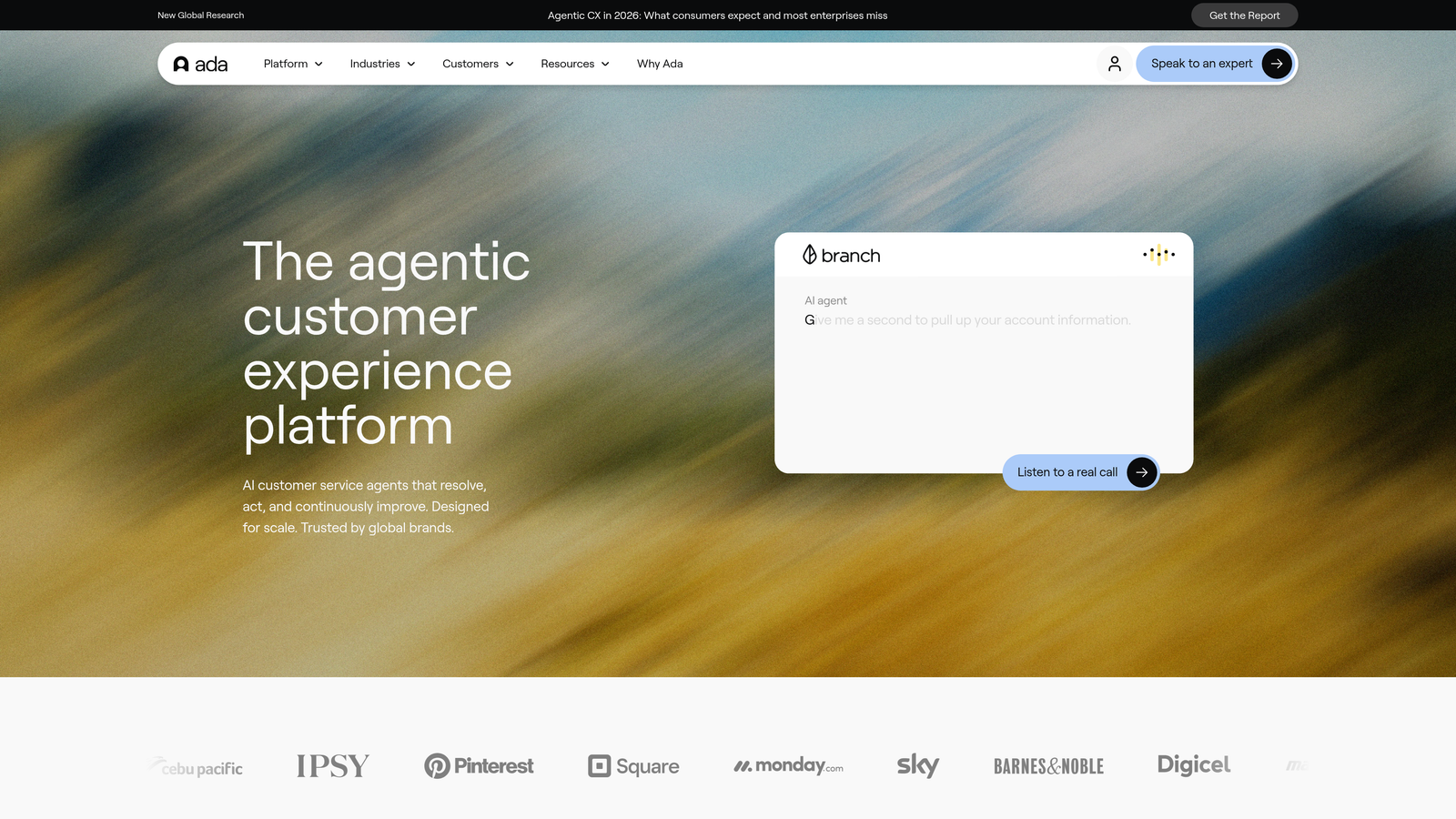
Ada is an AI-powered customer service automation platform focused on no-code agent building, multilingual support, and measurable automated resolution rates.
Where This Tool Shines
Ada's no-code agent builder is genuinely accessible for teams without engineering resources. Support and CX teams can configure AI agents, set brand voice parameters, and build conversation flows without writing code. This makes iteration faster and reduces dependency on technical teams for ongoing maintenance.
The multilingual capability, covering over 50 languages, is a standout feature for global customer bases. Ada also provides built-in tools for measuring and optimizing automated resolution rates, which is useful for teams that need to demonstrate ROI from their AI investment to stakeholders.
Key Features
No-Code Agent Builder: Configure AI agents and conversation flows without engineering involvement, including brand voice controls.
Multilingual Support: Handles conversations in 50+ languages, making it viable for global support operations.
Resolution Measurement Tools: Built-in analytics for tracking and optimizing automated resolution rates over time.
CRM and Helpdesk Integrations: Connects to Zendesk, Salesforce, and other major platforms.
Proactive Messaging: Supports personalized, outbound engagement in addition to reactive support.
Best For
Mid-market and enterprise companies with global customer bases that need multilingual AI agents and want CX teams to own configuration without engineering bottlenecks.
Pricing
Custom pricing targeting mid-market and enterprise. Contact Ada directly for a quote tailored to your volume and use case.
6. Forethought
Best for: Teams that want to add generative AI and intelligent triage on top of an existing Zendesk or Salesforce Service Cloud deployment.
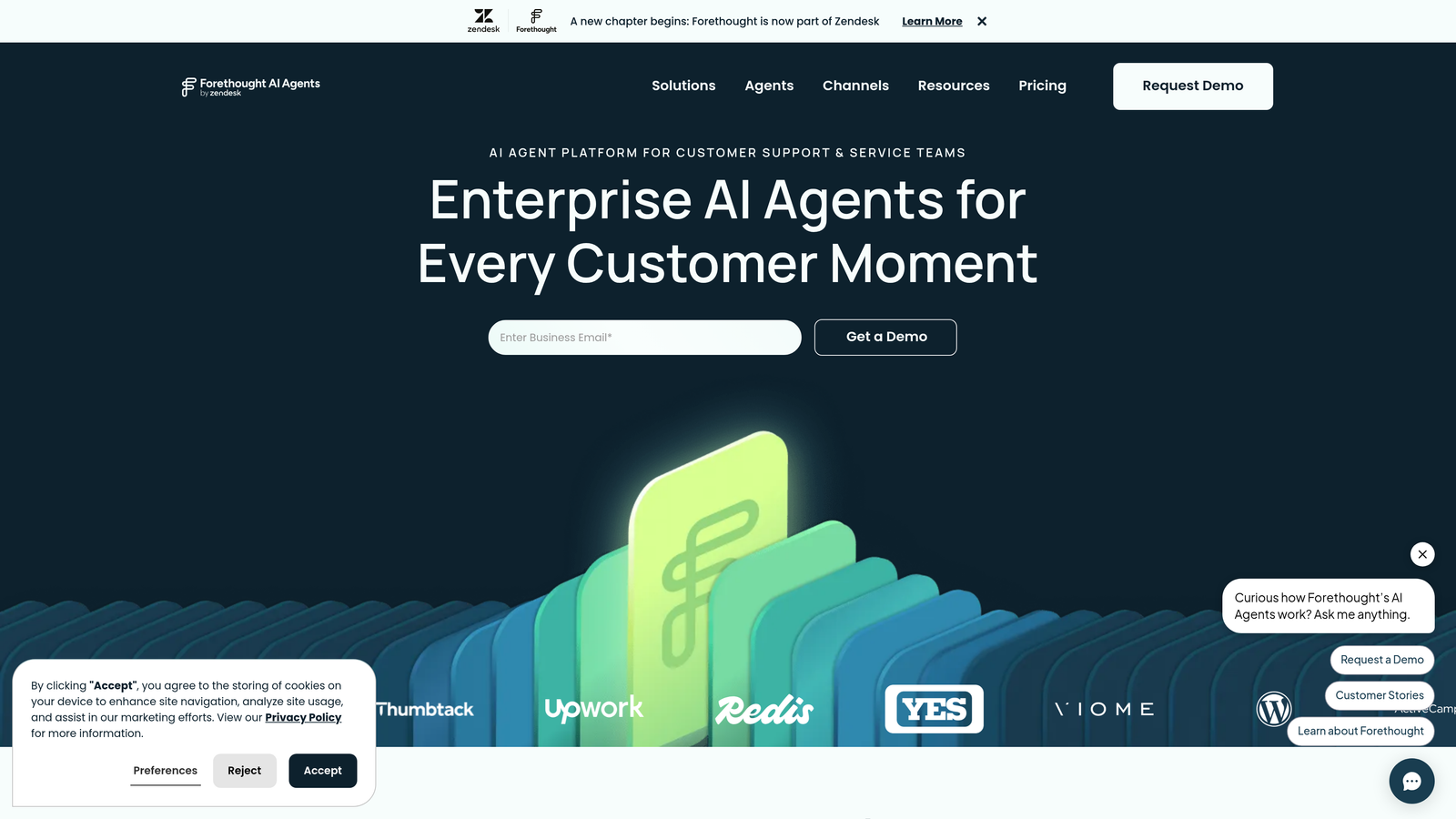
Forethought layers generative AI capabilities through its SupportGPT engine onto existing helpdesk platforms, adding intelligent routing, deflection, and knowledge-grounded responses.
Where This Tool Shines
Forethought is built for teams that aren't ready to replace their helpdesk but want to add meaningful AI capability on top of it. SupportGPT generates responses grounded in your existing knowledge base, reducing hallucination risk while improving response quality. The intelligent triage layer handles routing and prioritization based on intent and urgency, which reduces the manual work that typically falls on team leads.
For organizations deeply invested in Zendesk or Salesforce Service Cloud, Forethought extends those platforms rather than competing with them. The deflection and resolution analytics help teams quantify the impact of AI adoption in a format that's easy to report upward.
Key Features
SupportGPT: Generates knowledge-grounded responses using your existing content to reduce hallucinations and improve accuracy.
Intelligent Triage: Routes and prioritizes tickets based on detected intent and urgency signals.
Helpdesk Overlay: Operates as an AI layer on top of Zendesk, Salesforce, and other platforms without replacing them.
Workflow Automation: Automates handling for high-volume, repetitive ticket types.
Deflection Analytics: Dashboard tracking resolution rates, deflection metrics, and AI performance over time.
Best For
Support teams on Zendesk or Salesforce Service Cloud that want to add generative AI without migrating platforms. Well-suited for teams with established workflows they want to preserve and enhance.
Pricing
Custom pricing based on ticket volume and platform. Contact Forethought for a quote specific to your environment.
7. Tidio
Best for: Small businesses and e-commerce teams that need quick-to-deploy AI chat without a complex implementation.
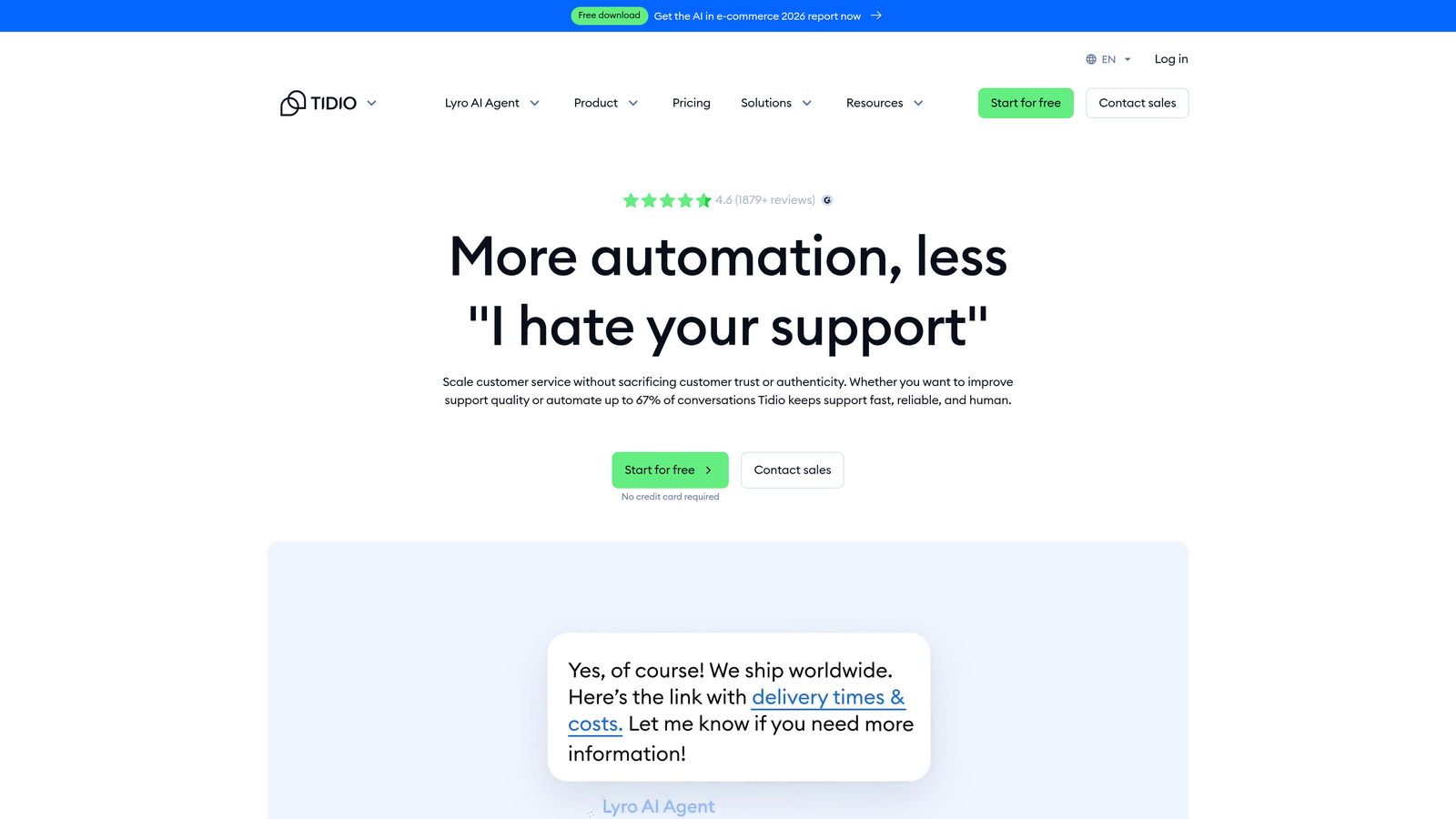
Tidio combines live chat and AI-powered automation through its Lyro AI assistant, designed for fast setup and accessible pricing for smaller teams.
Where This Tool Shines
Tidio's defining characteristic is speed of deployment. Teams can go from sign-up to live AI chat in minutes, not weeks, which makes it genuinely practical for small businesses without dedicated IT or support operations teams. The visual drag-and-drop chatbot builder lowers the barrier further, allowing non-technical users to build and adjust conversation flows independently.
The combination of live chat and AI in a single widget is a practical advantage for small teams where the same person often handles both. Native integrations with Shopify, WordPress, and Wix make it a natural fit for e-commerce and content-driven businesses.
Key Features
Lyro AI Assistant: Conversational AI that handles automated support interactions with a natural, context-aware tone.
Visual Chatbot Builder: Drag-and-drop interface for building conversation flows without writing code.
Fast Setup: Live in minutes, making it accessible for teams without technical implementation resources.
E-Commerce Integrations: Native connections to Shopify, WordPress, and Wix.
Combined Chat and AI Widget: Single widget handles both live agent and AI-automated conversations.
Best For
Small businesses, e-commerce operators, and content publishers that need AI chat without enterprise complexity or pricing. Less suited for B2B SaaS teams with complex product support needs or deep integration requirements.
Pricing
Free plan available. Paid plans start around $29 per month, with Lyro AI available as an add-on. Check Tidio's site for current tier details.
8. Kustomer
Best for: Omnichannel support teams that want a CRM-first platform with AI automation and a unified customer timeline.
Kustomer is a CRM-first customer support platform that aggregates every customer interaction into a unified timeline, with AI-powered routing, classification, and response suggestions layered on top.
Where This Tool Shines
Kustomer's unified customer timeline is its most distinctive feature. Rather than treating each ticket as an isolated event, Kustomer shows agents the full history of every interaction across every channel in a single view. This context makes both AI and human responses more informed and reduces the repetitive back-and-forth that frustrates customers.
The built-in CRM eliminates the need for a separate customer database, which simplifies the tech stack for teams that don't already have a CRM in place. The workflow automation engine with business rules is flexible enough to handle complex routing logic without custom development.
Key Features
Unified Customer Timeline: Aggregates every interaction across email, chat, SMS, social, and voice into a single chronological view.
AI Classification and Routing: Automatically classifies tickets and routes them based on intent and customer context.
Built-In CRM: Eliminates the need for a separate customer database by storing customer data natively.
Omnichannel Coverage: Handles email, chat, SMS, social, and voice from one platform.
Business Rules Engine: Flexible workflow automation for complex routing and escalation logic.
Best For
Omnichannel support teams, particularly in B2C or high-volume environments, that need a unified customer view and don't want to maintain a separate CRM. Enterprise pricing makes it less accessible for smaller teams.
Pricing
Enterprise pricing starting around $89 per user per month. Ownership has changed in recent years, so verify current pricing and plan structure directly with Kustomer.
9. Drift (Salesloft)
Best for: Revenue-focused teams that want conversational AI spanning both sales pipeline acceleration and post-sale support within a single platform.
Drift, now part of the Salesloft revenue platform, offers conversational AI with playbook-based automation for support scenarios alongside its core sales engagement capabilities.
Where This Tool Shines
Drift's differentiation is its revenue orientation. While most platforms on this list are built primarily around support resolution, Drift connects support interactions to pipeline and revenue signals. Real-time buyer intent scoring and engagement data give go-to-market teams visibility into how post-sale interactions influence retention and expansion.
For teams where support and sales operate closely together, or where support conversations frequently surface upsell opportunities, the Salesloft integration creates a unified view of the customer journey. Meeting scheduling and pipeline routing built into the chat experience reduce friction for accounts that need human attention quickly.
Key Features
Conversational AI for Sales and Support: Handles both pre-sale and post-sale interactions within the same platform.
Buyer Intent Signals: Real-time engagement scoring and intent data surfaced during support interactions.
Meeting Scheduling in Chat: Allows customers to book meetings directly from a conversation without leaving the chat widget.
Salesloft Integration: Deep connection to Salesloft's revenue orchestration platform for unified pipeline visibility.
Playbook Automation: Configurable playbooks for handling common support scenarios consistently at scale.
Best For
Revenue-focused B2B teams where support and sales functions are closely aligned and where surfacing pipeline signals from support interactions has direct business value. Less suited for teams that need pure support automation without the sales overlay.
Pricing
Part of the broader Salesloft platform with custom pricing. Contact Salesloft directly for a quote based on your team size and use case.
Choosing the Right Platform for Your Team
The honest answer is that no single platform is the right fit for every team. The best choice depends on your architecture preference, your existing stack, your team's technical capacity, and what you actually need AI to do beyond deflecting tickets.
Here's a practical breakdown by persona:
Enterprise teams on existing helpdesks: Zendesk AI and Forethought are the natural choices if you're deeply invested in Zendesk or Salesforce and want to add AI without migration risk. Forethought works as a pure overlay; Zendesk AI extends what's already there.
Mid-market teams building from scratch: Ada and Kustomer both offer strong platforms for teams that want purpose-built AI or a CRM-first support experience. Ada wins on multilingual flexibility; Kustomer wins on unified customer context.
SMBs and e-commerce: Tidio and Freshdesk Freddy AI offer the most accessible entry points. Tidio is faster to deploy; Freshdesk offers more depth if you're already in the Freshworks ecosystem.
Intercom-first teams: Fin is the obvious choice if your team and customers already live in Intercom. It's native, fast to activate, and handles escalation gracefully.
Revenue-aligned teams: Drift within Salesloft makes sense when support and sales share pipeline goals and you need intent signals surfaced in support conversations.
B2B teams that want AI-first architecture with business intelligence: See Halo in action to understand what it looks like when support AI is built from the ground up rather than layered on top. Page-aware agents, continuous learning, and a smart inbox that surfaces customer health and revenue signals make it a different category of tool for teams that want support to inform the entire business, not just close tickets faster.
Your support team shouldn't scale linearly with your customer base. The right intelligent support platform handles routine resolution, guides users through your product, and surfaces the signals your product and revenue teams actually need, so your people can focus on the work that genuinely requires a human.