9 Best Intelligent Support Software Options for B2B Teams in 2026
Discover the 9 best intelligent support software options for B2B teams in 2026, comparing AI-native platforms against traditional helpdesks with bolted-on AI features. This guide evaluates each solution on automation depth, integration ecosystem, and scalability to help support teams move beyond ticket management and deliver faster, more accurate customer resolutions.
 Matt PattoliFounder13 min read
Support teams are drowning in tickets while customers expect instant, accurate answers. The old model of reactive helpdesks and manual triage simply doesn't scale for B2B SaaS teams managing complex products and growing customer bases. Intelligent support software changes the equation: instead of just organizing work, it resolves it.
But "intelligent" means different things across the market. Some platforms bolt AI onto existing helpdesk infrastructure. Others are built AI-first from the ground up. The best options for B2B teams in 2026 are evaluated on automation depth, integration ecosystem, learning capabilities, scalability, and genuine value beyond ticket deflection.
If you're exploring your options, it's worth understanding what separates AI-native support platforms from traditional helpdesks with AI features layered on top. The distinction has real implications for how your support operation scales. You might also want to review common customer support automation strategies before committing to a platform.
Here are the top intelligent support software options worth evaluating for your B2B team this year.
1. Halo AI
Best for: B2B SaaS teams wanting AI-native support with page-aware context and business intelligence.
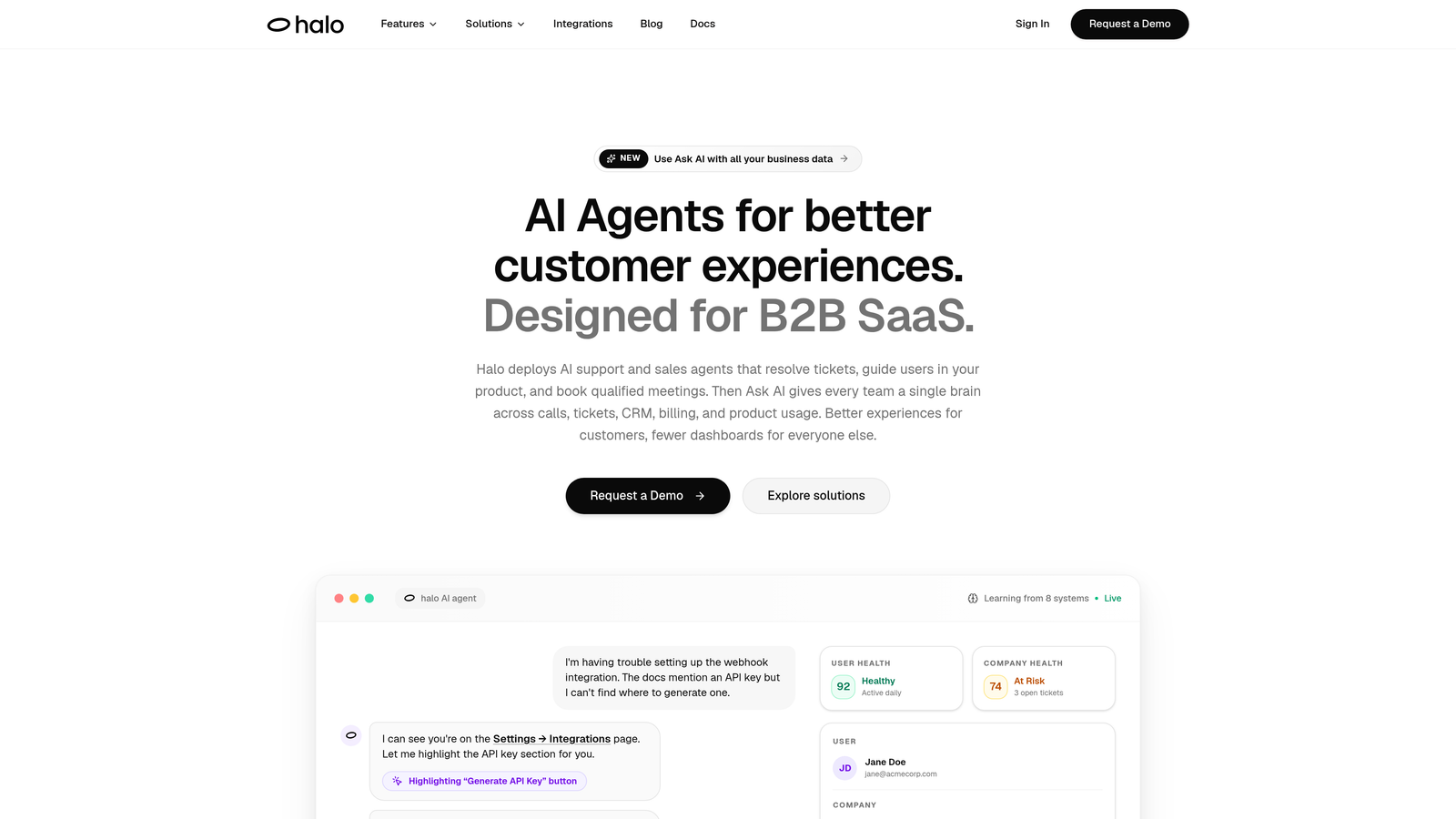
Halo AI is an AI-first customer support platform that deploys intelligent agents to resolve tickets, guide users through your product, and surface actionable business intelligence.
Where This Tool Shines
Halo's standout differentiator is page-aware context. The AI agent actually sees what the user sees, allowing it to deliver visual, contextual guidance rather than generic scripted responses. This matters enormously for SaaS products where support questions are almost always tied to a specific screen, workflow, or feature state.
Beyond ticket resolution, Halo surfaces signals that most support tools ignore entirely: customer health indicators, revenue anomalies, and churn indicators pulled from your connected business stack. Your support inbox becomes an intelligence layer, not just a queue.
Key Features
Page-Aware AI Agents: Agents see the user's current page and UI state, enabling contextual visual guidance that generic chatbots can't replicate.
Autonomous Ticket Resolution with Smart Escalation: AI handles routine tickets end-to-end and routes complex issues to live agents with full conversation context preserved.
Auto Bug Ticket Creation: Automatically generates bug reports routed directly to Linear or your existing dev workflow, closing the loop between support and engineering without manual handoffs.
Smart Inbox with Business Intelligence: Surfaces customer health signals, revenue anomalies, and churn indicators directly within your support inbox.
Deep Integration Ecosystem: Connects natively with Linear, Slack, HubSpot, Intercom, Stripe, Zoom, PandaDoc, and Fathom, so support data flows across your entire business stack.
Continuous Learning: Every resolved interaction improves the AI's future performance, meaning the system gets measurably smarter over time without manual retraining.
Best For
Product-led SaaS companies and B2B teams that want support to do more than close tickets. Halo is particularly well-suited for teams using Linear for engineering workflows, where the auto bug ticket creation creates immediate operational value. Also strong for teams that want support data to inform customer success and revenue decisions.
Pricing
Visit haloagents.ai for current pricing plans. Pricing reflects the platform's AI-first architecture and business intelligence capabilities.
2. Zendesk
Best for: Enterprise teams needing a proven, feature-rich helpdesk with AI layered across channels.
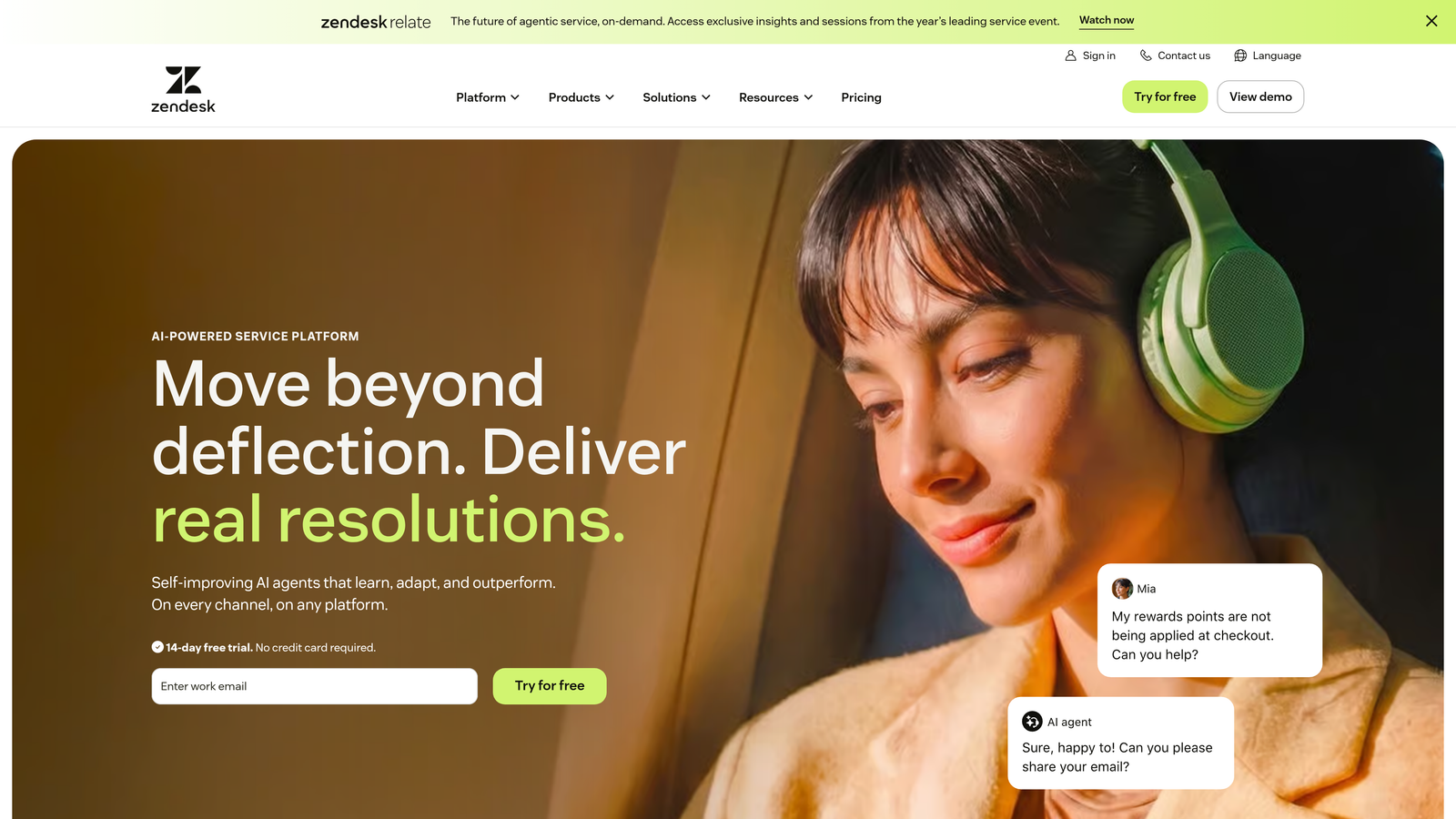
Zendesk is the market-leading enterprise helpdesk platform with AI capabilities delivered through Zendesk AI, covering intelligent triage, agent copilot functionality, and automated responses.
Where This Tool Shines
Zendesk's core strength is breadth. If your support operation spans email, chat, voice, and social media, Zendesk handles all of it within a single platform. The integration marketplace, with over 1,000 available connections, means you can wire it into almost any existing tech stack without custom development.
The Zendesk AI additions, built in partnership with OpenAI, bring meaningful automation to triage and agent assistance. That said, it's worth noting that these AI features are layered onto an existing helpdesk architecture rather than built from the ground up as AI-native functionality. For enterprise teams with complex, multi-channel needs and existing Zendesk investments, it remains a strong choice.
Key Features
Zendesk AI Triage: Intelligent ticket classification and suggested replies that reduce manual sorting and first-response time.
Agent Copilot: Real-time guidance and suggested next steps during live conversations to help agents resolve issues faster.
Multi-Channel Support: Unified inbox across email, chat, voice, and social channels with consistent routing rules.
Integration Marketplace: Over 1,000 pre-built integrations covering CRM, billing, analytics, and collaboration tools.
Advanced Reporting Suite: Customizable dashboards and analytics for tracking support performance across channels and teams.
Best For
Large enterprise support organizations with complex multi-channel operations and dedicated admin resources to manage configuration. Less ideal for lean SaaS teams looking for out-of-the-box AI intelligence without significant setup overhead.
Pricing
Suite plans start around $55 per agent per month. Pricing can increase substantially at higher tiers with AI add-ons. Verify current pricing at zendesk.com.
3. Intercom
Best for: SaaS companies wanting conversational in-product support with a capable AI agent.
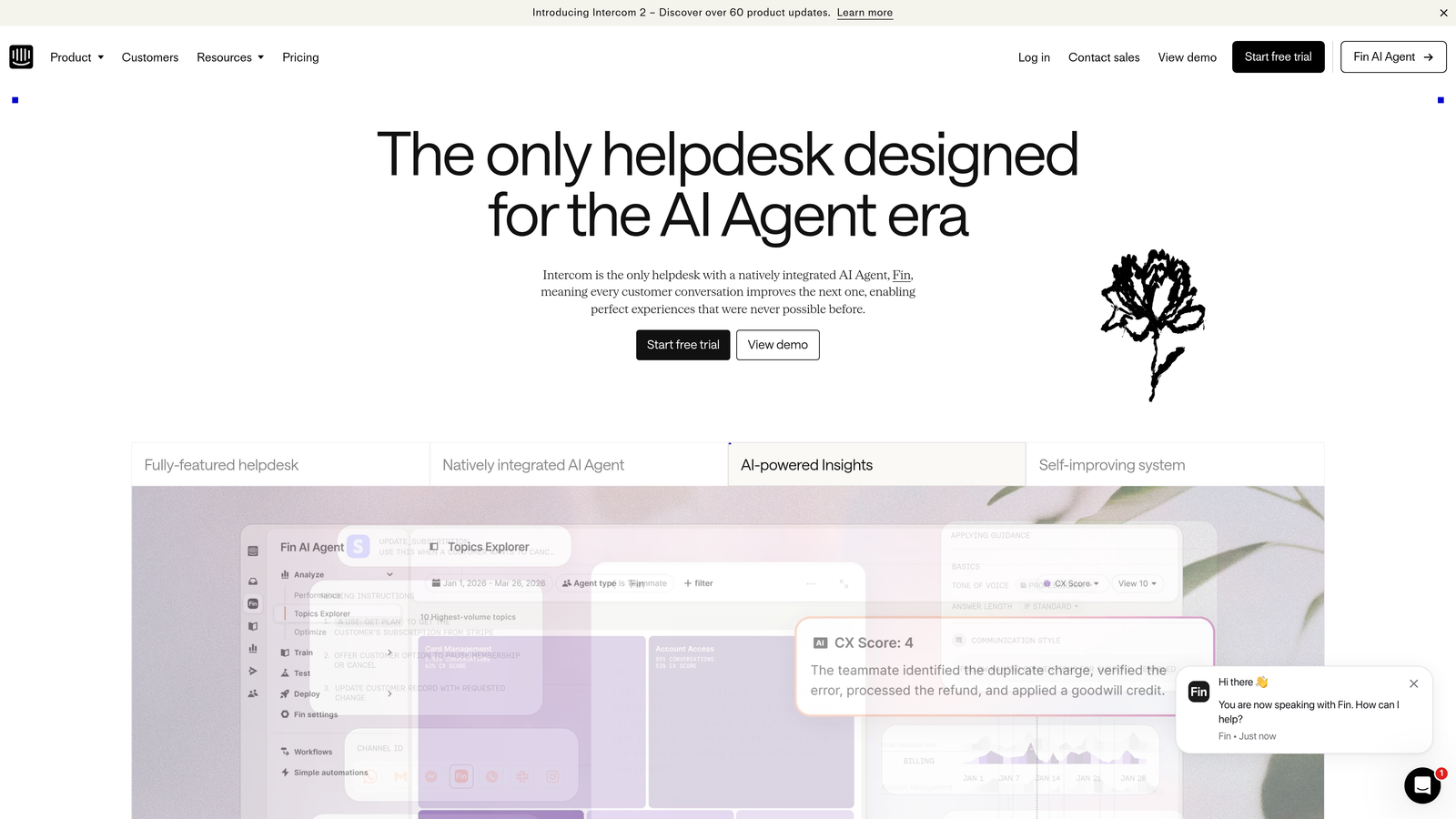
Intercom is a conversational support platform featuring Fin, an AI agent built on GPT-4 that resolves support queries directly from your help content with minimal configuration.
Where This Tool Shines
Fin is genuinely one of the more capable AI agents in this space for handling common support questions. It reads your existing help documentation and answers customer questions autonomously, which means teams with solid knowledge bases can deploy it quickly and see meaningful deflection without extensive training.
Intercom's in-product messenger experience is polished and well-suited to SaaS UX expectations. The combination of proactive messaging, product tours, and reactive support in one platform makes it appealing for product-led growth teams that want to blur the line between onboarding and support.
Key Features
Fin AI Agent: GPT-4 powered autonomous agent that resolves conversations directly from your help content without manual bot building.
AI Summarize and Compose: Productivity tools that help agents understand conversation history quickly and draft replies faster.
In-Product Messenger: Clean, customizable chat widget designed for SaaS user experiences.
Proactive Messaging and Product Tours: Outbound messaging capabilities for onboarding, announcements, and feature adoption.
Shared Inbox with Conversation Routing: Team inbox with assignment rules and priority queuing.
Best For
SaaS companies with established help documentation looking for fast AI deployment and strong in-product messaging. Teams that want to combine support, onboarding, and proactive engagement in a single tool.
Pricing
Pricing varies by plan tier and usage. Check intercom.com for current rates, as Fin AI is often priced separately from base plans.
4. Freshdesk
Best for: SMB and mid-market teams wanting AI-assisted support at accessible price points.
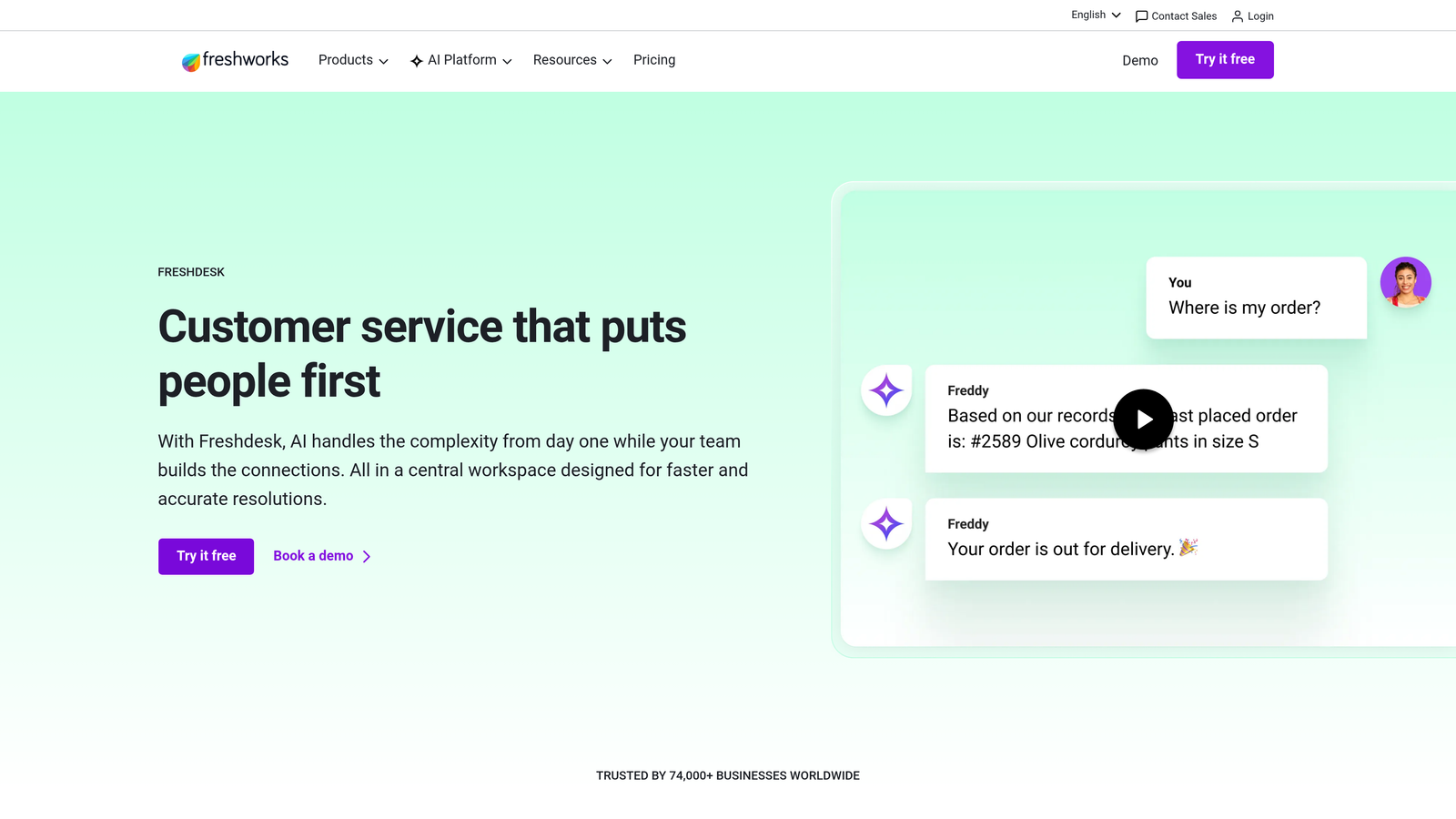
Freshdesk is a multi-channel helpdesk from Freshworks featuring the Freddy AI suite, covering self-service bots, agent assist, and AI-driven analytics.
Where This Tool Shines
Freshdesk's value proposition is strong AI capability without enterprise-level pricing. The Freddy AI suite spans the full support workflow: Freddy Self Service handles chatbot deflection before tickets are created, Freddy Copilot assists agents during resolution, and Freddy Insights surfaces analytics patterns that would otherwise require manual reporting.
Being part of the broader Freshworks ecosystem is also an advantage for teams already using Freshsales or Freshservice. Data flows naturally across products without custom integration work, which simplifies the stack for growing companies.
Key Features
Freddy Self Service: AI-powered chatbot that deflects common questions before they become tickets.
Freddy Copilot: Real-time agent assistance with suggested responses and next-best-action guidance.
Freddy Insights: AI-driven analytics that surface support trends, bottlenecks, and performance patterns.
Multi-Channel Inbox: Unified support across email, chat, phone, and social channels.
Free Plan: A functional free tier for small teams to get started without upfront commitment.
Best For
SMB and mid-market teams that want meaningful AI assistance without enterprise pricing. Also a natural fit for teams already in the Freshworks ecosystem who want unified data across sales, IT, and support.
Pricing
Free plan available. Paid plans start around $15 per agent per month. Verify current pricing and Freddy AI add-on costs at freshdesk.com.
5. Salesforce Service Cloud
Best for: Enterprise teams deeply embedded in the Salesforce ecosystem needing unified CRM and support data.
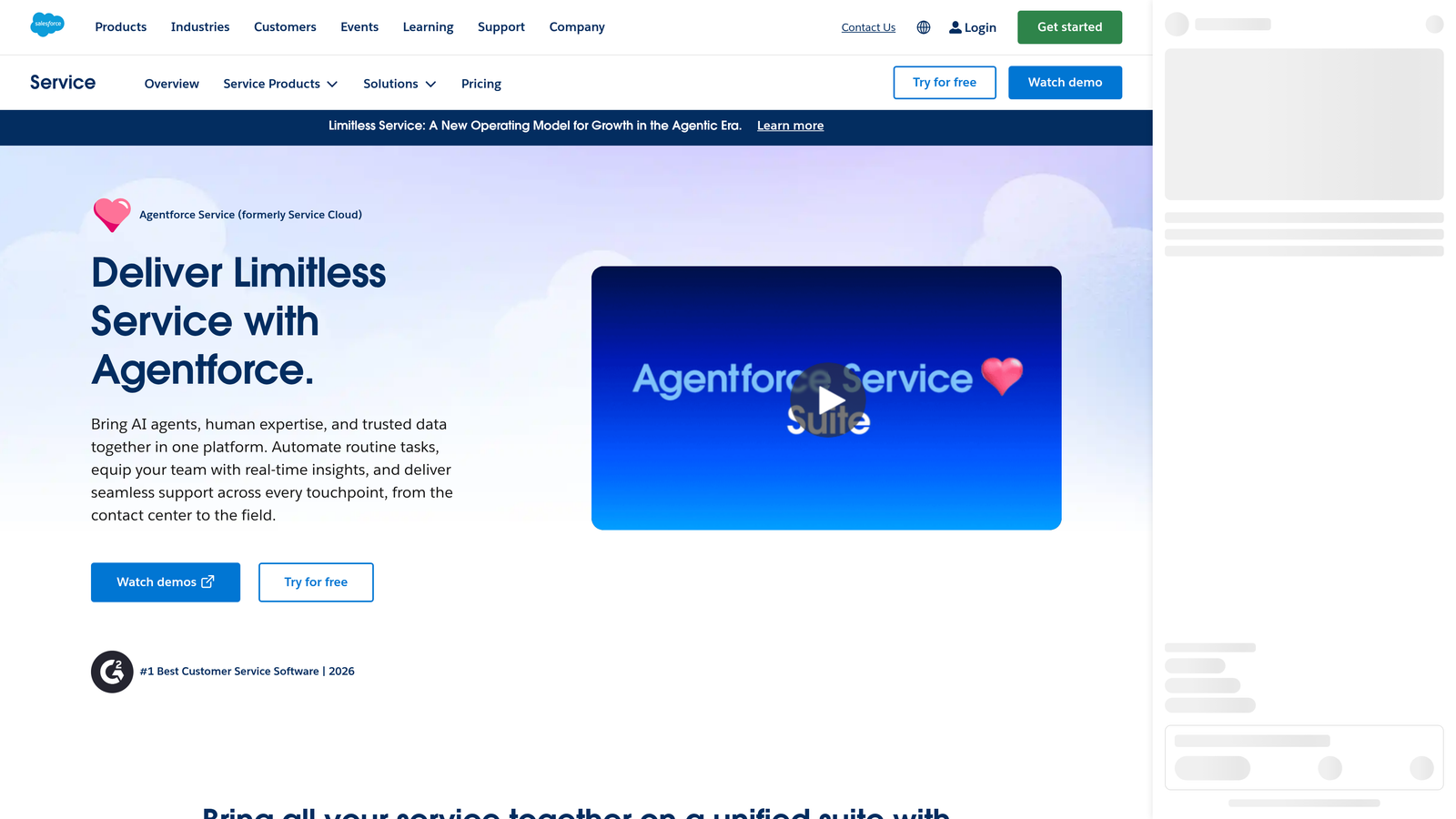
Salesforce Service Cloud is an enterprise-grade support platform with Einstein AI providing predictive, personalized support capabilities across the full customer lifecycle.
Where This Tool Shines
The core advantage of Service Cloud is data unification. When your support platform lives inside Salesforce, every agent has immediate access to the full customer record: deal history, contract value, product usage, and prior interactions. Einstein AI then uses that combined data for case classification, sentiment analysis, and next-best-action recommendations that are genuinely informed by business context.
For enterprises where support and sales teams share accountability for customer outcomes, this level of integration is difficult to replicate with separate tools. The tradeoff is significant configuration complexity and cost, which makes it a poor fit for lean or early-stage teams.
Key Features
Einstein AI: Handles case classification, next-best-action recommendations, and sentiment analysis using unified CRM and support data.
Unified Customer Record: Full CRM context available to every support agent without switching tools or tabs.
Omni-Channel Routing: Intelligent case distribution across email, chat, voice, and social based on agent skills and availability.
Einstein Copilot: Generative AI assistance for agents during live conversations and case resolution.
Enterprise Workflow Automation: Extensive customization for complex support processes, approval chains, and escalation logic.
Best For
Large enterprises already using Salesforce CRM where support and revenue data unification is a strategic priority. Not well-suited for teams outside the Salesforce ecosystem or those without dedicated Salesforce admin resources.
Pricing
Enterprise pricing with multiple tiers. Check salesforce.com for current Service Cloud pricing, as costs scale significantly with features and user count.
6. Help Scout
Best for: Teams that want AI-assisted efficiency without removing the human element from support.
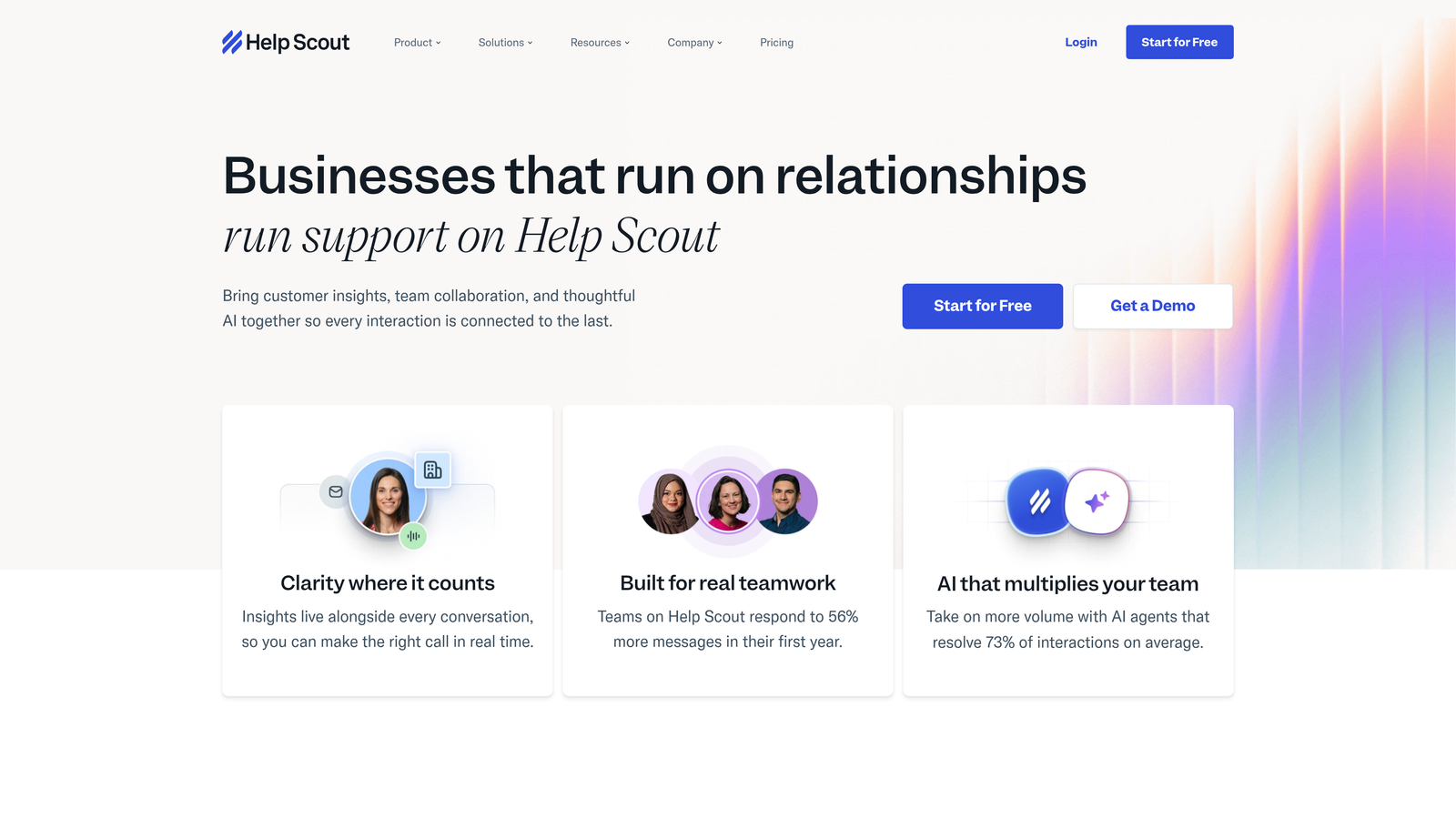
Help Scout is a human-first support platform with a clean, email-centric interface and assistive AI features designed to help agents work faster without over-automating customer interactions.
Where This Tool Shines
Help Scout occupies a deliberate position in this market: it believes some customer interactions should stay human, and its AI features reflect that philosophy. Rather than autonomous resolution, Help Scout's AI summarizes conversations, drafts replies for agent review, and powers self-service through its Beacon widget. Agents stay in control; AI just removes the friction.
The interface is genuinely clean and intuitive. Teams that have struggled with the complexity of enterprise helpdesks often find Help Scout's minimal learning curve to be a meaningful productivity advantage, particularly for smaller support teams where onboarding time matters.
Key Features
AI Summarize: Instantly condenses long conversation threads so agents can get up to speed without reading every message.
AI Drafts: Generates reply drafts for agent review and editing, reducing time-to-response without removing human judgment.
AI Answers in Beacon: Self-service widget that uses your documentation to answer customer questions before they contact support.
Shared Inbox with Collision Detection: Prevents two agents from replying to the same conversation simultaneously.
Clean Interface: Minimal complexity with fast onboarding, designed for teams that don't want to manage helpdesk configuration overhead.
Best For
Small to mid-sized teams that value human connection in support and want AI to assist rather than replace agents. Strong fit for companies where brand voice and relationship quality are core differentiators.
Pricing
Plans start around $20 per user per month. Verify current pricing at helpscout.com.
7. Tidio
Best for: Small businesses and e-commerce teams needing accessible AI chat at entry-level pricing.
Tidio is a live chat and AI chatbot platform featuring Lyro, an AI agent that handles customer conversations autonomously at a price point accessible to small and growing businesses.
Where This Tool Shines
Tidio's Lyro AI handles common customer questions end-to-end without requiring bot flow configuration. It learns from your existing support content and FAQs, making initial deployment fast for teams without dedicated technical resources. When Lyro can't resolve an issue, it hands off to a live agent smoothly.
The visual chatbot builder also gives non-technical teams the ability to create custom automation flows for specific scenarios, like order tracking, appointment booking, or lead qualification, without writing code. This flexibility at an accessible price point makes Tidio a practical entry point for teams not yet ready for enterprise tooling.
Key Features
Lyro AI Chatbot: Autonomous conversation handling that resolves common questions without manual bot building.
Live Chat with Agent Takeover: Seamless handoff from AI to human agents when conversations require it.
Visual Flow Builder: Drag-and-drop chatbot automation for custom scenarios without coding.
E-Commerce Integrations: Native connections with Shopify and WooCommerce for order-related support automation.
Free Plan: Basic live chat features available at no cost for teams just getting started.
Best For
Small businesses, e-commerce brands, and early-stage teams that need affordable AI chat without complex setup. Less suited for B2B SaaS teams with sophisticated support workflows, deep product integrations, or enterprise-scale ticket volumes.
Pricing
Free plan available. Lyro AI plans start around $29 per month. Verify current pricing at tidio.com.
8. Kustomer
Best for: High-volume support teams needing a unified customer timeline with AI-driven workflow automation.
Kustomer is a CRM-powered support platform, now Meta-owned, offering a unified customer timeline and AI-driven automation workflows designed for teams handling large conversation volumes across multiple channels.
Where This Tool Shines
Kustomer's unified customer timeline is its defining feature. Every interaction a customer has ever had with your company, across every channel, appears in a single chronological view. For support agents handling complex, multi-touchpoint customer relationships, this eliminates the constant context-switching and "let me look up your account" delays that frustrate both agents and customers.
The AI automation layer sits on top of this rich data model, enabling routing, classification, and auto-response workflows that are informed by full customer history rather than just the current conversation. Teams with high conversation volumes and complex customer relationships tend to get the most out of this architecture.
Key Features
Unified Customer Timeline: Complete interaction history across all channels in a single chronological view for every customer.
AI Conversation Routing: Intelligent assignment of conversations based on customer data, agent skills, and conversation context.
Workflow Automation: Configurable automation for repetitive support tasks, status updates, and escalation triggers.
Deep CRM Data Integration: Full customer context including purchase history, lifetime value, and prior support interactions available at the agent level.
Omni-Channel Inbox: Unified view across email, chat, SMS, social, and voice channels.
Best For
Mid-market and enterprise teams with high conversation volumes and complex customer relationships spanning multiple channels. The CRM-native approach makes it particularly valuable for businesses where customer history heavily influences support decisions.
Pricing
Mid-market to enterprise pricing. Check kustomer.com for current plans and pricing tiers.
9. Drift (Salesloft)
Best for: B2B teams where support and revenue conversations are tightly connected and need to flow together.
Drift is a conversational AI platform, now part of Salesloft, originally built for B2B sales and support teams that need AI-driven conversations to serve both customer resolution and revenue qualification simultaneously.
Where This Tool Shines
Drift's core insight is that in many B2B companies, the line between a support conversation and a sales conversation is blurry. A customer asking about a feature limitation might be a candidate for an upsell. A prospect asking a pre-sales question needs the same fast, accurate response as a paying customer. Drift's conversational AI handles both contexts within the same platform.
The integration with Salesloft's broader revenue platform means that conversation data flows into sales workflows, creating visibility that purely support-focused tools don't offer. For revenue teams that want support and sales aligned on buyer signals, this integration is the primary draw.
Key Features
Conversational AI for Support and Sales: AI-powered chat that handles both support resolution and sales qualification within the same interface.
AI-Powered Meeting Booking: Automatically schedules meetings with sales reps directly from chat conversations.
Account-Based Targeting: Personalized conversation experiences based on company identity and account data.
Salesloft Revenue Platform Integration: Conversation data feeds directly into Salesloft's sales engagement and analytics workflows.
Real-Time Buyer Intent Signals: Surfaces engagement signals to help sales teams prioritize follow-up based on conversation activity.
Best For
B2B teams in sales-led or hybrid go-to-market motions where support and revenue conversations overlap. Less ideal for product-led SaaS teams that need deep product integration, autonomous ticket resolution, or engineering workflow connectivity.
Pricing
Contact Salesloft directly for current Drift pricing at salesloft.com.
Which Tool Is Right for Your Team?
The honest answer is that the best intelligent support software depends entirely on where your team sits today and where you need to go.
For enterprise teams with complex multi-channel operations and existing platform investments, Zendesk and Salesforce Service Cloud offer proven scale. For teams already deep in the Salesforce ecosystem, Service Cloud's unified CRM and support data is difficult to replicate with separate tools.
For SaaS companies that want strong in-product messaging alongside AI resolution, Intercom's Fin agent is a capable option with fast time-to-value. Freshdesk delivers meaningful AI functionality at SMB-friendly pricing, making it a practical choice for growing teams not ready for enterprise contracts.
Help Scout is the right call for teams that want AI efficiency without losing the human touch. Kustomer suits high-volume teams where customer history drives every support decision. Tidio is the accessible entry point for small businesses and e-commerce brands. Drift makes sense when support and revenue conversations need to live in the same workflow.
But if you're building or scaling a B2B SaaS product and want support that does more than close tickets, Halo AI is worth a closer look. The page-aware context, auto bug ticket creation, continuous learning, and business intelligence capabilities represent a fundamentally different approach: support as a strategic layer across your entire business, not just a cost center to optimize.
Your support team shouldn't scale linearly with your customer base. Let AI agents handle routine tickets, guide users through your product, and surface business intelligence while your team focuses on complex issues that need a human touch. See Halo in action and discover how continuous learning transforms every interaction into smarter, faster support.