9 Best Intelligent Support Systems Reviewed for 2026
This guide delivers in-depth intelligent support system reviews of nine platforms — from AI-first autonomous helpdesks to enhanced traditional tools — evaluating each on AI autonomy, learning capability, integration depth, business intelligence output, and scalability, so SaaS and enterprise teams can confidently choose the right fit for 2026.
 Grant CooperFounder14 min read
Your helpdesk shouldn't just log tickets. It should resolve them, learn from them, and surface the business intelligence hiding inside them. That's the promise of a truly intelligent support system, and it's a meaningful leap beyond what traditional platforms were designed to do.
The market has matured fast. Teams evaluating platforms today aren't just asking "can it handle email and chat?" They're asking: can the AI resolve tickets autonomously? Does it get smarter over time? Does it connect to our CRM, billing system, and engineering tools? And does it surface insights that matter to product and revenue teams, not just support managers?
To answer those questions, this review covers nine platforms across the full spectrum: AI-first architectures built around autonomous resolution, and enhanced traditional helpdesks that have layered AI onto proven infrastructure. Each is evaluated on AI autonomy, learning capability, integration depth, business intelligence output, and scalability.
Whether you're a scaling SaaS team reconsidering your current stack or an enterprise comparing enterprise-grade options, this breakdown will help you find the right fit.
1. Halo AI
Best for: B2B SaaS teams that want AI as the core architecture, not a feature add-on
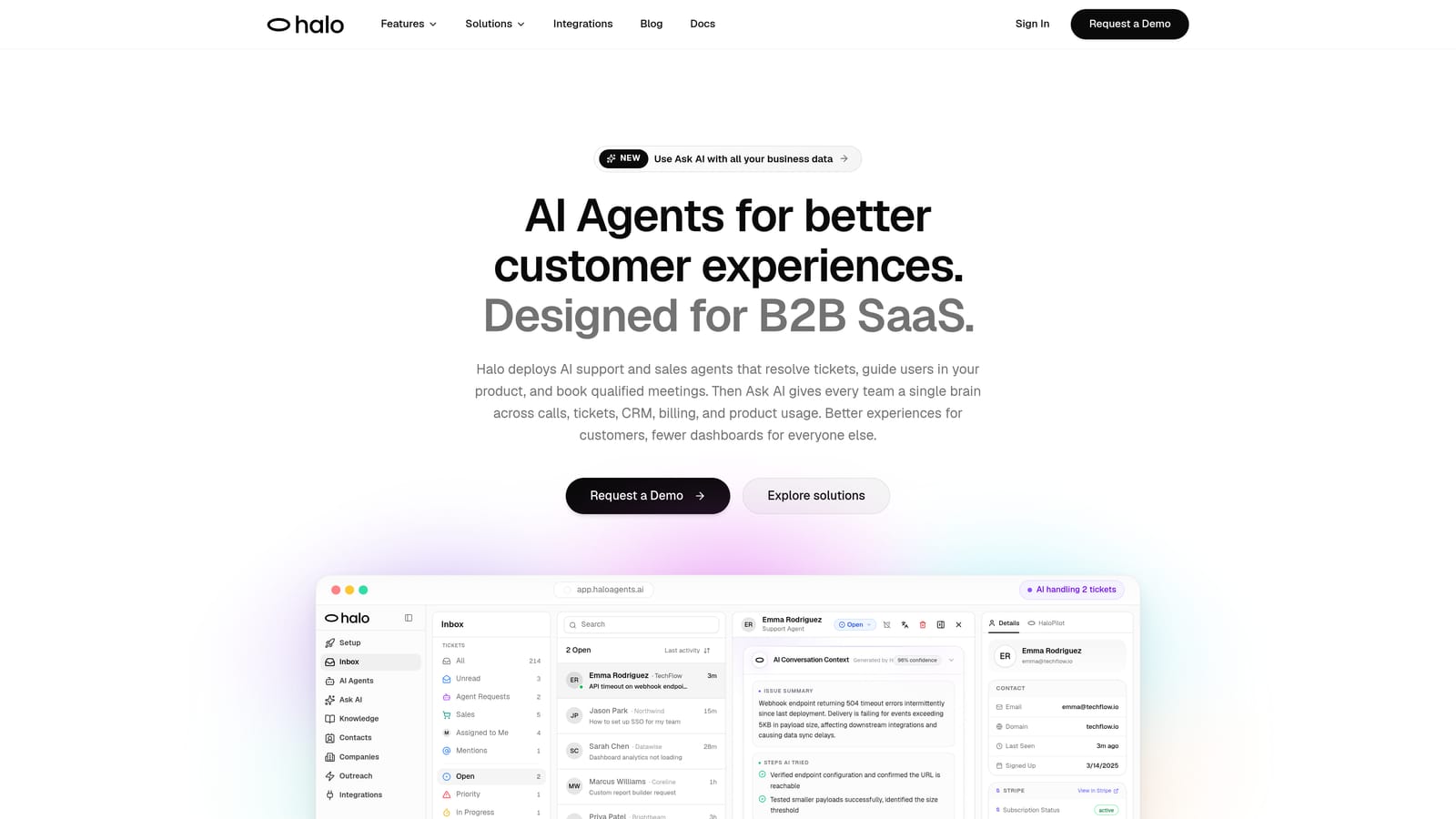
Halo AI is an AI-first customer support platform that deploys autonomous agents to resolve tickets, guide users through your product with contextual awareness, create bug reports automatically, and surface business intelligence signals across your entire support operation.
Where This Tool Shines
The fundamental difference with Halo AI is architectural. Most platforms started as helpdesks and added AI on top. Halo was built the other way around: AI agents are the core, and everything else, the inbox, the widget, the integrations, serves that autonomous resolution engine. That distinction matters when you're trying to actually reduce ticket volume rather than just manage it more efficiently.
The page-aware chat widget is a genuine differentiator. It sees what the user sees: their current location in your product, the UI elements on screen, and the context of their session. This means guidance is specific and actionable rather than generic. Combined with continuous learning from every resolved interaction, the system compounds in value over time rather than plateauing.
Key Features
Autonomous AI Agents: Resolve support tickets without human involvement, handling routine queries end-to-end while escalating complex issues with full context preserved.
Page-Aware Chat Widget: Understands where users are in your product and delivers contextually relevant UI guidance, not generic help center links.
Smart Inbox with Business Intelligence: Surfaces customer health signals, revenue anomalies, and product insights from support conversations, giving leadership visibility beyond support metrics.
Auto Bug Ticket Creation: Identifies and routes product issues directly to engineering tools like Linear, removing the manual handoff between support and development teams.
Full-Stack Integrations: Connects across the business stack including Slack, HubSpot, Stripe, Intercom, Zoom, PandaDoc, and Fathom, so support intelligence flows into the tools your whole company uses.
Best For
Scaling SaaS companies and B2B product teams that want to reduce support headcount growth while improving resolution quality. Particularly strong for teams where support data should inform product, revenue, and customer success decisions, not just live inside a helpdesk.
Pricing
Not publicly listed. Halo AI operates on a demo-based model. Contact the team at haloagents.ai to explore pricing for your team size and use case.
2. Intercom
Best for: Teams wanting a mature conversational platform with a capable AI agent layer
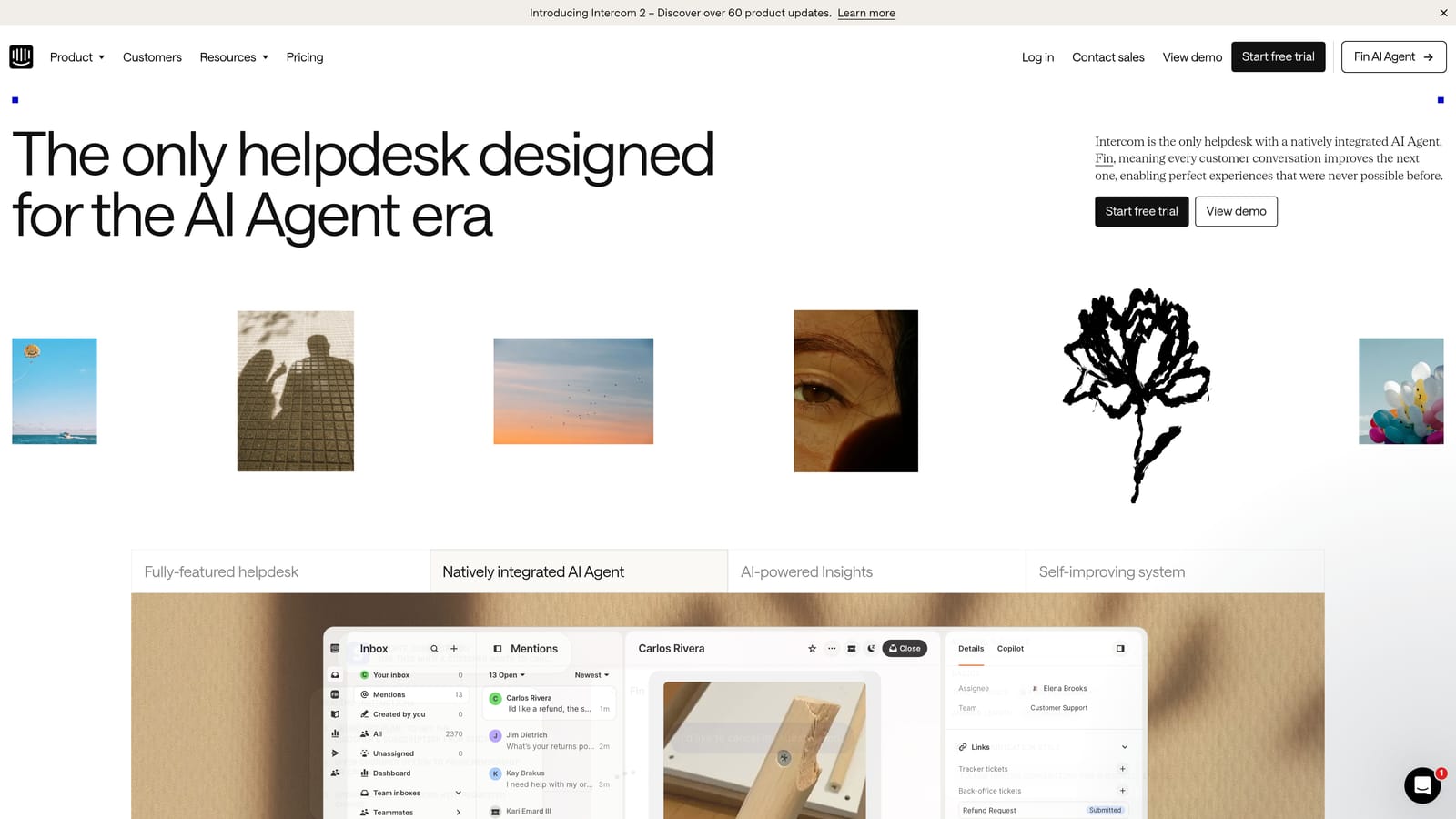
Intercom is a well-established conversational support platform that combines a robust messenger experience with Fin, its AI agent built on large language models, designed to resolve queries using your existing help content.
Where This Tool Shines
Intercom's strength is its messenger-first experience and the maturity of its platform. The in-app messenger, mobile SDK, and conversation management tools are polished from years of iteration. Fin AI agent sits on top of this infrastructure and can handle a meaningful portion of incoming queries by drawing on your existing knowledge base content.
The app marketplace is extensive, and teams that want a single platform for outbound messaging, product tours, and inbound support will find Intercom covers a lot of ground. The caveat is that AI here is layered onto a conversation platform rather than architected as the core, which can create some friction when pushing toward higher autonomy.
Key Features
Fin AI Agent: Uses large language models to resolve support queries from your help center content, with configurable escalation paths.
Messenger-First Experience: Strong in-app and mobile support with a well-designed user-facing interface that feels native to modern SaaS products.
Extensive App Marketplace: Hundreds of integrations available, covering CRM, analytics, e-commerce, and productivity tools.
Shared Inbox: Team collaboration on conversations with assignment, tagging, and internal notes built in.
Outbound Messaging and Product Tours: Proactive engagement tools built into the same platform as support, useful for onboarding and activation workflows.
Best For
Mid-market SaaS teams that want a unified platform for support, onboarding, and proactive messaging. Strong fit for teams with an existing Intercom setup who want to extend it with AI rather than migrate to a new system.
Pricing
Multiple tiers available. AI features are available on higher plans, and usage-based pricing can scale significantly depending on conversation volume. Evaluate total cost carefully as you grow.
3. Zendesk
Best for: Enterprises that need proven helpdesk infrastructure with a broad AI feature set
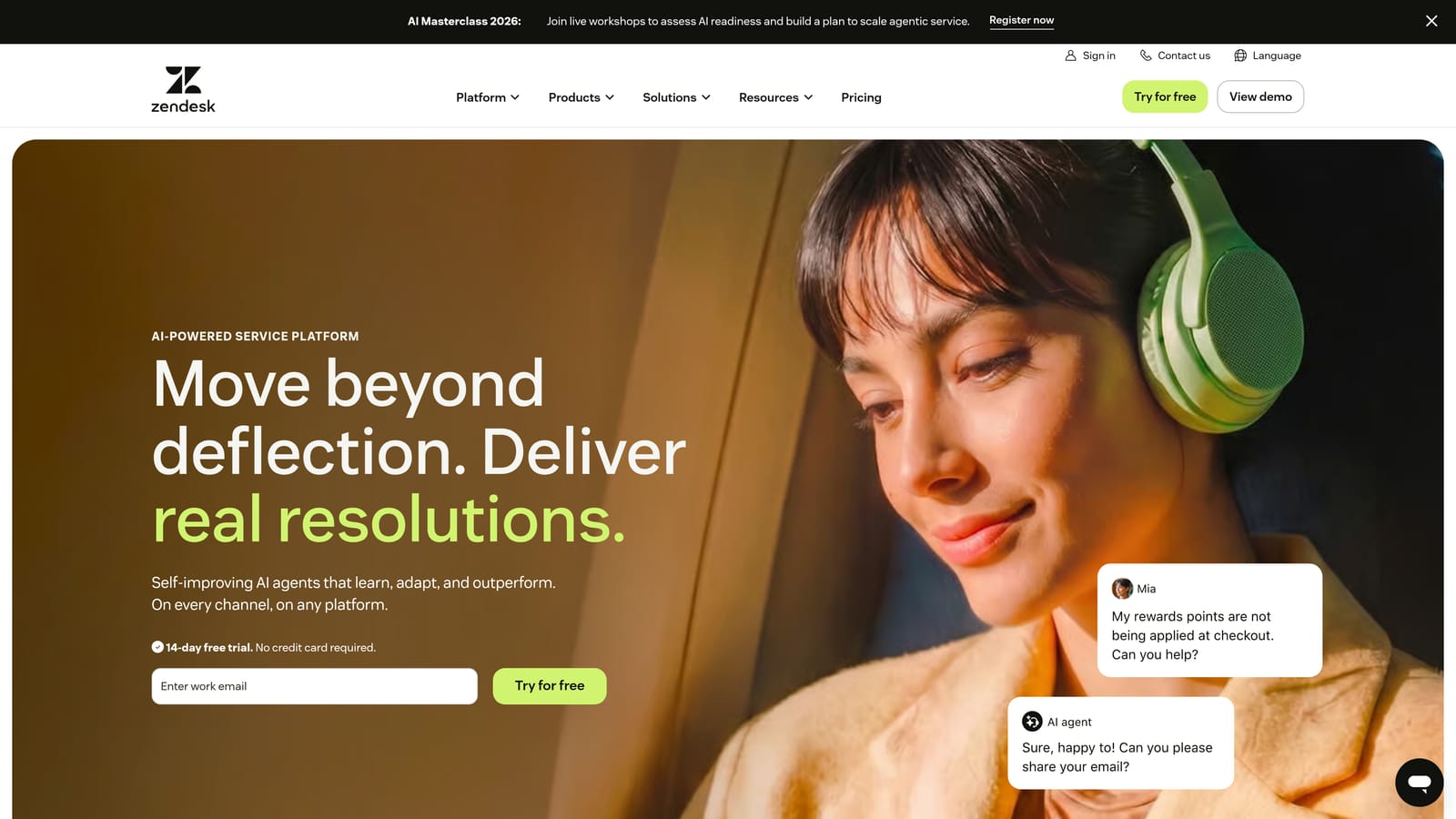
Zendesk is the market-leading enterprise helpdesk, offering a comprehensive AI suite layered onto its proven ticketing, routing, and workflow infrastructure that has scaled with some of the world's largest support operations.
Where This Tool Shines
Zendesk's core advantage is scale and ecosystem maturity. The platform handles complex routing rules, advanced SLA management, and omnichannel support across email, chat, voice, and social with reliability that enterprise teams depend on. Its partner and integration marketplace is one of the largest in the category.
The Zendesk AI suite adds intelligent triage, AI-generated reply suggestions, and macro recommendations on top of this infrastructure. It's a meaningful capability upgrade for teams already invested in the Zendesk ecosystem, though the AI was added progressively rather than rebuilt from scratch, which is worth understanding before expecting fully autonomous resolution.
Key Features
Zendesk AI Suite: Intelligent triage, AI-generated replies, and macro suggestions that assist agents rather than replace them on routine queries.
Advanced SLA Management: Sophisticated routing rules and service level agreement tracking for teams managing complex support commitments.
Large Partner Ecosystem: Extensive marketplace of integrations and certified implementation partners for complex deployments.
Robust Reporting and Analytics: Detailed support metrics and custom dashboards for operations-focused teams.
Omnichannel Support: Email, chat, voice, and social media managed within a unified agent interface.
Best For
Enterprise teams with established Zendesk workflows who want to incrementally add AI capabilities without migrating infrastructure. Also strong for organizations that require extensive compliance controls and a large implementation partner network.
Pricing
Suite plans from approximately $55 per agent per month. AI features are available at higher tiers. Enterprise pricing is available on request.
4. Freshdesk
Best for: SMBs and mid-market teams seeking cost-effective omnichannel support with AI assistance
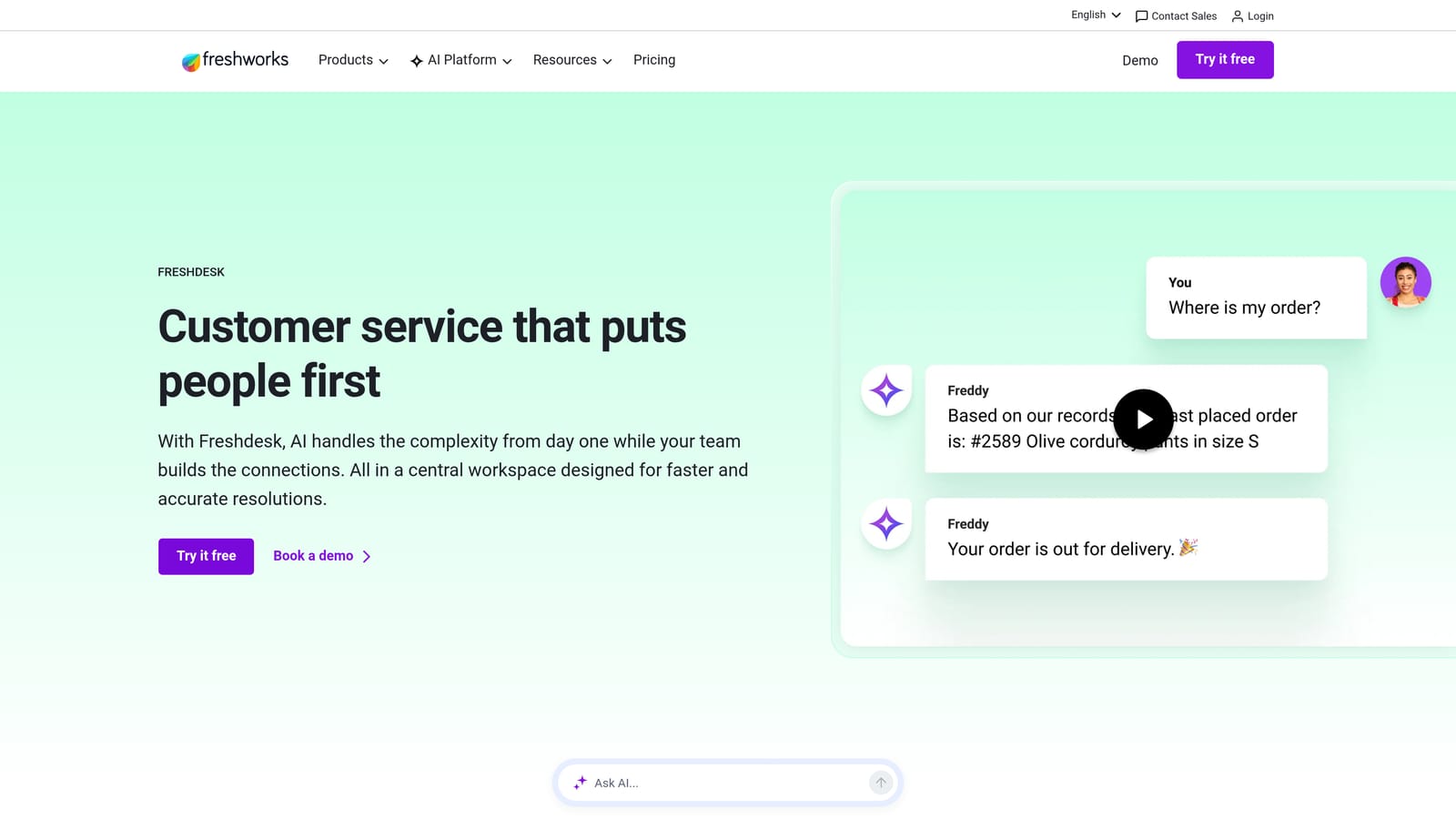
Freshdesk is a Freshworks product offering omnichannel helpdesk software with Freddy AI, designed for teams that want solid support automation at a price point that doesn't require enterprise budgets.
Where This Tool Shines
Freshdesk's value proposition is accessibility. The platform covers the core helpdesk workflows, including email, chat, phone, and social, at pricing that smaller teams can justify. The free tier is genuinely functional for early-stage teams, and the upgrade path is gradual enough to scale with headcount.
Freddy AI provides suggested replies, auto-triage, and chatbot capabilities that reduce manual work for agents. The AI features are generally considered less mature than Intercom's Fin or Zendesk's AI suite, but for teams that don't need cutting-edge autonomy, Freshdesk delivers solid value for the cost.
Key Features
Freddy AI: Suggested replies, auto-triage, and chatbot capabilities that help agents handle volume without fully autonomous resolution.
Omnichannel Inbox: Email, chat, phone, and social media managed in a single workspace for agents.
Collision Detection: Prevents multiple agents from responding to the same ticket simultaneously, reducing duplicate effort.
Canned Responses and Automation Rules: Template-based efficiency tools and workflow automation for repetitive support tasks.
Free Tier: A genuinely usable free plan for small teams just getting started with structured support.
Best For
Small to mid-market teams that need reliable omnichannel helpdesk functionality without enterprise pricing. Particularly strong for teams where cost efficiency is a primary constraint and full AI autonomy is a future goal rather than an immediate need.
Pricing
Free plan available. Paid plans start from approximately $15 per agent per month, scaling with features and agent count.
5. Salesforce Service Cloud
Best for: Enterprises where support and sales data must live in the same unified platform
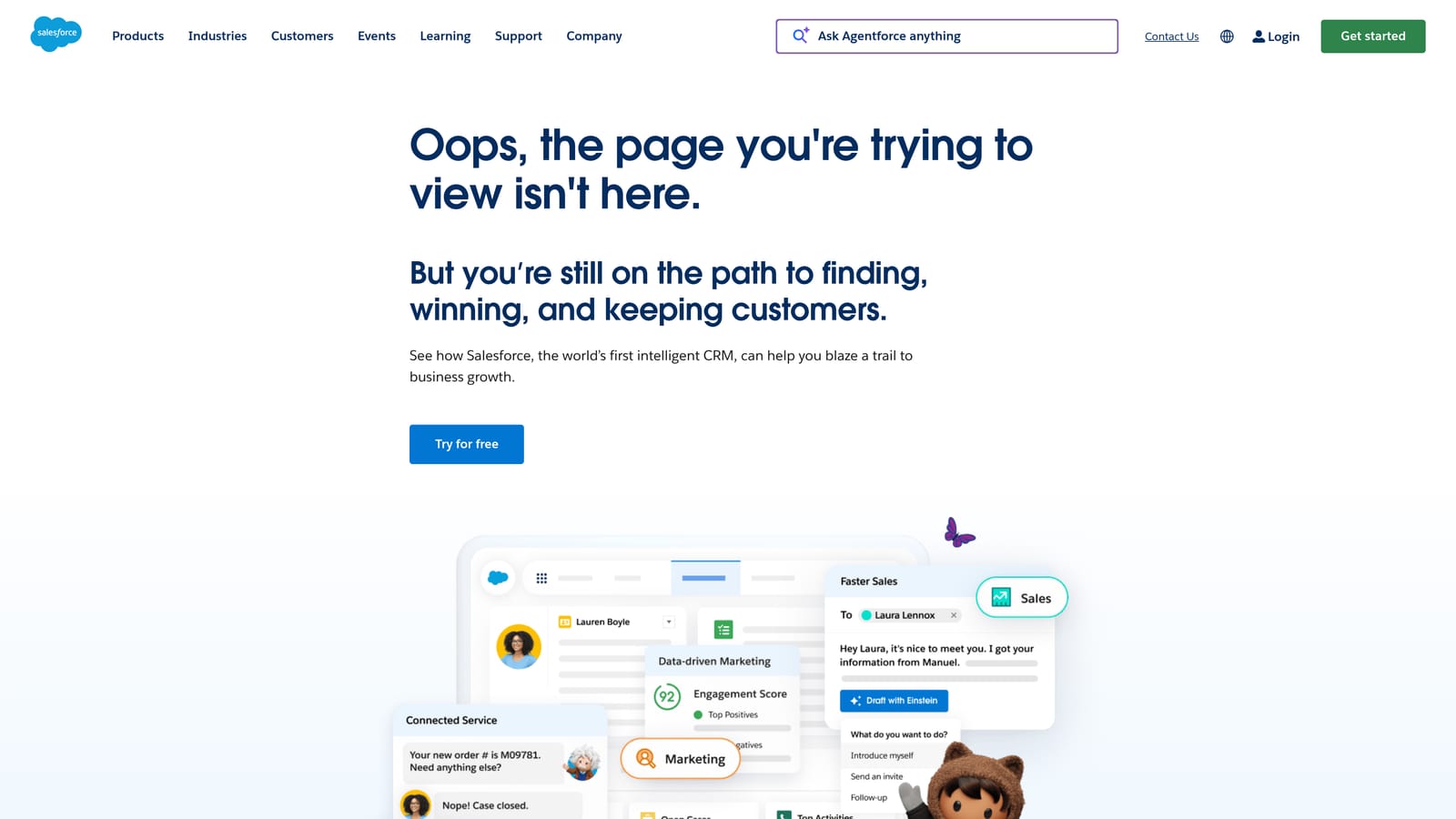
Salesforce Service Cloud is enterprise-grade customer service software deeply integrated with Salesforce CRM, powered by Einstein AI for case intelligence, knowledge recommendations, and next-best-action guidance.
Where This Tool Shines
Service Cloud's defining strength is its native integration with the Salesforce ecosystem. For organizations where customer support data, sales history, and account management all need to inform each other in real time, the unified data model is genuinely powerful. Agents can see a customer's full commercial relationship while resolving a support case, which changes the quality of the interaction.
Einstein AI adds case classification, knowledge article recommendations, and next-best-action suggestions that help agents move faster and more accurately. The platform also handles field service, self-service portals, and complex compliance requirements that other tools in this list don't address at the same depth.
Key Features
Einstein AI: Case classification, knowledge recommendations, and next-best-action guidance that assist agents through complex support workflows.
Native CRM Integration: Full customer data, account history, and commercial context accessible within support workflows without switching tools.
Omni-Channel Routing: Intelligent case distribution based on agent skills, availability, and case priority.
Self-Service Portal and Field Service: Extended capabilities for organizations with complex service delivery models beyond digital support.
Advanced Compliance and Security Controls: Enterprise-grade data governance for regulated industries and large organizations.
Best For
Large enterprises already invested in the Salesforce ecosystem where support, sales, and account management data must be unified. Complex to implement and typically requires Salesforce expertise, making it less suited for smaller or faster-moving teams.
Pricing
Enterprise pricing; generally among the higher-cost options in the market. Contact Salesforce sales for current quotes specific to your organization's scale and requirements.
6. HubSpot Service Hub
Best for: Teams already on HubSpot CRM who want support and ticketing in the same ecosystem
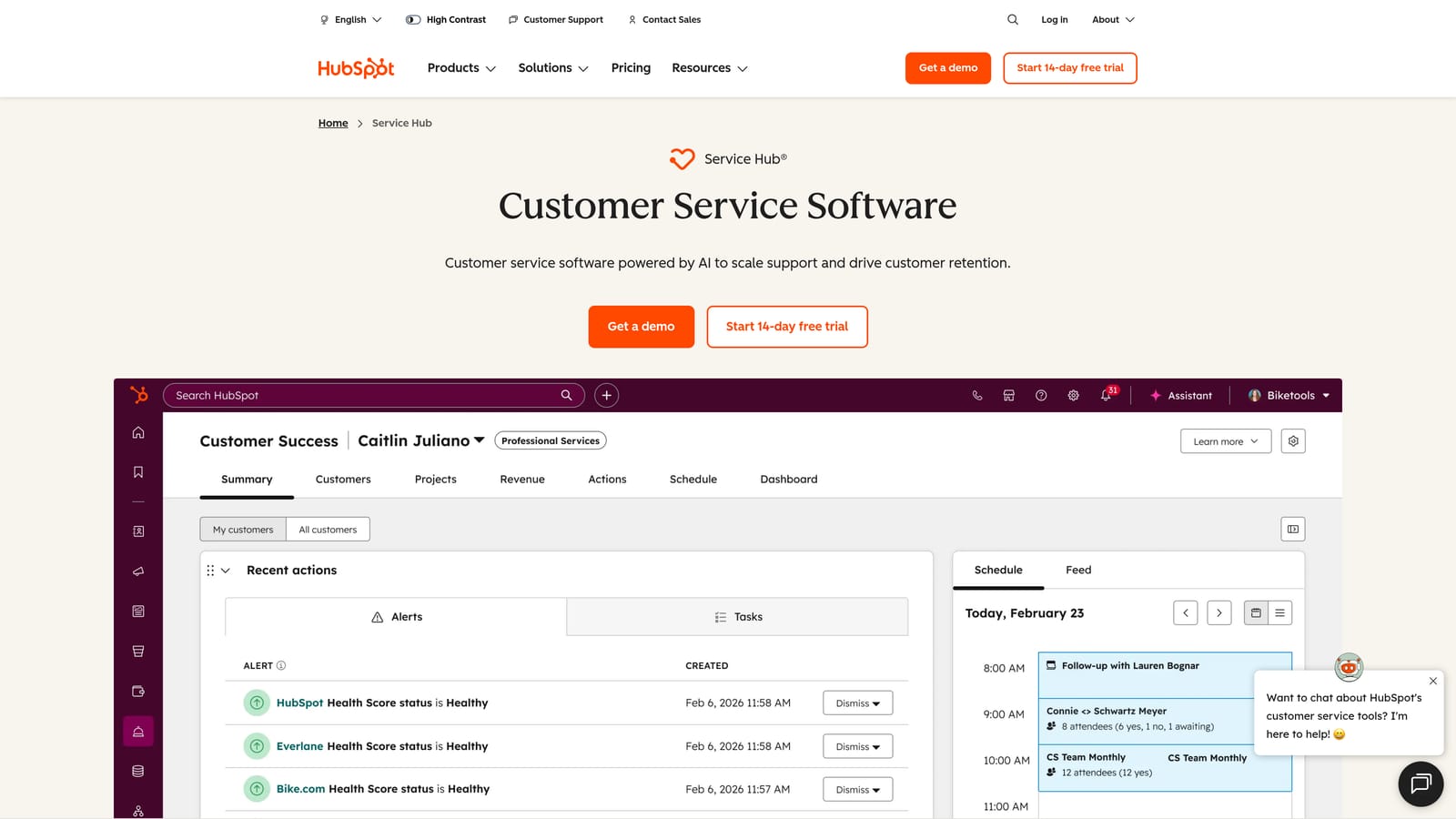
HubSpot Service Hub is HubSpot's customer service module, offering ticketing, AI-assisted replies, and a shared customer timeline for teams that want support integrated directly with their marketing and sales data.
Where This Tool Shines
The core appeal of Service Hub is the unified contact timeline. When marketing, sales, and support all live in HubSpot, every agent sees the full history of a customer's interactions across all touchpoints before writing a single reply. That context eliminates a lot of the friction that comes from fragmented data across disconnected tools.
AI-assisted reply drafts and conversation intelligence make agents faster without requiring a full AI-first architecture. The built-in customer feedback tools, including NPS, CSAT, and CES surveys, are a practical addition that many dedicated support platforms require third-party integrations to match.
Key Features
Shared Contact Timeline: Marketing, sales, and support interactions unified in a single customer view accessible to every agent.
AI-Assisted Reply Drafts: Conversation intelligence that suggests responses and helps agents draft replies faster.
Customer Portal: Self-service ticket tracking that reduces inbound volume from customers checking status.
Knowledge Base Builder: Integrated help content creation that feeds both agent workflows and customer self-service.
Built-In Feedback Surveys: NPS, CSAT, and CES surveys native to the platform without requiring additional integrations.
Best For
Teams already using HubSpot CRM for sales and marketing who want to extend the same platform to support rather than introduce a separate helpdesk. The value compounds significantly when the full HubSpot suite is in use.
Pricing
Free tools available. Professional tier from approximately $90 per month. Enterprise tier available for advanced automation and reporting requirements.
7. Tidio
Best for: Small businesses and early-stage teams needing accessible live chat with AI automation
Tidio is a live chat and AI platform built for small businesses and early-stage teams, featuring Lyro AI chatbot for automated conversation resolution without requiring technical setup or large budgets.
Where This Tool Shines
Tidio's strongest quality is accessibility. Setup is fast, the interface is approachable, and the pricing is structured for teams that can't justify enterprise contracts. For businesses that primarily operate in e-commerce or direct-to-consumer contexts, the Shopify and WooCommerce integrations are well-executed and genuinely useful.
Lyro AI handles a meaningful share of routine conversations by drawing on your support content, with smooth handoff to human agents when queries exceed its scope. For teams at the early stages of support automation, Tidio provides a practical on-ramp without the complexity of larger platforms.
Key Features
Lyro AI: Conversational chatbot trained on your support content that handles routine queries and hands off to human agents when needed.
Live Chat and AI Hybrid: Seamless transition between automated and human-handled conversations within the same interface.
No-Code Installation: Fast setup without engineering involvement, making it accessible for non-technical teams.
E-Commerce Integrations: Native connections to Shopify and WooCommerce for order-related support workflows.
Visitor Tracking and Proactive Triggers: Behavioral triggers that initiate conversations based on visitor activity, useful for conversion-focused support.
Best For
Small businesses, e-commerce brands, and early-stage startups that need live chat and basic AI automation without the complexity or cost of enterprise platforms. Less suited for complex B2B SaaS workflows requiring deep integrations or high autonomy.
Pricing
Free plan available. Paid plans from approximately $29 per month. Lyro AI conversations are billed separately based on volume.
8. Kustomer
Best for: High-volume consumer support teams that need a unified customer timeline with AI routing
Kustomer is a CRM-first support platform built for high-volume consumer support operations, offering a unified customer timeline and AI-powered routing across all communication channels in a single workspace.
Where This Tool Shines
Kustomer's unified timeline is its defining feature. Every order, interaction, return, and conversation a customer has ever had is visible to the agent in a single scrollable view. For consumer brands handling high volumes of order-related queries, this eliminates the constant context-switching between a helpdesk and a separate CRM or order management system.
AI-powered routing and sentiment detection help prioritize conversations intelligently, ensuring that high-frustration or high-value customers reach the right agent quickly. The business intelligence dashboards give operations teams visibility into support performance at a level of detail that smaller platforms don't match.
Key Features
Unified Customer Timeline: All interactions, orders, and history consolidated in a single agent view, eliminating context-switching between tools.
AI-Powered Routing and Sentiment Detection: Intelligent conversation prioritization based on customer sentiment and query type.
Omnichannel Inbox: Email, chat, SMS, social media, and voice managed within a single agent workspace.
Workflow Automation: Configurable automation for repetitive support tasks that reduce manual agent effort.
Business Intelligence Dashboards: Detailed operational reporting for support leadership and quality assurance teams.
Best For
High-volume consumer support operations, particularly retail, e-commerce, and subscription businesses, where a unified customer history and intelligent routing deliver meaningful efficiency gains. Less commonly used in pure B2B SaaS environments.
Pricing
Per-user pricing in the mid-to-enterprise range. Contact Kustomer directly for current rates based on team size and volume.
9. Gladly
Best for: Premium consumer brands that prioritize relationship-driven support over ticket-centric workflows
Gladly is a people-based support platform that replaces ticket numbers with a continuous, lifelong conversation history per customer, representing a fundamentally different philosophy from traditional helpdesk thinking.
Where This Tool Shines
Gladly's premise is that customers are people, not ticket numbers. Every interaction a customer has ever had, regardless of channel, lives in a single continuous thread. Agents never start a conversation cold, and customers never have to repeat themselves because they switched from email to chat. For brands where the support experience is part of the product's premium feel, this approach creates a genuinely different quality of interaction.
The agent experience is notably simplified compared to traditional helpdesks. There are no queues of numbered tickets to work through: just a clear view of customers who need attention, with full context always visible. Sidekick AI handles self-service resolution for customers who want to find answers independently before reaching a human.
Key Features
No Ticket Numbers: Every interaction is part of a single, lifelong customer conversation thread rather than an isolated ticket with a number.
Radically Simplified Agent Experience: Full customer context always visible without navigating between ticket queues or multiple system views.
AI-Assisted Suggested Replies: Recommended responses that help agents move faster while maintaining a consistent brand voice.
Omnichannel in One Thread: Voice, email, chat, SMS, and social interactions unified in a single customer timeline regardless of channel.
Sidekick AI: Self-service resolution capability for customers who prefer to find answers before reaching out to an agent.
Best For
Premium consumer brands, high-end retail, and relationship-driven businesses where the quality of the support experience is a brand differentiator. Less common in pure B2B SaaS environments where ticket-based workflows and deep product integrations are higher priorities.
Pricing
Enterprise pricing on a demo-based model. Contact Gladly directly for current rates specific to your team size and support volume.
Which Tool Is Right for Your Team?
Nine platforms, nine different philosophies. The right choice depends on one foundational question: do you need AI as the core architecture, or as a feature added to an existing helpdesk?
If you're a scaling SaaS team that wants autonomous ticket resolution, contextual product guidance, and business intelligence that flows beyond the support team, Halo AI is the strongest fit. It's built AI-first, which means you're not working around legacy infrastructure to get to autonomy.
For teams already deep in the Salesforce or HubSpot ecosystems, Service Cloud and Service Hub are the logical extensions: you gain support capabilities without fragmenting your customer data. Intercom is the right call for teams that want a mature conversational platform with a capable AI agent and strong outbound messaging in the same tool.
Zendesk remains the reliable choice for enterprises that need proven infrastructure, a large partner network, and gradual AI adoption. Freshdesk covers similar ground at a lower price point for teams where budget is the primary constraint.
For consumer brands, Gladly and Kustomer each offer unified customer timelines that ticket-centric platforms can't match. And for small businesses or early-stage teams taking their first steps into AI-assisted support, Tidio provides an accessible on-ramp without the complexity of enterprise tools.
Your support team shouldn't scale linearly with your customer base. AI agents should handle routine tickets, guide users through your product, and surface business intelligence while your team focuses on the complex issues that genuinely need a human touch. See Halo in action and discover how continuous learning transforms every interaction into smarter, faster support.