9 Best Intelligent Support Ticket Systems in 2026
An intelligent support ticket system replaces manual triage and rigid workflows with AI-powered classification, prioritization, and auto-resolution. This guide ranks the 9 best platforms available in 2026, evaluated on AI capability, integration depth, ease of setup, and real business value for SaaS and B2B support teams.
 Grant CooperFounder14 min read
Support tickets shouldn't just be a queue to clear. They should be a source of insight, automation, and faster resolutions. Yet many teams are still wrestling with legacy helpdesks that require manual triage, rigid workflows, and zero learning capability.
An intelligent support ticket system changes that. Instead of routing tickets by hand and copy-pasting macros, these platforms use AI to classify, prioritize, auto-resolve, and escalate — often before a human agent even sees the request.
This list covers the top intelligent support ticket systems available in 2026, evaluated on AI capability, integration depth, ease of setup, and real business value beyond just deflection rates. Whether you're a lean SaaS team handling hundreds of tickets a week or a scaling B2B company managing enterprise support queues, there's a right tool here for your stage.
1. Halo AI
Best for: B2B SaaS teams that want AI-first ticket resolution with page-aware context and business intelligence.
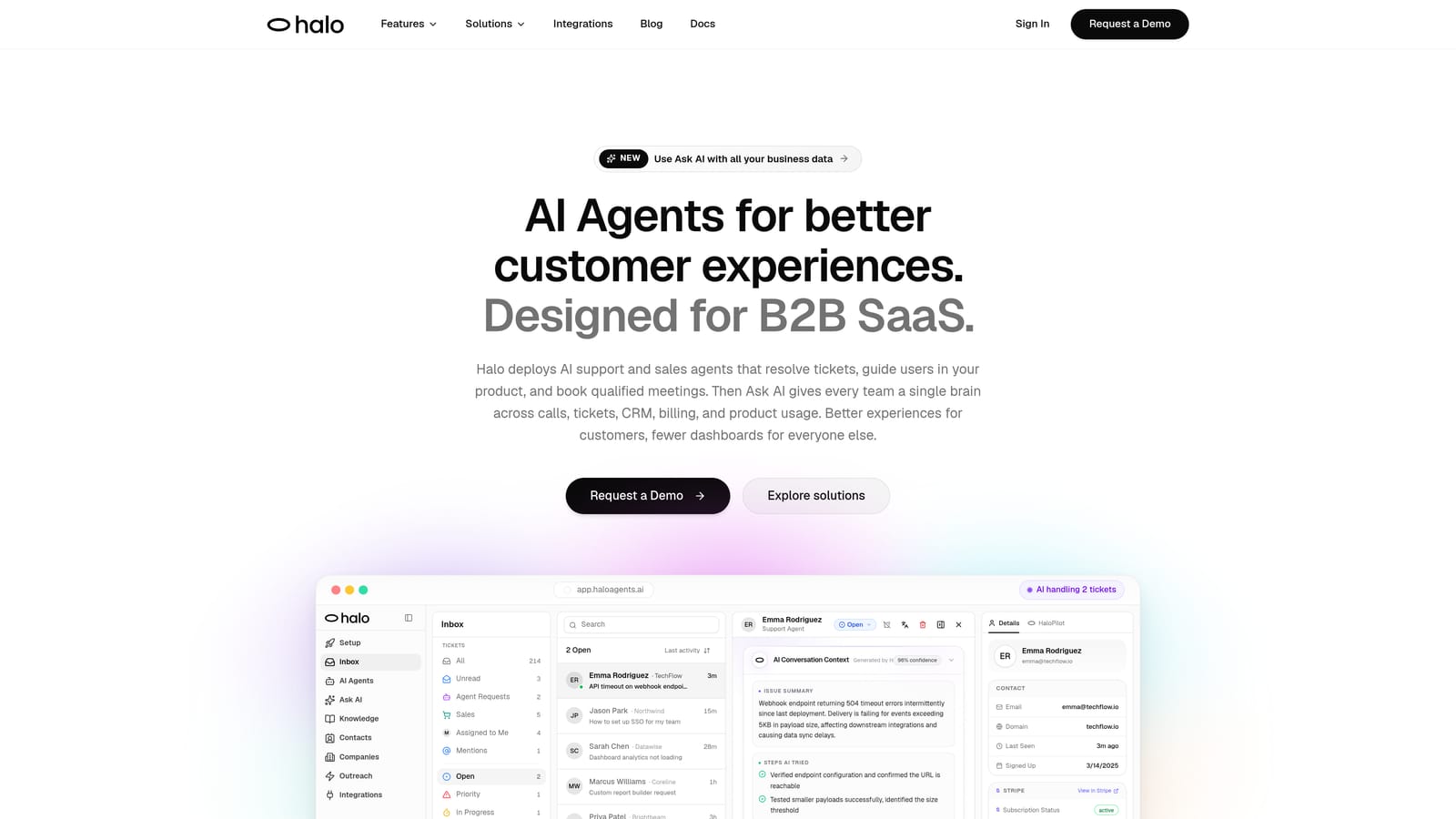
Halo AI is an AI-first customer support platform that deploys intelligent agents to resolve tickets, guide users through your product, and surface business intelligence signals — all while learning from every interaction.
Where This Tool Shines
Most helpdesks bolt AI onto an existing workflow. Halo AI was built the other way around: the AI agent is the core, not an add-on. That architectural difference matters because the system continuously improves with every resolved ticket rather than relying on static rules or periodic model updates.
The standout capability is page-aware context. Halo's chat widget actually sees what the user sees inside your product, which means it can provide visual UI guidance rather than generic instructions. For SaaS teams where "how do I do X in the app" tickets dominate the queue, this alone changes the deflection calculus significantly.
Key Features
Autonomous AI Agents: Resolve tickets end-to-end without human involvement for common issues, handling the full resolution cycle independently.
Page-Aware Chat Widget: The AI sees what the user sees in your product and delivers contextual, visual UI guidance rather than generic answers.
Smart Inbox with Business Intelligence: Surfaces customer health signals, revenue anomalies, and trend detection directly from support patterns — not just ticket metrics.
Auto Bug Ticket Creation: Automatically generates and routes bug reports to Linear or connected project management tools when issues are detected.
Live Agent Handoff: Escalates complex issues to human agents with full conversation context preserved, so agents never start from scratch.
Deep Integrations: Connects natively with Slack, HubSpot, Intercom, Stripe, Zoom, PandaDoc, and Fathom for a unified business stack.
Best For
Halo AI is purpose-built for B2B SaaS product teams that want more than ticket deflection. If your support data should be informing your product roadmap, customer success motion, and revenue intelligence, this is the platform designed for that ambition. It's particularly well-suited for teams scaling support without scaling headcount.
Pricing
Contact for pricing. Halo AI is designed for B2B SaaS teams and pricing is scoped to your team's needs. Visit haloagents.ai to get started.
2. Zendesk
Best for: High-volume enterprise support operations that need proven, deeply configurable infrastructure with broad integration coverage.
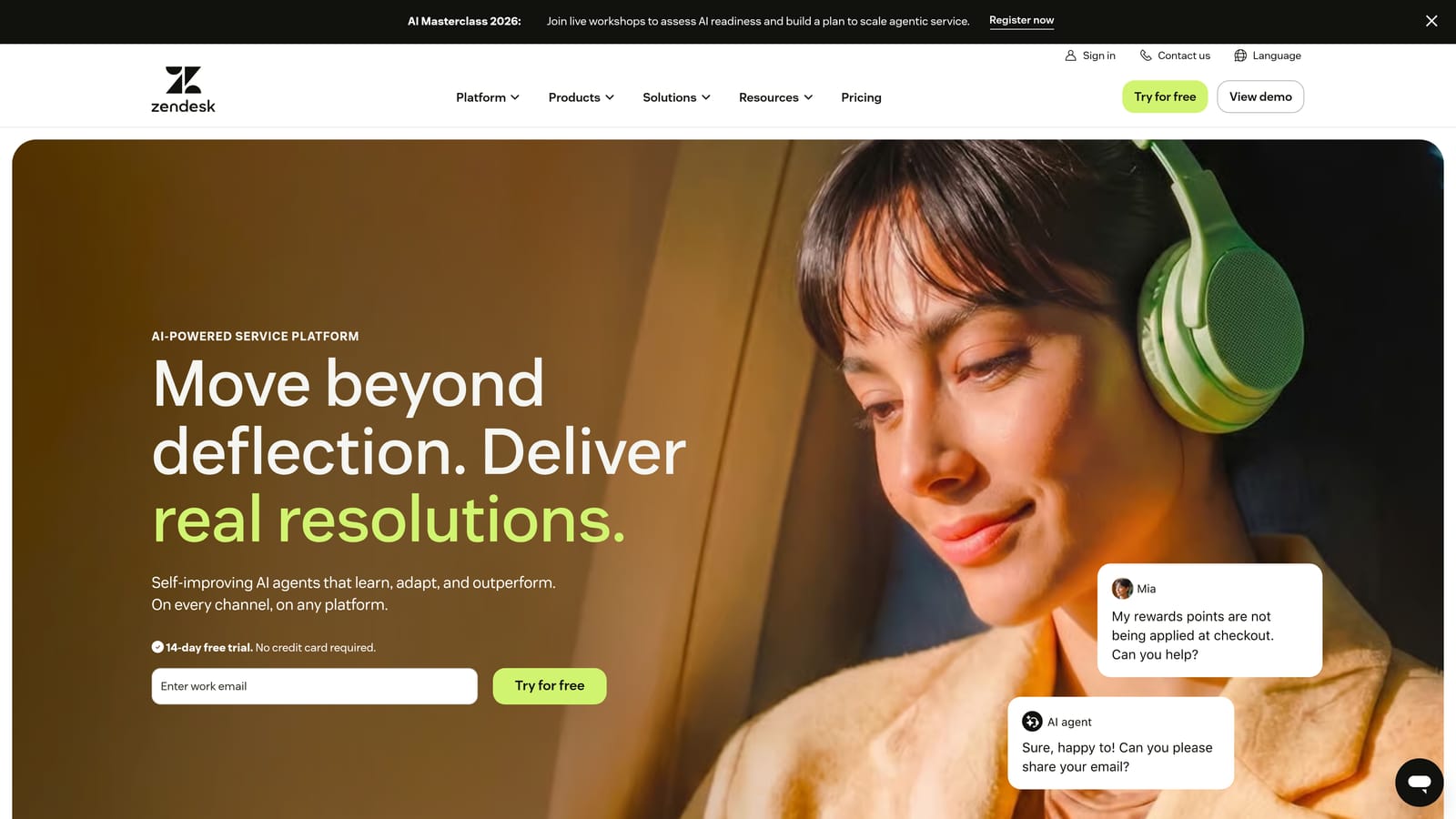
Zendesk is one of the most established helpdesk platforms, now with a dedicated AI suite for triage, response suggestions, and intelligent routing across complex support operations.
Where This Tool Shines
Zendesk's strength is its maturity. The platform has been refined across thousands of enterprise deployments, and the breadth of its integration marketplace (over 1,000 apps) means it connects to almost any business system you're already running. For large teams with complex workflows, that configurability is genuinely valuable.
The AI suite adds intelligent triage and macro suggestions on top of that foundation. It's AI-enabled rather than AI-first, which means the AI features augment an already-powerful workflow engine rather than replacing it. Teams that need fine-grained control over every routing rule will appreciate this approach.
Key Features
AI-Powered Triage: Automatic ticket classification and priority scoring to reduce manual sorting at the front of the queue.
Intelligent Macros: AI-suggested response templates and macros based on ticket content and historical resolution patterns.
Integration Marketplace: Over 1,000 app integrations covering CRM, billing, analytics, and productivity tools.
Advanced Analytics: Custom reporting dashboards for tracking resolution times, agent performance, and support trends.
Omnichannel Support: Unified inbox across email, chat, voice, and social media channels.
Best For
Zendesk is best for mid-market and enterprise teams that need a battle-tested platform with extensive customization options. If your support operation has complex routing requirements, multiple product lines, or a large agent team, Zendesk's configurability justifies the investment.
Pricing
Suite Team starts at approximately $55/agent/month. AI features are available on higher tiers. Pricing scales considerably for enterprise configurations.
3. Freshdesk
Best for: Growing SMBs that want accessible AI-powered ticketing without enterprise-level complexity or cost.
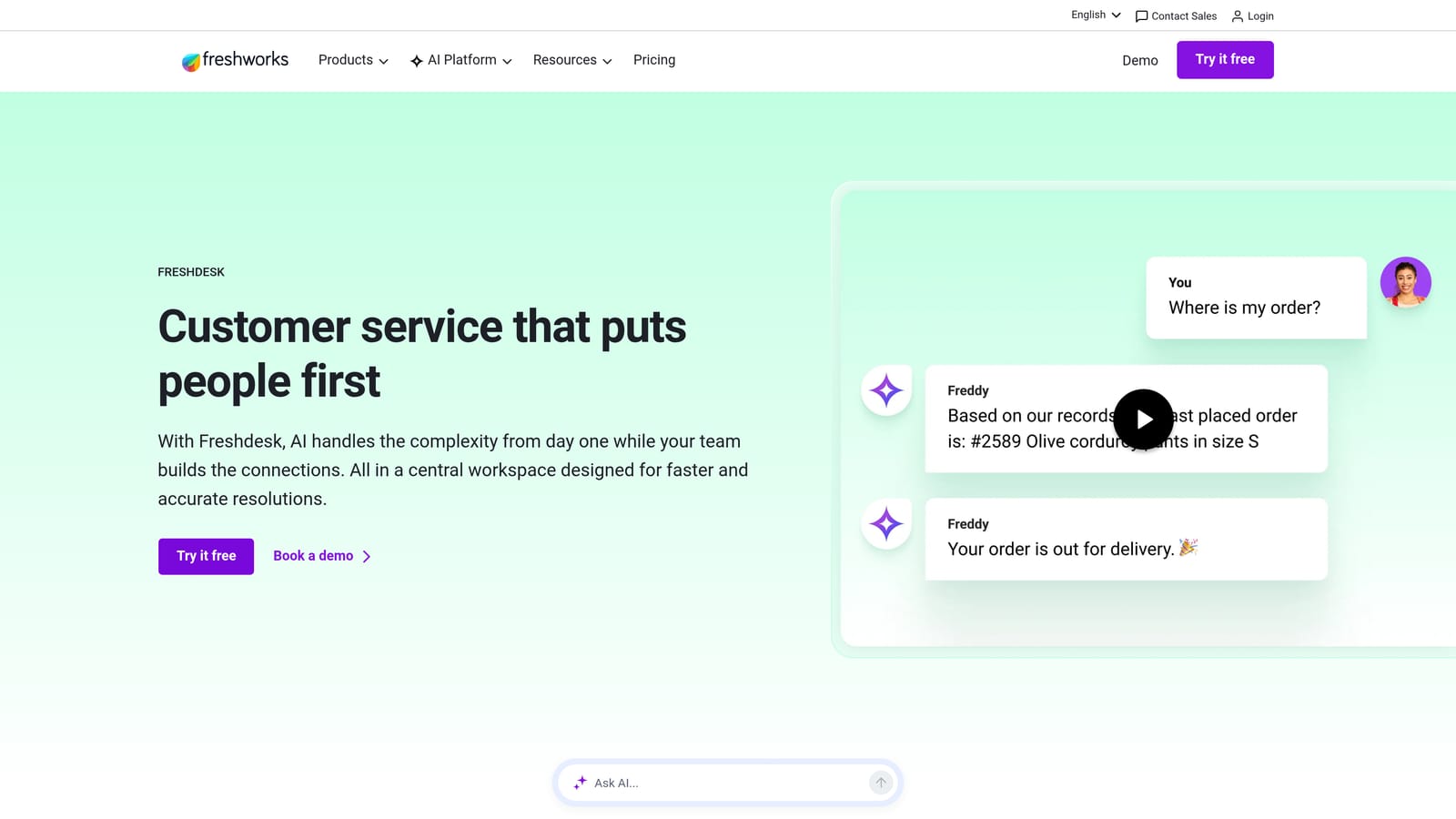
Freshdesk is a widely used helpdesk platform with Freddy AI built in for automatic ticket triage, suggested responses, and basic autonomous resolution across multiple support channels.
Where This Tool Shines
Freshdesk hits a practical sweet spot between capability and affordability. Freddy AI handles the most time-consuming parts of front-line support: categorizing incoming tickets, assigning priority, routing to the right agent, and drafting initial responses. For teams that don't have the budget for enterprise tooling but still want meaningful AI assistance, this is a strong entry point.
The omnichannel coverage is genuinely broad, pulling in email, chat, phone, and social media without requiring separate platform subscriptions. Collision detection prevents the classic "two agents, one ticket" embarrassment that plagues shared inboxes.
Key Features
Freddy AI Triage: Automatic ticket categorization, priority assignment, and routing based on content analysis and historical patterns.
AI-Suggested Responses: Freddy drafts responses based on ticket content and your knowledge base, reducing agent composition time.
Omnichannel Inbox: Unified coverage across email, chat, phone, and social media channels in a single interface.
Collision Detection: Prevents multiple agents from simultaneously working the same ticket, eliminating duplicated effort.
Freddy Self Service: AI-powered knowledge base deflection that answers common questions before they become tickets.
Best For
Freshdesk is ideal for growing SMBs and mid-market teams that need solid AI-assisted ticketing without a steep implementation curve. It's particularly accessible for teams migrating from basic email-based support who want a meaningful upgrade without enterprise complexity.
Pricing
Free plan available for up to 10 agents. Paid plans start at approximately $15/agent/month. AI features are available on Growth and higher tiers.
4. Intercom
Best for: Product-led SaaS companies that want conversational AI resolution with ticketing built around the chat model.
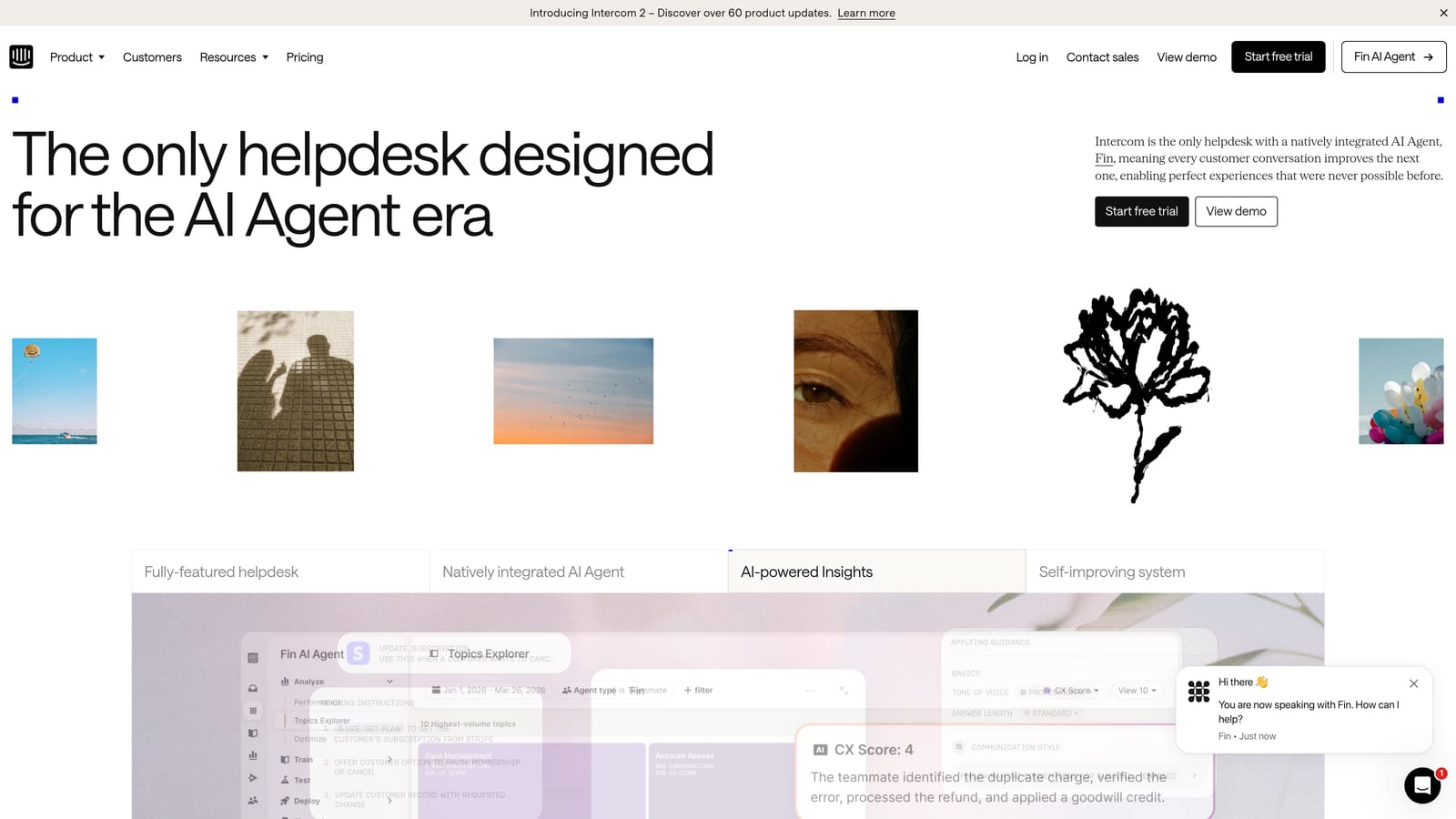
Intercom is a chat-first customer platform with Fin AI agent at its core, designed to resolve support conversations autonomously and escalate to human agents when needed.
Where This Tool Shines
Intercom's approach flips the traditional ticketing model. Rather than starting with a ticket and assigning it to an agent, the Fin AI agent handles the conversation first. Tickets are generated from unresolved conversations, which means the AI gets the first pass at every inquiry. For product-led growth companies where chat is the primary support channel, this feels natural rather than bolted on.
Fin AI has earned a reputation for handling a meaningful portion of common support queries without human involvement. The key is that it draws from your existing content: help docs, knowledge base articles, and past conversations. The richer your content library, the better Fin performs.
Key Features
Fin AI Agent: Autonomous conversational resolution of common support queries, pulling from your knowledge base and help content.
Conversation-to-Ticket Flow: Tickets generated automatically from unresolved AI conversations, preserving full context for agents.
In-Product Messaging: Proactive support capabilities and in-app messaging to address issues before users reach out.
Customer Data Platform: Personalized support experiences powered by customer attributes and behavioral data.
AI-Assisted Agent Workflows: Shared inbox with AI suggestions and automation to accelerate human agent responses.
Best For
Intercom is the natural choice for product-led SaaS companies with active in-app chat support. Teams that have already invested in building out a help center will see the strongest Fin AI performance, since the model relies heavily on that content library.
Pricing
Starts at approximately $39/seat/month. Fin AI is priced separately on a usage basis, so total cost scales with resolution volume.
5. Help Scout
Best for: Teams that prioritize relationship quality and want AI to accelerate agents rather than replace them entirely.
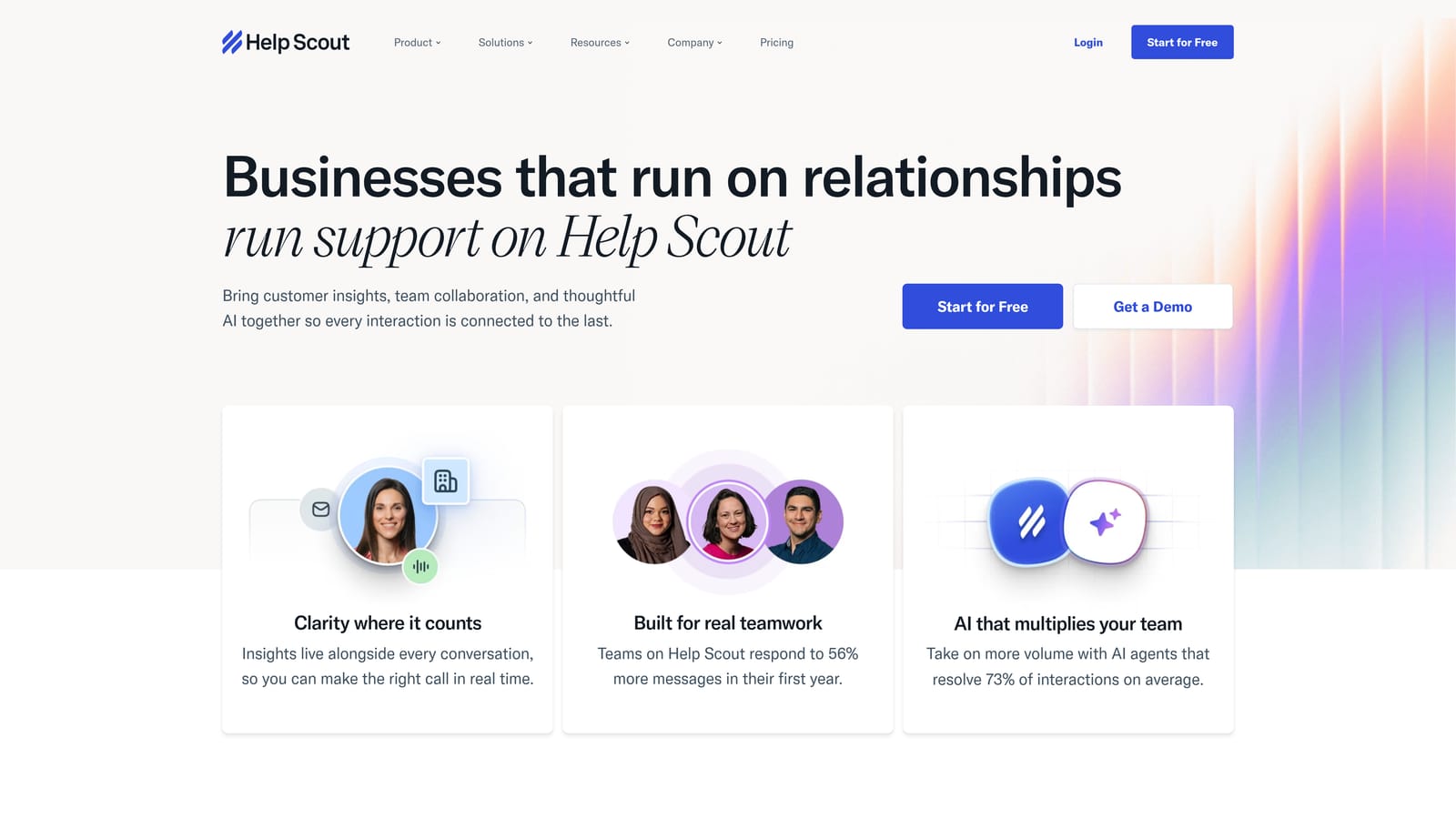
Help Scout is a clean, inbox-style support platform that uses AI to accelerate agent responses while deliberately keeping the human element central to every customer interaction.
Where This Tool Shines
Help Scout has a clear philosophy: AI should make your agents better, not invisible. The platform's AI features are designed to reduce the cognitive load on agents — summarizing long threads, drafting initial responses, adjusting tone — rather than autonomously resolving tickets without human review. For teams where relationship quality is a genuine competitive differentiator, this intentional approach is worth choosing deliberately.
The UI is notably clean and easy to adopt. Teams migrating from Gmail or basic email support often find Help Scout the least disruptive transition, and the Beacon widget adds in-app help without requiring significant engineering work.
Key Features
AI Summarize: Condenses long email threads into quick context snapshots so agents can catch up instantly without reading the full history.
AI Drafts: Suggests responses based on ticket content, which agents can review, edit, and send rather than composing from scratch.
AI Assist: Adjusts tone, edits length, and handles translation for agents working with diverse customer bases.
Collision Detection: Shared inbox visibility prevents duplicate responses and wasted agent effort.
Beacon Widget: In-app help center and proactive messaging for deflecting common questions before they become tickets.
Best For
Help Scout is ideal for teams in professional services, B2B SaaS, or any context where a thoughtful, human response genuinely matters to customer retention. It's also a strong choice for smaller teams that want AI assistance without the complexity of enterprise-grade automation.
Pricing
Starts at approximately $20/user/month on the Standard plan. Higher tiers unlock additional AI features and reporting capabilities.
6. Zoho Desk
Best for: Teams already using the Zoho ecosystem that want intelligent ticketing tightly integrated with CRM and business analytics.
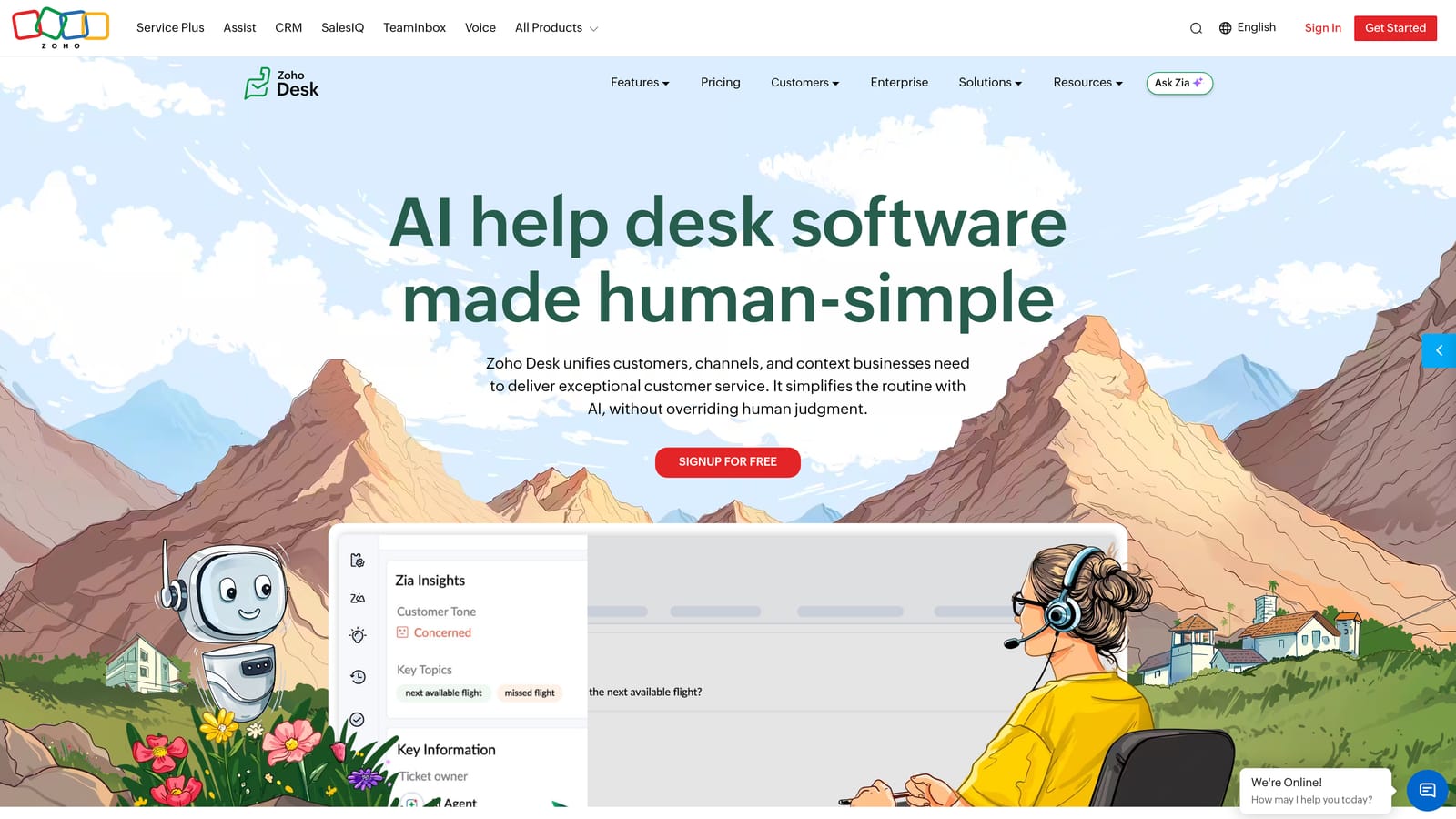
Zoho Desk is an intelligent helpdesk platform with Zia AI providing sentiment analysis, anomaly detection, and response suggestions — tightly integrated with the broader Zoho business ecosystem.
Where This Tool Shines
Zoho Desk's differentiation is the Zia AI layer combined with deep ecosystem integration. Zia doesn't just triage tickets: it reads customer sentiment, flags emotional escalation risk, and alerts you when ticket volume or response times deviate from expected norms. For support managers who want early warning signals rather than lagging metrics, this anomaly detection capability is genuinely useful.
The value compounds significantly if your team already uses Zoho CRM. Support agents see full customer history, deal status, and account health without switching tabs, which makes context-aware responses much faster to produce.
Key Features
Zia Sentiment Analysis: Detects customer emotion and flags tickets at risk of escalation before they become complaints.
Anomaly Alerts: Notifies teams when ticket volume, response times, or resolution rates deviate from established norms.
AI-Suggested Responses: Zia recommends responses and tags based on ticket content and historical resolution patterns.
Zoho Ecosystem Integration: Deep native connections to Zoho CRM, Zoho Analytics, Zoho SalesIQ, and other Zoho products.
Blueprint Workflow Automation: Structured process automation for ticket handling that enforces consistent resolution steps across the team.
Best For
Zoho Desk is the natural choice for businesses already invested in the Zoho platform. The standalone value is solid, but the compounding benefits of CRM integration and shared analytics make it particularly compelling for Zoho-first organizations.
Pricing
Free plan available for up to 3 agents. Paid plans start at approximately $14/agent/month, making it one of the more affordable options with AI capabilities included.
7. Tidio
Best for: Small SaaS teams and e-commerce businesses that want fast AI deployment at an accessible price point.
Tidio is an accessible AI support platform with Lyro AI for autonomous query resolution, designed for fast deployment and affordable intelligent ticketing for smaller teams.
Where This Tool Shines
Tidio's primary advantage is speed of deployment. Most teams can get Lyro AI handling live conversations within a day of setup, without requiring technical configuration or a lengthy onboarding process. For small teams that have been managing support through email or a basic chat widget, this represents a significant capability jump with minimal friction.
Lyro AI handles autonomous resolution of common questions without agent involvement, and the handoff to a human agent is clean when a query exceeds its capability. The e-commerce integrations with Shopify and WooCommerce make it particularly relevant for product-based businesses alongside SaaS teams.
Key Features
Lyro AI: Autonomous resolution of common customer questions without requiring agent involvement, learning from your existing help content.
AI-to-Human Handoff: Smooth escalation from Lyro AI to live agents when queries exceed the AI's resolution capability.
Basic Ticketing Automation: Automation rules, tagging, and routing for organizing incoming support requests.
E-Commerce Integrations: Native connections to Shopify, WooCommerce, and similar platforms for order and product context.
Quick Setup: Minimal technical configuration required, with most teams operational within hours rather than weeks.
Best For
Tidio is best for small SaaS teams, early-stage startups, and e-commerce businesses that want meaningful AI support capability without enterprise complexity or budget. Teams that have outgrown email support but aren't ready for a full helpdesk platform will find it a practical bridge.
Pricing
Free plan available. Lyro AI plans start at approximately $29/month, making it one of the most affordable AI-capable options on this list.
8. Kustomer
Best for: High-volume B2C support operations that need a unified customer timeline with AI-powered routing and workflow automation.
Kustomer is a CRM-native ticketing platform that unifies the full customer journey into a single timeline, with AI automation for routing, tagging, and response suggestions across high-volume support operations.
Where This Tool Shines
Kustomer's core differentiator is the unified customer timeline. Every interaction across every channel, email, chat, SMS, social, and voice, appears in a single chronological view alongside purchase history, previous tickets, and account data. For support agents handling complex customer relationships, this eliminates the context-switching that slows down resolution and frustrates customers who have to repeat themselves.
The AI automation layer handles the operational overhead: routing tickets to the right team, applying tags based on content and intent, and suggesting responses that agents can send with minimal editing. For high-volume operations where consistency and speed are critical, this combination of unified data and AI automation is genuinely powerful.
Key Features
Unified Customer Timeline: All interactions across every channel combined into a single chronological view with full customer history.
AI-Powered Routing: Automatic ticket routing and tagging based on content analysis and customer intent detection.
Workflow Automation: Configurable automation for repetitive ticket handling steps, reducing manual agent effort on routine tasks.
Built-In CRM Data: Customer purchase history, account status, and relationship data surfaced directly within support conversations.
Omnichannel Coverage: Unified support across email, chat, SMS, social media, and voice channels.
Best For
Kustomer is best suited for high-volume B2C support operations where agents handle complex customer relationships across multiple touchpoints. It's particularly strong for retail, subscription businesses, and any operation where purchase history context is essential to good support.
Pricing
Starts at approximately $89/user/month at the Enterprise tier. This positions Kustomer toward mid-market and enterprise buyers rather than early-stage teams.
9. Salesforce Service Cloud
Best for: Large enterprises already on the Salesforce platform that need deep CRM integration and enterprise-grade AI case management.
Salesforce Service Cloud is an enterprise-grade support platform with Einstein AI for case classification, predictive routing, and next-best-action recommendations — deeply unified with the Salesforce CRM ecosystem.
Where This Tool Shines
Service Cloud's strength is its integration depth with the Salesforce platform. For enterprises where Sales, Service, and Marketing all run on Salesforce, the unified data model means support agents have complete customer context: open opportunities, contract status, account health, and full interaction history. Einstein AI builds on top of that data foundation to make routing and classification genuinely predictive rather than rule-based.
The next-best-action recommendations are particularly valuable for complex B2B support scenarios where the right resolution path depends on account tier, contract terms, or relationship history. This is the kind of nuanced guidance that simpler AI triage systems can't replicate.
Key Features
Einstein AI Case Classification: Automatic case categorization and intelligent routing based on content analysis and historical resolution patterns.
Next-Best-Action Recommendations: AI-guided suggestions that direct agents toward optimal resolutions based on customer data and case context.
Predictive Case Fields: Auto-populated case fields based on historical patterns, reducing manual data entry for agents.
Salesforce CRM Integration: Full customer data, account history, and opportunity context surfaced directly within every support case.
Omni-Channel Routing: Intelligent workload balancing across all support channels with skills-based and capacity-aware routing.
Best For
Service Cloud is the right choice for large enterprises already operating on the Salesforce platform. The implementation complexity and cost are significant, so it's best justified when the Salesforce ecosystem integration unlocks capabilities that standalone helpdesks cannot match.
Pricing
Starter plans begin at approximately $25/user/month. Enterprise and Unlimited tiers, where most of the advanced AI features live, scale considerably higher. Implementation costs should be factored into the total investment.
Which Intelligent Support Ticket System Is Right for You?
Every tool on this list earns its place, but the right choice depends on where your team is and what you're actually trying to solve.
For AI-first architecture with business intelligence: Halo AI is purpose-built for B2B SaaS teams that want more than ticket deflection. If you want your support data to inform product decisions, surface customer health signals, and resolve tickets autonomously while learning from every interaction, this is the platform designed for that outcome.
For enterprise scale with deep configurability: Zendesk and Salesforce Service Cloud are the proven choices for large organizations with complex routing requirements and existing enterprise tooling. Service Cloud is the natural fit if you're already on Salesforce.
For growing SMBs on a practical budget: Freshdesk and Zoho Desk offer solid AI-assisted ticketing at accessible price points. Zoho Desk is particularly compelling if you're already in the Zoho ecosystem.
For product-led SaaS with chat-first support: Intercom's Fin AI agent is the natural fit, especially if you've already built out a help center and want AI to handle first-pass resolution at scale.
For relationship-first support: Help Scout's intentional approach to human-augmented AI is worth choosing deliberately if customer relationship quality is a genuine differentiator for your business.
For fast deployment at small scale: Tidio gets you to AI-powered resolution quickly without enterprise complexity or budget.
Your support team shouldn't scale linearly with your customer base. Let AI agents handle routine tickets, guide users through your product, and surface business intelligence while your team focuses on complex issues that need a human touch. See Halo in action and discover how continuous learning transforms every interaction into smarter, faster support.