9 Best Intelligent Ticket Deflection Software Tools in 2026
Intelligent ticket deflection software uses AI to automatically resolve support requests before they reach human agents, saving time and reducing costs. This guide evaluates the 9 best platforms available in 2026, comparing AI sophistication, integration depth, and deflection accuracy to help B2B SaaS teams find the right solution for their existing helpdesk stack.
 Matt PattoliFounder14 min read
Every support ticket your team resolves manually is time your engineers, product managers, and agents could spend on higher-value work. Intelligent ticket deflection software uses AI to intercept, understand, and resolve incoming support requests before they ever reach a human queue, reducing volume, cutting response times, and improving customer satisfaction without scaling headcount.
But not all deflection tools are created equal. Some are basic FAQ bots bolted onto existing helpdesks. Others are purpose-built AI platforms that understand context, learn from every interaction, and connect to your entire business stack.
This list covers the top intelligent ticket deflection platforms available in 2026, evaluated on AI sophistication, integration depth, deflection accuracy, and value for B2B SaaS teams. Whether you're running Zendesk, Freshdesk, Intercom, or a custom stack, there's a solution here for your team.
1. Halo AI
Best for: B2B SaaS teams that want an AI-first support platform built to learn and scale.
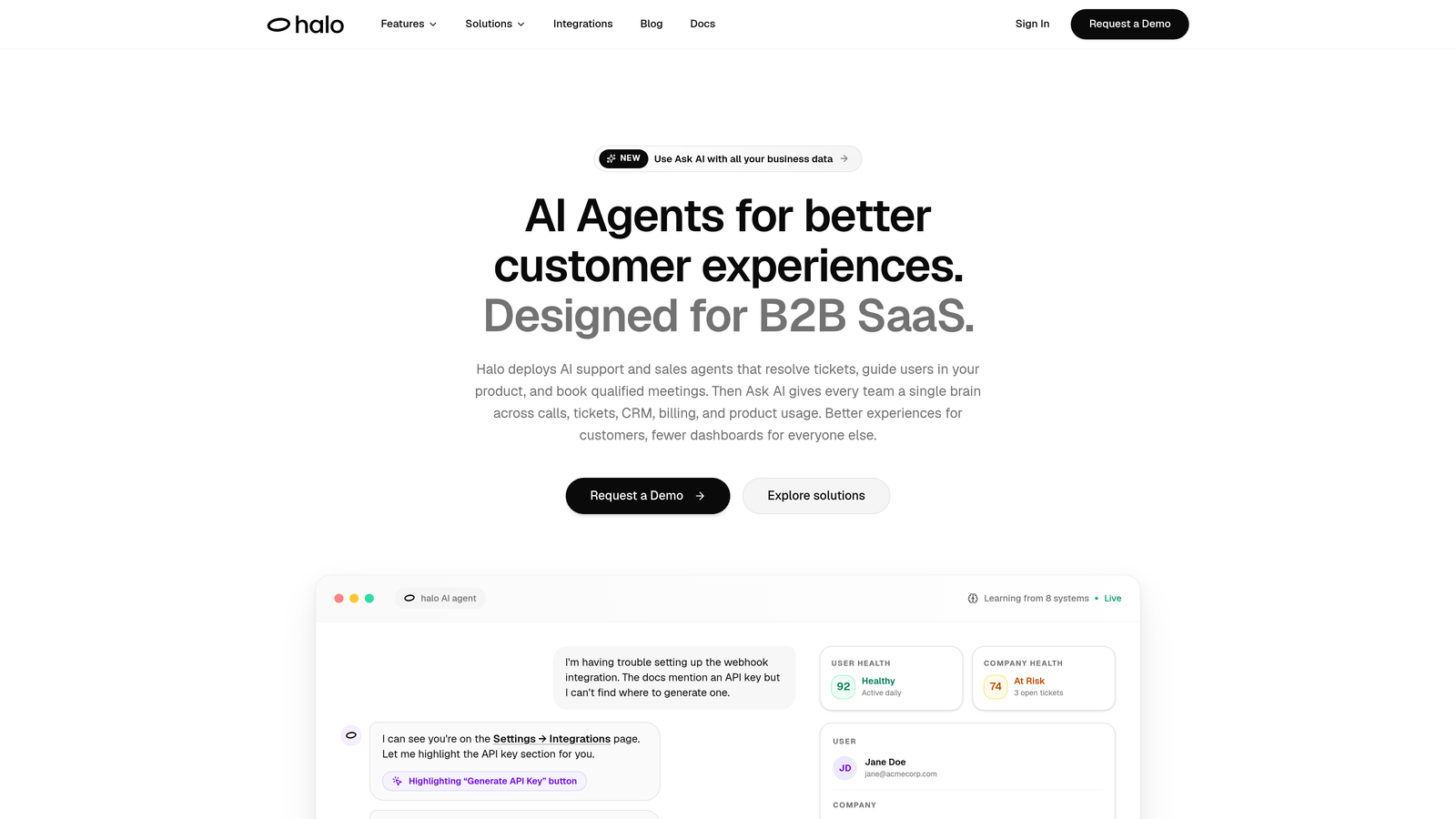
Halo AI is an AI-native customer support platform that deploys intelligent agents to resolve tickets, guide users through your product with page-aware context, and surface business intelligence signals across your entire support operation.
Where This Tool Shines
Most deflection tools work by matching keywords to knowledge base articles. Halo goes further: its AI agents are page-aware, meaning they understand what screen or workflow a user is currently viewing inside your product. That context transforms generic deflection into genuinely useful guidance, the kind that actually resolves issues rather than pointing users toward a help center homepage.
What also sets Halo apart is continuous learning. Every resolved interaction feeds back into the model, so deflection accuracy improves over time rather than plateauing after initial setup. Pair that with auto bug ticket creation routed directly to Linear and integrations across Slack, HubSpot, Stripe, Zoom, PandaDoc, and Fathom, and you have a platform that does more than deflect tickets. It makes your entire support operation smarter.
Key Features
Page-Aware AI Agents: The AI sees what users see in your product, enabling contextual deflection that's relevant to the exact moment of friction.
Continuous Learning: Every interaction improves deflection accuracy over time without manual retraining or rule updates.
Auto Bug Ticket Creation: Automatically generates and routes bug reports to Linear or your preferred issue tracker when users report product issues.
Smart Inbox with Business Intelligence: Surfaces customer health signals, revenue anomalies, and support trend detection beyond standard ticket analytics.
Full Business Stack Integrations: Connects natively with Linear, Slack, HubSpot, Intercom, Stripe, Zoom, PandaDoc, and Fathom.
Clean Live Agent Handoff: Escalates to human agents with full conversation context preserved, so nothing gets repeated or lost.
Best For
B2B SaaS companies that want more than a deflection layer. Halo is purpose-built for product and support teams that need their AI to understand product context, integrate with their full toolchain, and deliver intelligence beyond ticket counts. Particularly strong for teams scaling support without scaling headcount.
Pricing
Contact for pricing. Halo is designed for B2B SaaS teams at scale, so plans are scoped to team size and use case rather than listed publicly.
2. Intercom Fin
Best for: Teams already on Intercom who want AI deflection without adding another tool.
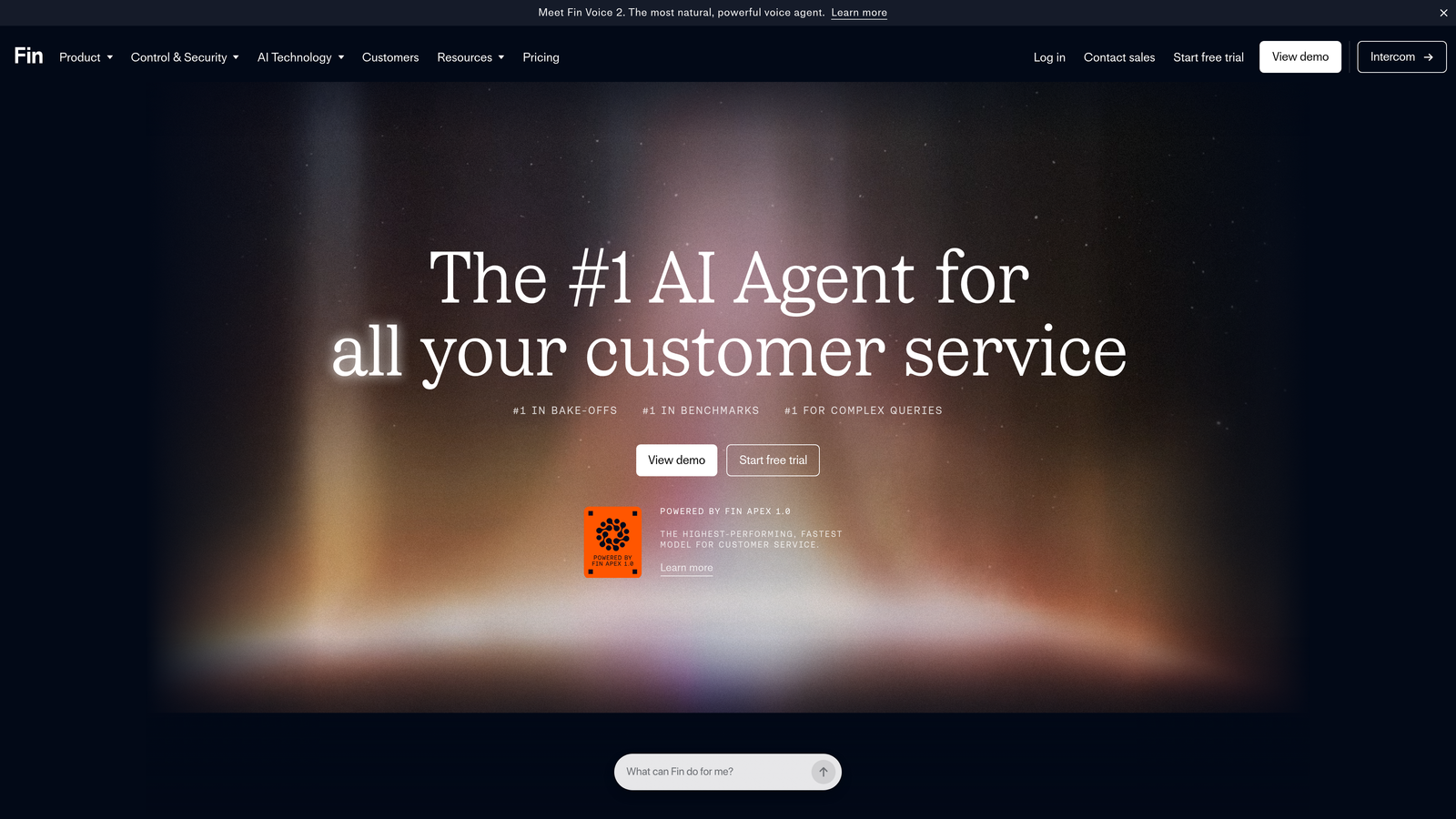
Intercom Fin is Intercom's native AI agent that resolves customer conversations using your existing knowledge base and support content, built directly into the Intercom messenger experience.
Where This Tool Shines
Fin's biggest advantage is how naturally it fits into an existing Intercom setup. There's no separate widget to configure, no new platform to learn, and no migration required. If you've already invested in Intercom's knowledge base and messenger, Fin activates on top of that investment immediately.
The LLM-powered resolution means Fin handles natural language queries rather than relying on rigid keyword matching. It reads your support content and synthesizes answers conversationally, which tends to produce more satisfying responses than article-link deflection alone.
Key Features
LLM-Powered Resolution: Uses large language models to generate answers from your Intercom knowledge base rather than just surfacing links.
Native Messenger Integration: Works within the Intercom messenger with no additional setup or widget configuration.
Multilingual Support: Handles conversations in multiple languages, useful for global customer bases.
Consumption-Based Pricing: You pay per AI resolution rather than per seat, which aligns cost directly with value delivered.
Seamless Human Handoff: Escalates within the same Intercom thread so agents have full context when they take over.
Best For
Mid-market SaaS teams already running Intercom who want intelligent deflection without adopting a new platform. Less suited for teams not on Intercom, since Fin's value is tightly coupled to the Intercom ecosystem.
Pricing
Consumption-based, charged per AI resolution. Requires an active Intercom subscription. Contact Intercom for current resolution pricing details.
3. Zendesk AI
Best for: Enterprise teams on Zendesk Suite who need deflection, triage, and agent assist in one integrated layer.
Zendesk AI is Zendesk's expanded AI suite covering intelligent deflection, intent-based triage, agent copilot assistance, and self-service automation across email, chat, and messaging channels.
Where This Tool Shines
Zendesk AI's strength is breadth. It doesn't just deflect inbound tickets; it also triages what gets through, assists agents in real time, and surfaces relevant help center articles before a user even clicks "submit." That full-funnel coverage makes it particularly valuable for high-volume enterprise support operations where every layer of the funnel matters.
The intent detection engine works across email, chat, and messaging simultaneously, which is important for teams managing omnichannel support. If your support operation is already deeply embedded in Zendesk Suite, the native integration means you're not managing a separate AI tool with its own configuration overhead.
Key Features
Intent Detection and Routing: Identifies ticket intent across email, chat, and messaging channels to route or deflect intelligently.
Pre-Submission Article Suggestions: Surfaces relevant help center content before users complete a ticket submission form.
Agent Copilot: Provides agents with suggested replies and next-best-action guidance to speed up resolution on tickets that do come through.
Native Zendesk Suite Integration: Works directly within existing Zendesk workflows, triggers, and automations without separate configuration.
Enterprise Reporting: Detailed deflection analytics and performance dashboards built for large-scale operations.
Best For
Enterprise support teams already on Zendesk Suite who want AI layered across their entire support workflow. Can feel complex to configure for smaller teams or those new to the Zendesk ecosystem.
Pricing
AI features are included in Zendesk Suite plans; advanced AI capabilities are available as a paid add-on. Pricing varies by plan tier and team size.
4. Freshdesk Freddy AI
Best for: Freshdesk users who want built-in AI deflection without purchasing a separate platform.
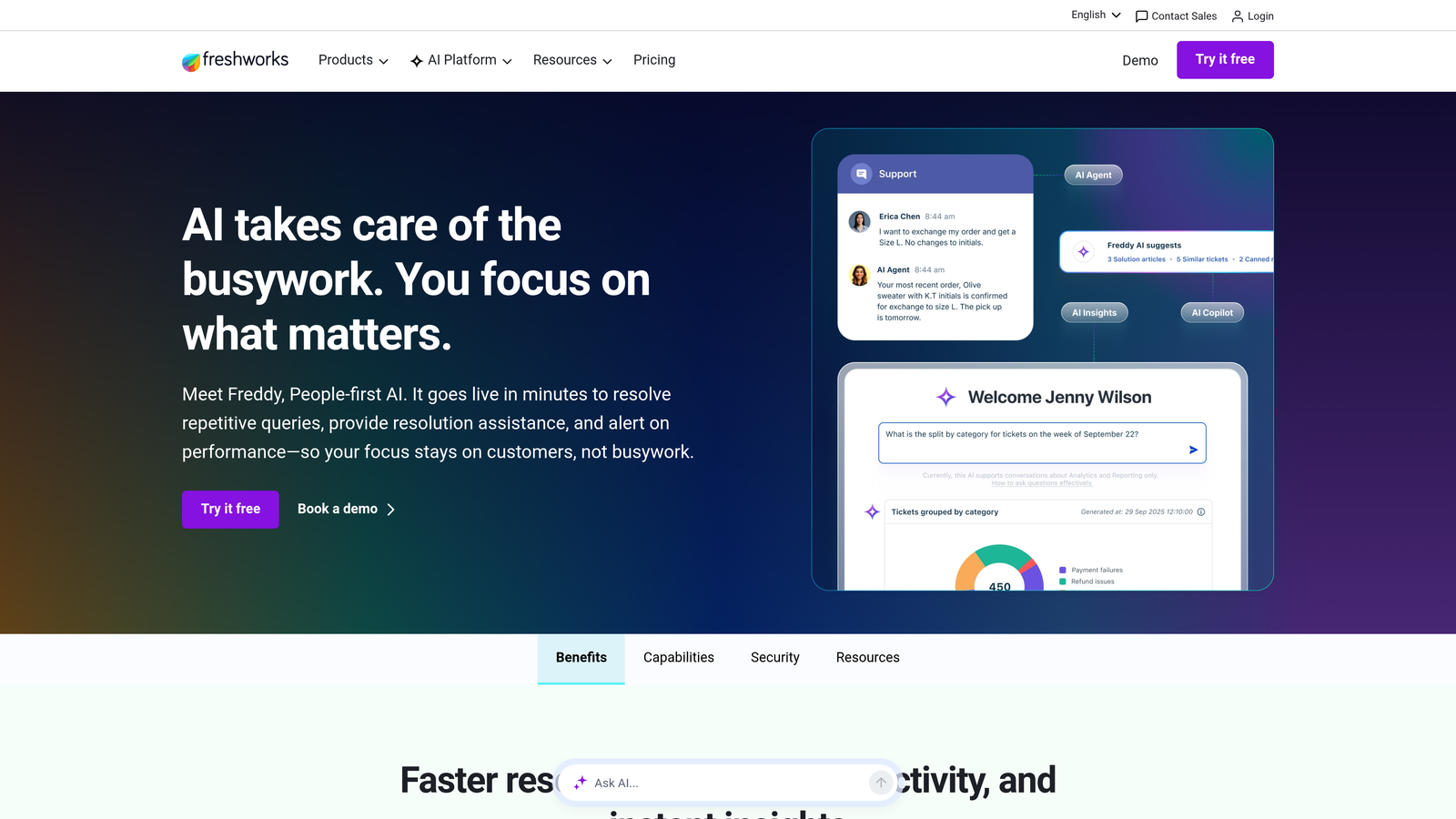
Freshdesk Freddy AI is Freshdesk's native AI layer featuring Freddy Self Service for customer-facing deflection and Freddy Copilot for agent assistance, bundled into Freshdesk plans at various tiers.
Where This Tool Shines
The core appeal of Freddy AI is convenience and cost-efficiency. For teams already paying for Freshdesk, Freddy Self Service activates deflection capabilities without a separate vendor, contract, or integration project. That makes it a practical starting point for teams that want to test AI deflection before committing to a dedicated platform.
Freddy Copilot adds value on the agent side by drafting replies and summarizing tickets, which helps agents work faster on the tickets that do make it through. The combination of self-service deflection and agent assist within a single tool keeps the workflow simple.
Key Features
Freddy Self Service: Conversational bot that suggests articles and handles simple customer queries before escalating to an agent.
Freddy Copilot: Assists agents with reply drafting, ticket summarization, and suggested next steps.
Bundled Pricing: Included in Freshdesk Growth plans and above, reducing the need for additional tool purchases.
Multi-Channel Support: Works across web, mobile, and messaging channels for consistent deflection coverage.
Freddy Insights: Analytics module for tracking support performance trends and identifying deflection opportunities.
Best For
SMB and mid-market teams on Freshdesk who want AI deflection without adopting a new platform. Less suited for teams needing deep customization or AI sophistication beyond what a bundled feature layer provides.
Pricing
Included in Freshdesk Growth plans and above, starting around $15 per agent per month. Advanced Freddy features are available on higher tiers.
5. Forethought
Best for: Enterprise support teams that need modular AI across deflection, triage, agent assist, and analytics.
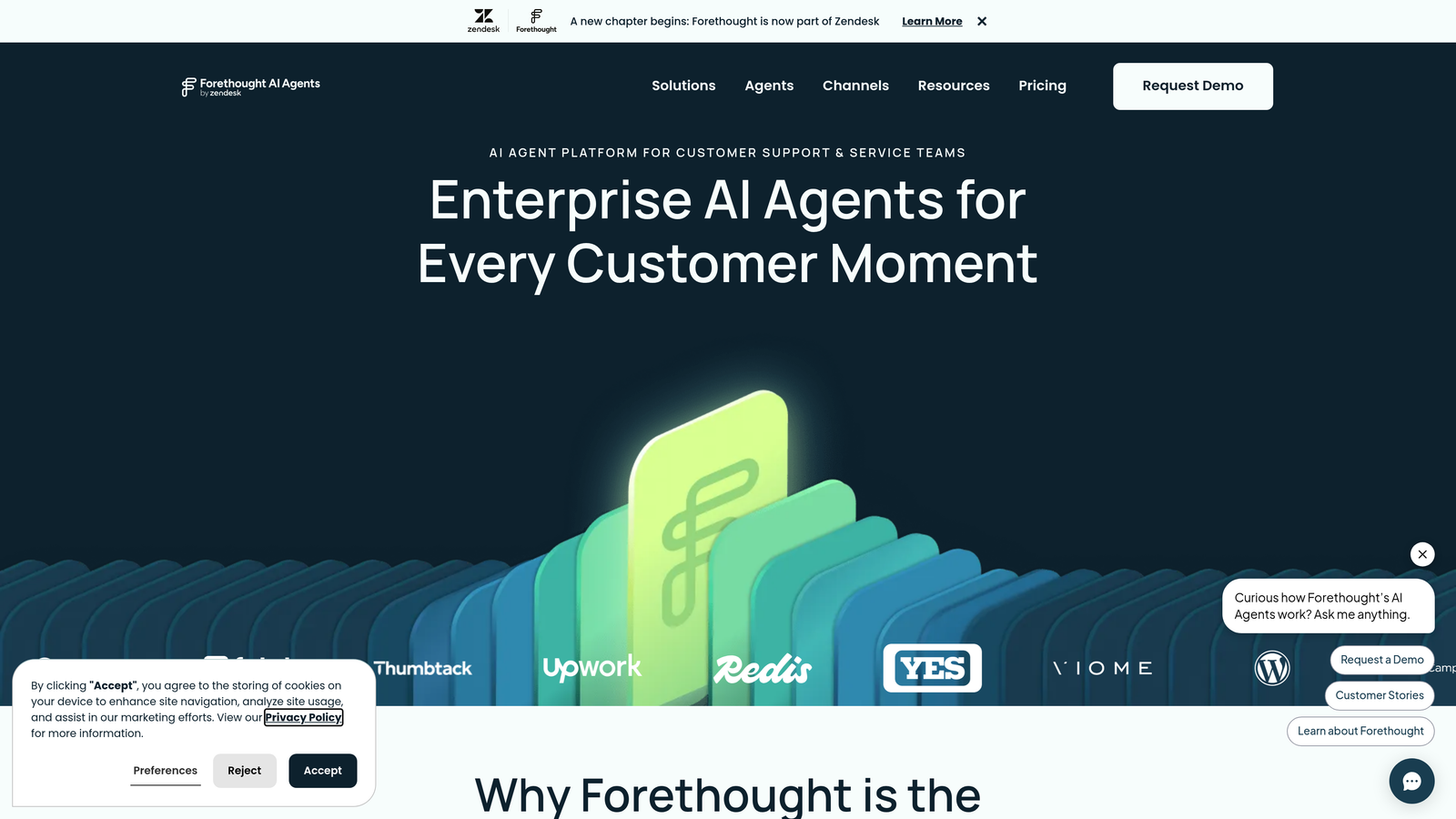
Forethought is an enterprise-focused AI support platform with dedicated modules for deflection, intelligent triage, agent assist, and support analytics, designed to integrate with your existing helpdesk rather than replace it.
Where This Tool Shines
Forethought's modular architecture is its defining characteristic. You can deploy just the deflection module (Solves), just the triage module, or the full platform depending on where your support operation needs the most help. That flexibility makes it appealing for enterprise teams that want to solve specific problems without overhauling their entire stack.
The predictive routing capabilities in the Triage module are particularly well-regarded. Rather than routing tickets by keyword or category alone, Forethought uses AI to predict the best agent or team for a given ticket based on historical patterns, which reduces handle time for tickets that do require human attention.
Key Features
Solves Module: Autonomous ticket deflection via chat and email, handling customer queries before they enter the agent queue.
Triage Module: AI-powered ticket routing and prioritization based on intent, sentiment, and historical resolution patterns.
Assist Module: Provides agents with relevant knowledge and suggested responses at the moment of handling.
Discover Module: Identifies support trends, knowledge gaps, and deflection opportunities from ticket data.
Broad Helpdesk Integrations: Connects with Zendesk, Salesforce, Freshdesk, ServiceNow, and other enterprise platforms.
Best For
Enterprise support organizations that need AI across multiple workflow stages and want to layer it on top of existing helpdesk investments. Modular purchasing allows teams to start with deflection and expand from there.
Pricing
Enterprise pricing, contact Forethought for a quote. Modular purchasing is available, so you're not required to buy the full platform upfront.
6. Tidio Lyro
Best for: SMBs and e-commerce teams that need fast, affordable AI deflection with minimal setup.
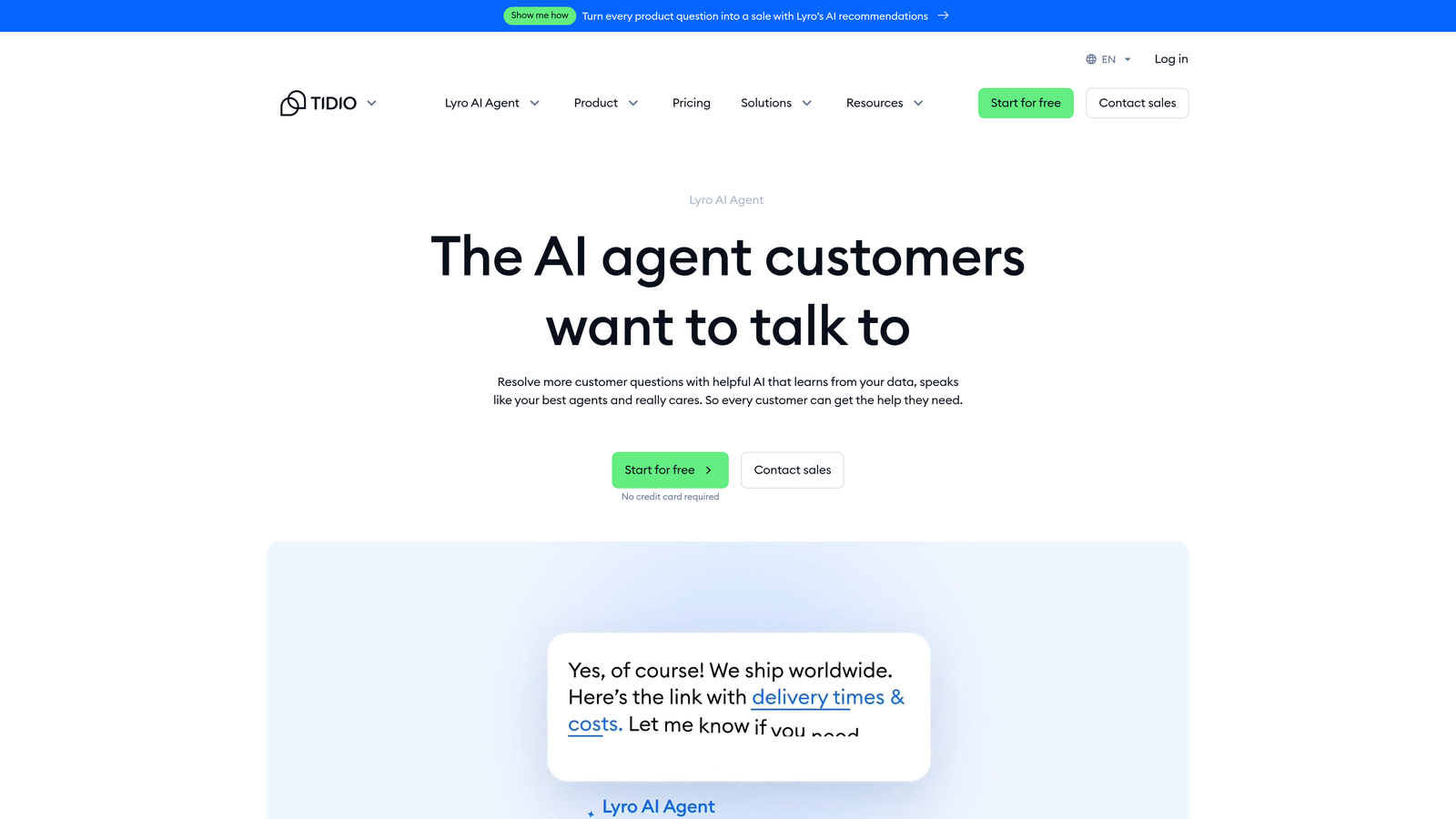
Tidio Lyro is an SMB-friendly conversational AI trained on your support content, designed for fast deployment and autonomous customer conversation handling with live chat fallback.
Where This Tool Shines
Lyro's standout quality is speed of deployment. Many teams can get it operational within hours rather than weeks, which makes it one of the most accessible entry points into AI deflection on this list. For small teams without a dedicated implementation resource, that matters significantly.
The free tier also lowers the barrier to experimentation. Teams can test Lyro's deflection capabilities on real conversations before committing to a paid plan, which is a genuine differentiator in a market where most platforms require upfront commitment.
Key Features
Lyro AI Training: Trained directly on your FAQ content and support documentation without complex configuration.
Automatic Live Chat Fallback: Smoothly hands off to human agents when it can't resolve a query autonomously.
Fast Setup: Typically operational within hours, not weeks, making it accessible for small teams.
Free Tier: Available for low-volume teams to test AI deflection before committing to a paid plan.
E-Commerce Integrations: Connects with Shopify and WooCommerce for product and order-related query deflection.
Best For
SMBs, e-commerce brands, and teams with straightforward support workflows who want fast, affordable AI deflection. Less suited for complex B2B SaaS workflows that require deep product context or multi-system integrations.
Pricing
Free tier available for low-volume use. Lyro AI paid plans start at approximately $29 per month and scale with conversation volume.
7. Kustomer IQ
Best for: High-volume consumer brands that need context-rich deflection powered by full customer history.
Kustomer IQ is the AI capability layer embedded within Kustomer's CRM-native support platform, using full customer history and purchase data to inform deflection and routing decisions.
Where This Tool Shines
Because Kustomer is a CRM-native platform, its AI has access to something most deflection tools don't: a complete picture of who the customer is. Purchase history, previous interactions, subscription status, and customer segment are all available to the AI at the moment of deflection. That context means Kustomer IQ can make smarter decisions about what to offer and when to escalate.
Proactive messaging is another differentiator. Kustomer IQ can reach out to customers before they submit a ticket based on behavioral signals, shifting the support model from reactive to proactive in a way that purely deflection-focused tools can't.
Key Features
CRM-Native AI Context: Accesses full customer purchase and interaction history to inform deflection decisions, not just keyword matching.
Intent-Based Routing: Routes conversations based on detected intent and customer segment, not just topic category.
Proactive Messaging: Initiates outreach to customers based on behavioral triggers before they reach out with an issue.
Unified Customer Timeline: Provides agents with a complete interaction history when AI-to-human handoff occurs.
Automated Conversation Routing: Directs incoming conversations to the right team or workflow without manual intervention.
Best For
High-volume DTC brands and retail companies where customer context is central to support quality. Teams should note that Kustomer has had some platform ownership transitions in recent years, so evaluating long-term roadmap stability is worth including in your assessment.
Pricing
Kustomer IQ is included in Kustomer platform plans, which start at approximately $89 per agent per month.
8. Capacity
Best for: Companies that need a single AI layer for both employee IT support and external customer support.
Capacity is a support automation platform combining AI chatbot, knowledge base, and helpdesk in one, with strong use cases across both internal IT helpdesk and external customer-facing deflection.
Where This Tool Shines
Capacity's dual-use positioning is genuinely unusual in this market. Most deflection tools are built exclusively for external customer support. Capacity handles both employee-facing IT requests and customer-facing support through the same AI layer, which makes it particularly valuable for mid-market companies that are managing both use cases and don't want to run two separate platforms.
The integrated knowledge base and helpdesk ticketing within a single platform also reduces the configuration complexity that comes with stitching together multiple tools. Teams get deflection, escalation, and knowledge management in one place.
Key Features
Dual-Use AI Layer: Handles both internal employee (IT) support and external customer support deflection from a single platform.
AI-Powered Knowledge Base: Surfaces relevant articles and answers through intelligent search rather than manual navigation.
Built-In Helpdesk Ticketing: Manages escalated tickets within the same platform, eliminating the need for a separate helpdesk tool.
Workflow Automation: Automates escalation paths, approval workflows, and routing without manual configuration.
Enterprise Integrations: Connects with Salesforce, Zendesk, Slack, Microsoft Teams, and other enterprise tools.
Best For
Mid-market and enterprise companies managing both IT helpdesk and customer support who want a unified AI platform. Also a strong fit for teams that want to consolidate knowledge base, ticketing, and deflection under a single vendor.
Pricing
Plans start at approximately $49 per month. Enterprise pricing is available for larger deployments.
9. Deflekt.ai
Best for: Teams that love their current helpdesk and want smarter pre-ticket deflection without migrating anything.
Deflekt.ai is a lightweight, helpdesk-agnostic deflection tool that adds an AI layer on top of your existing support system, intercepting tickets before creation by surfacing relevant knowledge base content at the right moment.
Where This Tool Shines
Deflekt.ai solves a specific problem elegantly: stopping tickets before they're created. Rather than managing conversations after they start, it intercepts users at the point of ticket submission and shows them relevant articles or answers. If the content resolves their question, they never submit. If it doesn't, the ticket goes through as normal.
That focused approach also means there's no platform migration, no new helpdesk to learn, and minimal configuration overhead. For teams that have invested in a well-organized knowledge base and are happy with their current helpdesk, Deflekt.ai adds meaningful deflection value without disrupting anything that's already working.
Key Features
Pre-Ticket Deflection: Surfaces relevant articles and answers before the user completes a ticket submission, intercepting requests at the source.
Helpdesk-Agnostic Integration: Works with Zendesk, Freshdesk, Help Scout, Front, and others without requiring a platform switch.
Zero Migration Required: Adds an AI deflection layer on top of your existing setup rather than replacing it.
Simple Configuration: Minimal setup overhead compared to full-platform AI tools.
Usage-Based Pricing: Transparent pricing model that scales with deflection volume rather than seat count.
Best For
Teams with a solid knowledge base and an existing helpdesk they're happy with, who want to reduce ticket volume without adopting a new platform. Not a full support platform, but a focused, effective deflection add-on.
Pricing
Starts at approximately $49 per month and scales with deflection volume.
Which Tool Is Right for Your Team?
The right intelligent ticket deflection software depends less on which tool has the longest feature list and more on where your team is starting from and where you need to go.
If you're a B2B SaaS team that needs AI-first deflection with product context, continuous learning, and deep integrations across your business stack, Halo AI is built specifically for that use case. Page-aware agents, auto bug ticket creation, and business intelligence signals make it more than a deflection tool: it's a support intelligence platform.
If you're already committed to a major helpdesk platform, the native options are compelling for their convenience. Intercom Fin is the strongest choice for Intercom users, Zendesk AI covers the full enterprise workflow for Zendesk Suite customers, and Freshdesk Freddy AI gives Freshdesk teams a cost-effective starting point without adding a new vendor.
For enterprise teams that need modular AI across deflection, triage, and agent assist layered onto an existing helpdesk, Forethought is purpose-built for that complexity. Kustomer IQ is the standout option when customer purchase history and CRM context are central to your deflection strategy.
SMBs and e-commerce teams should look at Tidio Lyro for fast, affordable deployment. Capacity is the right call when you need a single AI layer for both IT and customer support. And Deflekt.ai is ideal for teams that want smarter pre-ticket deflection without touching their existing helpdesk setup.
Your support team shouldn't scale linearly with your customer base. Let AI agents handle routine tickets, guide users through your product, and surface business intelligence while your team focuses on complex issues that need a human touch. See Halo in action and discover how continuous learning transforms every interaction into smarter, faster support.