9 Best Intelligent Ticket Resolution Systems for B2B Teams in 2026
Intelligent ticket resolution systems use AI to automatically understand, route, and resolve support tickets — reducing triage time and improving response rates for B2B teams. This guide evaluates the 9 strongest platforms available in 2026 across resolution accuracy, integration depth, learning capabilities, and scalability.
 Matt PattoliFounder13 min read
Every support team reaches a breaking point. Ticket volume climbs, response times slip, and agents spend more time triaging than actually solving problems. Intelligent ticket resolution systems change that equation by using AI to understand, route, and resolve tickets automatically, often before a human ever needs to get involved.
This list covers the strongest platforms available in 2026, evaluated on resolution accuracy, integration depth, learning capabilities, and how well they scale with growing B2B teams. Whether you're running a lean startup support operation or managing thousands of tickets per month on Zendesk or Intercom, there's a fit here.
Each tool is assessed on its own merits. Halo AI is listed first because it was built specifically for this use case, but the other tools are genuinely strong options depending on your stack and priorities.
1. Halo AI
Best for: B2B SaaS teams that want AI-first ticket resolution built from the ground up, not bolted onto a legacy helpdesk.
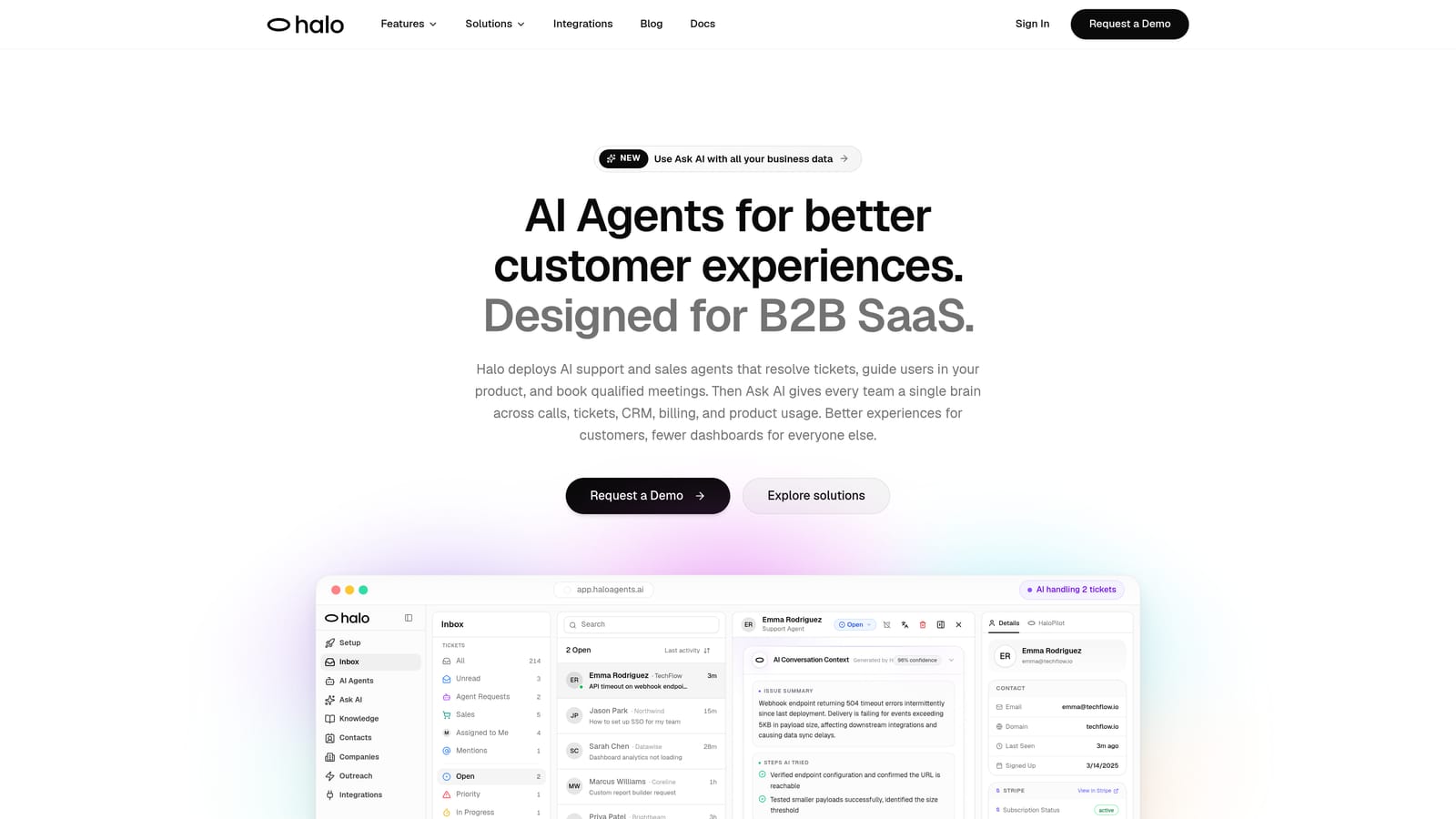
Halo AI is a purpose-built AI support platform that resolves tickets, guides users through your product, and surfaces business intelligence, all from a single AI-first architecture.
Where This Tool Shines
Most AI support tools are layers added on top of existing helpdesks. Halo was designed differently: resolution is the core architecture, not a feature. That distinction matters when you're trying to achieve genuine autonomous resolution rather than slightly faster agent-assisted workflows.
The page-aware context is particularly notable. Halo's chat widget sees what the user sees on-screen, which means the AI can offer guidance specific to the exact page or state a user is on, rather than generic help center responses. For product-led SaaS companies, this closes a significant gap between documentation and real-time user context.
Key Features
Page-Aware AI Agent: The widget reads on-screen context to deliver guidance relevant to where the user actually is in your product.
Continuous Learning: Resolution accuracy improves with every interaction, so the system gets smarter as your product evolves.
Auto Bug Ticket Creation: Automatically generates structured bug reports from support conversations and routes them to Linear or equivalent tools.
Smart Inbox with Business Intelligence: Surfaces customer health signals, revenue anomalies, and churn indicators directly from support data, going well beyond standard ticket analytics.
Live Agent Handoff: Escalates to human agents with full conversation context preserved, so nothing gets lost in the transition.
Deep Integration Stack: Connects to Linear, Slack, HubSpot, Intercom, Stripe, Zoom, PandaDoc, and Fathom, linking support to your entire business stack.
Best For
Product teams and B2B SaaS companies that want support to function as a source of business intelligence, not just a cost center. Especially strong for teams managing product complexity where contextual, in-product guidance matters more than generic deflection.
Pricing
Pricing is available on request and requires a demo. Typical for AI platforms at this tier targeting B2B teams with meaningful ticket volume.
2. Zendesk AI
Best for: Enterprise teams already running on Zendesk who want AI capabilities without migrating their entire support stack.
Zendesk AI is the native AI layer embedded across the Zendesk Suite, covering intelligent triage, intent detection, and agent assist for high-volume support operations.
Where This Tool Shines
If your team is already running on Zendesk, the AI layer integrates directly into your existing workflows, routing rules, and macros. There's no migration, no parallel system to manage, and no retraining your team on a new interface. For large enterprise teams, that operational continuity is genuinely valuable.
The Agent Copilot feature is well-executed: it drafts replies, suggests next-best actions, and pulls relevant knowledge articles in real time. It won't replace human agents, but it meaningfully reduces the cognitive load of handling high ticket volumes.
Key Features
Intelligent Triage: Detects intent and sentiment on incoming tickets to route them accurately without manual sorting.
Auto-Tagging and Macro Suggestions: Reduces repetitive agent actions by automating classification and suggesting relevant response templates.
Bot-Based Deflection: Handles common queries before they reach a human agent, reducing overall ticket volume.
Agent Copilot: Drafts replies and surfaces next-best-action recommendations directly within the agent workspace.
Native Workflow Integration: AI features slot into existing Zendesk routing rules, SLAs, and views without configuration overhead.
Best For
Enterprise support teams with large existing Zendesk deployments who want to layer AI onto current workflows rather than rebuild from scratch. Less compelling for teams evaluating helpdesks fresh.
Pricing
AI features are available on Suite Professional and above, starting around $115 per agent per month. Verify current pricing at zendesk.com as plans evolve.
3. Freshdesk Freddy AI
Best for: Mid-market teams using the Freshworks ecosystem who want unified AI across support, ITSM, and CRM without adding a separate platform.
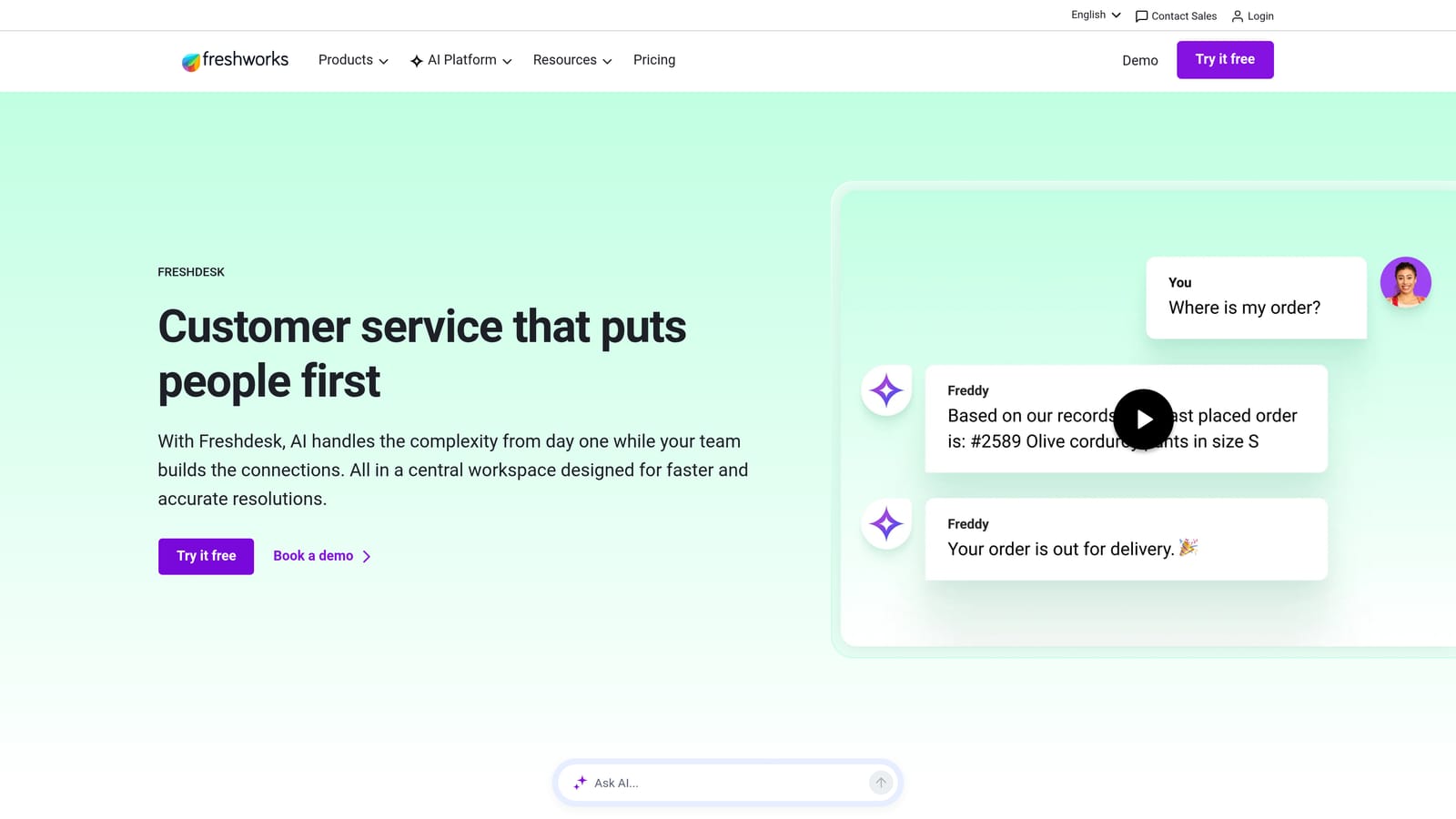
Freshdesk Freddy AI is Freshworks' cross-product AI layer, covering self-service deflection, agent copilot capabilities, and analytics across the Freshworks product suite.
Where This Tool Shines
Freddy's strength is ecosystem coherence. If your team uses Freshdesk for support, Freshservice for ITSM, and Freshsales for CRM, Freddy AI spans all three. That unified AI layer means consistent intelligence across departments rather than siloed tools with separate learning loops.
The pricing relative to enterprise alternatives also makes Freddy worth serious consideration for mid-market teams. You get meaningful AI capabilities at a price point that doesn't require CFO sign-off on every renewal.
Key Features
Freddy Self Service: Bot-based deflection that handles common queries before they reach the agent queue.
Freddy Copilot: Assists agents with reply drafting, thread summarization, and suggested responses.
Freddy Insights: AI-driven analytics that surface patterns in ticket data and support performance.
Cross-Product AI: Spans Freshdesk, Freshservice, and Freshsales for teams using multiple Freshworks products.
Competitive Mid-Market Pricing: Accessible price points compared to Salesforce or Zendesk enterprise tiers.
Best For
Teams already invested in the Freshworks ecosystem. Also a solid entry point for growing mid-market companies that want AI-assisted support without enterprise-level complexity or cost.
Pricing
Freddy AI features are available on Growth plans and above, with pricing varying by product and tier. Verify current pricing at freshworks.com.
4. Intercom Fin
Best for: SaaS product companies with well-maintained help centers who want conversational AI resolution with a pay-per-performance pricing model.
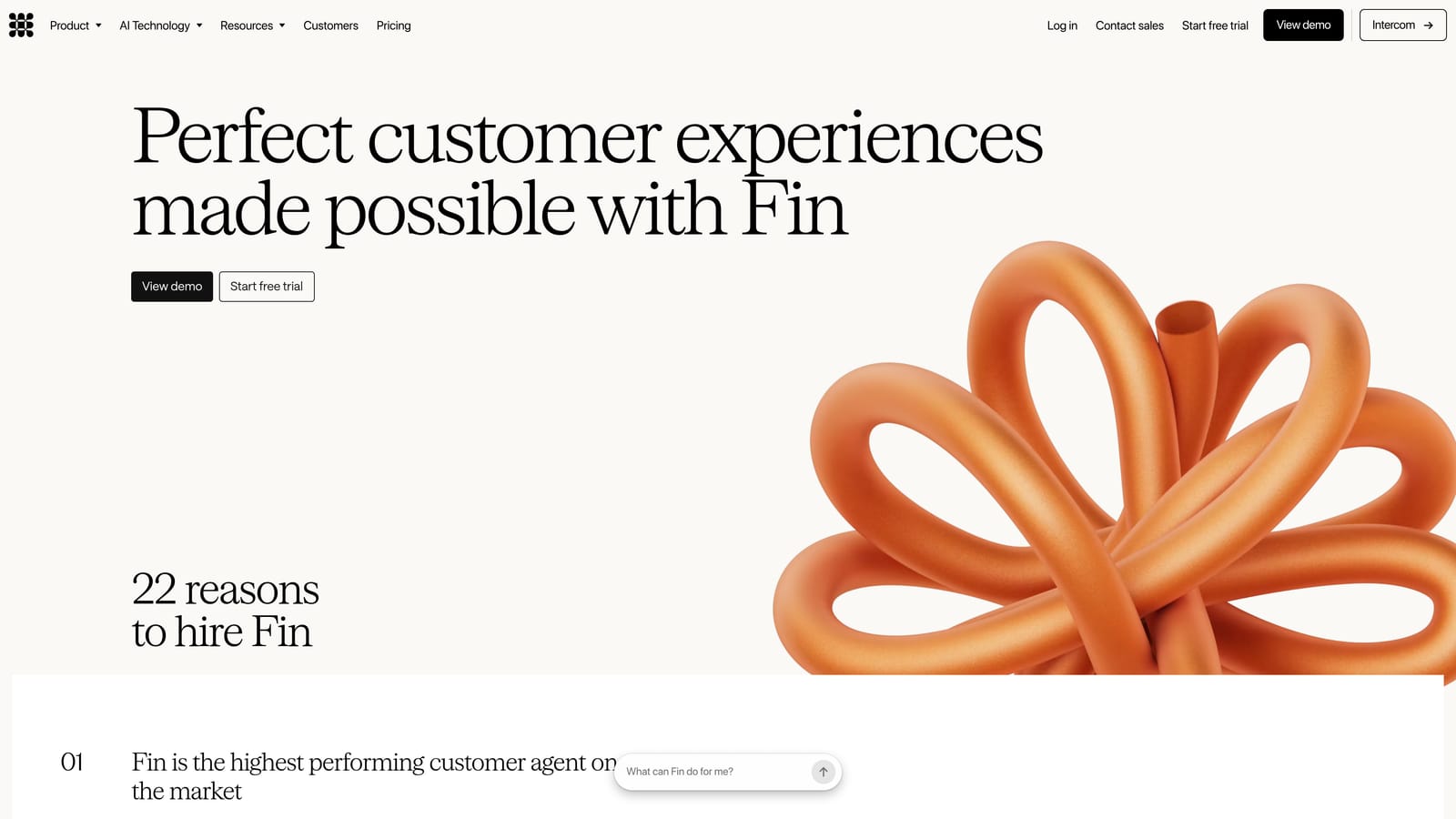
Intercom Fin is Intercom's AI agent that resolves tickets conversationally by drawing on your existing help content as its knowledge base.
Where This Tool Shines
Fin's approach to resolution is notably conversational. Rather than routing users to articles, it synthesizes answers from your documentation and delivers them in natural dialogue. For companies with thorough help centers, this translates to resolution quality that genuinely competes with human agents on common query types.
The pay-per-resolution pricing model is worth highlighting because it aligns cost directly with value. You're paying for outcomes, not seat licenses, which changes the ROI calculation significantly for teams evaluating AI deflection.
Key Features
Multi-Source Knowledge Ingestion: Pulls from help articles, PDFs, and other documentation sources to build its resolution knowledge base.
Conversational Resolution: Handles complex, multi-step queries through natural dialogue rather than static article suggestions.
Pay-Per-Resolution Pricing: Cost scales with actual resolutions delivered, not with agent seat count.
Seamless Inbox Handoff: Escalates to the Intercom inbox with full context when Fin can't resolve a query.
Help Center Integration: Deeply integrated with Intercom's existing content and inbox infrastructure.
Best For
Product companies already using Intercom with strong help documentation. Resolution quality is closely tied to documentation quality, so teams with thin or outdated content will see limited results.
Pricing
Fin is priced per resolution on top of existing Intercom seat costs. Verify current rates at intercom.com, as the model has evolved through recent product updates.
5. Salesforce Einstein for Service
Best for: Enterprise organizations where support, sales, and customer success all run on Salesforce and need AI resolution informed by full CRM context.
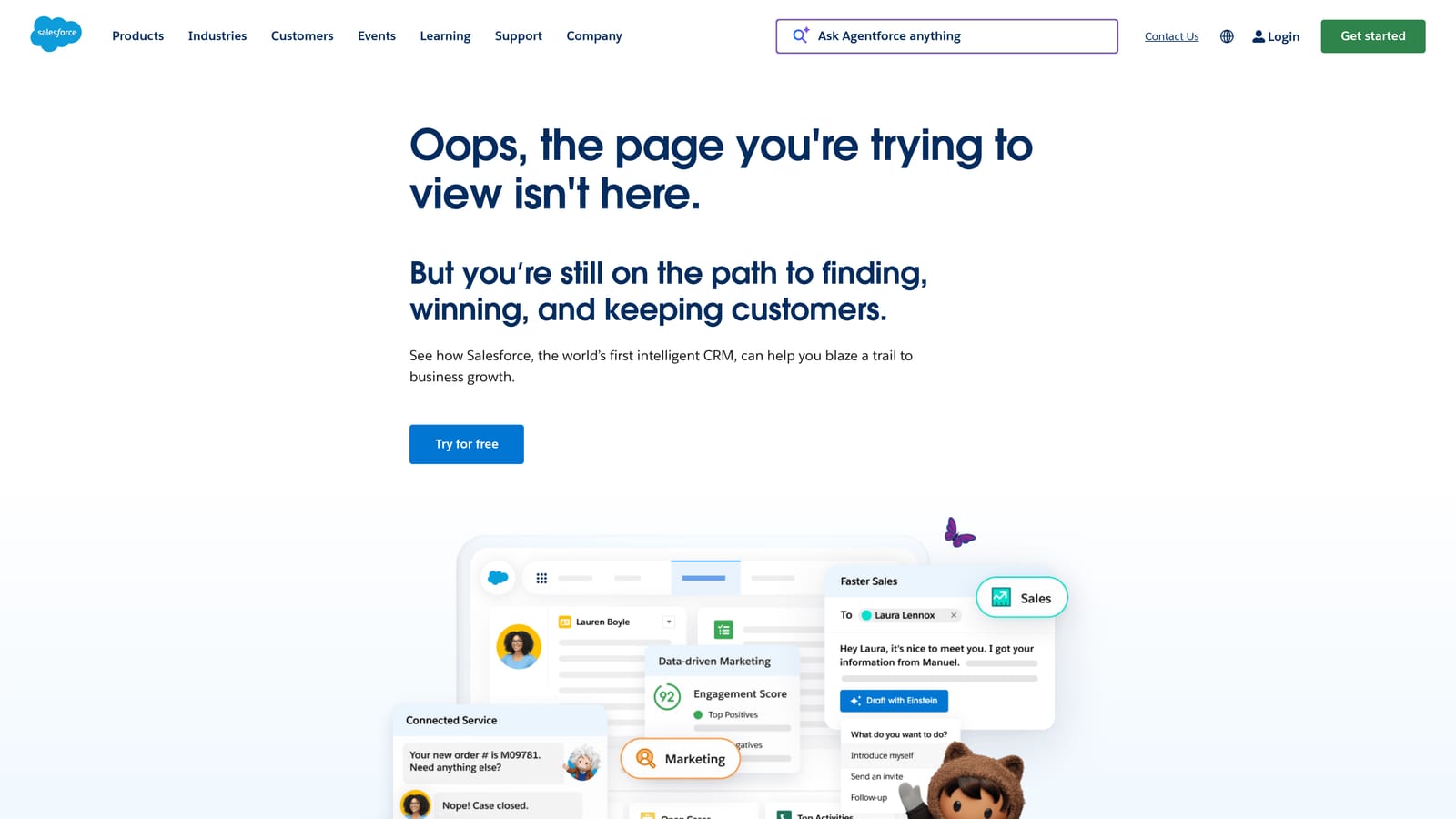
Salesforce Einstein for Service is the AI layer embedded in Salesforce Service Cloud, providing case classification, next-best-action guidance, and increasingly autonomous resolution through Agentforce.
Where This Tool Shines
The defining advantage here is CRM context. Every resolution decision Einstein makes is informed by the customer's complete history across sales, marketing, and service interactions. That level of context is difficult to replicate with standalone support tools and genuinely changes what's possible in complex B2B support scenarios.
Agentforce, Salesforce's newer autonomous agent product, extends Einstein into more proactive resolution workflows. For enterprises already committed to the Salesforce platform, this creates a coherent path toward greater automation without introducing a new vendor.
Key Features
Case Classification and Routing: Automatically classifies and routes cases using full CRM history as context.
Next-Best-Action: Recommends the most effective agent response or action based on case data and historical patterns.
Knowledge Article Surfacing: Surfaces relevant articles in real time based on case content as agents work.
Agentforce Integration: Extends toward more autonomous resolution workflows for enterprises ready to move beyond agent-assist.
Unified Cross-Functional View: Connects support interactions to the full customer record across sales, marketing, and service.
Best For
Large enterprises where Salesforce is the system of record across multiple departments. Overkill for teams not already on the Salesforce platform; transformative for those who are.
Pricing
Service Cloud Enterprise starts around $165 per user per month. Verify current pricing and available AI add-ons at salesforce.com.
6. Tidio Lyro
Best for: SMBs and growing teams that need conversational AI resolution without developer resources or enterprise-level budgets.
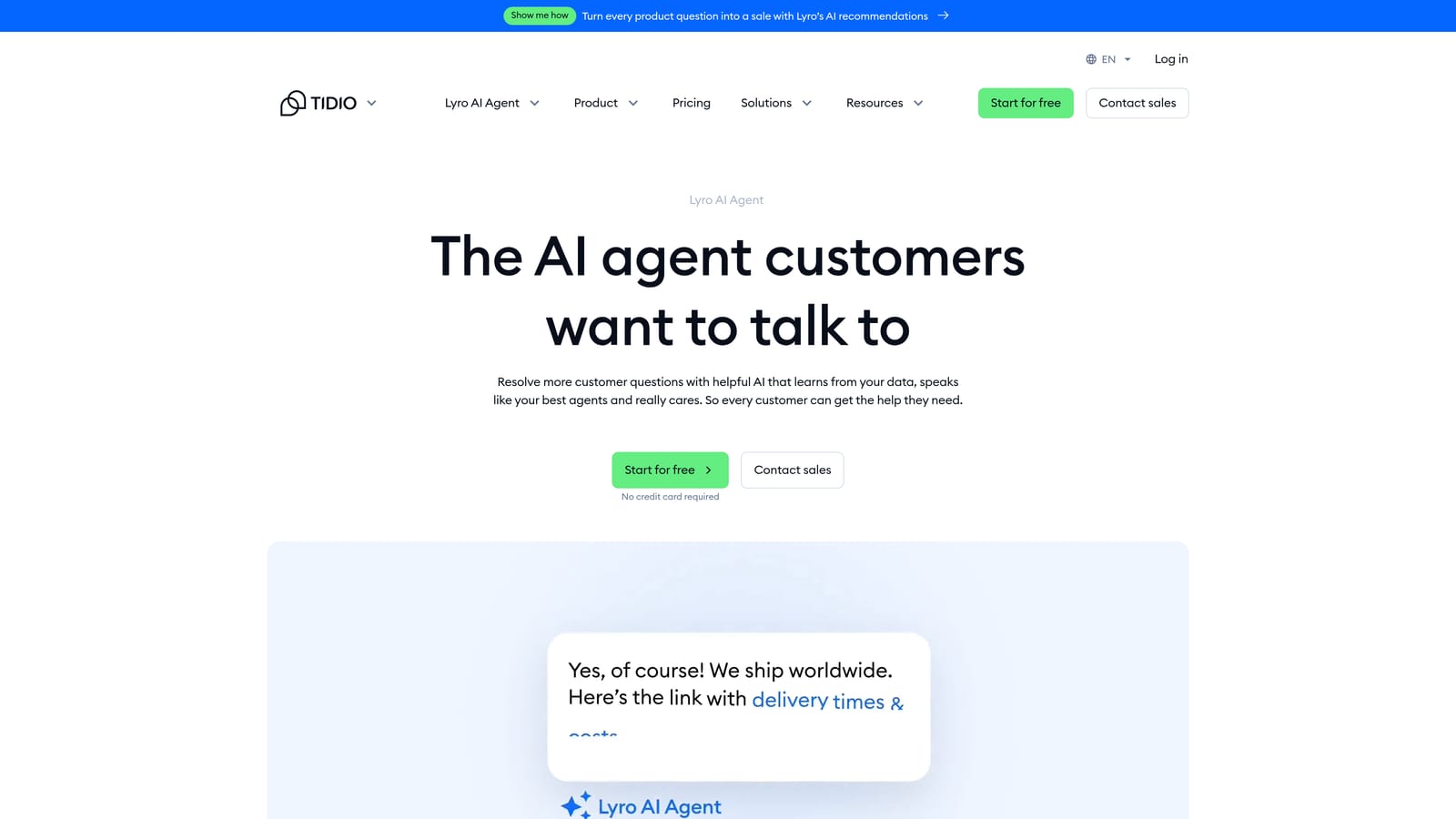
Tidio Lyro is a conversational AI tool trained on your company's content and designed to deploy quickly without technical overhead.
Where This Tool Shines
Lyro's appeal is accessibility. Most enterprise-tier AI tools require implementation resources, integration work, and meaningful configuration before they deliver value. Lyro is designed to be operational quickly, with non-technical teams able to handle the setup themselves.
For SMBs that are outgrowing manual support but aren't ready for enterprise platforms, Lyro fills a real gap. It handles a defined set of conversation types autonomously and escalates cleanly when queries fall outside its scope, which is exactly the right behavior for a team that can't afford mishandled escalations.
Key Features
Content-Trained AI: Lyro learns from your existing help content to answer questions accurately without extensive manual configuration.
Fast Deployment: Teams can go live without developer involvement, reducing time-to-value significantly.
Autonomous Handling with Clean Escalation: Resolves within its scope and escalates edge cases without dropping context.
SMB-Accessible Pricing: Significantly more affordable than enterprise alternatives, with a pricing model that makes sense for smaller ticket volumes.
Non-Technical Onboarding: Designed for support managers and ops teams, not engineers.
Best For
Small to mid-sized teams, particularly in e-commerce and SaaS, that need meaningful AI deflection without the budget or resources required for enterprise platforms.
Pricing
Lyro is available as an add-on to Tidio's base plans, which start around $29 per month. Verify current add-on pricing at tidio.com.
7. Help Scout AI
Best for: Teams that want AI to reduce agent effort without removing humans from the final decision on every customer response.
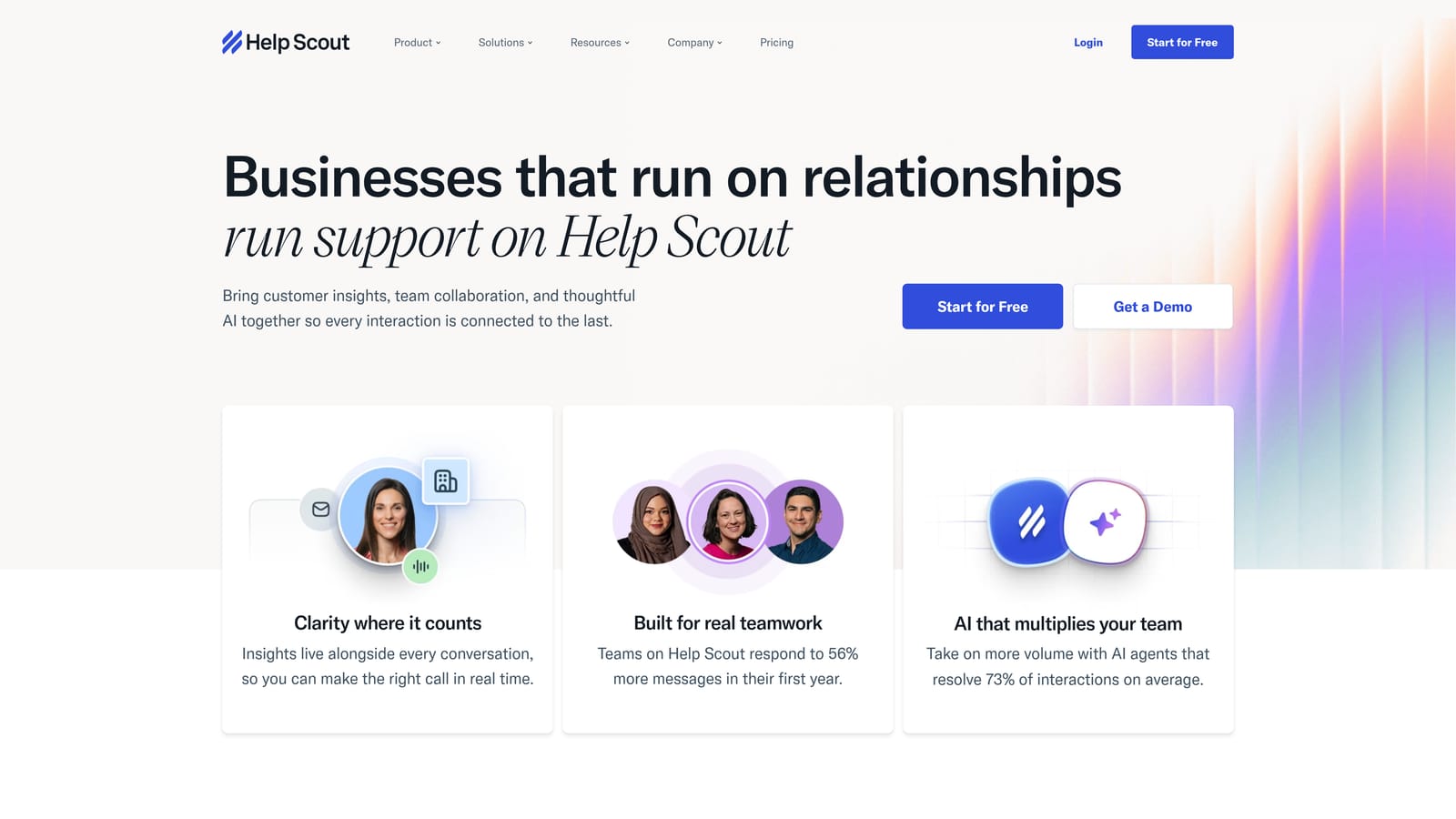
Help Scout is an AI-assisted support platform built around a human-first philosophy, where AI drafts and assists but agents always decide what gets sent.
Where This Tool Shines
Help Scout occupies a specific and deliberate position: AI as co-pilot, not replacement. If your team has built its brand on high-quality, relationship-driven support, Help Scout's approach protects that without sacrificing efficiency. Agents get AI-drafted replies they can edit and send, rather than automated responses going out without review.
This is a meaningful distinction for B2B teams where a poorly worded automated response to a high-value account can create real problems. Help Scout keeps humans accountable for every customer interaction while still cutting the time it takes to respond.
Key Features
AI Drafts: Generates complete reply suggestions for agents to review, edit, and send.
AI Summarize: Condenses long conversation threads so agents can get up to speed without reading every message.
AI Assist: Rewrites and improves agent-drafted replies for clarity and tone before sending.
Human-First Architecture: Every response is reviewed by a human agent; no autonomous sending without approval.
Collaborative Interface: Clean, relationship-focused workspace designed for team collaboration on complex accounts.
Best For
Teams where relationship quality and brand voice matter as much as resolution speed. Not the right choice if autonomous resolution is the primary goal; ideal if you want AI to make your agents better rather than replace them.
Pricing
Plans start around $22 per user per month, with AI features available on higher tiers. Verify current plan details at helpscout.com.
8. Zoho Desk Zia
Best for: Teams running on the Zoho ecosystem who want AI-powered sentiment analysis, escalation prediction, and routing intelligence without adding external tools.
Zoho Desk Zia is Zoho's AI assistant embedded in Zoho Desk, offering sentiment analysis, escalation prediction, and deep integration with Zoho CRM and Zoho One.
Where This Tool Shines
Zia's escalation prediction capability stands out in this category. Most AI support tools focus on deflection and routing; Zia also surfaces tickets that are at risk of escalating before they do, giving agents a window to intervene proactively. For teams managing accounts where escalations carry real business consequences, that's a genuinely useful signal.
The Zoho ecosystem integration is the other key strength. If your team is already using Zoho CRM, Zoho One, or other Zoho products, Zia adds AI intelligence across that stack without requiring a separate vendor relationship or data sync configuration.
Key Features
Sentiment Analysis: Flags incoming tickets by emotional tone to help agents prioritize responses appropriately.
Escalation Prediction: Identifies tickets likely to escalate based on patterns in the conversation and customer history.
Auto-Tagging and Classification: Automatically categorizes tickets for accurate routing without manual intervention.
Response Suggestions: Surfaces historically effective replies based on similar past tickets.
Zoho Ecosystem Integration: Connects directly with Zoho CRM and the broader Zoho One suite for unified context.
Best For
Teams already operating within the Zoho ecosystem. Strong value for the price point, but less compelling as a standalone choice for teams not already using Zoho products.
Pricing
Zia is available on Zoho Desk's Enterprise plan, which starts around $40 per agent per month. Verify current pricing at zoho.com.
9. Kustomer IQ
Best for: High-volume B2B teams managing complex, long-lifecycle customer relationships where full customer timeline context is critical to resolution quality.
Kustomer IQ is the AI layer within Kustomer's CRM-native support platform, using the complete customer timeline to inform every routing and resolution decision.
Where This Tool Shines
Kustomer's architecture is built around a unified customer timeline: every interaction, purchase, support ticket, and behavior signal is consolidated into a single view. When IQ makes routing and resolution decisions, it's drawing on that full history, not just the current ticket. For teams managing customers with multi-year relationships, multiple products, or subscription complexity, that context changes resolution quality significantly.
Backed by Meta's AI investment, Kustomer benefits from infrastructure and research that most independent support platforms can't match. Teams evaluating enterprise-tier options should put it on the shortlist alongside Salesforce and Zendesk.
Key Features
Unified Customer Timeline: Every AI decision is informed by the customer's complete history across all interactions and channels.
Intelligent Routing: Routes tickets based on customer history, agent expertise, and relationship context rather than just ticket content.
AI-Powered Deflection: Handles self-service resolution before tickets reach the human queue.
Proactive Conversation Triggers: Initiates outreach based on customer behavior signals before issues become tickets.
Meta AI Infrastructure: Benefits from significant ongoing AI investment and research through Meta's ownership.
Best For
Enterprise and high-growth B2B teams managing complex customer relationships with long lifecycles, multiple touchpoints, or subscription-based models where churn context matters as much as resolution speed.
Pricing
Enterprise-tier pricing, available on request at kustomer.com. Expect pricing in line with other enterprise support platforms.
Making the Right Choice for Your Team
The most important question isn't which tool has the best feature list. It's whether you want AI built into your support foundation from day one, or AI layered on top of an existing helpdesk. That architectural choice shapes everything else.
Here's a practical breakdown by use case to help you narrow the field:
Best for SMBs and lean teams: Tidio Lyro and Help Scout are the clearest fits. Lyro gets you autonomous deflection at an accessible price point with minimal setup. Help Scout gives you AI-assisted efficiency while keeping humans in control of every response.
Best for enterprise teams: Zendesk AI and Salesforce Einstein are the established leaders. Zendesk wins if your team is already on the platform and wants AI without migration. Salesforce wins if support, sales, and success all run on the same CRM and you need resolution informed by full customer context.
Best for Freshworks and Zoho ecosystems: Freddy AI and Zia are the natural choices for teams already invested in those platforms. Both add meaningful AI intelligence without introducing a new vendor or data sync complexity.
Best for SaaS product teams: Halo AI and Intercom Fin are the strongest options for product-led companies that want AI resolution tied directly to product context. Fin excels when you have strong documentation and want conversational resolution with pay-per-performance pricing. Halo is the better fit when you want AI-first architecture, page-aware context, autonomous bug routing, and business intelligence built into the support layer from the ground up.
Your support team shouldn't scale linearly with your customer base. Let AI agents handle routine tickets, guide users through your product, and surface business intelligence while your team focuses on complex issues that need a human touch. See Halo in action and discover how continuous learning transforms every interaction into smarter, faster support.