9 Best Intelligent Virtual Agent Software Platforms in 2026
This guide evaluates the 9 best Intelligent Virtual Agent Software platforms available in 2026, comparing them on autonomy, integration depth, learning capability, and fit for B2B SaaS and product teams. It helps support leaders move beyond basic chatbots and choose an IVA that resolves tickets autonomously, scales with growing demand, and delivers measurable business intelligence.
 Grant CooperFounder12 min read
B2B support teams are under real pressure right now. Ticket volumes keep climbing, customer expectations keep rising, and simply hiring more agents isn't a sustainable answer. Intelligent virtual agent (IVA) software bridges that gap by deploying AI that resolves tickets autonomously, guides users through your product, escalates to humans when needed, and gets smarter with every single interaction.
Unlike basic chatbots that follow rigid scripts, modern IVAs understand context, integrate deeply with your tech stack, and handle complex multi-step conversations. The category has matured considerably, and the difference between a good IVA and a great one often comes down to how much it learns, how well it connects to your broader business stack, and how gracefully it hands off to humans when needed.
Here are the top intelligent virtual agent platforms available in 2026, evaluated on autonomy, integration depth, learning capability, and real-world fit for B2B SaaS and product teams.
1. Halo AI
Best for: B2B SaaS teams that want support to generate product and revenue intelligence, not just deflect tickets.
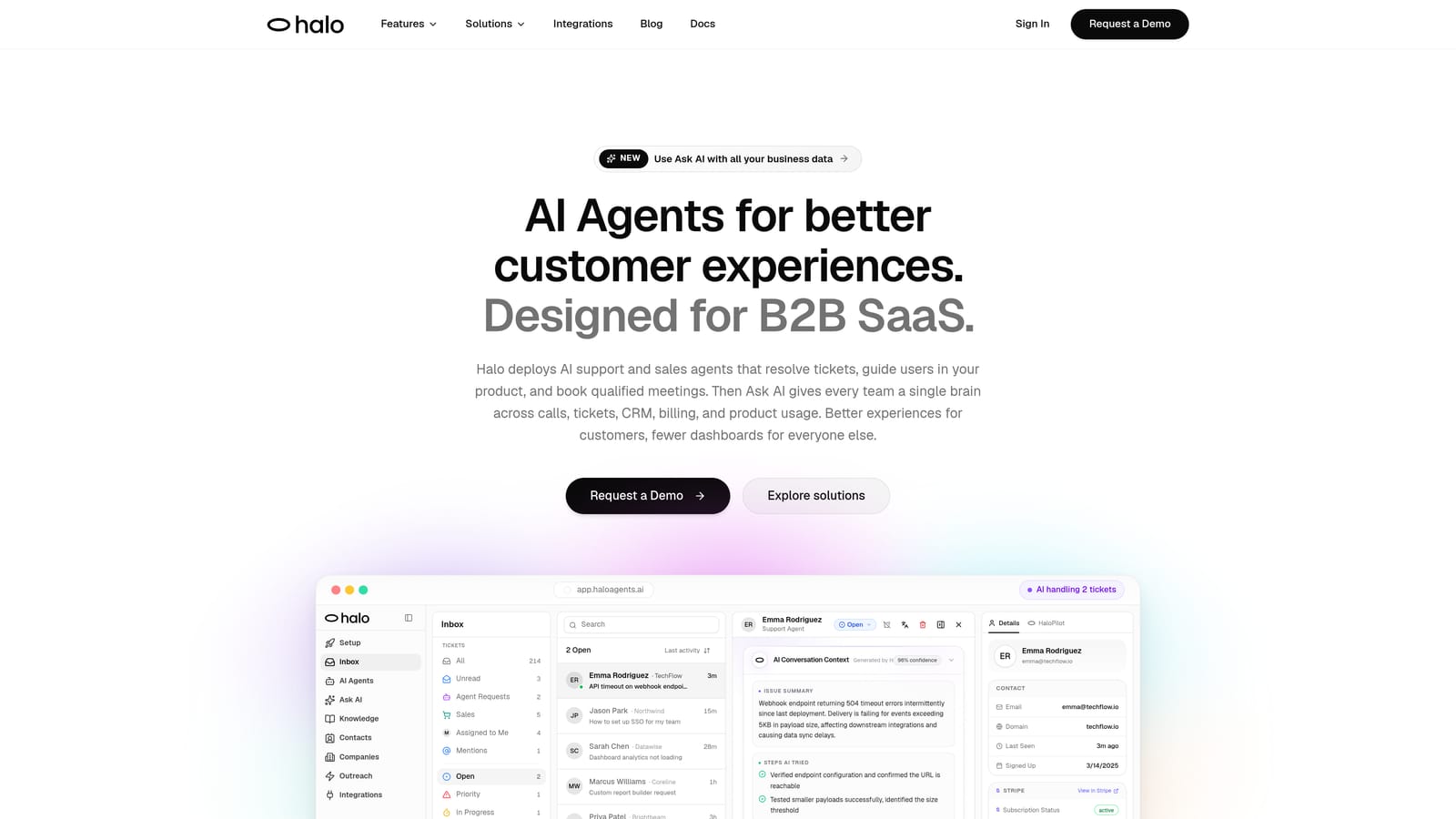
Halo AI is an AI-first customer support platform built from the ground up around intelligent agents, not bolted onto an existing helpdesk.
Where This Tool Shines
What separates Halo from most IVA platforms is its page-aware architecture. The AI agent sees exactly what the user sees in your product, which means its guidance is contextually accurate rather than generic. It's not pulling a canned response from a knowledge base article; it's responding to where the user actually is and what they're actually doing.
Beyond ticket resolution, Halo's smart inbox surfaces business intelligence signals that most support tools completely miss. Customer health indicators, revenue anomalies, and churn signals emerge from support conversations and get routed to the right teams. For product-led SaaS companies, that turns support from a cost center into a genuine intelligence function.
Key Features
Page-Aware Chat Widget: The AI sees what the user sees, enabling contextual and accurate in-product guidance rather than generic knowledge base responses.
Continuous Learning: Every resolved interaction feeds back into the model, so Halo gets measurably smarter over time without manual retraining.
Smart Inbox with Business Intelligence: Surfaces customer health signals, revenue anomalies, and churn indicators from support conversations directly to relevant teams.
Auto Bug Ticket Creation: Automatically identifies product issues from support conversations and routes bug tickets to Linear or your engineering stack.
Live Agent Handoff: Escalates to human agents with full conversation context preserved, so customers never have to repeat themselves.
Deep Integration Stack: Connects natively to Linear, Slack, HubSpot, Intercom, Stripe, Zoom, PandaDoc, and Fathom.
Best For
Product-led SaaS companies and B2B teams building AI-first support operations. Particularly strong for teams that want support interactions to generate product insights, flag revenue risks, and feed engineering workflows, not just close tickets.
Pricing
Contact for pricing. A demo is available at haloagents.ai.
2. Intercom Fin
Best for: Teams already running on Intercom who want generative AI without switching platforms.
Intercom Fin is Intercom's native generative AI agent, deeply embedded in the Messenger and inbox ecosystem.
Where This Tool Shines
Fin's biggest advantage is how naturally it fits inside the Intercom environment. If your team already lives in Intercom for messaging, inbox management, and customer conversations, Fin adds AI resolution capability without any new interfaces to learn or additional platforms to manage.
The generative AI layer draws answers from your existing help center articles and conversation history, which means setup is relatively fast for teams with a well-maintained knowledge base. Handoff to human agents happens within the same Intercom interface, keeping the workflow clean.
Key Features
Generative AI Answers: Draws from help center content and past conversations to generate contextually relevant responses.
Native Intercom Integration: Works directly within Intercom Messenger, inbox, and workflow tools with no separate platform required.
Human Handoff: Escalates to agents within the same Intercom interface, preserving conversation continuity.
Multilingual Support: Handles queries across multiple languages without additional configuration.
Usage-Based Pricing: Charges per resolution, which aligns cost to value but can scale unpredictably at high volumes.
Best For
Teams already invested in the Intercom ecosystem who want to add AI resolution without changing their support stack. Less compelling as a standalone IVA for teams not already using Intercom.
Pricing
Usage-based, priced per resolution. Check intercom.com for current rates, and model your expected resolution volume before committing.
3. Zendesk Advanced AI
Best for: Zendesk-native teams wanting AI augmentation across their existing agent workspace.
Zendesk Advanced AI is a native AI layer built into the Zendesk agent workspace, covering both customer-facing deflection and agent productivity tools.
Where This Tool Shines
For teams deeply embedded in Zendesk, Advanced AI is the path of least resistance. It adds intent detection, sentiment analysis, and automated triage without requiring agents to change how they work. Macro suggestions and next-best-action recommendations appear directly in the workspace they already use every day.
The customer-facing bot handles deflection across email, chat, and messaging channels, and the AI-powered triage means tickets get to the right queue faster. It's an incremental improvement to an existing Zendesk operation rather than a ground-up AI transformation.
Key Features
Intelligent Triage: Detects intent, sentiment, and language to route tickets accurately before a human touches them.
AI-Suggested Macros: Recommends response templates and next-best actions to agents in real time.
Customer-Facing Bot: Handles deflection across chat, email, and messaging without leaving the Zendesk environment.
No New Interface: Everything surfaces inside the existing Zendesk agent workspace, minimizing adoption friction.
Multi-Channel Coverage: Works across email, chat, and messaging in a unified view.
Best For
Organizations with significant Zendesk investments who want AI augmentation rather than a platform replacement. Teams seeking full autonomous resolution from scratch may find the capabilities more incremental than transformative.
Pricing
Available as an add-on to Zendesk Suite plans. Pricing varies by tier; check zendesk.com for current details.
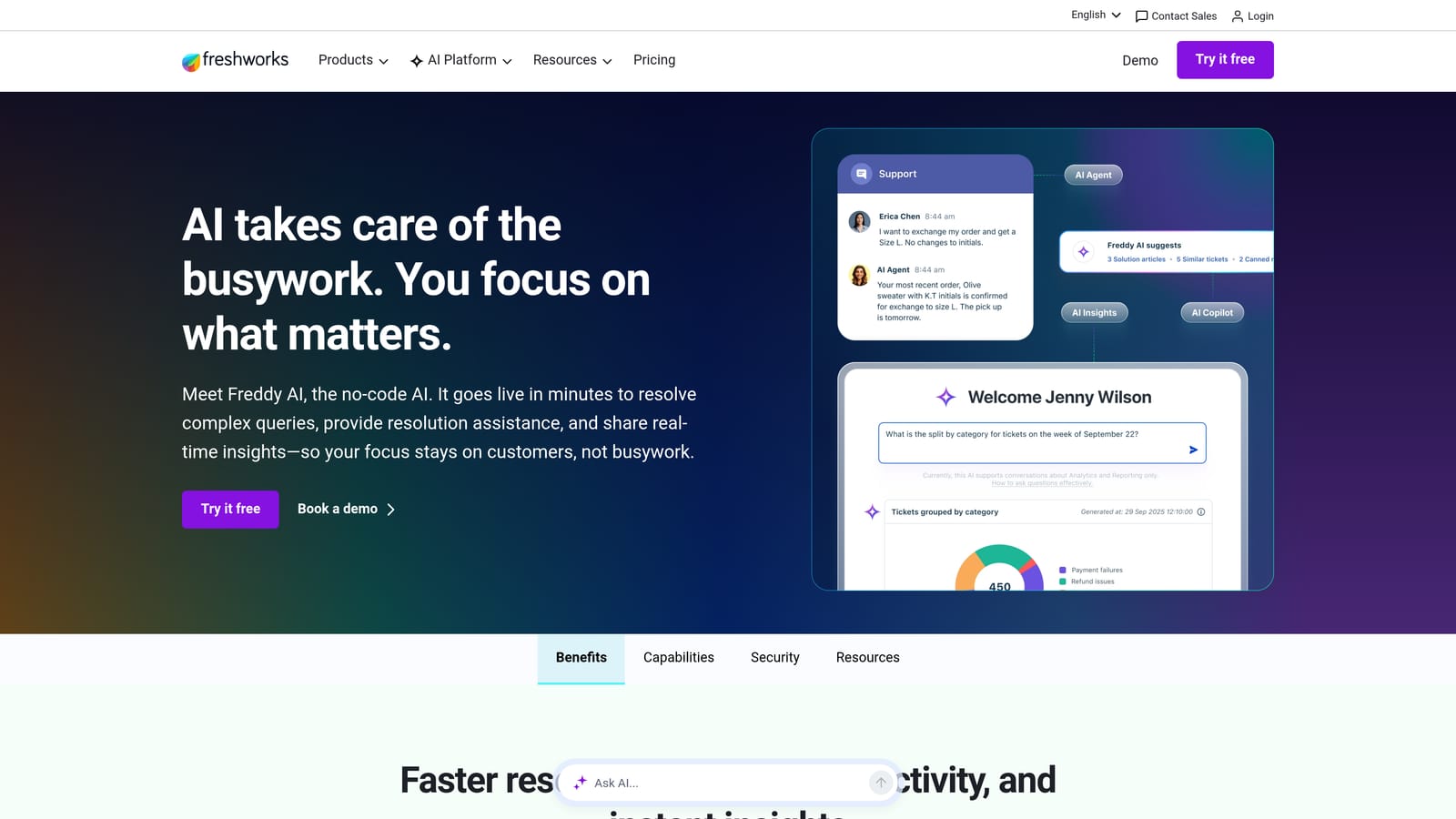
4. Freshdesk Freddy AI
Best for: SMB and mid-market teams on Freshworks who want both customer-facing deflection and agent productivity tools.
Freshdesk Freddy AI is Freshworks' two-mode AI suite covering both customer-facing automation and internal agent assistance.
Where This Tool Shines
Freddy's dual-mode approach is genuinely useful. Freddy Self Service handles customer-facing deflection, while Freddy Copilot assists agents with suggested responses, ticket summaries, and productivity shortcuts. Teams get both sides of the AI equation without stitching together separate tools.
Freshworks also tends to price more accessibly than Zendesk or Salesforce equivalents, making Freddy a realistic option for growing teams that aren't yet at enterprise scale but need real AI capabilities.
Key Features
Freddy Self Service: Customer-facing bot trained on your knowledge base for ticket deflection before agents are involved.
Freddy Copilot: Real-time agent assist with suggested responses, summaries, and productivity recommendations.
Historical Training: Learns from your existing knowledge base and ticket history for company-specific accuracy.
Native Freshworks Integration: Works seamlessly across Freshdesk and Freshservice without additional connectors.
Accessible Pricing: Generally more affordable than enterprise-tier competitors, with Copilot available as an add-on.
Best For
SMB and mid-market teams running on Freshworks who want AI across both customer deflection and agent productivity. A practical choice for growing teams not yet ready for enterprise-tier platforms.
Pricing
Included in select Freshworks plans; Copilot is available as an add-on. Check freshworks.com for current plan details.
5. Salesforce Agentforce
Best for: Enterprise organizations running their business on Salesforce who need autonomous AI across service, sales, and operations.
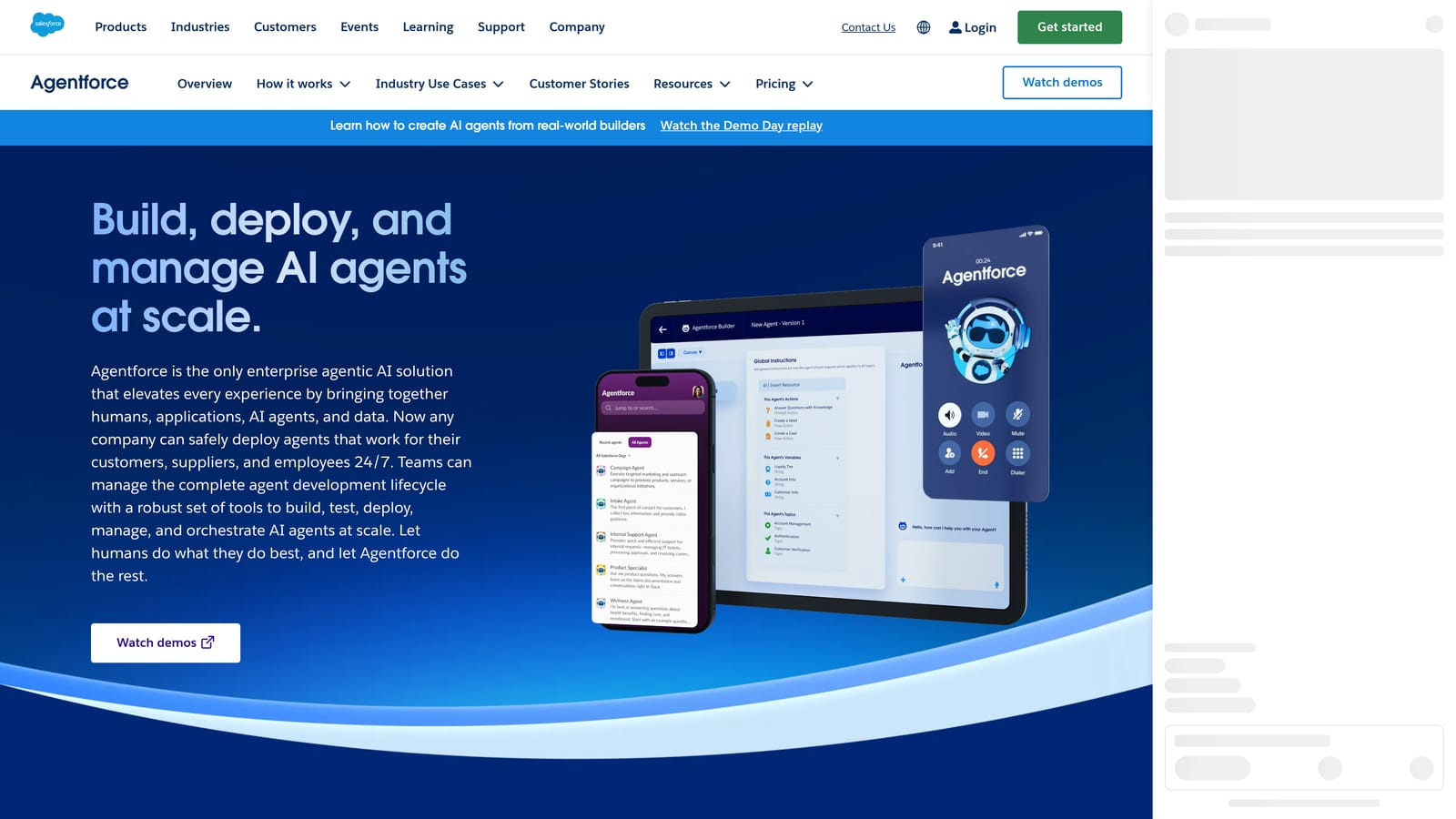
Salesforce Agentforce is Salesforce's autonomous AI agent platform, deeply integrated with Service Cloud, Sales Cloud, and the full Salesforce data model.
Where This Tool Shines
Agentforce's core advantage is the depth of data it can act on. Because it's grounded in the full Salesforce CRM, every AI interaction has access to case history, account data, order records, and customer attributes. That context enables genuinely personalized resolutions rather than generic answers pulled from a knowledge base.
The platform can take autonomous actions across cases, accounts, and orders, not just answer questions. For enterprises with complex service workflows already modeled in Salesforce, Agentforce can automate multi-step processes that would otherwise require significant human effort.
Key Features
Autonomous Actions: Takes real actions across Salesforce cases, accounts, and orders, not just generates text responses.
CRM-Grounded Intelligence: Every resolution is informed by the full Salesforce customer data model for personalized outcomes.
Multi-Channel Deployment: Operates across chat, email, voice, and messaging within the Salesforce ecosystem.
Pre-Built Agent Templates: Accelerates deployment with templates for common support and service workflows.
Enterprise Security: Inherits Salesforce's enterprise-grade compliance and security controls.
Best For
Large enterprises already running on Salesforce that need AI automation deeply embedded in their existing data model and workflows. Implementation complexity and cost make this less accessible for smaller teams.
Pricing
Consumption-based pricing. Contact Salesforce directly for enterprise quotes at salesforce.com.
6. Forethought Solve
Best for: Support teams with rich ticket history who want AI that reflects their specific resolution patterns, not generic responses.
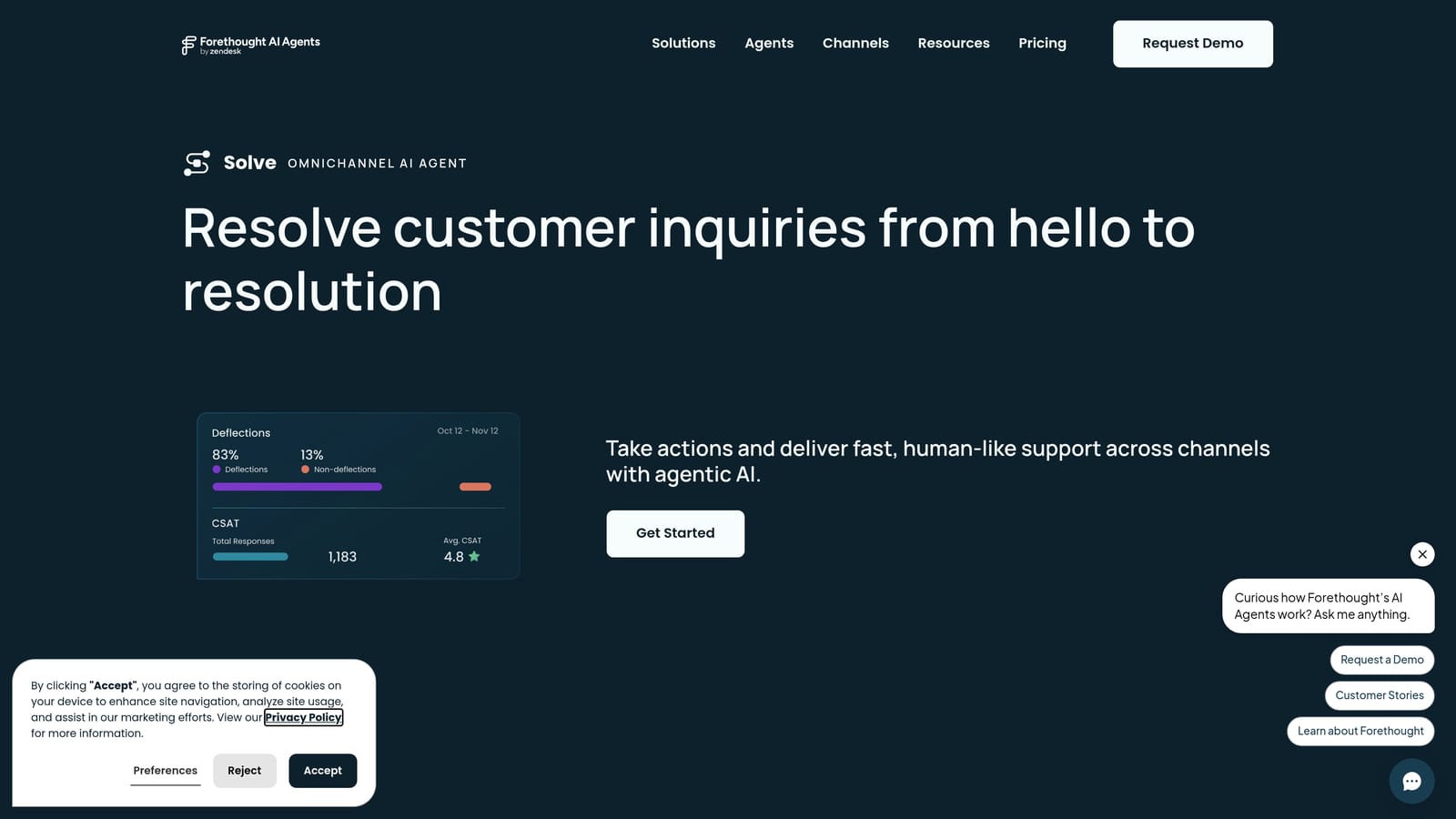
Forethought Solve is a generative AI support agent trained on a company's historical ticket data, with a strong emphasis on resolution quality over raw deflection volume.
Where This Tool Shines
Most AI support tools train on generic knowledge bases. Forethought's approach is to train on your historical ticket data, which means the AI learns how your team actually resolves issues, not just what your documentation says. For teams with years of ticket history, that produces noticeably more accurate and contextually appropriate responses.
The emphasis on CSAT over deflection rate is also a meaningful philosophical difference. Forethought is designed to prioritize answer quality, which tends to produce better customer outcomes than platforms optimizing purely for ticket containment.
Key Features
Historical Ticket Training: Trains on your actual resolved tickets for company-specific, pattern-matched answers.
Helpdesk Integrations: Connects with Zendesk, Salesforce, Freshdesk, and other major platforms without replacing them.
Triage and Routing: Classifies and routes tickets intelligently alongside autonomous resolution.
CSAT-Focused Design: Optimizes for answer quality and customer satisfaction rather than raw deflection metrics.
Workflow Automation: Handles multi-step ticket handling beyond single-turn responses.
Best For
Teams with substantial ticket history who want AI that reflects their specific support patterns. Also a strong fit for teams frustrated with generic AI responses that don't match their product's nuances.
Pricing
Custom pricing. Contact Forethought directly at forethought.ai for a quote.
7. Ada
Best for: High-volume, consumer-facing support operations needing strong multilingual coverage and a no-code builder.
Ada is an established no-code IVA platform with a visual automation builder, broad channel coverage, and multilingual support across 50+ languages.
Where This Tool Shines
Ada's no-code visual builder is genuinely accessible to non-technical teams. Support managers and operations leads can build, modify, and deploy automation flows without engineering involvement, which dramatically reduces the time between identifying a gap and shipping a fix.
The multilingual depth is also a real differentiator. For companies supporting customers across multiple regions and languages, Ada's 50+ language support means you're not building and maintaining separate flows for each market.
Key Features
No-Code Visual Builder: Non-technical teams can build and manage automation flows without engineering resources.
50+ Language Support: Native multilingual capability across a wide range of languages without separate configuration.
Omnichannel Coverage: Deploys across web chat, SMS, voice, and social messaging channels.
CRM and Helpdesk Integrations: Connects with major CRM and helpdesk platforms for data-informed responses.
AI Personalization: Uses customer data to tailor responses and conversation paths.
Best For
Consumer-facing brands with high support volumes and multilingual requirements. Ada is particularly strong for e-commerce and broad consumer support; teams needing deep B2B SaaS workflow automation may find it less specialized.
Pricing
Custom pricing. Contact Ada at ada.cx for a quote.
8. Tidio Lyro
Best for: Startups and small businesses that need IVA capabilities quickly and affordably, without a complex implementation.
Tidio Lyro is Tidio's AI agent layer combining live chat and conversational AI in a fast-to-deploy, accessible package designed for smaller teams.
Where This Tool Shines
Lyro's standout quality is speed to value. For teams that need to go from zero to a working AI support layer quickly, Lyro can typically be live within hours rather than weeks. The combined live chat and AI interface also means you're not managing two separate systems for human and automated conversations.
The pricing is genuinely accessible for early-stage teams. Most enterprise IVA platforms price at a level that makes them impractical for startups, and Lyro fills that gap meaningfully for companies that need real AI capability on a constrained budget.
Key Features
Conversational AI: Trained on your FAQ and knowledge base content for fast, accurate responses to common queries.
Combined Live Chat and AI: Single platform for both human and AI-handled conversations, no separate tools required.
Fast Deployment: Typically live within hours, not weeks, with minimal technical setup.
Affordable Entry Pricing: Accessible to startups and small teams that can't justify enterprise-tier costs.
Common Integrations: Connects with Shopify, WordPress, and a range of standard SaaS tools.
Best For
Startups, small businesses, and early-stage SaaS teams that need IVA functionality without enterprise complexity or pricing. Teams that outgrow Lyro will likely need to migrate to a more capable platform as their support volume and workflow complexity increases.
Pricing
Lyro AI starts at approximately $29/month. Check tidio.com for current plan details.
9. Kustomer
Best for: Subscription SaaS and DTC brands where full customer context, including purchase history and prior interactions, directly affects resolution quality.
Kustomer is a CRM-native customer service platform with AI automation built around a unified customer timeline, giving every interaction complete historical context.
Where This Tool Shines
Kustomer's defining characteristic is the unified customer timeline. Every conversation, whether handled by AI or a human agent, has immediate access to purchase history, prior interactions, subscription status, and customer attributes. That context depth enables AI resolutions that feel genuinely personalized rather than transactional.
For subscription businesses where a customer's tenure, plan, or recent behavior directly shapes how you should respond, that context isn't optional. Kustomer's CRM-native architecture makes it available automatically, without agents having to look it up across multiple systems.
Key Features
Unified Customer Timeline: Every conversation surfaces complete purchase history, prior interactions, and customer attributes in a single view.
Context-Grounded AI: Automation layer uses rich customer context to personalize resolutions rather than relying on generic knowledge base answers.
Omnichannel Coverage: Handles email, chat, SMS, social, and voice in a unified platform.
Proactive Workflows: Triggers support actions based on customer behavior signals, not just inbound requests.
Deep CRM Data Model: Particularly well-suited for subscription SaaS and DTC use cases with complex customer data structures.
Best For
Subscription SaaS companies and DTC brands where customer history, purchase data, and behavioral context are central to delivering quality support. Less optimized for teams that don't have rich customer data to draw from.
Pricing
Starts at approximately $89/user/month. Check kustomer.com for current pricing and plan options.
Which Platform Is Right for Your Team?
The right intelligent virtual agent platform depends heavily on where you're starting from and what you need AI to actually do for your business.
Here's a quick-reference guide by use case:
Building AI-first support for a B2B SaaS product: Halo AI. The page-aware context, continuous learning, and business intelligence signals make it the strongest fit for product-led teams that want support to generate insights, not just close tickets.
Already running on Intercom: Intercom Fin. The native integration removes friction and adds generative AI without changing your existing workflow.
Deeply invested in Zendesk: Zendesk Advanced AI. The best way to add AI augmentation to an existing Zendesk operation without a platform migration.
SMB or mid-market on Freshworks: Freshdesk Freddy AI. Accessible pricing with solid dual-mode coverage across deflection and agent productivity.
Enterprise on Salesforce: Salesforce Agentforce. The deepest CRM-grounded AI for organizations already running their business on the Salesforce platform.
Quality-focused teams with rich ticket history: Forethought Solve. Trains on your actual resolved tickets for company-specific accuracy and CSAT-optimized responses.
High-volume multilingual consumer support: Ada. The no-code builder and 50+ language support make it the strongest choice for broad, multilingual consumer-facing operations.
Startups and early-stage teams on a budget: Tidio Lyro. Fast to deploy, affordable, and gets you working AI support without enterprise complexity.
Subscription SaaS or DTC with deep customer data: Kustomer. The unified customer timeline gives every AI interaction the context needed for genuinely personalized resolutions.
Your support team shouldn't scale linearly with your customer base. Let AI agents handle routine tickets, guide users through your product, and surface business intelligence while your team focuses on complex issues that need a human touch. See Halo in action and discover how continuous learning transforms every interaction into smarter, faster support.