9 Best Machine Learning Customer Support Tools in 2026
This guide ranks the 9 best machine learning customer support tools of 2026, evaluating each on ML capability depth, integration flexibility, deployment ease, and real-world utility for B2B and SaaS teams — helping you choose whether you're upgrading a legacy helpdesk or building an AI-native support operation from scratch.
 Matt PattoliFounder14 min read
Machine learning has fundamentally changed what customer support software can do. Instead of routing tickets based on rigid rules or making agents hunt through knowledge bases manually, modern ML-powered tools can predict intent, automate resolutions, surface insights, and continuously improve without anyone rewriting a single workflow.
But not all tools use ML the same way. Some bolt AI onto legacy helpdesk infrastructure. Others are built AI-first, with machine learning woven into every layer of the product. The difference shows up in resolution rates, escalation quality, and how fast the system gets smarter over time.
This list covers the best machine learning customer support tools available in 2026, evaluated on depth of ML capability, integration flexibility, ease of deployment, and real-world utility for B2B and SaaS teams. Whether you're replacing a legacy helpdesk, augmenting your existing stack, or building an AI-native support operation from scratch, there's a fit here for you. For context on how AI-native tools compare to traditional platforms, see our Zendesk vs AI support platform breakdown.
1. Halo AI
Best for: B2B and SaaS teams that want an AI-native support platform with deep business intelligence.
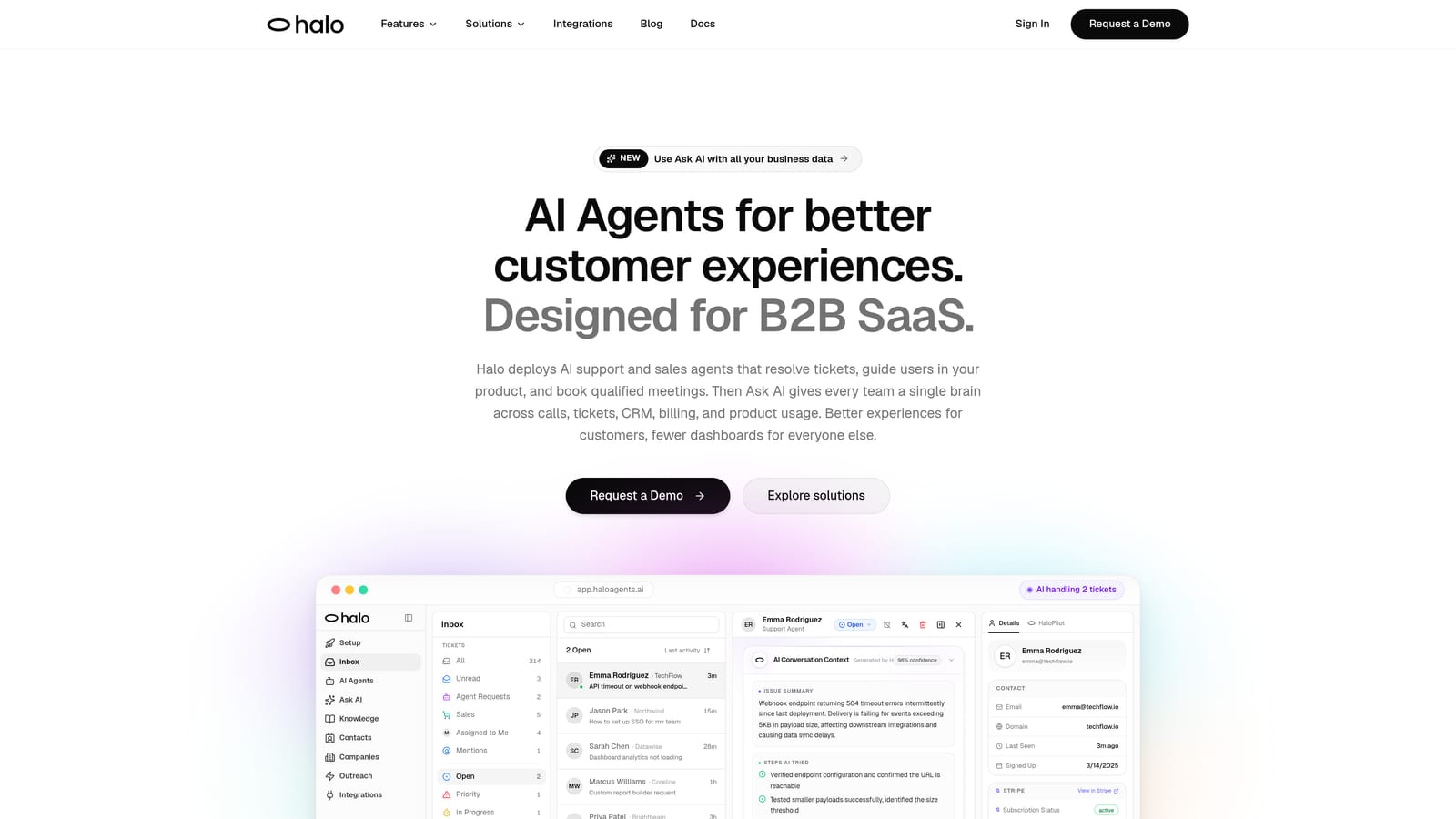
Halo AI is an AI-first customer support platform built from the ground up with machine learning at its core, not layered on top of legacy infrastructure.
Where This Tool Shines
What separates Halo from most tools on this list is its page-aware context. The AI agent actually sees what the user sees, enabling it to provide visual guidance specific to the exact screen or workflow the customer is on. That level of contextual awareness isn't something you can retrofit onto a traditional helpdesk.
Halo also goes beyond support into business intelligence territory. Its smart inbox surfaces customer health signals, revenue flags, and anomaly detection, turning your support queue into a source of strategic insight. And because the system learns continuously from every resolved interaction, it gets smarter without requiring manual retraining or workflow updates.
Key Features
Page-Aware AI Agents: The agent sees the user's current screen and delivers contextual, visual guidance relevant to their exact situation.
Continuous Learning: Every resolved ticket improves the model automatically, with no manual retraining required.
Auto Bug Ticket Creation: Detected issues are automatically routed as bug tickets directly to Linear, closing the loop between support and engineering.
Smart Inbox with Business Intelligence: Surfaces customer health signals, revenue flags, and anomaly detection beyond standard support metrics.
Live Agent Handoff: Complex issues escalate to human agents with full conversation context preserved, so nothing gets repeated.
Deep Integrations: Connects natively with Slack, HubSpot, Intercom, Stripe, Zoom, PandaDoc, and Fathom across the modern SaaS stack.
Best For
Halo is best suited for B2B SaaS companies that want more than ticket deflection. If you need an AI layer that also informs product decisions, flags at-risk accounts, and integrates across your entire business stack without requiring a helpdesk migration, this is a strong fit. Teams scaling support without scaling headcount will find the continuous learning architecture particularly valuable.
Pricing
Contact for pricing. A demo is available at haloagents.ai.
2. Intercom
Best for: Messaging-first teams that want an LLM-powered AI agent within a mature messenger infrastructure.
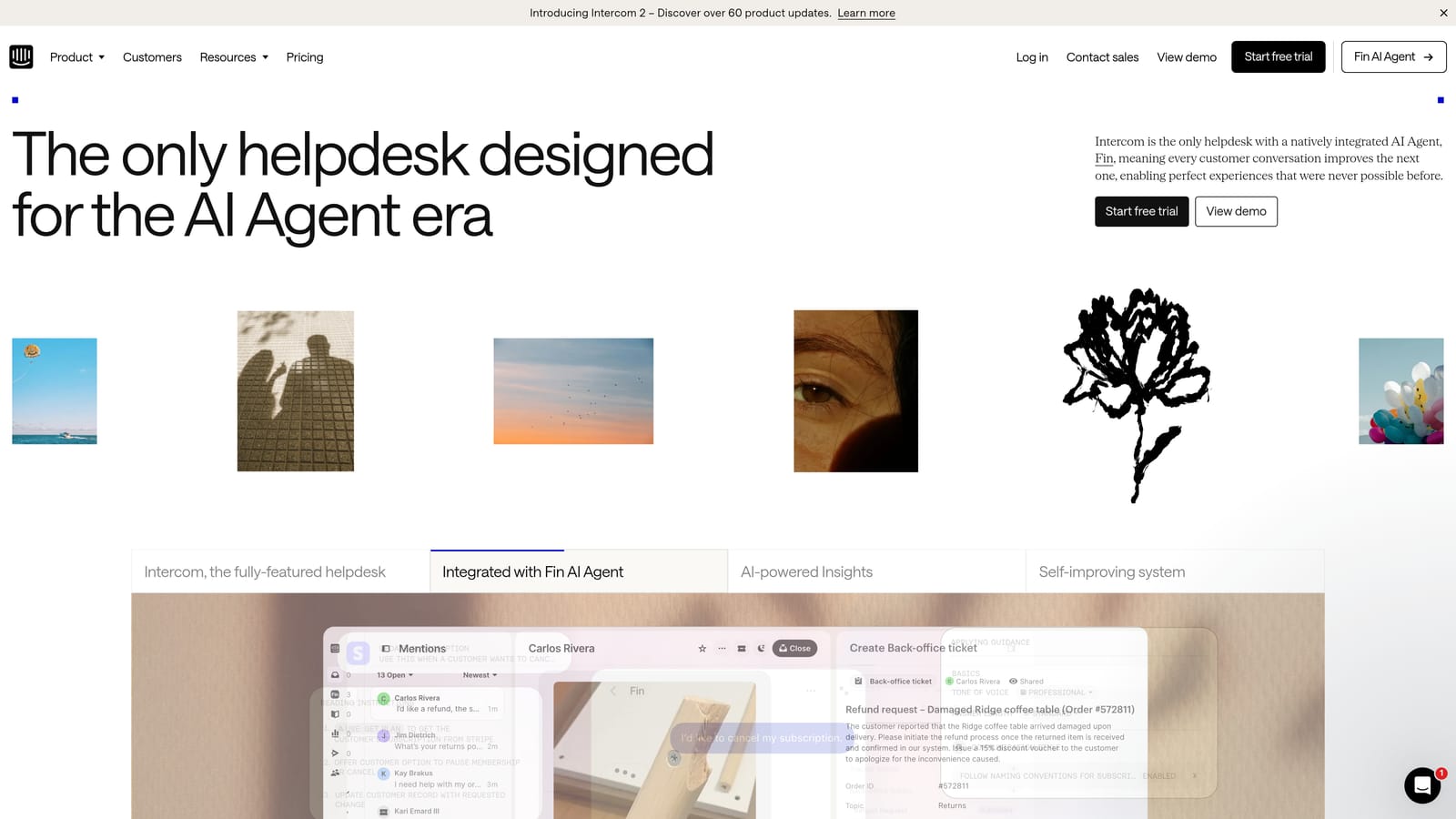
Intercom is a conversational support platform whose Fin AI agent uses large language model technology to resolve queries end-to-end within Intercom's messenger.
Where This Tool Shines
Intercom's Fin AI agent handles resolution using LLM-based intent classification, and when it can't resolve something, it escalates within the same messenger thread without disrupting the customer experience. That continuity matters: the customer never feels handed off to a different system.
For teams already invested in Intercom's ecosystem, Fin is a natural next step. The ML-powered inbox triage and conversation routing add meaningful efficiency on top of an already solid platform. The main consideration is that Fin's pricing is usage-based per resolution, so costs can scale quickly with volume.
Key Features
Fin AI Agent: LLM-powered bot handles end-to-end resolution with ML-based intent classification.
Seamless Escalation: Hands off to human agents within the same messenger thread, preserving context.
ML-Powered Inbox Triage: Automatically routes and prioritizes conversations based on predicted intent.
Multichannel Coverage: Works across web, mobile, and email channels from a single platform.
Usage-Based AI Pricing: Fin resolutions are billed per resolution, giving teams flexibility on AI spend.
Best For
Intercom is ideal for mid-market companies that prioritize conversational support and are already using or considering Intercom's broader platform. Teams with high chat volume and a need for polished messenger experiences will get the most value here.
Pricing
Starts at approximately $39 per seat per month. Fin AI resolutions are billed separately on a per-resolution basis.
3. Zendesk
Best for: Enterprise teams that need a mature helpdesk with ML-powered triage and routing layered on top.
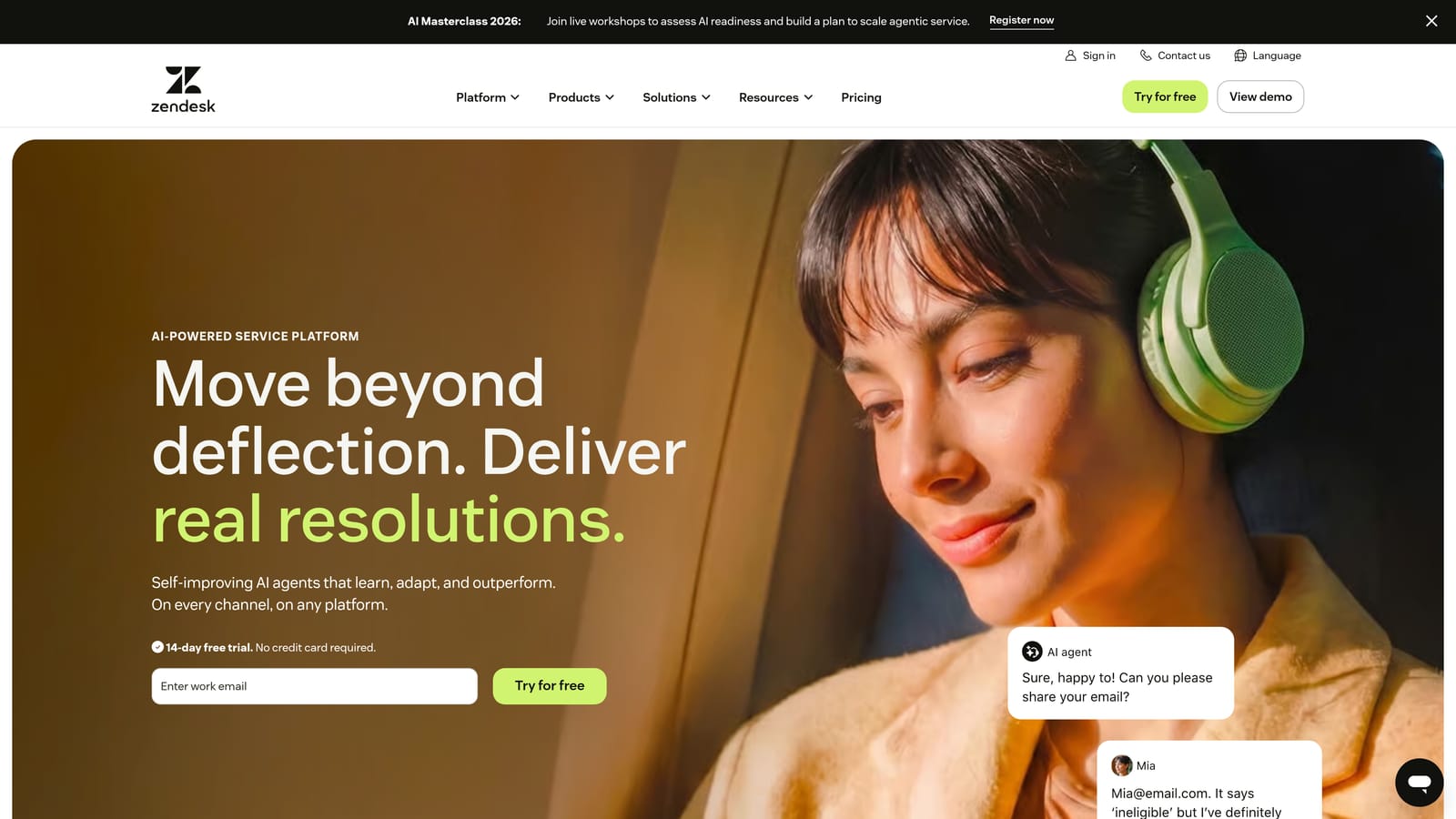
Zendesk is an enterprise helpdesk platform with an AI suite that adds machine learning-powered triage, intelligent routing, and agent assist capabilities to a well-established ticketing foundation.
Where This Tool Shines
Zendesk's strength is its maturity. The platform has deep compliance features, an extensive app marketplace, and enterprise-grade infrastructure that large organizations rely on. The AI suite adds ML-powered intent classification and intelligent routing without requiring teams to abandon a system they've spent years configuring.
That said, the ML capabilities are additive rather than foundational. Zendesk started as a ticketing system and has built AI on top of it, which means the intelligence layer is solid but not as deeply integrated as AI-native platforms. For teams with complex, established workflows that need ML enhancement rather than replacement, it's a practical choice. You can also explore our Zendesk automation tools comparison for a deeper look.
Key Features
AI-Powered Triage: ML classifies incoming tickets by intent and urgency automatically.
Intelligent Routing: Routes tickets based on ML-predicted topic, reducing manual assignment.
Agent Assist: Surfaces macro and response suggestions to speed up human agent replies.
Zendesk AI Suite: Add-on package for more advanced automation and AI-driven workflows.
Enterprise Marketplace: Hundreds of integrations and compliance features for large organizations.
Best For
Zendesk is best for enterprise organizations with established ticketing workflows that want to add ML capabilities without migrating to a new platform. Teams with strict compliance requirements or complex integration needs will find the ecosystem particularly valuable.
Pricing
Suite plans start at approximately $55 per agent per month. AI add-ons are priced separately and vary by feature set.
4. Freshdesk
Best for: SMB teams that want ML-assisted support with accessible pricing and a free entry tier.
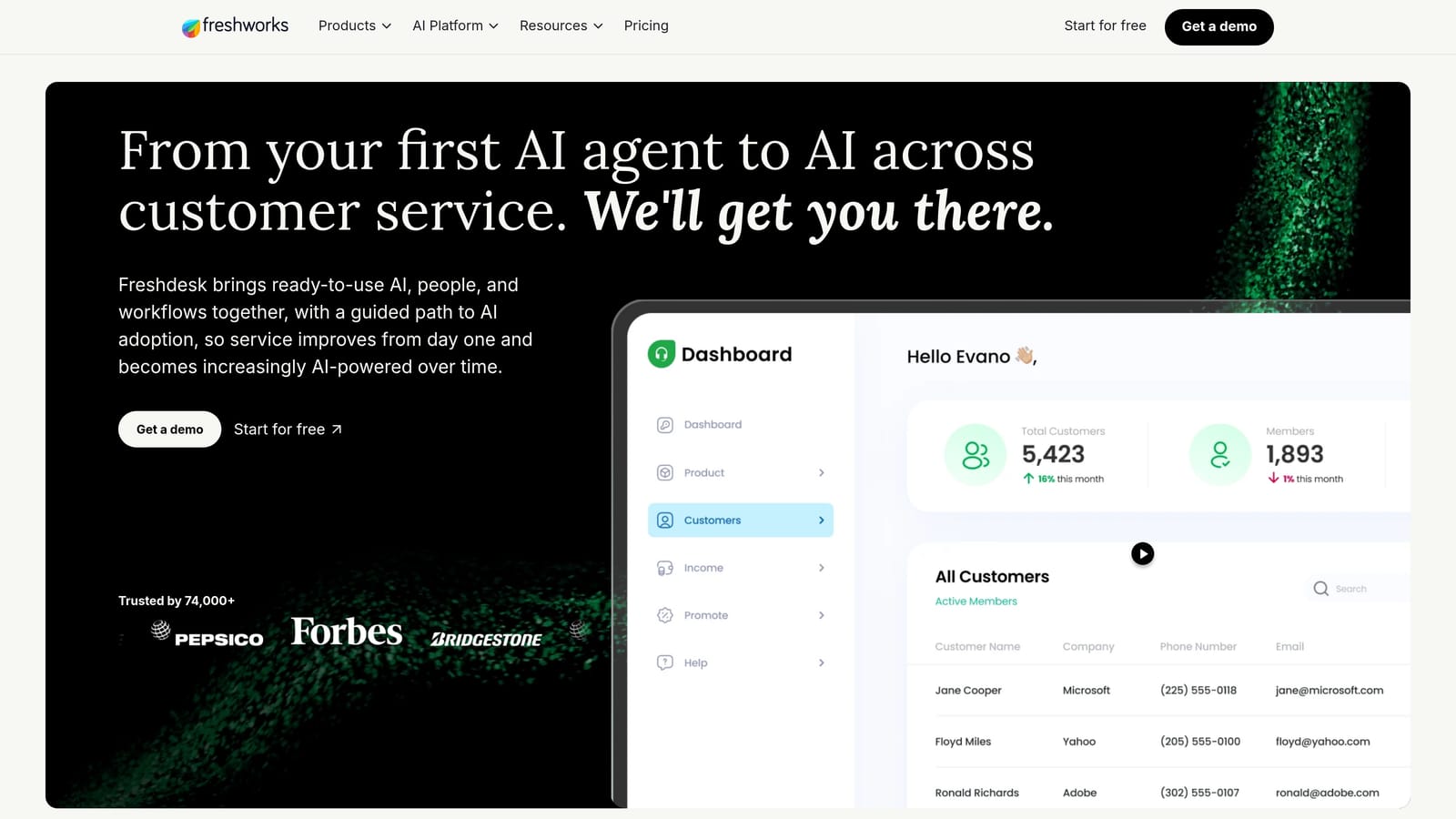
Freshdesk is an SMB-friendly helpdesk platform with Freddy AI providing machine learning-assisted triage, sentiment detection, and agent productivity features.
Where This Tool Shines
Freshdesk hits a sweet spot for smaller teams: capable ML features without the enterprise price tag. Freddy AI handles auto-triage and intelligent ticket categorization, which meaningfully reduces the manual sorting burden on small support teams. The sentiment analysis on incoming conversations helps agents prioritize frustrated customers before situations escalate.
The free tier makes it genuinely accessible for teams just getting started with ML-assisted support. As teams grow, Freddy Copilot on higher tiers adds more sophisticated agent assist functionality. The ML depth isn't at the level of AI-native platforms, but for SMB use cases, it doesn't need to be.
Key Features
Freddy AI Triage: Automatically categorizes and tags incoming tickets using ML classification.
Sentiment Analysis: Detects customer sentiment on incoming conversations to help agents prioritize.
Suggested Responses: Recommends canned replies and response options to speed up agent workflows.
Freddy Copilot: More advanced agent assist features available on higher-tier plans.
Free Tier: A functional free plan makes it accessible for small teams with limited budgets.
Best For
Freshdesk is the right call for SMBs and growing startups that need ML-powered triage and sentiment analysis without committing to enterprise-level pricing. Teams migrating from a basic email inbox to a structured support system will find the learning curve manageable and the ML features immediately useful.
Pricing
Free plan available. Paid plans start at approximately $15 per agent per month. Freddy AI features unlock on higher-tier plans.
5. Forethought
Best for: Enterprise teams that want to add ML intelligence to an existing helpdesk without migrating away from it.
Forethought is an ML-first support intelligence platform designed to layer on top of existing helpdesks, adding triage, deflection, and routing without requiring any platform migration.
Where This Tool Shines
Forethought's core value proposition is straightforward: you don't have to rip out your existing helpdesk to get sophisticated ML. It sits on top of Zendesk, Salesforce Service Cloud, ServiceNow, and others, adding ML-powered triage and deflection as a layer. For enterprise organizations with years of configuration invested in their current platform, this is a significant advantage.
The Discover module is particularly useful for support leaders. It surfaces trends and insights from ticket data that would otherwise require manual analysis, helping teams identify recurring issues, product gaps, and training opportunities. The Solve module handles conversational deflection before tickets are even created.
Key Features
ML Triage and Auto-Tagging: Intelligently classifies and tags tickets on top of Zendesk, Salesforce, and ServiceNow.
Solve AI: Conversational deflection module that resolves queries before they become tickets.
Discover Module: Surfaces support trends, recurring themes, and actionable insights from ticket data.
Triage Module: Intelligent routing and prioritization based on ML-detected intent and urgency.
No Migration Required: Adds ML capabilities to your existing helpdesk without disrupting current workflows.
Best For
Forethought is a strong fit for enterprise teams with entrenched Zendesk or Salesforce deployments that want ML-powered triage and deflection without the disruption of switching platforms. It's particularly well-suited for organizations where the political or operational cost of migration is prohibitive.
Pricing
Custom pricing. Contact Forethought directly for a quote based on your team size and helpdesk environment.
6. Kustomer
Best for: High-volume support teams that need ML-powered intent detection within a CRM-native environment.
Kustomer is a CRM-native support platform with ML-powered intent detection, conversation intelligence, and automated workflow triggers built around a unified customer timeline.
Where This Tool Shines
Kustomer's differentiation is the unified customer timeline. Rather than treating each support interaction in isolation, it combines support history, order data, and CRM information into a single view. The ML layer then operates on that richer data set, enabling more accurate intent detection and more relevant automated responses.
The automated workflow triggers based on ML-detected signals are genuinely powerful for high-volume teams. When the system detects a specific intent or sentiment pattern, it can trigger workflows automatically, reducing the manual intervention required from agents. Omnichannel coverage across chat, email, phone, and social keeps everything consolidated.
Key Features
ML Intent Detection: Classifies and routes conversations based on ML-predicted intent across all channels.
Unified Customer Timeline: Combines support, order, and CRM data into a single agent view.
Automated Workflow Triggers: ML-detected signals automatically trigger relevant workflows and actions.
AI-Suggested Responses: Agent assist surfaces relevant responses based on conversation context.
Omnichannel Support: Covers chat, email, phone, and social from a single unified platform.
Best For
Kustomer is best for high-volume, relationship-driven support operations where CRM context is central to every interaction. E-commerce brands and B2C companies with complex customer histories will find the unified timeline particularly valuable.
Pricing
Starts at approximately $89 per agent per month at the Enterprise tier. Contact Kustomer for volume-based pricing.
7. Tidio
Best for: SMB and e-commerce teams that want an accessible ML chatbot with a free entry point.
Tidio is an accessible AI chat platform featuring Lyro AI, an ML-powered bot designed for small and mid-sized businesses and e-commerce teams handling common queries automatically.
Where This Tool Shines
Tidio's Lyro AI uses ML-based intent matching to resolve common queries without human intervention. For e-commerce teams dealing with repetitive questions about orders, shipping, and returns, this kind of automated resolution can meaningfully reduce ticket volume. The visual chatbot builder makes setup accessible for non-technical teams.
The platform's e-commerce integrations with Shopify and WooCommerce make it a natural fit for online retailers. The ML capabilities are narrower than enterprise tools on this list, but they're well-matched to the use cases Tidio targets. The affordable pricing structure, including a free tier, makes it one of the most accessible entry points into ML-assisted support.
Key Features
Lyro AI Chatbot: ML-based intent matching resolves common queries automatically without agent involvement.
Visual Chatbot Builder: Non-technical teams can build and modify flows without writing code.
Live Chat with Handoff: Seamlessly transfers conversations to human agents when Lyro reaches its limits.
E-Commerce Integrations: Native integrations with Shopify and WooCommerce for order and product context.
Free Tier: Entry-level plan available at no cost, with paid plans scaling by conversation volume.
Best For
Tidio is the right fit for SMBs and e-commerce businesses that need automated chat resolution without a complex implementation. Teams with straightforward, high-frequency queries and limited technical resources will find Lyro AI delivers immediate value at a price point that makes sense.
Pricing
Free plan available. Lyro AI starts at approximately $29 per month. Paid plans scale with conversation volume.
8. Ada
Best for: Enterprise teams that need a no-code AI agent with ML-driven personalization across multiple languages.
Ada is a no-code enterprise AI agent platform with an ML-driven personalization engine that adapts responses based on user behavior and data signals.
Where This Tool Shines
Ada's personalization engine is its standout capability. Rather than delivering the same scripted response to every user, the ML layer adapts based on user context and behavioral signals, making interactions feel more relevant and less robotic. For enterprise brands serving diverse customer segments, that adaptability matters.
The no-code builder is genuinely accessible for CX teams without engineering support. Multilingual support across dozens of languages makes Ada a practical choice for global operations where managing multiple language-specific bots would otherwise be a significant overhead. The analytics dashboard provides clear visibility into deflection rates and conversation performance.
Key Features
ML Personalization Engine: Adapts responses based on user context, behavior, and data signals in real time.
No-Code Builder: CX teams can build, modify, and deploy AI agents without engineering involvement.
Multilingual Support: Handles conversations across dozens of languages from a single platform.
Enterprise Integrations: Deep connections with enterprise CRMs and helpdesks for data-driven responses.
Analytics Dashboard: Tracks conversation performance, deflection rates, and resolution quality over time.
Best For
Ada is well-suited for enterprise B2C and B2B brands that need a no-code AI agent with strong personalization and multilingual capabilities. Organizations serving global customer bases or managing multiple product lines will benefit most from the adaptability and language coverage.
Pricing
Custom enterprise pricing. Contact Ada directly for a quote based on your volume and integration requirements.
9. Assembled
Best for: Support operations leaders who need ML-powered workforce management, forecasting, and capacity planning.
Assembled is an ML-powered workforce management platform focused on demand forecasting, staffing optimization, and capacity planning for support operations teams.
Where This Tool Shines
Assembled occupies a different niche than every other tool on this list. It's not a ticket resolution or chat platform. It applies ML to the operational side of support: predicting volume, optimizing schedules, and ensuring you have the right number of agents available at the right times. For teams where staffing inefficiency is a significant cost driver, this is where the ML impact is most direct.
The demand forecasting engine uses historical data to predict support volume with enough accuracy to inform staffing decisions in advance. Real-time adherence monitoring lets operations managers see how closely teams are following their schedules, and scenario planning tools help leaders model headcount decisions before committing to them.
Key Features
ML Demand Forecasting: Predicts support volume based on historical patterns to inform staffing decisions.
Automated Scheduling: Generates staffing and scheduling recommendations based on forecasted demand.
Real-Time Adherence Monitoring: Tracks whether agents are following their schedules as the day unfolds.
Scenario Planning: Models headcount and coverage decisions before committing to them operationally.
Helpdesk Integrations: Connects with Zendesk, Salesforce, Intercom, and other platforms for volume data.
Best For
Assembled is the right choice for support operations leaders at mid-market and enterprise companies where scheduling inefficiency and demand unpredictability create real cost problems. It complements any ticket resolution tool on this list rather than replacing one.
Pricing
Custom pricing. Contact Assembled directly for a quote tailored to your team size and operational complexity.
Which Tool Is Right for Your Team?
The right ML customer support tool depends entirely on what problem you're actually trying to solve. Here's a quick framework to cut through the noise.
AI-native SaaS teams: Halo AI is the strongest fit if you want machine learning woven into every layer of your support operation, not added on top. The page-aware context, continuous learning, and business intelligence signals make it more than a support tool.
Messaging-first mid-market teams: Intercom with Fin AI is the natural choice if you're already in the Intercom ecosystem or if conversational messenger support is central to your customer experience.
Enterprise teams with existing helpdesks: Zendesk suits teams with mature ticketing workflows that want ML enhancement without migration. Forethought is the better option if you want sophisticated ML triage and deflection without touching your current helpdesk setup at all.
SMB and budget-conscious teams: Freshdesk and Tidio both offer free entry tiers with ML capabilities that are well-matched to smaller-scale needs. Freshdesk leans more toward structured ticketing; Tidio is stronger for chat-first and e-commerce contexts.
High-volume CX with CRM requirements: Kustomer's unified customer timeline and ML intent detection make it the right call for relationship-driven, omnichannel support operations where CRM context is central to every interaction.
No-code enterprise AI agents: Ada is the clear fit for enterprise brands that need a personalized, multilingual AI agent their CX team can manage without engineering support.
Support operations forecasting: Assembled stands alone in this category. If staffing efficiency and demand prediction are your primary pain points, it's the only tool on this list built specifically for that problem.
Your support team shouldn't scale linearly with your customer base. Let AI agents handle routine tickets, guide users through your product, and surface business intelligence while your team focuses on complex issues that need a human touch. See Halo in action and discover how continuous learning transforms every interaction into smarter, faster support.