9 Best Machine Learning Tools for Customer Service in 2026
This guide evaluates the 9 best machine learning for customer service tools in 2026, covering AI agents, NLP engines, and analytics platforms that go beyond basic automation to intelligently route tickets, predict churn, and improve with every customer interaction. Each tool is assessed on ML depth, deployment ease, and real-world utility for B2B SaaS teams.
 Grant CooperFounder13 min read
Machine learning has fundamentally changed what customer service teams can accomplish. We're well past the era of scripted chatbots and keyword-matching auto-replies. Today's ML-powered tools understand intent, predict churn, route intelligently, and genuinely improve with every interaction they process.
The challenge is that "machine learning for customer service" covers a wide spectrum. Some tools are purpose-built AI agents that resolve tickets end-to-end. Others are analytics layers, NLP engines, or automation platforms bolted onto existing helpdesks. The distinction matters enormously when you're evaluating what will actually move the needle for your team.
This list cuts through the noise. We've selected tools that genuinely apply machine learning to customer service workflows, evaluated on depth of ML capability, ease of deployment for non-data-science teams, integration flexibility, and real-world utility for B2B SaaS and product teams. Whether you're replacing a legacy helpdesk, augmenting your existing support stack, or building toward fully autonomous support, there's a fit here. For a broader look at automation options, our guide to automated customer support is a good companion read.
1. Halo AI
Best for: B2B SaaS teams wanting AI-first autonomous support with business intelligence built in
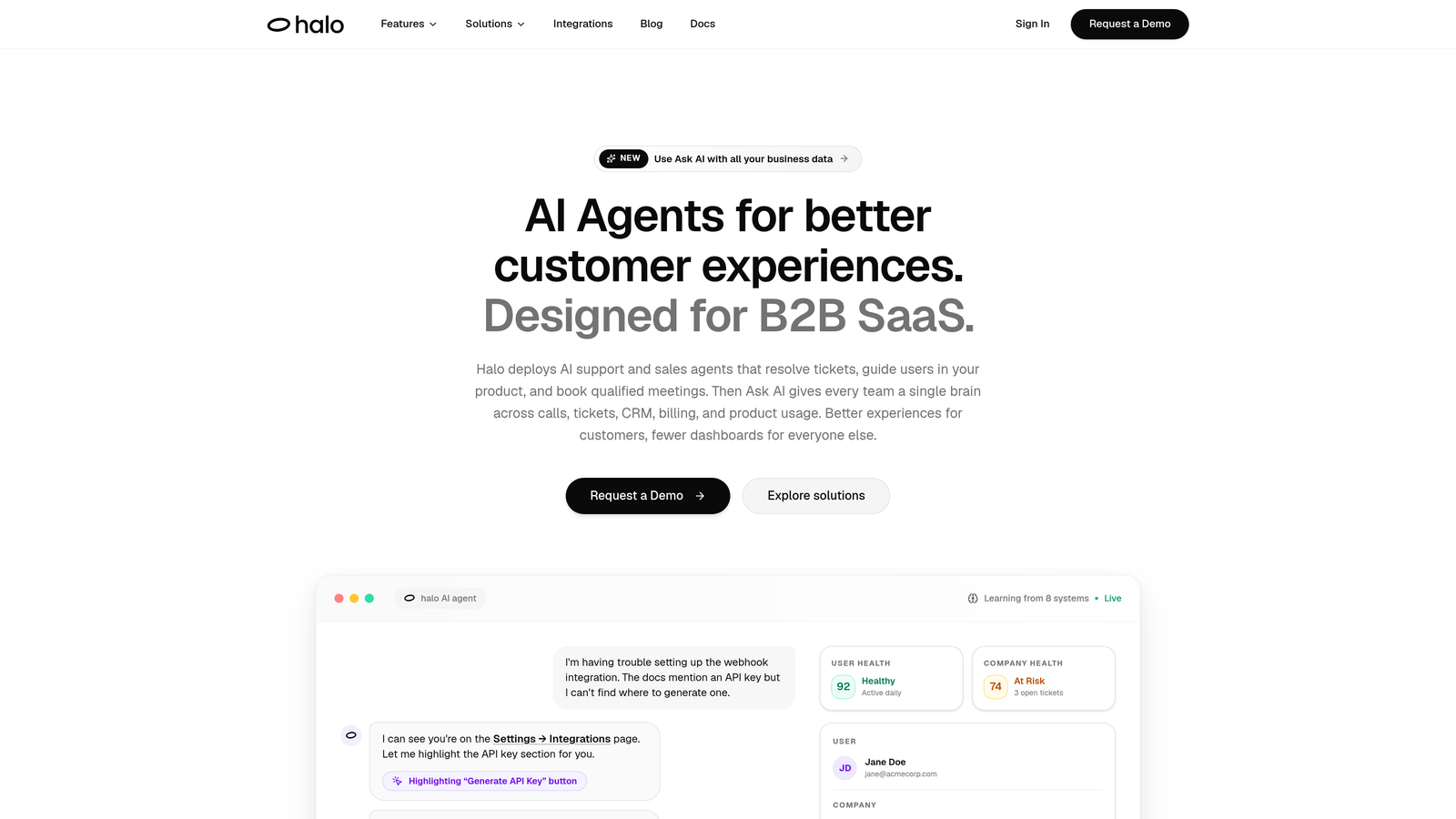
Halo AI is an AI-first customer support platform that deploys autonomous agents to resolve tickets, guide users through your product, and surface business intelligence while continuously learning from every interaction.
Where This Tool Shines
Most ML tools in this space are features added on top of existing helpdesk infrastructure. Halo is built differently: machine learning is the foundation, not the add-on. The platform's continuous learning loop means every resolved ticket makes the next resolution smarter, without requiring manual retraining or data science involvement.
What genuinely sets Halo apart is page-aware context. The chat widget understands what page a user is on and what they're looking at, enabling visual UI guidance that goes far beyond generic help articles. Combine that with automatic bug ticket creation and business intelligence signals surfaced directly in the inbox, and you have a support layer that doesn't just resolve tickets but actively informs your product and revenue decisions.
Key Features
Autonomous Ticket Resolution: AI agents handle tickets end-to-end with a continuous learning loop that improves accuracy over time without manual intervention.
Page-Aware Chat Widget: The widget sees what the user sees, providing contextual UI guidance and product walkthroughs based on their exact location in your app.
Auto Bug Ticket Creation: Automatically detects and routes bug reports to Linear or your issue tracker, closing the loop between support and engineering.
Smart Inbox with Business Intelligence: Surfaces customer health signals, revenue anomalies, and churn indicators directly in the support inbox, turning support data into strategic insight.
Live Agent Handoff: Escalates complex issues to human agents with full conversation context preserved, so nothing gets repeated.
Deep Integration Stack: Connects natively with Linear, Slack, HubSpot, Intercom, Stripe, Zoom, PandaDoc, and Fathom.
Best For
B2B SaaS companies and product teams that want more than ticket deflection. Halo is particularly well-suited for teams that need support data to feed back into product development, customer success, and revenue operations. If you're scaling headcount to keep up with support volume, Halo is built to break that pattern.
Pricing
Current pricing plans are available at haloagents.ai. Pricing is structured to accommodate growing SaaS teams at different stages.
2. Intercom (Fin AI Agent)
Best for: Teams already on Intercom who want AI resolution without switching platforms
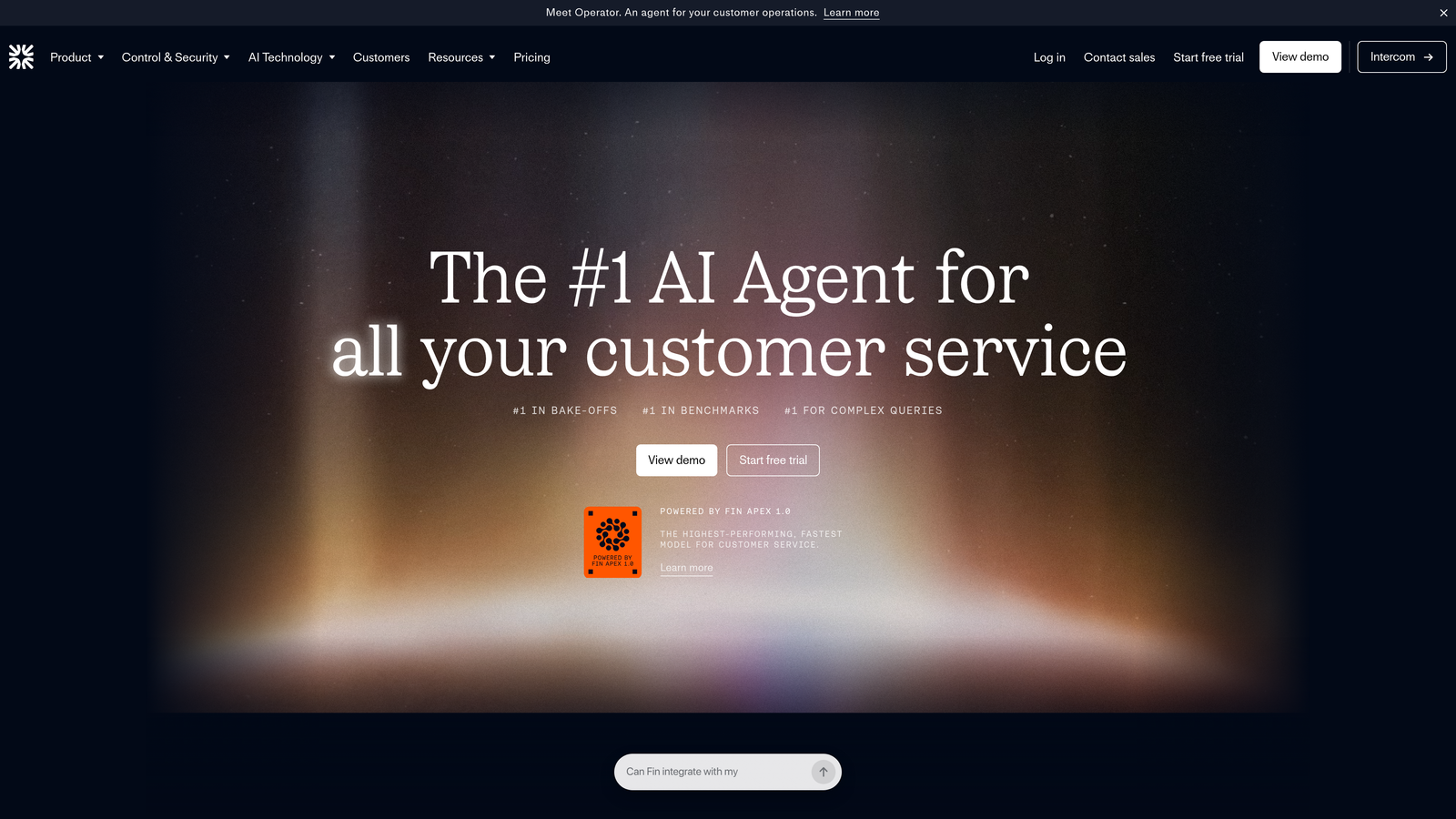
Intercom's Fin AI Agent is an LLM-powered support agent built natively into the Intercom messenger, designed to resolve conversations directly without human involvement.
Where This Tool Shines
Fin's biggest advantage is how naturally it fits into an existing Intercom setup. If your team is already using Intercom for customer conversations, deploying Fin requires minimal workflow disruption. It ingests your existing help content and starts resolving common queries almost immediately.
The handoff experience is also well-executed. When Fin reaches the boundary of its confidence, it transfers the conversation to a human agent within the same inbox, with full context intact. For teams that want AI resolution without rebuilding their support stack, that seamlessness is genuinely valuable.
Key Features
LLM-Powered Resolution: Uses large language model reasoning trained on your help content to resolve conversations without scripted flows.
Multi-Source Knowledge Ingestion: Pulls from help centers, PDFs, and URLs to build a comprehensive knowledge base for resolution.
Seamless Human Handoff: Escalates to live agents within the Intercom inbox when queries exceed Fin's resolution confidence.
Containment Reporting: Analytics showing what Fin resolved versus what required human intervention, useful for optimizing knowledge coverage.
Multilingual Support: Handles conversations across multiple languages without separate configuration.
Best For
Teams already invested in the Intercom ecosystem. If you're not on Intercom, the switching cost makes this less compelling compared to standalone AI agent platforms.
Pricing
Fin is available as an add-on to existing Intercom plans with usage-based resolution pricing. Full details at intercom.com.
3. Zendesk AI
Best for: Large support organizations running Zendesk Suite who need enterprise-grade ML across the full support lifecycle
Zendesk AI is an enterprise ML suite built natively into the Zendesk platform, covering intelligent triage, agent copilot, QA automation, and predictive analytics.
Where This Tool Shines
Zendesk AI's strength is breadth. It applies machine learning at every stage of the support workflow: tickets are auto-tagged and routed on arrival, agents get real-time suggestions while working a case, QA scoring happens automatically in the background, and CSAT prediction flags at-risk customers before they churn.
For large support organizations with established Zendesk workflows, the ML capabilities layer in without requiring a platform migration. The knowledge base gap detection is a particularly useful feature, surfacing content holes that cause deflection failures.
Key Features
Intelligent Triage: Auto-tagging, intent detection, and routing that assigns tickets to the right queue and agent without manual review.
Agent Copilot: Real-time suggested replies and next-action recommendations that reduce handle time and improve consistency.
Automated QA Scoring: ML-driven quality scoring across agent conversations, removing the need for manual QA sampling.
CSAT and Churn Prediction: Predictive signals that identify customers likely to give poor ratings or churn before the interaction closes.
Knowledge Base Gap Detection: Identifies topics generating tickets that aren't covered by existing help content.
Best For
Enterprise support teams with high ticket volumes, established Zendesk infrastructure, and a need for ML across the full support lifecycle rather than just resolution automation.
Pricing
AI features are included in higher-tier Zendesk Suite plans. Current pricing available at zendesk.com.
4. Freshdesk Freddy AI
Best for: Growing teams on Freshdesk who want accessible ML features without enterprise-level pricing
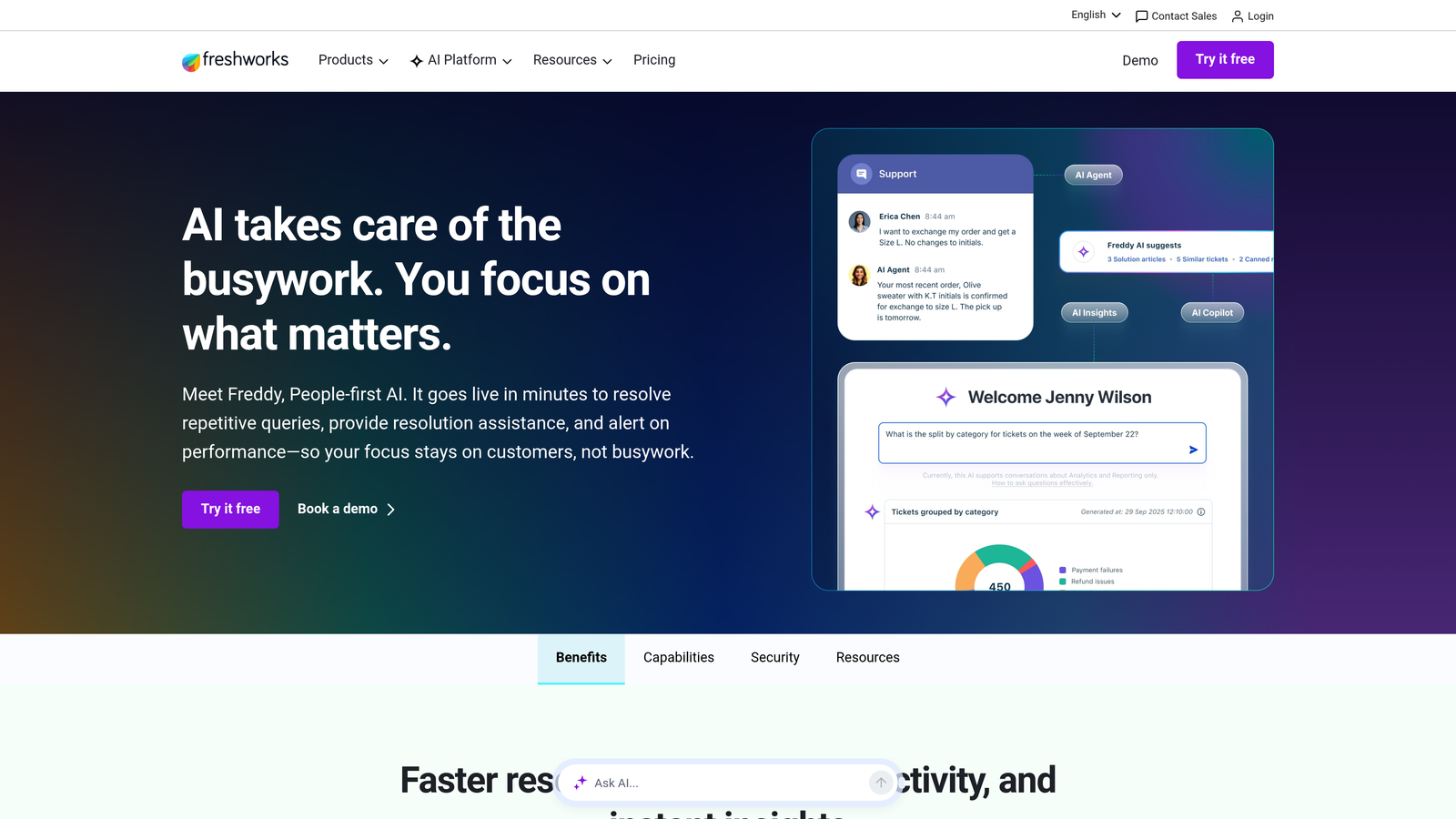
Freshdesk Freddy AI is Freshworks' ML layer for customer support, spanning auto-triage, agent assist, self-service bots, and conversation analytics within the Freshdesk platform.
Where This Tool Shines
Freddy AI hits a practical sweet spot for teams that need real ML capability without the complexity or cost of enterprise platforms. The no-code bot builder makes self-service automation accessible to support managers who aren't technical, and the agent copilot features reduce training time for new reps significantly.
Freddy Insights deserves specific mention: the anomaly detection capability flags unusual patterns in support volume or customer sentiment, which is genuinely useful for catching product incidents or seasonal trends before they become crises.
Key Features
Freddy Copilot: Real-time agent suggestions and AI-assisted reply drafting that accelerates resolution without removing human judgment.
Auto-Triage and Categorization: ML-driven ticket classification that routes incoming requests based on content and intent.
Freddy Self Service: ML-powered deflection bot that handles common queries before they reach an agent.
Freddy Insights: Anomaly detection and performance analytics that surface unusual patterns in support data.
No-Code Bot Builder: Conversation design tools accessible to non-technical team members.
Best For
SMB and mid-market teams on Freshdesk looking for meaningful ML capabilities at a more accessible price point than Zendesk or Salesforce.
Pricing
Freddy AI features are tiered across Freshdesk Growth, Pro, and Enterprise plans. Details at freshworks.com.
5. Salesforce Einstein for Service Cloud
Best for: Enterprise teams where Salesforce is the system of record and CRM data should power support intelligence
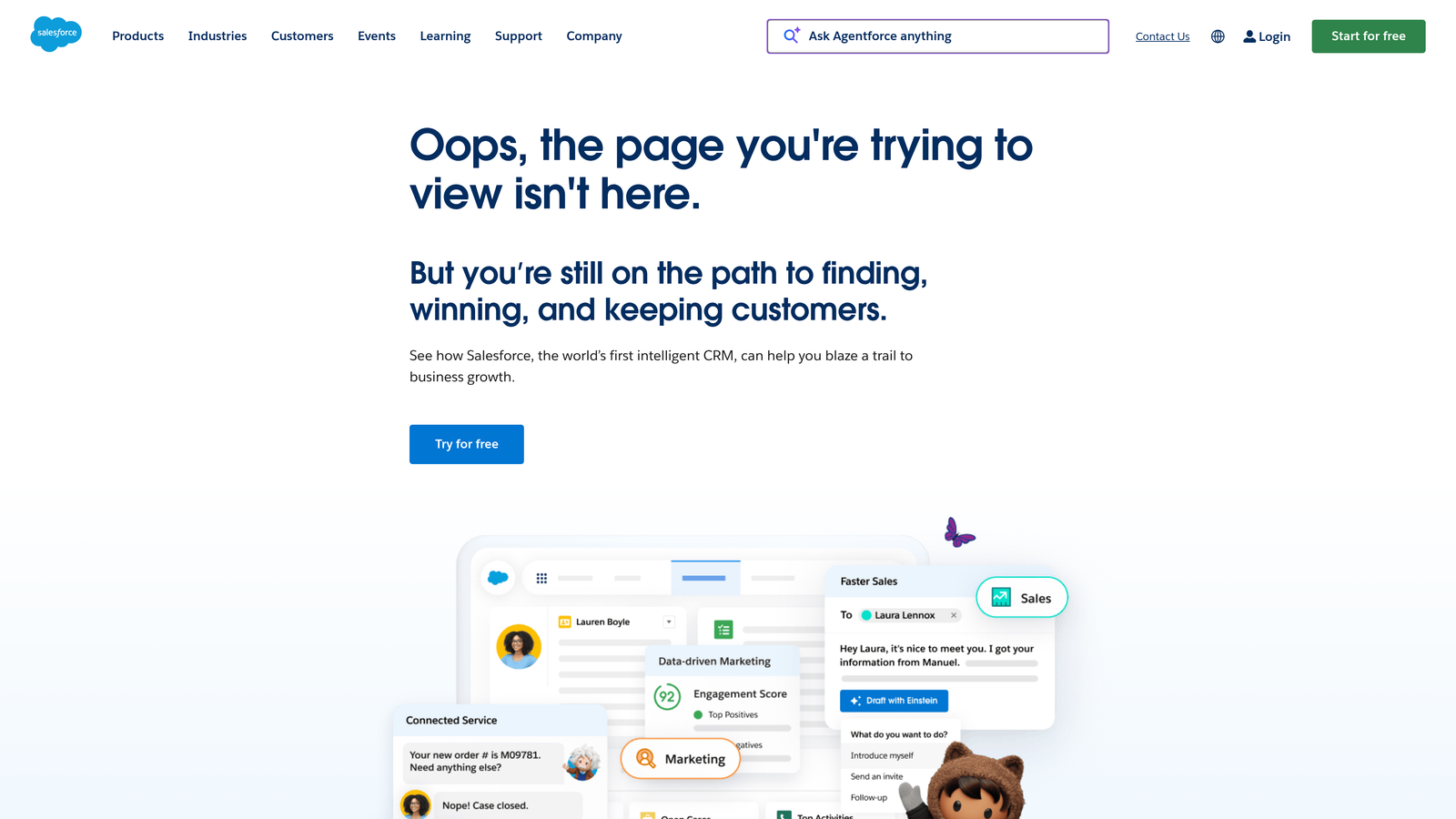
Salesforce Einstein for Service Cloud is enterprise-grade ML embedded in Service Cloud, leveraging full CRM data for case classification, next-best-action recommendations, and predictive service intelligence.
Where This Tool Shines
Einstein's core advantage is data depth. Because it draws on the entire Salesforce data model, including sales history, marketing interactions, and account data, its ML models can make predictions and recommendations that no standalone support tool can match. A case classification model that knows a customer's contract value, renewal date, and past escalation history is fundamentally more intelligent than one operating on ticket content alone.
For enterprises where Salesforce is already the source of truth, Einstein doesn't require data integration work. The intelligence is already there, waiting to be activated.
Key Features
ML-Powered Case Classification: Routes cases using the full CRM history of the customer, not just the content of the current ticket.
Next-Best-Action Recommendations: Guides agents on the optimal response or escalation path based on customer profile and case context.
Einstein Bots: Self-service deflection bots that can access CRM data to personalize responses.
Predictive CSAT and Escalation Risk: Flags cases likely to result in poor satisfaction or escalation before they deteriorate.
Cross-Cloud Integration: Deep connectivity with Sales Cloud, Marketing Cloud, and Data Cloud for unified intelligence.
Best For
Large enterprises where Salesforce is the primary business system and support intelligence needs to connect directly to revenue and account data.
Pricing
Available on Service Cloud Enterprise and Unlimited editions. Custom pricing through Salesforce sales team.
6. Ada
Best for: High-volume deflection at scale, particularly in multilingual or regulated industries
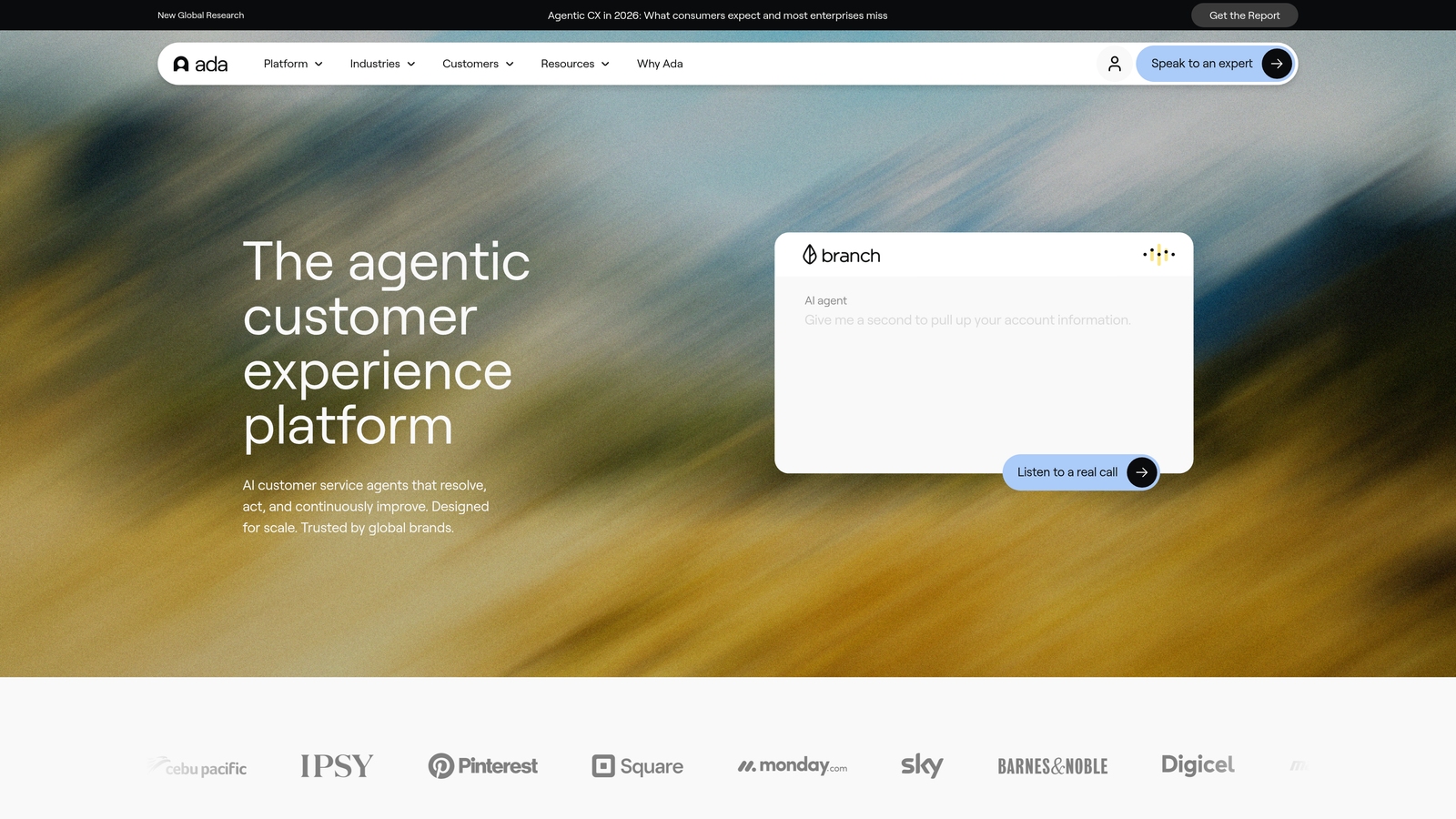
Ada is a purpose-built AI agent platform focused on high-volume deflection, featuring no-code conversation design and ML-driven intent recognition across hundreds of topics.
Where This Tool Shines
Ada is built specifically for scale. Its ML-based intent recognition is designed to handle a wide range of customer topics without requiring a conversation flow for every possible question. For organizations handling very high support volumes, particularly in telecom, fintech, or e-commerce, that breadth of intent coverage translates directly into containment rates.
The no-code conversation builder makes Ada accessible to support and CX teams without engineering involvement. Non-technical teams can design, test, and update conversation flows independently, which matters enormously when product or policy changes need to be reflected quickly.
Key Features
ML-Based Intent Recognition: Understands customer intent across a broad topic range without requiring explicit scripting for every scenario.
No-Code Conversation Builder: Empowers non-technical teams to design and maintain conversation flows without engineering support.
Multilingual Support: Handles conversations across many languages, making it suitable for global support operations.
CRM and Helpdesk Integrations: Connects with major platforms to pull customer data and log interactions.
Containment Analytics: Reporting on deflection rates and conversation performance to guide optimization.
Best For
Enterprise and mid-market teams in high-volume industries that need scalable deflection with multilingual capability and minimal technical overhead for conversation management.
Pricing
Custom enterprise pricing. Contact Ada directly at ada.cx for current details.
7. Forethought
Best for: Teams that want ML intelligence layered on top of an existing helpdesk without switching platforms
Forethought is an ML intelligence layer that sits on top of existing helpdesks, specializing in ticket triage, intelligent routing, agent assist, and automated resolution without requiring a platform migration.
Where This Tool Shines
Forethought solves a real problem: you've invested in Zendesk, Salesforce, or Freshdesk, your team knows the platform, and switching isn't on the table. But you still need ML-driven triage, smarter routing, and agent assistance. Forethought plugs into your existing helpdesk and adds that intelligence layer without disrupting established workflows.
The three-product structure (Triage, Assist, Solve) lets teams adopt incrementally. You can start with auto-tagging and routing, add agent copilot capabilities, then move toward automated resolution as confidence builds. That progressive adoption path reduces implementation risk considerably.
Key Features
Triage: ML-powered auto-tagging, prioritization, and routing that processes tickets on arrival before any agent touches them.
Assist: Agent copilot that surfaces relevant articles and suggested replies in real time during active conversations.
Solve: Automated resolution for common ticket types that don't require human judgment.
Native Helpdesk Integration: Works directly within Zendesk, Salesforce, and Freshdesk without replacing them.
Deflection Analytics: Conversation intelligence reporting on containment, resolution rates, and knowledge coverage.
Best For
Teams committed to their existing helpdesk who want to add ML capabilities incrementally without a platform switch or significant re-implementation work.
Pricing
Custom pricing. Contact Forethought at forethought.ai for current details.
8. Kustomer
Best for: High-volume CX teams managing complex, multi-channel customer histories who need CRM-native ML automation
Kustomer is a CRM-native customer service platform with embedded ML automation, unified customer timelines, and intelligent workflow orchestration built for high-volume CX operations.
Where This Tool Shines
Kustomer's unified customer timeline is its defining characteristic. Rather than treating each ticket as an isolated event, Kustomer assembles every interaction, purchase, and behavior signal into a single customer view. ML models then operate on that full context, making routing, prioritization, and auto-response decisions that are far more informed than what ticket-only systems can achieve.
The proactive outreach capability is particularly useful for customer success-oriented support teams. Behavior-based triggers can initiate outreach before a customer even submits a ticket, shifting support from reactive to proactive.
Key Features
Unified Customer Timeline: Aggregates all interactions, transactions, and data points into a single customer record that ML models draw on.
ML-Driven Routing and Prioritization: Routes conversations based on customer profile, history, and predicted complexity.
AI-Powered Auto-Responses: Generates and sends responses for common queries without agent involvement.
Proactive Outreach Triggers: Behavior-based signals that initiate customer contact before issues escalate to tickets.
Omnichannel Support: Unified handling across email, chat, social, SMS, and voice within a single interface.
Best For
High-volume CX teams in e-commerce, consumer apps, or subscription businesses where full customer history is essential context for every support interaction.
Pricing
Enterprise pricing tiers. Contact Kustomer at kustomer.com for current plan details.
9. Tidio Lyro AI
Best for: Small teams and SMBs that need fast AI deployment with minimal technical overhead
Tidio Lyro AI is an SMB-friendly conversational AI agent trained directly on your support content, designed for fast deployment without a data science team or complex implementation.
Where This Tool Shines
Lyro's value proposition is simplicity and speed. You point it at your FAQ and help content, and it starts handling common support queries autonomously. For small teams stretched thin across multiple responsibilities, getting to working AI resolution in hours rather than weeks is genuinely meaningful.
The confidence-based handoff model is well-calibrated for SMB needs. When Lyro isn't confident in a response, it routes to a human rather than guessing, which keeps the experience reliable without requiring extensive tuning. The combined live chat and chatbot interface also means you're not managing two separate tools.
Key Features
Content-Trained AI: Lyro learns from your FAQ and help documentation, requiring no custom ML training or data labeling.
Autonomous Query Handling: Resolves common support questions without human intervention across chat.
Confidence-Based Handoff: Automatically routes to a human agent when the AI's confidence falls below threshold, maintaining response quality.
Unified Chat Interface: Live chat and AI bot operate within the same interface, simplifying the agent experience.
Fast Setup: Deployable without engineering resources, making it accessible for lean teams.
Best For
Small SaaS teams, e-commerce businesses, and SMBs that need capable AI support without the implementation complexity or cost of enterprise platforms.
Pricing
Lyro is available on paid Tidio plans with conversation-based usage pricing. Full details at tidio.com.
Choosing the Right Tool for Your Team
The right machine learning tool for customer service depends heavily on where you are in your support maturity journey and what problems you're actually trying to solve.
If you're building toward fully autonomous support with business intelligence built in, Halo AI is the strongest fit. Its AI-first architecture, page-aware context, and continuous learning loop make it purpose-built for B2B SaaS teams that want support to inform product and revenue decisions, not just deflect tickets.
For teams already deep in enterprise helpdesk ecosystems, Zendesk AI and Salesforce Einstein deliver the broadest ML coverage without requiring a platform change. Zendesk wins on support-specific depth; Salesforce wins when CRM data needs to power every support decision.
If accessible pricing and faster time-to-value matter more than enterprise breadth, Freshdesk Freddy AI and Tidio Lyro both deliver real ML capability without the complexity. Freddy is the better fit for growing teams on Freshdesk; Lyro is the fastest path to working AI resolution for small teams.
And if you want ML intelligence without switching helpdesks, Forethought is the cleanest solution, layering triage, assist, and automated resolution on top of whatever platform you're already running.
Your support team shouldn't scale linearly with your customer base. Let AI agents handle routine tickets, guide users through your product, and surface business intelligence while your team focuses on complex issues that need a human touch. See Halo in action and discover how continuous learning transforms every interaction into smarter, faster support.