9 Best Multilingual AI Customer Service Tools in 2026
Multilingual AI customer service tools help B2B companies eliminate language barriers in customer support by automatically detecting and responding in customers' native languages without expanding headcount. This guide evaluates the 9 strongest platforms available in 2026, comparing language coverage, AI quality, and integrations to help SaaS and product teams scale support across global markets efficiently.
 Matt PattoliFounder14 min read
As B2B companies expand into new markets, language barriers in customer support become a real operational bottleneck. Hiring multilingual agents at scale is expensive and slow, and customers expect fast, accurate answers regardless of what language they speak.
Multilingual AI customer service tools solve this by automatically detecting language, responding in kind, and maintaining consistent support quality across dozens of languages without additional headcount. The best platforms go beyond basic translation: they understand context, learn from every interaction, and integrate with the tools your team already uses.
This list covers the strongest multilingual AI customer service tools available in 2026, evaluated on language coverage, AI quality, integrations, and real-world usability for B2B SaaS and product teams. Whether you're scaling into new regions or simply want to stop routing tickets by language, there's a solution here for your stack.
1. Halo AI
Best for: B2B SaaS teams wanting AI-first multilingual support with deep business intelligence
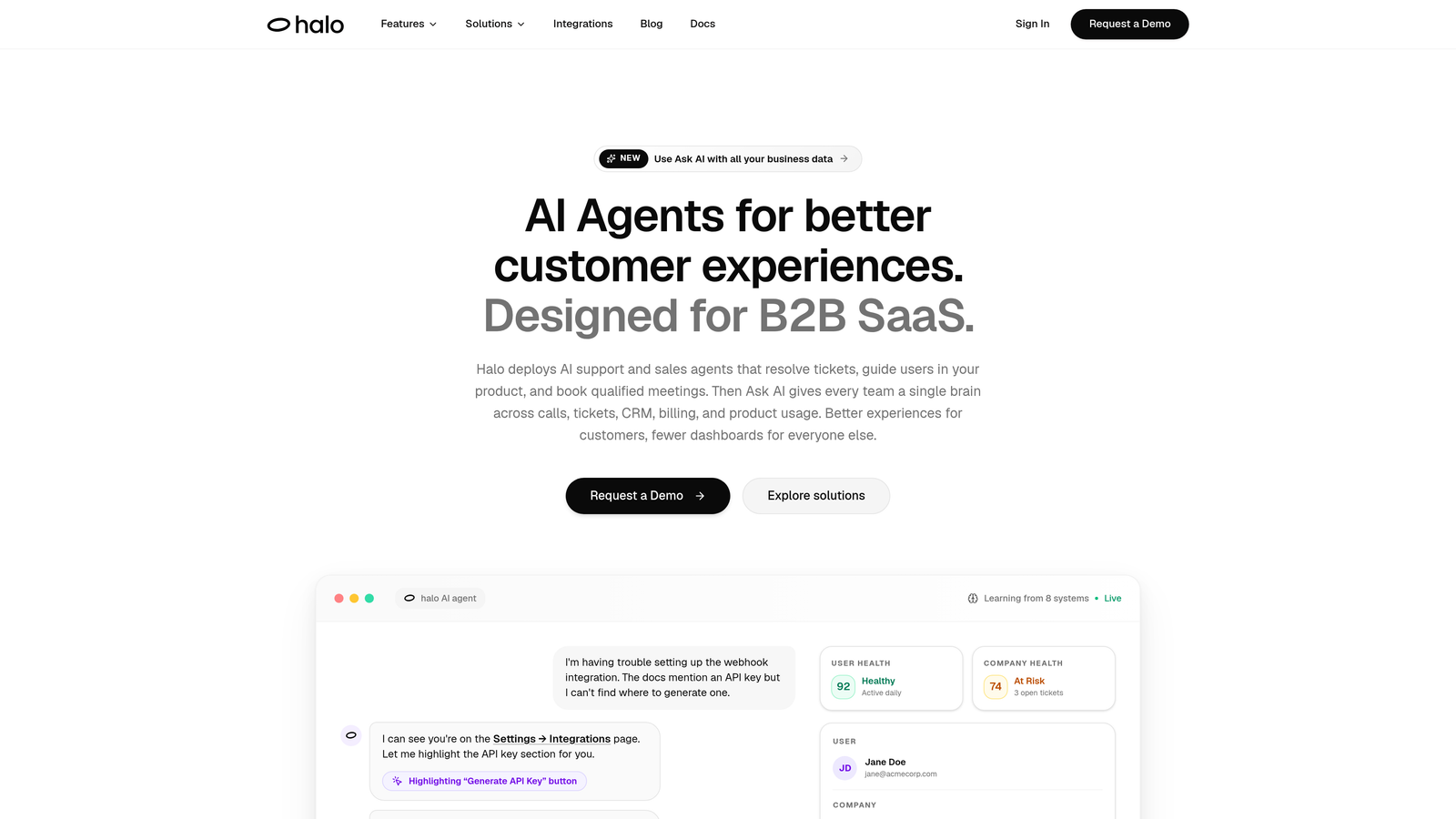
Halo AI is an AI-first customer support platform that deploys intelligent agents to resolve tickets, guide users through your product, and surface business intelligence across every interaction.
Where This Tool Shines
What separates Halo from most multilingual tools is its architecture. Rather than bolting AI onto an existing helpdesk, Halo is built AI-first from the ground up. Multilingual support is handled through the underlying LLM, meaning the same intelligence that resolves an English ticket applies equally to one written in French, Spanish, or Japanese.
The page-aware chat widget is a standout capability. It sees what the user sees in your product, so responses are contextually accurate regardless of the language the customer is writing in. Combine that with continuous learning across every interaction, and the system gets meaningfully smarter over time rather than staying static.
Key Features
Autonomous Multilingual Ticket Resolution: AI agents resolve support tickets across languages without requiring manual routing or language-specific configuration.
Page-Aware Context: The chat widget understands which page or feature a user is on, delivering accurate guidance in any language based on real product context.
Smart Inbox with Business Intelligence: Surfaces signals from multilingual customer interactions, including customer health trends, anomaly detection, and revenue intelligence beyond standard support metrics.
Auto Bug Ticket Creation: Automatically generates bug reports from support conversations and routes them to engineering tools like Linear, regardless of the language the issue was reported in.
Live Agent Handoff: Escalates complex issues to human agents with full conversation context preserved, including the original language and any translated context.
Broad Integration Stack: Connects with Linear, Slack, HubSpot, Intercom, Stripe, Zoom, PandaDoc, and Fathom, making it a central node in your support and product operations.
Best For
Product-led SaaS companies expanding internationally who want AI that does more than translate. Halo is a strong fit for teams that need multilingual support to feed into broader business intelligence, not just close tickets faster.
Pricing
Contact for pricing at haloagents.ai. Given the AI-first architecture and business intelligence layer, pricing is tailored to team size and usage.
2. Intercom Fin
Best for: Teams already using Intercom who want native multilingual AI with minimal migration
Intercom Fin is Intercom's native AI agent, powered by large language models and designed to resolve customer questions across languages within the Intercom platform.
Where This Tool Shines
If your team is already living inside Intercom, Fin is the path of least resistance to multilingual AI support. It plugs directly into your existing inbox, messenger, and ticketing setup without requiring a separate integration layer. The GPT-4 foundation means it handles nuanced, multi-turn conversations across languages reasonably well.
The resolution-based pricing model is worth understanding before committing. It aligns cost with value in theory, but in high-volume multilingual environments, costs can scale quickly. Teams should model their expected resolution volume carefully before assuming it's the most economical option.
Key Features
GPT-4 Powered Multilingual Resolution: Handles customer questions across multiple languages using large language model capabilities built into the Intercom platform.
Native Intercom Integration: Works directly within Intercom's inbox, messenger, and ticketing without additional configuration or third-party connectors.
Human Handoff with Context: Escalates to live agents with the full conversation history preserved, including language context.
Customizable Tone and Persona: Allows teams to configure Fin's communication style per language or region to match brand voice across markets.
Resolution-Based Pricing: Charges per resolved conversation rather than per seat, which can be cost-efficient for lower-volume teams.
Best For
Companies already committed to the Intercom ecosystem who want to add multilingual AI resolution without changing their support stack. Less compelling for teams not already using Intercom.
Pricing
Intercom plans start around $74/month; Fin is charged per resolution on top of the base plan. Total cost depends heavily on conversation volume and resolution rates.
3. Zendesk AI
Best for: High-volume, multi-region support operations running on the Zendesk platform
Zendesk AI is Zendesk's built-in AI suite offering intelligent triage, multilingual ticket classification, automated responses, and agent assistance across the entire Zendesk platform.
Where This Tool Shines
Zendesk AI earns its place through sheer depth of integration with the Zendesk ticketing infrastructure. Multilingual intent detection, intelligent routing, and AI-assisted agent replies all work within the same environment your team already operates in. For enterprise teams processing thousands of multilingual tickets daily, having classification and routing happen automatically is a significant operational gain.
The configuration complexity is the honest tradeoff here. Getting Zendesk AI tuned for multiple languages and regions takes meaningful setup time. Teams without dedicated Zendesk administrators may find the initial investment steeper than expected.
Key Features
Multilingual Intent Detection: Automatically identifies the topic and language of incoming tickets and routes them accordingly.
AI-Powered Suggested Replies: Surfaces response suggestions for agents in the customer's language, reducing drafting time across multilingual queues.
Intelligent Routing: Routes tickets based on language, topic, urgency, and agent skill set simultaneously.
Self-Service AI Bots: Deploys conversational bots across multiple languages for common support scenarios before tickets reach agents.
Deep Reporting Integration: Connects AI performance data with Zendesk's existing reporting infrastructure for unified analytics across languages.
Best For
Enterprise support teams with existing Zendesk infrastructure and dedicated administrators. Particularly strong for organizations running multi-region operations at scale where intelligent routing drives real efficiency gains.
Pricing
Included in Zendesk Suite plans; Suite Team starts around $55/agent/month. Higher tiers unlock more advanced AI capabilities.
4. Freshdesk Freddy AI
Best for: Growing teams wanting multilingual AI support at accessible price points
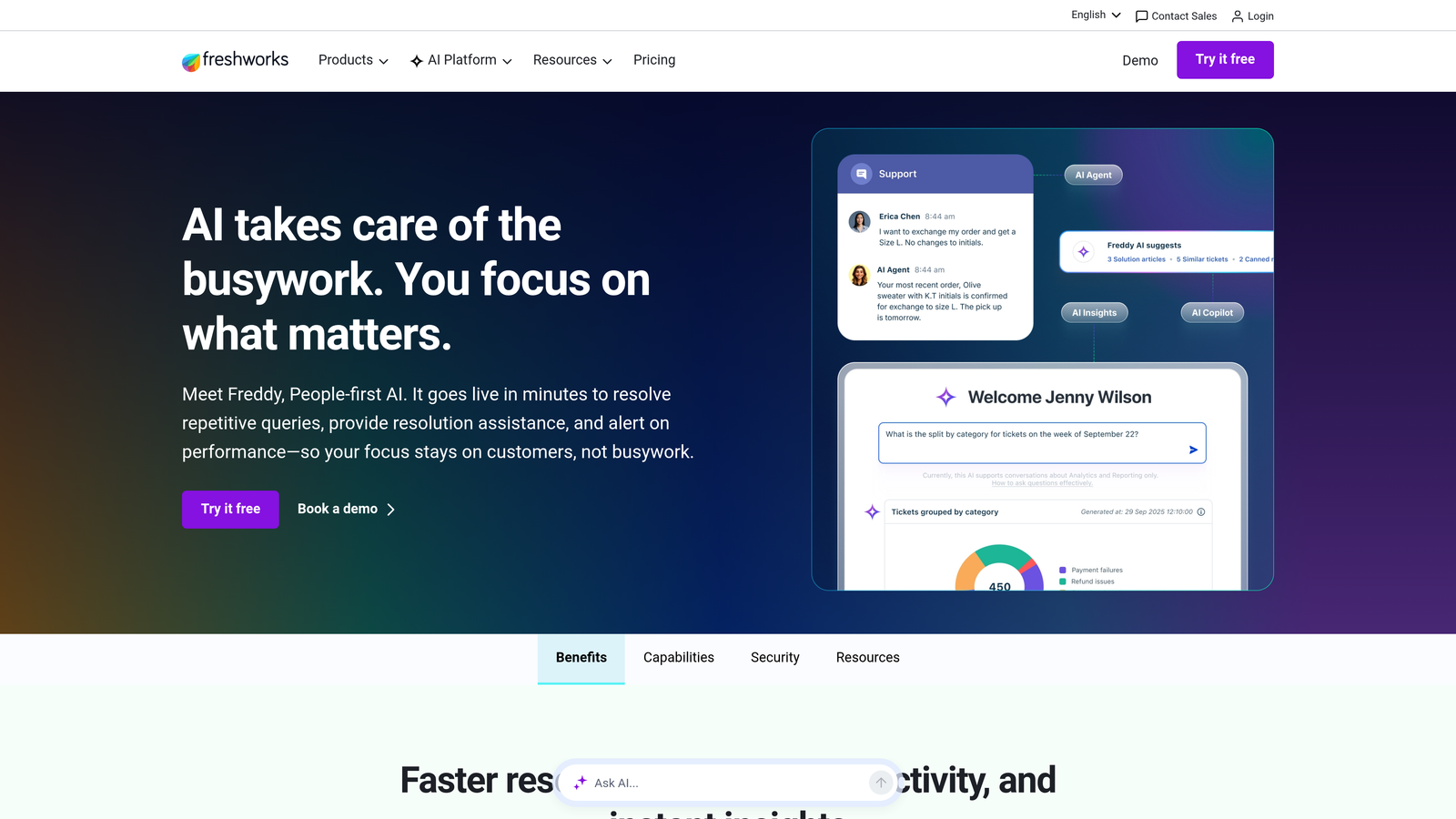
Freshdesk Freddy AI is Freshworks' AI assistant embedded across the Freshdesk platform, offering multilingual self-service automation and agent assistance within an affordable support suite.
Where This Tool Shines
Freddy AI's strength is that it covers multiple layers of the support workflow without requiring a premium budget. Freddy Self Service handles multilingual customer queries before they reach agents. Freddy Copilot assists agents with drafting responses in the customer's language. Freddy Insights surfaces trends across multilingual ticket data. That's a lot of coverage across one integrated suite.
For teams scaling from a single market into two or three new regions, Freshdesk's pricing structure makes the multilingual AI layer accessible without a significant cost jump. The tradeoff is that depth of AI capability is generally below what you'd find in dedicated AI-first platforms.
Key Features
Freddy Self Service: Handles multilingual customer queries autonomously, deflecting common questions before they enter the agent queue.
Freddy Copilot: Assists agents with multilingual response drafting and suggested replies within the Freshdesk interface.
Freddy Insights: Surfaces trends and patterns across multilingual ticket data to inform support strategy.
Cross-Suite Integration: Works across Freshdesk, Freshchat, and Freshservice for a consistent AI layer across the Freshworks ecosystem.
Competitive Pricing: Accessible pricing relative to enterprise alternatives makes it viable for mid-market teams watching unit economics carefully.
Best For
Growing B2B teams already using or considering Freshdesk who want multilingual AI without enterprise-level spend. A practical choice for companies expanding into two to four new language markets.
Pricing
Freddy AI is available as an add-on on Freshdesk plans; the Growth plan starts around $15/agent/month, making it one of the more accessible options on this list.
5. Tidio
Best for: Lean teams wanting fast multilingual AI deployment with minimal technical overhead
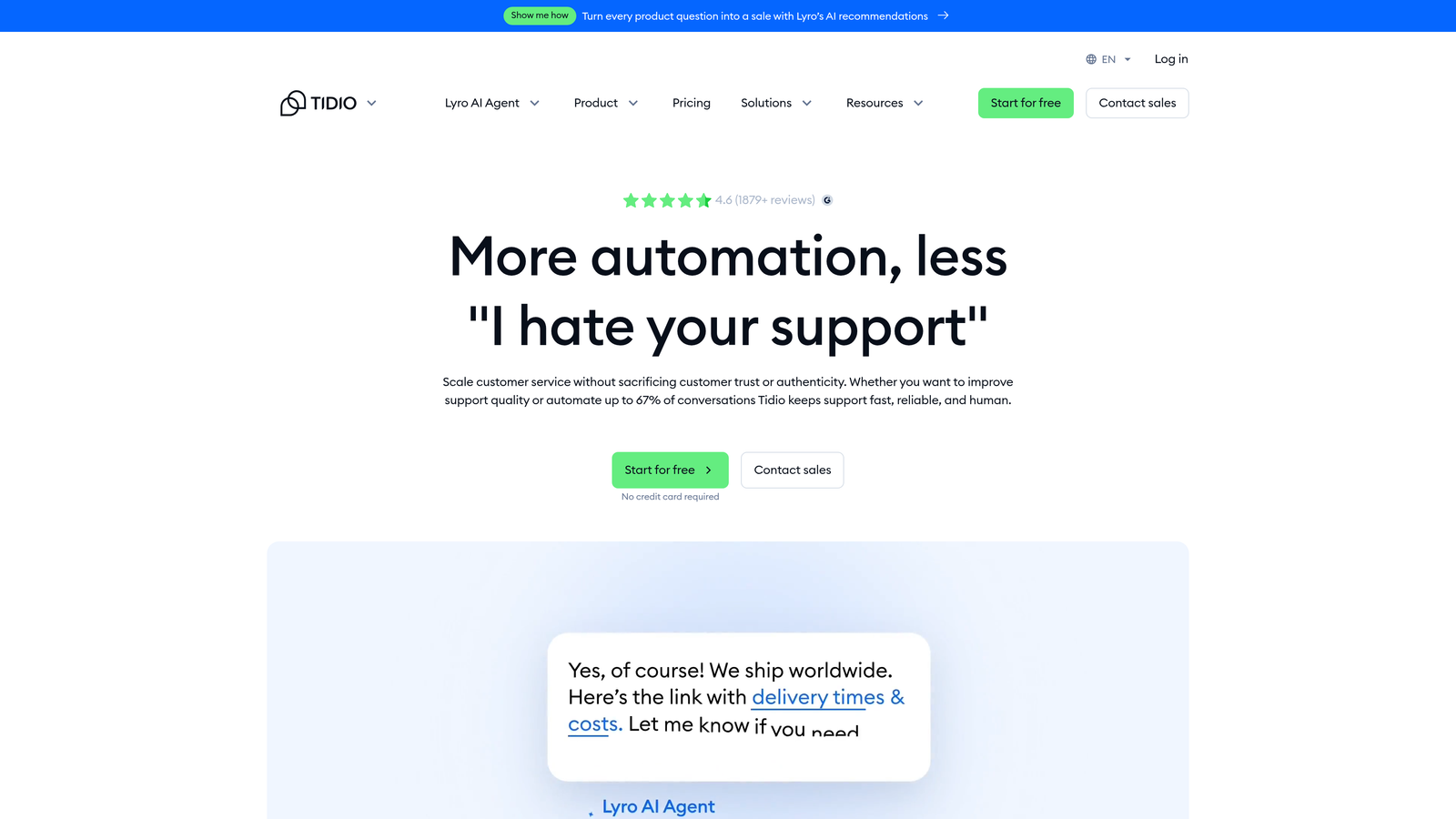
Tidio is an accessible AI customer service platform featuring Lyro AI, a conversational agent that handles multilingual support interactions with minimal setup required.
Where This Tool Shines
Tidio's appeal is speed to value. Lyro AI can be up and running across multiple languages without engineering resources or complex configuration. Automatic language detection means customers get responses in their language without any manual routing setup. For teams that have been putting off multilingual support because of implementation complexity, Tidio removes most of that barrier.
The honest limitation is scope. Lyro handles a defined set of conversations well and escalates beyond that boundary to live agents. For SaaS teams with complex, technical support queries, Lyro's ceiling may be reached frequently. It's a strong starting point, but not a complete solution for high-complexity support environments.
Key Features
Lyro AI Multilingual Conversations: Handles customer support interactions across languages with low technical overhead and automatic language detection.
Automatic Language Detection: Identifies the customer's language and responds accordingly without manual configuration per language.
Live Chat Fallback: Seamlessly hands off to human agents when Lyro reaches the boundary of its capabilities.
Pre-Built Automation Flows: Provides ready-made flows for common support scenarios that work across languages out of the box.
SaaS and E-Commerce Integrations: Connects with popular platforms to pull in relevant context for more accurate responses.
Best For
Small to mid-sized teams, particularly those new to AI support automation, who want to add multilingual capability quickly without a large implementation project. Also suitable as an entry-level option while evaluating more advanced platforms.
Pricing
Free plan available; Lyro AI starts from $29/month with paid plans scaling based on conversation volume.
6. Kustomer
Best for: Omnichannel support teams needing multilingual AI across chat, email, voice, and social
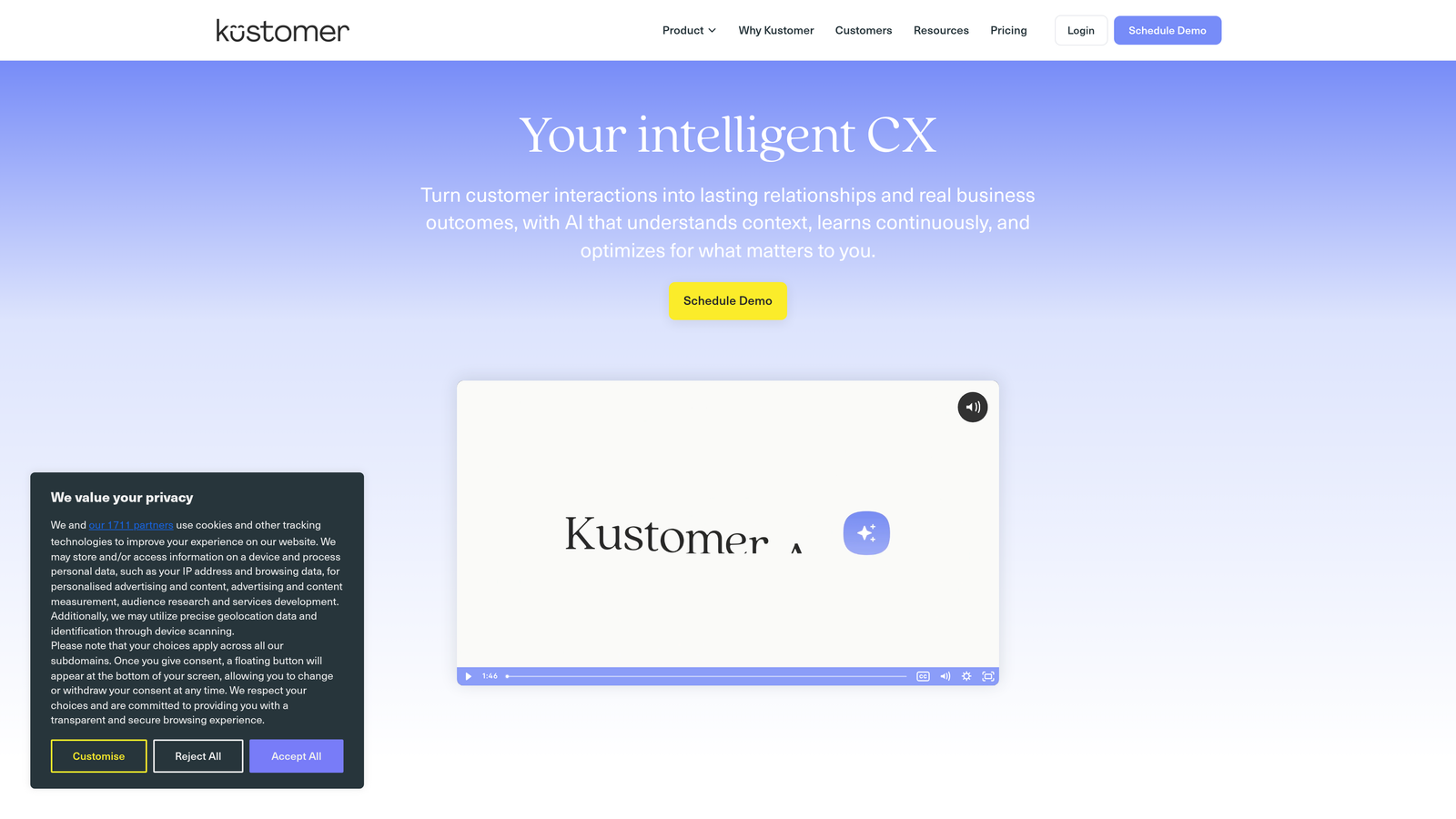
Kustomer is a CRM-native customer service platform with AI automation across omnichannel touchpoints, supporting multilingual interactions across chat, email, voice, and social.
Where This Tool Shines
Kustomer's differentiator is its CRM-native architecture. Every multilingual customer interaction is grounded in full customer history, not just the current conversation. An AI responding to a billing question in German has access to the customer's entire relationship context, which meaningfully improves resolution accuracy compared to tools that treat each conversation in isolation.
The unified agent workspace consolidates all channels into a single view with a conversation timeline, which matters significantly when customers are reaching out in multiple languages across multiple channels. Agents don't need to switch contexts to understand what a customer has already communicated.
Key Features
Omnichannel Multilingual AI: Handles multilingual interactions consistently across chat, email, voice, and social media channels.
CRM-Native Architecture: Every AI response is informed by full customer history and relationship context, not just the current ticket.
AI-Powered Routing: Automatically routes conversations in any language based on topic, urgency, and customer context.
Unified Agent Workspace: Consolidates all channels and conversation history into a single timeline view for agents handling multilingual queues.
Workflow Automation: Supports custom automation for multilingual support processes across the full customer journey.
Best For
Mid-market and enterprise teams running omnichannel support operations where customer history context is critical to resolution quality. Particularly strong for companies where customers interact across multiple channels in multiple languages.
Pricing
Enterprise pricing; plans start around $89/agent/month, positioning Kustomer toward teams with meaningful support volume that justifies the investment.
7. Forethought
Best for: Enterprise teams wanting intelligent multilingual triage before tickets reach human agents
Forethought is an enterprise AI platform focused on intelligent triage, routing, and resolution of support tickets, with multilingual classification capabilities that improve efficiency before human agents engage.
Where This Tool Shines
Forethought operates at the front of the support workflow. Before a ticket reaches a human agent, Forethought classifies it, routes it intelligently, and in many cases resolves it autonomously through Solveflows. That upstream intelligence means multilingual tickets don't pile up in a general queue waiting for a language-qualified agent to pick them up.
The integration breadth is a genuine strength for enterprise environments. Connecting with Zendesk, Salesforce, ServiceNow, and other major platforms means Forethought can layer multilingual intelligence on top of whatever helpdesk infrastructure is already in place, rather than requiring a platform migration.
Key Features
Multilingual Ticket Triage: Classifies and categorizes incoming tickets by language, intent, and urgency automatically.
Solveflows: Automated resolution paths that handle multilingual tickets end-to-end without agent involvement for eligible query types.
AI-Assisted Response Drafting: Helps agents draft responses in the ticket's original language, reducing time spent on multilingual reply composition.
Enterprise Integrations: Connects with Zendesk, Salesforce, ServiceNow, and other major helpdesk and CRM platforms.
Deflection Analytics by Language: Tracks resolution quality and deflection rates segmented by language to identify where AI is performing and where it needs improvement.
Best For
Enterprise support operations with high ticket volumes across multiple languages that need intelligent triage and routing to function at scale. Best suited for teams already using Zendesk, Salesforce, or ServiceNow who want to add an AI layer without replacing their core platform.
Pricing
Enterprise pricing; contact Forethought directly for a quote based on volume and integration requirements.
8. Chatbase
Best for: Teams wanting a no-code multilingual chatbot trained on their own documentation
Chatbase is a no-code AI chatbot builder that lets teams train a custom chatbot on their own documentation, with multilingual support powered by underlying LLM capabilities.
Where This Tool Shines
Chatbase's appeal is simplicity. You point it at your knowledge base, help docs, or URLs, and it builds a chatbot that can answer questions from that content in multiple languages. No engineers required. For teams that have comprehensive documentation but lack the resources to configure a full AI support platform, Chatbase offers a fast path to multilingual self-service.
The tradeoff is depth. Chatbase is a chatbot builder, not a full support operations platform. It doesn't have intelligent ticket routing, agent assist, or business intelligence layers. For straightforward FAQ-style support across multiple languages, it works well. For complex, multi-step support workflows, you'll hit its ceiling quickly.
Key Features
Knowledge Base Training: Trains the chatbot directly on your documentation, help articles, or website URLs without manual content entry.
Multilingual LLM Responses: Leverages GPT-4 to respond in the customer's language based on the content it was trained on.
Embeddable Chat Widget: Deploys as a chat widget on your website or within your product with minimal technical setup.
Conversation Analytics: Provides basic analytics on conversation volume, topics, and lead capture without requiring a separate analytics platform.
No Engineering Required: The entire setup process is accessible to non-technical team members, from training to deployment.
Best For
Lean teams, early-stage SaaS companies, or teams with strong documentation who want to add multilingual self-service quickly without a large implementation investment. A practical entry point before graduating to a more comprehensive platform.
Pricing
Free plan available; paid plans start from $19/month, making Chatbase one of the most accessible options on this list from a cost perspective.
9. Dixa
Best for: Mid-market and enterprise teams in Europe wanting multilingual AI with strong agent experience
Dixa is a conversational customer service platform combining AI automation with a unified agent workspace, featuring multilingual routing and AI-assisted responses for mid-market and enterprise teams.
Where This Tool Shines
Dixa takes a balanced approach to AI: automation handles what it can, and the agent workspace is designed to make human agents as effective as possible when they do engage. The unified workspace consolidates all channels into a single view, and AI-assisted response suggestions help agents handle multilingual queues without needing to be fluent in every language a customer might write in.
For European companies in particular, Dixa's GDPR-compliant infrastructure and strong regional presence make it a natural fit. Data residency and compliance requirements that can complicate deployments of US-first platforms are handled as baseline features rather than add-ons.
Key Features
Multilingual AI Routing: Automatically routes conversations based on language, topic, and agent availability across all channels.
Unified Agent Workspace: Consolidates chat, email, voice, and social into a single interface with full conversation context.
AI-Assisted Response Suggestions: Surfaces suggested replies in the customer's language to help agents respond accurately and efficiently.
Conversation Analytics with Language Segmentation: Tracks performance metrics segmented by language to identify gaps and optimization opportunities.
GDPR-Compliant Infrastructure: Built with European data requirements as a core feature, not an afterthought.
Best For
Mid-market and enterprise teams, particularly in Europe, who want multilingual AI support alongside a well-designed agent experience. Strong fit for companies where agent satisfaction and efficiency are as important as automation rates.
Pricing
Plans start around $39/agent/month; enterprise pricing is available for larger teams with more complex requirements.
Which Tool Is Right for Your Team
The right multilingual AI customer service tool depends heavily on where you are in your growth journey and what infrastructure you're already running on.
If you're a B2B SaaS company wanting AI-first multilingual support that learns continuously and integrates across your entire business stack, Halo AI is the strongest starting point. The combination of page-aware context, business intelligence, and autonomous ticket resolution goes well beyond what most multilingual tools offer.
If you're already committed to Intercom or Zendesk, their native AI layers offer the lowest-friction path to multilingual automation. Fin and Zendesk AI both leverage the infrastructure you've already built, which matters when the alternative is a platform migration.
For lean teams needing fast deployment without engineering resources, Chatbase and Tidio offer accessible entry points. Both can be running in days rather than weeks, and both support multilingual interactions through LLM foundations without complex configuration.
For enterprise operations with high ticket volumes across multiple regions, Forethought's upstream triage intelligence and Kustomer's CRM-native omnichannel architecture each solve distinct problems at scale. Dixa is the strongest choice for European teams where GDPR compliance and agent experience are non-negotiable priorities.
The most important shift in 2026 is moving from translation as a feature to AI that genuinely understands multilingual customer intent and routes, resolves, or escalates intelligently based on that understanding. Tools that only translate are falling behind tools that reason across languages.
Before committing to any platform, test it with real support scenarios in your target languages. Edge cases, including regional dialects, technical terminology, and emotional escalations, reveal far more than demo environments ever will.
Your support team shouldn't scale linearly with your customer base. Let AI agents handle routine tickets, guide users through your product, and surface business intelligence while your team focuses on complex issues that need a human touch. See Halo in action and discover how continuous learning transforms every interaction into smarter, faster support.