9 Best Omnichannel Support AI Platforms in 2026
Discover the 9 best omnichannel support AI platforms in 2026, evaluated for native AI capability, channel breadth, and integration depth. This guide helps B2B teams—from lean SaaS startups to enterprise helpdesks—find the right solution for unifying email, chat, social, and messaging into one intelligent layer that routes tickets, resolves issues autonomously, and gives agents full customer context.
 Grant CooperFounder13 min read
Managing customer support across email, chat, social, and messaging apps is hard enough without juggling disconnected tools. Omnichannel support AI platforms solve this by unifying every channel under one intelligent layer, routing tickets, resolving issues autonomously, and giving agents full context regardless of where a conversation started.
This list covers the best platforms available in 2026, evaluated on AI capability, channel breadth, integration depth, and real-world usability for B2B teams. Whether you're running a lean support team at a fast-growing SaaS company or managing a complex enterprise helpdesk, there's a solution here built for your situation.
A quick note on selection: every tool here was chosen for native AI (not just bolt-on automation), true omnichannel coverage, meaningful integrations with business tools, and transparent pricing. Halo AI is listed first because it's the platform behind this content, but every tool on this list earns its place on merit.
1. Halo AI
Best for: B2B SaaS teams that want AI-first support with deep product and business context
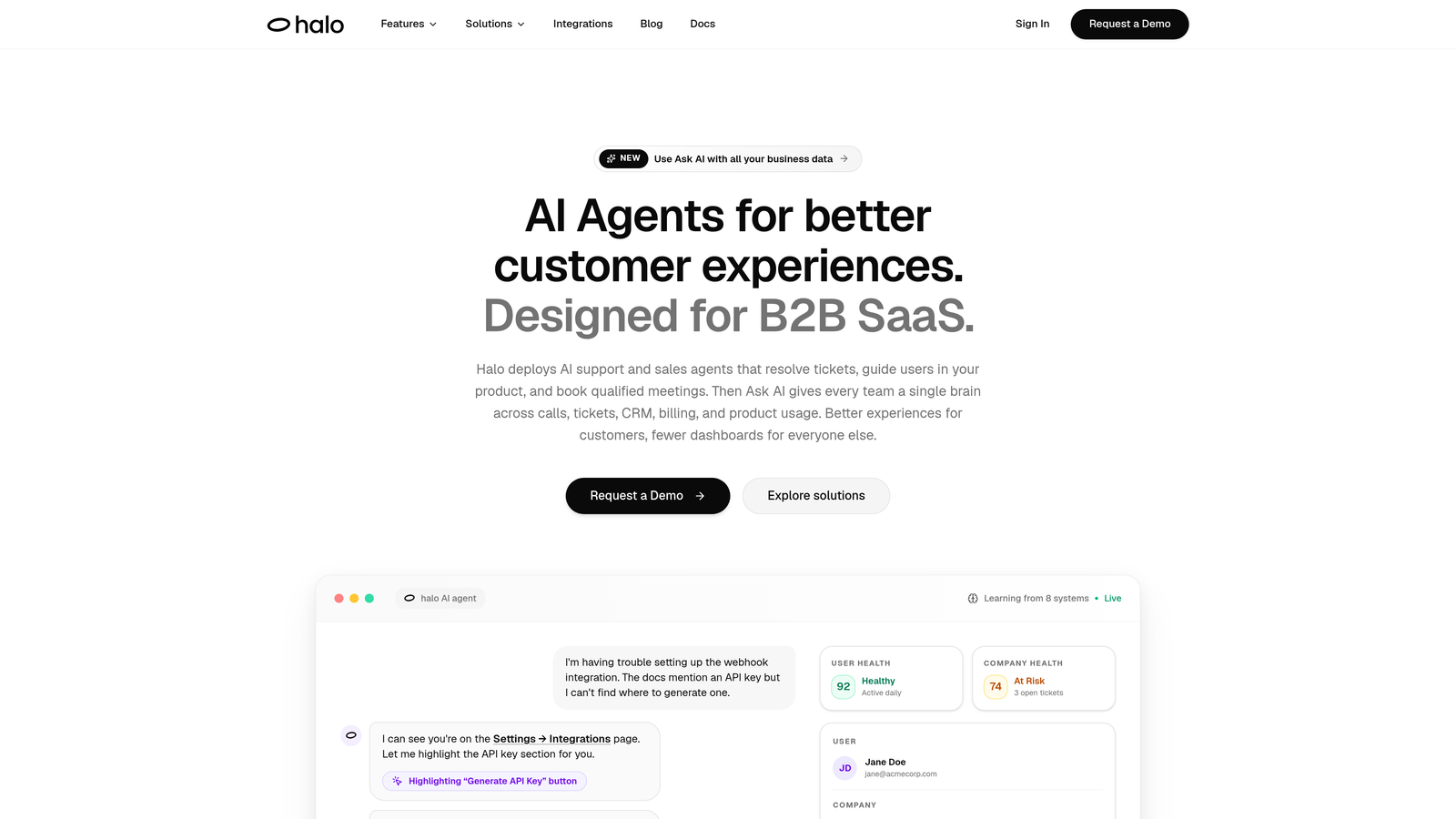
Halo AI is an AI-native customer support platform built specifically for B2B SaaS teams, deploying intelligent agents that resolve tickets, guide users through your product, and surface business intelligence signals.
Where This Tool Shines
Halo's most distinctive capability is its page-aware chat widget. The AI can see what page and UI state a user is on, which means it doesn't just respond to what someone types. It responds to what they're actually experiencing. That context gap is where most support tools fall short, and Halo closes it.
Beyond ticket resolution, Halo functions as a business intelligence layer. The smart inbox surfaces customer health signals, revenue anomalies, and churn risk indicators drawn from support conversations. This turns your support queue into a source of strategic signal, not just a list of problems to close.
Key Features
Page-Aware Chat Widget: The AI sees your user's current page and UI state, enabling visual guidance that goes beyond text-based responses.
Smart Inbox with Business Intelligence: Surfaces customer health signals, revenue anomalies, and churn indicators alongside standard support metrics.
Autonomous Ticket Resolution with Handoff: AI resolves tickets independently and escalates to live agents with full conversation context preserved.
Auto Bug Ticket Creation: Automatically generates structured bug reports from support conversations and files them directly into Linear or equivalent tools.
Deep Integration Stack: Connects with Linear, Slack, HubSpot, Intercom, Stripe, Zoom, PandaDoc, and Fathom, bridging support with your entire business stack.
Continuous Learning Loop: The AI improves from every resolved interaction, meaning the system gets smarter the more your team uses it.
Best For
Halo is best suited for B2B SaaS companies that want AI architecturally central to their support operation, not layered on top of a legacy helpdesk. It's particularly valuable for product teams that need support and product usage context to flow in the same direction.
Pricing
Pricing is not publicly listed. Contact the team directly at haloagents.ai for current rates and a demo.
2. Zendesk AI
Best for: Established teams that need a mature, enterprise-grade omnichannel helpdesk with broad integrations
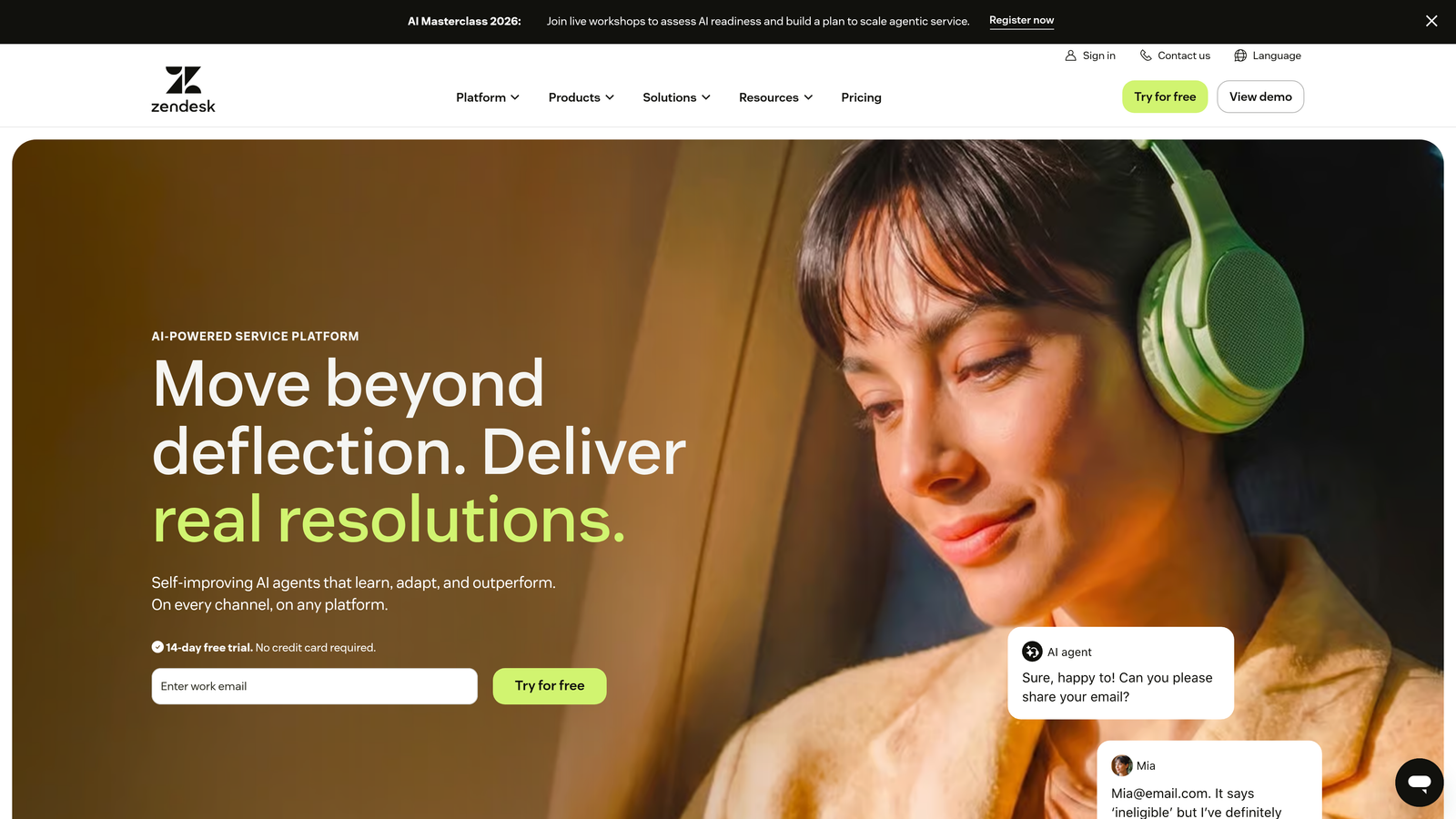
Zendesk AI is the AI-enhanced version of the industry's most established helpdesk platform, offering omnichannel coverage across email, chat, voice, and social with intelligent triage and automated resolution.
Where This Tool Shines
Zendesk's greatest strength is its maturity. The platform has been refined over many years, and the breadth of its channel coverage, combined with an app marketplace of over 1,000 integrations, means it can slot into almost any existing tech stack. For teams that need proven infrastructure and strong compliance posture, it's hard to beat.
The AI capabilities, delivered through the Zendesk AI suite, handle intelligent triage, suggested responses, and automated resolution for common query types. The honest caveat is that the AI layer feels additive to legacy infrastructure rather than architecturally native. That distinction matters more as AI-first platforms raise the bar for what autonomous resolution looks like.
Key Features
Omnichannel Inbox: Covers email, chat, voice, WhatsApp, Facebook Messenger, Instagram, and more from a unified workspace.
Intelligent Triage and Routing: Routes tickets based on intent, sentiment, and priority signals detected by AI.
AI-Suggested Responses: Surfaces recommended replies to agents and handles automated resolution for high-frequency queries.
1,000+ App Marketplace: Extensive pre-built integrations with CRM, billing, analytics, and engineering tools.
Enterprise Compliance: Strong security, audit, and compliance capabilities suited to regulated industries and large organizations.
Best For
Mid-market to enterprise teams that need a proven, well-supported platform with broad channel coverage and a large integration ecosystem. Particularly strong for organizations already invested in the Zendesk ecosystem.
Pricing
Suite plans start from approximately $55/agent/month. Verify current pricing at zendesk.com as rates change frequently.
3. Intercom
Best for: Product-led SaaS companies that want AI-powered in-app support with strong customer lifecycle context
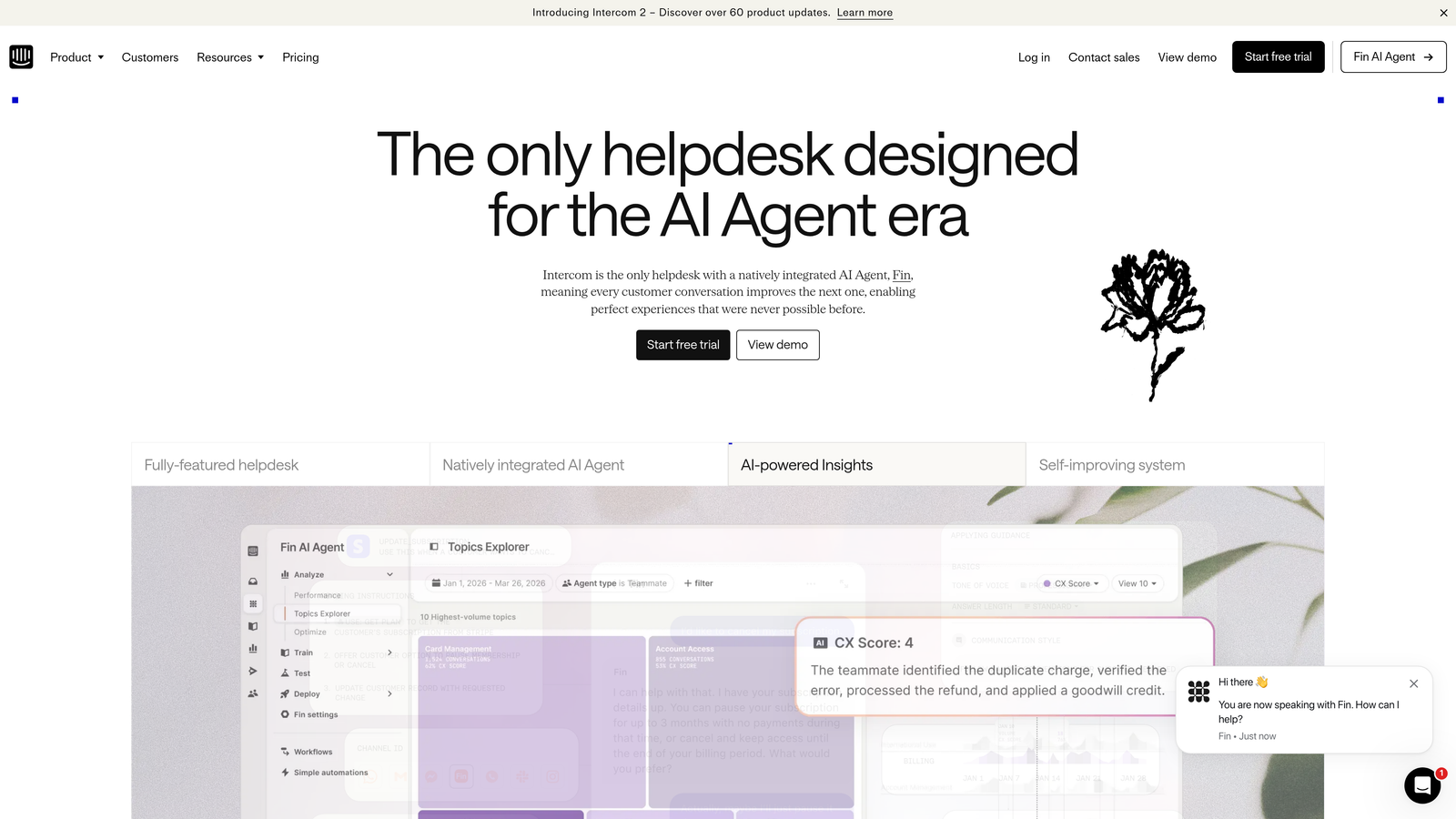
Intercom is a conversational support platform with a strong in-product messaging heritage and Fin, its AI agent designed to resolve inbound queries autonomously using your existing help content.
Where This Tool Shines
Intercom's Fin AI agent is genuinely capable of resolving a meaningful share of inbound queries without human involvement, drawing on your help center content to generate accurate, contextual responses. The in-product messaging experience is polished and deeply integrated with customer lifecycle data, which gives both AI and human agents useful context on who they're talking to.
Where Intercom particularly stands out is its fit for product-led growth companies. If your support motion is closely tied to onboarding, activation, and feature adoption, Intercom's combination of in-app messaging, lifecycle context, and conversation design tools creates a cohesive experience.
Key Features
Fin AI Agent: Resolves inbound queries autonomously using help center content, with usage-based pricing for AI resolutions.
Omnichannel Coverage: In-app chat, email, WhatsApp, and SMS, with phone support available via integrations.
Customer Lifecycle Context: Full contact and behavioral history available to both AI and human agents during every conversation.
Conversation Design Tools: Build custom AI workflows and branching conversation flows without engineering resources.
Product-Led Growth Fit: Designed for SaaS onboarding, activation, and support use cases in a single platform.
Best For
SaaS companies with a product-led growth motion, particularly those where onboarding and support overlap. Less suited to teams with heavy voice or phone support requirements.
Pricing
From approximately $29/seat/month for base plans; Fin AI usage-based pricing is additional. Verify current pricing at intercom.com.
4. Freshdesk (Freddy AI)
Best for: SMB and mid-market teams that need omnichannel support with strong value and a unified Freshworks ecosystem
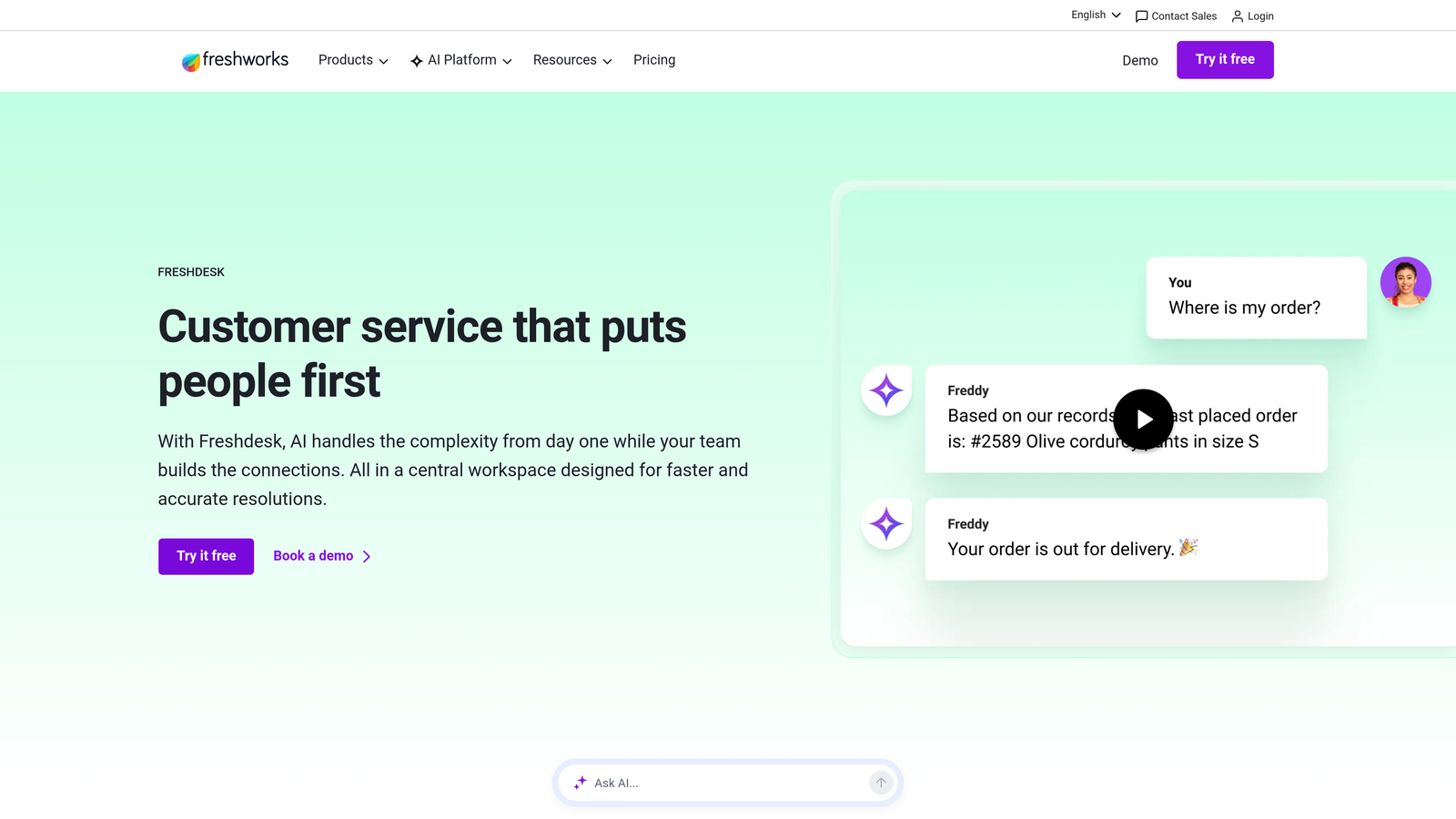
Freshdesk is Freshworks' omnichannel support platform with Freddy AI powering automation across ticketing, chat, and phone, making it a strong value option for growing teams.
Where This Tool Shines
Freshdesk's most compelling advantage is the breadth of the Freshworks suite. If your team also needs a CRM, ITSM capabilities, or a phone system, Freshworks offers all of these under one roof with Freddy AI running across each product. That unified ecosystem reduces integration complexity significantly for teams that would otherwise stitch together multiple vendors.
The value proposition is also genuinely strong. With a free tier for small teams and paid plans that remain competitive even at mid-market scale, Freshdesk is often the most cost-effective path to omnichannel AI support for teams that don't need enterprise-level complexity.
Key Features
Freddy AI Across Products: AI automation runs across Freshdesk (tickets), Freshchat (messaging), and Freshcaller (phone) in a unified experience.
Full Omnichannel Coverage: Email, chat, phone, WhatsApp, and social channels supported natively.
AI Ticket Categorization and Routing: Freddy automatically categorizes, prioritizes, and routes incoming tickets with suggested responses for agents.
Unified Freshworks Ecosystem: Native integration with Freshsales CRM, Freshservice ITSM, and other Freshworks products.
Accessible Free Tier: Small teams can get started without a financial commitment, making evaluation low-risk.
Best For
SMB and mid-market teams looking for strong omnichannel coverage at a competitive price point, particularly those who would benefit from the broader Freshworks product suite.
Pricing
Free tier available; paid plans from approximately $15/agent/month. Verify current pricing at freshworks.com.
5. Salesforce Service Cloud
Best for: Large enterprises running support within the Salesforce ecosystem that need AI with full CRM data access
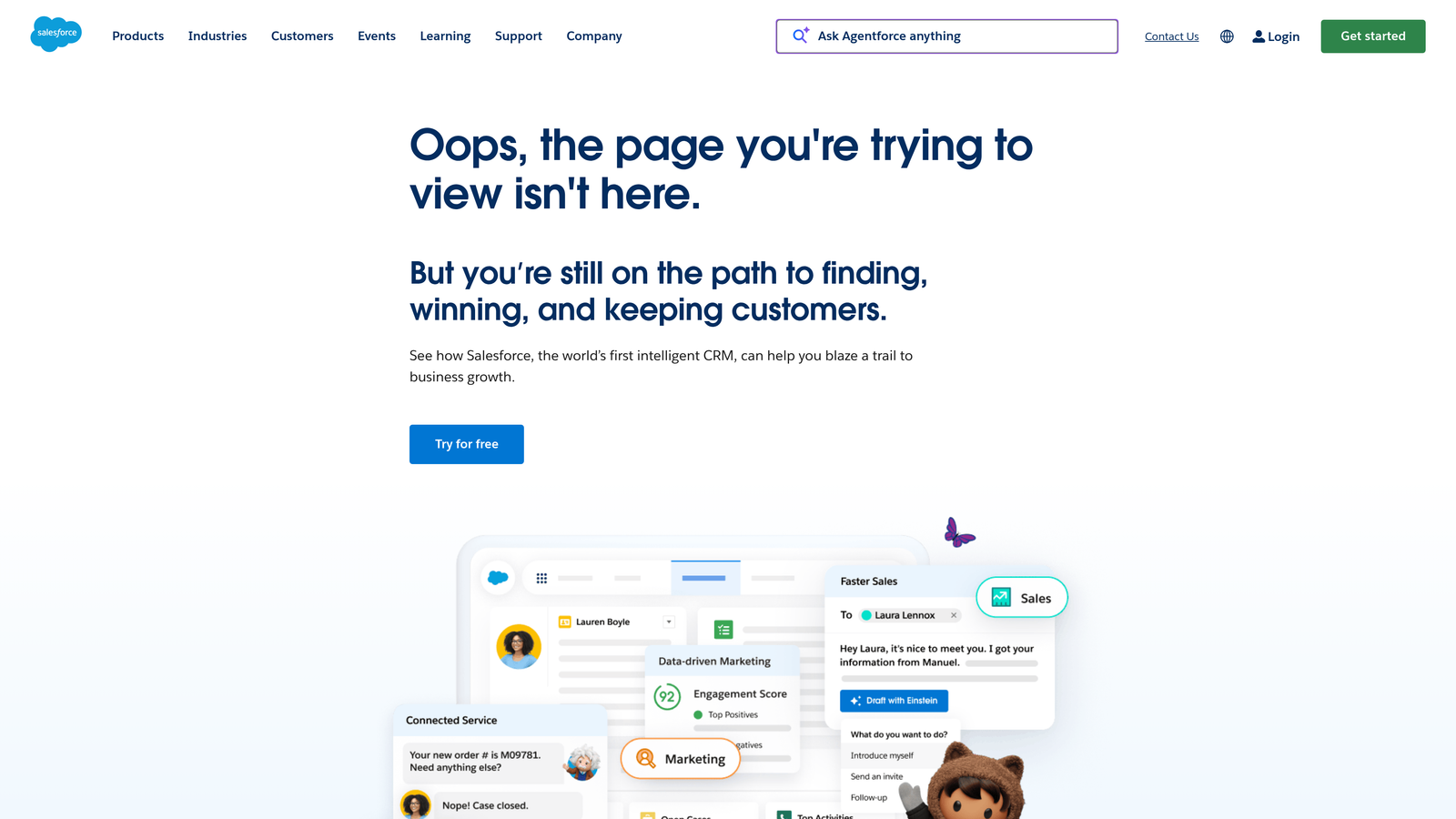
Salesforce Service Cloud is an enterprise-grade omnichannel support platform with Einstein AI using full Salesforce CRM data to power smarter resolutions, routing, and case management.
Where This Tool Shines
The defining advantage of Service Cloud is Einstein AI's access to the full Salesforce data model. When an AI agent or human agent handles a support case, they're working with complete context: purchase history, open deals, contract status, marketing engagement, and more. That depth of context is genuinely difficult to replicate through integrations alone.
Service Cloud also covers the broadest range of support channels at the enterprise level, including field service capabilities that most support platforms don't touch. For organizations with complex, multi-touch customer journeys that span sales, service, and field operations, it's a natural fit.
Key Features
Einstein AI with Full CRM Context: AI operates on complete Salesforce customer data, including deals, contracts, and engagement history.
Enterprise Omnichannel: Email, chat, phone, social, messaging, and field service covered in a single platform.
Intelligent Case Routing: Priority scoring and routing logic informed by full customer and deal data.
Enterprise Compliance and Security: Deep audit capabilities, data residency options, and compliance tooling for regulated industries.
Native Salesforce Integration: Seamless connection with Sales Cloud, Marketing Cloud, and the broader Salesforce platform.
Best For
Large enterprises already committed to the Salesforce ecosystem. Likely overkill for SMB or mid-market teams, and requires meaningful implementation investment to get right.
Pricing
Enterprise pricing; contact Salesforce directly for current rates at salesforce.com.
6. Tidio
Best for: Small e-commerce and SMB teams that want fast AI deployment without enterprise complexity
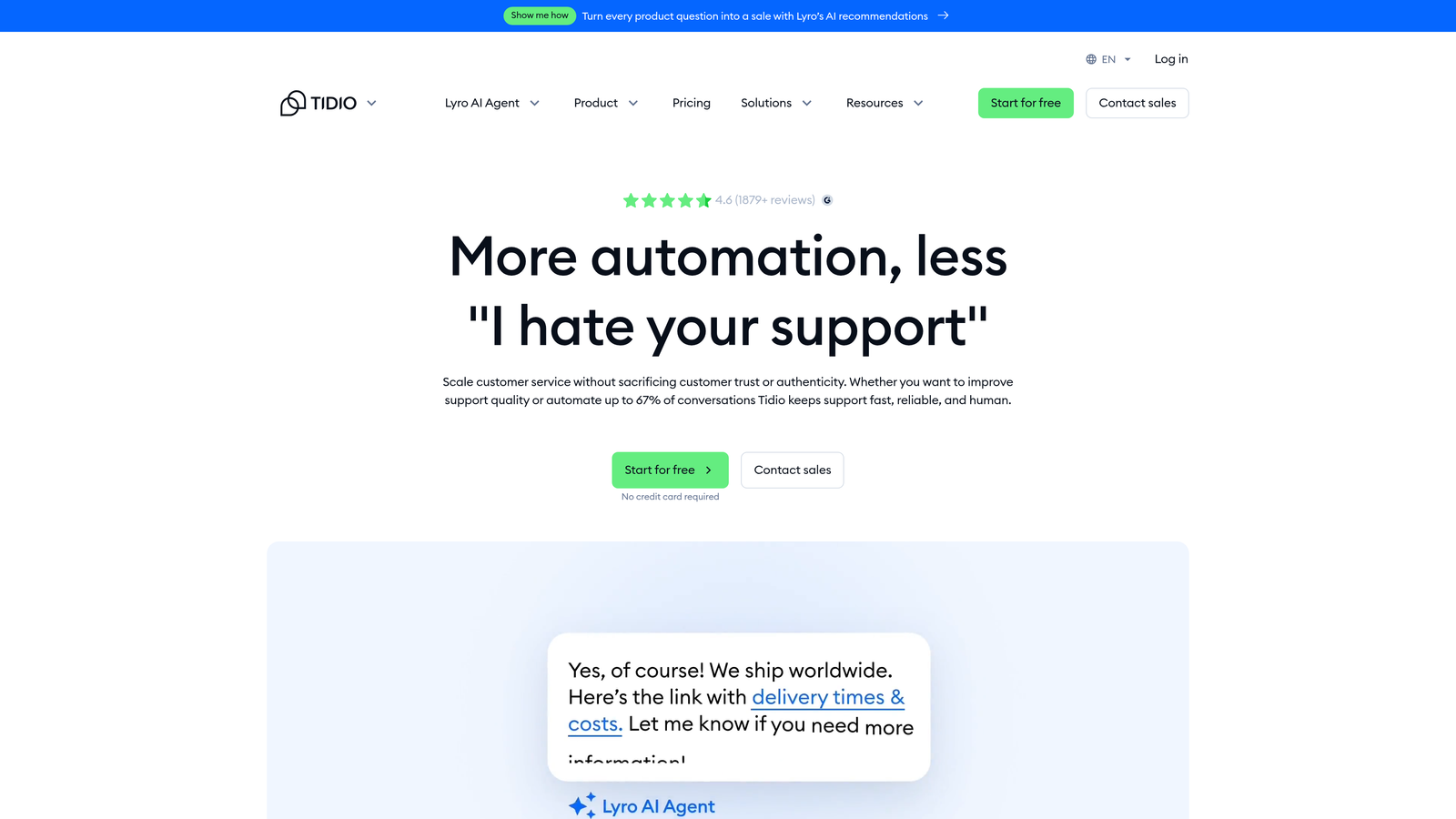
Tidio is a lightweight omnichannel support platform with Lyro AI, designed for fast deployment and strong e-commerce integrations, making it the most accessible entry point on this list.
Where This Tool Shines
Tidio's strength is simplicity. Lyro AI can be up and running quickly, and the platform's native integrations with Shopify and WooCommerce mean e-commerce teams get relevant context like order status and purchase history without complex setup. For teams that need to move fast and don't have dedicated support operations staff, this is genuinely valuable.
The visual chatbot builder also makes it easy to design custom conversation flows without engineering support. That kind of self-serve configurability matters for small teams where everyone wears multiple hats.
Key Features
Lyro AI Agent: Handles automated chat resolution with quick setup and a low barrier to getting started.
Omnichannel Coverage: Live chat, email, Facebook Messenger, and Instagram supported natively.
E-Commerce Integrations: Native Shopify and WooCommerce integrations bring order and customer data into support conversations.
Visual Chatbot Builder: Design custom conversation flows without writing code.
Free Tier Available: Teams can start without upfront cost and scale into paid plans as needs grow.
Best For
Small e-commerce businesses and SMBs that want accessible AI-powered chat support with minimal setup. Less suited to complex B2B support environments or teams needing broad channel coverage beyond chat and social.
Pricing
Free tier available; Lyro AI plans from approximately $29/month. Verify current pricing at tidio.com.
7. Kustomer
Best for: High-volume consumer support teams that need a unified customer timeline across every channel
Kustomer is a CRM-native support platform that gives AI and agents a unified timeline of every customer interaction across all channels, making it particularly strong for high-volume consumer support operations.
Where This Tool Shines
Kustomer's core architectural decision, building the support platform on top of a CRM rather than treating CRM data as an integration, pays off in the quality of AI and agent context. Every conversation happens against a backdrop of complete customer history across every channel and touchpoint. For support teams handling complex, multi-touch customer journeys, that unified timeline is a meaningful operational advantage.
The platform is particularly well-suited to consumer brands managing high volumes of support interactions where customer history and sentiment context directly affect resolution quality. The AI's ability to draw on that full history, rather than just the current conversation thread, leads to more relevant and efficient resolutions.
Key Features
Unified Customer Timeline: Every interaction across email, chat, social, SMS, WhatsApp, and voice appears in a single chronological view.
AI on Full Customer History: AI operates on complete interaction history, not just the current ticket, for more contextual resolutions.
Omnichannel Routing: Intelligent prioritization and routing across all supported channels.
CRM-Native Architecture: Customer data lives in the platform natively, eliminating the need for a separate CRM integration.
High-Volume Journey Support: Designed for complex, multi-touch customer journeys with many interaction points.
Best For
Consumer-facing brands managing high support volumes where full customer history is critical to resolution quality. Less focused on B2B SaaS use cases than some alternatives on this list.
Pricing
Contact Kustomer directly for current pricing at kustomer.com.
8. Sprinklr Service
Best for: Global enterprise brands managing customer support at social scale across 30+ digital channels
Sprinklr Service is an enterprise digital and social customer service platform with the broadest channel coverage on this list, purpose-built for global brands managing support across social media at scale.
Where This Tool Shines
No platform on this list matches Sprinklr's channel breadth. With coverage across 30+ channels including Twitter/X, Facebook, Instagram, TikTok, WhatsApp, email, chat, and voice, it's built for organizations where social is a primary support channel, not an afterthought. The integrated brand monitoring and sentiment analysis capabilities mean support and brand teams can work from the same data layer.
The AI triage and routing capabilities are designed for the specific challenge of high-volume social support, where conversation velocity and public visibility create operational pressures that standard helpdesk tools aren't built to handle. For enterprise brands managing thousands of social interactions daily, that specialization matters.
Key Features
30+ Channel Coverage: The most comprehensive channel list on this list, spanning social, messaging, email, chat, and voice.
AI Triage Across Social and Digital: Intelligent routing and prioritization designed for the pace and volume of social support.
Brand Monitoring and Sentiment Analysis: Integrated listening and sentiment capabilities alongside customer service operations.
Enterprise Governance and Compliance: Robust reporting, audit trails, and governance tools for regulated or complex organizations.
Unified Agent Workspace: All channels managed from a single agent interface regardless of where the conversation originated.
Best For
Large enterprise brands with significant social support volume and global operations. Sprinklr's complexity and pricing make it unsuitable for SMB or mid-market teams without dedicated implementation resources.
Pricing
Enterprise pricing; contact Sprinklr for current rates at sprinklr.com.
9. HubSpot Service Hub
Best for: HubSpot CRM users that want native omnichannel support with full contact and deal context on every ticket
HubSpot Service Hub is HubSpot's support module that gives teams using HubSpot CRM a native omnichannel support layer with AI assistance and full contact and deal context available on every conversation.
Where This Tool Shines
The core value proposition here is integration depth with HubSpot CRM. If your team already lives in HubSpot for sales and marketing, Service Hub means every support ticket comes with complete contact, company, and deal history attached automatically. There's no integration to configure, no data sync to maintain, and no context lost in translation between systems.
The AI capabilities handle reply suggestions and ticket summarization effectively, though they're less advanced than dedicated AI-first support platforms. For teams where CRM context matters more than cutting-edge AI autonomy, that's a reasonable tradeoff, particularly given the accessible entry-level pricing.
Key Features
Native HubSpot CRM Integration: Full contact, company, and deal data available on every ticket without any integration setup.
AI Reply Suggestions and Summarization: AI assists agents with suggested responses and conversation summaries to speed resolution.
Shared Inbox and Help Desk: Team collaboration tools built into the same workspace as ticket management.
Free Tools Available: Entry-level capabilities accessible without a paid plan, scaling with your HubSpot subscription.
Best For
Teams already using HubSpot CRM that want to add omnichannel support without leaving the HubSpot ecosystem. Less compelling for teams not already on HubSpot, where dedicated support platforms offer stronger AI capabilities.
Pricing
Free tools available; paid plans from approximately $15/seat/month. Verify current pricing at hubspot.com.
Which Platform Is Right for Your Team?
The right omnichannel support AI platform depends less on feature checklists and more on where your team is starting from and what you're optimizing for. Here's a practical breakdown.
If you're a B2B SaaS team that wants AI-first support with product context: Halo AI is built specifically for this. The page-aware widget, business intelligence layer, and deep integrations with tools like Linear, Stripe, and HubSpot make it the strongest fit for SaaS support operations that want AI architecturally central, not bolted on.
If you need a proven enterprise platform with broad integrations: Zendesk AI remains the safe, well-supported choice. The AI isn't the most advanced on this list, but the ecosystem maturity and channel coverage are hard to match.
If you're running a product-led growth motion: Intercom's Fin AI and in-product messaging capabilities are purpose-built for this use case, particularly for teams where onboarding and support are closely intertwined.
If budget is a primary constraint: Freshdesk and HubSpot Service Hub both offer genuine omnichannel AI capabilities at accessible price points, with free tiers to get started.
If social scale is your primary challenge: Sprinklr Service has no real competition on channel breadth for enterprise brands managing high-volume social support.
One broader point worth keeping in mind: the gap between "helpdesk with AI features" and "AI-native support platform" is widening. Platforms where AI is architecturally central, learning continuously from every interaction, tend to compound in value over time in ways that bolt-on AI additions don't. That learning loop is worth evaluating carefully in any demo or trial.
Your support team shouldn't scale linearly with your customer base. Let AI agents handle routine tickets, guide users through your product, and surface business intelligence while your team focuses on complex issues that need a human touch. See Halo in action and discover how continuous learning transforms every interaction into smarter, faster support.