8 Best On-Premise AI Support Software Solutions in 2026
This guide reviews the 8 best on premise AI support software solutions available in 2026, helping B2B teams in regulated industries — subject to HIPAA, GDPR, or strict data sovereignty rules — deploy powerful AI-driven customer support entirely within their own infrastructure. Each platform is evaluated on deployment flexibility, AI capability, compliance features, integrations, and total cost of ownership.
 Grant CooperFounder13 min read
For many B2B companies in regulated industries, cloud-based support tools aren't just inconvenient — they're off the table entirely. Data sovereignty requirements, HIPAA mandates, GDPR obligations, and internal security policies mean that customer data must stay within your own infrastructure. Full stop.
But on-premise doesn't mean settling for outdated technology. A new generation of AI-powered support software can be deployed within your own environment, giving you the intelligence of modern AI agents without handing your data to a third-party cloud provider.
Below are the top on-premise AI support software solutions available in 2026, covering everything from fully self-hosted open-source platforms to enterprise private cloud deployments. Tools were evaluated on deployment flexibility, AI capability depth, integration ecosystem, security and compliance features, and total cost of ownership.
1. Halo AI
Best for: B2B product teams wanting AI-first support automation with strong data control and deep integrations
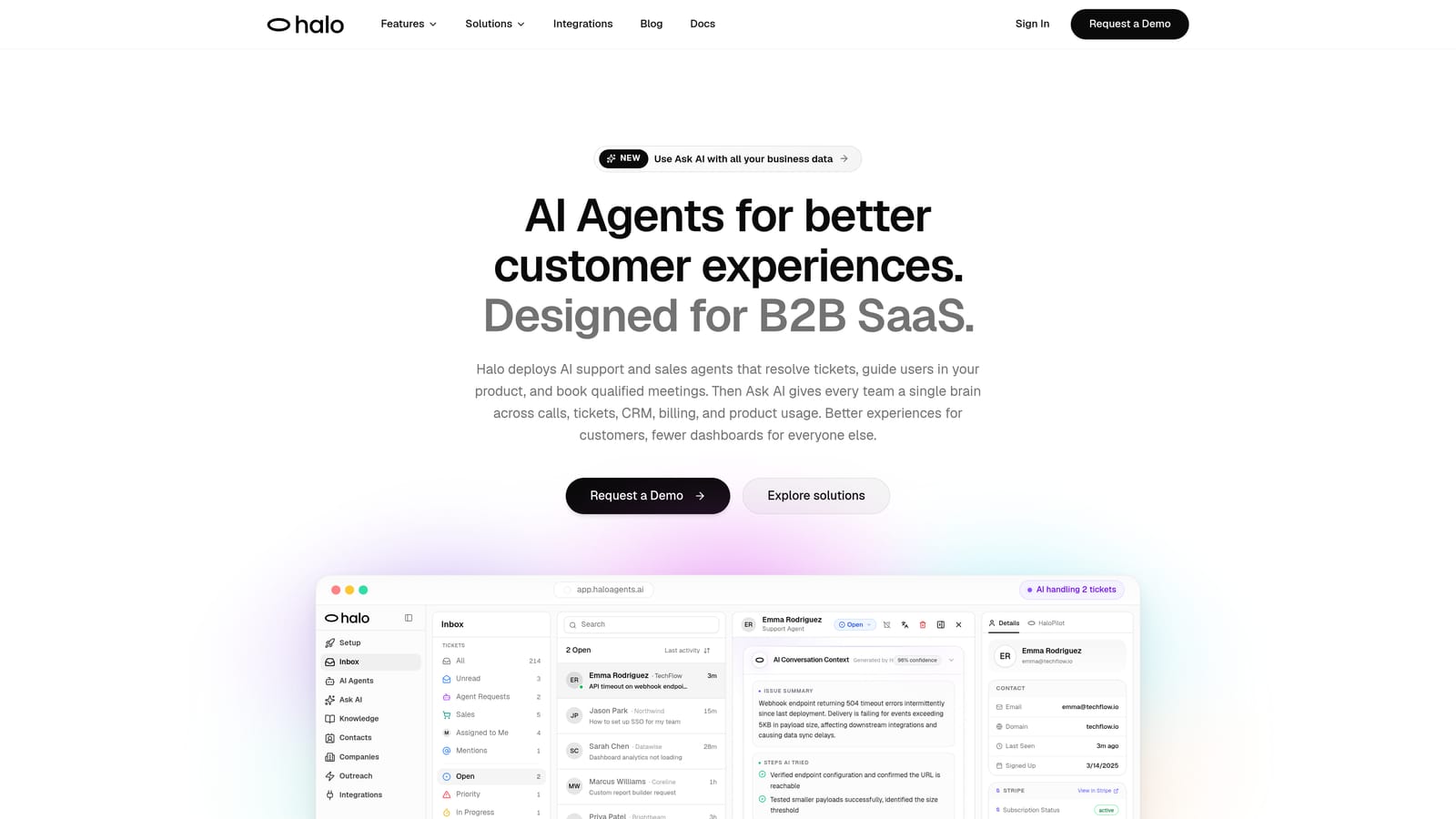
Halo AI is an AI-first customer support platform that deploys intelligent agents to resolve tickets, guide users through your product, and generate bug reports — continuously learning from every interaction.
Where This Tool Shines
Halo AI is worth a transparent note upfront: it is primarily a cloud SaaS platform, but with strong data isolation options and private deployment configurations that make it a serious contender for teams evaluating on-premise alternatives. If your requirement is bare-metal self-hosting, Halo may not be the fit. But if you need AI-first intelligence with meaningful data control and are open to dedicated or private cloud deployments, it's one of the most capable options on this list.
What genuinely sets Halo apart is its architecture. Rather than bolting AI onto a legacy helpdesk, Halo was built AI-first. The page-aware chat widget sees what the user sees, enabling contextual guidance rather than generic responses. Every ticket interaction feeds back into the system, making the agents measurably smarter over time. The smart inbox goes beyond ticket management, surfacing customer health signals, anomaly detection, and revenue intelligence that most support tools simply don't provide.
Key Features
Intelligent AI Agents: Autonomously resolve support tickets without requiring human intervention on routine issues.
Page-Aware Chat Widget: Understands the user's current context within your product, enabling precise visual guidance rather than one-size-fits-all answers.
Smart Inbox with Business Intelligence: Goes beyond ticketing to surface customer health signals, revenue intelligence, and anomaly detection across your support data.
Auto Bug Ticket Creation: Automatically generates and routes bug reports to Linear or your engineering stack, closing the loop between support and product.
Live Agent Handoff: Seamlessly escalates complex issues to human agents when AI has reached its limits.
Deep Integration Ecosystem: Connects with Linear, Slack, HubSpot, Intercom, Stripe, Zoom, PandaDoc, and Fathom out of the box.
Best For
Product teams and B2B SaaS companies that want modern AI support capabilities without scaling headcount. Particularly strong for teams that need their support platform to connect across the full business stack, not just handle tickets in isolation. Teams with strict bare-metal self-hosting requirements should contact Halo directly to discuss private deployment options.
Pricing
Contact Halo AI directly for enterprise and private deployment pricing. Given the platform's integration depth and AI-first architecture, pricing is tailored to deployment scope and team size.
2. Freshdesk (Freshworks)
Best for: Mid-market and enterprise teams already in the Freshworks ecosystem needing private cloud deployment
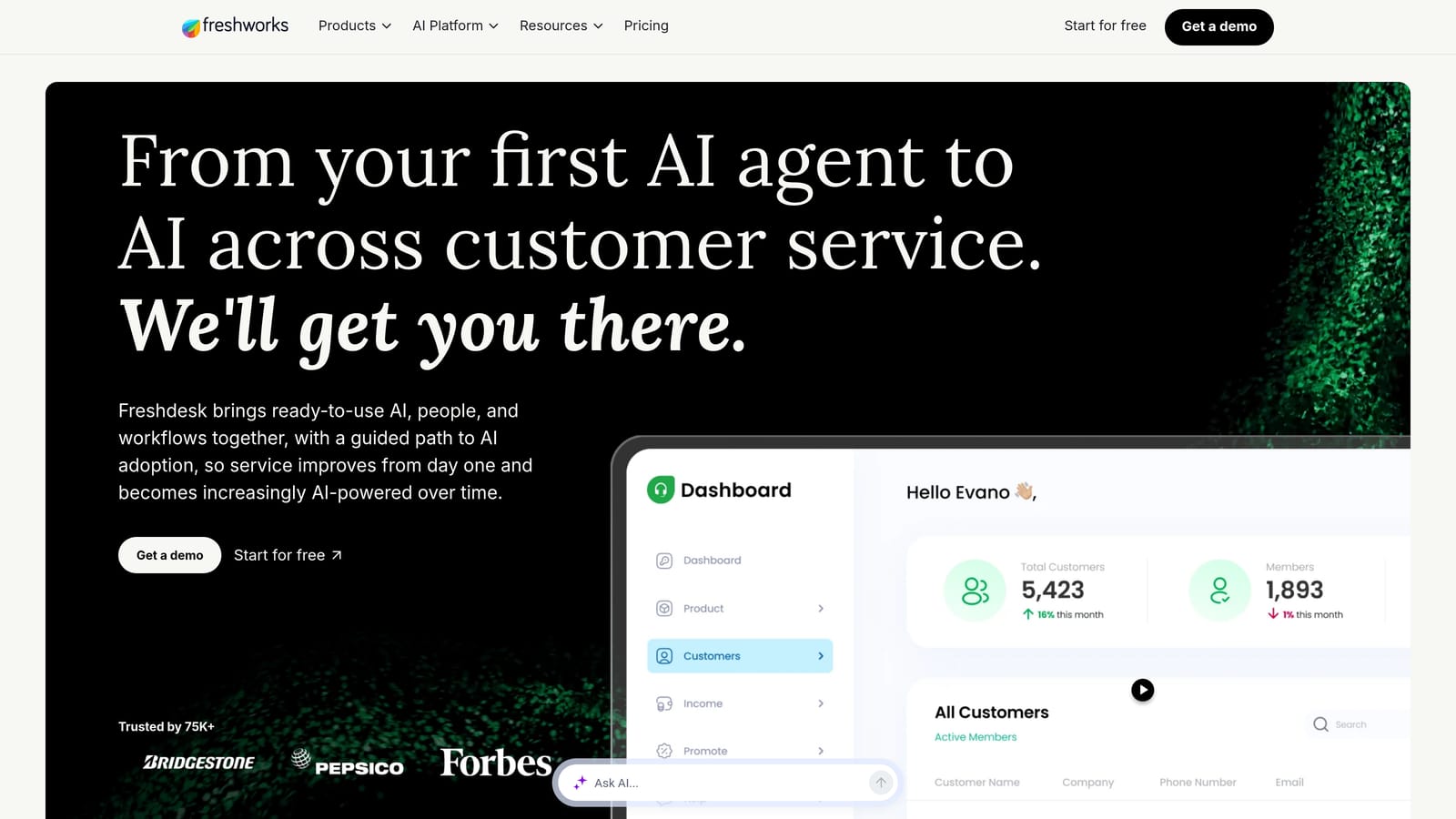
Freshdesk is a mature, enterprise-ready helpdesk platform with Freddy AI capabilities and private cloud or on-premise deployment options for regulated industries.
Where This Tool Shines
Freshdesk has been around long enough to have worked out most of the rough edges that plague newer entrants. Its Freddy AI layer adds meaningful automation on top of a well-established ticketing foundation: suggested replies, ticket summarization, and agent assist features that reduce the cognitive load on support teams without requiring significant configuration.
For enterprise buyers, the private cloud and on-premise deployment options make Freshdesk a legitimate option in regulated sectors. The trade-off is that accessing these deployment modes requires enterprise-tier contracts, so smaller teams will find the on-premise path cost-prohibitive. If you're already using other Freshworks products like Freshsales or Freshservice, the ecosystem coherence is a genuine advantage.
Key Features
Freddy AI: Provides suggested replies, ticket summarization, and agent assist capabilities built directly into the helpdesk workflow.
Private Cloud and On-Premise Deployment: Available for enterprise customers with data residency and compliance requirements.
Omnichannel Support: Covers email, live chat, phone, and social media from a single platform.
Automation and SLA Management: Robust rule-based automation with configurable SLA policies and escalation paths.
Integration Marketplace: Large library of pre-built integrations with CRMs, project management tools, and communication platforms.
Best For
Enterprise teams in financial services, healthcare, or other regulated industries that need a proven helpdesk platform with AI assist features and the option for private or on-premise deployment. Best suited for organizations already invested in the Freshworks product ecosystem.
Pricing
Enterprise plans are required to access on-premise and private cloud deployment options. Contact Freshworks sales directly for current pricing, as it varies by deployment configuration and contract size.
3. Zammad
Best for: Teams wanting a fully open-source, self-hosted helpdesk with a modern UI and zero licensing costs
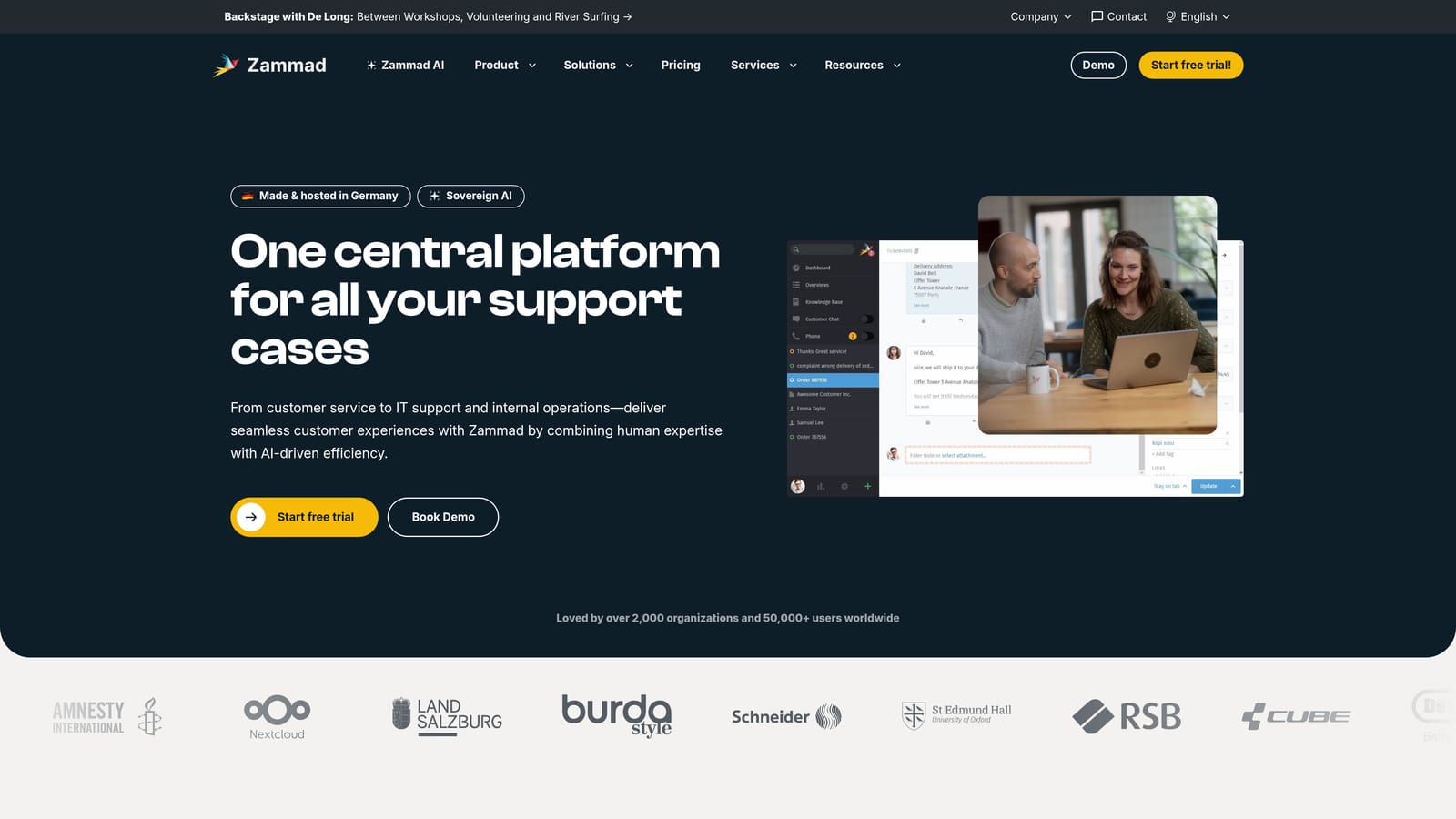
Zammad is a fully open-source, self-hosted helpdesk and customer support system with a modern web interface and an active developer community.
Where This Tool Shines
Zammad occupies a sweet spot that's surprisingly hard to find: genuinely modern UI design in an open-source package. Many self-hosted helpdesk tools feel like they were designed in 2009 and never updated. Zammad doesn't have that problem. The interface is clean, the ticket management workflow is intuitive, and the REST API gives engineering teams the flexibility to build custom integrations without fighting the platform.
AI capabilities in Zammad are growing but remain more limited compared to AI-first platforms. Think of it as a strong helpdesk foundation that you can extend with AI integrations rather than an AI-native platform out of the box. For teams whose primary requirement is data sovereignty with a solid helpdesk workflow, Zammad delivers well.
Key Features
100% Open Source: Deploy on your own servers with full data ownership and no vendor lock-in.
Multi-Channel Support: Handles email, phone, live chat, and social media channels from a unified interface.
REST API: Comprehensive API for custom integrations with internal tools and third-party systems.
Role-Based Access Control: Granular permissions and audit logs for compliance-conscious environments.
Growing AI Assist Features: Recent releases have introduced AI-assisted capabilities with continued development on the roadmap.
Best For
Engineering-led teams or organizations with internal DevOps capacity that want a fully self-hosted helpdesk with no licensing fees. Particularly well-suited for companies that need data sovereignty guarantees and are comfortable managing their own infrastructure.
Pricing
Free for self-hosted open-source deployments. Hosted managed plans start at approximately €5 per agent per month, though pricing should be confirmed directly with Zammad as it may have changed.
4. Chatwoot
Best for: Teams wanting open-source omnichannel support with Docker or Kubernetes self-hosting
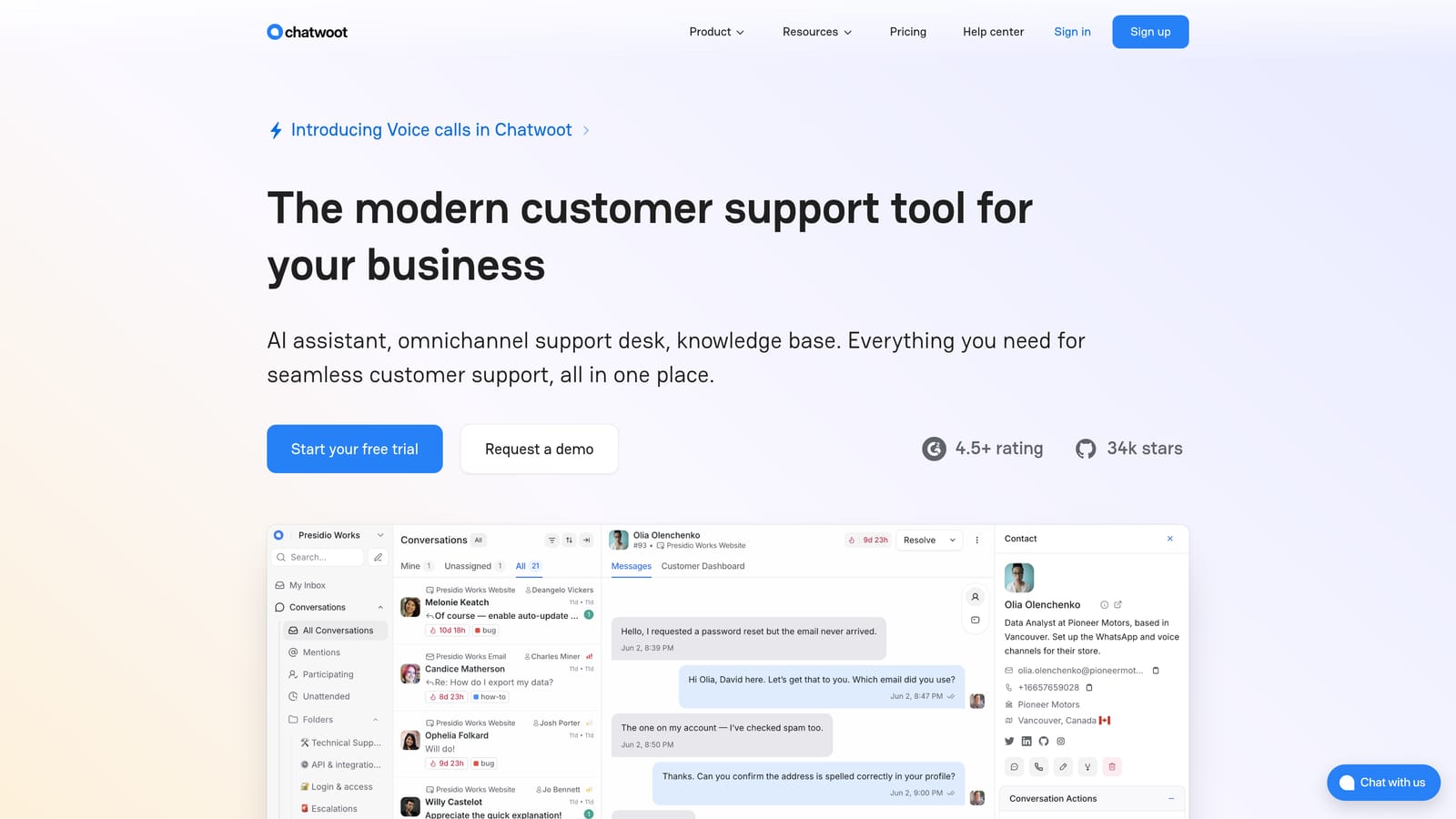
Chatwoot is an open-source omnichannel customer support platform deployable via Docker or Kubernetes, with an active GitHub community and frequent release cadence.
Where This Tool Shines
Chatwoot's strength is its channel breadth combined with its self-hosting flexibility. If your customers reach you across email, live chat, WhatsApp, social media, and API channels, Chatwoot consolidates all of that into a single inbox without forcing you into a cloud dependency. The Docker and Kubernetes deployment paths are well-documented, making it accessible to teams with standard DevOps capabilities.
The open-source community around Chatwoot is genuinely active, which matters for long-term viability. Frequent releases mean the platform keeps pace with evolving requirements, and the webhook and API support gives teams a solid foundation for layering in custom AI integrations as their needs grow.
Key Features
Self-Hosted via Docker or Kubernetes: Full data sovereignty with well-documented deployment paths on your own infrastructure.
Omnichannel Inbox: Unified view across email, live chat, WhatsApp, social media, and API channels.
Team Collaboration Tools: Canned responses, labels, conversation assignments, and internal notes for agent coordination.
Webhook and API Support: Flexible integration hooks for connecting custom AI models or third-party automation tools.
Active Open-Source Community: Regular releases and community contributions keep the platform current and well-maintained.
Best For
Product and engineering teams that need omnichannel support coverage with full self-hosting control. A strong choice for startups and mid-market companies that want to avoid cloud SaaS costs while maintaining a modern support interface across multiple customer channels.
Pricing
Free for self-hosted deployments. Cloud-hosted plans are available starting at approximately $19 per month, though current pricing should be verified directly with Chatwoot.
5. Botpress
Best for: Developer teams building custom AI support bots with on-premise deployment and full NLU control
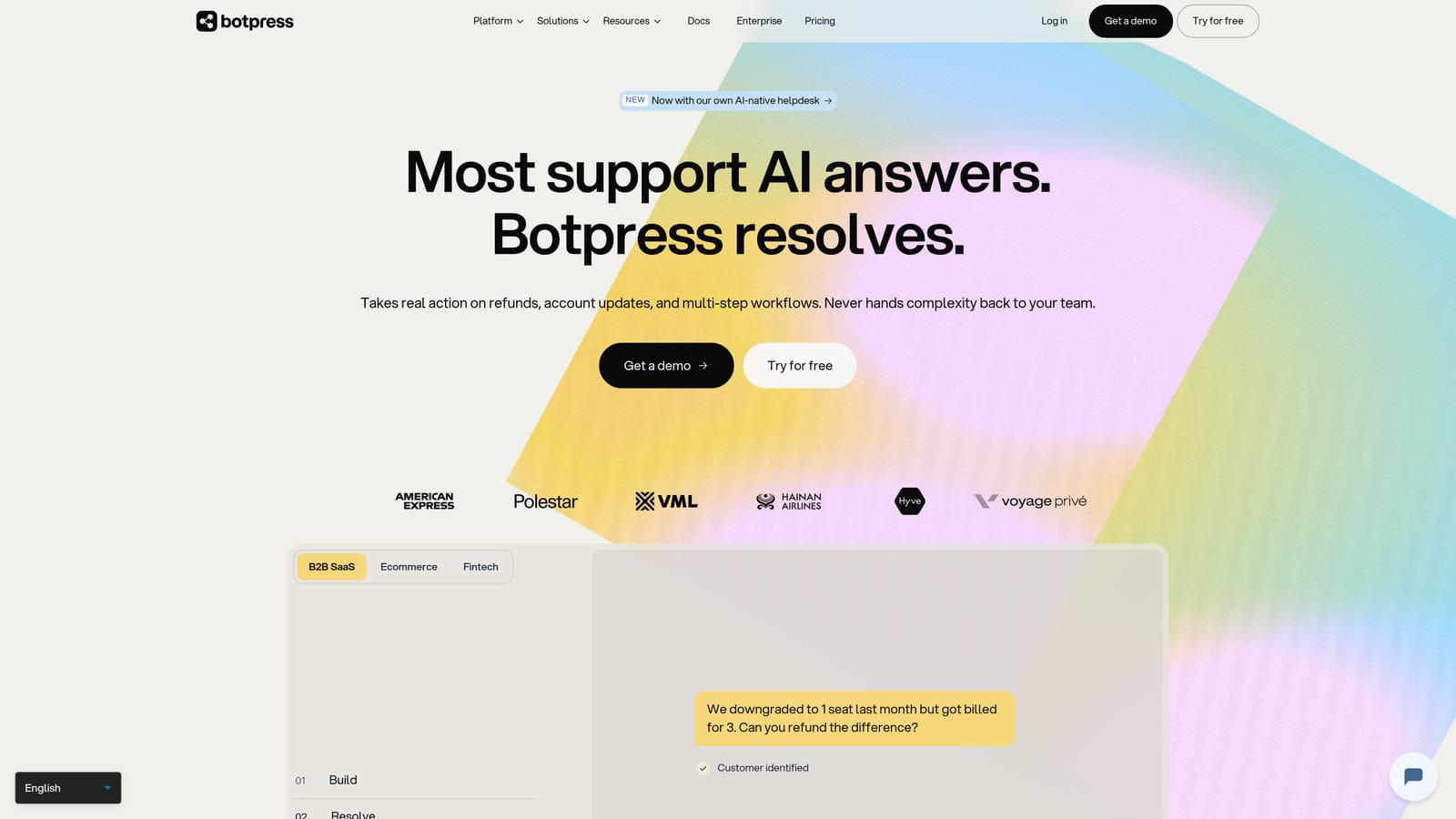
Botpress is a developer-first AI chatbot platform with on-premise deployment support, a visual flow builder, and strong natural language understanding capabilities for building custom support bots.
Where This Tool Shines
Botpress sits at the intersection of no-code accessibility and full developer control. The visual flow builder lets non-technical team members design conversation flows without writing code, while developers can drop into full code-level customization whenever the visual builder hits its limits. That flexibility is rare in on-premise chatbot platforms.
The built-in NLU engine combined with LLM integration support means Botpress can handle both intent-based conversation design and modern generative AI responses within the same platform. For teams building sophisticated support bots that need to handle complex, branching conversations while keeping all data on their own infrastructure, Botpress is one of the more capable options available.
Key Features
On-Premise and Self-Hosted Deployment: Run the entire platform on your own infrastructure with no data leaving your environment.
Visual Flow Builder: Design conversation flows visually with the option to extend via full code customization for complex logic.
Built-In NLU and LLM Integration: Combines traditional intent recognition with modern large language model capabilities for conversational AI.
Multi-Channel Deployment: Deploy bots across web, Slack, Microsoft Teams, WhatsApp, and other channels from a single build.
Analytics and Conversation Logging: Track bot performance and conversation data entirely within your own infrastructure.
Best For
Development teams and technical organizations that need to build custom AI support bots with precise control over conversation design, NLU behavior, and data residency. Well-suited for enterprises in regulated industries that need AI chatbot capabilities without cloud data dependencies.
Pricing
Open-source core is free. Enterprise plans with advanced features and support are available; contact Botpress sales for current pricing.
6. Rasa
Best for: Enterprises with strict data residency requirements building production-grade conversational AI from the ground up
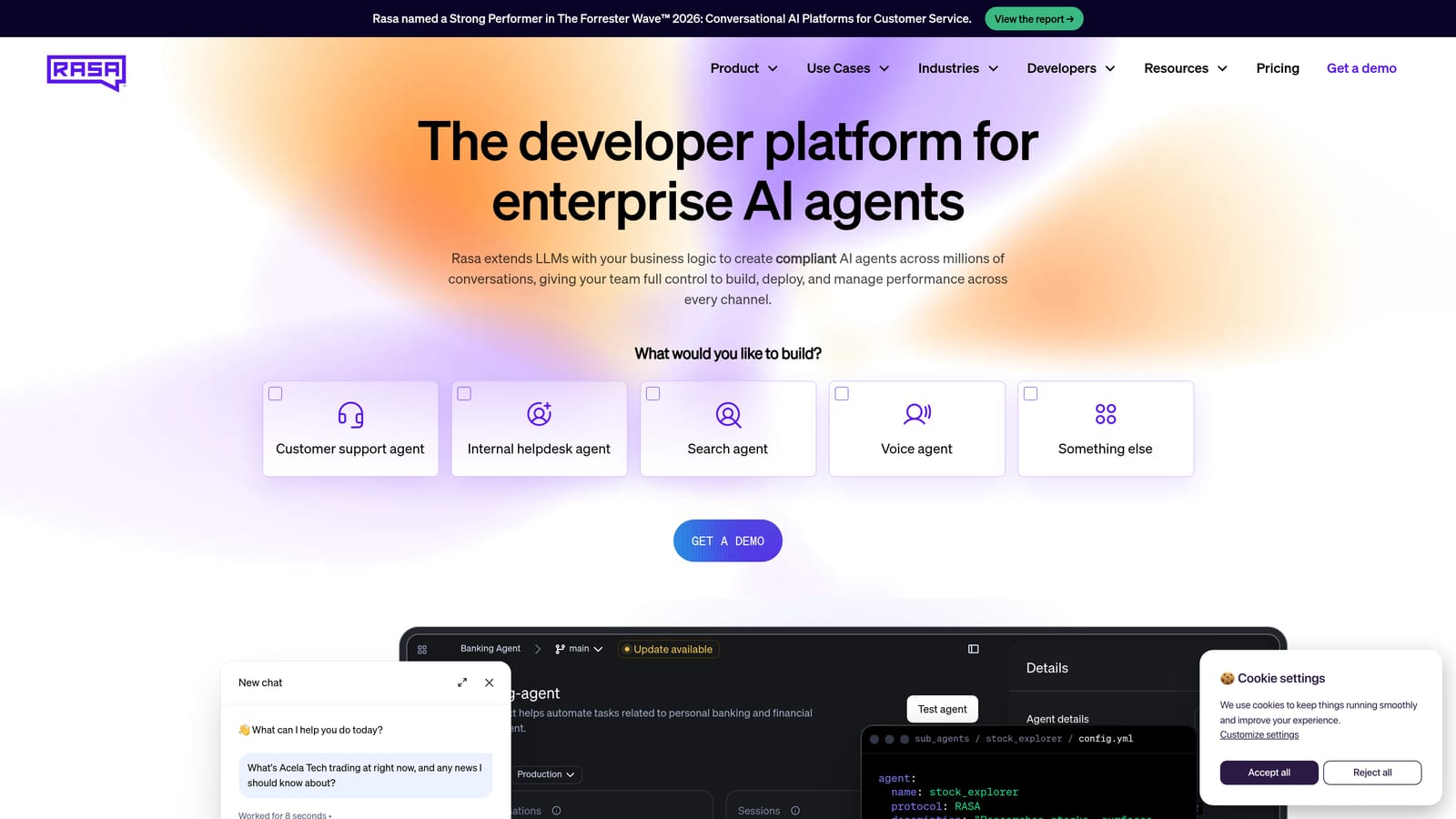
Rasa is the industry-standard open-source conversational AI framework that runs entirely on your own infrastructure, widely adopted by enterprises in healthcare, finance, and government sectors.
Where This Tool Shines
Rasa is the framework teams reach for when the requirement is absolute: no data leaves your environment, ever. It's not the easiest platform to get up and running — Rasa requires meaningful engineering investment to deploy and maintain — but the control it provides is unmatched among open-source options. The dialogue management engine gives teams fine-grained control over conversation behavior that higher-level tools abstract away.
The commercial Rasa Pro tier adds enterprise-grade features including analytics dashboards, role-based access control, and support SLAs on top of the open-source core. For organizations that have already validated Rasa in a proof-of-concept and need to move to production with enterprise support, Rasa Pro provides that path without requiring a migration to a different platform.
Key Features
Fully Self-Hosted Architecture: No data ever leaves your environment; the entire NLU and dialogue stack runs on your own servers.
Open-Source NLU and Dialogue Management: Fine-grained control over intent recognition, entity extraction, and conversation flow logic.
Rasa Pro Enterprise Features: Adds analytics, role-based access control, and support SLAs on top of the open-source foundation.
Custom LLM Integration: Supports integration with custom or self-hosted large language models for generative AI capabilities.
Proven in Regulated Sectors: Widely deployed in healthcare, financial services, and government organizations with strict compliance requirements.
Best For
Enterprise engineering teams in highly regulated industries that need maximum control over their conversational AI stack. Rasa is the right choice when compliance requirements are non-negotiable and the team has the technical capacity to build and maintain a custom deployment.
Pricing
Open-source framework is free. Rasa Pro enterprise pricing is available on request; contact Rasa directly for current commercial terms.
7. Rocket.Chat
Best for: Security-conscious organizations needing self-hosted omnichannel support combined with internal team communication
Rocket.Chat is an open-source team communication and omnichannel customer support platform that can be fully self-hosted, popular with government agencies, healthcare organizations, and security-focused enterprises.
Where This Tool Shines
Rocket.Chat's unique value is that it handles both internal team communication and external customer support within a single self-hosted platform. For organizations that need to eliminate cloud dependencies across their entire communication stack, not just their helpdesk, this consolidation is genuinely useful. You're not managing two separate self-hosted systems; you're managing one.
The omnichannel Livechat feature is built into the platform rather than bolted on, which means it benefits from the same security and compliance infrastructure as the rest of Rocket.Chat. End-to-end encryption, compliance logging, and the ability to deploy on Docker, Kubernetes, or bare metal make it a credible option for organizations with serious security requirements. AI capabilities come through the marketplace rather than being native, which means some additional configuration work is required.
Key Features
Flexible Self-Hosting: Deploy on Docker, Kubernetes, or bare metal with full control over your infrastructure and data.
Built-In Omnichannel Support: Livechat for external customer conversations is integrated natively alongside internal team communication.
Marketplace AI Integrations: Access chatbot and automation capabilities through the marketplace, including connections to AI providers.
End-to-End Encryption and Compliance: Strong security features including E2E encryption and compliance logging for regulated environments.
Dual-Purpose Platform: Serves both internal team communication and external customer support from a single deployment.
Best For
Government agencies, healthcare organizations, and enterprises that need to consolidate internal communication and external customer support into a single self-hosted platform. Also a strong choice for security-conscious teams that want E2E encryption across all communication channels.
Pricing
Community edition is free for self-hosted deployments. Enterprise plans start at approximately $7 per user per month, though current pricing should be confirmed with Rocket.Chat directly.
8. Gladly
Best for: High-volume enterprise support teams in retail, financial services, or hospitality needing dedicated private cloud deployment
Gladly is an enterprise customer support platform built around people-centric conversations rather than ticket numbers, with dedicated private cloud deployments for data-sensitive industries.
Where This Tool Shines
Gladly takes a fundamentally different philosophical approach to customer support. Where most platforms organize work around tickets, Gladly organizes around people. Every interaction a customer has across every channel — email, voice, chat, SMS, social — lives in a single continuous conversation thread tied to that person. For support teams handling high-value customers where context matters, this model reduces the frustrating "can you explain your issue again?" dynamic that ticket-based systems often create.
The dedicated private cloud deployment option makes Gladly relevant for data-sensitive enterprises that need isolation guarantees without the operational overhead of full self-hosting. AI features including suggested replies, summarization, and intelligent routing are built into the platform rather than requiring third-party integrations. The trade-off is that Gladly is firmly enterprise-tier in both capability and cost, making it less accessible for smaller teams.
Key Features
Dedicated Private Cloud Deployment: Enterprise-grade data isolation without the operational burden of full self-hosting.
People-Centric Conversation Model: Full customer history across all channels in a single continuous thread, organized by person rather than ticket number.
Built-In AI Features: Suggested replies, conversation summarization, and intelligent routing built natively into the platform.
Full Channel Coverage: Voice, email, chat, SMS, and social media handled from a unified agent interface.
Enterprise-Scale Architecture: Designed for high-volume support operations with the reliability and performance requirements that come with it.
Best For
Large enterprises in retail, financial services, or hospitality with high-volume support operations and data residency requirements. Gladly's people-centric model is particularly valuable for organizations where customer lifetime value is high and context continuity across interactions directly impacts retention.
Pricing
Enterprise only. Contact Gladly sales directly for current pricing, as it is tailored to deployment configuration and support volume.
Which Tool Is Right for Your Situation
The right choice here depends heavily on your deployment requirements, technical capacity, and how much AI capability you need out of the box.
If your requirement is absolute self-hosting with no external dependencies, the open-source options are your starting point. Rasa is the gold standard for conversational AI with full data residency, though it demands significant engineering investment. Zammad and Chatwoot are better choices if you need a complete helpdesk workflow rather than a conversational AI framework. Botpress sits in the middle, offering developer-friendly bot-building on your own infrastructure. Rocket.Chat is worth considering if you need to consolidate internal and external communication into a single self-hosted system.
If you need enterprise support, SLAs, and private cloud deployment without managing your own infrastructure, Freshdesk and Gladly are the mature commercial options. Freshdesk is the stronger fit for teams already in the Freshworks ecosystem or needing broad omnichannel coverage. Gladly earns its place for high-volume enterprise teams where the people-centric conversation model aligns with how they think about customer relationships.
For teams that want the intelligence of modern AI-first support without the operational overhead of full self-hosting, Halo AI is worth a serious look. The page-aware agents, continuous learning architecture, and business intelligence capabilities go well beyond what traditional helpdesks with AI bolt-ons can deliver. If private cloud or dedicated deployment configurations meet your data control requirements, it offers a level of AI capability that the self-hosted open-source options aren't yet matching.
Your support team shouldn't scale linearly with your customer base. Let AI agents handle routine tickets, guide users through your product, and surface business intelligence while your team focuses on complex issues that need a human touch. See Halo in action and discover how continuous learning transforms every interaction into smarter, faster support.