8 Best Product-Aware Customer Support Tools in 2026
Product aware customer support tools close the context gap between what customers type and what they were actually doing in your product — giving human and AI agents the page-level signals needed to resolve issues faster, reduce escalations, and deliver support that feels genuinely intelligent. This guide ranks the 8 best options in 2026 across SaaS team sizes and support stacks.
 Grant CooperFounder12 min read
Most support tools know what a customer typed. Product-aware support tools know what they were doing when they typed it: which page they were on, what they clicked, what error they hit. That context gap is exactly why generic chatbots frustrate users while truly intelligent support agents resolve issues on first contact.
Product-aware customer support tools connect your support layer directly to your product experience, giving agents (human or AI) the context they need to deliver accurate, relevant answers without making customers repeat themselves. The result is faster resolution, fewer escalations, and a support experience that actually feels like the product knows you.
This list covers the best tools in this category as of 2026, evaluated on depth of product context, AI resolution quality, integration breadth, and how well each solution scales without scaling headcount. Whether you're running a lean SaaS team or managing thousands of daily tickets, there's a right fit here for your stack.
1. Halo AI
Best for: AI-first teams that need autonomous ticket resolution with genuine page-level product context.
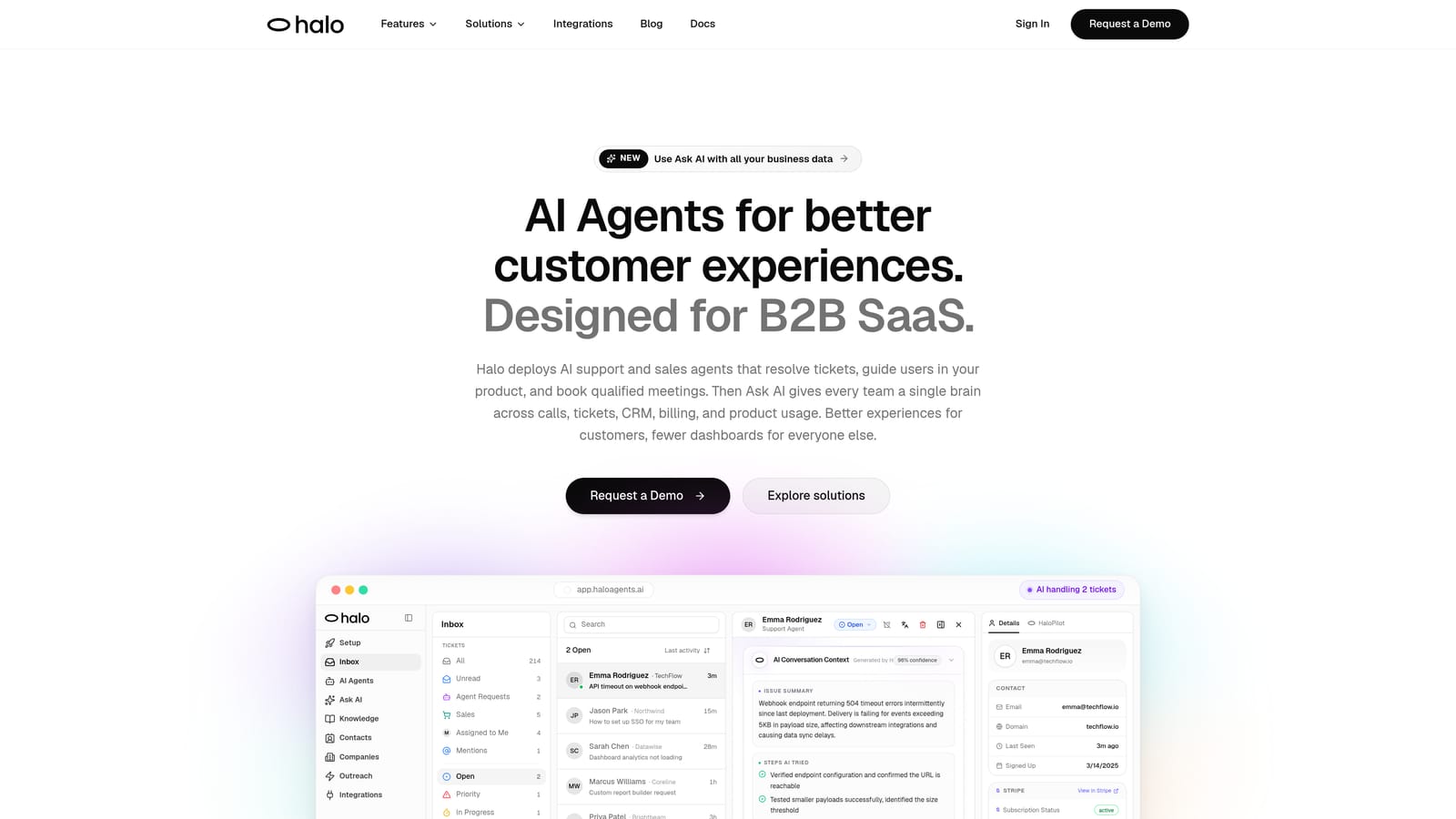
Halo AI is an AI-native customer support platform built around autonomous resolution, page-aware context, and business intelligence signals embedded directly in the support layer.
Where This Tool Shines
Halo's standout feature is its page-aware chat widget. Rather than asking users to describe their screen, Halo captures the current URL and UI state at the moment of contact, giving the AI agent full context to provide step-by-step visual guidance. This is a meaningful architectural difference from chatbots bolted onto existing helpdesks.
Beyond resolution, Halo's smart inbox surfaces business intelligence signals alongside tickets: customer health indicators, revenue anomalies, and churn signals. Support stops being a cost center and starts feeding intelligence back into the business. The continuous learning model means every resolved interaction makes the next one faster and more accurate.
Key Features
Page-Aware Chat Widget: Captures the user's current URL and UI state to enable contextual, step-by-step guidance without requiring users to describe their screen.
Autonomous AI Agents: Resolve tickets end-to-end with live agent handoff available for complex issues that genuinely need a human touch.
Smart Inbox with Business Intelligence: Surfaces customer health scores, revenue anomalies, and churn indicators alongside support tickets for a fuller picture of account risk.
Auto Bug Ticket Creation: Routes bug reports directly to Linear from support interactions, closing the loop between support and engineering without manual handoffs.
Broad Integration Stack: Connects to Linear, Slack, HubSpot, Intercom, Stripe, Zoom, PandaDoc, and Fathom for a unified view across the business.
Best For
SaaS product teams and B2B companies that want to move beyond reactive helpdesk workflows. Particularly well-suited for teams using a modern stack (Linear, HubSpot, Slack) who want AI that genuinely understands the product context, not just the ticket text. Also a strong fit for teams looking to surface customer intelligence without adding a separate CS analytics tool.
Pricing
Contact for pricing. A demo is available at haloagents.ai/demo for teams that want to see the page-aware agent in action before committing.
2. Intercom
Best for: Mid-market SaaS teams wanting a mature messaging platform with solid AI resolution and product event context.
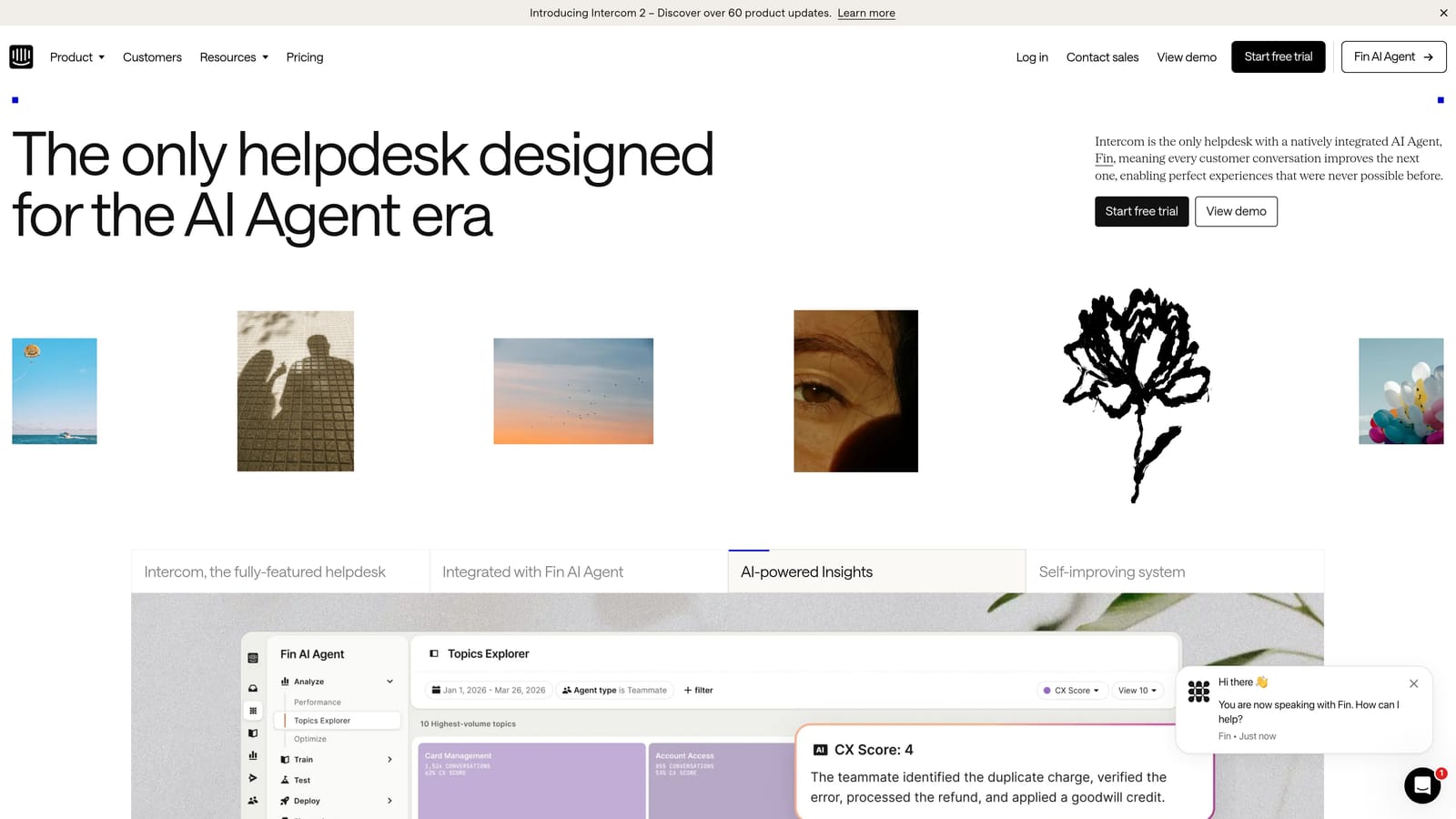
Intercom is a customer messaging platform with Fin AI, product event tracking, and one of the most mature ecosystems in the category.
Where This Tool Shines
Fin, Intercom's AI agent, is trained on your own support content and handles a meaningful portion of inbound queries without human involvement. What makes it more than a basic chatbot is the product event data layer: Fin and human agents both have context about what users have actually done inside the product, not just what they typed in the chat window.
Intercom's strength is its all-in-one nature. Shared inbox, proactive messaging, in-app chat, and product tours all live in one platform. For teams that want to consolidate their customer communication stack, that's a real advantage. The tradeoff is cost: Fin AI is billed per resolution, which can add up quickly at scale.
Key Features
Fin AI Agent: Trained on company support content for autonomous query resolution with a clear handoff path to human agents.
Product Event Data Layer: Provides context on what users have done in the product, enabling more relevant responses from both AI and human agents.
Unified Messaging Platform: Shared inbox, proactive messaging, and in-app chat in a single tool.
Extensive Integration Marketplace: Connects to a wide range of CRM, analytics, and product tools.
Best For
Teams already invested in the Intercom ecosystem who want AI resolution without switching platforms. Strong fit for mid-market SaaS companies with established support workflows and enough ticket volume to justify per-resolution pricing.
Pricing
Starts at approximately $39/month; Fin AI usage is billed separately per resolution, so total cost scales with volume.
3. Zendesk
Best for: Enterprise teams needing deep workflow configurability, SLA management, and a large integration ecosystem.
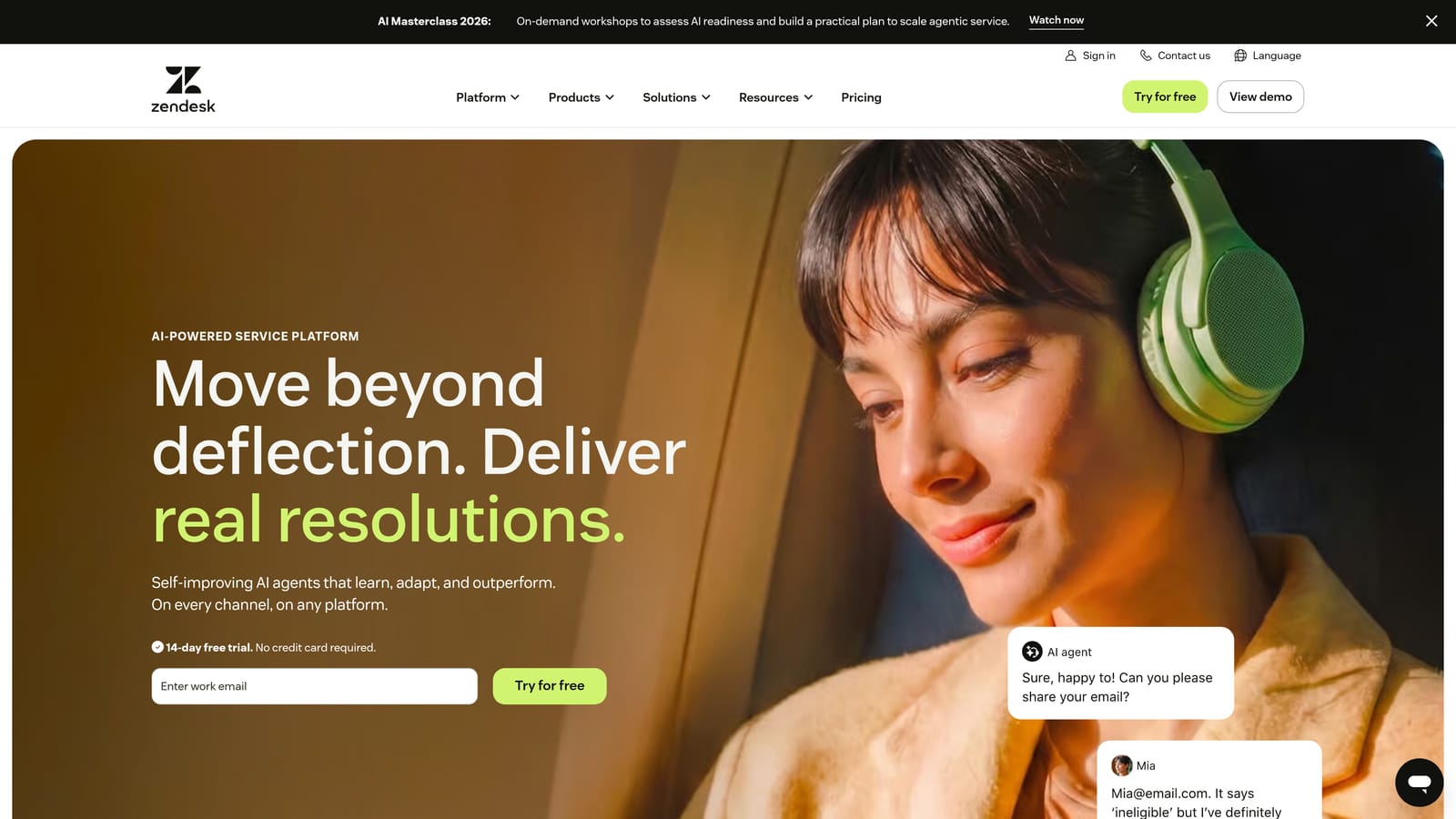
Zendesk is the dominant enterprise helpdesk, now with AI Copilot for agent assistance and improving autonomous resolution capabilities.
Where This Tool Shines
Zendesk's core strength is configurability. Advanced SLA management, sophisticated routing rules, and a massive integration marketplace mean you can connect nearly any product or business data source to the support workflow. For enterprise orgs with complex compliance requirements or multi-brand support operations, Zendesk's depth is hard to match.
AI Copilot handles response suggestions and ticket summarization well, and autonomous resolution capabilities have improved significantly. That said, product-awareness in Zendesk comes primarily through integrations and custom attributes rather than native page-level context. It's more agent-assist than fully autonomous, which suits teams that want AI to augment human agents rather than replace them.
Key Features
AI Copilot: Provides agent response suggestions and ticket summarization to speed up human-assisted resolution.
Advanced SLA Management: Sophisticated routing rules and SLA tooling for enterprise support operations.
Large Integration Marketplace: Extensive options for connecting product data, CRM, and business intelligence tools.
Robust Reporting and Compliance: Enterprise-grade analytics and compliance tooling for regulated industries.
Best For
Enterprise SaaS companies and large B2B organizations with complex support workflows, compliance requirements, or multi-brand operations. Less ideal for smaller teams that find the configuration overhead heavy relative to their needs. For a deeper comparison, see the Zendesk automation tools comparison.
Pricing
Suite plans start at approximately $55/agent/month; AI add-ons are priced separately, so total cost depends on the features enabled.
4. Freshdesk
Best for: Growing SaaS teams that want accessible automation and competitive pricing without enterprise complexity.
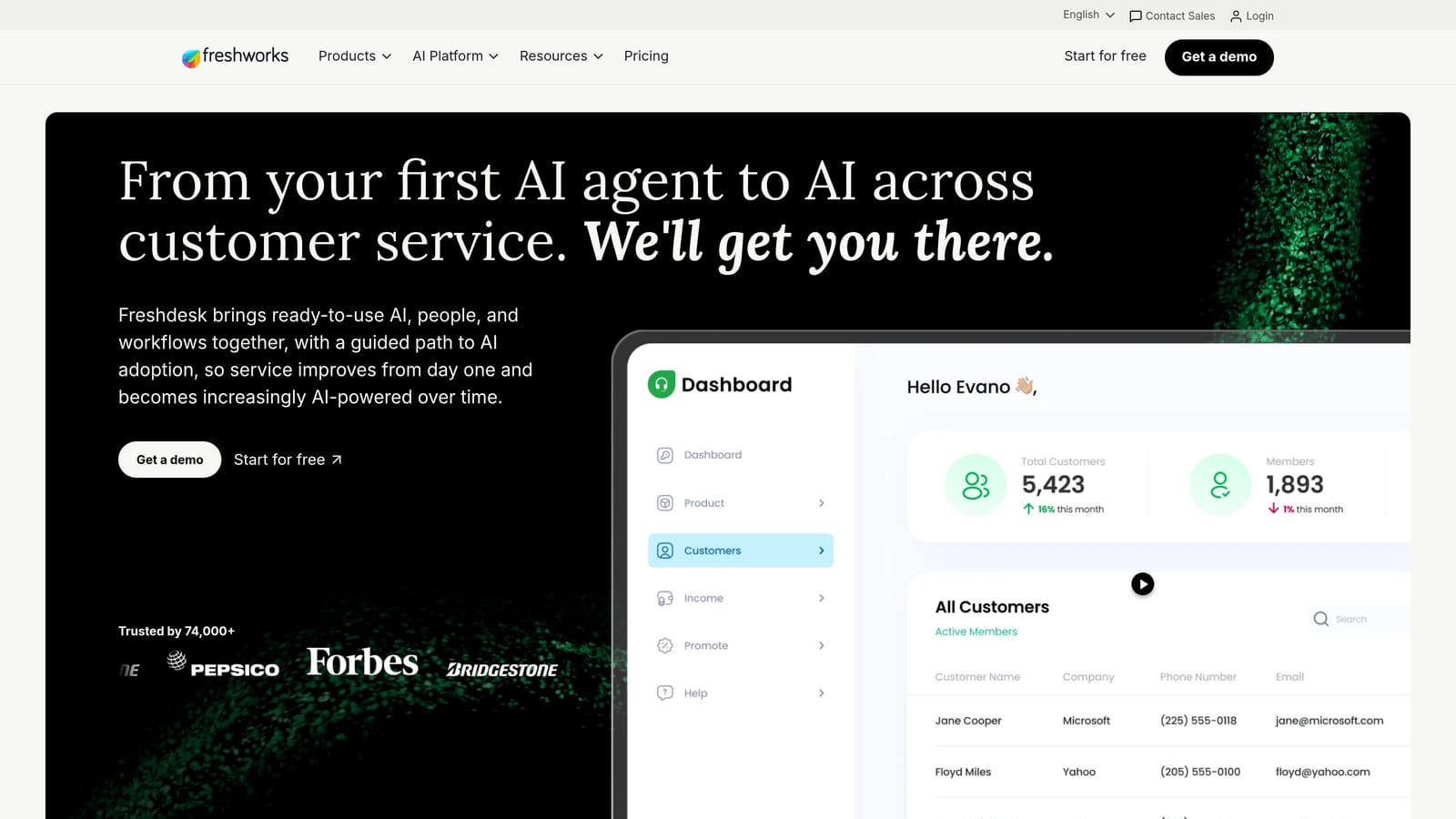
Freshdesk is Freshworks' helpdesk product with Freddy AI automation and omnichannel support at a price point that works for SMB and mid-market teams.
Where This Tool Shines
Freshdesk's value proposition is straightforward: solid automation, omnichannel coverage, and pricing that doesn't require a procurement conversation. Freddy AI handles response suggestions, auto-categorization, and simple query resolution, which covers a meaningful portion of routine ticket volume for most teams.
Product context comes through integrations rather than native page-awareness, which is a limitation compared to purpose-built tools. But for teams that primarily need a reliable helpdesk with AI assistance rather than full autonomous resolution, Freshdesk delivers a clean experience without the overhead of more complex platforms.
Key Features
Freddy AI: Handles response suggestions, auto-categorization, and resolution of straightforward queries.
Omnichannel Support: Covers email, chat, phone, and social from a single platform.
Marketplace Integrations: Connects product context through third-party integrations with CRM and analytics tools.
Free Tier: Available for small teams exploring automation before committing to a paid plan.
Best For
SMB and mid-market SaaS teams that want automation without enterprise contracts. Also a solid choice for teams migrating off spreadsheets or basic email inboxes who need a structured helpdesk with AI assistance built in from day one.
Pricing
Free tier available for small teams; paid plans start at approximately $15/agent/month, making it one of the more accessible options in the category.
5. Pendo
Best for: Product teams that want to deflect support tickets by answering common questions directly inside the product UI.
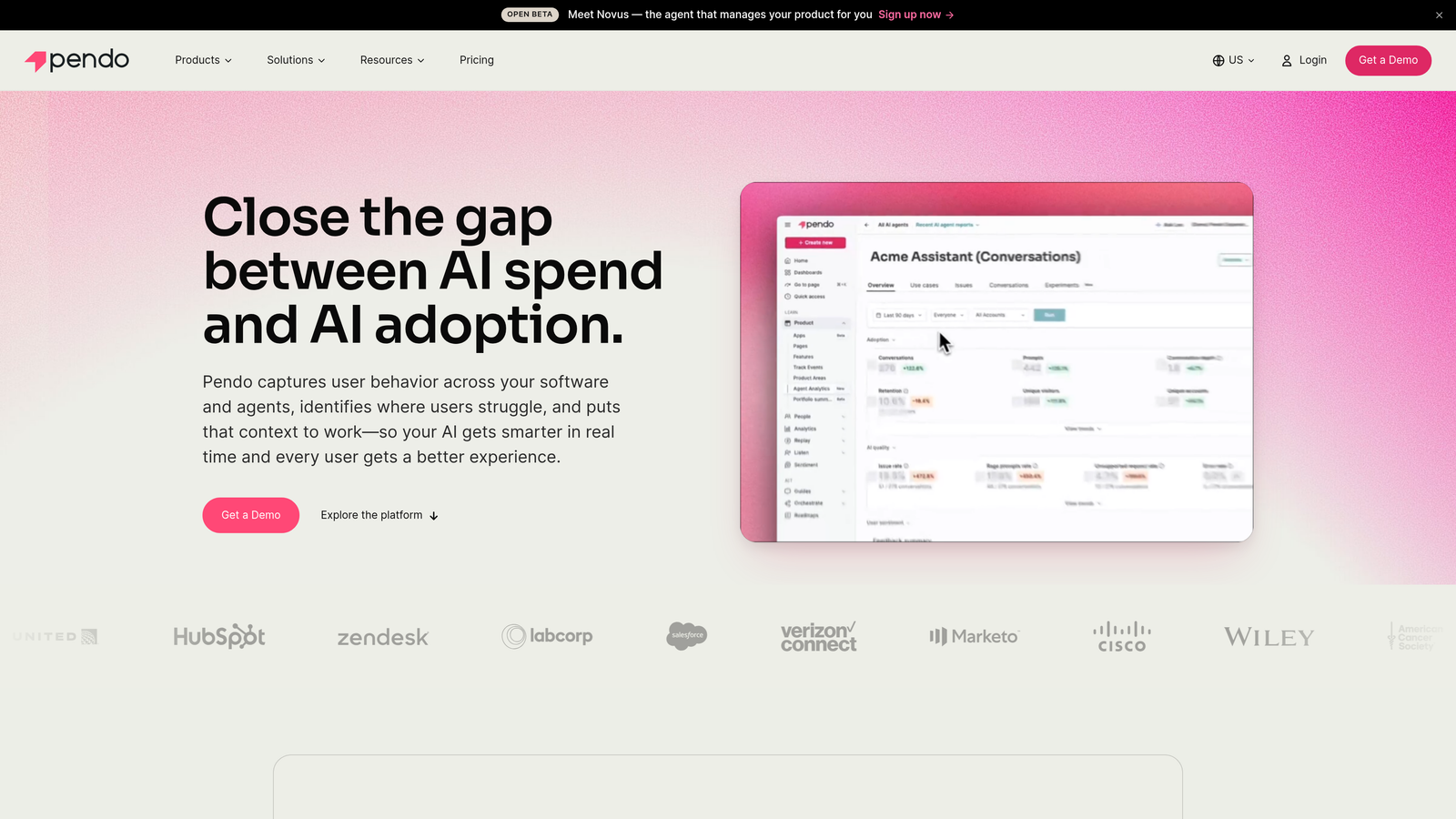
Pendo is a product analytics and in-app guidance platform that reduces ticket volume by surfacing answers before users ever reach the support channel.
Where This Tool Shines
Pendo operates upstream of traditional support. Its in-app tooltips, walkthroughs, and resource centers are surfaced based on actual user behavior, which means the right guidance appears at the right moment rather than waiting for a user to get stuck and file a ticket. For SaaS products with complex workflows or frequent onboarding friction, this kind of proactive deflection can significantly reduce inbound support volume.
The behavioral analytics layer is also genuinely useful for support teams: identifying which features or flows are generating the most friction gives you a clear roadmap for where in-app guidance will have the highest impact. Pendo integrates with helpdesks to close the loop between product signals and support workflows.
Key Features
In-App Guidance: Tooltips, walkthroughs, and resource centers surfaced based on user behavior to answer questions before tickets are created.
Behavioral Analytics: Identifies friction points in the product driving support volume, enabling targeted improvements.
Embedded Feedback Collection: NPS and user feedback collected directly within the product experience.
Helpdesk Integrations: Connects product signals to support workflows for a closed-loop view of user issues.
Best For
Product teams and support leaders at SaaS companies where onboarding complexity or feature discoverability is a primary driver of ticket volume. Best used alongside a helpdesk, not as a standalone support solution.
Pricing
Free tier available for small applications; paid plans are custom-quoted based on monthly active users and features required.
6. Gainsight
Best for: Enterprise SaaS companies with dedicated CS teams that need proactive, product-signal-driven customer success playbooks.
Gainsight is an enterprise customer success platform that turns product usage data into proactive outreach and CS playbooks before tickets are ever created.

Where This Tool Shines
Gainsight's approach to product-awareness is different from the other tools on this list. Rather than improving reactive support, it aims to eliminate the need for it by catching at-risk accounts before they reach out. Customer health scores built from product usage, support history, and CRM data give CS teams an early warning system for churn risk and expansion opportunities.
Automated playbooks triggered by product signals, such as a customer not engaging with a key feature or showing a usage drop, allow CS teams to intervene at exactly the right moment. For enterprise SaaS with complex accounts and dedicated CS managers, this kind of proactive motion is hard to replicate with a standard helpdesk.
Key Features
Customer Health Scores: Built from product usage, support history, and CRM data to surface at-risk and expansion-ready accounts.
Automated CS Playbooks: Triggered by product signals like feature non-adoption or usage drops for timely, relevant outreach.
Timeline and Success Plans: Account management tooling for enterprise CS teams managing complex, multi-stakeholder relationships.
Deep Integrations: Connects to Salesforce, Zendesk, and major product analytics platforms for a unified data picture.
Best For
Enterprise SaaS companies with dedicated customer success teams managing large, high-value accounts. Not a fit for teams without a structured CS function, and too heavyweight for SMB or early-stage teams.
Pricing
Enterprise pricing only; custom quotes required. Expect a procurement process rather than self-serve onboarding.
7. Fullstory
Best for: Support and product teams that need complete behavioral context on what users did before filing a ticket.
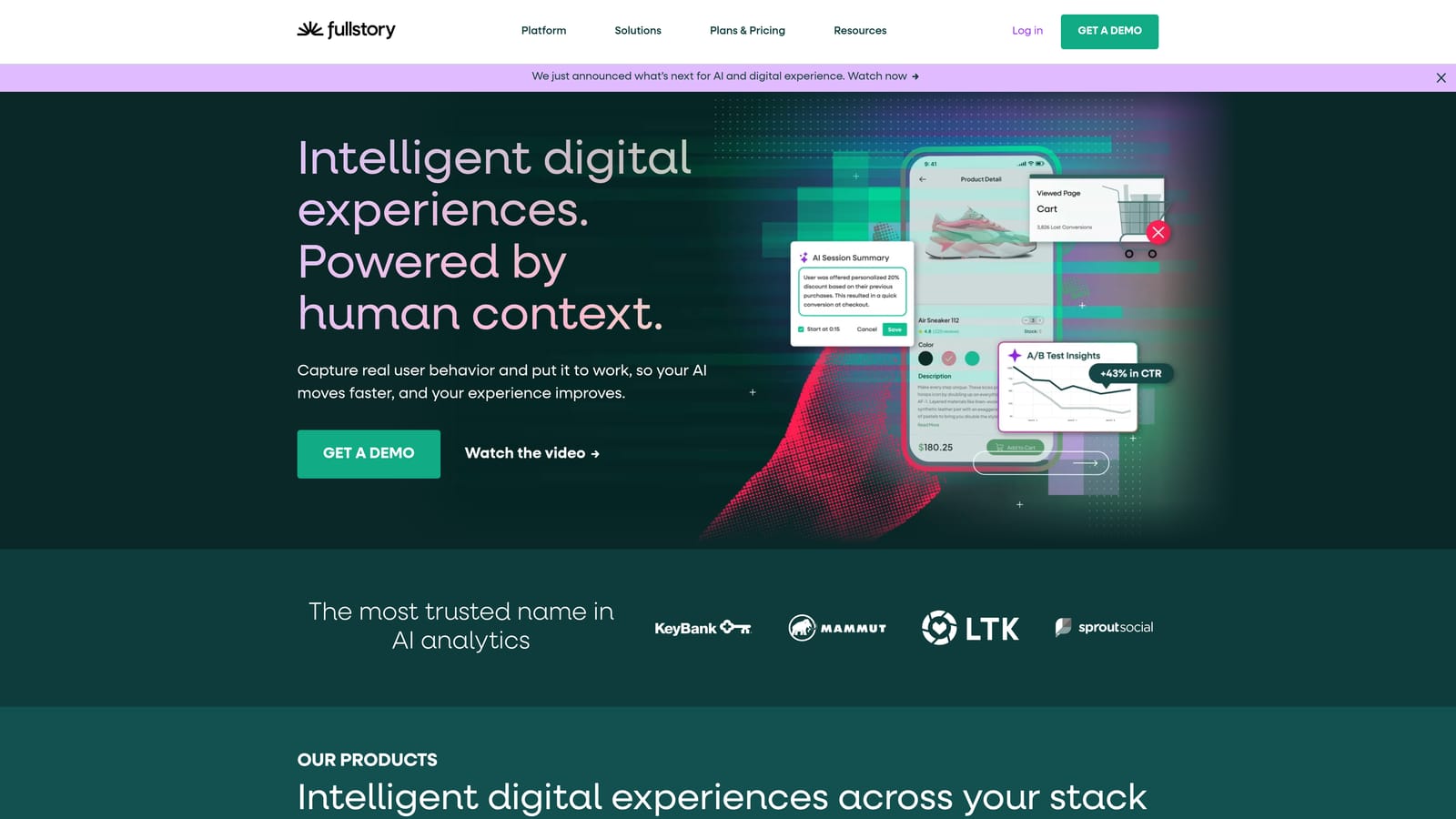
Fullstory is a session replay and behavioral analytics platform that gives support and product teams a complete picture of user actions leading up to a reported issue.
Where This Tool Shines
The core value for support teams is simple: when a customer files a ticket, agents can watch a replay of exactly what the user did before the issue occurred. This eliminates the back-and-forth of "can you describe what happened?" and the frustrating "I can't reproduce this" cycle that slows resolution and erodes user trust.
Fullstory's DX Data layer structures behavioral data so it can be piped into other tools, including Zendesk, Intercom, and Jira. Frustration signals like rage clicks and error clicks are surfaced automatically, giving support teams an immediate read on where users are hitting walls without needing to watch every session in full.
Key Features
Session Replay: Captures every user interaction for full behavioral context on reported issues, eliminating ambiguity in ticket reproduction.
DX Data Layer: Structured behavioral data that can be piped into support platforms and analytics tools.
Frustration Signal Detection: Automatically surfaces rage clicks and error clicks to identify problem areas without manual review.
Support Workflow Integrations: Connects with Zendesk, Intercom, and Jira to bring session context directly into the ticket.
Best For
Support teams that regularly deal with hard-to-reproduce bugs, and product teams that want to understand user friction at a granular level. Works best as a context layer alongside an existing helpdesk rather than as a standalone support solution.
Pricing
Free trial available; paid plans are custom-quoted based on session volume and feature requirements.
8. Chameleon
Best for: Smaller SaaS teams that want contextual in-app guidance and ticket deflection without engineering resources.
Chameleon is a no-code product adoption platform with contextual help launchers, in-app tours, and user segmentation that deflects support tickets before they're created.
Where This Tool Shines
Chameleon's no-code approach is its biggest differentiator. Product tours, tooltips, and modals can be deployed without engineering involvement, which matters enormously for smaller teams where engineering time is the scarcest resource. The contextual help launcher surfaces relevant articles based on the user's current page, which is a lightweight but effective form of product-awareness.
User segmentation lets you show different guidance to different cohorts, so a new user sees onboarding walkthroughs while a power user sees advanced feature tips. That kind of targeted deflection reduces the generic "how do I get started?" tickets that eat up support capacity without adding complexity to the implementation.
Key Features
No-Code Deployment: Product tours, tooltips, and modals deployable without engineering involvement, enabling fast iteration on in-app guidance.
Contextual Help Launchers: Surface relevant help articles based on the user's current page to deflect tickets at the point of confusion.
User Segmentation: Show different guidance to different user cohorts based on role, plan, or behavior.
Analytics Integrations: Connects with Segment, HubSpot, and major analytics platforms for behavioral targeting.
Best For
Early-stage and growth-stage SaaS teams with limited engineering resources who want to add in-app guidance quickly. A natural complement to a helpdesk rather than a replacement, similar in positioning to Pendo but more accessible for smaller teams and budgets.
Pricing
Starts at approximately $279/month; a free trial is available for teams that want to test contextual guidance before committing.
Which Tool Is Right for Your Team?
The right choice depends on where your biggest support challenge actually lives. Here's a quick way to think through it.
If autonomous AI resolution with genuine page-level product context is the priority, Halo AI is the strongest option in the category. The page-aware architecture, continuous learning model, and business intelligence signals make it particularly well-suited for SaaS teams that want support to do more than close tickets.
For teams already embedded in the Intercom ecosystem, Intercom with Fin AI offers solid autonomous resolution without a platform migration. Zendesk remains the go-to for enterprise organizations with complex workflows and compliance requirements. Freshdesk covers the SMB and mid-market segment with accessible pricing and reliable automation.
If ticket deflection before contact is the goal, Pendo and Chameleon both deliver in-app guidance that answers questions inside the product. Pendo offers more depth in behavioral analytics; Chameleon is faster to implement without engineering. For enterprise CS teams managing high-value accounts, Gainsight turns product signals into proactive playbooks that prevent issues before they become tickets. And Fullstory is the clearest choice when support teams need full behavioral context on what users did before reporting a problem.
Your support team shouldn't scale linearly with your customer base. Let AI agents handle routine tickets, guide users through your product, and surface business intelligence while your team focuses on complex issues that need a human touch. See Halo in action and discover how continuous learning transforms every interaction into smarter, faster support.