Revenue Intelligence Platform: What It Is and Why It Matters
A revenue intelligence platform centralizes data to fix blind spots. Discover how it works, key features, integration needs, and steps
 Grant CooperFounder12 min read
Only 7% of sales organizations reach 90% forecast accuracy, so a revenue intelligence platform is justified only when it improves the quality and usability of the forecast, not when it adds another dashboard. The strongest platforms consolidate scattered revenue signals, explain forecast changes, and turn insight into action inside the workflows teams already use.
That distinction matters because most revenue teams don't suffer from a lack of software. They suffer from conflicting numbers, incomplete CRM records, disconnected customer signals, and forecast calls driven by negotiation rather than evidence. The current buying question is no longer which platform has the most AI features. It's whether one system can replace enough overlapping tools to improve decisions without creating new data, privacy, and adoption problems.
What Is a Revenue Intelligence Platform
A revenue intelligence platform is a decision layer that sits above the CRM. It combines structured records, such as opportunities, stages, close dates, billing data, and customer status, with unstructured signals from emails, meetings, calls, and other interactions. It then uses that combined context to forecast outcomes, identify risk, and recommend action.
That makes it different from a conventional reporting dashboard. A dashboard describes what has already happened. Revenue intelligence should help a manager understand what is likely to happen, why the model reached that conclusion, and what someone should do next.
The business problem is revenue blindness. Sales may see opportunity stages, customer success may see declining engagement, support may see repeated issues, and finance may see billing changes. Each team has a partial view. The platform's job is to connect those views without forcing leaders to reconcile separate spreadsheets before every forecast meeting.

The decision layer above the CRM
The CRM remains the system of record. A revenue intelligence platform doesn't eliminate it. Instead, it enriches CRM data with signals the CRM usually captures poorly or not at all, then returns useful conclusions to the systems where sales and RevOps teams work.
A useful mental model is:
- CRM: What the team recorded.
- Revenue intelligence: What the combined evidence suggests.
- Workflow automation: What the team should do next.
This is also where customer intelligence platforms fit into the wider architecture. Customer intelligence focuses on account understanding, while revenue intelligence applies that understanding to forecasting, pipeline decisions, retention, and expansion.
From manual judgment to explainable prediction
Traditional forecasting often depends on stage probabilities, rep confidence, manager adjustments, and a spreadsheet assembled before a leadership meeting. Those inputs still matter, but they become fragile when records are stale or when important buyer behavior exists only in a call transcript or email thread.
AI-assisted forecasting can weight real-time buyer signals, pipeline changes, and activity patterns. Industry implementation guidance reports average forecast-accuracy gains of 10% to 20% for organizations adopting AI-powered sales forecasting, as documented by Gartner's revenue intelligence market reviews. That figure shouldn't be treated as a guarantee. It describes the potential of better evidence, not a substitute for clean processes or reliable data.
The practical test is simple. If the platform shows a risk score but can't identify the underlying signals, sales managers won't trust it. If it explains that a deal has lost stakeholder engagement, missed its next step, and slipped its close date, the forecast becomes a conversation about evidence rather than opinion.
Core Capabilities and Architecture
A revenue intelligence platform works as a pipeline, not as a magic prediction engine. The strongest implementations connect four layers: ingestion, normalization, analytics, and activation. Each layer affects the quality of the next.
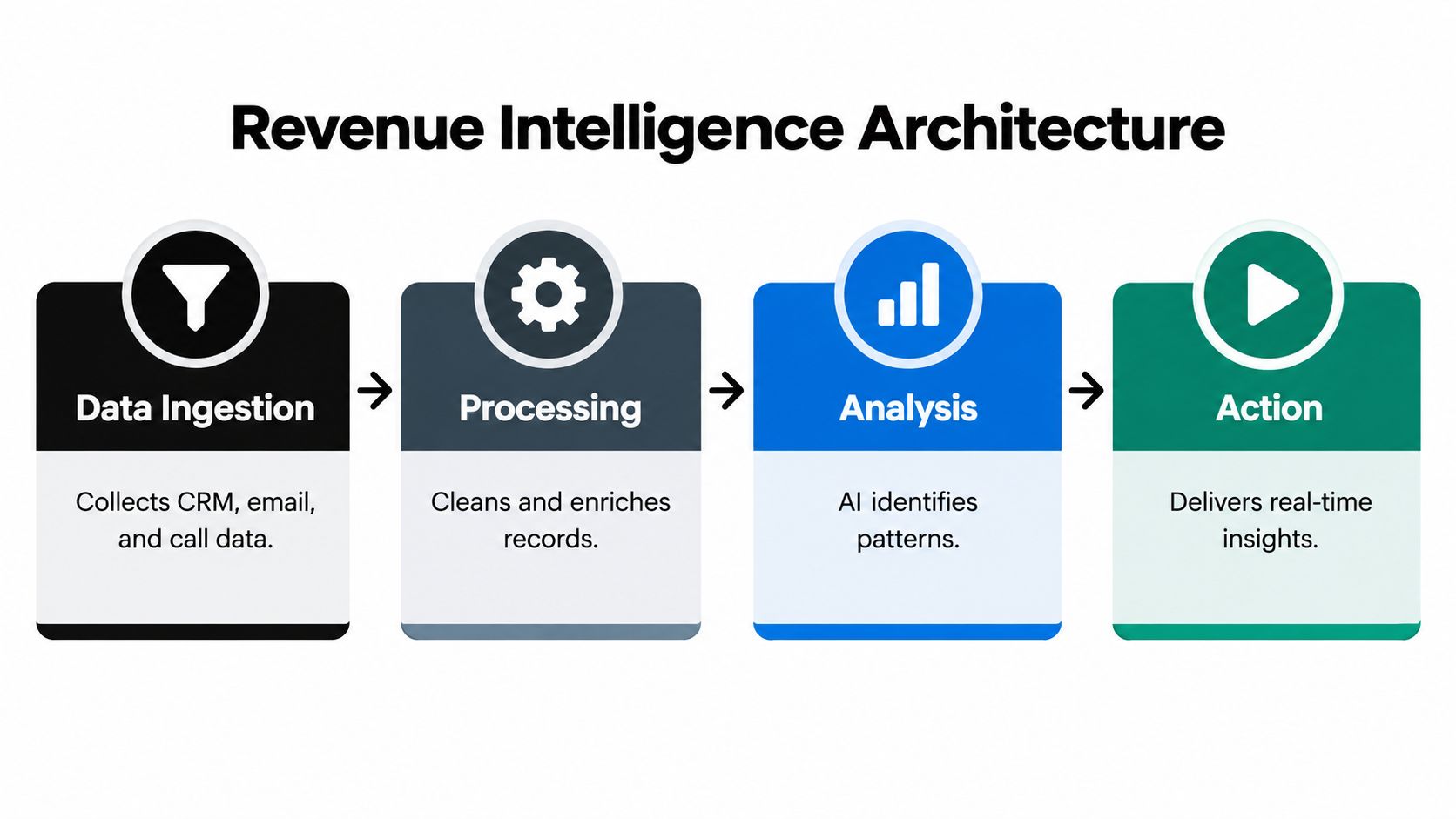
1. Ingestion brings the evidence together
The platform should collect data from the systems where revenue activity happens. Common inputs include:
- CRM records: Accounts, contacts, opportunities, stages, owners, close dates, and activities.
- Sales interactions: Emails, calls, meetings, transcripts, and engagement patterns.
- Commercial systems: Billing events, renewals, subscriptions, and customer value.
- Customer signals: Support conversations, success milestones, product adoption, and account health.
A platform that integrates only with the CRM may produce a cleaner version of existing reporting, but it won't see the full buying or retention context. Integration depth matters more than the number of logos on a vendor's marketplace page. Ask whether the system can connect to the specific CRM instances, communication tools, billing systems, and support platforms your teams use. Guidance on evaluating that integration layer is available in this API integration platform overview.
2. Normalization prevents bad inputs from becoming confident outputs
Raw revenue data is inconsistent. Reps use stages differently, close dates drift, contacts are duplicated, and the same company may appear under multiple names. Normalization and cleansing standardize fields, resolve identities, remove duplicates, and connect interactions to the correct account or opportunity.
This layer is easy to underestimate. A model trained on incomplete activity history can produce precise-looking but unreliable scores. Data completeness and consistency determine whether the platform is detecting meaningful patterns or merely rewarding teams that log more activity.
3. Analytics and AI identify patterns
Once the data is usable, the platform can combine structured pipeline information with unstructured interaction data. It may detect changes in engagement, missing buying committee participation, stalled momentum, customer risk, or expansion signals.
The useful output isn't a generic health score. It should show the signals behind the score and distinguish between a real risk and an absence of data. A deal with no recorded activity may be neglected, or the activity may exist in an unconnected email system. Those scenarios require different responses.
4. Activation turns insight into operating behavior
Insights matter only when they reach the person who can act. Platforms may send alerts to a manager, update a CRM field, surface a task for a rep, or add customer context to a support workflow.
Practical rule: Don't approve an alert until you can name its owner, response, and expected business outcome.
Activation also creates a feedback loop. Teams act on signals, outcomes return to the dataset, and RevOps can assess which alerts were useful. Without that loop, revenue intelligence becomes an expensive reporting layer that people check occasionally and ignore during busy periods.
Market Trends and Consolidation Drivers
Revenue intelligence is expanding quickly, although published market estimates vary by methodology. One report estimates a global market of USD 3.89 billion in 2025, projecting USD 11.40 billion by 2034 and a 12.7% CAGR from 2026 to 2034. Another estimates USD 3.41 billion in 2026 and USD 13.7 billion by 2033, with a 21.8% CAGR, as reported by Growth Market Reports. The specific forecast matters less than the shared direction. Revenue teams are buying software that centralizes forecasting, pipeline visibility, and account activity.
The more important operational signal is consolidation. A separate industry snapshot reports that the median revenue technology stack fell from 8.4 tools in 2024 to 5.2 tools in early 2026. That change suggests buyers are no longer rewarding vendors just for adding another specialized dashboard. They want fewer systems that share data and support a connected operating process.
Why consolidation improves execution
Every additional tool creates integration work, ownership questions, duplicated records, and another place for a rep to check. Tool reduction doesn't automatically create better operations, but removing overlapping systems can make data lineage easier to understand.
The architecture is also cloud-first. Cloud deployments accounted for approximately 71.3% of revenue intelligence market revenue in 2025, while software represented about 63.7% of total revenue, with the software component valued at $2.67 billion that year, according to DataIntelo's revenue intelligence market analysis. Another estimate puts software at 65.2% of market share and North America at 42.8% of global revenue in 2025, indicating strong adoption in digital-first buying environments.
That concentration creates a practical selection lesson. A platform should fit your existing cloud stack, identity controls, data flows, and operating rhythm. A tool that requires heavy manual exports will undermine the consolidation case, even if its prediction model looks impressive in a demo.
Teams comparing account intelligence, intent, and forecasting capabilities may also benefit from this practical comparison of 6sense or Demandbase for B2B. The choice isn't always either-or. The right question is which capability belongs in the core platform and which should remain a specialist layer.
Implementation and Evaluation Framework
A feature checklist is a weak business case. Evaluate a revenue intelligence platform against the operational problem you're paying it to solve, then test whether it can replace an existing tool without removing a capability your team still needs.
Start with a baseline. Record how leaders currently build the forecast, how long the process takes, how often managers override the number, which signals they review manually, and where teams lose time reconciling systems. Then define the outcome you want, such as fewer forecast disputes, earlier deal-risk detection, less manual inspection, or stronger visibility into renewal and expansion risk.
AI-assisted forecasting has a measurable benchmark. Organizations adopting these systems report 10% to 20% average gains in forecast accuracy, according to Gartner's revenue intelligence reviews. Treat that as an evaluation reference, not a promised result. Your vendor should test performance on your historical opportunity data and explain where the model is strong, uncertain, or dependent on missing inputs.
Replacement versus complement
A platform may replace a forecasting tool when it produces a more trusted forecast, supports the required hierarchy, and explains changes at deal level. It may complement conversation intelligence when call analysis remains valuable for coaching but the revenue platform adds billing, support, and customer-success context.
It should replace a workflow tool only when its alerts, routing, ownership, and audit trail match the workflows that currently keep teams aligned. Otherwise, consolidation can create a gap disguised as simplification.
| Evaluation Factor | Why It Matters | Questions to Ask |
|---|---|---|
| Forecast quality | A more accurate number improves planning and reduces debate | Can the vendor backtest historical data and explain errors? |
| Integration depth | Missing signals weaken scoring and create manual work | Which CRM, email, call, billing, and support systems connect natively? |
| Explainability | Managers need evidence they can challenge and act on | Can users see the specific signals behind a score or forecast change? |
| Governance | Unified data increases privacy and access responsibilities | Can administrators control fields, roles, retention, and audit history? |
| Total cost of ownership | License savings can disappear through services and maintenance | What implementation, integration, support, and replacement costs remain? |
| Workflow activation | Insight has no value if teams don't respond | Where do alerts appear, and how are actions assigned and measured? |
A practical rollout sequence
Clean the core records before enabling broad AI recommendations. Start with one forecast motion or customer segment, establish clear owners for alerts, and review false positives with frontline managers. Expand only after the team can show that the platform changes decisions rather than merely adding another screen.
A multi-source data integration framework can help RevOps map sources, owners, fields, and downstream uses before implementation. That mapping is more valuable than a long list of promised integrations because it reveals which data supports a decision.
Data Governance and Privacy Considerations
More data doesn't always create better intelligence. A platform that ingests CRM records, emails, calls, chat, collaboration data, billing information, and support tickets can identify relationships that siloed systems miss, but it can also amplify noisy, biased, outdated, or improperly collected data.
The governance question starts with purpose. Define which decisions the platform supports and which data sources are necessary for those decisions. Call recordings may provide strong deal context, while a broad collaboration feed may contain sensitive conversations with little predictive value. Collecting everything makes access control, retention, consent, and model interpretation harder.
Signal quality needs an owner
RevOps should create a source register that documents:
- Data purpose: The decision or workflow each source supports.
- Access scope: Which roles can view raw records and derived insights.
- Quality checks: How missing, duplicated, stale, or contradictory records are handled.
- Retention rules: How long transcripts, messages, and activity histories remain available.
- Model review: How teams investigate biased scores, false positives, and unexplained recommendations.
Cloud deployments accounted for 78.9% of reported implementations, according to DataIntelo's revenue intelligence platform market report. That makes vendor security and privacy controls part of the product evaluation, not a procurement detail to resolve later.
Privacy changes when systems combine
A CRM record may have one access policy. A call recording may have another. A Slack or Teams message can involve employees, customers, or third parties who never expected their words to feed a revenue model. When the platform combines these sources, the organization must reassess lawful use, consent, regional requirements, role-based access, and the difference between raw content and derived scores.
Don't accept “the model is secure” as a complete answer. Ask how the vendor separates tenants, encrypts data, handles deletion requests, restricts sensitive fields, logs access, and prevents unauthorized users from inferring customer information from a score.
Governance test: If a manager can't explain why a record entered the model, who can see the output, and how to correct it, the implementation isn't ready to scale.
Data quality monitoring should continue after launch. A data quality monitoring approach helps teams detect broken integrations and drift before unreliable inputs become accepted forecast signals.
Real-World Use Cases Across Teams
Revenue intelligence becomes useful when teams apply the same evidence to different decisions. Sales may focus on deal progression, customer success on account health, support on unresolved friction, and product on adoption barriers. The platform connects those perspectives without forcing every team to use the same workflow.

A sales manager can use interaction and pipeline signals to identify opportunities that need intervention. A customer success leader can combine declining engagement, unresolved support issues, and billing context to prioritize an account review. Product managers can see whether repeated feature questions correlate with adoption friction or renewal risk.
Support teams offer a particularly valuable source of revenue context because customers often disclose urgency, dissatisfaction, expansion needs, or implementation blockers in tickets before those signals reach a formal account review. Revenue intelligence from support tickets turns those conversations into structured context for customer health and commercial follow-up.
One account, several decisions
Consider a customer whose support conversations show recurring workflow problems while product usage declines. Support can escalate the issue, customer success can adjust the success plan, product can investigate the friction, and sales can avoid treating the account as a routine renewal. No single team owns the entire picture, but each team can act on the part it controls.
Sales development teams can also use revenue context to prioritize outreach and coordinate prospecting capacity. For teams reviewing external prospecting support, a resource on how to Hire BDR can help frame the people and process decision alongside the technology decision.
The video below provides additional context for teams considering how revenue signals can move from analysis into daily operations.
Halo AI is one option for teams that want support conversations connected with CRM and billing context, with capabilities for surfacing churn prediction, expansion signals, and revenue impact from support interactions. The right platform depends on whether your primary gap is forecasting, conversation analysis, workflow coordination, or the connection between customer support and commercial outcomes.
Halo AI connects support conversations with customer and revenue context, helping teams surface churn risks, expansion signals, and operational insights from the systems they already use. Visit Halo AI to see how its AI-first support platform can connect customer interactions to revenue intelligence and coordinated action.