9 Best SaaS Customer Support Automation Tools in 2026
This guide evaluates nine leading SaaS customer support automation tools across AI capability, integrations, scalability, and pricing to help growing teams resolve tickets faster without expanding headcount. Whether you're replacing a legacy helpdesk or building a support function from scratch, it covers the right fit for every stage and use case.
 Matt PattoliFounder13 min read
Support teams at growing SaaS companies face a familiar paradox: ticket volume scales with product growth, but headcount can't keep pace. The result is slower response times, agent burnout, and customers who churn before they ever reach a resolution.
Customer support automation tools have matured significantly. Today's best platforms don't just deflect tickets — they resolve them, learn from every interaction, surface business intelligence, and hand off seamlessly to humans when complexity demands it.
This list covers nine tools evaluated across five criteria: depth of AI capability, integration breadth, ease of deployment, scalability for B2B SaaS teams, and value relative to pricing. Whether you're replacing a legacy helpdesk, adding AI on top of an existing stack, or building a support function from scratch, there's a fit here for your stage and use case.
1. Halo AI
Best for: B2B SaaS teams that want AI-first support with built-in business intelligence
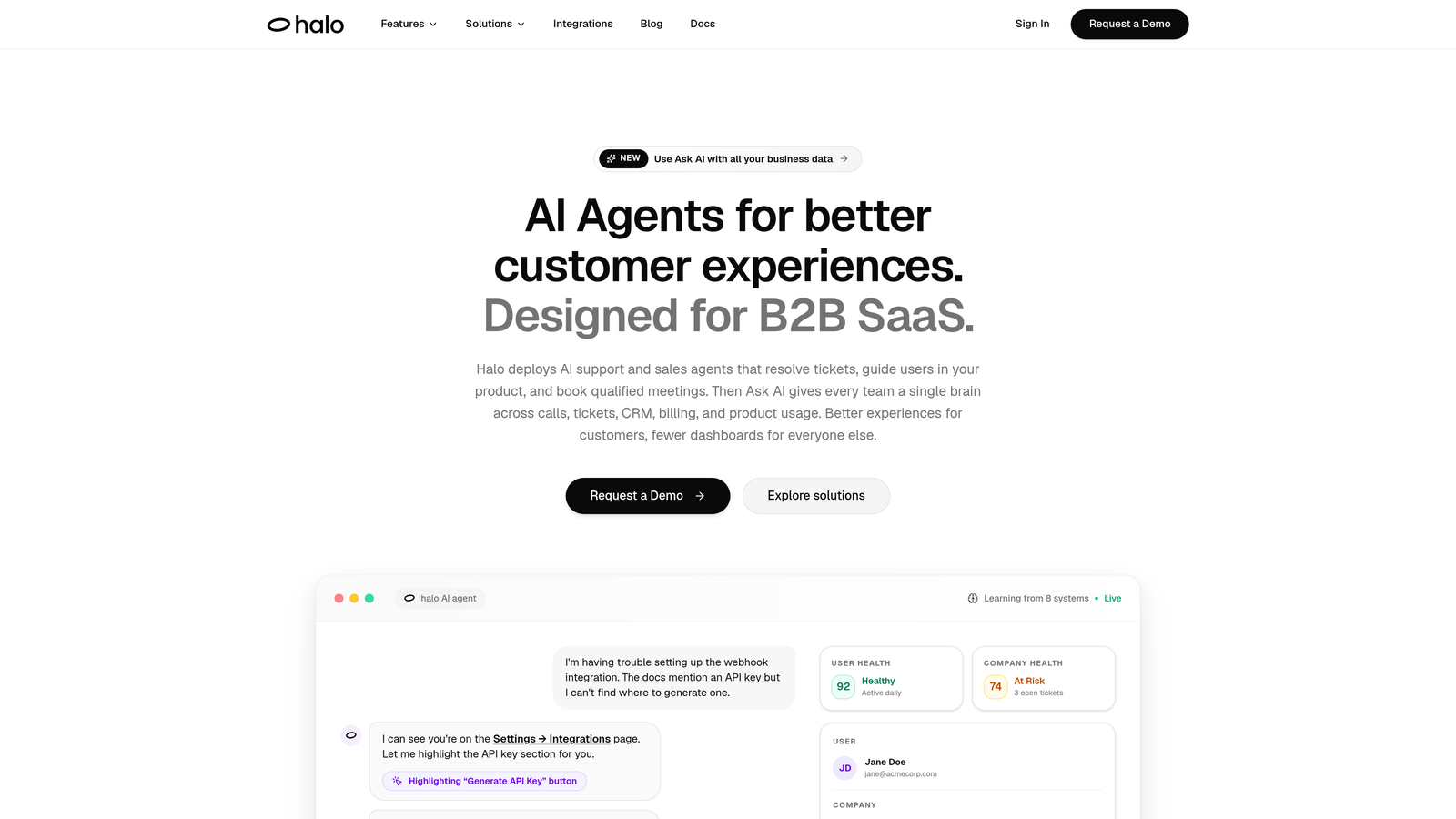
Halo AI is an AI-native customer support platform built specifically for B2B SaaS teams that need more than ticket deflection.
Where This Tool Shines
What separates Halo from most tools on this list is its architecture. It wasn't built as a helpdesk with AI bolted on — it was designed from the ground up around intelligent agents that resolve tickets, guide users through your product with page-aware context, and continuously improve from every interaction they handle.
The page-aware capability is particularly notable for SaaS teams. Halo's chat widget understands where a user is inside your product and provides contextual guidance based on that location — not just a generic knowledge base lookup. On top of that, the smart inbox surfaces business intelligence signals like customer health, revenue risk, and product friction patterns, turning support data into something your whole team can act on.
Key Features
Page-Aware AI Agents: Understands where users are in your product and delivers contextually relevant guidance, not just static article suggestions.
Smart Inbox with Business Intelligence: Surfaces customer health signals, revenue intelligence, and anomaly detection alongside standard support metrics.
Auto Bug Ticket Creation: Automatically generates bug reports connected to Linear, eliminating manual reporting steps for your engineering team.
Live Agent Handoff: Escalates complex issues to human agents with full conversation context preserved, so nothing gets repeated.
Deep Integration Stack: Connects to Linear, Slack, HubSpot, Intercom, Stripe, Zoom, PandaDoc, and Fathom — covering the full B2B SaaS toolchain.
Continuous Learning Architecture: Improves with every resolved interaction, meaning the system gets smarter the longer it runs.
Best For
B2B SaaS product teams that want an AI-first support layer with genuine business intelligence capabilities — not just deflection metrics. Particularly well-suited for teams where support data should inform product decisions, customer success, and revenue retention.
Pricing
Contact for pricing — built for B2B SaaS teams at scale. Visit haloagents.ai for current details and to request a demo.
2. Intercom
Best for: Mid-market SaaS teams wanting a mature all-in-one messaging and AI platform
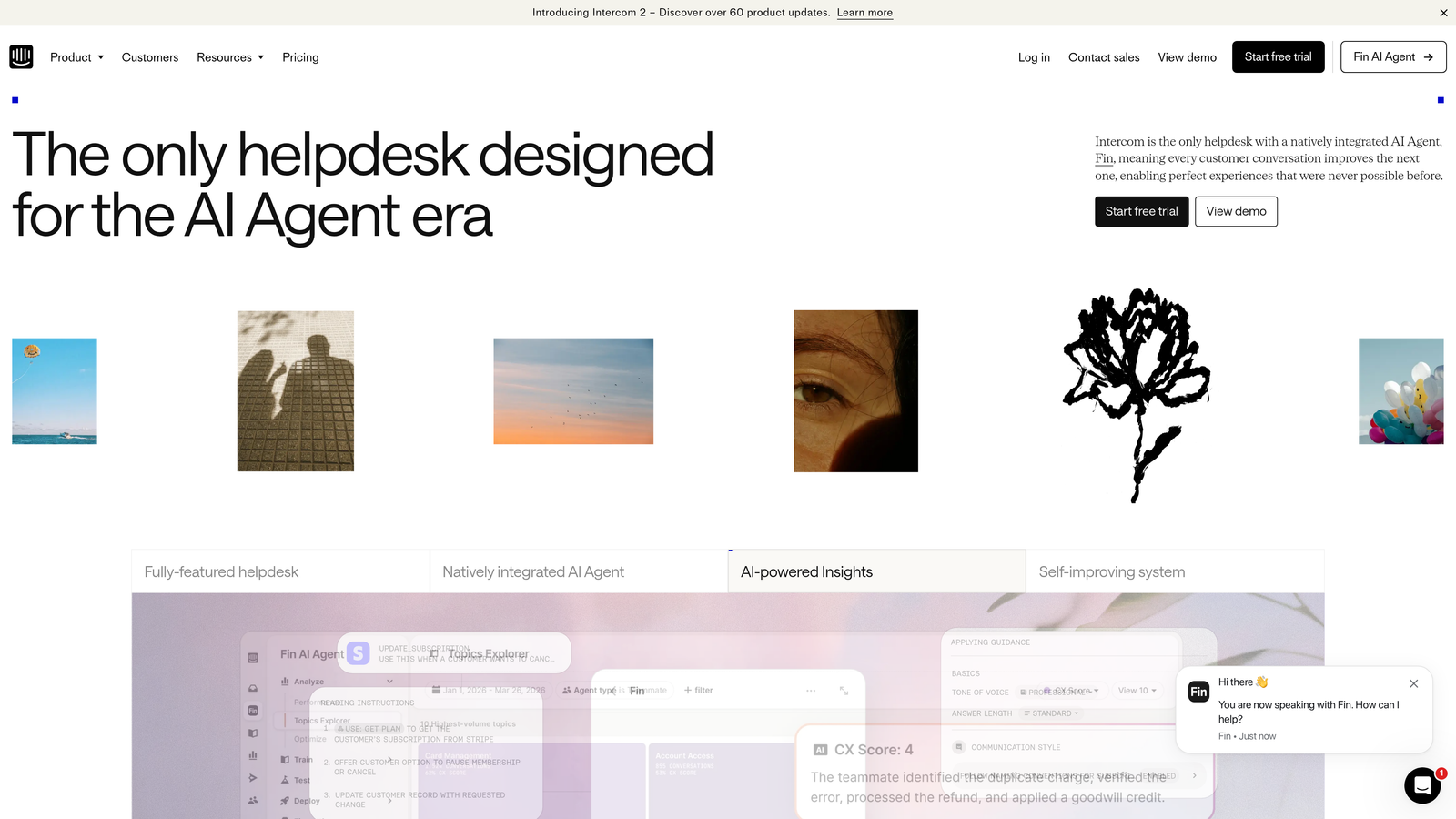
Intercom is a mature customer messaging platform with Fin, its AI agent built on large language model technology, layered on top of a robust CRM-style customer data foundation.
Where This Tool Shines
Intercom's strength is the combination of a rich customer data layer and a capable AI agent. Fin can autonomously resolve conversations across chat and email, and it does so with access to behavioral context and conversation history that many standalone AI tools simply don't have. If your team is already invested in Intercom, the upgrade path to AI-assisted resolution is relatively smooth.
The proactive support capabilities — in-product tours, outbound messaging, and targeted onboarding flows — are genuinely differentiated. For SaaS teams that want to get ahead of support tickets before they're created, Intercom's toolset is hard to match at this level of maturity.
Key Features
Fin AI Agent: Handles autonomous ticket resolution across chat and email using large language model reasoning.
Unified Customer Data Layer: Combines conversation history, behavioral data, and customer attributes in a single view.
Proactive Messaging and In-Product Tours: Enables teams to surface help content and onboarding flows before users reach out.
Extensive Integration Ecosystem: Connects with a wide range of SaaS tools across CRM, analytics, and engineering workflows.
Reporting and CSAT Tracking: Built-in analytics covering resolution rates, response times, and customer satisfaction scores.
Best For
Mid-market SaaS companies with existing Intercom investments, or teams that want a single platform covering messaging, AI resolution, and proactive customer engagement. Worth noting that pricing has increased significantly in recent years — verify current plans before committing.
Pricing
Starts at $39/seat/month; AI features available on higher tiers. Pricing has shifted upward in recent years — confirm current plans at intercom.com.
3. Zendesk
Best for: Enterprise teams needing multi-channel ticketing with AI-powered triage at scale
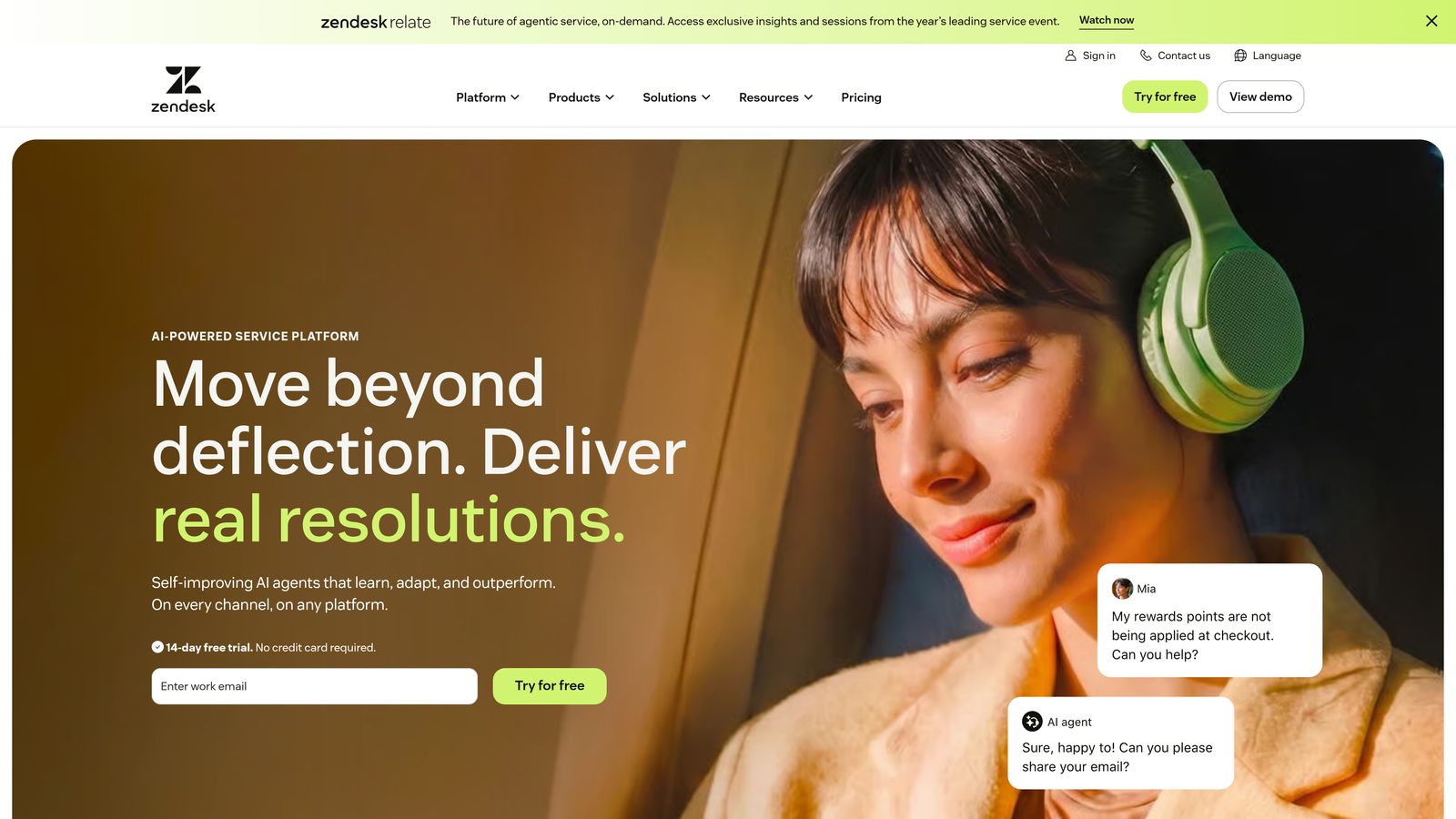
Zendesk is the enterprise standard for multi-channel ticketing, now with AI-powered triage, intelligent routing, and agent assist built into its Suite plans.
Where This Tool Shines
Zendesk's core advantage is breadth. It handles email, chat, voice, social, and messaging channels in a single platform with over a thousand marketplace integrations. For enterprise teams managing high conversation volumes across multiple channels, that coverage is hard to replicate.
The AI additions — intelligent triage, AI bots for deflection, and Agent Copilot for suggested replies — bring Zendesk closer to modern AI-first tools without requiring a platform migration. That said, teams evaluating Zendesk purely for AI capability may find newer, purpose-built tools more capable. Zendesk's strength is scale and stability, not cutting-edge AI architecture.
Key Features
AI-Powered Triage and Routing: Automatically classifies and routes incoming tickets based on intent, priority, and agent availability.
AI Bots for Deflection: Handles common queries across web, mobile, and messaging channels before tickets reach the queue.
Agent Copilot: Provides suggested replies, macros, and next-best-action recommendations directly in the agent workspace.
1,000+ Marketplace Integrations: Connects with virtually any tool in a modern SaaS stack.
Advanced Reporting and SLA Management: Comprehensive analytics with SLA tracking, custom dashboards, and performance benchmarking.
Best For
Enterprise SaaS companies with complex multi-channel support needs and existing Zendesk investments. Can feel heavyweight for smaller teams — the feature set is broad, and configuration complexity scales accordingly.
Pricing
Suite plans start at $55/agent/month; AI add-ons and advanced features available at higher tiers. Verify current plan structure at zendesk.com.
4. Freshdesk
Best for: SMBs and growing SaaS teams wanting omnichannel AI support at accessible pricing
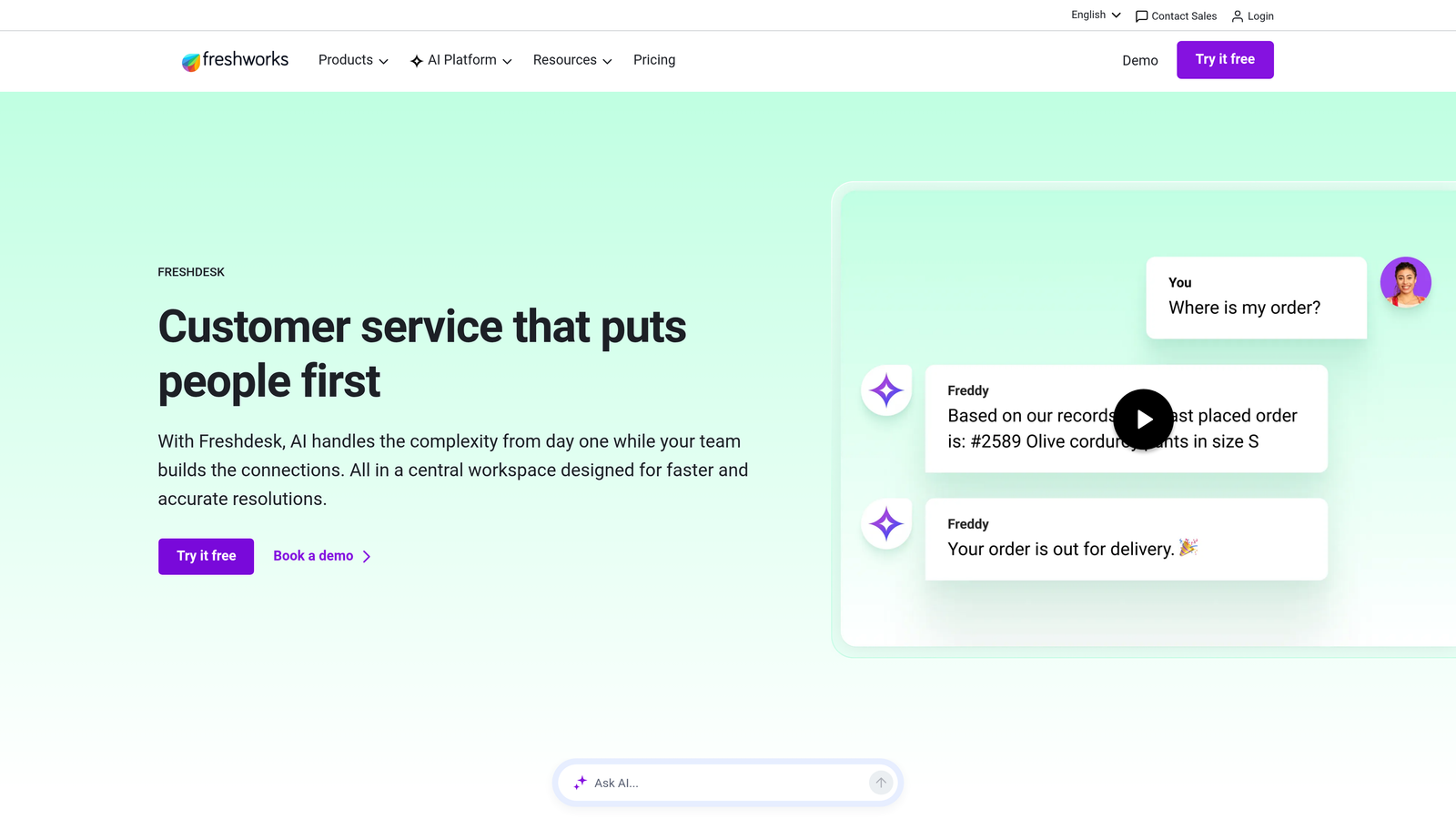
Freshdesk is Freshworks' helpdesk platform with Freddy AI embedded across the ticket lifecycle, from triage to resolution, at a price point accessible to teams that aren't yet at enterprise scale.
Where This Tool Shines
Freshdesk's value proposition is straightforward: a capable, omnichannel support platform with AI features at a price that doesn't require enterprise budget approval. Freddy AI covers the key bases — ticket summarization, suggested replies, auto-triage, and self-service deflection — without requiring a separate AI platform purchase.
For teams graduating from shared inboxes or basic email tools, Freshdesk provides a clear upgrade path with structure, automation, and AI built in. The free plan also makes initial evaluation low-risk, which is genuinely useful for teams still defining their support stack.
Key Features
Freddy AI for Agents: Provides ticket summarization, suggested replies, and auto-triage to reduce manual agent workload.
Freddy Self Service: AI-powered chatbot for deflecting common queries before they become tickets.
Omnichannel Support: Covers email, chat, phone (via Freshcaller), and social channels in a unified inbox.
Automation Rules: Configurable routing, escalation, and assignment workflows based on ticket attributes.
Built-in CSAT and Reporting: Standard dashboards covering resolution times, agent performance, and customer satisfaction.
Best For
SMBs and early-to-mid-stage SaaS teams that need omnichannel coverage with AI assistance at a predictable cost. Teams with more complex B2B SaaS workflows may find the AI depth limited compared to purpose-built platforms.
Pricing
Free plan available; paid plans start at $15/agent/month. AI features unlock on Growth tier and above — review current plan details at freshworks.com.
5. Tidio
Best for: Lean teams that need fast AI chat deployment with strong deflection for common queries
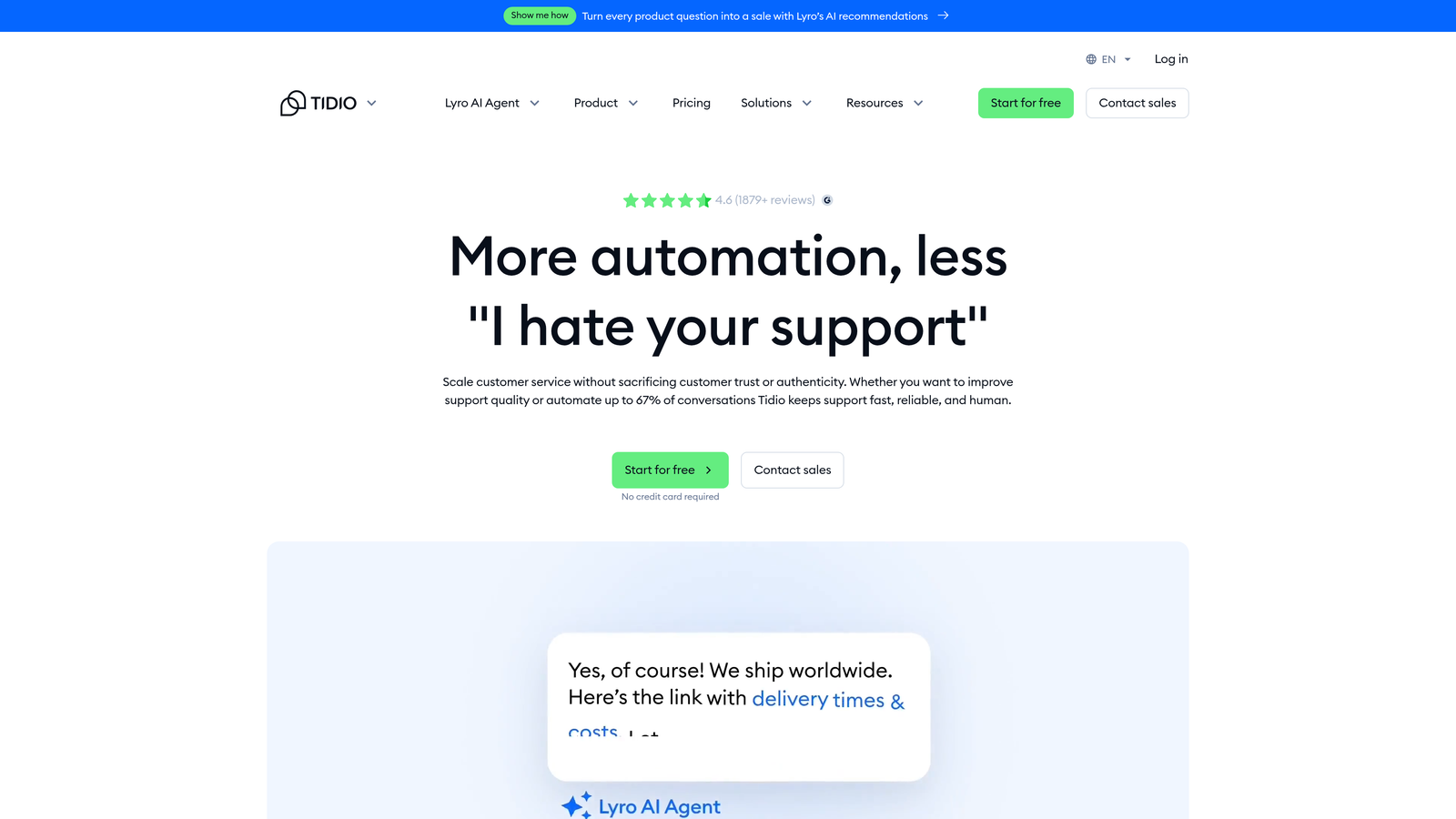
Tidio is a fast-to-deploy AI chat platform centered on Lyro, its conversational AI, designed for teams that need meaningful deflection without weeks of configuration.
Where This Tool Shines
Tidio's strongest selling point is speed to value. Pre-built conversation templates, a straightforward setup process, and Lyro's ability to handle common queries autonomously mean teams can be live and deflecting tickets in a short timeframe. For lean support teams stretched thin, that time-to-deployment advantage is real.
Lyro handles the repetitive, high-frequency queries that consume disproportionate agent time — password resets, plan questions, basic how-tos — and routes anything more complex to a live agent. It's not trying to be a full-stack support platform, and for teams with simpler needs, that focused scope is a feature, not a limitation.
Key Features
Lyro AI Chatbot: Autonomously resolves common support queries through conversational AI without requiring manual scripting.
Pre-Built Conversation Templates: Accelerates deployment with ready-to-use flows for frequent support scenarios.
Live Chat Fallback: Smooth agent takeover when Lyro reaches the edge of its resolution capability.
Email and Messenger Integrations: Extends coverage beyond web chat to additional communication channels.
Bot Performance Analytics: Tracks conversation outcomes, deflection rates, and query categories to optimize over time.
Best For
Small to mid-sized SaaS teams that want fast AI chat deployment for common query deflection. Less suited for complex B2B SaaS workflows that require deep integrations, business intelligence, or nuanced multi-step automation.
Pricing
Free plan available; Lyro AI starts at $29/month. Pricing scales with conversation volume — review current tiers at tidio.com.
6. Drift (Salesloft)
Best for: Teams where sales, success, and support workflows are tightly coupled
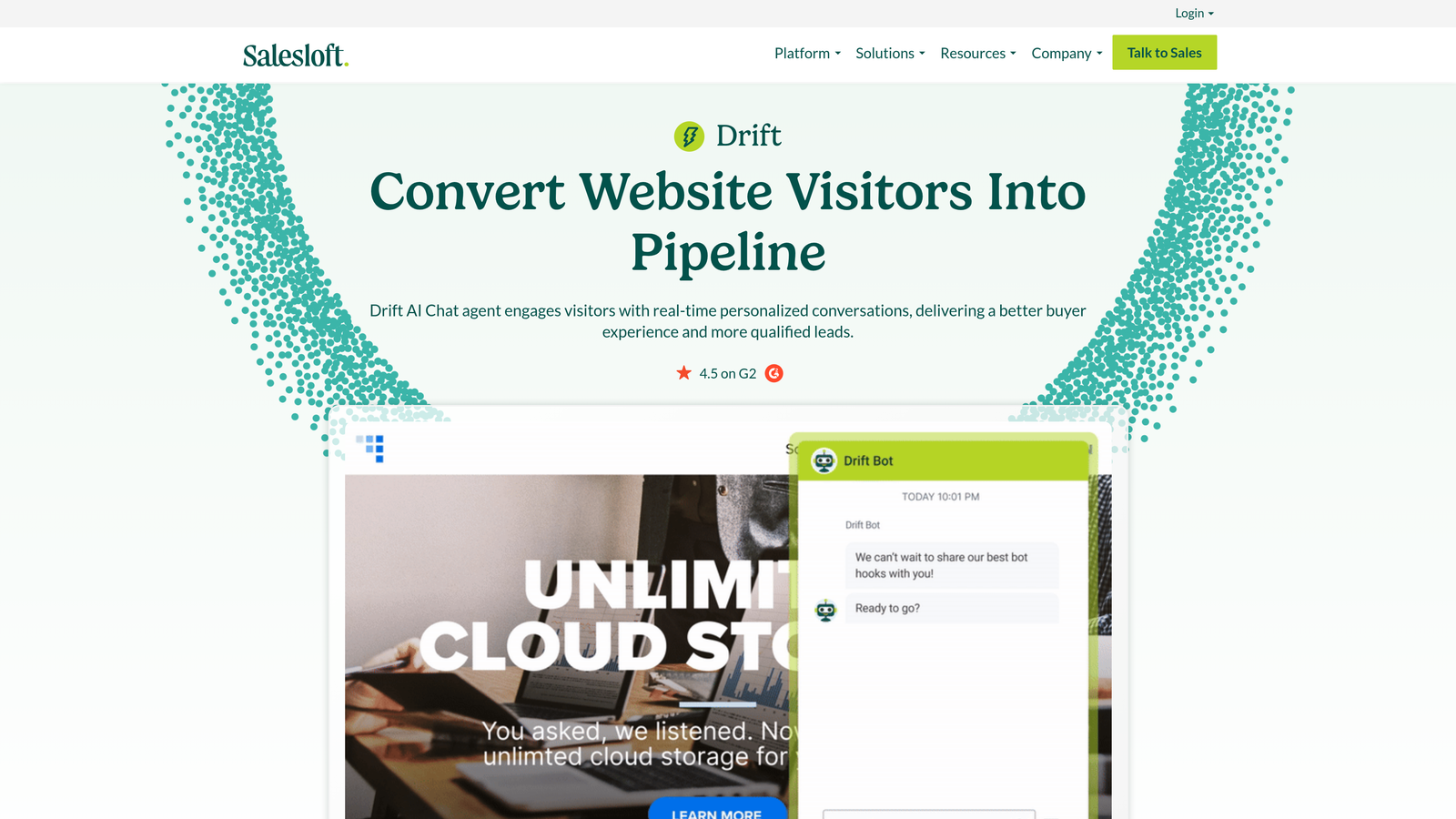
Drift is a conversational platform that bridges sales and support automation, using AI to qualify, route, and assist customers across the full post-sale journey.
Where This Tool Shines
Drift's differentiation is its positioning at the intersection of sales and support. Rather than treating these as separate functions, Drift's AI routes and qualifies conversations across the full customer lifecycle — from initial qualification through post-sale support. For companies where customer success and support are closely linked to revenue retention, that cross-functional view has genuine value.
The Salesloft acquisition has brought tighter revenue workflow integration, though it's worth noting the product has undergone changes since the acquisition. Teams doing due diligence should verify current product direction and roadmap before committing.
Key Features
AI-Powered Chatbots: Handles qualification and support routing across buyer and customer journeys in a single platform.
Real-Time Notifications: Alerts teams to high-value customer conversations as they happen.
Meeting Scheduling Automation: Integrates scheduling directly into support and sales flows, reducing friction.
Revenue Intelligence: Connects support interactions to pipeline data, surfacing revenue signals from customer conversations.
CRM and Workflow Integrations: Native connections to Salesforce, HubSpot, and Salesloft workflows.
Best For
SaaS companies where support and sales or customer success workflows overlap significantly, and where connecting conversation data to revenue outcomes is a priority. Less suited for teams that need pure-play support automation depth.
Pricing
Enterprise pricing — contact Drift or Salesloft directly for current plans. Pricing is not publicly listed.
7. Kustomer
Best for: High-volume support teams that want CRM-native automation with full customer context
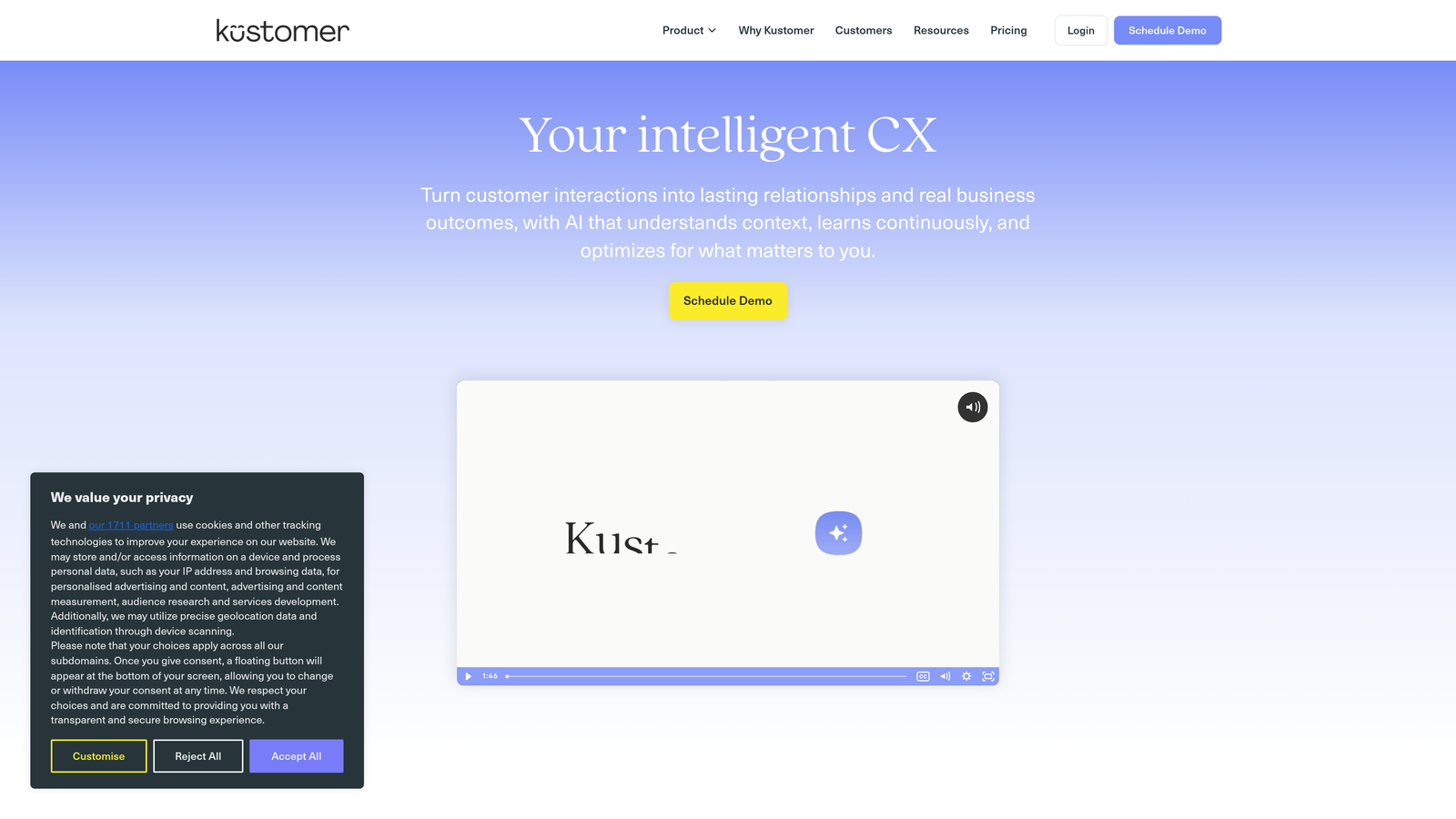
Kustomer is a CRM-native support platform that unifies customer history, conversation data, and AI-driven workflow automation, built for teams managing high conversation volumes across multiple channels.
Where This Tool Shines
Kustomer's unified customer timeline is its core differentiator. Every interaction, across every channel, is surfaced in a single chronological view — giving agents full context without tab-switching or manual data assembly. For teams managing complex customer relationships at volume, that consolidated view meaningfully reduces handle time and repetition.
The built-in CRM component also reduces the need for separate customer data tooling, which can simplify the overall stack. One consideration for buyers: Kustomer's ownership history (a Meta acquisition followed by a subsequent sale) has raised questions about long-term roadmap stability. It's worth factoring into due diligence conversations.
Key Features
Unified Customer Timeline: Aggregates all interactions across channels into a single, chronological customer view.
AI-Powered Routing, Tagging, and Suggested Responses: Reduces manual triage and helps agents respond faster with contextually relevant suggestions.
Complex Workflow Automation: Supports multi-step, conditional automation for sophisticated support processes.
Omnichannel Coverage: Handles email, chat, SMS, social, and voice from a single platform.
Built-in CRM: Reduces dependency on separate customer data tools by embedding CRM functionality natively.
Best For
High-volume support teams that need full customer context alongside automation, and where a built-in CRM reduces the need for additional tooling. Teams should review the current ownership and roadmap situation before making a long-term commitment.
Pricing
Starts at $89/user/month; enterprise plans available. Verify current pricing at kustomer.com before budgeting.
8. Help Scout
Best for: SaaS teams where support quality is a brand differentiator and human touch matters
Help Scout is a deliberately human-first support platform that uses AI to make agents faster and more effective, without trying to remove them from the equation.
Where This Tool Shines
Help Scout's philosophy is worth understanding before evaluating its features: it's not optimizing for maximum deflection. It's optimizing for high-quality human support, augmented by AI. If your support team is a competitive differentiator and your customers expect thoughtful, personal responses, that framing matters.
AI Summarize and AI Drafts reduce the time agents spend on administrative tasks — catching up on long threads, drafting initial responses — without removing human judgment from the final output. For companies where a canned AI response would actively damage the customer relationship, this approach is the right fit.
Key Features
AI Summarize: Instantly condenses long conversation threads so agents have full context on takeover without reading every message.
AI Drafts: Generates suggested replies for agent review, keeping humans in the loop before anything is sent.
Beacon Embedded Help Widget: Surfaces AI-powered article suggestions in-product before users reach out to support.
Shared Inbox with Collision Detection: Prevents duplicate responses with real-time visibility into who is handling each conversation.
Transparent, Per-User Pricing: Predictable pricing with no hidden feature gating across tiers.
Best For
SaaS companies where support quality is a brand differentiator and the team culture values human judgment in customer interactions. Not the right fit for teams primarily focused on maximizing autonomous resolution rates.
Pricing
Standard plan starts at $22/user/month; Pro at $44/user/month. Pricing is straightforward with no significant feature gating surprises.
9. Forethought
Best for: Enterprise teams wanting AI capabilities on top of an existing Zendesk or Salesforce investment
Forethought is an AI layer that sits on top of existing helpdesks like Zendesk and Salesforce Service Cloud, adding triage, auto-resolution, and agent assist without requiring platform migration.
Where This Tool Shines
Forethought's core value proposition is risk reduction. For enterprise teams with deeply entrenched Zendesk or Salesforce workflows, the prospect of migrating to a new platform is a significant operational and political hurdle. Forethought sidesteps that entirely by plugging its AI capabilities into the existing stack rather than replacing it.
The three-module structure — Triage for classification, Solve for autonomous resolution, and Assist for agent co-pilot support — gives teams the flexibility to deploy AI incrementally. That staged approach is genuinely useful for organizations that need to build internal confidence in AI before expanding its scope.
Key Features
Triage AI: Intelligently classifies and routes incoming tickets based on intent and historical patterns.
Solve AI: Autonomously resolves repetitive, high-frequency ticket types without agent involvement.
Assist AI: Acts as an agent co-pilot, surfacing suggested responses and relevant knowledge base content in real time.
Helpdesk Integrations: Plugs into Zendesk, Salesforce Service Cloud, ServiceNow, and other major platforms without replacing them.
Deflection and Performance Analytics: Tracks AI performance by ticket category, deflection rates, and resolution quality.
Best For
Enterprise teams with significant existing investments in Zendesk or Salesforce Service Cloud that want to add AI capabilities without a platform migration. Less relevant for teams building a support stack from scratch or those open to replacing their current helpdesk.
Pricing
Enterprise pricing — contact Forethought directly for current plans. Not publicly listed.
Which Tool Is Right for Your Team
The right choice here depends less on which tool has the longest feature list and more on where your team is today and where it needs to go.
Here's a quick orientation by use case:
AI-first with business intelligence: Halo AI is the standout choice for B2B SaaS teams that want an intelligent support layer that also surfaces customer health signals, revenue risk, and product friction — not just deflection rates.
Mature all-in-one messaging: Intercom remains a strong option for teams already invested in the platform, particularly where proactive messaging and in-product engagement are part of the support strategy.
Enterprise ticketing at scale: Zendesk is the default for large organizations managing multi-channel volume with complex SLA requirements.
Budget-conscious SMB: Freshdesk delivers omnichannel AI support at a price point that works for earlier-stage teams.
Fast deployment for lean teams: Tidio gets you to meaningful deflection quickly, with minimal configuration overhead.
Sales-support overlap: Drift makes sense when revenue workflows and support workflows need to share context and routing logic.
High-volume CRM-native: Kustomer is worth evaluating for teams that want full customer context without maintaining a separate CRM.
Human-first culture: Help Scout is the right fit when support quality is a brand value, not just a cost center.
AI layer over existing helpdesk: Forethought is the low-migration-risk path for enterprises with entrenched Zendesk or Salesforce deployments.
Before finalizing your decision, ask yourself three questions: Do you need AI that understands product context, or is general ticket deflection sufficient? Does your team need business intelligence from support data, or just faster resolution? Are you building a new support stack, or augmenting an existing one?
Your support team shouldn't scale linearly with your customer base. Let AI agents handle routine tickets, guide users through your product, and surface business intelligence while your team focuses on complex issues that need a human touch. See Halo in action and discover how continuous learning transforms every interaction into smarter, faster support.