Why Support Agents Lack Product Visibility (And What It's Costing You)
When support agents lack product visibility, they're forced to ask customers for context that should already be available, creating friction that drives churn. This structural gap in traditional support tooling costs B2B SaaS companies in resolution time, customer satisfaction, and revenue retention.
 Matt PattoliFounder13 min read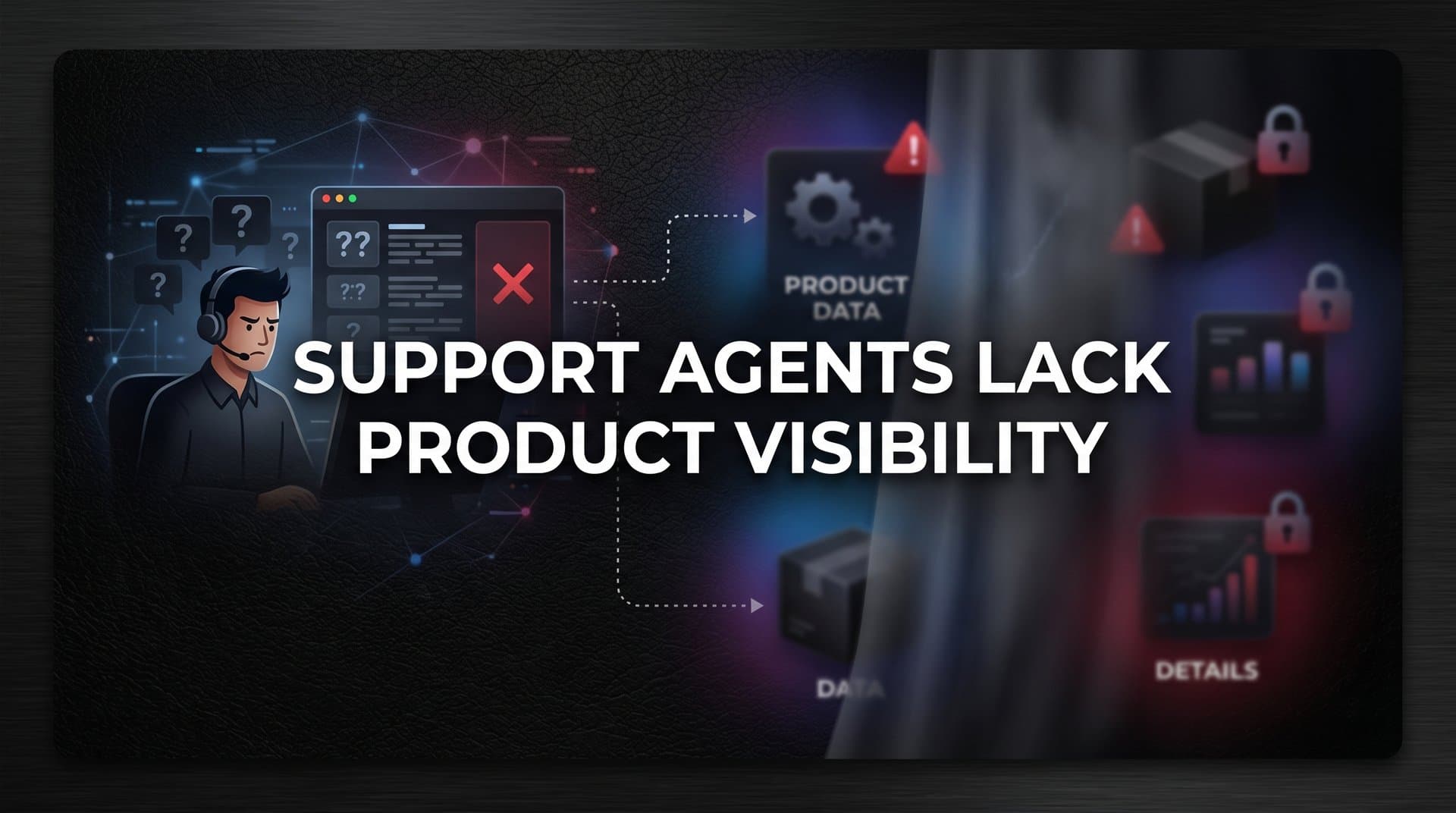
Picture this: a customer opens your chat widget, frustrated. They've been staring at a broken button on your billing page for ten minutes, tried refreshing twice, and now they're one bad interaction away from churning. Your support agent receives the message. And what do they see? A name, an email address, and a sentence that says "the button isn't working."
That's it. No page context. No error state. No record of what the user clicked before things went wrong. The agent, doing their best, responds with the classic: "Can you tell me which page you're on and what you're trying to do?" The customer sighs, types it all out, and waits again.
This scenario plays out thousands of times a day across B2B SaaS companies, and the frustrating part is that it isn't anyone's fault. Your support agents aren't undertrained. Your customers aren't bad at explaining themselves. The problem is structural. Traditional support tooling was built to manage conversations, not to understand the product context that triggered them. The result is a visibility gap baked into the architecture itself, and it's quietly costing you more than you realize.
This article breaks down exactly what that gap is, why it exists, what it's costing your team and your customers, and what a modern, AI-first approach to support actually looks like when product visibility is built in from the ground up.
The Invisible Wall Between Support and Your Product
When we talk about product visibility in the support context, we're talking about something specific: the ability for a support agent, whether human or AI, to understand what page a user is on, what UI elements are visible to them, what errors they've encountered, what they've already tried, and what their account state looks like at the exact moment they reach out for help.
That's a lot of context. And right now, most support systems receive almost none of it.
Think about how platforms like Zendesk, Freshdesk, and Intercom were originally designed. They are, at their core, communication management systems. Their job is to receive inbound messages, route them to the right people, track their status, and help teams respond efficiently. They do this well. But they were architected as a layer on top of your product, not inside it. They receive the ticket; they don't understand the product state that created it.
This is the context gap: the distance between what a user is experiencing inside your product and what the support agent can actually see when the conversation begins. When a user submits a ticket or opens a chat, the support system typically captures their message, their email or account ID, and maybe their browser and operating system. What it almost never captures is which page they're on in any meaningful way, what UI elements are currently visible, what actions they took in the last five minutes, or what support tickets missing product context fail to convey about the error state the application is in.
So the agent is responding to a description of a problem, not the problem itself. They're working from a secondhand account, filtered through a frustrated user who may not know the right terminology, may have already forgotten a step, or may simply be too annoyed to type out the full sequence of events.
This isn't a gap you can close by hiring better agents or writing more thorough knowledge base articles. It's a gap that exists because the support layer and the product layer were never designed to talk to each other. The tooling treats support as something that happens after the product experience, not as something embedded within it.
And that distinction matters enormously, because the moment a user reaches out for help is precisely the moment when product context is most valuable. They're in the product right now. The confusion is happening in real time. But the support system is operating blind.
Why This Gap Exists in the First Place
Understanding why the visibility gap exists helps clarify why it's so persistent. It's not an oversight that any single team failed to address. It's the result of three compounding factors: architecture, organization, and tooling history.
The Architectural Reality: Most support platforms sit outside the product stack by design. They receive inbound messages through a widget or email integration, but they aren't embedded in the product experience in a way that gives them access to session data, page state, or user behavior. The data that would be most useful to a support agent, what the user is currently looking at, what they clicked, what the application returned, lives in your product's frontend and backend. Getting it into a support conversation requires deliberate engineering work that most companies never prioritize until the pain becomes severe.
The Organizational Silo: In most B2B SaaS companies, support and product teams operate in fundamentally different worlds. Engineers build the product and track issues in tools like Linear or Jira. Support teams handle customer conversations in Zendesk or Intercom. Product teams analyze behavior in analytics platforms. These systems rarely share data in real time, and without someone deliberately building the bridges between them, the information stays siloed. The disconnect between support and product teams means neither side has the full picture of what customers are experiencing.
This organizational separation also means that insights generated in support rarely make it back to the people who could act on them. A pattern of confusion around a specific feature stays buried in ticket text rather than surfacing as a signal in the product roadmap conversation.
The Legacy Tooling Problem: Legacy chat widgets and ticketing systems were built for a specific use case: helping human agents manage conversations at scale. Human agents can ask clarifying questions. They can interpret vague descriptions and make educated guesses. They can ask a user to share a screenshot. The tooling was designed around that human workflow, which meant that capturing rich product context upfront wasn't a priority.
But the rise of AI-powered support changes the equation entirely. AI agents need context to act correctly. They can't rely on conversational intuition the way a skilled human agent can. An AI that doesn't know what page a user is on is genuinely limited in what it can do, far more limited than a human in the same situation. The old architecture wasn't built for this new reality, and bolting AI onto a context-blind system doesn't solve the underlying problem.
The Real Cost of Context-Blind Support
The visibility gap isn't just an inconvenience. It has measurable downstream effects on resolution time, customer trust, and the quality of product intelligence your organization can generate from support interactions.
Resolution Time Suffers: Every clarifying question in a support conversation adds latency. In live chat, a round of back-and-forth adds friction and increases the likelihood that the user abandons the conversation entirely before getting an answer. In asynchronous support like email or ticketing, a single clarification cycle can add hours or even days to resolution time. When an agent has to ask "which page are you on?" or "what exactly did you click?", they're not being inefficient. They're doing the only thing they can with the information available. But the cost is real, and it compounds across every ticket in your queue.
The more context an agent has at the start of a conversation, the fewer questions they need to ask. Page-aware context doesn't just make responses more accurate, it makes them faster, because the agent already knows the answer to the first three questions they would have asked.
Accuracy and Trust Erode: Agents without product visibility are more likely to give generic guidance. And generic guidance, when a user has a specific problem on a specific screen, doesn't just fail to help. It actively damages trust. If a user is on a pricing page with a broken call-to-action and the support response is "try clearing your cache and refreshing the page," the message received isn't "we're working on it." It's "we have no idea what you're talking about."
That kind of response can turn a recoverable situation into a churn event. Users don't expect perfection. They do expect to feel understood. A response that demonstrates zero awareness of their actual situation signals that the lack of support visibility is leaving them without the help they need.
Product Intelligence Goes Dark: This is the cost that's easiest to overlook and potentially the most significant. Support conversations are one of the richest sources of product feedback available to any SaaS company. Recurring confusion on a specific page signals a UX problem. Repeated errors on a particular workflow signal a bug. Spikes in support volume around a feature signal adoption friction. These are exactly the signals that product and engineering teams need to prioritize their work.
But without product visibility, these signals are buried in unstructured ticket text. They require manual analysis to surface, and by the time someone does the analysis, the moment for action has often passed. The visibility gap doesn't just hurt support quality. It severs the feedback loop between your customers' real-time experience and the teams who could improve it, creating a lack of support insights for the product team that slows down roadmap decisions.
What Page-Aware Support Actually Looks Like
So what does it look like when support has genuine product visibility? The experience is different enough from traditional support that it's worth walking through concretely.
Page-aware support means that when a user opens the chat widget or submits a request, the support system already knows which page they're on, what UI elements are currently visible, and what their account context looks like. The user doesn't need to explain any of this. The system already has it.
The practical effect is immediate. Instead of the conversation starting with "Can you tell me what you're trying to do?", it starts with a response that's already calibrated to the user's actual situation. If they're on the billing page and something looks wrong, the response addresses the billing page specifically. If they're in the middle of an onboarding flow and they're stuck, the guidance picks up from exactly where they are.
Visual UI Guidance Changes Everything: One of the most powerful capabilities that page-awareness unlocks is visual product guidance in customer support. Instead of written instructions like "go to Settings, then click Billing, then find the Invoices tab," a page-aware system can highlight the exact button the user needs to click, draw their attention to the relevant UI element, or walk them through a flow interactively within the product itself.
This matters because written instructions for navigating a UI are notoriously unreliable. Interfaces change. Labels shift. What the documentation says and what the user sees are often slightly different, and that gap is enough to cause confusion. Visual guidance anchored to the actual current state of the UI eliminates that gap entirely.
From Reactive to Proactive: Perhaps the most fundamental shift that page-aware support enables is moving from a reactive model to a proactive one. In a reactive model, the user describes a problem and the agent responds. In a proactive model, the system already understands the context and can respond with precision from the very first message, sometimes even before the user has fully articulated what's wrong.
This isn't just faster. It's a qualitatively different experience. Users feel understood rather than processed. The support interaction feels like talking to someone who knows the product and knows their situation, rather than someone reading from a script who needs to be caught up from scratch every time.
Achieving this requires a specific technical architecture: a widget or SDK embedded in the product that can read page context, a mechanism to pass that context to the AI or agent handling the conversation, and a response layer capable of using that context to generate specific, relevant guidance. These aren't incremental improvements to a standard chat widget. They represent a fundamentally different approach to connecting support with product data.
How AI Agents Close the Product Visibility Gap
Here's where the AI-first versus bolt-on-AI distinction becomes critical. Many established helpdesk platforms have added AI capabilities in recent years: suggested replies, auto-tagging, sentiment analysis, automated responses to common questions. These additions are genuinely useful. But they don't solve the visibility gap, because the underlying architecture still lacks product context.
An AI layer sitting on top of a context-blind system is still context-blind. It can generate faster responses to incomplete information. It can categorize tickets more efficiently. But it can't tell a user exactly what to click on the page they're currently looking at, because it doesn't know what page they're on.
AI-First Architecture Starts with Context: AI-first support platforms, by contrast, are built with product context as a core input rather than an afterthought. The AI isn't receiving a message and trying to infer what the user might be experiencing. It's receiving a message plus a structured snapshot of the user's current product state, and generating a response that accounts for all of it. This is architecturally different, not just incrementally better.
The distinction matters practically. An AI agent with page context can answer questions that a context-blind AI simply cannot. It can say "I can see you're on the integrations page and the connection to your CRM is showing a red status indicator. Here's what that means and how to fix it." That response is only possible if the AI knows what the user is looking at. Understanding how AI agents work in customer support makes clear why this architectural difference is so consequential.
Continuous Learning Compounds the Advantage: The other dimension where AI-first architecture creates lasting value is through continuous learning. An AI agent that sees product context on every interaction doesn't just perform better in the moment. It accumulates knowledge over time about which pages generate the most confusion, which workflows break most often, and which responses resolve issues fastest. This feedback loop means the system gets more accurate and more efficient with every interaction, building an advantage that compounds rather than plateaus.
Support Becomes a Product Intelligence Layer: Perhaps the most underappreciated consequence of closing the visibility gap is what it does to the quality of intelligence flowing from support to the rest of the organization. When the AI knows which page every support interaction originated from, patterns become visible automatically. Recurring confusion on a specific screen becomes a signal for the product team. A cluster of similar errors on a particular workflow triggers a bug report surfaced through support tickets. Spikes in support volume around a feature flag inform a rollout decision.
This is the difference between support as a cost center and support as a strategic function. Product visibility doesn't just make individual support interactions better. It turns the support layer into a continuous feedback mechanism that informs engineering priorities, product roadmap decisions, and customer health monitoring in real time.
Putting It All Together: From Visibility Gap to Support Intelligence
The visibility gap is a structural problem. It isn't caused by undertrained agents or poorly written documentation. It's the result of support tooling that was designed to manage conversations rather than understand the product context behind them. Solving it requires rethinking the architecture of support, not just improving the people or processes within the existing architecture.
The good news is that the path forward is clear. Teams that close this gap don't just improve their support metrics. They transform support into something genuinely different: a product intelligence layer that generates signals for engineering, informs product decisions, and provides customer health data that customer success teams can actually act on. The support function stops being a reactive queue and starts being a real-time window into how customers experience the product.
Where support is heading is toward systems that understand the product as well as the people using it. Not reactive ticket queues staffed by agents working from incomplete information, but intelligent, context-aware systems that know what users are looking at, what they've tried, and what they need before the first message is even sent.
That's not a distant vision. It's what AI-first support architecture makes possible today, when product visibility is built in from the ground up rather than bolted on as an afterthought.
Halo AI's page-aware chat widget and AI agents are built from the ground up to eliminate the visibility gap. Every interaction is informed by real product context, every resolution contributes to continuous learning, and every pattern in your support data becomes actionable intelligence for your product and engineering teams. See Halo in action and discover how a support system that actually sees what your users see changes everything about how you resolve issues, reduce churn, and build better products.