Why Support Agents Spending Time on Basic Questions Is Costing You More Than You Think
When support agents spending time on basic questions like password resets and billing inquiries dominates the queue, complex issues go unanswered and response times suffer—not because of staffing shortages, but because skilled professionals are misallocated to repetitive, low-value tasks that drain capacity and quietly undermine overall support performance.
 Matt PattoliFounder15 min read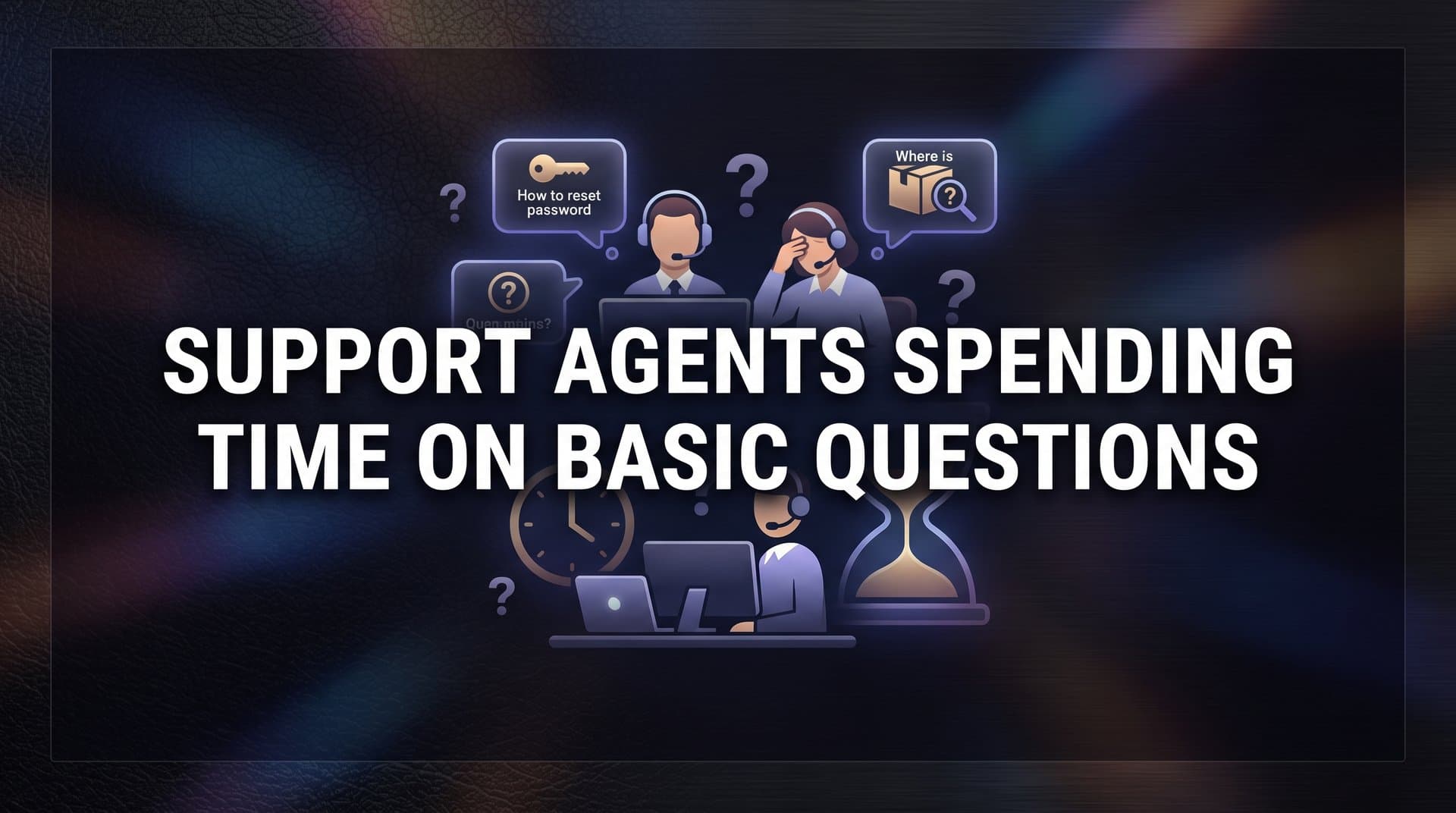
Picture a support team that's fully staffed, well-trained, and genuinely committed to doing good work. Tickets are coming in, agents are responding, and on paper everything looks functional. But the queue keeps growing. Response times are slipping. Complex issues are sitting unanswered for hours while the team is clearly busy. What's going wrong?
The answer usually isn't headcount. It's allocation. A closer look at what's actually moving through the queue reveals a familiar pattern: password reset requests, billing clarification questions, "how do I find this feature" inquiries, and plan comparison questions. Tickets with known answers, documented somewhere, that are landing in front of skilled professionals who were hired to do something far more demanding.
This is the repetition trap, and it's quietly undermining support operations at companies that otherwise have everything in place. The problem isn't that your agents aren't capable. It's that the system is asking them to spend a significant portion of their working hours on questions that require no expertise to answer. When you trace that pattern to its source, you find structural costs that go well beyond wasted time: eroded morale, slower resolution for customers with real problems, and a team that's burning out on work that doesn't use what they're actually good at.
This article unpacks why support agents spending time on basic questions is such a persistent and underappreciated problem, what it actually costs when you look beyond the surface, and how modern teams are building a smarter model that lets AI handle the repetitive layer while freeing agents to do the work that genuinely requires them.
The Repetition Trap: How Basic Questions Dominate Support Queues
Walk through the ticket queue of almost any B2B SaaS support team and a pattern emerges quickly. A significant portion of what's sitting there isn't complex. It's the same handful of question types, arriving in high volume, day after day.
In B2B SaaS environments, the most common categories tend to look like this: account access and password resets, billing questions about charges or plan features, navigation help for users who can't find a specific setting or workflow, and general "how does this work" questions about product functionality. These aren't edge cases or unusual requests. They're the steady background noise of any growing product with an expanding user base.
What makes this particularly challenging is that these tickets rarely get triaged away from skilled agents. In a traditional helpdesk setup, every inbound request enters the same queue and gets assigned through the same workflow. There's no intelligent layer that looks at a ticket, recognizes it as a routine question with a documented answer, and resolves it before a human ever touches it. The ticket arrives, it sits in the queue, and eventually an agent picks it up.
The volume dynamics make this worse. Basic questions don't arrive at the same rate as complex ones. They arrive in clusters, often triggered by product updates, billing cycles, or onboarding waves. When a new cohort of users signs up and starts exploring the product, a surge of navigation and how-to questions follows. When invoices go out, billing inquiries spike. The queue fills with low-complexity tickets faster than it fills with technical escalations, which means the ratio of repetitive to complex work is often skewed heavily toward the former.
The compounding effect is where the real damage happens. When basic tickets pile up, they don't just consume agent time on their own terms. They also push complex issues further back in the queue. A customer with a genuine technical problem, a billing dispute that requires investigation, or an integration failure that's blocking their workflow is waiting behind a stack of password reset requests. That customer's experience degrades not because the team lacks the skills to help them, but because those skills are occupied elsewhere.
The result is a two-sided quality problem. Customers with simple needs wait longer than they should for answers that could have been delivered instantly. Customers with complex needs wait even longer because the agents who can actually help them are tied up. Neither group gets the experience they deserve, and the team is working hard the entire time without meaningfully closing the gap.
The Hidden Costs Behind Every Repetitive Ticket
It's easy to frame the repetition problem as a time management issue. Agents are spending time on low-value work; they should be spending it on high-value work. That framing is accurate, but it undersells how much is actually at stake when you look at the full picture.
Start with the straightforward financial reality. Support agents represent a real investment: salary, benefits, onboarding, training, and the ongoing cost of management and tooling. That investment is made with the expectation that agents will apply their skills to problems that require human judgment. When a meaningful portion of their working hours goes toward answering questions that have documented answers, the return on that investment erodes proportionally. You're paying for expertise and getting FAQ navigation.
The cognitive cost is less obvious but arguably more damaging to output quality. Context-switching, the act of moving between different types of tasks that require different mental modes, carries a real productivity penalty. This is well-established in cognitive psychology and workplace research: each time a person shifts from one type of task to another, there's a re-engagement cost. The brain needs time to load the new context before it can perform at full capacity.
For a support agent, this means moving from a trivial password reset ticket to a complex technical escalation isn't as simple as finishing one and starting the other. The mental shift required to engage deeply with a nuanced problem after handling a series of routine requests takes time and cognitive energy. The quality of work on the complex ticket suffers as a result, even if the agent is experienced and capable. The repetitive work isn't just consuming time; it's degrading performance on the work that actually matters.
Then there's the retention dimension, which tends to get overlooked in operational conversations but carries significant long-term cost. Support roles already carry high turnover rates across the industry. Repetitive, low-autonomy work is a well-understood contributor to disengagement. When skilled professionals spend most of their day answering questions that require no judgment, they don't feel like they're growing. They don't feel like their expertise is valued. Over time, that feeling translates into disengagement, and disengagement precedes departure.
Every agent who leaves represents a real cost that extends well beyond the inconvenience of backfilling the role. There's the recruiting process, the time spent interviewing and evaluating candidates, the onboarding investment, and then the ramp-up period before a new hire reaches full productivity. During that ramp-up period, the team's capacity is reduced, senior agents spend time on mentorship instead of their own work, and the queue absorbs the impact. The cycle of turnover driven by underutilization is expensive in ways that rarely show up on a support dashboard.
When you add up the direct cost of misallocated agent time, the indirect cost of degraded performance from context-switching, and the long-term cost of turnover driven by disengagement, the price of support agents spending time on basic questions is considerably higher than it appears on the surface.
Why This Problem Persists Even in Well-Run Teams
Here's the thing that makes this problem frustrating: it persists in teams with good leadership, solid processes, and genuine commitment to doing support well. This isn't a management failure. It's a structural one, and understanding the distinction matters if you want to actually fix it.
Traditional helpdesk systems, the Zendesks, Freshdesks, and Intercoms that most B2B SaaS teams are built on, were designed around a specific model: tickets come in, agents work through them, managers monitor the queue. It's a workflow management system. What it isn't is an intelligent layer that evaluates whether a ticket needs a human at all. By default, everything routes to agents. The system has no mechanism to intercept a routine question, recognize that it has a known answer, and resolve it before a human ever gets involved.
This isn't a criticism of those platforms. They do what they were built to do. But they were built for a world where human agents were the primary resolution mechanism, and the goal was to help those agents work more efficiently. The question of whether certain tickets should bypass agents entirely wasn't part of the original design brief.
Knowledge bases and FAQ pages exist precisely to address this gap, and yet they consistently fail to deflect the volume of tickets they theoretically should. The reason is straightforward: self-service tools require customers to leave their current context, navigate to a separate resource, search for the right answer, and trust that what they find applies to their specific situation. That's a significant amount of friction for someone who just wants a quick answer to a simple question.
Customers don't fail to use knowledge bases because they're lazy. They fail to use them because the experience of getting help in the moment, from a person or a system that understands their context, is dramatically better than the experience of searching a documentation library. The knowledge base answers the question in the abstract. What the customer needs is the answer in context, applied to their specific situation on the specific page they're looking at.
The training bottleneck adds another layer to the structural problem. New agents take time to ramp up, and during that period they're not operating at full capacity. They lean on senior agents for guidance, escalate questions they're not yet confident handling, and work more slowly through their queue. This is normal and expected, but it has a real effect on team capacity. Senior agents who are pulled into mentorship and guidance roles spend less time on the complex work only they can handle. The entire team's ability to focus on high-value work is diluted during every onboarding cycle.
None of these are problems that better management practices can solve in isolation. They require a structural change: an intelligent layer that sits upstream of the helpdesk and handles what doesn't need to reach agents in the first place.
What Changes When AI Handles the Repetitive Layer
The shift that modern AI agents make possible isn't just about automating existing workflows. It's about moving the point of intervention earlier in the process, before tickets are created, rather than after they're already in the queue.
This distinction between deflection and automation is worth making clearly. Automation, in the traditional sense, means taking a ticket that already exists and resolving it without human involvement. Deflection means preventing the ticket from being created in the first place by answering the question at the moment it arises. The most effective AI systems do both, but deflection is where the upstream value is greatest. A ticket that never enters the queue doesn't consume any agent time, doesn't add to queue depth, and doesn't contribute to the backlog that pushes complex issues further back.
Page-aware context is what makes deflection genuinely useful rather than just a fancier FAQ. An AI agent that knows a user is on the billing settings page when they ask about a charge can deliver a specific, relevant answer about what they're looking at, not a generic link to a billing documentation article. An AI agent that sees a user on the integration configuration screen can walk them through the specific steps for the integration they're setting up. The answer isn't just correct in the abstract; it's correct for this user, in this moment, in this context.
That contextual specificity is what closes the gap that knowledge bases fail to close. It removes the friction of self-service by meeting customers where they are rather than asking them to go somewhere else to find help. Understanding how AI agents work in support makes clear why this contextual layer is so much more effective than static documentation.
Intelligent triage handles the tickets that do require human attention. When a question is genuinely complex, emotionally charged, or involves account-specific information that requires investigation, the AI recognizes that and routes it to an agent, with context attached. The agent receives the ticket already categorized, tagged with relevant information, and enriched with the conversation history from the AI interaction. They're not starting from scratch; they're picking up a handoff that's already been partially processed.
This changes the nature of what agents receive in their queue. Instead of a mix of routine and complex tickets arriving in no particular order, agents get a queue that's been filtered to contain only the work that actually needs them. The ratio of meaningful to routine work shifts dramatically.
The learning loop is what separates modern AI agents from static automation tools. A traditional rule-based system resolves what it was explicitly programmed to resolve and fails on everything else. It doesn't get better over time unless someone manually updates it. An AI agent that learns from every resolved interaction gets progressively better at recognizing patterns, handling new question types, and delivering accurate answers. The deflection rate isn't fixed; it improves continuously as the system accumulates experience. The return on the initial investment grows over time rather than plateauing.
Freeing Agents to Do Work That Actually Matters
There's a useful reframe worth making here. When we talk about removing repetitive work from agents' plates, it's easy to frame it as a cost-reduction story: fewer tickets per agent, lower headcount requirements, reduced operational expense. That framing is accurate, but it misses what's arguably more valuable.
Support agents are good at things that AI isn't. Nuanced troubleshooting that requires understanding a customer's specific technical environment. Relationship-building with accounts that are at risk of churning. Escalation management that requires reading between the lines of what a frustrated customer is actually saying. Pattern recognition that connects a series of seemingly unrelated tickets to an underlying product issue. These are genuinely high-value capabilities, and they're what support professionals were hired to bring to the table.
None of those capabilities are being exercised when an agent is answering their fourth password reset request of the morning. The skill is there; the opportunity to apply it isn't. Removing the repetitive layer doesn't diminish the agent's role. It clarifies it. The broader case for automating repetitive support questions is precisely that it restores agents to the work they were actually hired to do.
The effect on agent experience is real and worth taking seriously. When the work in front of you consistently requires your judgment, your empathy, and your expertise, you engage differently with it. You develop faster. You feel more connected to the outcomes. The conversations you have with customers are more meaningful because the customers you're talking to have problems that actually need you. That's a fundamentally different professional experience than working through a queue of questions that have documented answers.
The downstream business outcomes follow naturally. Teams that redeploy agent capacity toward complex and high-value interactions tend to see improvements in the quality of those interactions. Critical issues get resolved faster because the agents handling them aren't context-switching from routine work. Customer relationships are managed with more attention and care. The signals that indicate a customer is struggling, at risk of churning, or encountering a product problem get noticed sooner because agents have the cognitive bandwidth to notice them.
Retention improves as well. When support professionals feel that their work is meaningful and that their skills are being used, they're more likely to stay. The turnover cycle driven by disengagement slows. The team accumulates institutional knowledge instead of constantly rebuilding it. The investment in each agent compounds over time rather than being written off when they leave.
Building a Support Operation That Scales Without Burning Out Your Team
Understanding the problem is one thing. Building toward a different model requires a practical starting point, and that starts with understanding what's actually in your queue.
An audit of your current ticket mix is the first step. Pull a sample of recent tickets and categorize them honestly: what percentage required genuine expertise to resolve, and what percentage had a known, documented answer that required no judgment? Most teams that do this exercise are surprised by the ratio. The repetitive layer is usually larger than it feels from inside the day-to-day work, partly because those tickets move quickly and don't leave much of an impression individually.
Once you have a clear picture of the repetitive tier, identify the top recurring question types. There are usually a small number of categories that account for a disproportionate share of volume. These are your highest-leverage automation opportunities. They're the questions that arrive most frequently, have the most consistent answers, and represent the clearest case for AI deflection.
The human-AI collaboration model that works best isn't a binary handoff. It's a layered approach where AI handles the first line of contact, resolves what it can, and escalates with full context when it can't. The escalation isn't a failure state; it's a deliberate design. When the AI recognizes that a ticket requires human judgment, it passes the conversation to an agent with the interaction history, the relevant context, and any diagnostic information already attached. The agent picks up a warm handoff, not a cold start.
Live handoff capability matters here. Customers who are mid-conversation and need to escalate to a human shouldn't experience a jarring transition or have to repeat themselves. A well-designed AI layer makes the transition seamless, preserving the conversation context so the agent can step in without friction.
This is also a scalability argument, not just an efficiency one. As your product grows, your user base expands, and your ticket volume grows with it. The traditional response to growing ticket volume is to grow headcount proportionally. That's expensive, slow, and creates an operational ceiling that becomes harder to manage over time. Building an intelligent layer that absorbs routine volume means that growth in your user base doesn't translate directly into growth in agent workload. The AI layer scales with the volume; the human team scales with the complexity. Teams exploring alternatives to hiring more support agents consistently find this model more sustainable as they grow.
That's a fundamentally different operating model, and it's the one that makes sustained growth manageable without burning out the people doing the work.
The Bottom Line: Unlock What Your Team Is Actually Capable Of
The problem isn't that your support agents aren't good enough. The problem is that the system is asking them to do work that doesn't require them. When a meaningful share of every agent's day is spent on questions that have known answers, the team's real capability, the judgment, the empathy, the pattern recognition, the relationship management, sits largely untapped.
Removing the repetitive layer doesn't just save time. It changes what your team is able to accomplish. It changes how agents feel about their work. It changes the experience customers have when they need real help. And it changes the economics of scaling your support operation as your product and user base grow.
This is precisely the problem Halo AI is built to solve. Halo deploys AI agents that resolve routine tickets before they ever reach your team, guide users through your product with page-aware context that delivers relevant answers in the moment, and continuously learn from every interaction so deflection rates improve over time. When a ticket genuinely needs a human, Halo escalates with full context so your agents can step in without starting from scratch. The result is a support operation where your team spends their time on the work that actually requires them.
Your support team shouldn't scale linearly with your customer base. Let AI agents handle routine tickets, guide users through your product, and surface business intelligence while your team focuses on complex issues that need a human touch. See Halo in action and discover how continuous learning transforms every interaction into smarter, faster support.