9 Best Support AI Platforms for B2B Companies in 2026
This guide evaluates the 9 best support AI platforms for B2B companies in 2026, comparing each on autonomous ticket resolution, B2B-specific integrations, and analytics depth. It helps technical SaaS support teams identify a purpose-built solution that scales efficiently without growing headcount.
 Grant CooperFounder13 min read
B2B support teams face a challenge that most helpdesk software wasn't designed for. Your customers are technical, their expectations are high, and every unresolved ticket is a quiet churn signal. Bolting a generic AI chatbot onto an aging ticketing system rarely moves the needle — and your customers notice.
A purpose-built support AI platform changes the equation. It handles tier-1 tickets autonomously, surfaces business intelligence from support interactions, and escalates to humans only when it genuinely matters. The result is faster resolution, fewer repetitive tickets, and a support operation that scales without scaling headcount.
This guide covers the top support AI platforms built specifically for B2B companies in 2026. We've evaluated each on autonomous resolution capability, B2B-specific integrations, analytics depth, and how well it handles the complexity of technical SaaS support. If you're already comparing your current helpdesk against modern alternatives, our breakdown of Zendesk vs. AI support platforms is worth reading alongside this guide.
1. Halo AI
Best for: B2B SaaS teams that want an AI-first platform with deep integrations and business intelligence built in.
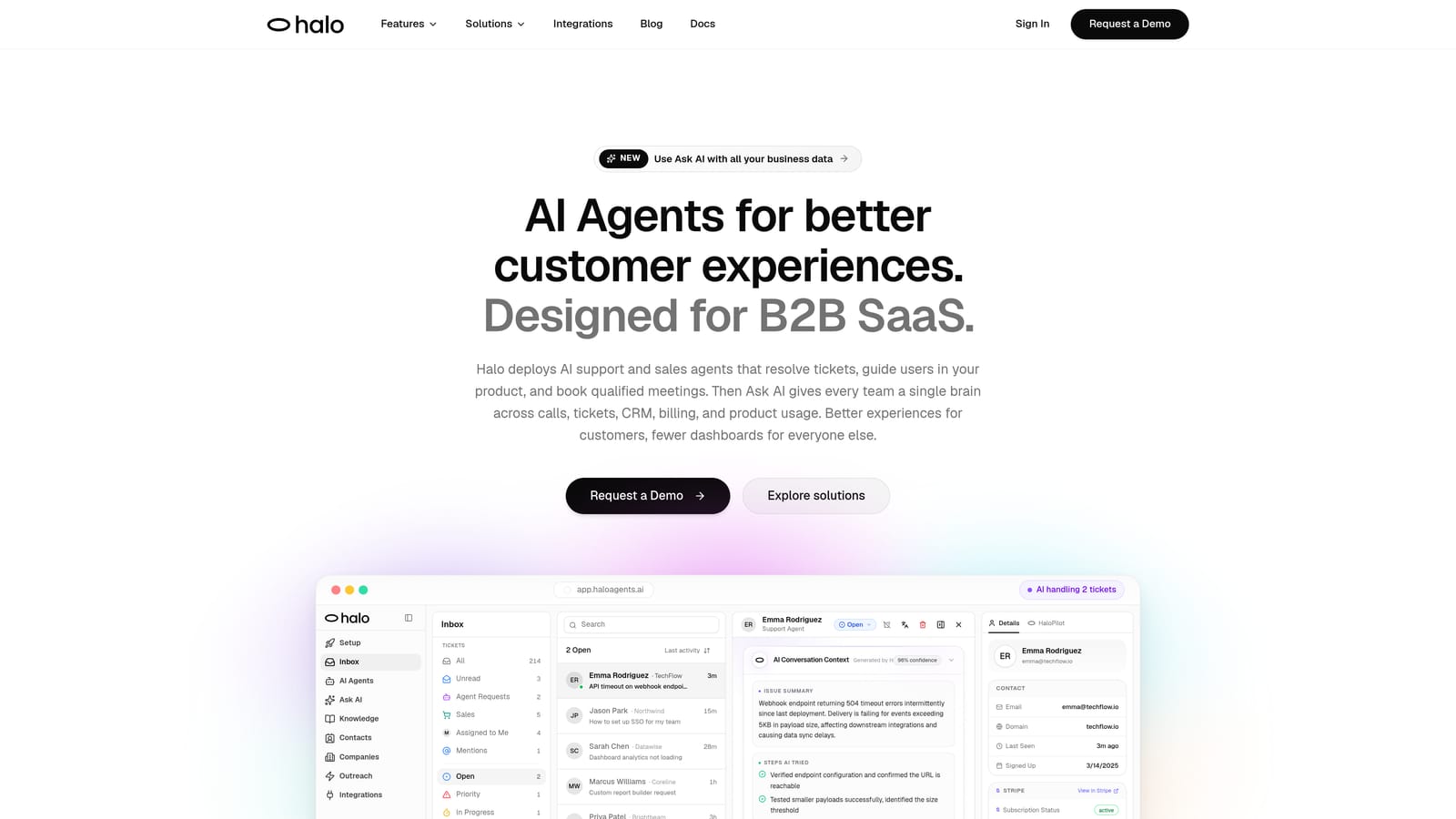
Halo AI is an AI-native customer support platform built specifically for B2B SaaS teams, deploying intelligent agents that resolve tickets, guide users visually through your product, auto-create bug reports, and surface business intelligence from every interaction.
Where This Tool Shines
Halo's most distinctive capability is its page-aware AI agent. Unlike standard chat widgets that respond to text alone, Halo's agent understands which page and product state a user is currently on, allowing it to provide in-context visual UI guidance. For complex SaaS products with multi-step workflows, this is a meaningful difference between a bot that frustrates users and one that actually resolves their issue.
The platform is also genuinely AI-first, not a helpdesk with AI features bolted on. This architectural decision matters because the entire data model is built around autonomous resolution and continuous learning. Every interaction the AI handles makes it incrementally smarter, which compounds over time in ways that retrofitted AI rarely achieves.
Key Features
Page-Aware AI Agent: Sees the user's current page and product state to deliver precise, in-context visual guidance rather than generic answers.
Smart Inbox with Business Intelligence: Surfaces customer health signals, revenue anomaly detection, and churn indicators from support interaction patterns — not just ticket deflection metrics.
Auto Bug Ticket Creation: Automatically identifies product issues from support conversations and routes them to engineering via Linear integration, closing the loop between support and product teams.
Native Integration Stack: Connects to HubSpot, Slack, Stripe, Intercom, Zoom, PandaDoc, and Fathom, enabling the AI to take autonomous action across your full business stack.
Live Agent Handoff with Full Context: When escalation is needed, the handoff preserves the full conversation history, page context, and account data so human agents can pick up without starting over.
Continuous Learning: Every resolved interaction feeds back into the model, improving resolution accuracy over time without manual retraining.
Best For
Halo AI is the strongest fit for B2B SaaS companies that want more than ticket deflection. If you need business intelligence from support data, deep integration with your existing stack, or an AI agent that genuinely understands your product's interface, Halo is worth a serious look. Lean startups scaling support without headcount and mid-market teams replacing legacy helpdesks will both find relevant value here.
Pricing
Halo AI uses a demo-based sales process. Contact for current pricing or book a demo at haloagents.ai.
2. Intercom (Fin AI Agent)
Best for: Teams already using Intercom's messenger and inbox who want a native AI agent without adding another vendor.
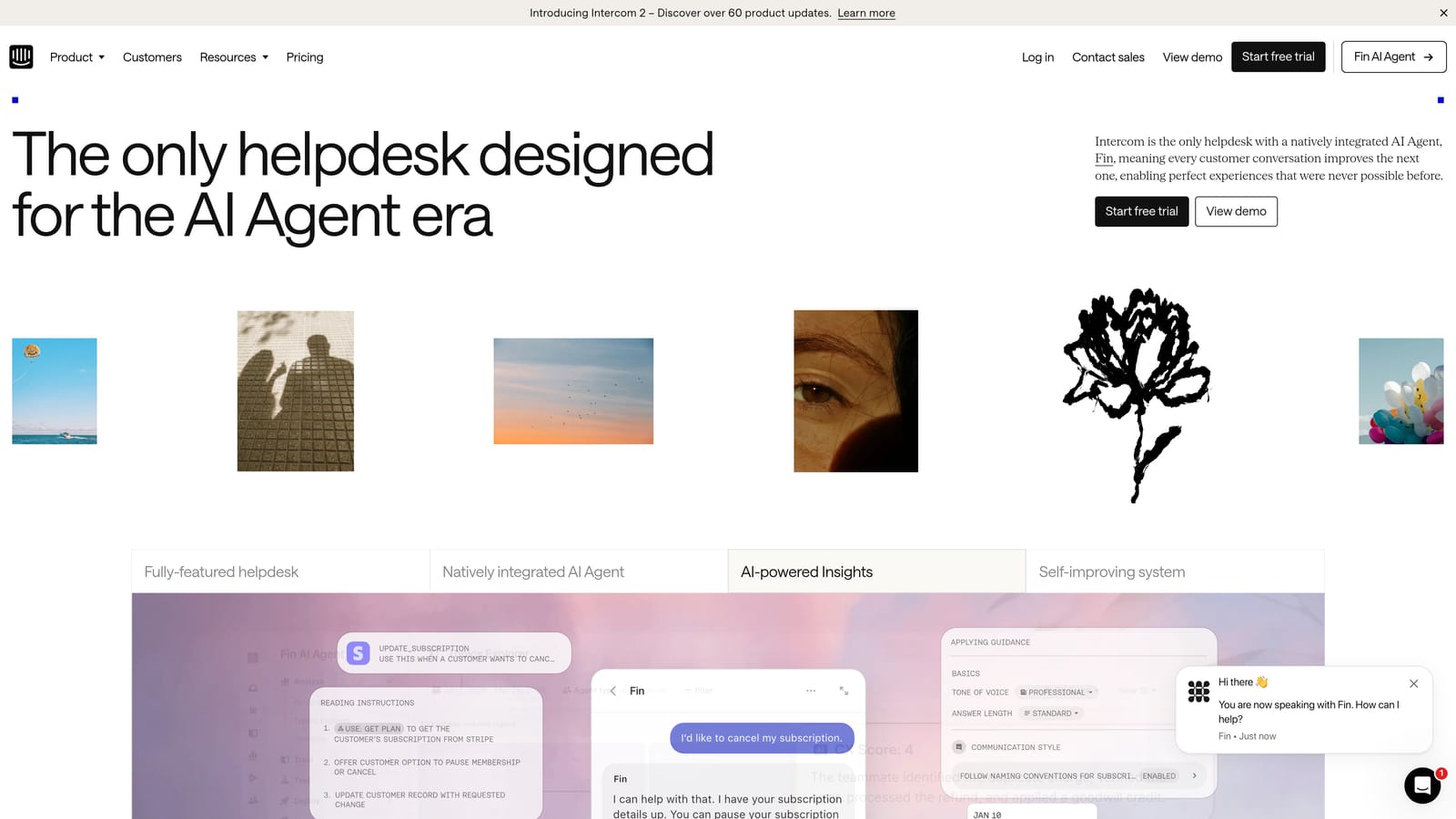
Intercom's Fin AI Agent is a conversational AI agent built natively into the Intercom platform, designed to resolve support conversations using help center content and custom answers within Intercom's existing workflows.
Where This Tool Shines
Fin's biggest advantage is how naturally it fits into the Intercom ecosystem. If your team already lives in Intercom's inbox and your customers interact with the Intercom messenger, Fin adds autonomous resolution without introducing a new platform to manage. The routing and handoff flows feel native because they are.
Fin also handles conversational support well, maintaining context across multi-turn exchanges and escalating to human agents smoothly within the same interface your team already uses.
Key Features
AI Resolution from Help Content: Answers customer questions directly from your help center articles and custom answer sets, reducing ticket volume without manual configuration per question.
Native Messenger Integration: Operates entirely within Intercom's messenger and inbox, so there's no separate tool for agents to manage.
Smooth Human Handoff: Escalates within the Intercom ecosystem with conversation context intact, keeping the experience consistent for both agents and customers.
Resolution Rate Analytics: Tracks AI resolution rates and conversation topic trends to help teams identify gaps in their help content.
Best For
Intercom Fin is the right call for teams with an existing Intercom investment who want to add AI resolution without a platform migration. It's less compelling for teams not already on Intercom, where the switching cost may not justify the fit.
Pricing
Fin AI Agent uses consumption-based pricing layered on top of existing Intercom plans. Verify current pricing at intercom.com.
3. Zendesk AI
Best for: Enterprise teams with deep Zendesk investment who need AI capabilities without migrating their entire support stack.
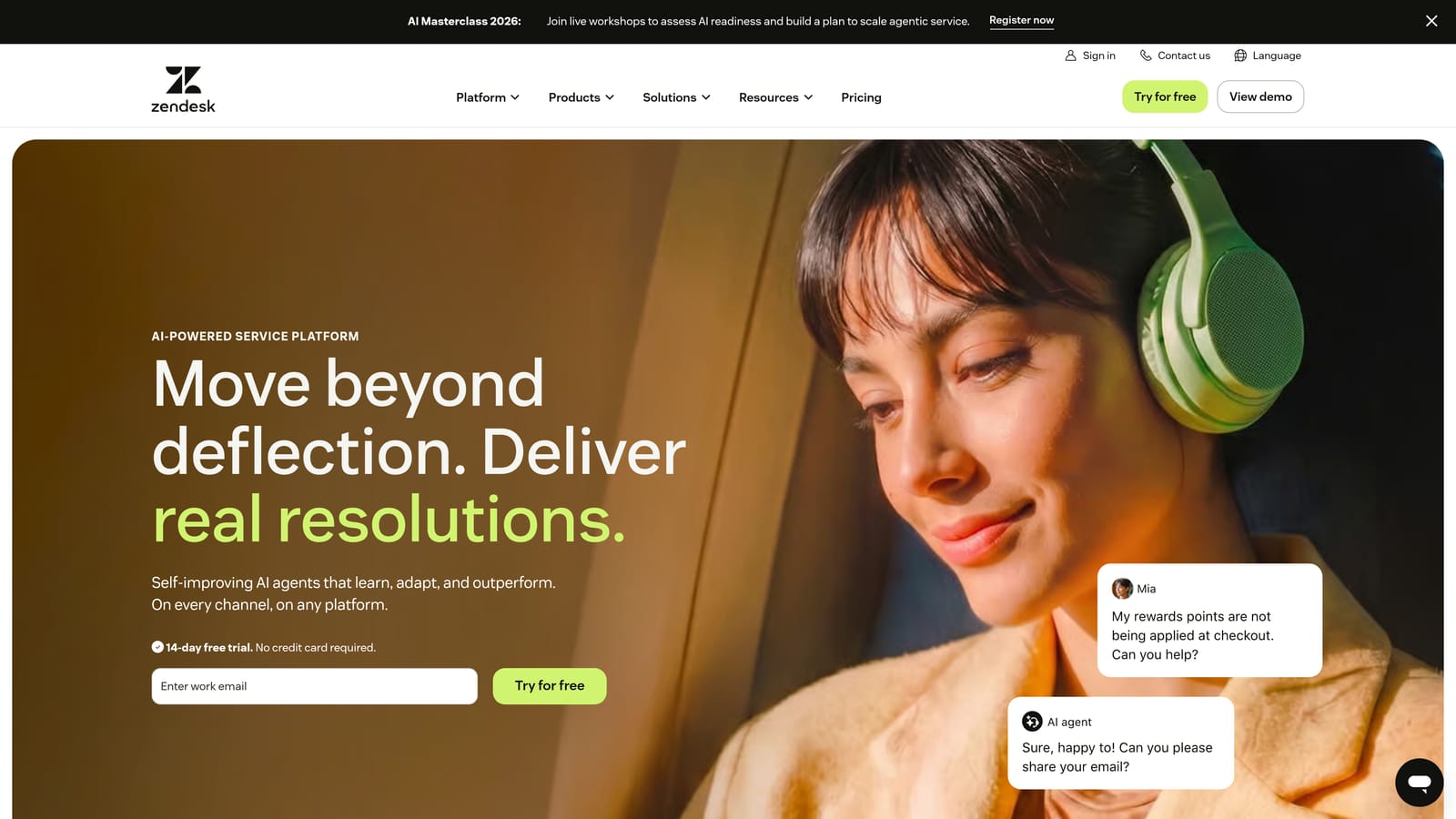
Zendesk AI brings AI agents, intelligent triage, and an agent copilot into the Zendesk Suite, extending the platform's enterprise-grade foundation with automation and assistance capabilities.
Where This Tool Shines
Zendesk AI's strength is the depth of its enterprise infrastructure. For organizations where compliance, security, and audit controls are non-negotiable, Zendesk's foundation provides a level of assurance that newer AI-native platforms are still building toward. If your legal and security teams have already approved your Zendesk environment, adding AI features is a lower-friction path than introducing a new vendor.
The agent copilot is particularly useful for complex B2B tickets where full automation isn't appropriate. Suggested replies and next-best-action guidance keep human agents efficient without removing them from the loop entirely.
Key Features
AI Agents for Deflection: Automated self-service that handles common questions before they become tickets, reducing volume for human agents.
Intelligent Triage: Automatically categorizes and routes incoming tickets based on content, intent, and priority signals.
Agent Copilot: Provides human agents with suggested replies, relevant knowledge base articles, and next-best-action recommendations in real time.
Enterprise Compliance Controls: Inherits Zendesk's enterprise-grade security, compliance certifications, and audit trail capabilities.
Best For
Enterprise support teams already running on Zendesk Suite who want AI capabilities without a platform migration. Less suited for teams starting fresh who want an AI-first architecture rather than AI layered onto a legacy system.
Pricing
Zendesk AI features are available as add-ons to existing Suite plans. Verify current pricing at zendesk.com.
4. Freshdesk Freddy AI
Best for: SMB and mid-market B2B teams that want accessible AI capabilities across deflection, agent assist, and analytics without enterprise-tier pricing.
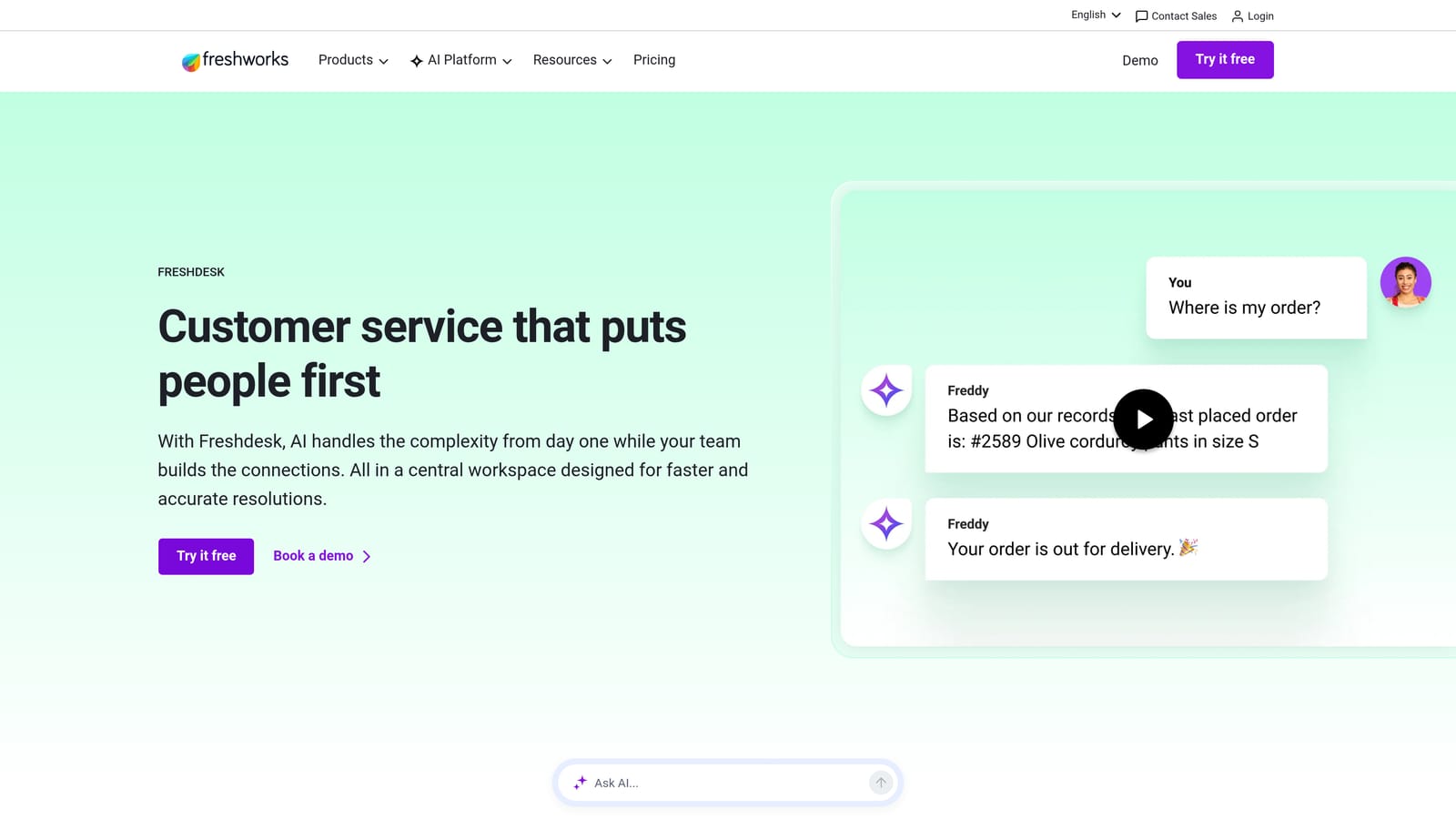
Freshdesk's Freddy AI is Freshworks' AI suite built into Freshdesk, covering self-service deflection, agent assistance, and support analytics across multiple pricing tiers.
Where This Tool Shines
Freddy AI's standout quality is accessibility. While Zendesk and Salesforce tend to price for enterprise budgets, Freshdesk offers AI capabilities at price points that work for growing B2B teams. For companies that need meaningful automation without a six-figure contract, Freddy covers the core use cases well.
The three-component structure — Self Service, Copilot, and Insights — gives teams a clear path to incrementally adopt AI capabilities as their needs grow, rather than committing to a full deployment upfront.
Key Features
Freddy Self Service: AI-powered deflection that resolves common questions before they reach your support queue.
Freddy Copilot: Agent assist that surfaces suggested responses and relevant knowledge to speed up human ticket resolution.
Freddy Insights: AI-driven analytics that identify support trends, bottlenecks, and opportunities for deflection improvement.
Tiered Availability: Freddy AI features are available across Growth, Pro, and Enterprise plans, making entry accessible for teams at different stages.
Best For
SMB and mid-market B2B companies that want solid AI capabilities at accessible price points, particularly teams already using Freshdesk who want to activate AI without switching platforms.
Pricing
Freddy AI is included in higher-tier Freshdesk plans. Verify current plan inclusions at freshworks.com.
5. Salesforce Agentforce
Best for: Enterprise B2B companies where Salesforce CRM is the system of record and personalized, account-aware support is a priority.
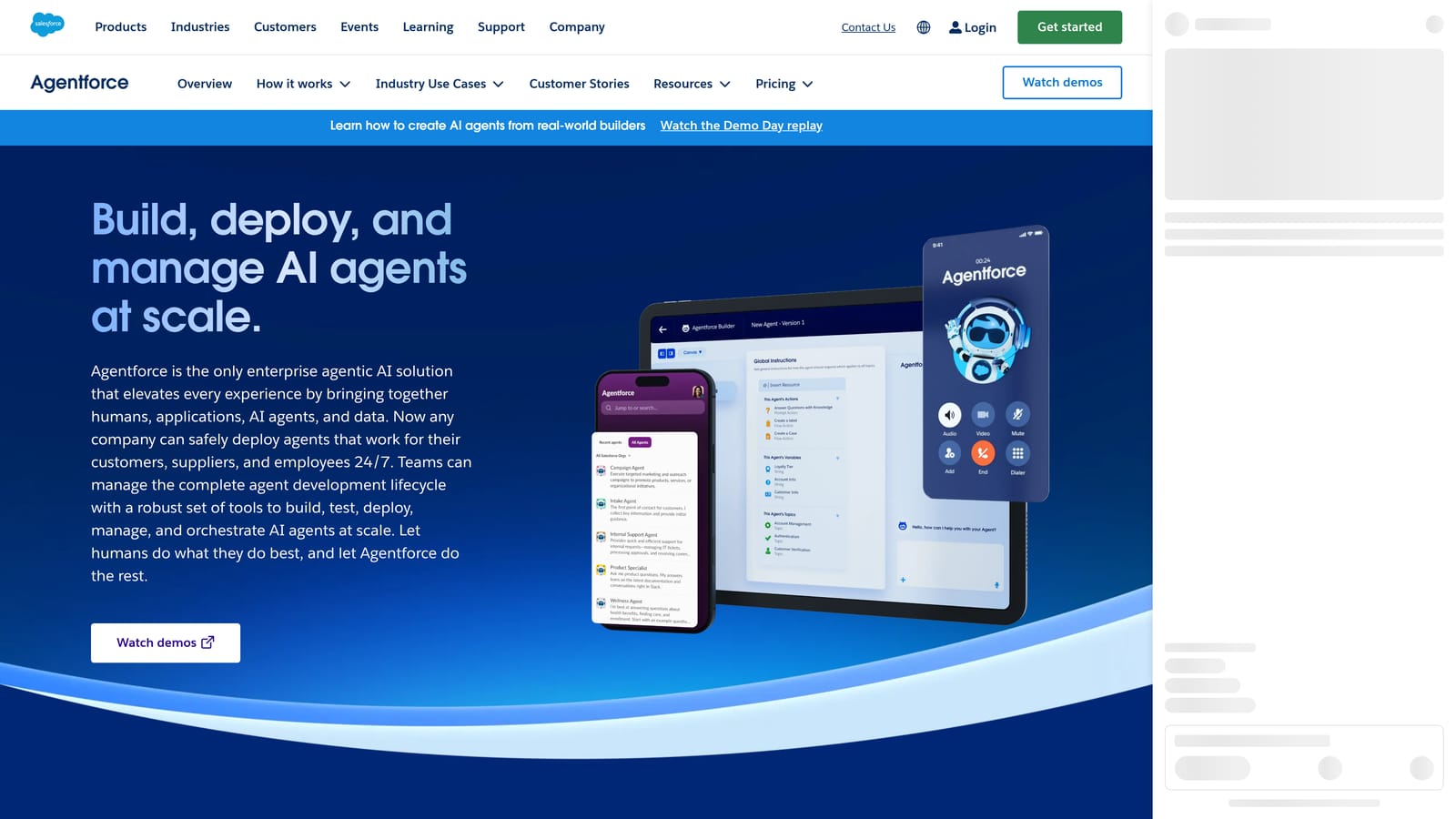
Salesforce Agentforce is Salesforce's autonomous AI agent platform, deeply integrated with Salesforce CRM to deliver account-aware support that draws on the full customer record.
Where This Tool Shines
Agentforce's core advantage is CRM depth. When your AI agent has native access to account history, contract details, case records, and relationship data, it can deliver support responses that feel genuinely personalized rather than generic. For enterprise B2B companies where account-level context changes everything, this integration is difficult to replicate with tools that pull CRM data through an API.
The platform also leverages Salesforce Flow for custom automation, making it highly configurable for complex enterprise workflows. Teams with Salesforce admins already on staff can build sophisticated support automations without starting from scratch.
Key Features
Native CRM Access: Direct access to Salesforce account history, contracts, case records, and relationship data for context-rich support responses.
Autonomous Agents: AI agents that take action across Salesforce workflows, not just answer questions, enabling resolution of multi-step support scenarios.
Salesforce Flow Integration: Highly configurable automation using Salesforce's existing workflow engine and custom objects.
Enterprise Security: Inherits Salesforce's enterprise compliance and security framework, critical for regulated industries.
Best For
Enterprise B2B organizations where Salesforce is the primary system of record and account-level personalization in support is a strategic priority. Less practical for teams not already invested in the Salesforce ecosystem.
Pricing
Agentforce uses consumption-based pricing. Verify current rates at salesforce.com.
6. Forethought AI
Best for: Teams that want to improve AI capabilities on top of their existing helpdesk without a full platform migration.
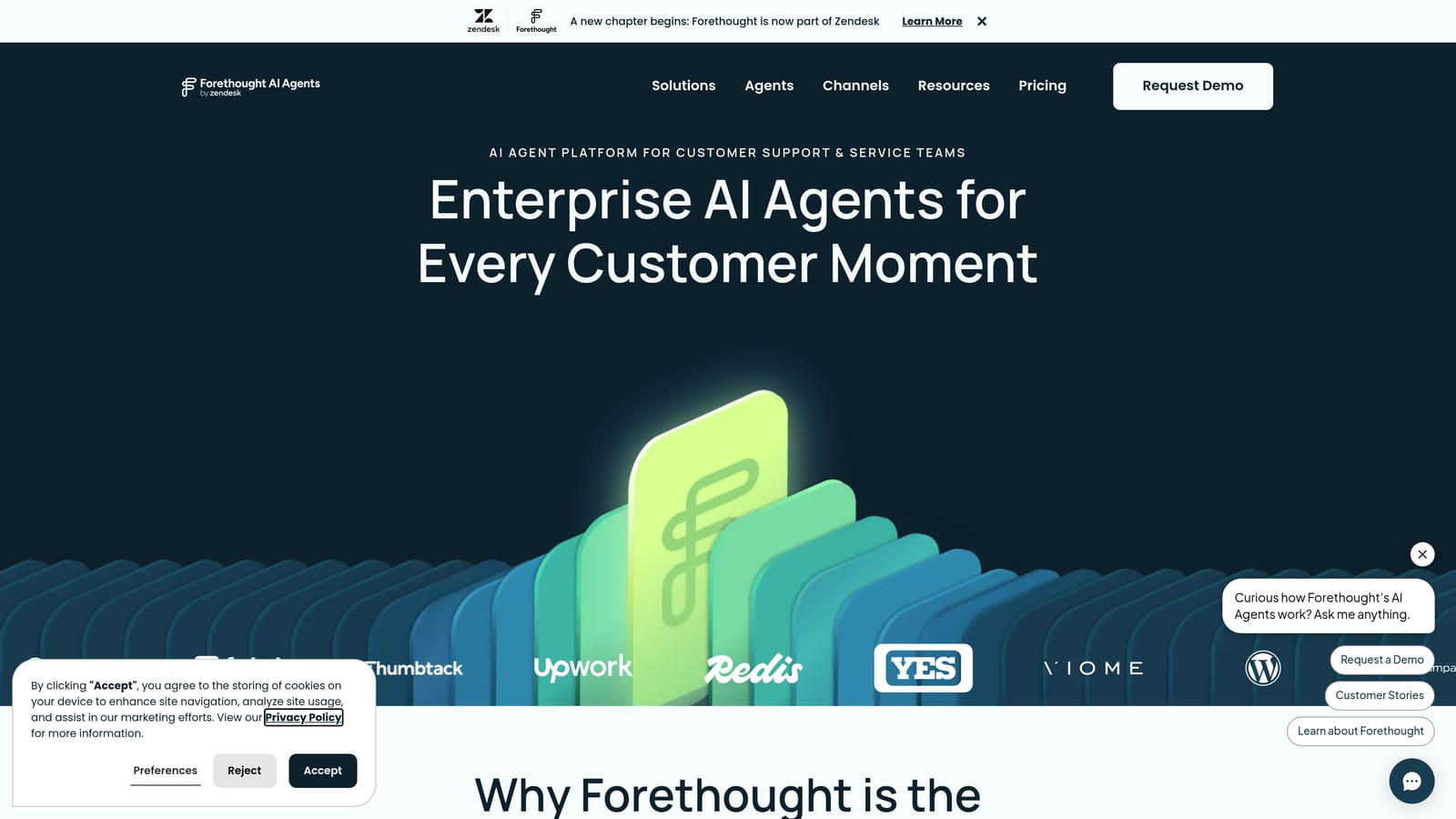
Forethought AI is an intelligent AI layer designed to sit on top of existing helpdesks like Zendesk, Salesforce, and Freshdesk, adding triage, deflection, and agent assist without replacing your current stack.
Where This Tool Shines
Forethought's value proposition is additive: you keep your existing helpdesk and gain AI capabilities on top of it. For teams with significant investment in their current platform, or organizations that can't justify a migration, this approach reduces the barrier to meaningful AI adoption considerably.
The workflow structure — Solve for deflection, Triage for routing, Assist for agent support — maps cleanly onto the stages where AI adds the most value in a typical B2B support operation, making it straightforward to identify where to start.
Key Features
Solve: AI-powered self-service deflection that intercepts common questions before a ticket is created.
Triage: Intelligent routing based on intent, sentiment, and urgency signals to get tickets to the right agent faster.
Assist: Agent copilot that surfaces suggested responses and relevant knowledge during live ticket resolution.
Multi-Helpdesk Compatibility: Works across Zendesk, Salesforce Service Cloud, Freshdesk, and other platforms without requiring migration.
Best For
B2B support teams that want AI-driven triage, deflection, and assist capabilities without the disruption of switching helpdesks. Particularly useful for teams on Zendesk or Salesforce who want to augment rather than replace.
Pricing
Contact for pricing. Verify current rates at forethought.ai.
7. Ada
Best for: Global B2B companies that need multilingual AI agents with enterprise governance controls and broad channel coverage.
Ada is a no-code AI agent builder with enterprise-grade controls, strong multilingual support, and coverage across web, mobile, SMS, and social channels.
Where This Tool Shines
Ada's multilingual capabilities make it one of the more compelling options for B2B companies serving customers across multiple regions and languages. Where many AI support platforms treat multilingual support as an afterthought, Ada has built it as a core capability — which matters when your customer base spans continents.
The no-code builder also lowers the barrier for non-technical teams to configure and update AI agents. In fast-moving B2B environments where product changes frequently, the ability for support or operations teams to update agent behavior without engineering involvement is a genuine operational advantage.
Key Features
No-Code Agent Builder: Visual configuration tools that allow non-technical teams to build, update, and test AI agents without engineering support.
Multilingual Support: Native language support across a broad range of languages, making it suitable for global customer bases.
Multi-Channel Coverage: Deploys across web, mobile, SMS, and social channels from a single configuration.
Enterprise Governance Controls: Testing environments, compliance controls, and governance frameworks for organizations with strict change management requirements.
Best For
Global B2B companies with multilingual support needs, or enterprise teams that need strong governance controls over AI agent behavior. Also well-suited for organizations where non-technical teams need to own AI agent configuration.
Pricing
Enterprise pricing, contact for a quote. Verify at ada.cx.
8. Kustomer
Best for: B2B teams that want CRM, helpdesk, and AI in a single platform with a unified customer timeline view.
Kustomer combines CRM, helpdesk, and AI capabilities in one platform, giving support agents a complete customer timeline alongside AI-powered workflow automation and intent detection.
Where This Tool Shines
Kustomer's unified customer timeline is its defining feature. Rather than toggling between a helpdesk and a CRM to understand a customer's history, agents see every interaction, purchase, and support event in a single view. For B2B support teams handling complex accounts with long relationship histories, this context reduces the time agents spend reconstructing what happened before they can actually help.
The platform's AI capabilities sit on top of this rich data model, which means intent detection and automated workflows have access to more customer context than tools that operate only on ticket data.
Key Features
Unified Customer Timeline: Every interaction, purchase, and support event consolidated in a single view, eliminating context-switching between tools.
AI-Powered Suggested Responses: Surfaces relevant responses based on conversation content and customer history.
Intent Detection and Automated Workflows: Triggers automated actions based on detected customer intent and behavioral data.
CRM and Helpdesk Combined: Reduces the number of tools in your support stack by consolidating customer data and support operations in one platform.
Best For
B2B support teams that want a unified CRM and helpdesk experience with AI layered on top, particularly teams frustrated by context-switching between separate systems during complex account interactions.
Pricing
Contact for pricing. Verify current rates at kustomer.com.
9. Tidio Lyro AI
Best for: Early-stage B2B startups that need fast AI deployment with minimal setup time and accessible pricing.
Tidio's Lyro AI is a conversational AI agent focused on rapid deployment, learning from existing help content to start deflecting tickets with minimal configuration time.
Where This Tool Shines
Lyro's standout quality is speed to value. Where many AI support platforms require significant configuration, integration work, and onboarding time, Lyro connects to your existing help content and goes live quickly. For early-stage teams that need to reduce support volume now rather than in three months, that deployment speed is genuinely valuable.
The free tier also makes Lyro accessible for startups that aren't yet ready to commit to a paid AI support platform. It's a reasonable starting point for teams building their first automated support layer before they know exactly what they need.
Key Features
Rapid Deployment: Connects to existing help content and goes live quickly, reducing time-to-value compared to more configuration-heavy platforms.
Conversational AI Deflection: Handles common support questions autonomously, reducing ticket volume without manual rule-building.
Free Tier Availability: Provides a no-cost entry point for early-stage teams evaluating AI support for the first time.
Human Handoff: Escalates to human agents when conversations exceed AI confidence thresholds, keeping the experience from breaking down on complex queries.
Best For
Early-stage B2B startups that need fast deployment and accessible pricing. Lyro is less suited for complex enterprise workflows or teams that need deep CRM integration and business intelligence from support data.
Pricing
Free tier available; paid Lyro plans scale with usage. Verify current pricing at tidio.com.
Which Platform Is Right for Your Team?
The right support AI platform depends heavily on where you are, what you're already running, and what you actually need from AI beyond basic ticket deflection.
Here's a quick guide by company type:
Early-stage startups: Start with Tidio Lyro for fast deployment and low cost, or go straight to Halo AI if you want an AI-first foundation that grows with you rather than one you'll outgrow.
Mid-market SaaS companies: Halo AI is the strongest fit if you want autonomous resolution, business intelligence from support data, and deep integrations with your existing stack. Intercom Fin is a solid choice if you're already committed to the Intercom ecosystem.
Enterprise teams on Salesforce: Agentforce is the natural choice when Salesforce is your system of record and account-level personalization is a priority.
Enterprise teams on Zendesk: Zendesk AI keeps you in your existing environment. If you're open to evaluating alternatives, Halo AI's AI-first architecture offers capabilities that bolt-on AI typically can't match.
Budget-conscious teams: Freshdesk Freddy AI offers the most accessible entry point for teams that need solid AI capabilities without enterprise-tier pricing.
The broader pattern across all of these is clear: platforms built AI-first from the ground up consistently outperform those that added AI to an existing helpdesk. The data model, the architecture, and the learning loops are simply better when AI is the core product rather than a feature layer.
Your support team shouldn't scale linearly with your customer base. Let AI agents handle routine tickets, guide users through your product, and surface business intelligence while your team focuses on complex issues that need a human touch. See Halo in action and discover how continuous learning transforms every interaction into smarter, faster support.