9 Best Support Automation Tools for B2B SaaS in 2026
This guide evaluates the 9 best support automation tools for B2B SaaS in 2026, comparing platforms on AI capability, helpdesk integrations, and deployment ease to help teams at any growth stage resolve tickets autonomously, reduce agent workload, and handle the technical complexity of multi-product SaaS environments without scaling headcount at the same pace as ticket volume.
 Grant CooperFounder14 min read
As your B2B SaaS product grows, ticket volume grows with it. Hiring agents at the same pace isn't sustainable, and simple keyword-matching chatbots stopped cutting it years ago. Today's support automation tools can resolve tickets autonomously, detect bugs before customers escalate them, route complex issues to the right human, and even surface revenue signals buried inside support conversations.
This guide covers the top support automation platforms built for B2B SaaS environments. Whether you're running a lean team on Zendesk, scaling past your first hundred enterprise customers, or rebuilding your support stack from scratch, there's a tool here for your stage. We evaluated each platform on AI capability, helpdesk integrations, ease of deployment, and how well it handles the realities of B2B SaaS: multi-product complexity, technical users, and high expectations for resolution quality.
1. Halo AI
Best for: B2B SaaS teams that want an AI-first support platform with deep product context
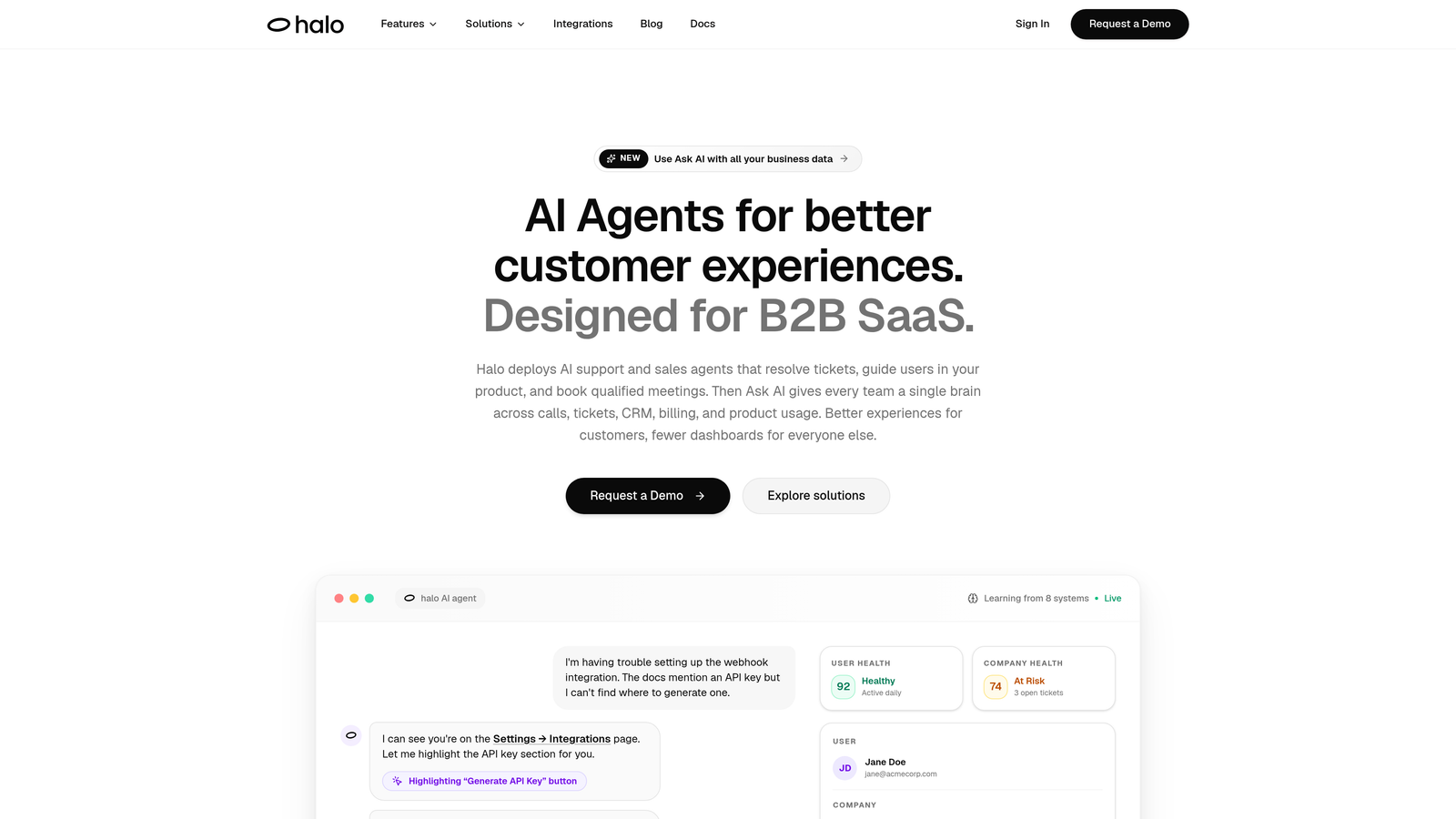
Halo AI is an AI-first customer support platform built specifically for B2B SaaS teams who need to scale support without scaling headcount.
Where This Tool Shines
What sets Halo apart from most tools on this list is its architecture. Rather than bolting AI onto an existing helpdesk, Halo was built AI-first from the ground up. That means the intelligence isn't a feature layer sitting on top of a legacy system — it's the foundation everything else runs on.
The page-aware chat widget is a standout capability. It understands where a user is inside your product and delivers contextual, visual guidance based on that context. For B2B SaaS where the same question can mean completely different things depending on which feature a user is in, this kind of situational awareness changes what automated resolution actually looks like in practice.
Key Features
Page-Aware Chat Widget: Understands user location within your product and provides contextually relevant visual guidance without requiring manual configuration per page.
Autonomous Ticket Resolution: AI agents resolve tickets independently and continuously learn from every interaction, improving resolution accuracy over time.
Auto Bug Ticket Creation: Detects issues in support conversations and automatically routes bug reports to Linear, reducing the manual handoff between support and engineering.
Smart Inbox with Business Intelligence: Surfaces customer health signals, revenue anomalies, and trend detection from within your support data — turning your inbox into a strategic data source.
Live Agent Handoff: Escalates complex issues to human agents with full conversation context preserved, so agents don't start from scratch.
Deep Integrations: Connects natively with Linear, Slack, HubSpot, Intercom, Stripe, Zoom, PandaDoc, and Fathom — covering the full operational stack most B2B SaaS teams actually use.
Best For
B2B SaaS teams at the growth or enterprise stage who want more than ticket deflection. Halo is particularly well-suited for teams where support data should be informing product decisions, customer success, and revenue retention — not just closing tickets faster.
Pricing
Contact for pricing. Enterprise and growth plans are available at haloagents.ai. Custom pricing reflects team size and integration requirements.
2. Intercom
Best for: Teams already using Intercom for sales and marketing who want unified AI-powered support
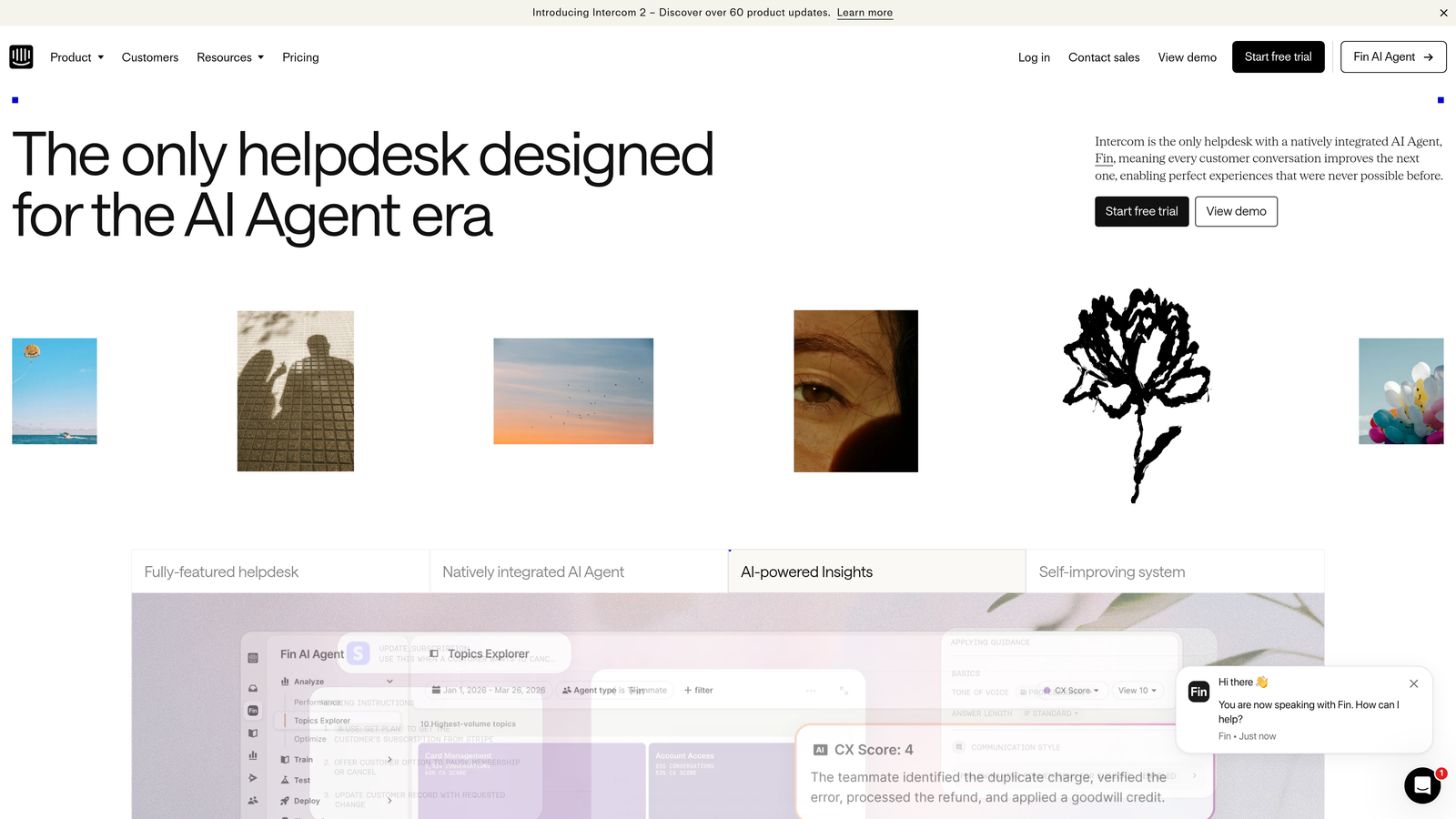
Intercom is a mature customer messaging platform with a well-developed AI agent, Fin, built on top of a robust CRM and conversation management system.
Where This Tool Shines
Intercom's strength is its ecosystem. If your team already uses Intercom for onboarding, product tours, or sales conversations, adding Fin AI for support resolution is a natural extension rather than a new implementation. The unified inbox combining chat, email, and in-app messaging keeps everything in one place.
Fin has matured significantly. It draws on your existing help content to resolve queries autonomously, and the AI Copilot feature assists human agents with suggested replies and conversation summaries during live tickets. For teams that want a single platform spanning the customer lifecycle, Intercom is a strong contender.
Key Features
Fin AI Agent: Handles autonomous customer query resolution using your existing help documentation and knowledge base content.
AI Copilot: Assists human agents with suggested replies, ticket summarization, and contextual information during live conversations.
Workflows Builder: Visual automation builder for routing, tagging, and escalation logic without requiring engineering involvement.
Unified Inbox: Combines chat, email, and in-app messaging into a single agent workspace.
Ecosystem Integrations: Connects with Salesforce, HubSpot, Stripe, and a broad range of SaaS tools.
Best For
Mid-market SaaS teams already invested in the Intercom ecosystem, or teams that want a single platform for support, onboarding, and customer engagement. Worth noting: Fin AI is billed per resolution, so costs can escalate at high ticket volumes.
Pricing
Starts at approximately $39 per seat per month. Fin AI usage is billed separately per resolution, which can significantly affect total cost at scale.
3. Zendesk AI
Best for: Enterprise SaaS teams already deeply embedded in the Zendesk ecosystem
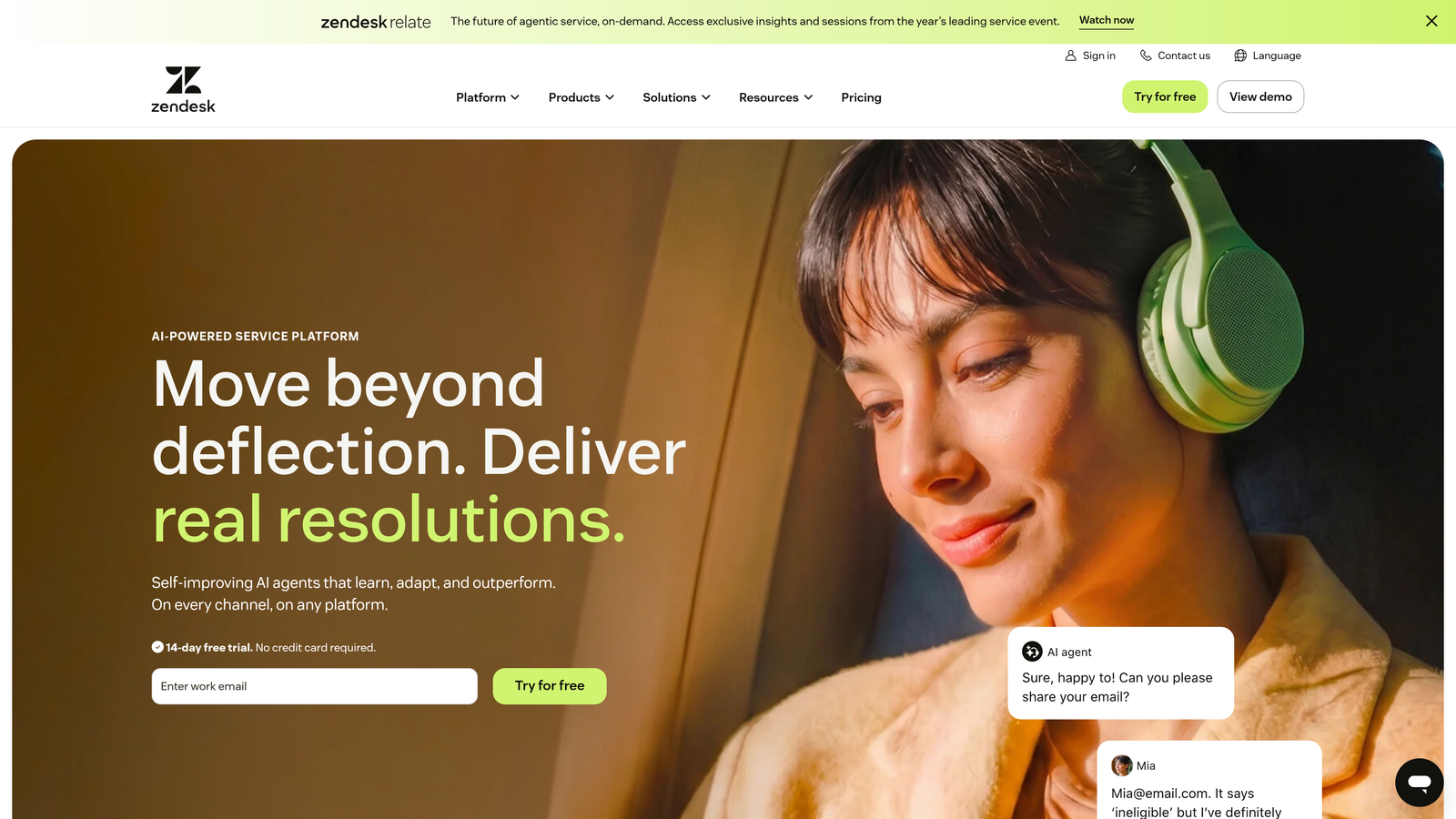
Zendesk AI is the AI capability layer built natively into Zendesk Suite, covering triage, routing, agent copilot, and self-service automation.
Where This Tool Shines
Zendesk remains the most widely deployed helpdesk in enterprise SaaS, and its AI features have evolved to match. If your team is already running on Zendesk, the path of least resistance for adding automation is enabling the AI features within your existing subscription rather than introducing a new platform.
Intelligent triage is a practical strength. Incoming tickets are automatically classified, prioritized, and routed before an agent touches them, which meaningfully reduces the manual overhead in high-volume environments. The Agent Copilot layer adds suggested replies and next-best-action recommendations directly in the agent workspace.
Key Features
Intelligent Triage: Automatically classifies, prioritizes, and routes incoming tickets based on content, intent, and customer attributes.
AI Agents: Handles automated self-service resolution across chat and email channels using your knowledge base.
Agent Copilot: Provides suggested replies, conversation summaries, and next-best-action guidance within the agent workspace.
Advanced Analytics: Built-in reporting suite covering ticket volume, resolution rates, agent performance, and trend analysis.
App Marketplace: Over 1,500 integrations available, covering most SaaS tools in the support and operations ecosystem.
Best For
Enterprise SaaS teams already running on Zendesk who want to add AI capabilities without switching platforms. Teams starting fresh may find AI-first alternatives offer deeper intelligence out of the box.
Pricing
Suite plans start at approximately $55 per agent per month. Advanced AI features are available on higher tiers, so total cost depends on the plan level your team requires.
4. Freshdesk (Freddy AI)
Best for: SMB to mid-market SaaS teams that want capable AI automation at accessible pricing
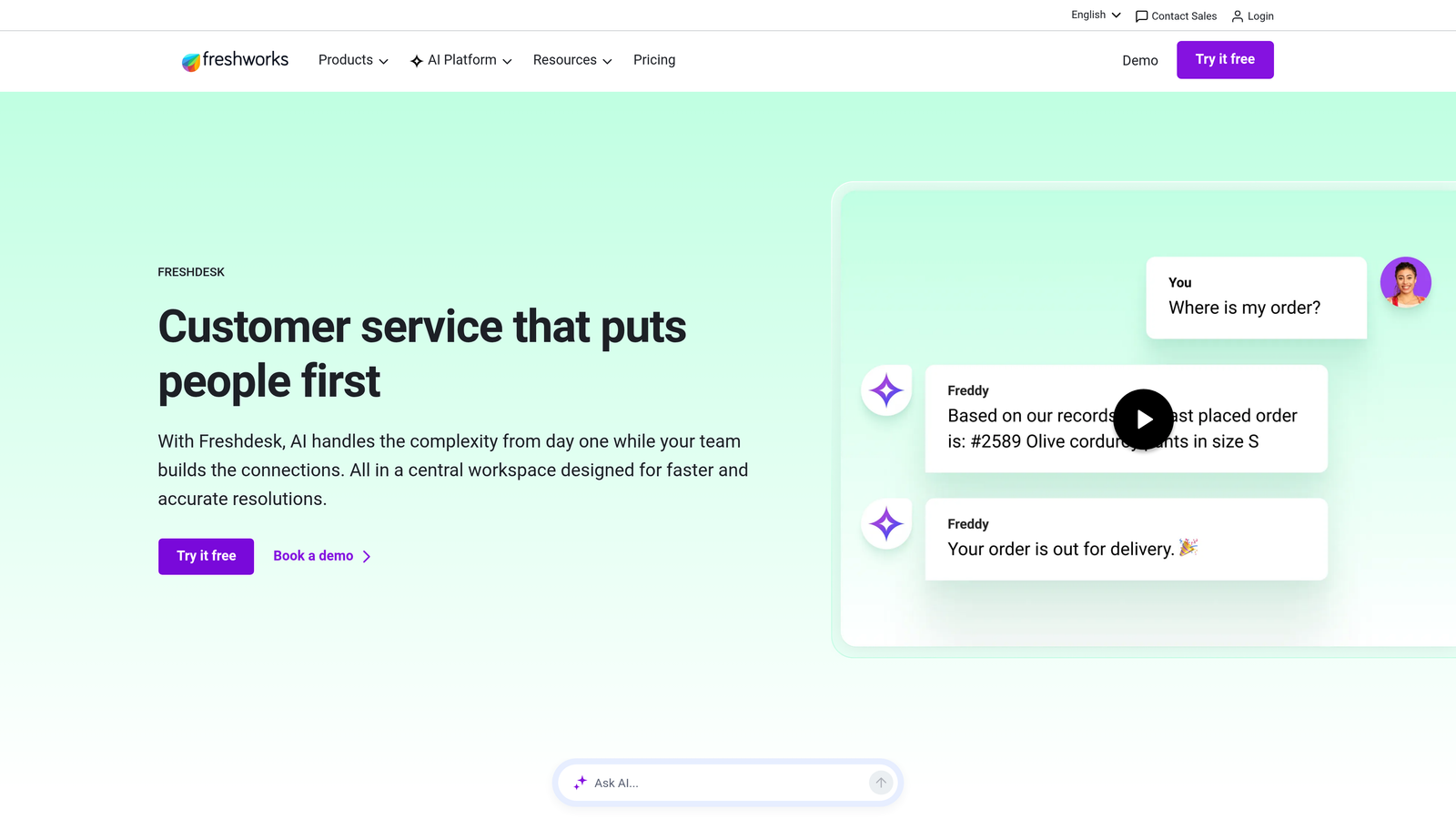
Freshdesk is a cloud-based helpdesk with the Freddy AI suite spanning self-service bots, agent assist, and analytics — generally at more accessible price points than Zendesk or Intercom.
Where This Tool Shines
Freshdesk's value proposition centers on breadth at a lower cost. The Freddy AI suite covers three distinct use cases: customer-facing self-service, in-inbox agent assistance, and analytics-driven insights. Getting all three in a single platform without enterprise-level pricing makes Freshdesk practical for teams that are scaling but not yet at enterprise scale.
Freddy Insights is worth highlighting specifically. It brings AI-generated analytics and anomaly detection to support data, which gives smaller teams visibility into what's driving ticket volume without needing a dedicated analytics function.
Key Features
Freddy Self Service: AI bot for automated customer-facing resolution using your help content and knowledge base.
Freddy Copilot: In-inbox agent assist with reply suggestions and ticket summarization during live support conversations.
Freddy Insights: AI-generated analytics with anomaly detection, trend identification, and performance reporting across support data.
Omnichannel Support: Covers email, chat, phone, and social from a single inbox.
Freshworks Ecosystem: Native integration with Freshsales, Freshservice, and the broader Freshworks product suite.
Best For
Early to mid-stage SaaS teams looking for a full-featured helpdesk with solid AI capabilities and pricing that doesn't require an enterprise budget. Teams already using other Freshworks products will benefit from native cross-product integration.
Pricing
Free plan available. Paid plans start at approximately $15 per agent per month. Freddy AI features are available as add-ons with separate pricing, so total cost depends on which Freddy components you enable.
5. Forethought
Best for: Teams that want to add AI intelligence to an existing helpdesk without switching platforms
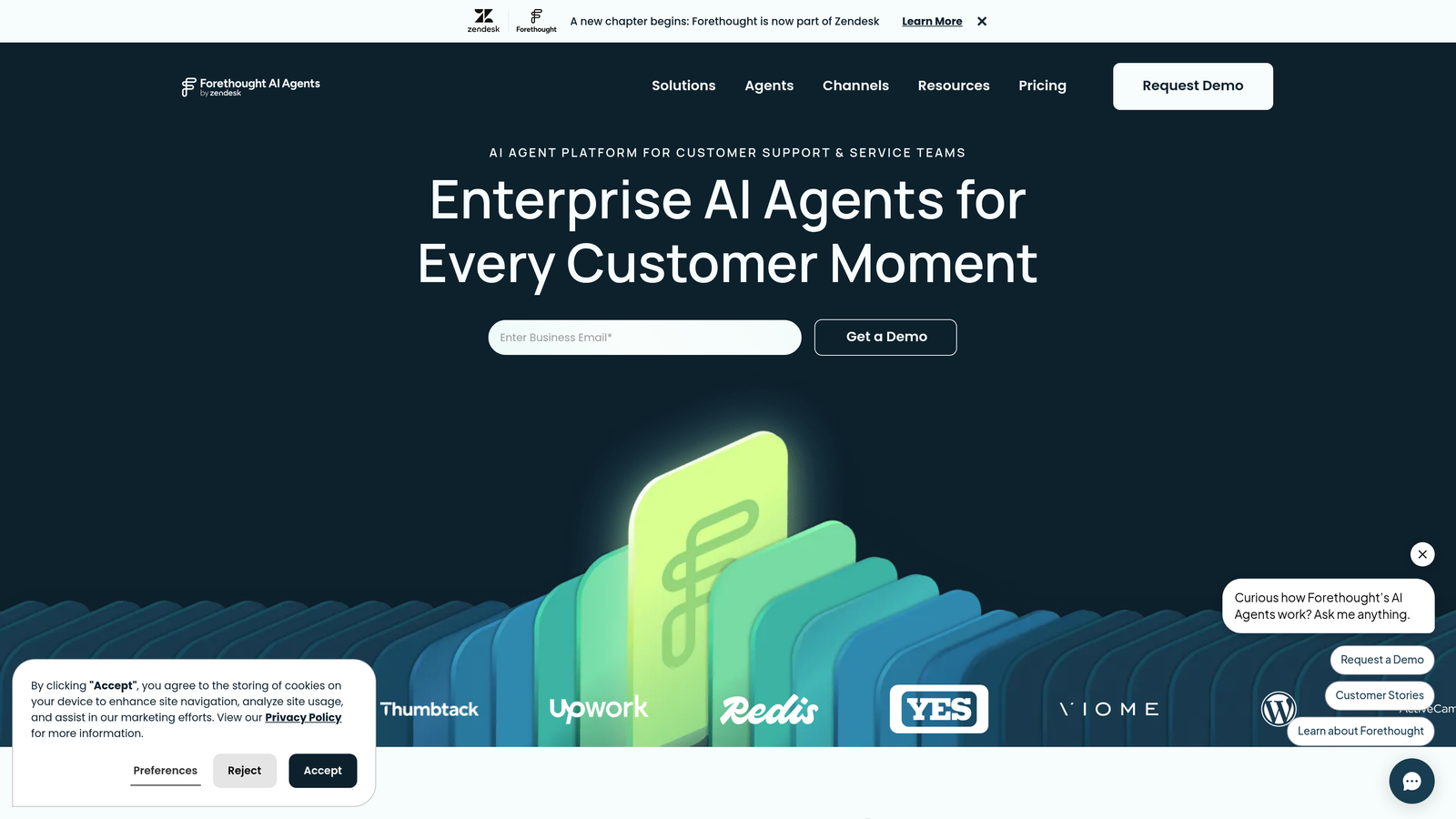
Forethought is an AI automation layer designed to sit on top of your existing helpdesk — adding intelligent triage, deflection, agent assist, and discovery without requiring a platform migration.
Where This Tool Shines
Forethought's core insight is that many teams don't want to replace Zendesk or Salesforce — they want to make them smarter. The platform operates as an AI layer on top of your existing system, which means you keep your current workflows, data, and agent familiarity while adding meaningful automation on top.
The Discover product is a differentiator. Rather than just automating what you already know, it analyzes your support data to surface automation opportunities and knowledge gaps you haven't addressed yet. For teams trying to understand where to invest in self-service content, this kind of insight is genuinely useful.
Key Features
Triage: AI-powered ticket classification, routing, and prioritization before tickets reach agents.
Solve: Automated self-service resolution that deflects tickets before they enter the queue.
Assist: Real-time agent copilot that surfaces relevant knowledge and suggested responses during live ticket handling.
Discover: Analytics layer that identifies automation opportunities, knowledge gaps, and patterns across your support data.
Helpdesk Compatibility: Works natively with Zendesk, Salesforce Service Cloud, and Freshdesk.
Best For
Mid-market and enterprise SaaS teams that have significant investment in Zendesk, Salesforce, or Freshdesk and want to layer AI capabilities without a platform switch. Teams with high ticket volume will see the most impact from Solve and Triage combined.
Pricing
Custom pricing based on ticket volume. Contact Forethought directly for a quote tailored to your support operation.
6. Tidio
Best for: Early-stage SaaS teams that need fast deployment with minimal engineering resources
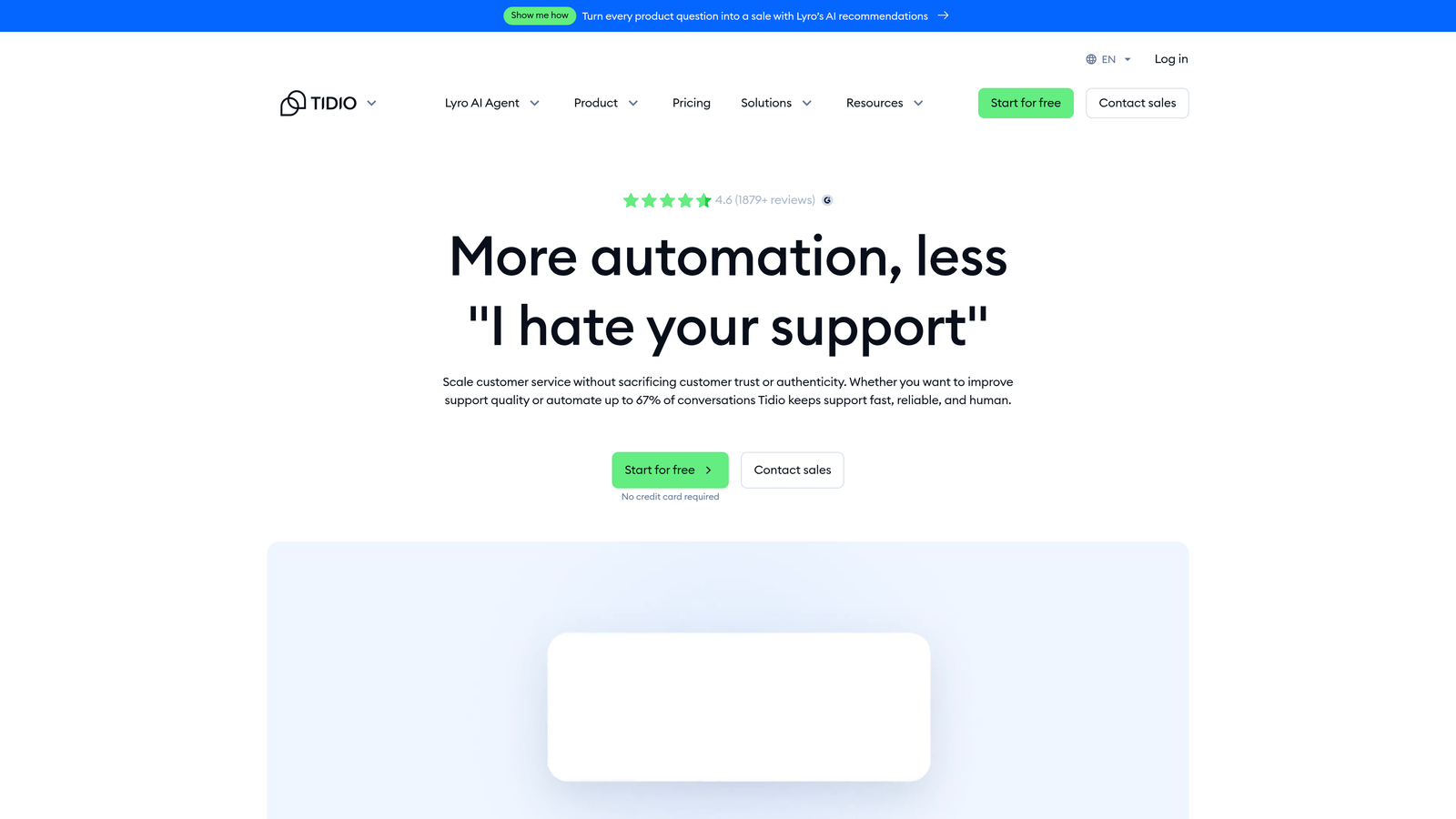
Tidio is a live chat and AI automation platform with Lyro AI for conversational ticket resolution, known for quick setup and accessible pricing.
Where This Tool Shines
Speed of deployment is Tidio's headline advantage. The visual flow builder lets you create automation sequences without writing code or filing engineering tickets, which matters a lot for early-stage teams where support is often one person wearing multiple hats. Lyro AI draws on your existing help content to handle conversational resolution without requiring a complex training process.
For teams that are pre-product-market-fit or in the early scaling phase, Tidio provides meaningful automation at a price point that makes sense before you're running hundreds of tickets per day. It's not the most sophisticated platform on this list, but it delivers solid value for its stage.
Key Features
Lyro AI: Conversational resolution engine that uses your existing help content to answer customer questions autonomously.
Visual Flow Builder: No-code automation builder for creating conversation sequences, routing rules, and escalation flows.
Live Chat with Handoff: Transitions from AI to human agents when conversations exceed Lyro's capabilities.
Integrations: Connects with Shopify, WordPress, Wix, and major CRM platforms.
Analytics Dashboard: Covers conversation volume, resolution rates, and agent performance metrics.
Best For
Early-stage SaaS teams, solo support operators, or lean teams that need a working automation setup quickly without significant engineering involvement. As ticket complexity and volume increase, teams typically outgrow Tidio and move to more capable platforms.
Pricing
Free plan available. Lyro AI starts at approximately $29 per month. Paid plans scale with conversation volume, making cost predictable at lower volumes.
7. Kustomer
Best for: B2B SaaS teams where support and customer success are tightly coupled
Kustomer is a CRM-first customer service platform that gives AI and agents a unified customer timeline, now part of Meta.
Where This Tool Shines
Kustomer's differentiation is context depth. Instead of treating each support interaction as an isolated ticket, it aggregates every customer interaction across all channels into a single timeline. When an AI or human agent picks up a conversation, they're working from the full customer relationship history, not just the current ticket.
For B2B SaaS teams where support is closely tied to customer success and retention, this context-rich approach changes what automation can do. Routing decisions, escalation logic, and AI responses can all be informed by customer attributes, subscription data, and historical behavior — not just the words in the current message.
Key Features
Unified Customer Timeline: Aggregates all customer interactions across channels into a single, chronological view for agents and AI.
AI-Powered Automation: Routing, tagging, and deflection built on rich CRM data rather than just ticket content.
KustomerIQ: Intelligent suggestions, sentiment analysis, and CSAT prediction powered by customer interaction history.
Omnichannel Inbox: Covers email, chat, voice, SMS, and social in a single agent workspace.
CRM Data Model: Enables context-aware automation based on customer attributes, subscription status, and relationship history.
Best For
B2B SaaS teams with complex customer relationships where support context and customer success context need to live in the same system. Particularly relevant for teams managing enterprise accounts where relationship history significantly affects how support should be handled.
Pricing
Starts at approximately $89 per agent per month. Enterprise plans are available with additional capabilities and support.
8. Capacity
Best for: SaaS companies managing both customer-facing and internal support from a single platform
Capacity is an AI-powered support automation platform centered on a connected knowledge base, handling customer support, IT, and HR workflows across web, email, and Slack.
Where This Tool Shines
Capacity's angle is breadth across support types. Most tools on this list focus exclusively on customer-facing support. Capacity handles both external customer support and internal support functions like IT and HR from the same platform. For SaaS companies at the stage where internal tooling and external support are both becoming operational bottlenecks, consolidating them into one system has real appeal.
The knowledge base is central to how Capacity works. It learns from support interactions over time, continuously improving the answers it surfaces automatically. The Slack integration is particularly useful for internal support scenarios where employees expect to get answers without leaving their primary communication tool.
Key Features
AI Knowledge Base: Learns from support interactions and automatically surfaces relevant answers across customer and internal queries.
Multi-Channel Deflection: Handles deflection across chat widget, email, and Slack simultaneously.
Helpdesk Ticketing: Ticket management with AI-assisted resolution for queries that require human follow-up.
Internal Support Workflows: Manages IT and HR support alongside customer support within the same platform.
Integrations: Connects with Salesforce, Zendesk, HubSpot, Microsoft Teams, and Slack.
Best For
Growing SaaS companies that need to address both customer support and internal support scaling simultaneously, or teams that want a single knowledge base powering automation across multiple use cases and channels.
Pricing
Custom pricing across growth and enterprise tiers. Contact Capacity directly for a quote based on your team size and use case requirements.
9. Drift (Salesloft)
Best for: PLG and sales-led SaaS teams where the same chat interface handles support and pipeline
Drift, now part of Salesloft, is a conversational AI platform that bridges support deflection and sales qualification in a single interface.
Where This Tool Shines
Drift's unique position on this list is the overlap between support and sales. In PLG and sales-led SaaS companies, the same chat widget that handles "how do I reset my password" also handles "can you tell me about enterprise pricing." Drift is built to handle both conversation types intelligently, routing support inquiries to resolution flows and sales inquiries to human reps or meeting booking.
The Salesloft acquisition has deepened the revenue operations angle. For teams where support conversations regularly convert into expansion or renewal opportunities, having a platform that recognizes and acts on those signals — rather than treating them as support tickets to close — is a meaningful capability.
Key Features
AI-Powered Chatbot: Deflects common support questions before they reach agents using conversational AI.
Conversation Routing: Distinguishes between support inquiries and sales opportunities and routes accordingly.
Playbooks: Automates multi-step conversation flows across support and sales use cases.
CRM Integrations: Connects with Salesforce, HubSpot, Marketo, and other revenue stack tools.
Meeting Booking Automation: Converts support or sales conversations directly into booked meetings without human intervention.
Best For
B2B SaaS teams using a product-led or sales-led growth motion where support and sales conversations happen in the same channel. Teams that need pure support automation depth may find dedicated platforms more capable; Drift's strength is the intersection of the two functions.
Pricing
Custom pricing as part of the Salesloft platform. Contact Salesloft for a quote based on your team's requirements.
Which Tool Is Right for Your Stage
The right choice depends heavily on where your company is and what you're trying to solve.
Early-stage teams with limited resources and lean engineering bandwidth should look at Tidio or Freshdesk Freddy AI. Both offer fast deployment, accessible pricing, and enough AI capability to meaningfully reduce manual ticket handling without a complex implementation.
Mid-market teams scaling ticket volume have the most options. If you want an AI-first platform built for B2B SaaS from the ground up, Halo AI is the strongest choice: it resolves tickets autonomously, surfaces business intelligence from support data, and integrates with the full operational stack your team actually uses. If you want to layer AI onto your existing helpdesk rather than replace it, Forethought is the cleanest path. If you're already on Intercom, Fin AI is the natural extension.
Enterprise teams deeply embedded in Zendesk should start with Zendesk AI before adding third-party layers. The integration overhead of switching platforms rarely justifies the capability gain at that scale unless you're hitting hard limits.
Teams where support and customer success overlap should look closely at Kustomer, where the CRM-first data model gives AI and agents the full relationship context they need to handle complex accounts well.
PLG and sales-led teams where support and pipeline live in the same chat interface should evaluate Drift as part of the Salesloft platform.
Before committing to any tool, ask three questions. Does this platform learn from interactions over time, or does it just match keywords? Does it integrate with the systems your team already uses — not just your helpdesk, but Linear, Slack, Stripe? And does it give you visibility into what's driving ticket volume, or just reduce it?
Your support team shouldn't scale linearly with your customer base. Let AI agents handle routine tickets, guide users through your product, and surface business intelligence while your team focuses on complex issues that need a human touch. See Halo in action and discover how continuous learning transforms every interaction into smarter, faster support.