9 Best Support Automation Tools for Enterprise Software in 2026
Enterprise software support teams struggle to scale headcount alongside growing ticket volume — and the wrong tooling makes it worse. This guide evaluates the 9 best support automation for enterprise software platforms in 2026, comparing each on AI capability, integration depth, and the ability to handle real enterprise complexity.
 Matt PattoliFounder13 min read
Enterprise software support teams face a compounding challenge: support volume grows with every new feature release, every new customer segment, and every new integration. But headcount can't scale at the same pace. The result is slower response times, overburdened agents, and customers who churn before they ever reach a resolution.
Support automation changes that equation. The right platform doesn't just deflect tickets — it resolves them intelligently, surfaces product insights, and hands off to humans only when it genuinely matters.
This list covers the top support automation tools built for enterprise software environments in 2026. We evaluated each on AI capability, integration depth, scalability, and how well they handle the complexity that enterprise products demand. If you're currently weighing modern AI-native platforms against legacy options, our comparison of Zendesk vs. modern support automation is worth a read before you decide.
1. Halo AI
Best for: B2B SaaS teams that want an AI-native support platform built to learn and scale.
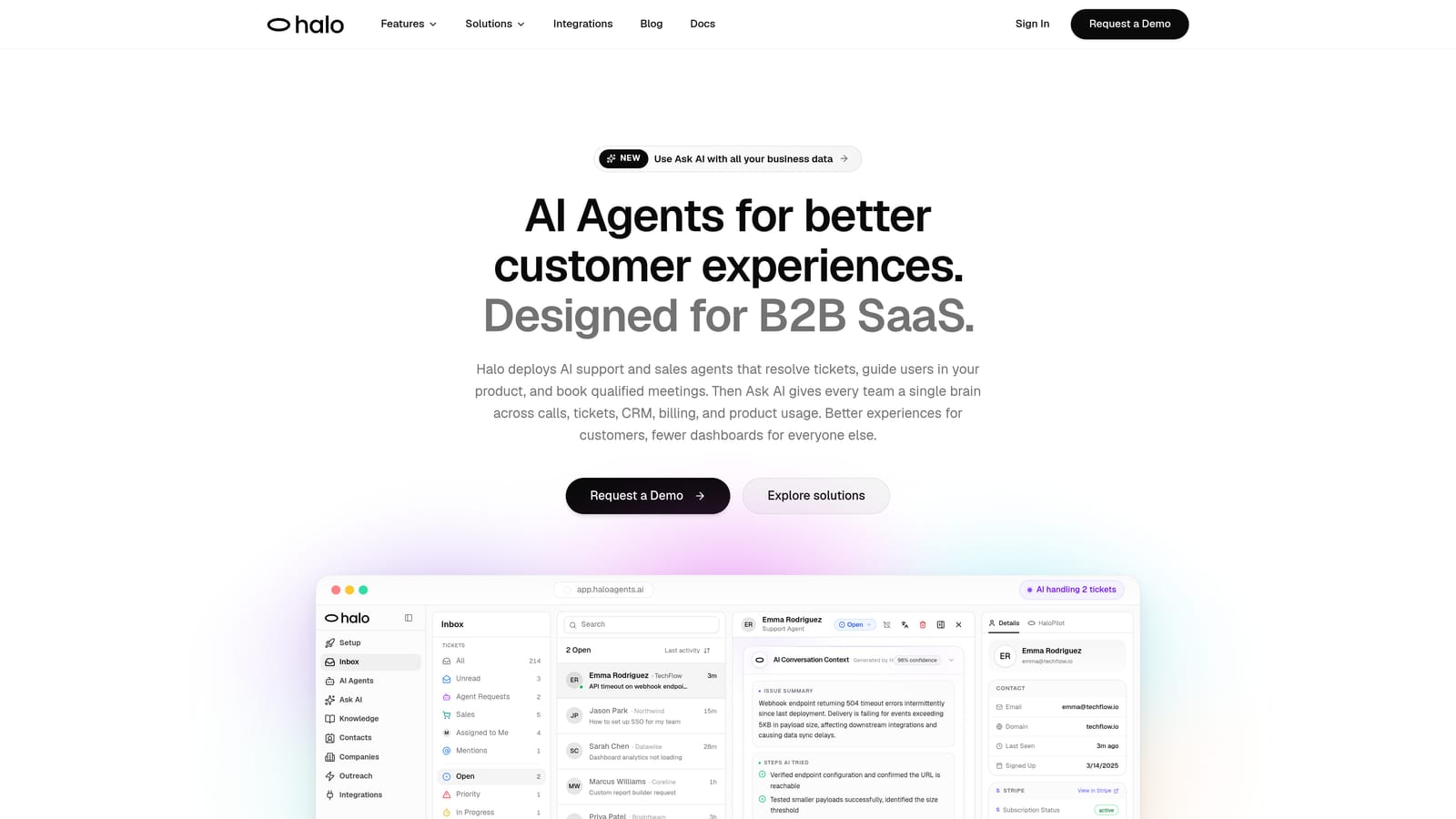
Halo AI is an AI-first customer support platform that deploys intelligent agents to resolve tickets, guide users through your product, and surface business intelligence from every interaction.
Where This Tool Shines
What sets Halo apart from most tools on this list is its architecture. It isn't AI bolted onto a legacy helpdesk — it's purpose-built as an AI-native platform for B2B SaaS. The most distinctive capability is page-aware context: Halo's agents understand exactly what screen a user is on inside your product, which means they can provide precise, relevant guidance rather than generic answers pulled from a knowledge base.
Beyond ticket resolution, Halo's smart inbox surfaces business intelligence signals that most support tools simply ignore. Think customer health indicators, anomaly detection, and revenue intelligence derived from support interactions. For enterprise teams, this transforms support from a cost center into a source of strategic insight.
Key Features
Page-Aware AI Agents: Agents understand the user's current context within your product, enabling precise, in-the-moment guidance rather than generic responses.
Autonomous Ticket Resolution with Live Handoff: Halo resolves routine tickets autonomously and escalates complex issues to human agents with full conversation context preserved.
Auto Bug Ticket Creation: Automatically identifies and routes bug reports directly to Linear or connected project management tools, closing the loop between support and engineering.
Smart Inbox with Business Intelligence: Surfaces customer health signals, anomaly detection, and revenue intelligence from support interactions — turning every ticket into a data point.
Deep Integration Stack: Connects natively with Linear, Slack, HubSpot, Intercom, Stripe, Zoom, PandaDoc, and Fathom, making it a connective layer across your entire business stack.
Best For
Halo is best suited for scaling B2B SaaS companies and product teams that want to replace their existing helpdesk with something purpose-built for AI. It's particularly valuable for teams that need their support platform to talk to engineering, sales, and customer success tools simultaneously.
Pricing
Custom pricing based on your team size and requirements. A demo is available at haloagents.ai — contact the team for enterprise plan details.
2. Intercom
Best for: Teams wanting a mature conversational support experience with strong in-app messaging.
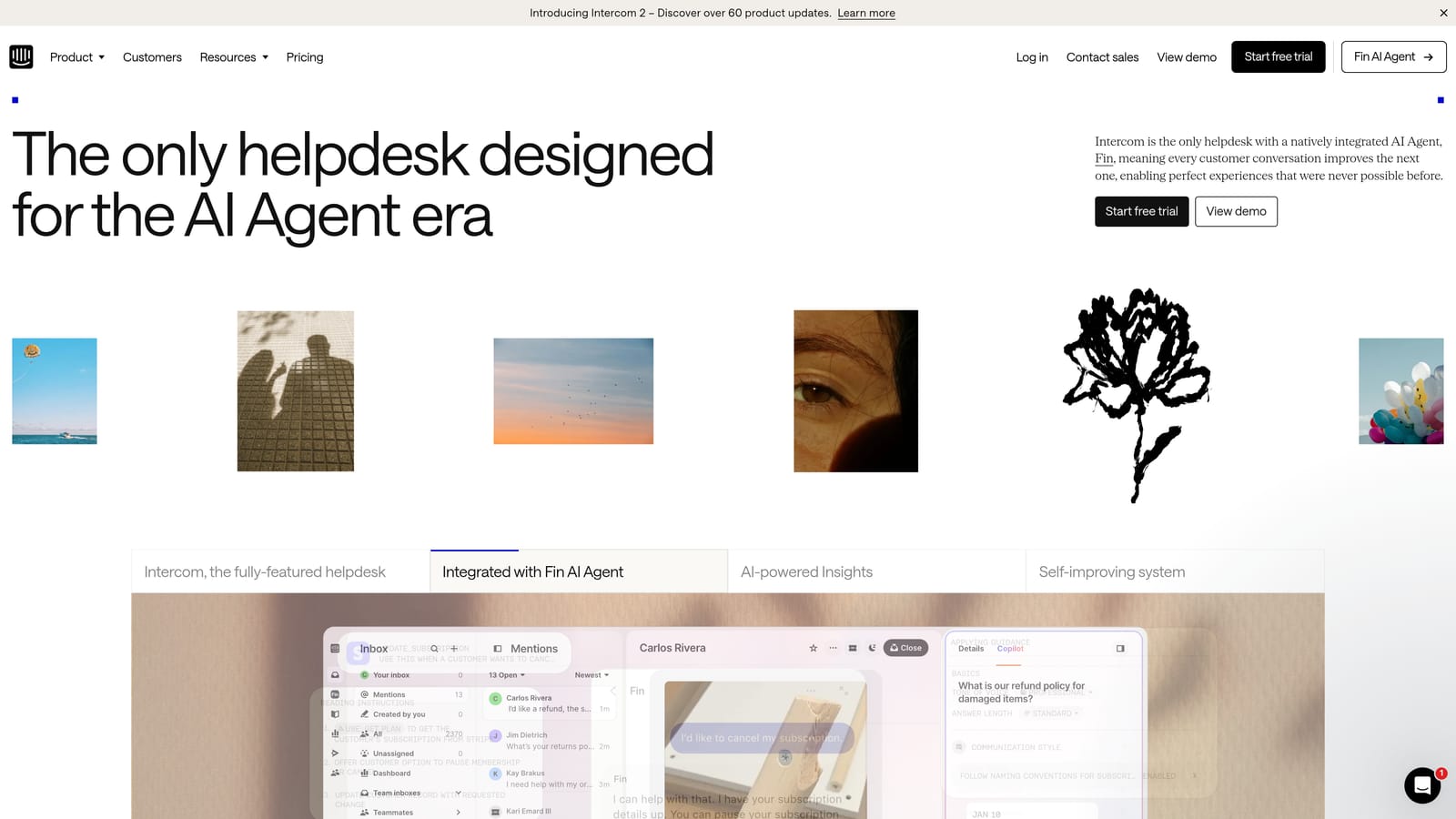
Intercom is a conversational support platform with a polished in-app messenger and Fin, its GPT-4-powered AI agent for autonomous query resolution.
Where This Tool Shines
Intercom has spent years building one of the most refined in-app messaging experiences in the market. The Fin AI agent handles a meaningful share of inbound queries for many customers, drawing on your existing knowledge base to resolve common questions without human involvement. The experience feels natural rather than robotic, which matters for software products where the support interaction reflects on the brand.
Intercom also excels at proactive support. You can trigger targeted messages based on user behavior, product usage, or lifecycle stage — making it useful for onboarding as well as reactive support. The app marketplace is extensive, giving enterprise teams plenty of integration flexibility.
Key Features
Fin AI Agent: Autonomous resolution of common support queries using GPT-4, trained on your existing knowledge content.
In-App Messenger: Highly customizable in-product chat with targeting and segmentation capabilities.
Shared Inbox with AI Assist: AI-generated drafts and conversation summaries to speed up human agent responses.
Proactive Support Features: Behavioral triggers for onboarding messages, product tours, and targeted outreach.
App Marketplace: Extensive third-party integrations for CRM, analytics, and workflow tools.
Best For
Mid-market to enterprise SaaS companies that want a conversational-first support experience with solid AI augmentation. Teams already invested in Intercom's messenger will find Fin a natural extension of their existing setup.
Pricing
Plans start at approximately $39/seat/month. Fin AI is priced per resolution at the enterprise tier. Custom pricing available for larger organizations.
3. Zendesk
Best for: Large support organizations that need robust routing, SLA management, and a vast integration ecosystem.
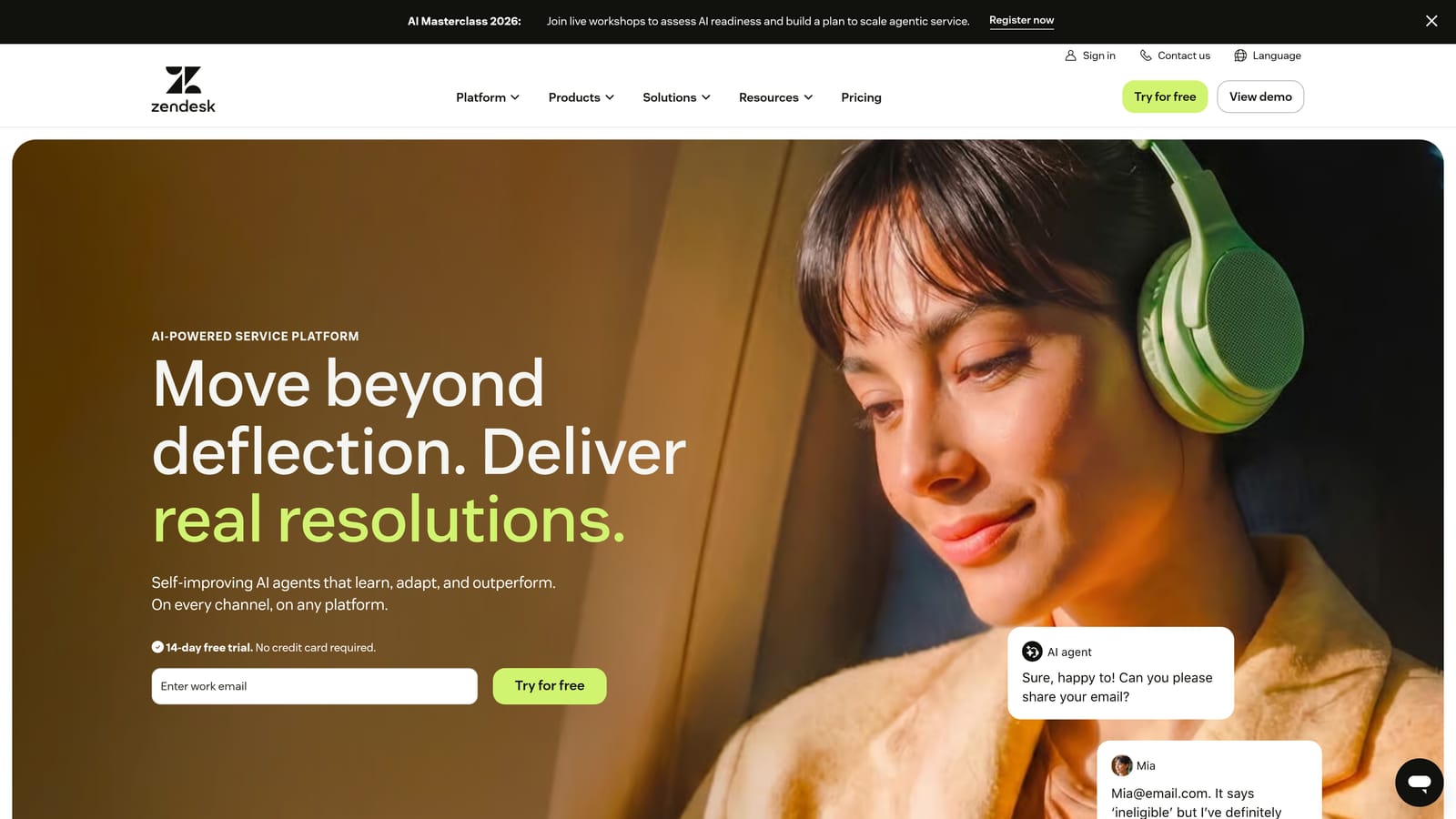
Zendesk is the industry-leading helpdesk platform with AI-powered triage, intelligent routing, and one of the deepest integration ecosystems in enterprise support.
Where This Tool Shines
Zendesk's strength is scale. If you're running a global support operation with complex routing rules, multi-tier SLA requirements, and dozens of integrations, Zendesk has the infrastructure to handle it. The platform's AI capabilities — powered by OpenAI — add generative AI to ticket workflows, including agent-assist drafts, automated responses, and intelligent classification.
The reporting and analytics layer is also a genuine differentiator for large teams. Zendesk Explore gives operations leaders the visibility they need to manage performance across regions, channels, and product lines. The trade-off is complexity: Zendesk can feel heavyweight for lean teams, and the implementation and admin overhead is real.
Key Features
AI-Powered Triage and Routing: Automatic ticket classification, intent detection, and intelligent routing to the right agent or queue.
Generative AI for Agents: AI-assisted drafts, conversation summaries, and automated responses built into the agent workspace.
SLA Management: Robust SLA tracking and enforcement for complex enterprise service agreements.
Workflow Automation: Triggers, automations, and macros for building sophisticated ticket handling logic.
Advanced Reporting: Zendesk Explore provides deep analytics for large support organizations managing performance at scale.
Best For
Enterprise software companies with large, established support operations that need proven infrastructure, compliance capabilities, and a mature vendor relationship. Less ideal for lean teams that want to move fast without dedicated admin resources.
Pricing
Suite plans start at approximately $55/agent/month. Enterprise plans are custom — contact Zendesk for pricing at scale.
4. Freshdesk
Best for: Mid-market software companies scaling support without enterprise-level budgets.
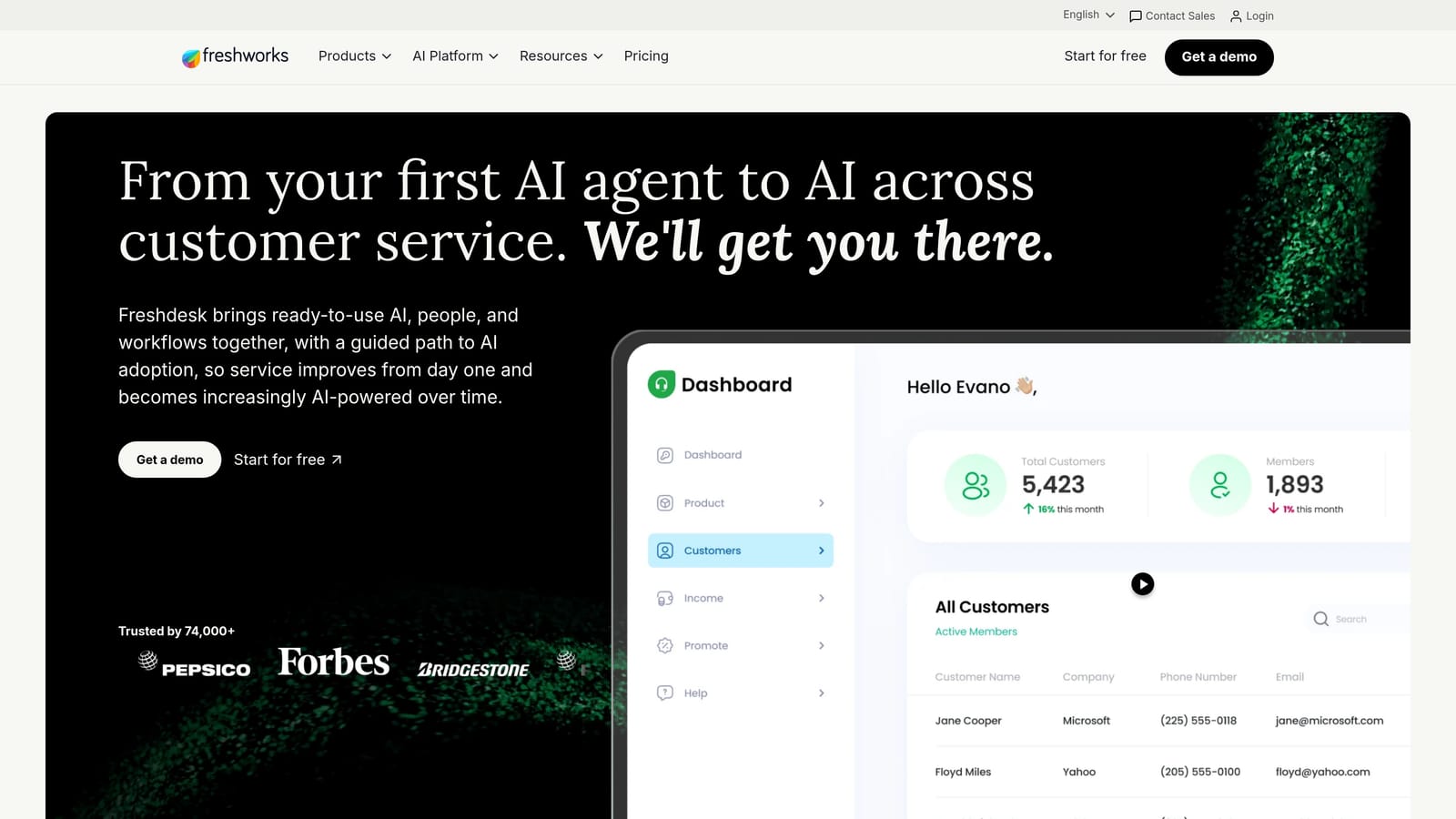
Freshdesk is Freshworks' omnichannel helpdesk featuring Freddy AI for auto-triage, suggested responses, and agent-assist at competitive price points.
Where This Tool Shines
Freshdesk punches above its price point. Freddy AI handles auto-triage and suggested responses out of the box, and Freddy Copilot provides real-time agent assistance that helps newer team members respond with confidence. The omnichannel coverage — email, chat, phone, social, and messaging apps — is comprehensive enough for most enterprise software support scenarios.
For teams that find Zendesk's pricing hard to justify or its complexity unnecessary, Freshdesk offers a credible alternative. It's particularly strong for growing software companies that need solid AI augmentation without a full-scale enterprise implementation project.
Key Features
Freddy AI: Handles ticket classification, auto-triage, and suggested responses with minimal configuration required.
Freddy Copilot: Real-time agent assistance with AI-generated suggestions and contextual guidance during live interactions.
Omnichannel Coverage: Unified inbox across email, chat, phone, social media, and messaging platforms.
Collision Detection: Prevents multiple agents from working the same ticket simultaneously.
Marketplace Integrations: Connects with popular SaaS tools across CRM, project management, and communication categories.
Best For
Mid-market software companies scaling their support operations and looking for strong AI capabilities without the cost or complexity of enterprise-tier platforms. The free tier also makes it accessible for early-stage teams testing the waters.
Pricing
A free tier is available for small teams. Paid plans start at approximately $15/agent/month. Enterprise pricing is custom.
5. Salesforce Service Cloud
Best for: Enterprises already running Salesforce across sales, success, and service.
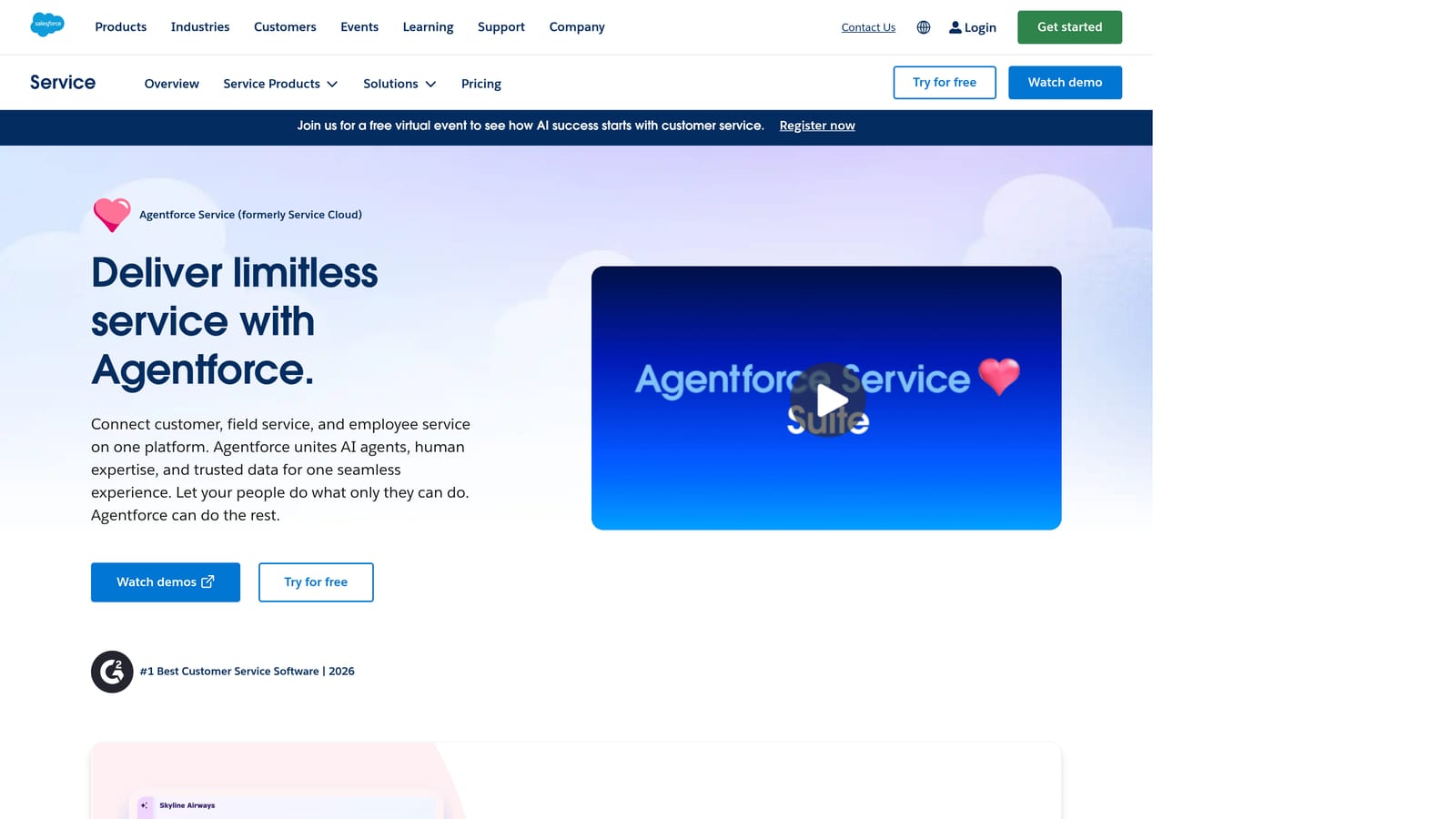
Salesforce Service Cloud is an enterprise-grade support platform deeply integrated with Salesforce CRM, powered by Einstein AI for case intelligence and next-best-action recommendations.
Where This Tool Shines
If your organization runs Salesforce for sales and customer success, Service Cloud is the natural choice for support. The unified data model means your support agents have full visibility into account history, deal status, and customer health — all in one place. Einstein AI adds case classification, intelligent routing, and knowledge recommendations that get smarter as your data grows.
Einstein Copilot brings generative AI into the agent workspace, helping reps draft responses and surface relevant knowledge articles faster. The Omni-Channel routing engine handles workload distribution intelligently across teams and skill sets. The honest caveat: Service Cloud's implementation complexity is significant. You'll likely need dedicated Salesforce admin resources to get full value.
Key Features
Einstein AI: Case classification, routing, knowledge recommendations, and next-best-action suggestions powered by your Salesforce data.
Einstein Copilot: Generative AI assistance for agents, including response drafts and contextual knowledge surfacing.
Omni-Channel Routing: Intelligent workload distribution based on agent skills, capacity, and priority rules.
Unified Customer Data: Full visibility across sales, service, and success on a single platform with no data silos.
Salesforce Ecosystem Integration: Deep native connections to Sales Cloud, Marketing Cloud, and the broader Salesforce platform.
Best For
Large enterprises with existing Salesforce investments and the admin resources to configure and maintain a complex platform. Not recommended for teams without a dedicated Salesforce administrator.
Pricing
Starter suite from approximately $25/user/month. Enterprise and Unlimited tiers are custom — contact Salesforce for pricing at scale.
6. Kustomer
Best for: Software companies with complex, multi-touch customer relationships that need a unified timeline view.
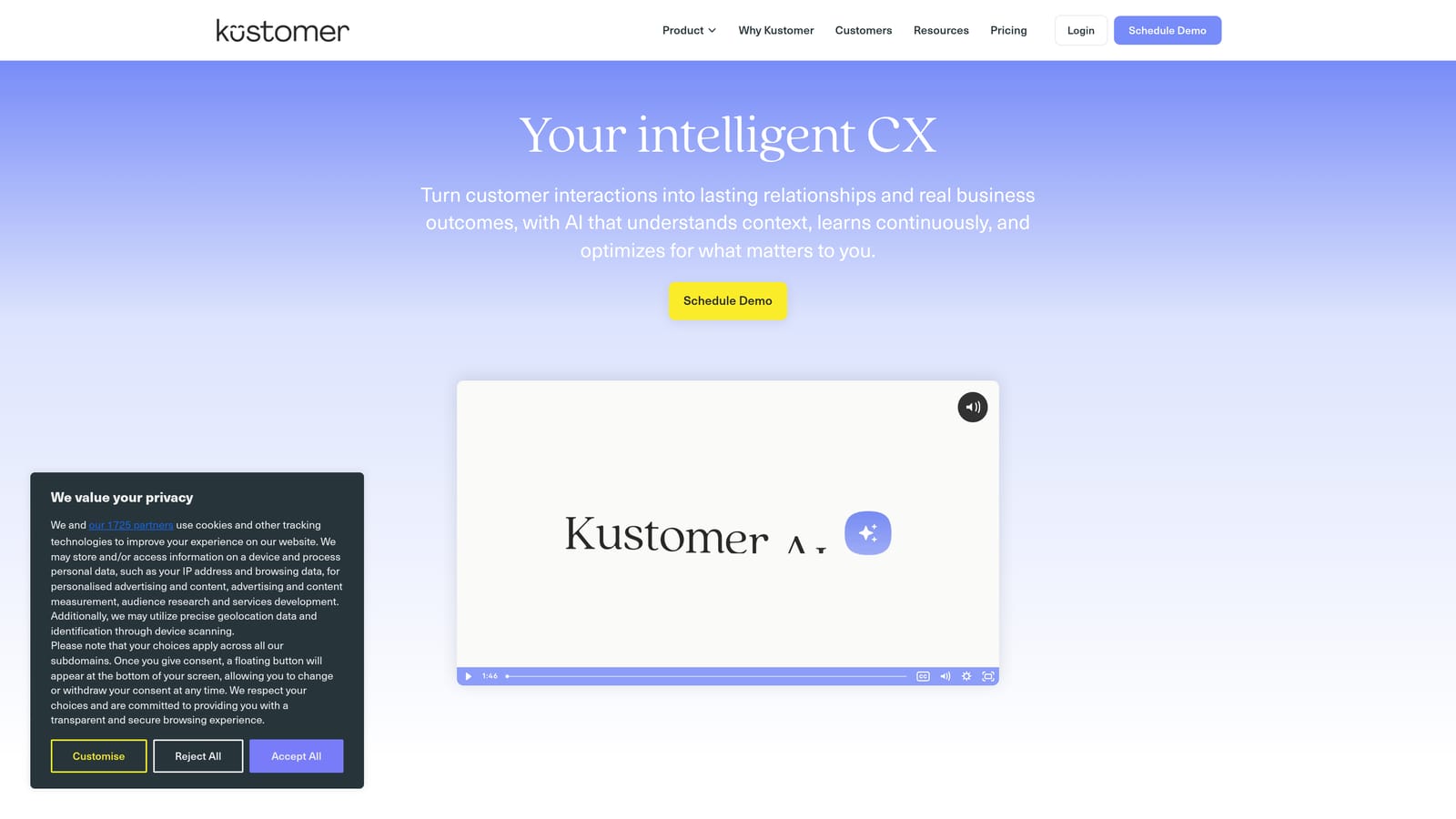
Kustomer is a CRM-first support platform (owned by Meta) that unifies every customer interaction into a single timeline, with AI-powered summaries and suggested responses.
Where This Tool Shines
Kustomer's core differentiator is the unified customer timeline. Every touchpoint — email, chat, voice, social, in-app — is aggregated into a single view, giving agents full context before they type a single word. For enterprise software companies with long, complex customer relationships spanning multiple products or business units, this context-richness genuinely changes the quality of support interactions.
The AI layer adds conversation summaries and suggested responses that help agents move faster without losing the personal touch. Kustomer's flexible data model also accommodates complex enterprise customer structures that simpler platforms can't represent accurately. One consideration worth noting: Kustomer is now Meta-owned, which some enterprise buyers factor into their data and privacy evaluations.
Key Features
Unified Customer Timeline: Every customer touchpoint and interaction aggregated into a single, chronological view for agents.
AI-Powered Summaries: Automatic conversation summaries and suggested responses to accelerate agent workflows.
Intelligent Routing: Automated workflow triggers and routing logic based on customer data and interaction history.
Omnichannel Support: Coverage across email, chat, voice, and social channels in a unified workspace.
Flexible Data Model: Accommodates complex enterprise customer relationships that standard ticket-based systems struggle to represent.
Best For
Enterprise software companies managing complex, high-value customer relationships where context and history are critical to every support interaction. Teams comfortable with Meta's ownership model and data practices.
Pricing
Enterprise pricing — contact Kustomer directly for current rates. Custom quotes based on team size and requirements.
7. Help Scout
Best for: Teams that want AI to augment agents rather than replace them.
Help Scout is a human-centered shared inbox platform with AI Drafts, AI Summarize, and AI Assist — designed to make agents faster and more effective, not redundant.
Where This Tool Shines
Help Scout takes a deliberately different philosophy from most tools on this list. Rather than pushing toward full automation, it focuses on making human agents more effective. AI Drafts generates instant reply suggestions based on conversation context. AI Summarize lets agents catch up on long threads in seconds. AI Assist helps refine tone and clarity before sending.
The result is a platform that feels clean and focused rather than feature-heavy. The Beacon widget enables in-app contextual self-service and chat, and the Docs knowledge base with AI-powered search rounds out a solid self-service layer. For teams where the quality of human interaction is a brand differentiator, Help Scout's approach is refreshingly honest about where AI adds value.
Key Features
AI Drafts: Instant reply suggestions generated from conversation context, ready for agents to review and send.
AI Summarize: One-click summaries of long conversation threads so agents can get up to speed instantly.
Beacon Widget: In-app contextual self-service and chat for proactive, in-product support.
Docs Knowledge Base: Built-in knowledge management with AI-powered search for self-service deflection.
Shared Inbox: Clean, collaborative inbox with collision detection and internal notes for team coordination.
Best For
Support teams where human judgment and relationship quality are central to the customer experience. Also a strong fit for teams transitioning from email-based support who want structure without overwhelming complexity.
Pricing
Plans start at approximately $20/user/month. Pro and custom plans are available for larger teams.
8. Drift (Salesloft)
Best for: Enterprise teams where support and revenue conversations overlap significantly.
Drift, now part of Salesloft, is a conversational AI platform that bridges support automation with revenue-generating conversations and strong ABM integrations.
Where This Tool Shines
Drift occupies a unique position on this list: it's the tool most explicitly designed for the intersection of support and sales. If your enterprise support conversations frequently surface expansion opportunities, renewal risks, or upsell signals, Drift's architecture is built to capture and act on those moments. Revenue acceleration features connect support chats directly to sales workflows, and meeting scheduling is built natively into chat flows.
The ABM integrations are a genuine differentiator for enterprise account-based engagement. Drift can identify high-value accounts visiting your site or product, trigger targeted conversations, and route them to the right human in real time. For B2B software companies where support and revenue motions overlap, this is a capability most pure-play helpdesks simply don't have.
Key Features
Conversational AI Bots: Support deflection and lead qualification handled by AI bots with configurable conversation flows.
Revenue Acceleration: Connects support conversations to sales workflows, enabling expansion and upsell capture from within chat.
ABM Integrations: Identifies and engages high-value enterprise accounts with targeted, personalized conversations.
Meeting Scheduling: Built-in calendar routing and scheduling within chat flows, eliminating friction from human handoffs.
Real-Time Alerts: Notifications for high-value account activity so sales and success teams can engage at the right moment.
Best For
Enterprise B2B software companies with a strong account-based go-to-market motion where support, success, and sales teams share responsibility for customer outcomes.
Pricing
Custom enterprise pricing — contact Salesloft or Drift directly for current plan details.
9. Forethought
Best for: Enterprises that want AI augmentation without migrating away from their existing helpdesk.
Forethought is an AI augmentation layer that sits on top of existing helpdesks — Zendesk, Salesforce Service Cloud, Freshdesk — to add predictive routing, generative AI answers, and workflow automation without requiring a platform migration.
Where This Tool Shines
Forethought's value proposition is straightforward: if you've invested heavily in your current helpdesk and aren't ready to migrate, Forethought brings meaningful AI capabilities without disrupting what's already working. The Solve product handles generative AI deflection before tickets are even created. Triage adds predictive routing and prioritization to incoming ticket streams. Assist surfaces AI-generated response suggestions for agents.
The Discover module is particularly useful for enterprise teams trying to understand where their knowledge gaps are and which automation opportunities have the highest potential ROI. Rather than replacing your helpdesk, Forethought makes it significantly smarter — which is a genuinely different approach from most tools on this list.
Key Features
Solve: Generative AI for autonomous deflection, answering user questions before a ticket is ever submitted.
Triage: Predictive routing and prioritization that intelligently distributes incoming tickets based on intent and urgency.
Assist: AI-generated response suggestions surfaced in the agent workspace to speed up resolution times.
Discover: Analytics module that identifies knowledge gaps, automation opportunities, and areas of high ticket volume.
Native Helpdesk Integrations: Deep integrations with Zendesk, Salesforce Service Cloud, and Freshdesk with minimal implementation overhead.
Best For
Enterprise software companies that have significant existing investment in Zendesk, Salesforce, or Freshdesk and want to layer AI capabilities on top without the risk and cost of a full platform migration.
Pricing
Custom pricing — contact Forethought directly for enterprise quotes based on ticket volume and use case.
Which Tool Is Right for Your Team?
The right choice depends less on feature checklists and more on where your team is starting from and where you want to go. Here's a quick way to think through it.
If you want an AI-native platform purpose-built for B2B SaaS — one that learns continuously, understands product context, and connects support to your entire business stack — Halo AI is the clear starting point.
If you're deeply invested in Zendesk, Salesforce, or Freshdesk and want AI augmentation without migration risk, Forethought is the most pragmatic path forward.
If your organization runs on Salesforce across sales, success, and service, Salesforce Service Cloud gives you the unified data model that makes AI recommendations genuinely intelligent.
For teams that want a conversational-first experience with strong in-app messaging, Intercom remains one of the most polished options in the market. For high-volume helpdesk operations with complex routing and SLA requirements, Zendesk is still the infrastructure standard. If budget efficiency matters and you're scaling fast, Freshdesk delivers solid AI capabilities at a competitive price point.
Teams that prioritize human-agent quality over automation depth will find Help Scout's philosophy refreshing. Enterprises where support and revenue conversations overlap should take a close look at Drift. And for companies managing complex, multi-touch customer relationships, Kustomer's unified timeline approach offers context that simpler tools can't match.
Your support team shouldn't scale linearly with your customer base. Let AI agents handle routine tickets, guide users through your product, and surface business intelligence while your team focuses on complex issues that need a human touch. See Halo in action and discover how continuous learning transforms every interaction into smarter, faster support.